REVIEW 2 major objections 6 minor 40 references
This paper claims that most known tricks for speeding up large FIR filters compose into one searchable design language, and that automatically searching it yields approximations that are both faster and more accurate than hand-tuned methods
Reviewed by Pith at T0; open to challenge. T0 means a machine referee read the full paper against a public rubric. the ladder, T0–T4 →
T0 review · deepseek-v4-flash
2026-08-01 09:47 UTC pith:YFWL53FB
load-bearing objection A genuinely useful synthesis-and-search system for fast filter approximations, with a real headline-number inconsistency the authors need to fix before it can be taken at face value. the 2 major comments →
Finding Fast Filters
The pith
A machine-rendered reading of the paper's core claim, the machinery that carries it, and where it could break.
Core claim
In the paper's own terms, the discovery is that fast filter approximation reduces to a differentiable program search: every well-known acceleration scheme is a composition of a small set of primitives — dense FIRs, tail-canceling IIRs (recursive filters whose infinite tail is canceled by a sparse correction, yielding a finite impulse response at near-constant cost), strided frequency-response-masking blocks, down/upsample wrappers, cascades, sums, and a pipe operator that promotes 1D filters to 2D. The system enumerates legal program trees under hand-written constraints informed by signal-processing intuition, fits each structure's continuous parameters by gradient descent (using a time-step
What carries the argument
The load-bearing object is a small domain-specific language whose primitives are composable filter programs: FIR (dense finite impulse response), TIIR (tail-canceling IIR — a recursive filter plus a sparse FIR correction that truncates an infinitely long impulse response after N steps at O(1) cost per output), Stride (a strided child computation followed by a factored-tower interpolator, generalizing frequency-response masking), DownUpsampleI/II (prefilter, subsample, child, zero-upsample, interpolate), and binary combinators Cascade, Sum, and Pipe that build 2D filters from 1D ones. The subtle piece is the differentiable TIIR parameterization: rather than differentiating through the recurre
Load-bearing premise
The reported Pareto frontier is only as trustworthy as the hand-written enumeration rules plus the cost model, which ranked 150k sampled designs and benchmarked only 2.5k; if the cost model mispredicts a pruned structure's throughput, the true frontier may contain better designs the search never saw.
What would settle it
Compile and benchmark all ~150k sampled designs for one target (e.g., 2D Gaussian size 201) instead of only the top-3 Pareto tiers. If any unbenchmarked design beats every published frontier point in throughput at equal or higher PSNR, the cost-model pruning is the limiting factor and the reported frontier is incomplete. A second test: run the identical pipeline on a held-out filter family not used in the paper, such as a sharp band-pass with 60 dB stopband attenuation, and check whether any generated design exceeds FFT throughput at PSNR above 50 dB; failure would mean the search's breadth do
If this is right
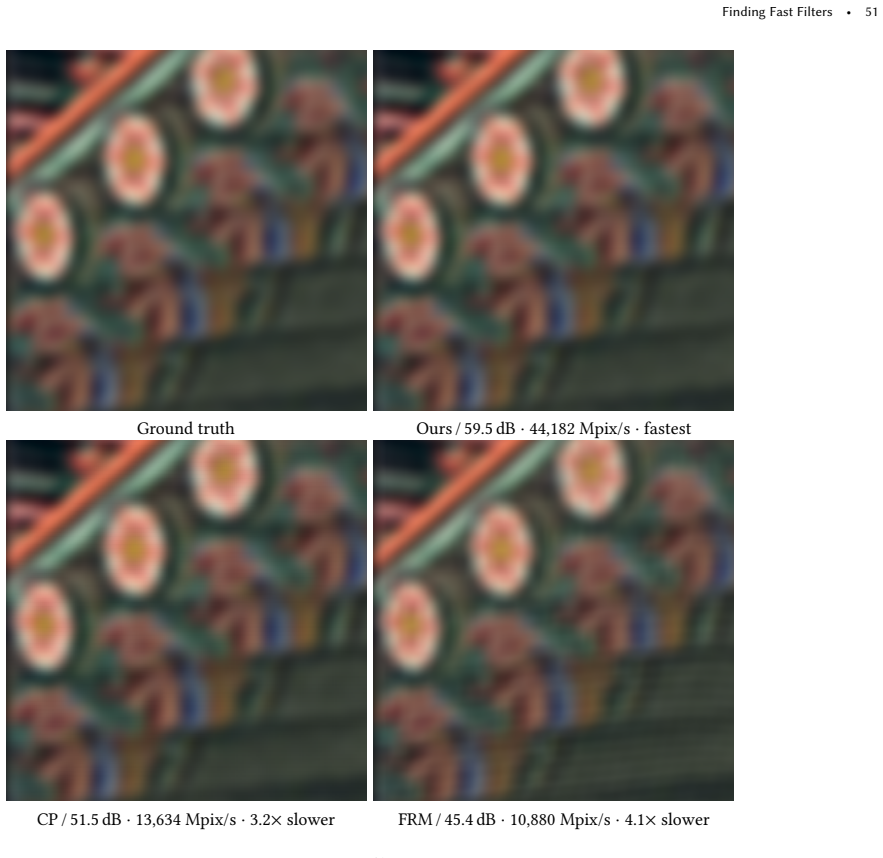
- For large Gaussian blurs, the search finds approximations that are visually indistinguishable from ground truth while running up to about 600x faster than FFT convolution on cache-resident images.
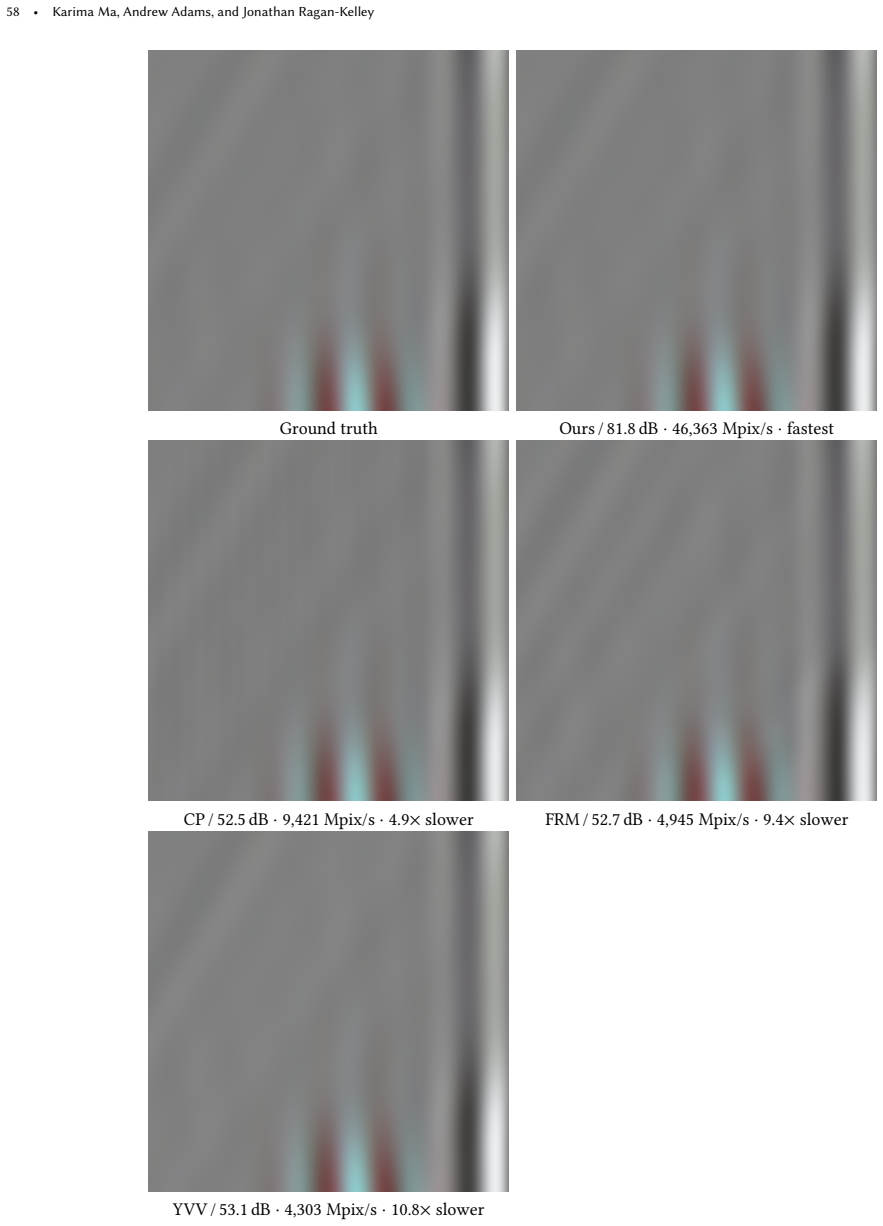
- The commonly used triple-box Gaussian approximation is Pareto-dominated: generated designs are 3.9–4.7x faster at equal or higher PSNR on 2D Gaussians.
- For real-time audio, HRIR binaural processing is reported 2.37x faster than a 16k-sample FFT and 8.66x faster than a 256-sample FFT block, with output indistinguishable from exact filtering; a telephone effect filter is 2.74x faster than FFT.
- For 2D low-pass filters that are not separable, generated approximations reach speedups up to about 613x over FFT for size 401.
- Prior acceleration methods appear as special cases or points inside the same search space, so isolated hand designs for new filters are likely to be automatically rediscovered or beaten by search.
Where Pith is reading between the lines
- The one-time training cost per filter could be amortized if, as the paper hints, a trained design can be resized across a parameter family (e.g., Gaussians of different radii); that would make the approach practical for production filter libraries.
- The reported dominance suggests that classical operation-count comparisons understate real gaps: on modern CPUs, vectorization, fusion, and memory locality matter as much as arithmetic count, a lesson likely to transfer to other signal-processing kernels.
- Because the enumeration constraints are hand-written, the breadth of the method is only as general as those rules; a strong test is whether the same constraints—or a learned variant—transfer to targets far outside the tested set, such as very sharp band-pass filters or 3D convolution kernels.
- The cost model's 0.97–0.98 correlation bounds how much of the true design space the frontier explores; benchmarking all sampled designs rather than the top 2,500 would reveal how many potentially better programs were pruned.
Editorial analysis
A structured set of objections, weighed in public.
Referee Report
Summary. The paper presents a DSL for fast FIR approximations whose primitives unify multi-rate filtering, tail-canceling IIRs, cascades/sums, and stride/interpolation. Search enumerates program structures, fits continuous parameters with gradient descent (including a reparameterization for TIIRs), uses a cost model to rank designs, then lowers top designs to optimized C++ (SIMD, tiling, fusion). Evaluation covers 1D Gaussian, Lanczos, HRIR, and telephone filters, and 2D Gaussian, Gabor, and low-pass filters, reporting Pareto frontiers against CP, FRM, triple-box, YVV, and SVD baselines, plus exact FFT/direct/separable methods.
Significance. If the results hold, this is a substantial systems contribution: the DSL subsumes CP and FRM, the differentiable TIIR parameterization is a useful technical building block, and the automatic lowering to fast C++ addresses a real gap in prior approximate-filtering work. The evaluation is extensive, includes qualitative outputs, and is often conservative (e.g., overestimating YVV throughput for Gabors). The central search-and-lowering pipeline is coherent, and the claimed dominance over the investigated baselines is credible. However, the headline 600x speedup in Fig. 1 is not supported as stated, and the completeness of the reported Pareto frontier is conditional on cost-model rankings that are not independently validated.
major comments (2)
- [Fig. 1; §4.6; Fig. 38] The headline claim that the Gaussian approximation runs '600 times faster than the fastest exact filtering method' is internally inconsistent. Section 4.6 explicitly states that for 2D Gaussians 'linearly separable convolution is faster' than FFT, and Fig. 38 reports a maximum speedup of 68.6x over that separable baseline for size 401. Thus 600x is measured against FFT convolution, not the fastest exact method. This is not a cosmetic caption issue: it inflates the advertised speedup by roughly 8.5x. Please correct the caption/text to say '600x faster than FFT convolution' or, preferably, report speedups against the actual fastest exact baseline (separable convolution), which yields ~70x.
- [§3.3; §7.2] The paper's 'Pareto frontier' is computed after pruning by enumeration constraints (Appendix 7.2) and by a cost model (Section 3.3) that ranks 150k designs and keeps only the top 3 tiers (2,500 designs) for benchmarking. The cost model has 0.97–0.98 log-log correlation, but no validation is provided that the cost model or the enumeration rules do not discard designs that would actually lie on the true frontier. Since the abstract and Section 3 claim to 'generate a Pareto frontier,' the paper should soften this wording to 'frontier over sampled/ranked designs' or add a validation experiment (e.g., benchmarking a random sample of lower-tier and pruned designs) to demonstrate that no Pareto-optimal designs are systematically excluded.
minor comments (6)
- [Fig. 1 caption] Typo: 'one our programs' should be 'one of our programs.' Also, the caption should specify which exact method the 600x figure refers to.
- [§3.3 vs Fig. 17] The text reports correlation coefficients 0.98 (1D) and 0.97 (2D), but Fig. 17 labels them as r=0.97 (1D) and r=0.98 (2D). The numbers are swapped and should be corrected.
- [§4.8] Typo: 'PSNR 61.dB' should be 'PSNR 61.4dB' or similar.
- [Table 4] The first data row 'Ours 1 1.96 21.94 46.97' is misaligned and confusing; align the columns and clarify the row labels.
- [§7.4] Capitalization of 'DownUpSample' vs. 'DownUpsample' is inconsistent throughout the manuscript and appendix; unify the notation.
- [General] The paper would benefit from an artifact/reproducibility statement, including whether code and benchmark scripts will be released.
Circularity Check
No circular derivation: search outputs are benchmarked, not predicted; the DSL subsuming CP/FRM is an expressiveness claim, not a forced result; only non-load-bearing self-citation exists.
full rationale
The central claim—that search finds faster, higher-quality approximations than CP/FRM/triple-box/YVV—is supported by direct benchmarking, not by the fitted cost model alone. Section 3.3 states that the cost model is used only to prune the search ('Afterwards, a small subset, 2500 out of 150k total designs, that made it to the top 3 Pareto tiers for each target were compiled and benchmarked to produce the final Pareto frontier'). The final Pareto points are therefore measured, not predicted from fitted constants, so the cost-model fits are not being relabeled as predictions. Similarly, the fact that CP and FRM are subsumed in the DSL by construction (Section 4: 'Both CP and FRM exist in our search space') explains why the system can express those baselines, but it does not by itself make the search results superior; the dominance is an empirical result. The self-citation to Ma et al. 2022 appears in related-work context ('as was done in Ma et al. [2022]') and in a discussion of Halide's limitations; it is not the load-bearing justification for the paper's originality or correctness. The TIIR derivation and the truncation reparameterization are developed in the paper with equations, not imported from a self-citation. One non-circular inconsistency should be noted: Fig. 1 and the introduction advertise '600 times faster than the fastest exact filtering method' for a 2D Gaussian, while Section 4.6 states that linearly separable convolution is faster than FFT for 2D Gaussians and reports the largest separable-relative speedup as 70.2x. This undermines the headline quantitative claim, but it is a measurement/comparison error, not a circular derivation. Overall, no step of the claimed derivation reduces to its own inputs or to a self-citation chain.
Axiom & Free-Parameter Ledger
free parameters (6)
- TIIR time-step resolution γ =
≥ max target frequency, exact per-target values not listed
- Pole-type sampling probabilities =
[0.875, 0.1, 0.025]
- Sigmoid temperature annealing τ =
5 → 50, rate 1.002 per iteration
- Cost-model FIR/TIIR coefficients =
FIR: 0.5/0.8/0.9; TIIR table [24, 19, 16, 13, 9]
- Early-stopping PSNR threshold and minimum iterations =
not specified numerically
- Training phase tile size D =
D = W/2, rounded to a multiple of S
axioms (6)
- standard math Z-transform and partial-fraction decomposition for order-2 IIRs (Eqs. 11-12)
- standard math TIIR algebra of Eqs. (5)-(10) from Wang and Smith 1997
- domain assumption Useful TIIRs have poles close to the unit circle and γ-rescaling makes the unit circle filled with useful magnitudes
- domain assumption Enumeration constraints in Appendix 7.2 eliminate only invalid or unlikely-competitive structures
- domain assumption Cost model ranks designs accurately enough that top-3 Pareto tiers contain the true Pareto frontier
- domain assumption Training on all-phase impulse inputs generalizes to white-noise PSNR
read the original abstract
Processing images, video, and audio often requires running large finite impulse response (FIR) filters with strict performance and latency requirements. Prior methods for fast filter approximations are special cases or combinations of a few key techniques: multi-rate and recurrent filtering, and decomposing filters into sums or cascades. We unify these techniques as primitives within a single design language for fast 1D and 2D filters. Given a target filter to approximate, we automatically search this program space, fitting continuous parameters with gradient descent, to generate a Pareto frontier of algorithms that trade off performance with quality. Our system produces substantially higher-quality and faster filter approximations than have been previously described for several popular imaging and audio filters. Furthermore we demonstrate how to automatically lower programs in this design space to optimized, vectorized, parallel, C++ code which is fused for data locality.
Figures






Reference graph
Works this paper leans on
-
[5]
InIEEE International Conference on Acoustics, Speech and Signal Process- ing, ICASSP 2022, Virtual and Singapore, 23-27 May
Direct Design of Biquad Filter Cascades with Deep Learning by Sampling Random Polynomials. InIEEE International Conference on Acoustics, Speech and Signal Process- ing, ICASSP 2022, Virtual and Singapore, 23-27 May
2022
-
[6]
https://doi.org/10.1109/ICASSP43922.2022.9747660 R
IEEE, Singapore, 3104–3108. https://doi.org/10.1109/ICASSP43922.2022.9747660 R. Crochiere and L. Rabiner
arXiv 2022
-
[7]
https: //doi.org/10.1109/ICASSP.1982.1171853 Elhanan Elboher and Michael Werman
ICASSP, Paris, 2046–2049. https: //doi.org/10.1109/ICASSP.1982.1171853 Elhanan Elboher and Michael Werman
arXiv 2046
-
[13]
https://doi.org/10.1145/2813885.2737977 Jonathan Frankle and Michael Carbin
Synthesizing data structure transformations from input-output examples.SIGPLAN Not.50, 6 (June 2015), 229–239. https://doi.org/10.1145/2813885.2737977 Jonathan Frankle and Michael Carbin
arXiv 2015
-
[20]
Graph.41, 5, Article 172 (May 2022), 18 pages
Searching for Fast Demosaicking Al- gorithms.ACM Trans. Graph.41, 5, Article 172 (May 2022), 18 pages. https: //doi.org/10.1145/3508461 Henry Massalin
-
[23]
https://doi.org/10.1016/S0146-664X(81)80009-3 Diego Nehab, André Maximo, Rodolfo S
Box-filtering techniques.Computer Graphics and Image Processing 17, 1 (1981), 65–70. https://doi.org/10.1016/S0146-664X(81)80009-3 Diego Nehab, André Maximo, Rodolfo S. Lima, and Hugues Hoppe
-
[24]
InProceedings of the 2011 SIGGRAPH Asia Conference(Hong Kong, China)(SA ’11)
GPU-Efficient Recursive Filtering and Summed-Area Tables. InProceedings of the 2011 SIGGRAPH Asia Conference(Hong Kong, China)(SA ’11). Association for Computing Machinery, New York, NY, USA, Article 176, 12 pages. https://doi.org/10.1145/2024156.2024210 Shahan C. Nercessian
arXiv 2011
-
[26]
https://doi.org/10.1109/TASSP.1984.1164348 Alan V
Interpolated finite impulse response filters.IEEE Transactions on Acoustics, Speech, and Signal Processing32, 3 (1984), 563–570. https://doi.org/10.1109/TASSP.1984.1164348 Alan V. Oppenheim and Ronald W. Schafer. 2013.Discrete-Time Signal Processing(3rd ed.). Prentice Hall Press, USA. 532–550 pages. K.K. Parhi and D.G. Messerschmitt
arXiv 1984
-
[34]
https: //api.semanticscholar.org/CorpusID:250627329 P
Style Transfer of Audio Effects with Differentiable Signal Processing.ArXivabs/2207.08759 (2022). https: //api.semanticscholar.org/CorpusID:250627329 P. Stoica and T. Soderstrom
Pith/arXiv arXiv 2022
-
[35]
The Steiglitz-McBride identification algorithm revisited–Convergence analysis and accuracy aspects.IEEE Trans. Automat. Control 26, 3 (1981), 712–717. https://doi.org/10.1109/TAC.1981.1102679 Andy Swanson
arXiv 1981
-
[36]
https://www
Latency and Its Effect on Performers. https://www. churchproduction.com/education/latency-and-its-affect-on-performers/. Accessed: 2025-04-30. A. Wang and J.O. Smith
2025
-
[40]
RoboGrammar: graph grammar for terrain-optimized robot design.ACM Trans. Graph.39, 6, Article 188 (Nov. 2020), 16 pages. https://doi.org/10.1145/3414685.3417831 Haisen Zhao, Max Willsey, Amy Zhu, Chandrakana Nandi, Zachary Tatlock, Justin Solomon, and Adriana Schulz
arXiv 2020
-
[41]
Co-optimization of design and fabrication plans for carpentry.ACM Transactions on Graphics (TOG)41, 3 (2022), 1–13
2022
-
[1973]
Approximate design relationships for low-pass FIR digital filters.IEEE Transactions on Audio and Electroacoustics21, 5 (1973), 456–460. https://doi.org/10. 1109/TAU.1973.1162510 L. Rabiner, N. Graham, and H. Helms
arXiv 1973
-
[1974]
Linear programming design of IIR digital filters with arbitrary magnitude function.IEEE Transactions on Acoustics, Speech, and Signal Processing22, 2 (1974), 117–123. https://doi.org/10.1109/TASSP.1974.1162558 Jonathan Ragan-Kelley, Andrew Adams, Sylvain Paris, Marc Levoy, Saman Amaras- inghe, and Frédo Durand
arXiv 1974
-
[1975]
Optimum FIR digital filter implementations for decimation, interpolation, and narrow-band filtering.IEEE Transactions on Acoustics, Speech, and Signal Processing23, 5 (1975), 444–456. https://doi.org/10.1109/TASSP. 1975.1162719 Franklin C. Crow
arXiv 1975
-
[1981]
https://doi.org/10.1016/0146-664X(81)90092-7 Y
Fast filter transform for image processing.Computer Graphics and Image Processing16, 1 (1981), 20–51. https://doi.org/10.1016/0146-664X(81)90092-7 Y. Chan and R. Langford
-
[1982]
Spectral estimation via the high-order Yule-Walker equations.IEEE Transactions on Acoustics, Speech, and Signal Processing30, 5 (1982), 689–698. https://doi.org/10.1109/TASSP.1982.1163946 Gaurav Chaurasia, Jonathan Ragan-Kelley, Sylvain Paris, George Drettakis, and Fredo Durand
arXiv 1982
-
[1984]
Summed-area tables for texture mapping. InProceedings of the 11th Annual Conference on Computer Graphics and Interactive Techniques (SIGGRAPH ’84). Association for Computing Machinery, New York, NY, USA, 207–212. https: //doi.org/10.1145/800031.808600 Rachid Deriche
-
[1986]
https://doi.org/10.1109/TCS.1986.1085930 Y.C
Frequency-response masking approach for the synthesis of sharp linear phase digital filters.IEEE Transactions on Circuits and Systems33, 4 (1986), 357–364. https://doi.org/10.1109/TCS.1986.1085930 Y.C. Lim and Y. Lian
arXiv 1986
-
[1987]
Superoptimizer: a look at the smallest program. InPro- ceedings of the Second International Conference on Architectual Support for Pro- gramming Languages and Operating Systems(Palo Alto, California, USA)(AS- PLOS II). Association for Computing Machinery, New York, NY, USA, 122–126. https://doi.org/10.1145/36206.36194 Naotake Masuda and Daisuke Saito
-
[1988]
In1988., IEEE International Symposium on Circuits and Systems
Computationally efficient wideband filters with very narrow transition bands. In1988., IEEE International Symposium on Circuits and Systems. 2013–2017 vol.3. https://doi.org/10.1109/ISCAS.1988.15337 RawTherapee Development Team
arXiv 2013
-
[1989]
Pipeline interleaving and parallelism in recursive digital filters. I. Pipelining using scattered look-ahead and decomposition. IEEE Transactions on Acoustics, Speech, and Signal Processing37, 7 (1989), 1099–1117. https://doi.org/10.1109/29.32286 PIXLS.US community
-
[1990]
Fast algorithms for low-level vision.IEEE Transactions on Pattern Analysis and Machine Intelligence12, 1 (1990), 78–87. https://doi.org/10.1109/34. 41386 R. Deriche and J. Abramatic
doi:10.1109/34 1990
-
[1993]
The optimum design of one- and two-dimensional FIR filters using the frequency response masking technique.IEEE Transactions on Circuits and Systems II: Analog and Digital Signal Processing40, 2 (1993), 88–95. https://doi.org/10.1109/82.219838 Karima Ma, Michael Gharbi, Andrew Adams, Shoaib Kamil, Tzu-Mao Li, Connelly Barnes, and Jonathan Ragan-Kelley
-
[1995]
Signal Processing44, 2 (1995), 139–151
Recursive implementation of the Gaussian filter. Signal Processing44, 2 (1995), 139–151. https://doi.org/10.1016/0165-1684(95)00020- E Ian T Young, Lucas J Van Vliet, and Michael Van Ginkel
-
[1997]
https: //doi.org/10.1109/78.599954 Ian T
On fast FIR filters implemented as tail-canceling IIR filters.IEEE Transactions on Signal Processing45, 6 (1997), 1415–1427. https: //doi.org/10.1109/78.599954 Ian T. Young and Lucas J. van Vliet
-
[1998]
In1998 IEEE Symposium on Advances in Digital Filtering and Signal Processing
Weighted least squares IIR filter design with arbitrary magnitude and phase responses and specified stability margin. In1998 IEEE Symposium on Advances in Digital Filtering and Signal Processing. Symposium Proceedings (Cat. No.98EX185). 82–86. https://doi.org/10.1109/ADFSP.1998.685700 Yong Lim
arXiv 1998
-
[2002]
IEEE Transactions on Signal Processing50, 11 (2002), 2798–2805
Recursive gabor filtering. IEEE Transactions on Signal Processing50, 11 (2002), 2798–2805. Allan Zhao, Jie Xu, Mina Konaković-Luković, Josephine Hughes, Andrew Spielberg, Daniela Rus, and Wojciech Matusik
2002
-
[2011]
In2011 18th IEEE International Conference on Image Processing
Cosine integral images for fast spatial and range filtering. In2011 18th IEEE International Conference on Image Processing. IEEE, New York, NY, USA, 89–92. https://doi.org/10.1109/ICIP.2011.6116704 Zeev Farbman, Raanan Fattal, and Dani Lischinski
arXiv 2011
-
[2012]
31, 4 (jul 2012), 32:1–32:12
Decoupling Algorithms from Schedules for Easy Optimization of Image Processing Pipelines. 31, 4 (jul 2012), 32:1–32:12. G. Rajan, Y. Neuvo, and S.K. Mitra
2012
-
[2014]
Darkroom: compiling high-level image processing code into hardware pipelines.ACM Trans. Graph.33, 4 (2014), 144–1. https://doi.org/10.1145/2601097.2601174 Intel. 2020.Intel Integrated Performance Primitives. Technical Report. In- tel. https://www.intel.com/content/www/us/en/develop/documentation/ipp-dev- reference/top.html jordanthebamf
arXiv 2014
-
[2015]
InProceedings of the 7th Conference on High-Performance Graphics(Los Angeles, California)
Compiling High Performance Recursive Filters. InProceedings of the 7th Conference on High-Performance Graphics(Los Angeles, California). ACM, New York, NY, USA, 85–94. https://doi.org/10.1145/2790060.2790063 Joseph T. Colonel, Christian J. Steinmetz, Marcus Michelen, and Joshua D. Reiss
-
[2017]
A database of head- related transfer functions and morphological measurements.Journal of the Audio Engineering Society143 (October 2017). C. Steinmetz, Nicholas J. Bryan, and Joshua D. Reiss
2017
-
[2019]
In7th International Conference on Learning Representations, ICLR 2019, New Orleans, LA, USA, May 6-9,
The Lottery Ticket Hypothesis: Finding Sparse, Trainable Neural Networks. In7th International Conference on Learning Representations, ICLR 2019, New Orleans, LA, USA, May 6-9,
2019
-
[2020]
IneDAFx 2020 Proceedings of the International Conference on Digital Audio Effects
Neural Parametric Equalizer Matching Using Differentiable Biquads. IneDAFx 2020 Proceedings of the International Conference on Digital Audio Effects. https://api.semanticscholar.org/CorpusID:226313578 Y. Neuvo, Dong Cheng-Yu, and S. Mitra
2020
-
[2021]
InProceedings of the 22nd International Society for Music Information Retrieval Conference
Synthesizer Sound Matching with Differ- entiable DSP. InProceedings of the 22nd International Society for Music Information Retrieval Conference. ISMIR, 428–434. https://doi.org/10.5281/zenodo.5624609 M.J. McDonnell
-
[2022]
https://www.apple
GarageBand (Version 10.4.6) [Computer software]. https://www.apple. com/mac/garageband/. Franz Baader and Tobias Nipkow. 1998.Term rewriting and all that. Cambridge University Press, USA. Peter J Burt
1998
-
[2023]
A Review of Differentiable Digital Signal Processing for Music & Speech Synthesis.ArXivabs/2308.15422 (2023). https://api.semanticscholar.org/CorpusID: 261276761 James Hegarty, John Brunhaver, Zachary DeVito, Jonathan Ragan-Kelley, Noy Cohen, Steven Bell, Artem Vasilyev, Mark Horowitz, and Pat Hanrahan
Pith/arXiv arXiv 2023
-
[2026]
https://raw.pixls.us
PIXLS.US Raw Image Database. https://raw.pixls.us. Public-domain (CC0) camera raw samples. Individual images referenced by their 62•Karima Ma, Andrew Adams, and Jonathan Ragan-Kelley getfile.phpURLs. Accessed 2026-07-21. L. Rabiner
2026
discussion (0)
Sign in with ORCID, Apple, or X to comment. Anyone can read and Pith papers without signing in.