REVIEW 4 major objections 5 minor 38 references
Multivariate Convolutional Sparse Coding with Low Rank Tensor
T0 review · 4 major / 5 minor · reviewed 2026-08-14 · deepseek-v4-flash
Pith's one-line read Adding a low-rank tensor structure to convolutional sparse coding lets a single model encode multivariate signals with far fewer nonzero coefficients while maintaining or improving reconstruction accuracy.
desk verdict A genuinely new tensor-CSC model with a clean Kruskal-regression link, but the formal constraint set makes the rank-1 sparsity claim false and the algorithm solves a different problem. read the letter →
The pith
A machine-rendered reading of the paper's core claim, the machinery that carries it, and where it could break.
The reading
What carries the argument
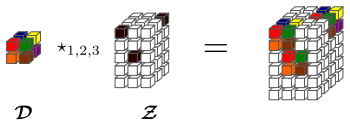
The load-bearing object is the CP (Canonical Polyadic) decomposition of the activation tensors, written through the Kruskal operator, which represents each activation as a sum of $R$ outer products of one-dimensional factors: $Z_k = \sum_{r=1}^R z^{(1)}_{k,r} \circ \cdots \circ z^{(p)}_{k,r}$. This representation cuts the number of activation parameters from $K\prod_i m_i$ to $KR\sum_i m_i$, and it turns each multidimensional convolution with an activation into a separable convolution that can be evaluated through the FFT. The other key identity is the equivalence in Proposition 2, which rewrites the convolution as an inner product with a circulant tensor, showing K-CSC is a Kruskal tensor regression; this is what lets the Z-step be solved by standard multi-channel CSC solvers and gives the model its theoretical footing.
What would settle it
Run AK-CSC on a synthetic tensor generated with known CP-rank and a known dictionary, then check whether the recovered $Z$ factors have rows of unit norm at every iteration and whether reconstruction error drops sharply only when the user-supplied rank equals the true rank. If the unconstrained $Z$-step systematically produces rows with norm far from one, or if the error profile shows no transition at the true rank, the paper's central efficiency claim would fail.
Extended reading notes
Core claim
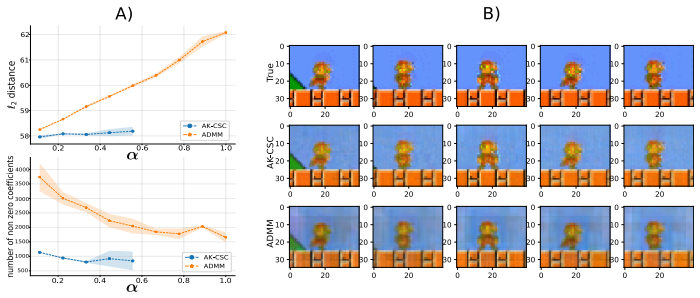
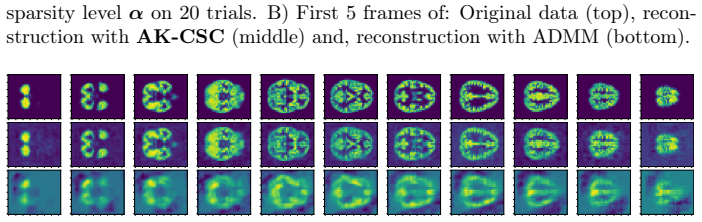
K-CSC writes the observed tensor signal as a sum over $K$ dictionary atoms convolved with activation tensors $Z_k$, and requires each $Z_k$ to factor as a CP decomposition into $R$ rank-one terms via the Kruskal operator. The paper shows that, under mild assumptions, this convolutional model is mathematically equivalent to a rank-$R$ Kruskal tensor regression, where each convolution with a rank-one activation becomes an inner product with a translated circulant tensor. On the algorithmic side, the paper introduces AK-CSC, an alternating scheme in which each mode's activation update reduces to a standard multi-channel convolutional sparse coding problem, and each dictionary update is a smooth convex problem. The paper's empirical claim is that this low-rank parametrization is what buys efficiency: with the same sparsity level, AK-CSC uses fewer nonzero coefficients than unconstrained ADMM and gives better or comparable reconstruction on synthetic tensors, a 30x30x3x20 animated color sequence, and a 31x37x31 fMRI volume.
Load-bearing premise
The whole procedure depends on the claim that, despite the full problem being nonconvex, minimizing over each $Z$ block separately is a convex problem whose unconstrained solve still respects the unit-norm row constraints of the activation factors; the paper states this but supplies no proof or convergence theorem.
Editorial extensions
If this is right
- For a tensor signal of order $p$, the activation parameter count falls from a product of mode sizes to a sum, so the model stays tractable as the number of modes grows.
- The equivalence to Kruskal tensor regression means statistical guarantees and regularization strategies from low-rank tensor regression carry over to the convolutional model.
- Because the low-rank form uses separable filters, each convolution can be computed via FFT, reducing filtering cost from $O(n_1 n_2 w_1 w_2)$ to $O(n_1 n_2 (w_1 + w_2))$ for two-dimensional images.
- With $R=1$ or $p=1$ the model reduces to previously studied rank-one multivariate CSC and to standard univariate convolutional dictionary learning, so the framework unifies those methods.
Reading between the lines
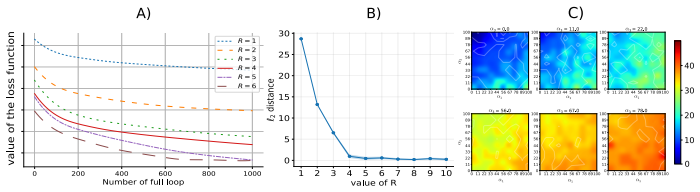
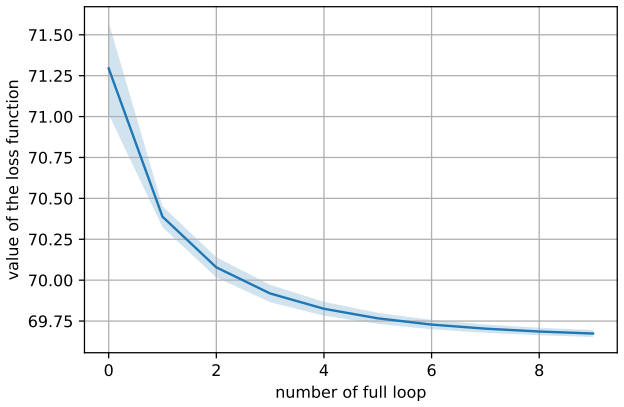
- The empirical flatness of the loss when $R$ exceeds the true rank suggests reconstruction error alone cannot identify the true rank; a rank-selection rule based on hold-out data or an extra penalty would be a natural next step.
- Because the low-rank constraint already encodes strong structure, the same framework could plausibly serve as a denoiser or a completion method for partially observed multivariate signals, though the paper does not test this.
- The paper's convergence evidence is empirical only; a formal guarantee that AK-CSC reaches a stationary point of problem (4) would be needed before relying on it in high-stakes applications.
- If the model is correct, a signal whose true activation rank exceeds the user-supplied $R$ should reconstruct poorly; this is a direct prediction that synthetic experiments with known rank could test.
Signed reviews
Editorial analysis
A structured set of objections, weighed in public.
Referee Report
Summary. The paper proposes K-CSC, a convolutional sparse coding model for multivariate tensor signals in which activation tensors are constrained to have low CP rank and elementwise sparsity. It proves an algebraic equivalence (Proposition 2) between the K-CSC model and a Kruskal tensor regression problem, and it introduces an alternating optimization algorithm (AK-CSC) that alternates between updating one CP factor block per mode and updating the dictionary. The paper evaluates AK-CSC on synthetic third-order tensors, an RGB animation tensor, and an fMRI tensor, comparing against an ADMM-based convolutional sparse coding solver. The central claims are that low-rank activation structure yields more parsimonious encodings with comparable or better reconstruction, and that the Kruskal-regression equivalence provides theoretical support for the model.
Significance. The algebraic reduction of multivariate convolutional sparse coding to Kruskal tensor regression is a useful conceptual bridge and is, as far as I can tell, correctly derived for unconstrained factor matrices. The parameter-count argument (K(R sum m_i) activations versus K prod m_i for the full tensor) is well motivated, and comparing against ADMM on real tensor data is a reasonable first evaluation strategy. However, the paper does not ship code, does not report error bars for most quantitative comparisons, and, more importantly, the formal model in Eq. (4) is not the problem solved by Algorithm 1. Because the central empirical claim is made for the rank-1 real-data experiments, where the stated row-normalization constraint would eliminate sparsity entirely, the main contribution needs substantial reworking before the results can be accepted.
major comments (4)
- [Section 3, Eq. (4) and Algorithm 1] The feasible set S in Eq. (4) requires ||(Z_{k,l})_{i,:}||_F = 1 for every row of every factor matrix. For R=1, which is the setting used in the real-data experiments of Section 5 (Figures 3 and 4), each row is a single scalar, so every entry of every Z_{k,l} has modulus one; the l1 penalty in (4) is then constant and cannot induce sparsity. Algorithm 1, line 14, solves an unconstrained multichannel CSC problem without the unit-row constraint. The method evaluated in the experiments is therefore not a solver for the stated model (4), and the reported advantage in the number of nonzero coefficients cannot be attributed to the proposed formalism.
- [Section 3, paragraph before Algorithm 1] The sentence 'The non-convex problem (4) is convex with respect to each Z block' is not justified as written. For fixed values of all other blocks, the data-fidelity term is indeed convex in Z_{k,l}, but the unit-row normalization constraint in S is nonconvex, so the constrained block subproblem is not a convex problem. Either the constraints should be removed or replaced by a convex surrogate, or the convexity claim must be explicitly restricted to the unconstrained relaxation actually solved in (5).
- [Section 2.3, Proposition 2] Proposition 2 establishes an algebraic equivalence with Kruskal regression for unconstrained factor matrices, but the paper's actual constrained model (4) is defined on S with row-normalized Z_{k,l}. The proposition does not cover the normalized feasible set, so it does not, by itself, justify the 'interesting theoretical guarantees' claimed in the abstract and in Section 2.3. No convergence or recovery theorem is supplied for Algorithm 1 either; Figure 2A is an empirical loss curve, not a proof that the alternating scheme converges.
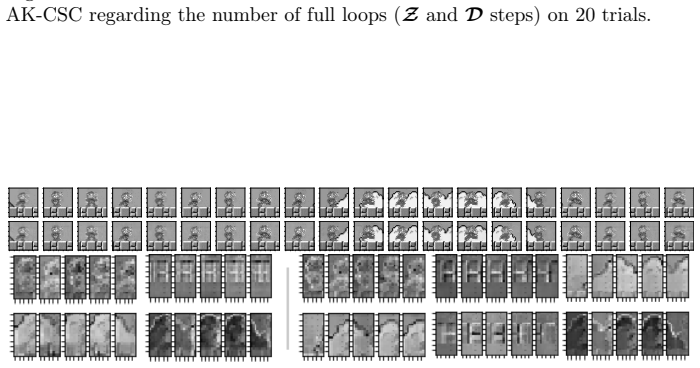
- [Section 3, Algorithm 1 and Section 5] The paper claims to provide an efficient optimization algorithm for the K-CSC model, but it gives no convergence analysis for the alternating scheme. Given that the objective is nonconvex and that the algorithm is inconsistent with the stated constraints, the status of the iterates is unclear. In addition, the quantitative comparison in Section 5 is incomplete: the real-data evaluations in Figures 3B and 4 are qualitative, and no code is provided, which limits reproducibility of the central empirical claim.
minor comments (5)
- [Section 3, Eq. (5) and Algorithm 1 line 14] Equation (5) includes the ridge penalty beta_l ||Z_{k,l}||_F^2, but Algorithm 1 line 14 solves the subproblem without the corresponding beta_m term; the algorithm and the stated objective should be aligned.
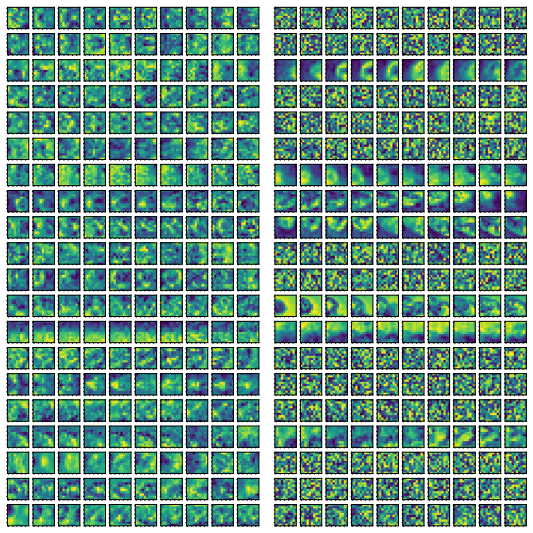
- [Sections 8.2 and 8.3] The appendix contains unresolved placeholder cross-references ('Figure??') in Sections 8.2 and 8.3, and the learned-atom figure is referred to but not displayed with a stable number.
- [Section 5] The real-data experiments report qualitative visual comparisons rather than quantitative reconstruction errors with standard deviations; a table of l2 errors and nonzero-count statistics across trials would strengthen the claimed advantage.
- [Section 4, multivariate CSC paragraph] The phrase 'R = +infinity' is informal: R is defined as a CP rank in Proposition 1, and the intended meaning 'no low-rank constraint' should be stated explicitly rather than through an infinite value.
- [Appendix, Proposition 4] Proposition 4 in the appendix duplicates Proposition 3 but does not mention the normalization constraints of Eq. (4), which further highlights the mismatch between the theoretical development and the constrained model.
Circularity Check
No significant circularity; the core derivation is an algebraic equivalence, and the experimental comparison is against an external ADMM baseline.
full rationale
The paper's derivation chain is self-contained in the relevant sense. Proposition 2 rewrites the convolutional K-CSC model as a Kruskal tensor regression through a circulant-tensor inner-product identity; this is an algebraic equivalence, not a parameter fitted to an outcome. The optimization algorithm reduces each Z-block update to a standard multi-channel CSC subproblem solved with external solvers (Garcia-Cardona and Wohlberg, 2018), and the experiments compare reconstruction against an external ADMM baseline (Wohlberg, 2016b). The reported 'fewer non-zero coefficients' are measured from the low-rank parameterization, not obtained by fitting a parameter to a subset of data and then predicting that same subset. There is one self-citation: Richard et al. (2012), coauthored by Vayatis, is used to support the general remark that sparse and low-rank regularizations can have adversarial influence; this is not load-bearing for the model, algorithm, or experimental claims. The paper does contain correctness risks that are outside the circularity definition: the claim that (4) is convex in each Z block is unsupported and likely false because the feasible set S imposes nonconvex unit-norm row constraints; Algorithm 1 line 14 solves an unconstrained problem without those constraints; and for R=1 the unit-row normalization makes l1 sparsity ineffective. These are consistency and validity concerns, not instances where a result is equivalent to its inputs by construction.
Assumptions & free parameters
free parameters (4)
- CP rank R =
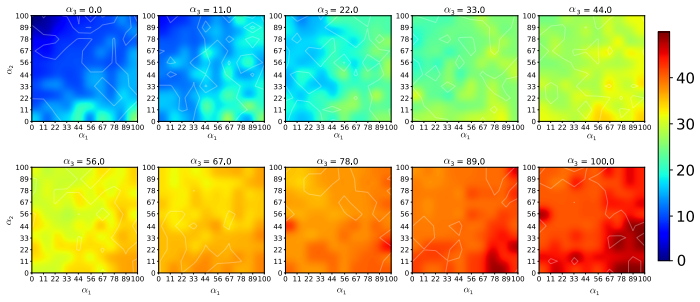
R*=4 in synthetic data; R=1 in Mario and fMRI experiments; overestimated values tested in Figure 2
- Sparsity penalties alpha_l =
Grid-searched in [0,100]^3
- Ridge penalties beta_l =
Not reported
- Dictionary size K and atom sizes =
K=10 with atom size R2x4x8 in synthetic data; K=20 with atom sizes 20x10x3x3 and 10x10x10 in real data
assumptions (5)
- standard math Every finite tensor has an exact CP decomposition with some rank R.
- domain assumption Each activation tensor Z_k has CP-rank exactly R.
- domain assumption The noise E has independent, centered subgaussian components.
- ad hoc to paper Problem (4) is convex in each Z block, so block coordinate descent is valid.
- domain assumption Guarantees for Kruskal tensor regression transfer to the K-CSC setting.
Cite this review
Pith. "Pith review of Multivariate Convolutional Sparse Coding with Low Rank Tensor." pith.science (2026). https://pith.science/paper/YFWODAAL
@misc{pith2026190803367,
  author       = {Pith},
  title        = {Pith review of: Multivariate Convolutional Sparse Coding with Low Rank Tensor},
  year         = {2026},
  howpublished = {\url{https://pith.science/paper/YFWODAAL}},
  note         = {Machine review of arXiv:1908.03367}
}
read the original abstract
This paper introduces a new multivariate convolutional sparse coding based on tensor algebra with a general model enforcing both element-wise sparsity and low-rankness of the activations tensors. By using the CP decomposition, this model achieves a significantly more efficient encoding of the multivariate signal-particularly in the high order/ dimension setting-resulting in better performance. We prove that our model is closely related to the Kruskal tensor regression problem, offering interesting theoretical guarantees to our setting. Furthermore, we provide an efficient optimization algorithm based on alternating optimization to solve this model. Finally, we evaluate our algorithm with a large range of experiments, highlighting its advantages and limitations.
Figures
Figures from the paper (5 more)
Reference graph
Works this paper leans on
-
[1]
Supervised dictionary learning
Julien Mairal, Jean Ponce, Guillermo Sapiro, Andrew Zisserman, and Francis R Bach. Supervised dictionary learning. In Advances in neural information processing systems, pages 1033--1040, 2009
work page 2009
-
[2]
Sparse representation for signal classification
Ke Huang and Selin Aviyente. Sparse representation for signal classification. In Advances in neural information processing systems, pages 609--616, 2007
work page 2007
-
[3]
rm k -svd: An algorithm for designing overcomplete dictionaries for sparse representation
Michal Aharon, Michael Elad, and Alfred Bruckstein. rm k -svd: An algorithm for designing overcomplete dictionaries for sparse representation. IEEE Transactions on signal processing, 54 0 (11): 0 4311--4322, 2006
work page 2006
-
[4]
Online learning for matrix factorization and sparse coding
Julien Mairal, Francis Bach, Jean Ponce, and Guillermo Sapiro. Online learning for matrix factorization and sparse coding. Journal of Machine Learning Research, 11 0 (Jan): 0 19--60, 2010
work page 2010
-
[5]
Convolutional Dictionary Learning: A Comparative Review and New Algorithms
Cristina Garcia-Cardona and Brendt Wohlberg. Convolutional dictionary learning. arXiv preprint arXiv:1709.02893, 2017
work page Pith review arXiv 2017
-
[6]
Tensor regression with applications in neuroimaging data analysis
Hua Zhou, Lexin Li, and Hongtu Zhu. Tensor regression with applications in neuroimaging data analysis. Journal of the American Statistical Association, 108 0 (502): 0 540--552, 2013
work page 2013
-
[7]
Andrzej Cichocki, Danilo Mandic, Lieven De Lathauwer, Guoxu Zhou, Qibin Zhao, Cesar Caiafa, and Huy Anh Phan. Tensor decompositions for signal processing applications: From two-way to multiway component analysis. IEEE Signal Processing Magazine, 32 0 (2): 0 145--163, 2015
work page 2015
-
[8]
Multivariate multilinear regression
Ya Su, Xinbo Gao, Xuelong Li, and Dacheng Tao. Multivariate multilinear regression. IEEE Transactions on Systems, Man, and Cybernetics, Part B (Cybernetics), 42 0 (6): 0 1560--1573, 2012
work page 2012
Show all 38 references
-
[9]
Low-rank regression with tensor responses
Guillaume Rabusseau and Hachem Kadri. Low-rank regression with tensor responses. In Advances in Neural Information Processing Systems, pages 1867--1875, 2016
2016
-
[10]
Near optimal sketching of low-rank tensor regression
Xingguo Li, Jarvis Haupt, and David Woodruff. Near optimal sketching of low-rank tensor regression. In Advances in Neural Information Processing Systems, pages 3466--3476, 2017
2017
-
[11]
Boosted sparse and low-rank tensor regression
Lifang He, Kun Chen, Wanwan Xu, Jiayu Zhou, and Fei Wang. Boosted sparse and low-rank tensor regression. In Advances in Neural Information Processing Systems, pages 1009--1018, 2018
2018
-
[12]
Tensor rank is np-complete
Johan H stad. Tensor rank is np-complete. Journal of Algorithms, 11 0 (4): 0 644--654, 1990
1990
-
[13]
Three-way arrays: rank and uniqueness of trilinear decompositions, with application to arithmetic complexity and statistics
Joseph B Kruskal. Three-way arrays: rank and uniqueness of trilinear decompositions, with application to arithmetic complexity and statistics. Linear algebra and its applications, 18 0 (2): 0 95--138, 1977
1977
-
[14]
Multilinear operators for higher-order decompositions
Tamara Gibson Kolda. Multilinear operators for higher-order decompositions. Technical report, Sandia National Laboratories, 2006
2006
-
[15]
Tensor decompositions and applications
Tamara G Kolda and Brett W Bader. Tensor decompositions and applications. SIAM review, 51 0 (3): 0 455--500, 2009
2009
-
[16]
Tensor decomposition for signal processing and machine learning
Nicholas D Sidiropoulos, Lieven De Lathauwer, Xiao Fu, Kejun Huang, Evangelos E Papalexakis, and Christos Faloutsos. Tensor decomposition for signal processing and machine learning. IEEE Transactions on Signal Processing, 65 0 (13): 0 3551--3582, 2017
2017
-
[17]
Tensor learning for regression
Weiwei Guo, Irene Kotsia, and Ioannis Patras. Tensor learning for regression. IEEE Transactions on Image Processing, 21 0 (2): 0 816--827, 2012
2012
-
[18]
Tensor completion for estimating missing values in visual data
Ji Liu, Przemyslaw Musialski, Peter Wonka, and Jieping Ye. Tensor completion for estimating missing values in visual data. IEEE transactions on pattern analysis and machine intelligence, 35 0 (1): 0 208--220, 2013
2013
-
[19]
Convolutional dictionary learning: A comparative review and new algorithms
Cristina Garcia-Cardona and Brendt Wohlberg. Convolutional dictionary learning: A comparative review and new algorithms. IEEE Transactions on Computational Imaging, 4 0 (3): 0 366--381, 2018
2018
-
[20]
A nonlinear programming algorithm for solving semidefinite programs via low-rank factorization
Samuel Burer and Renato DC Monteiro. A nonlinear programming algorithm for solving semidefinite programs via low-rank factorization. Mathematical Programming, 95 0 (2): 0 329--357, 2003
2003
-
[21]
Rank, decomposition, and uniqueness for 3-way and n-way arrays
Joseph B Kruskal. Rank, decomposition, and uniqueness for 3-way and n-way arrays. Multiway data analysis, pages 7--18, 1989
1989
-
[22]
Estimation of simultaneously sparse and low rank matrices
Emile Richard, Pierre-Andr \'e Savalle, and Nicolas Vayatis. Estimation of simultaneously sparse and low rank matrices. arXiv preprint arXiv:1206.6474, 2012
2012 arXiv
-
[23]
Convolutional sparse representation of color images
Brendt Wohlberg. Convolutional sparse representation of color images. In 2016 IEEE Southwest Symposium on Image Analysis and Interpretation (SSIAI), pages 57--60. IEEE, 2016 a
2016
-
[24]
Blood cell detection and counting in holographic lens-free imaging by convolutional sparse dictionary learning and coding
Florence Yellin, Benjamin D Haeffele, and Ren \'e Vidal. Blood cell detection and counting in holographic lens-free imaging by convolutional sparse dictionary learning and coding. In 2017 IEEE 14th International Symposium on Biomedical Imaging (ISBI 2017), pages 650--653. IEEE, 2017
2017
-
[25]
A fast proximal method for convolutional sparse coding
Rakesh Chalasani, Jose C Principe, and Naveen Ramakrishnan. A fast proximal method for convolutional sparse coding. In The 2013 International Joint Conference on Neural Networks (IJCNN), pages 1--5. IEEE, 2013
2013
-
[26]
A fast iterative shrinkage-thresholding algorithm for linear inverse problems
Amir Beck and Marc Teboulle. A fast iterative shrinkage-thresholding algorithm for linear inverse problems. SIAM journal on imaging sciences, 2 0 (1): 0 183--202, 2009
2009
-
[27]
Distributed optimization and statistical learning via the alternating direction method of multipliers
Stephen Boyd, Neal Parikh, Eric Chu, Borja Peleato, Jonathan Eckstein, et al. Distributed optimization and statistical learning via the alternating direction method of multipliers. Foundations and Trends in Machine learning , 3 0 (1): 0 1--122, 2011
2011
-
[28]
Multivariate convolutional sparse coding for electromagnetic brain signals
Tom Dupr \'e La Tour, Thomas Moreau, Mainak Jas, and Alexandre Gramfort. Multivariate convolutional sparse coding for electromagnetic brain signals. In Advances in Neural Information Processing Systems, pages 3292--3302, 2018
2018
-
[29]
Efficient multi-dimensional tensor sparse coding using t-linear combination
Fei Jiang, Xiao-Yang Liu, Hongtao Lu, and Ruimin Shen. Efficient multi-dimensional tensor sparse coding using t-linear combination. In AAAI, 2018
2018
-
[30]
High order tensor formulation for convolutional sparse coding
Adel Bibi and Bernard Ghanem. High order tensor formulation for convolutional sparse coding. In 2017 IEEE International Conference on Computer Vision (ICCV), pages 1790--1798. IEEE, 2017
2017
-
[31]
Tensor-based dictionary learning for spectral ct reconstruction
Yanbo Zhang, Xuanqin Mou, Ge Wang, and Hengyong Yu. Tensor-based dictionary learning for spectral ct reconstruction. IEEE transactions on medical imaging, 36 0 (1): 0 142--154, 2017
2017
-
[32]
Tensor-based dictionary learning for dynamic tomographic reconstruction
Shengqi Tan, Yanbo Zhang, Ge Wang, Xuanqin Mou, Guohua Cao, Zhifang Wu, and Hengyong Yu. Tensor-based dictionary learning for dynamic tomographic reconstruction. Physics in Medicine & Biology, 60 0 (7): 0 2803, 2015
2015
-
[33]
Convolutional dictionary learning through tensor factorization
Furong Huang and Animashree Anandkumar. Convolutional dictionary learning through tensor factorization. In Feature Extraction: Modern Questions and Challenges, pages 116--129, 2015
2015
-
[34]
Tensorly: Tensor learning in python
Jean Kossaifi, Yannis Panagakis, Anima Anandkumar, and Maja Pantic. Tensorly: Tensor learning in python. Journal of Machine Learning Research, 20 0 (26): 0 1--6, 2019. URL http://jmlr.org/papers/v20/18-277.html
2019
-
[35]
Sporco: A python package for standard and convolutional sparse representations
Brendt Wohlberg. Sporco: A python package for standard and convolutional sparse representations. In Proceedings of the 15th Python in Science Conference, Austin, TX, USA, pages 1--8, 2017
2017
-
[36]
Statistical learning with sparsity: the lasso and generalizations
Robert Tibshirani, Martin Wainwright, and Trevor Hastie. Statistical learning with sparsity: the lasso and generalizations. Chapman and Hall/CRC, 2015
2015
-
[37]
Efficient algorithms for convolutional sparse representations
Brendt Wohlberg. Efficient algorithms for convolutional sparse representations. IEEE Transactions on Image Processing, 25 0 (1): 0 301--315, 2016 b
2016
-
[38]
Functional connectivity of human striatum: a resting state fmri study
Adriana Di Martino, Anouk Scheres, Daniel S Margulies, AMC Kelly, Lucina Q Uddin, Zarrar Shehzad, B Biswal, Judith R Walters, F Xavier Castellanos, and Michael P Milham. Functional connectivity of human striatum: a resting state fmri study. Cerebral cortex, 18 0 (12): 0 2735--...
2008
Reviewed August 14, 2026 · model on record in the stance chip above.
Discussion (0). Continue with ORCID to comment.