A Predictive Neural Network Architecture for Early Detection of Low-Rate Cyberattacks
Pith reviewed 2026-06-26 20:38 UTC · model grok-4.3
The pith
A neural network forecasts future QoS values from traffic history to detect low-rate denial-of-service attacks by spotting prediction errors.
A machine-rendered reading of the paper's core claim, the machinery that carries it, and where it could break.
Core claim
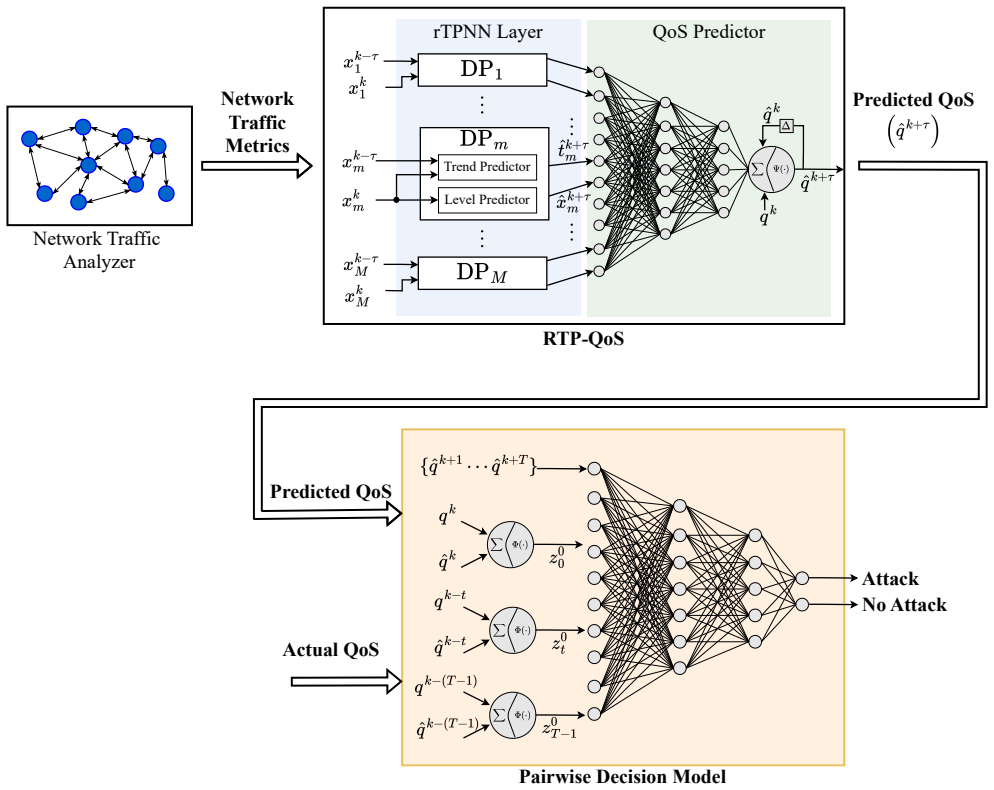
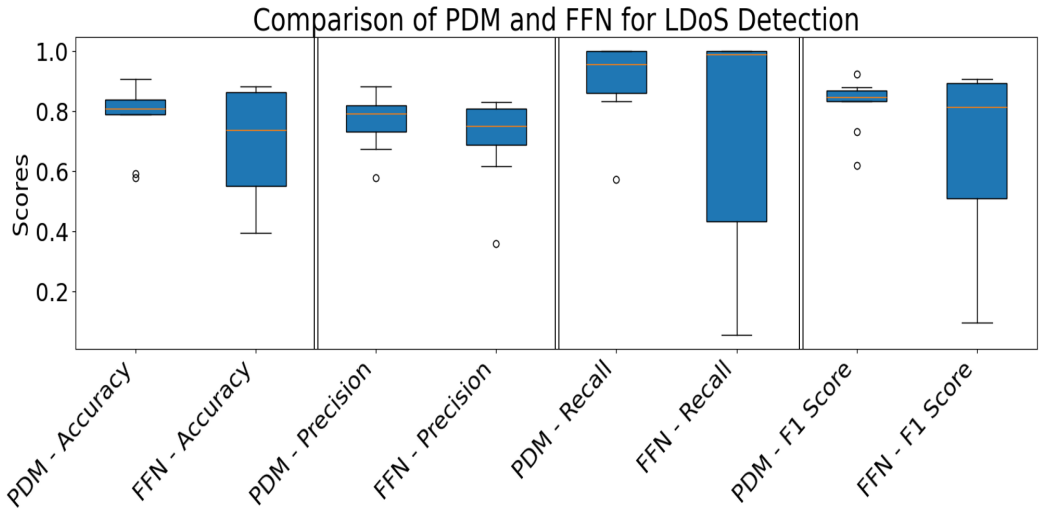
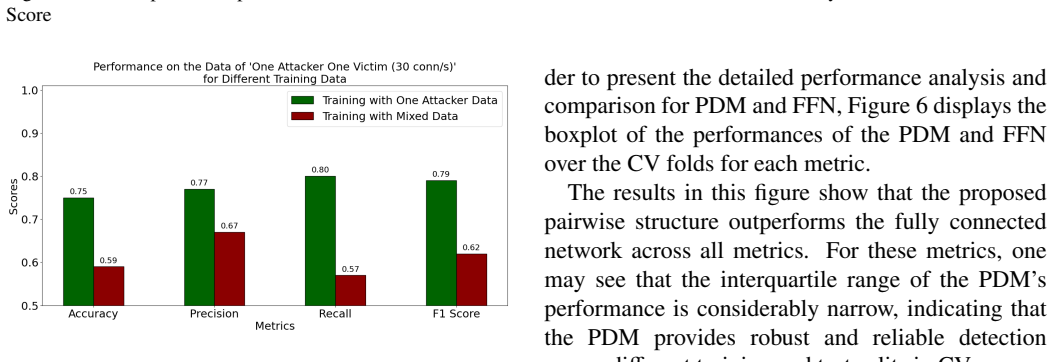
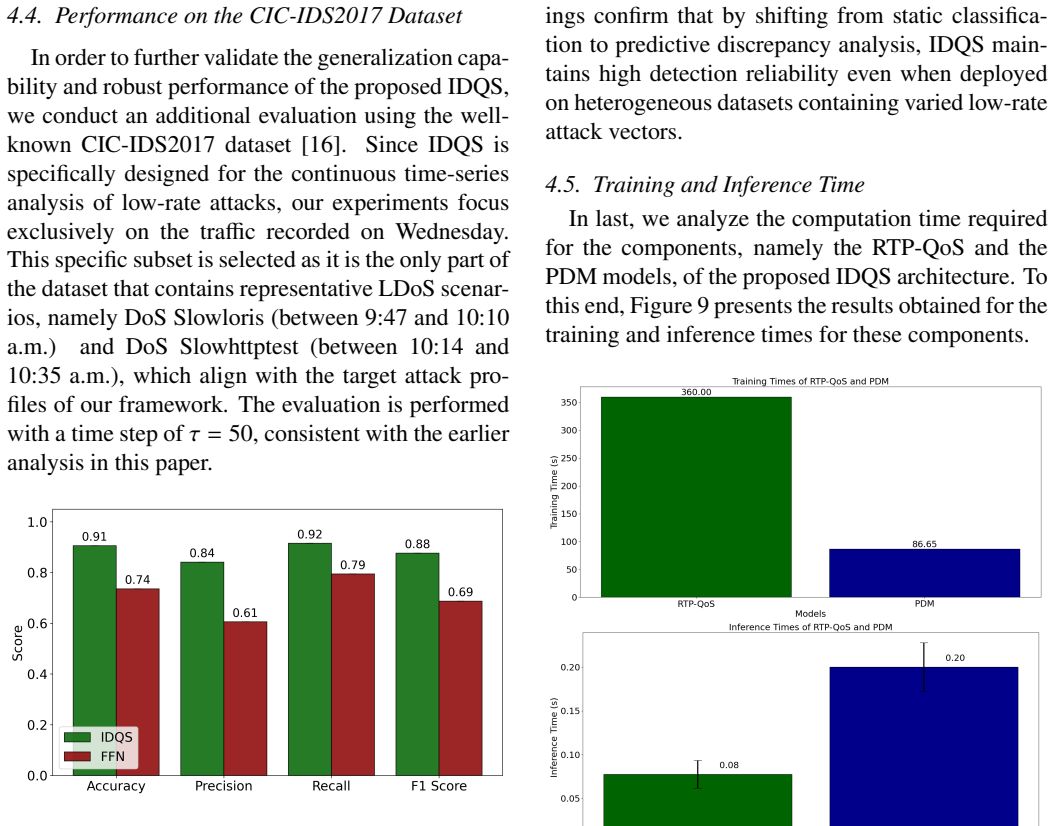
IDQS combines RTP-QoS, a Recurrent Trend Predictive Neural Network that learns historical traffic patterns to forecast future QoS metrics, with PDM, a Pairwise Decision Model that flags potential LDoS attacks when discrepancies arise between predicted and observed QoS. On the SDN-SlowRate-DDoS dataset it exceeds 79 percent detection accuracy and on CIC-IDS2017 it exceeds 91 percent, both with high recall and low false negatives while completing inference in 0.28 seconds.
What carries the argument
RTP-QoS, the Recurrent Trend Predictive Neural Network that forecasts QoS from historical patterns, paired with PDM, the Pairwise Decision Model that treats large prediction-observation gaps as attack indicators.
If this is right
- LDoS attacks can be identified before they cause noticeable service degradation.
- The approach runs fast enough for continuous monitoring on resource-limited IoT hardware.
- High recall across varied attack patterns reduces the chance of missing ongoing low-rate assaults.
- Performance holds on two independent public datasets, suggesting applicability beyond a single traffic source.
Where Pith is reading between the lines
- The same prediction-plus-discrepancy logic could be applied to other measurable network quantities to catch different attack families.
- Retraining the predictor on recent data streams might improve robustness when traffic patterns shift over time.
- Embedding the detector inside existing SDN controllers would allow automated responses without extra sensors.
Load-bearing premise
That gaps between the network's QoS forecasts and the values actually observed are caused by attacks rather than ordinary traffic changes or quirks of the chosen datasets.
What would settle it
A collection of normal IoT traffic traces containing only routine fluctuations on which the system nevertheless generates frequent false attack alerts.
Figures
read the original abstract
Low-Rate Denial of Service (LDoS) attacks pose a significant challenge to IoT networks due to their subtle and prolonged nature, often evading traditional intrusion detection systems. This paper presents IDQS (Intrusion Detection via QoS Prediction), a lightweight and proactive framework for early LDoS attack detection. IDQS integrates two new key components: (i) RTP-QoS, a Recurrent Trend Predictive Neural Network that learns and forecasts future Quality of Service (QoS) based on historical traffic patterns, and (ii) PDM, a Pairwise Decision Model that evaluates discrepancies between predicted and actual QoS to identify potential attacks. Evaluated on the public SDN-SlowRate-DDoS and CIC-IDS2017 datasets, IDQS respectively achieves over 79% and 91% detection accuracy across most attack scenarios with high recall and low false negatives, while maintaining an end-to-end inference time of just 0.28 seconds. The results demonstrate the effectiveness and efficiency of IDQS for real-time deployment in resource-constrained IoT environments.
Editorial analysis
A structured set of objections, weighed in public.
Referee Report
Summary. The manuscript proposes IDQS, a framework for early detection of Low-Rate Denial of Service (LDoS) attacks in IoT networks. It integrates RTP-QoS, a Recurrent Trend Predictive Neural Network that forecasts Quality of Service metrics from historical traffic patterns, and PDM, a Pairwise Decision Model that flags attacks via discrepancies between predicted and observed QoS values. On the SDN-SlowRate-DDoS and CIC-IDS2017 datasets, the method is reported to achieve detection accuracies exceeding 79% and 91% respectively, with high recall, low false negatives, and an end-to-end inference time of 0.28 seconds.
Significance. If the performance claims hold under proper validation, the work would address a recognized gap in detecting subtle, prolonged LDoS attacks that often evade signature- or anomaly-based IDS in IoT settings. The predictive-plus-comparison design is a plausible direction for proactive detection in resource-constrained environments, though its practical value rests on demonstrating that residuals are attack-specific rather than artifacts of normal traffic variance.
major comments (2)
- [Abstract] Abstract: The reported accuracies (over 79% and 91%) and inference time are stated without any information on the neural network training procedure, validation splits, hyperparameter choices, or controls for overfitting. This absence prevents evaluation of whether the numbers reflect genuine generalization or dataset-specific fitting.
- [Abstract] Abstract: The RTP-QoS + PDM pipeline is presented as separating LDoS from benign traffic via prediction discrepancies, yet no ablation, threshold robustness test, or statistical comparison of residual distributions under controlled benign variance (e.g., bursty IoT flows) is supplied. Without such evidence the central claim that discrepancies reliably indicate attacks remains unsupported.
Simulated Author's Rebuttal
We thank the referee for the constructive feedback on our manuscript. We address each major comment below and indicate where revisions will be made to strengthen the presentation of our results.
read point-by-point responses
-
Referee: [Abstract] Abstract: The reported accuracies (over 79% and 91%) and inference time are stated without any information on the neural network training procedure, validation splits, hyperparameter choices, or controls for overfitting. This absence prevents evaluation of whether the numbers reflect genuine generalization or dataset-specific fitting.
Authors: The full manuscript details the experimental protocol in Section 4, including time-series cross-validation on the two public datasets, hyperparameter selection via grid search (LSTM hidden size 64, learning rate 0.001, dropout 0.2), and early stopping based on validation loss to mitigate overfitting. The abstract is intentionally concise, but we agree that a brief reference to the validation approach would improve transparency. We will revise the abstract to include one sentence summarizing the training and validation procedure. revision: yes
-
Referee: [Abstract] Abstract: The RTP-QoS + PDM pipeline is presented as separating LDoS from benign traffic via prediction discrepancies, yet no ablation, threshold robustness test, or statistical comparison of residual distributions under controlled benign variance (e.g., bursty IoT flows) is supplied. Without such evidence the central claim that discrepancies reliably indicate attacks remains unsupported.
Authors: The PDM is designed to flag statistically significant deviations between predicted and observed QoS, and the reported high recall with low false negatives on both datasets provides supporting evidence. However, we acknowledge that explicit ablation of the predictive component, threshold sensitivity analysis, and direct comparison of residual distributions under controlled benign variance would further substantiate the claim. We will add these analyses (including ablation results and Kolmogorov-Smirnov tests on residuals) to the revised manuscript. revision: yes
Circularity Check
No circularity: standard predictive anomaly detection pipeline with independent training and evaluation
full rationale
The IDQS framework trains RTP-QoS on historical traffic patterns to produce QoS forecasts and then applies PDM to discrepancies with observed values. This is a conventional prediction-error anomaly detector whose training objective and detection rule are not equivalent by construction; the reported accuracies on SDN-SlowRate-DDoS and CIC-IDS2017 are external performance metrics rather than tautological outputs of the same fitted quantities. No self-citation load-bearing steps, uniqueness theorems, or ansatz smuggling appear in the provided description, and the derivation chain remains self-contained against the public datasets.
Axiom & Free-Parameter Ledger
Reference graph
Works this paper leans on
-
[1]
Al-Turjman, Artificial intelligence in IoT, V ol
F. Al-Turjman, Artificial intelligence in IoT, V ol. 13, Springer, 2019
2019
-
[2]
Baccour, N
E. Baccour, N. Mhaisen, A. A. Abdel- latif, A. Erbad, A. Mohamed, M. Hamdi, 16 M. Guizani, Pervasive ai for iot applications: A survey on resource-efficient distributed arti- ficial intelligence, IEEE Communications Sur- veys & Tutorials 24 (4) (2022) 2366–2418
2022
-
[3]
K. G. Manoharan, J. A. Nehru, S. Balasubra- manian, Artificial intelligence and iot, Springer 10 (2021) 978–981
2021
-
[4]
Ericsson, Ericsson Mobility Report (Nov. 2019). [link]. URLhttps://www.ericsson.com/en/ mobi-lity-report
2019
-
[5]
URLhttps://www.hp.com/us-en/ hp-news/press-release.html?id= 1744676
Hp study reveals 70 percent of Internet of Things devices vulnerable to attack. URLhttps://www.hp.com/us-en/ hp-news/press-release.html?id= 1744676
-
[6]
Gelenbe, M
E. Gelenbe, M. Nakıp, T. Czachórski, Improv- ing massive access to IoT gateways, Perfor- mance Evaluation 157 (2022) 102308
2022
-
[7]
Rodoplu, M
V . Rodoplu, M. Nakıp, D. T. Eliiyi, C. Güzeli¸ s, A multiscale algorithm for joint forecasting– scheduling to solve the massive access problem of iot, IEEE Internet of Things Journal 7 (9) (2020) 8572–8589
2020
-
[8]
Yoachimik, DDoS attack trends for 2022 Q2, accessed: 2023-03-09 (June 2022)
O. Yoachimik, DDoS attack trends for 2022 Q2, accessed: 2023-03-09 (June 2022). URLhttps://blog.cloudflare.com/ ddos-attack-trends-for-2022-q2/
2022
-
[9]
URLhttps://www.extrahop.com/ re-sources/attacks/dos/
ExtraHop, Denial of Service attack: definition, examples, and prevention, accessed: 2023-03- 09 (January 2022). URLhttps://www.extrahop.com/ re-sources/attacks/dos/
2023
-
[11]
M. Nasereddin, M. Nakıp, E. Gelenbe, Mea- surement based evaluation and mitigation of flood attacks on a lan test-bed, in: 2023 IEEE 48th Conference on Local Computer Net- works (LCN), 2023, pp. 1–4.doi:10.1109/ LCN58197.2023.10223358
arXiv 2023
-
[12]
Kiner, T
E. Kiner, T. April, Google mitigated the largest DDoS attack to date, peaking above 398 million rps, accessed: 2023-11-20 (October 2023). URLhttps://cloud.google.com/ blog/products/identity-security/ google-cloud-mitigated-largest-ddos-attack-peaking-above-398-million-rps
2023
-
[13]
IEEE Access8, 62011–62031 (2020) https://doi.org/10.1109/ACCESS.2020
W. Zhijun, L. Wenjing, L. Liang, Y . Meng, Low-rate dos attacks, detection, defense, and challenges: A survey, IEEE Access 8 (2020) 43920–43943.doi:10.1109/ACCESS.2020. 2976609
-
[14]
URLhttps://www.cloudflare
What is a low and slow attack?, accessed: 2024-03-02. URLhttps://www.cloudflare. com/en-gb/learning/ddos/ ddos-low-and-slow-attack/
2024
-
[15]
N. M. Yungaicela-Naula, C. Vargas-Rosales, J. A. Pérez-Díaz, E. Jacob, C. Martinez- Cagnazzo, Sdn-slowrate-ddos dataset (2023). doi:10.21227/amrt-8y98. URLhttps://dx.doi.org/10.21227/ amrt-8y98
-
[16]
Sharafaldin, A
I. Sharafaldin, A. H. Lashkari, A. A. Ghorbani, et al., Toward generating a new intrusion de- tection dataset and intrusion traffic characteri- zation., ICISSp 1 (2018) 108–116
2018
-
[17]
Bovenzi, G
G. Bovenzi, G. Aceto, D. Ciuonzo, A. Montieri, V . Persico, A. Pescapé, Network anomaly de- tection methods in IoT environments via deep learning: A fair comparison of performance and robustness, Computers & Security 128 (2023) 103167
2023
-
[18]
IoT-23: A labeled dataset with malicious and benign IoT network traffic,
S. Garcia, A. Parmisano, M. J. Erquiaga, IoT- 23: A labeled dataset with malicious and be- nign IoT network traffic (May 2021).doi: 10.5281/zenodo.4743746. URLhttps://doi.org/10.5281/zenodo. 4743746 17
-
[19]
URLhttps://www.kaggle.com/ymirsky/ network-attack-dataset-kitsune
Kitsune Network Attack Dataset (August 2020). URLhttps://www.kaggle.com/ymirsky/ network-attack-dataset-kitsune
2020
-
[20]
Nakip, E
M. Nakip, E. Gelenbe, Mirai botnet attack detection with auto-associative dense random neural network, in: 2021 IEEE Global Commu- nications Conference (GLOBECOM), IEEE, 2021, pp. 01–06
2021
-
[21]
Nakip, E
M. Nakip, E. Gelenbe, Botnet attack detection with incremental online learning, in: Security in Computer and Information Sciences: Second International Symposium, EuroCybersec 2021, Nice, France, October 25–26, 2021, Revised Selected Papers, Springer, 2022, pp. 51–60
2021
-
[22]
C. S. Htwe, Y . M. Thant, M. M. S. Thwin, Botnets attack detection using machine learn- ing approach for IoT environment, in: Journal of Physics: Conference Series, V ol. 1646, IOP Publishing, 2020, p. 012101
2020
-
[23]
Sriram, R
S. Sriram, R. Vinayakumar, M. Alazab, K. So- man, Network flow based IoT botnet attack detection using deep learning, in: IEEE IN- FOCOM 2020-IEEE Conference on Computer Communications Workshops (INFOCOM WK- SHPS), IEEE, 2020, pp. 189–194
2020
-
[24]
Y . N. Soe, Y . Feng, P. I. Santosa, R. Hartanto, K. Sakurai, Machine learning-based IoT-botnet attack detection with sequential architecture, Sensors 20 (16) (2020) 4372
2020
-
[25]
Nakıp, E
M. Nakıp, E. Gelenbe, Online self-supervised deep learning for intrusion detection systems, IEEE Transactions on Information Forensics and Security (2024)
2024
-
[26]
Polat, M
H. Polat, M. Türko ˘glu, O. Polat, A. ¸ Sengür, A novel approach for accurate detection of the ddos attacks in sdn-based scada systems based on deep recurrent neural networks, Expert Sys- tems with Applications 197 (2022) 116748
2022
-
[27]
Polat, S
O. Polat, S. Oyucu, M. Türko ˘glu, H. Polat, A. Aksoz, F. Yardımcı, Hybrid ai-powered real- time distributed denial of service detection and traffic monitoring for software-defined-based vehicular ad hoc networks: A new paradigm for securing intelligent transportation networks, Applied Sciences 14 (22) (2024) 10501
2024
-
[28]
A. Jain, R. Bagoria, P. Arora, An intelligent zero-day attack detection system using unsu- pervised machine learning for enhancing cy- ber security, Knowledge-Based Systems (2025) 113833
2025
-
[29]
G. Macia-Fernandez, J. E. Diaz-Verdejo, P. Garcia-Teodoro, Mathematical model for low-rate dos attacks against application servers, IEEE Transactions on Information Forensics and Security 4 (3) (2009) 519–529.doi:10. 1109/TIFS.2009.2024719
arXiv 2009
-
[30]
Z. Wu, L. Zhang, M. Yue, Low-rate dos attacks detection based on network multifractal, IEEE Transactions on Dependable and Secure Com- puting 13 (5) (2016) 559–567.doi:10.1109/ TDSC.2015.2443807
arXiv 2016
-
[31]
D. Tang, S. Zhang, J. Chen, X. Wang, The detection of low-rate dos attacks using the sadbscan algorithm, Information Sciences 565 (2021) 229–247
2021
-
[32]
M. Aiello, E. Cambiaso, M. Mongelli, G. Pa- paleo, An on-line intrusion detection approach to identify low-rate dos attacks, in: 2014 In- ternational Carnahan Conference on Security Technology (ICCST), 2014, pp. 1–6.doi: 10.1109/CCST.2014.6987039
-
[33]
A. Reed, L. S. Dooley, S. K. Mostefaoui, A reliable real-time slow dos detection frame- work for resource-constrained iot networks, in: 2021 IEEE Global Communications Confer- ence (GLOBECOM), 2021, pp. 1–6.doi: 10.1109/GLOBECOM46510.2021.9685612
-
[34]
L. Liu, H. Wang, Z. Wu, M. Yue, The detec- tion method of low-rate dos attack based on multi-feature fusion, Digital Communications and Networks 6 (4) (2020) 504–513
2020
-
[35]
Cheng, J
H. Cheng, J. Liu, T. Xu, B. Ren, J. Mao, W. Zhang, Machine learning based low-rate 18 ddos attack detection for sdn enabled iot net- works, International Journal of Sensor Net- works 34 (1) (2020) 56–69
2020
-
[36]
C. Xu, J. Shen, X. Du, Low-rate dos attack detection method based on hybrid deep neural networks, Journal of Information Security and Applications 60 (2021) 102879
2021
-
[37]
H. S. Ilango, M. Ma, R. Su, Low rate dos at- tack detection in iot - sdn using deep learning, in: 2021 IEEE International Conferences on Internet of Things (iThings) and IEEE Green Computing & Communications (GreenCom) and IEEE Cyber, Physical & Social Comput- ing (CPSCom) and IEEE Smart Data (Smart- Data) and IEEE Congress on Cybermatics (Cy- bermatics),...
2021
-
[38]
H. S. Ilango, M. Ma, R. Su, A feedforward– convolutional neural network to detect low-rate dos in iot, Engineering Applications of Artifi- cial Intelligence 114 (2022) 105059
2022
-
[39]
Vengathattil, S
S. Vengathattil, S. M. Shaffi, Advanced network security through predictive intelli- gence: Machine learning approaches for proac- tive threat detection—an experimental study, Methodology 2 (3)
-
[40]
S. E. Maoudj, A. Belghiat, A deep learning- based approach with two-step minority classes prediction for intrusion detection in internet of things networks, Knowledge-Based Systems 312 (2025) 113143
2025
-
[41]
S. S. Akhi, F. Shakil, S. K. Dey, M. I. Tusher, F. Kamruzzaman, S. S. Jamee, S. A. Tisha, N. Rahman, Enhancing banking cybersecurity: An ensemble-based predictive machine learn- ing approach, Am. J. Eng. Technol. 7 (03) (2025) 88–97
2025
-
[42]
Huang, X
Z. Huang, X. Huang, K. Xue, J. Han, L. Chen, Q. Sun, J. Lu, Defending against link-flooding attacks with adversary interest prediction and grouped online load balancing, IEEE Transac- tions on Networking 33 (3) (2025) 1056–1069
2025
-
[43]
Al-Quayed, Z
F. Al-Quayed, Z. Ahmad, M. Humayun, A sit- uation based predictive approach for cyberse- curity intrusion detection and prevention us- ing machine learning and deep learning algo- rithms in wireless sensor networks of industry 4.0, Ieee Access 12 (2024) 34800–34819
2024
-
[44]
V . D. M. Rios, P. R. Inácio, D. Magoni, M. M. Freire, Detection and mitigation of low-rate denial-of-service attacks: A survey, IEEE Ac- cess 10 (2022) 76648–76668
2022
-
[45]
Vedula, P
V . Vedula, P. Lama, R. V . Boppana, L. A. Trejo, On the detection of low-rate denial of service attacks at transport and application layers, Elec- tronics 10 (17) (2021) 2105
2021
-
[46]
D. Tang, X. Wang, Y . Yan, D. Zhang, H. Zhao, Adms: An online attack detection and mitiga- tion system for ldos attacks via sdn, Computer Communications 181 (2022) 454–471
2022
-
[47]
Hajimaghsoodi, R
M. Hajimaghsoodi, R. Jalili, Rad: A statis- tical mechanism based on behavioral analysis for ddos attack countermeasure, IEEE Transac- tions on Information Forensics and Security 17 (2022) 2732–2745
2022
-
[48]
Çakmak, The impact of denial-of-service attacks and queue management algorithms on cellular networks, Journal of Intelligent Sys- tems: Theory and Applications 7 (1) (2024) 1– 13
M. Çakmak, The impact of denial-of-service attacks and queue management algorithms on cellular networks, Journal of Intelligent Sys- tems: Theory and Applications 7 (1) (2024) 1– 13
2024
-
[49]
D. V . Hernandez, Y .-K. Lai, H. T. Ignatius, Real-time ddos detection in high-speed net- works: A deep learning approach with multi- variate time series, Electronics 14 (13) (2025) 2673
2025
-
[50]
de Miranda Rios, Detection of stealthy dis- tributed denial of service attacks using artifi- cial intelligence methods, Ph.D
V . de Miranda Rios, Detection of stealthy dis- tributed denial of service attacks using artifi- cial intelligence methods, Ph.D. thesis, Univer- sidade da Beira Interior (2025)
2025
-
[51]
C.-C. Chiu, T. He, Stealthy dgos attack: de- grading of service under the watch of network tomography, IEEE/ACM Transactions on Net- working 29 (3) (2021) 1294–1307. 19
2021
-
[52]
Yousef, Unveiling the stealthy threat: Low- rate denial of service (ldos) attacks, in: Key Is- sues in Network Protocols and Security, Inte- chOpen, 2024
D. Yousef, Unveiling the stealthy threat: Low- rate denial of service (ldos) attacks, in: Key Is- sues in Network Protocols and Security, Inte- chOpen, 2024
2024
-
[53]
Y . Wu, Y . Ru, Z. Lin, C. Liu, T. Xue, X. Zhao, J. Chen, Research on cyber attacks and de- fensive measures of power communication net- work, IEEE internet of things journal 10 (9) (2022) 7613–7635
2022
-
[54]
Moreira de Souza Berretta, P
F. Moreira de Souza Berretta, P. C. Oprime, J. E. Sordan, Cyberattacks and the risk to pro- duction and service systems–an analysis from the perspective of quality management, The TQM Journal (2025)
2025
-
[55]
T. A. Nguyen, D. Min, E. Choi, J.-W. Lee, De- pendability and security quantification of an in- ternet of medical things infrastructure based on cloud-fog-edge continuum for healthcare moni- toring using hierarchical models, IEEE Internet of Things Journal 8 (21) (2021) 15704–15748
2021
-
[56]
Baldini, Detection of cybersecurity spoofing attacks in vehicular networks with recurrence quantification analysis, Computer Communica- tions 191 (2022) 486–499
G. Baldini, Detection of cybersecurity spoofing attacks in vehicular networks with recurrence quantification analysis, Computer Communica- tions 191 (2022) 486–499
2022
-
[57]
Yakin, M
N. Yakin, M. Zhitkov, A. Chernikov, P. Pe- pelyaev, Security threats and service degrada- tion detection in lorawan networks, in: 2021 Ural Symposium on Biomedical Engineering, Radioelectronics and Information Technology (USBEREIT), IEEE, 2021, pp. 0455–0458
2021
-
[58]
Sawas, H
A. Sawas, H. E. Farag, Real-time detection of stealthy iot-based cyber-attacks on power distribution systems: A novel anomaly pre- diction approach, Electric Power Systems Re- search 223 (2023) 109496
2023
-
[59]
Kfoury, Jorge Crichigno, and Elias Bou-Harb
M. Nakip, C. Güzeli¸ s, O. Yildiz, Recur- rent trend predictive neural network for multi- sensor fire detection, IEEE Access 9 (2021) 84204–84216.doi:10.1109/ACCESS.2021. 3087736. 20
discussion (0)
Sign in with ORCID, Apple, or X to comment. Anyone can read and Pith papers without signing in.