REVIEW 4 major objections 5 minor 15 references
Using Semantic Role Knowledge for Relevance Ranking of Key Phrases in Documents: An Unsupervised Approach
T0 review · 4 major / 5 minor · reviewed 2026-08-14 · deepseek-v4-flash
Pith's one-line read Semantic role knowledge, folded into PageRank as node weights, improves unsupervised keyphrase ranking on scientific abstracts.
desk verdict The SRL weights are inert as described because PageRank initialization cannot influence the final rank; the paper's central claim rests on a misdescribed mechanism. read the letter →
The pith
A machine-rendered reading of the paper's core claim, the machinery that carries it, and where it could break.
The reading
What carries the argument
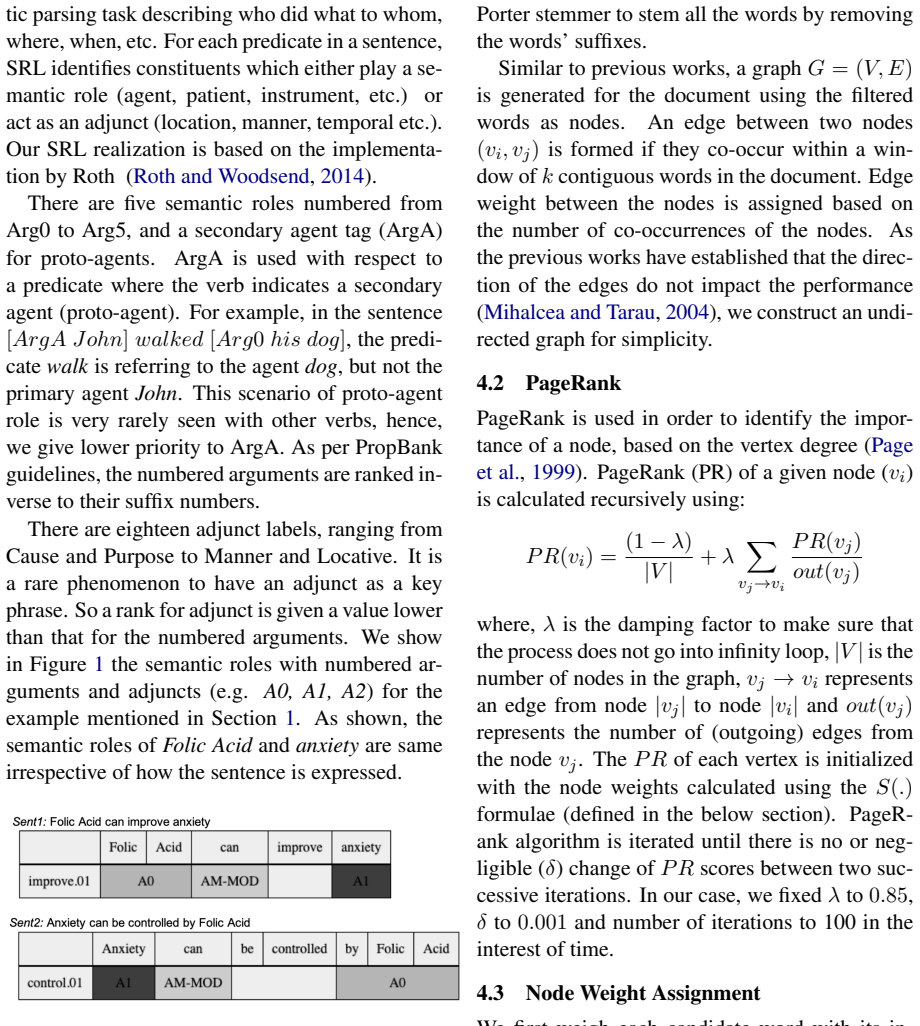
The load-bearing mechanism is the node-weight function $S(v_i)=SP(w_i)/n \times SRL(w_i)/n$, in which $SP(w_i)$ sums inverse sentence position weighted by frequency and $SRL(w_i)$ sums the semantic-role ranks of the word over the sentences where it appears, with $n$ the number of sentences containing the word. Role ranks follow the numbered argument scheme, with Arg0 highest, Arg1 next, and adjuncts lowest, encoding the intuition that agents and patients are more keyphrase-worthy than temporal or locative modifiers. This product initializes PageRank, so the graph's score flow is modulated by role information rather than by connectivity alone.
What would settle it
Replace the semantic-role score $SRL(w_i)$ in SemanticRank's initialization with a constant while keeping sentence-position scores unchanged, and re-run on KDD and WWW; if F1 at top 8 stays at 12.8 and 15.6 rather than falling toward the position-only baseline, the semantic-role component contributes nothing.
Extended reading notes
Core claim
The central claim is that semantic roles carry ranking signal for key phrases and that this signal survives being folded into PageRank as node initialization. Concretely, each candidate word is scored by multiplying its normalized sentence-position score by its normalized semantic-role score, and that product seeds PageRank; phrase scores are sums of the PageRank scores of their words. On KDD at top 6 and top 8, SemanticRank reaches F1 of 12.2 and 12.8, above the best baseline scores of 11.6 and 12.1; on WWW it reaches 15.0 and 15.6, above the best baselines of 13.1 and 12.3; on Inspec it is comparable to PositionRank. The paper interprets these results as evidence that semantic role knowledge can act as a new lexical feature in ranking.
Load-bearing premise
The entire ranking advantage rests on the semantic-role labeler being accurate on the input abstracts, and the paper reports that labeler at 87% precision in-domain, 77% out-of-domain, with worse performance on grammatically incomplete sentences—the kind of text found in many of the titles in its own datasets.
Editorial extensions
If this is right
- Any graph-based keyphrase ranker can adopt the same trick: replace its uniform or position-only PageRank initialization with role-weighted scores, without retraining or supervision.
- The method can be applied to any new document collection where a semantic-role parser is available, since no labeled keyphrases are needed.
- On well-formed abstract prose the role signal helps; on terse or grammatically incomplete titles it is likely to hurt, so practical deployments should apply the feature selectively.
- The reported parity with PositionRank on Inspec indicates the feature does not degrade ranking where position already dominates, making it a safe addition in mixed corpora.
Reading between the lines
- The paper's sensitivity test shows nearly identical results when Arg0 and Arg1 ranks are perturbed, which suggests the ordered role ranks may matter less than the coarse argument-versus-adjunct distinction; replacing ranks with a binary indicator would isolate the mechanism.
- The same role-weighted initialization could transfer to other graph-scoring tasks such as extractive summarization or entity ranking, because the ingredient is a document graph plus a linguistic prior, not a keyphrase-specific pipeline.
- A title-only evaluation would likely show smaller or negative gains, since semantic-role precision drops on elliptical text; comparing title-only against abstract-only on the same datasets would test whether the feature's benefit is confined to well-formed sentences.
Signed reviews
Editorial analysis
A structured set of objections, weighed in public.
Referee Report
Summary. The paper proposes SemanticRank, an unsupervised keyphrase-ranking method that combines sentence-position and term-frequency scores with semantic role label (SRL) information as a node-weight multiplier in a PageRank graph. Candidate words are selected as nouns/adjectives, connected by co-occurrence within a window, and PageRank is initialized with S(vi) = (SP(wi)/n)·(SRL(wi)/n). Key phrases are generated as adjective-noun sequences and scored by summing PageRank scores of their words. The method is evaluated on KDD, WWW, and Inspec against TextRank, SingleRank, TopicRank, PositionRank, and MultipartiteRank, reporting precision, recall, F1, MRR, and MAP. The authors claim that semantic role information can serve as a new lexical feature and that the approach achieves overall improvement over state-of-the-art baselines on all datasets.
Significance. If the central claim is valid, the paper introduces a linguistically motivated, unsupervised feature for graph-based keyphrase ranking that is simple and complementary to position/frequency cues. The evaluation uses external standard benchmarks (KDD, WWW, Inspec) with author-labeled gold keyphrases, and the feature weights are set by linguistic priors rather than fitted to test labels, so the circularity burden is low. However, the evidence as presented does not yet isolate the contribution of the SRL component: there is no ablation removing or randomizing the SRL factor, the cited sensitivity table is missing, the headline improvement claim is contradicted by parts of Table 2, and several experimental parameters are unreported. The core idea is plausible and potentially publishable after substantial revision, but the current manuscript does not establish that semantic-role information is the cause of the reported gains.
major comments (4)
- [§4.3, Node Weight Assignment] The central claim that semantic role information drives the observed gains is not supported by an ablation. Because S(vi) = (SP(wi)/n)·(SRL(wi)/n) and the SRL score is a normalized value in [0,1], replacing SRL(wi) with any positive constant scales all PageRank initialization scores uniformly and, for fixed PageRank parameters, leaves the final ranking unchanged. The paper never reports this constant-SRL condition or a randomized-role condition, so the comparison with PositionRank cannot isolate the SRL contribution, especially since the graph construction, edge weighting, and position weighting also differ from PositionRank.
- [§5.3, Results] The sensitivity analysis referenced as "Table ??" is absent from the submission, and the text states that precision, recall, and F1 are "practically the same" for KDD and WWW under different role-rank assignments. This missing table is load-bearing: the invariance claim, if true, directly weakens the attribution of the gains to the semantic-role ranking, and without the table the reader cannot assess how much the role-order choice matters or whether the reported numbers are reproducible.
- [Abstract and Table 2] The abstract's claim of "an overall improvement on all the data sets" is not supported by Table 2. On Inspec, SemanticRank essentially ties PositionRank at Top2 (36.5/6.2/10.3 vs 36.5/6.2/10.2) and Top6, and at Top2 on KDD and WWW PositionRank or MultipartiteRank achieves higher F1. The actual support is limited to N=6 and N=8 on KDD and WWW, with KDD significance at p=0.09/0.07; the scope of the improvement claim should be revised accordingly.
- [§4.1 and §5.3, Experimental Setup] The co-occurrence window size k used to construct the graph is never reported, and no sensitivity to k is given. Combined with the unablated architectural differences from PositionRank, this leaves open the possibility that the gains come from the choice of k or from the graph-construction details rather than from the SRL feature. The authors should report k, justify its value, and ideally show results across a small range of k to rule out this confound.
minor comments (5)
- [§5.3, Sensitivity paragraph] The text mentions a "Storwize dataset" that does not appear anywhere else in the paper; this should be removed or the dataset should be introduced and described.
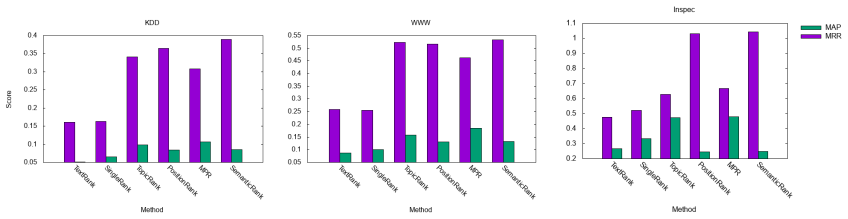
- [Figure 2] The MRR and MAP bar chart is difficult to read and does not report numeric values; the corresponding numbers should be given in the text or in a table so that the claims can be verified.
- [§5.2, Experimental Setups] The statistical significance testing is not described: the authors should state which test was used, whether it is paired across documents, and how the p-values for KDD and WWW were computed, given that KDD values of 0.09 and 0.07 are only marginally significant.
- [§6, Conclusions and Future Work] The limitations section correctly notes that SRL is less accurate on grammatically incomplete titles, but the paper does not quantify how often titles contribute key phrases or whether SemanticRank's dependence on well-formed sentences explains its weaker Inspec results; a brief quantitative note would strengthen the limitation discussion.
- [Abstract] The phrase "state-of-art" should be "state-of-the-art," and the claim of improvement should be made conditional on the specific datasets and N values that Table 2 actually supports.
Circularity Check
No significant circularity found; the method is externally benchmarked and no fitted quantity is renamed as a prediction.
full rationale
The derivation chain is self-contained and externally benchmarked. SemanticRank's initial node score is S(vi)=SP(wi)/n * SRL(wi)/n, where SP uses inverse sentence position and frequency, and SRL sums hand-assigned PropBank role ranks (Arg0 > Arg1 > ...) divided by a normalization constant. The role ranks are a fixed linguistic prior, set before evaluation; they are not learned from or fitted to the gold keyphrase labels, and no parameter of the model is tuned on the test sets. The method is compared against five baselines on KDD, WWW, and Inspec using author-labeled keyphrases, so the reported P/R/F1, MRR, and MAP are external evidence rather than a restatement of the model's inputs. There are no load-bearing self-citations: the only external tool (Roth and Woodsend's SRL implementation) is cited as a component, not as proof of the claim. The main evidentiary weakness—no ablation that removes or randomizes the SRL factor, and the missing 'Table ??' sensitivity table—is a support/attribution problem, not a circularity: it may mean the headline claim is under-supported, but the paper does not define its output in terms of its input or rename a fitted quantity as a prediction. Therefore no circular step meets the evidentiary bar, and the honest finding is score 0.
Assumptions & free parameters
free parameters (3)
- Graph co-occurrence window k =
not reported
- Semantic role rank order =
Arg0 > Arg1 > ... > adjuncts
- PageRank damping factor lambda =
0.85
assumptions (4)
- domain assumption Semantic roles correlate with key phrase importance
- domain assumption SRL system labels are correct enough to rank key phrases
- domain assumption Noun and adjective candidates plus Porter stemming capture key phrases
- standard math PageRank converges to a stable rank vector
Cite this review
Pith. "Pith review of Using Semantic Role Knowledge for Relevance Ranking of Key Phrases in Documents: An Unsupervised Approach." pith.science (2026). https://pith.science/paper/YGJ76L2T
@misc{pith2026190803313,
  author       = {Pith},
  title        = {Pith review of: Using Semantic Role Knowledge for Relevance Ranking of Key Phrases in Documents: An Unsupervised Approach},
  year         = {2026},
  howpublished = {\url{https://pith.science/paper/YGJ76L2T}},
  note         = {Machine review of arXiv:1908.03313}
}
read the original abstract
In this paper, we investigate the integration of sentence position and semantic role of words in a PageRank system to build a key phrase ranking method. We present the evaluation results of our approach on three scientific articles. We show that semantic role information, when integrated with a PageRank system, can become a new lexical feature. Our approach had an overall improvement on all the data sets over the state-of-art baseline approaches.
Figures
Reference graph
Works this paper leans on
-
[1]
Florian Boudin. 2018. https://doi.org/10.18653/v1/N18-2105 Unsupervised keyphrase extraction with multipartite graphs . In Proceedings of the 2018 Conference of the North American Chapter of the Association for Computational Linguistics: Human Language Technologies, Volume 2 (Short Papers), pages 667--672. Association for Computational Linguistics
-
[2]
A. Bougouin, F. Boudin, and B. Daille. 2013. Topicrank: Graph-based topic ranking for keyphrase extraction. In International Joint Conference on Natural Language Processing, pages 543--551
work page 2013
- [3]
-
[4]
Corina Florescu and Cornelia Caragea. 2017. https://doi.org/10.18653/v1/P17-1102 Positionrank: An unsupervised approach to keyphrase extraction from scholarly documents . In Proceedings of the 55th Annual Meeting of the Association for Computational Linguistics (Volume 1: Long Papers), pages 1105--1115. Association for Computational Linguistics
-
[5]
Daniel Gildea and Daniel Jurafsky. 2002. https://doi.org/10.1162/089120102760275983 Automatic labeling of semantic roles . Comput. Linguist., 28(3):245--288
-
[6]
Kazi Saidul Hasan and Vincent Ng. 2014. http://www.aclweb.org/anthology/P14-1119 Automatic keyphrase extraction: A survey of the state of the art . In Proceedings of the 52nd Annual Meeting of the Association for Computational Linguistics (Volume 1: Long Papers), pages 1262--1273, Baltimore, Maryland. Association for Computational Linguistics
work page 2014
-
[7]
Anette Hulth. 2003. https://doi.org/10.3115/1119355.1119383 Improved automatic keyword extraction given more linguistic knowledge . In Proceedings of the 2003 Conference on Empirical Methods in Natural Language Processing, EMNLP '03, pages 216--223, Stroudsburg, PA, USA. Association for Computational Linguistics
-
[8]
Zhiyuan Liu, Wenyi Huang, Yabin Zheng, and Maosong Sun. 2010. http://dl.acm.org/citation.cfm?id=1870658.1870694 Automatic keyphrase extraction via topic decomposition . In Proceedings of the 2010 Conference on Empirical Methods in Natural Language Processing, EMNLP '10, pages 366--376, Stroudsburg, PA, USA. Association for Computational Linguistics
Show all 15 references
-
[9]
Mihalcea and P
R. Mihalcea and P. Tarau. 2004. TextRank : Bringing order into texts. In Proceedings of EMNLP-04 and the 2004 Conference on Empirical Methods in Natural Language Processing
2004
-
[10]
Lawrence Page, Sergey Brin, Rajeev Motwani, and Terry Winograd. 1999. The pagerank citation ranking: Bringing order to the web. Technical report, Stanford InfoLab
1999
-
[11]
Sameer S Pradhan, Wayne H Ward, Kadri Hacioglu, James H Martin, and Daniel Jurafsky. 2004. Shallow semantic parsing using support vector machines. In HLT-NAACL, pages 233--240
2004
-
[12]
Michael Roth and Kristian Woodsend. 2014. Composition of word representations improves semantic role labelling. In Proceedings of the 2014 Conference on Empirical Methods in Natural Language Processing (EMNLP), pages 407--413
2014
-
[13]
Xiaojun Wan and Jianguo Xiao. 2008. Single document keyphrase extraction using neighborhood knowledge. In Proceedings of the 23rd National Conference on Artificial Intelligence - Volume 2
2008
-
[14]
URL: " 'urlintro :=
ENTRY address author booktitle chapter edition editor howpublished institution journal key month note number organization pages publisher school series title type volume year eprint doi pubmed url lastchecked label extra.label sort.label short.list INTEGERS output.state before...
-
[15]
write newline
" write newline "" before.all 'output.state := FUNCTION n.dashify 't := "" t empty not t #1 #1 substring "-" = t #1 #2 substring "--" = not "--" * t #2 global.max substring 't := t #1 #1 substring "-" = "-" * t #2 global.max substring 't := while if t #1 #1 substring * t #2 gl...
Reviewed August 14, 2026 · model on record in the stance chip above.
Discussion (0). Continue with ORCID to comment.