Designing for Being-With: Presence Without Personhood in Conversational Human-AI Interaction
Pith reviewed 2026-05-20 13:45 UTC · model grok-4.3
The pith
Conversational AI can be designed for relational presence without implying personhood or authority.
A machine-rendered reading of the paper's core claim, the machinery that carries it, and where it could break.
Core claim
Bounded relational presence supports attentiveness, continuity, and responsiveness in conversational agents while explicitly avoiding claims of personhood, therapeutic authority, or human equivalence, as developed through research-through-design and ethnography across various real-world settings.
What carries the argument
Bounded relational presence, a designable interaction quality that can be tuned, constrained, and deliberately withdrawn to maintain relational coherence without overreach.
If this is right
- Conversational interactions remain useful and engaging without users mistaking the AI for a human or expert.
- Risks of relational overreach are reduced in contexts like education or care by explicit limit-setting.
- Designers can choose to withdraw presence as a positive feature rather than a failure.
- Accountable withdrawal becomes part of the interaction design, promoting user awareness of the system's nature.
Where Pith is reading between the lines
- These principles could extend to non-conversational AI interfaces where presence is simulated.
- New design tools might emerge for evaluating how well an AI communicates its boundaries.
- Users in care-adjacent roles might benefit from clearer expectations, leading to better decisions about when to involve humans.
Load-bearing premise
That explicitly designing for honesty of limits and accountable withdrawal will effectively prevent relational overreach in care-adjacent contexts.
What would settle it
A study showing that users still attribute personhood or therapeutic authority to the AI despite the use of bounded presence designs and explicit signals.
Figures
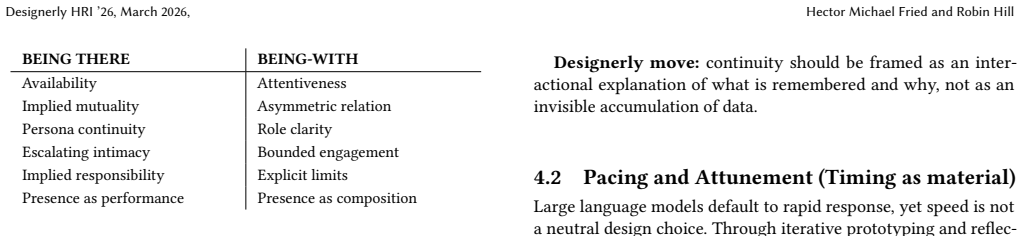
read the original abstract
Conversational AI systems increasingly generate social presence through linguistic fluency, emotional mirroring, and continuity across interactions. While these qualities can support engagement, they also risk relational overreach-particularly in care-adjacent contexts where users may interpret fluent systems as empathic, competent, or authoritative. This position paper argues for a designerly alternative: being-with without becoming. Drawing on a program of research-through-design and design ethnography involving the design, deployment, and reflective analysis of conversational agents across public, educational, cultural, and care-adjacent settings, the paper introduces the concept of bounded relational presence. Bounded presence supports attentiveness, continuity, and responsiveness while explicitly avoiding claims of personhood, therapeutic authority, or human equivalence. Presence is reframed as a designable interaction quality that can be tuned, constrained, and deliberately withdrawn, rather than maximized as a performance goal. The contribution is not a deployed clinical system, but a set of designerly principles for shaping relational interaction in conversational HRI that emphasize relational coherence, honesty of limits, and accountable withdrawal.
Editorial analysis
A structured set of objections, weighed in public.
Referee Report
Summary. This position paper argues for reframing social presence in conversational AI as a designable, tunable, and deliberately withdrawable interaction quality rather than a performance goal to be maximized. Drawing on a program of research-through-design and design ethnography across public, educational, cultural, and care-adjacent settings, the authors introduce 'bounded relational presence' that supports attentiveness, continuity, and responsiveness while explicitly avoiding claims of personhood, therapeutic authority, or human equivalence. The contribution consists of three designerly principles—relational coherence, honesty of limits, and accountable withdrawal—intended to mitigate relational overreach without requiring deployed clinical systems.
Significance. If the proposed principles hold under further scrutiny, the work offers a valuable conceptual framework for ethical design in human-AI interaction, particularly in sensitive domains. The grounding in reflective analysis from multiple design deployments across diverse settings is a clear strength, providing concrete examples that could guide practitioners and stimulate empirical follow-up studies on boundary-setting mechanisms.
major comments (1)
- [Abstract and principles elaboration] The central claim that honesty of limits and accountable withdrawal will effectively reduce over-attribution of empathy or authority (abstract and the section elaborating the three principles) rests on reflective analysis of the design program. No comparative outcome data, user-interpretation measures, or documented cases where these mechanisms were tested against overreach in care-adjacent contexts are provided, leaving the load-bearing assumption about preventive effectiveness unverified by direct evidence.
minor comments (2)
- [Introduction] The introduction could more explicitly contrast the proposed principles with existing frameworks in HRI ethics or presence research to clarify novelty.
- [Design cases] Some descriptions of the design cases are high-level; adding one or two concrete examples of how 'accountable withdrawal' was implemented in a specific deployment would improve traceability.
Simulated Author's Rebuttal
We thank the referee for their positive assessment of the paper's grounding in design deployments across diverse settings and for recommending minor revision. We address the single major comment below, acknowledging the distinction between conceptual proposal and empirical verification.
read point-by-point responses
-
Referee: [Abstract and principles elaboration] The central claim that honesty of limits and accountable withdrawal will effectively reduce over-attribution of empathy or authority (abstract and the section elaborating the three principles) rests on reflective analysis of the design program. No comparative outcome data, user-interpretation measures, or documented cases where these mechanisms were tested against overreach in care-adjacent contexts are provided, leaving the load-bearing assumption about preventive effectiveness unverified by direct evidence.
Authors: We agree that the manuscript provides no comparative outcome data, user-interpretation measures, or documented cases testing the mechanisms against over-attribution in care-adjacent contexts. As a position paper, the work draws on reflective analysis from a research-through-design and design ethnography program to articulate bounded relational presence and the three principles (relational coherence, honesty of limits, and accountable withdrawal). We do not claim or demonstrate that these principles have been empirically verified for preventive effectiveness; the contribution is explicitly framed as a set of designerly principles rather than a validated clinical intervention. To strengthen clarity, we will revise the abstract and the principles section to state more explicitly that the principles are proposed heuristics informed by observed patterns in our deployments, without asserting verified reduction of over-attribution, and to note that empirical testing of their effectiveness remains an open direction for future work. revision: partial
Circularity Check
No significant circularity in conceptual position paper
full rationale
The paper is a position paper that proposes bounded relational presence as a designerly reframing, derived from the authors' program of research-through-design and design ethnography across various settings. It contains no equations, fitted parameters, quantitative predictions, or self-referential derivations that reduce to inputs by construction. The central claims are presented as reflective principles emphasizing relational coherence, honesty of limits, and accountable withdrawal, forming an independent conceptual contribution rather than a circular reduction to prior results or self-citations. The argument is self-contained as a design-oriented position without load-bearing self-citation chains or ansatz smuggling.
Axiom & Free-Parameter Ledger
axioms (1)
- domain assumption Relational overreach is a meaningful risk in care-adjacent conversational AI that requires explicit design countermeasures
invented entities (1)
-
bounded relational presence
no independent evidence
Lean theorems connected to this paper
-
IndisputableMonolith/Foundation/RealityFromDistinction.leanreality_from_one_distinction unclear?
unclearRelation between the paper passage and the cited Recognition theorem.
Presence is reframed as a designable interaction quality that can be tuned, constrained, and deliberately withdrawn... principles... emphasize relational coherence, honesty of limits, and accountable withdrawal.
What do these tags mean?
- matches
- The paper's claim is directly supported by a theorem in the formal canon.
- supports
- The theorem supports part of the paper's argument, but the paper may add assumptions or extra steps.
- extends
- The paper goes beyond the formal theorem; the theorem is a base layer rather than the whole result.
- uses
- The paper appears to rely on the theorem as machinery.
- contradicts
- The paper's claim conflicts with a theorem or certificate in the canon.
- unclear
- Pith found a possible connection, but the passage is too broad, indirect, or ambiguous to say the theorem truly supports the claim.
Reference graph
Works this paper leans on
-
[1]
Sorio Boit and Rajvardhan Patil. 2025. A Prompt Engineering Framework for Large Language Model–Based Mental Health Chatbots: Conceptual Framework. JMIR Mental Health12 (2025), e75078. doi:10.2196/75078
-
[2]
Ungar, João Sedoc, and Sharath Chandra Guntuku
Young Min Cho, Sunny Rai, Lyle H. Ungar, João Sedoc, and Sharath Chandra Guntuku. 2023. An Integrative Survey on Mental Health Conversational Agents to Bridge Computer Science and Medical Perspectives. InProceedings of the 2023 Conference on Empirical Methods in Natural Language Processing. Association for Computational Linguistics, Singapore, 11346–11369...
-
[3]
Line Farah, Julie Davaze-Schneider, Tess Martin, Pierre Nguyen, Isabelle Borget, and Nicolas Martelli. 2023. Are Current Clinical Studies on Artificial Intelligence- Based Medical Devices Comprehensive Enough to Support a Full Health Tech- nology Assessment? A Systematic Review.Artificial Intelligence in Medicine140 (2023), 102547. doi:10.1016/j.artmed.20...
-
[4]
Stefanie Felsberger, Stefanie Ullmann, Clementine Collett, Gina Neff, and Thomas Lacy. 2025. How AI and Digital Technologies Enable Gendered Harms. Written evidence submitted to the UN Working Group on Discrimination against Women and Girls. Minderoo Centre for Technology and Democracy, University of Cambridge
work page 2025
-
[5]
Hector Michael Fried. 2025.A Different Kind of Empathy: Chatbot Ethnography as Another Way of “Being There”. PhD diss. University of Edinburgh
work page 2025
-
[6]
Stade, Philip Held, Shannon Wiltsey Stirman, and Johannes C
Richard Gaus, Elizabeth C. Stade, Philip Held, Shannon Wiltsey Stirman, and Johannes C. Eichstaedt. 2025. Generative AI for Mental Health: Opportunities, Risks, and Research Gaps. Manuscript
work page 2025
-
[7]
Elizabeth C. Stade, Zoe M. Tait, Samuel T. Campione, Shannon Wiltsey Stirman, and Johannes C. Eichstaedt. 2025. Current Real-World Use of Large Language Models for Mental Health. OSF preprint. Retrieved from OSF
work page 2025
-
[8]
Stade, Shannon Wiltsey Stirman, Philip Held, and Johannes C
Elizabeth C. Stade, Shannon Wiltsey Stirman, Philip Held, and Johannes C. Eich- staedt. 2024. Responsible Development of Large Language Models for Psychother- apy. Policy brief. Stanford Institute for Human-Centered Artificial Intelligence
work page 2024
-
[9]
Stanford Institute for Human-Centered Artificial Intelligence (HAI). 2023. A Blueprint for Using AI in Psychotherapy. Policy report. Stanford University
work page 2023
-
[10]
2010.Experience-Centered Design: Designers, Users, and Communities in Dialogue
Peter Wright and John McCarthy. 2010.Experience-Centered Design: Designers, Users, and Communities in Dialogue. Morgan & Claypool, San Rafael, CA
work page 2010
-
[11]
Antal Zemplényi, Konstantin Tachkov, Laszlo Balkanyi, Zsuzsanna Ida Petykó, Guenka Petrova, Marcin Czech, Dalia Dawoud, Wim Goettsch, Iñaki Gutier- rez Ibarluzea, Rok Hren, Saskia Knies, László Lorenzovici, Zorana Maravic, Oresta Piniazhko, Alexandra Savova, Manoela Manova, Tomas Tesar, Špela Zerovnik, and Zoltán Kaló. 2023. Recommendations to Overcome Ba...
discussion (0)
Sign in with ORCID, Apple, or X to comment. Anyone can read and Pith papers without signing in.