REVIEW 2 major objections 4 minor 45 references
RePos: Relative-to-Absolute Pose Factorization for Cross-Environment WiFi-Based 3D Human Pose Estimation
T0 review · 2 major / 4 minor · reviewed 2026-08-02 · deepseek-v4-flash
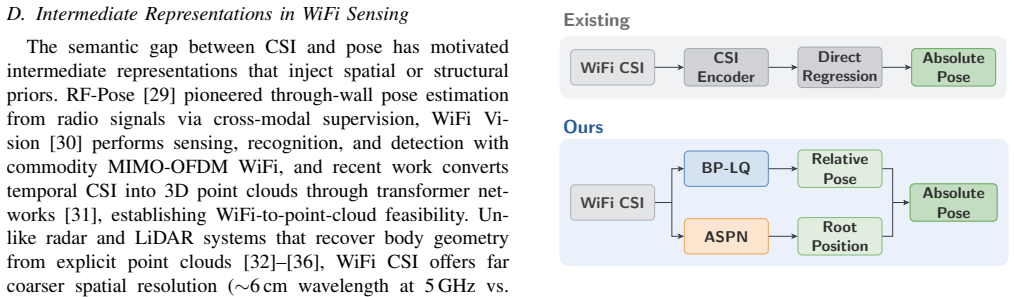
Pith's one-line read This paper claims that WiFi-based 3D human pose estimation fails across rooms because absolute-pose regression entangles body structure with room-specific position cues, and that factoring the output into a root-relative pose plus a separat
desk verdict RePos is a genuine step for cross-env WiFi pose, but its root branch is a source-room prior, not a localizer; the paper would be stronger if the abstract said so. read the letter →
The pith
A machine-rendered reading of the paper's core claim, the machinery that carries it, and where it could break.
The reading
What carries the argument
The core object is the identity J_abs = J_rel + r, which splits the absolute pose into a root-relative skeleton and a pelvis/root offset broadcast to all joints. It is realized by two independently trained branches: Stage 1 predicts J_rel from Body-Part Latent Queries (BP-LQs), 150 learnable latent tokens grouped into six anatomical regions, refined by Skeleton Graph Attention (SGA), which masks attention according to a skeletal adjacency matrix; Stage 2, the Amplitude-based Spatial Prior Network (ASPN), maps CSI amplitude through a latent modulation code and a differentiable beamforming-plus-IFFT spatial decomposition into a heatmap, then regresses r. The factorization's work is to ensure t
What would settle it
Run the same evaluation protocol on a dataset in which subjects move freely across a large unseen room (X/Y range of several meters) and the target room's position centroid is displaced from the training rooms. If RePos's root error stays near 200-300 mm and its MPJPE advantage over direct baselines persists, the central claim survives; if its root error rises to roughly the centroid displacement and MPJPE converges to the baselines, the claim is falsified as stated, showing the gain was prior recall rather than factorization.
Extended reading notes
Core claim
The central claim is that coordinate overfitting — not poor geometry recovery — is what breaks WiFi pose models in unseen rooms, and that this can be removed at the output side. Predict the root-relative pose J_rel and the root position r separately, then set J_abs = J_rel + r. The structure branch never sees absolute-position targets, so room-specific position cues cannot leak into the body estimate; the ASPN reads only CSI amplitude and learns a differentiable spatial-decomposition heatmap for localization. The reported result is a 10-21% MPJPE reduction on the MM-Fi cross-environment protocol (254.4-296.1 mm vs 320.6-355.8 mm for the strongest baseline per protocol), with root error rough
Load-bearing premise
The central claim rests on the assumption that an unseen room's subject positions lie close to the training rooms' position distribution, because the paper's own Table IV shows the root branch emits a near-source-room prior (predicted-root centroid shifts 13 mm while the true root shifts 278 mm), which is only reasonable when, as in MM-Fi, subject placement is constrained (X/Y std at most 7 cm) and the error is mostly a room-coordinate offset.
Editorial extensions
If this is right
- If RePos is right, WiFi-only pose models can be deployed in unseen rooms with no calibration, because the environment-stable body structure splits cleanly from location.
- The factorized gain is predominantly a localization gain: on the reported benchmark the method cuts root error to 203-261 mm while PA-MPJPE differences against baselines stay around 3 mm, so downstream applications that care about where in the room a person is gain the most.
- The benefit disappears once the target room is seen: after few-shot fine-tuning the direct variant edges out the factorized one, meaning the factorization is a zero-shot transfer mechanism, not a universal accuracy boost.
- The structure branch is stable across rooms: leave-one-room-out PA-MPJPE stays within 102-107 mm, so the learned body representation can be reused across layouts.
- Because the two branches share no intermediate tensor, Stage-1 errors do not cascade into localization; even 80 mm injected noise in the relative pose raises final error by only about 25 mm.
Reading between the lines
- Editorial inference: the paper's own numbers (predicted-root centroid shift 13 mm vs 278 mm true) imply RePos's root branch is a learned prior over the training rooms' coordinate frame rather than a physical localizer; the approach may therefore transfer whenever the target room's positions overlap the source distribution, and may fail on free-roaming subjects until the ASPN learns position-sensit
- Editorial inference: a testable consequence is that on a free-roaming dataset with multi-meter X/Y movement, RePos's root error should grow roughly with the target-room centroid displacement and the MPJPE advantage over baselines should shrink; if root error instead stays stable, the branch is doing genuine localization rather than prior recall.
- Editorial inference: the same output-side factorization could be dropped into other WiFi sensing tasks that mix an environment-stable target with an environment-dependent location — gesture shape vs hand location, activity class vs where it occurs — and should produce a similar cross-environment gain wherever the location factor varies most.
- Editorial inference: because the failure mode is largely a coordinate offset, a single labelled target frame that corrects the root centroid should recover most of the gap, consistent with the paper's few-shot result where one subject of fine-tuning reverts the regime to in-domain.
Editorial analysis
A structured set of objections, weighed in public.
Referee Report
Summary. The paper proposes RePos, a factorized framework for WiFi-CSI-based 3D human pose estimation that decomposes the output as J_abs = J_rel + r (Eq. 2): a root-relative structure branch (BP-LQs + Skeleton Graph Attention) and a separate root-position branch (ASPN) that predicts the pelvis position from CSI amplitude via a differentiable, beamforming-inspired spatial decomposition. A direct single-stage variant, RePos-D, is introduced for in-domain deployment. On Person-in-WiFi-3D, RePos-D reports an in-domain MPJPE of 86.9 mm, a 3.4% improvement over DT-Pose. Under the MM-Fi Setting-3 cross-environment protocol (train E01--E03, test E04), RePos reports MPJPE reductions of 10--21% over prior WiFi-only methods across three activity protocols. The paper supports these results with controlled same-backbone comparisons, leave-one-environment-out cross-validation, leakage-free few-shot transfer, component ablations, and domain-gap diagnostics that explicitly measure the transferability of relative pose versus root position.
Significance. If the reported results hold, RePos provides a simple and potentially useful architectural inductive bias for cross-environment WiFi-based pose estimation: separating an environment-stable relative pose from an environment-dependent root position. The paper is methodologically strong in several respects: it validates its central premise on ground-truth labels (Table IV), tests its own mechanism rather than only comparing end-to-end benchmarks, includes a controlled direct-regression variant sharing the same backbone, reports LOEO and leakage-free few-shot evaluations, and is unusually transparent about the limitations of the ASPN, explicitly calling it a coarse, partly environment-dependent localizer rather than a physical phase estimator. The main caveats are that the cross-environment gains are demonstrated under MM-Fi's constrained subject placement and that the abstract and contributions state the root-branch mechanism more strongly than the paper's own diagnostics support.
major comments (2)
- [Section V-E, Table IV; Section IV-C; Abstract] The paper's own diagnostics undermine the mechanism claim stated in the abstract ('a separate network estimates the root position') and in Section IV-C ('root-localization branch'). Table IV shows that the predicted-root centroid shifts only 13 mm from source rooms to E04 while the ground-truth root centroid shifts 278 mm, and the E04 root error is 261 mm — essentially the missed displacement. This indicates that the ASPN learned a source-room position prior, not a target-room localizer. The 10–21% MPJPE gains are therefore demonstrated only for MM-Fi's regime, where subject placement is constrained (Section V-F: X/Y std ≤ 7 cm) and root error is dominated by room-coordinate offsets (Section VI). The paper does acknowledge this in its limitations, but the abstract and contributions do not carry the caveat. Please either add a free-roaming or shifted-coordinate experiment showing behavior
- [All experimental tables] No standard deviations or seed variance are reported anywhere. Several key claims rest on margins comparable to typical run-to-run noise: the PA-MPJPE separation between RePos and the strongest baselines is about 3 mm (Table III), the few-shot ranking difference between RePos and RePos w/o ASPN is 1.3 mm (Table VI), the SGA ablation gain is 2.1/0.9 mm (Table VIII), and the token-allocation sensitivity spread is 0.6 mm (Table IX). Without variance estimates, the reader cannot assess whether the '~3 mm' PA margin, the 'insensitive' token allocation, or the 1.3-mm few-shot inversion are meaningful. Please report mean ± std over at least 5 seeds (or resampling-based confidence intervals) for the main comparisons and the ablation/sensitivity tables, and state whether the differences supporting the claims are statistically significant.
minor comments (4)
- [Section IV-E] The self-supervised Masked-CSI Pre-training (MCP) used for RePos-D is described in a single sentence with no architectural or training details. Since it is part of the in-domain SOTA recipe, please provide enough detail (mask ratio, reconstruction target, pretraining data, schedule) for reproducibility.
- [Section V-G, Table VI] The statement that 'RePos without the ASPN matches MetaFi++ (351.4 vs 349.6 mm)' uses a 1.8-mm difference with no variance; this should be qualified or supported by the seed analysis requested above.
- [Fig. 7(e)] The heatmap axes are labeled 'Spatial Bin (X)' and 'Spatial Bin (Y)', but the decomposition produces angular and delay-like latent dimensions, not physical X/Y. Please adjust the labels or caption to avoid implying direct Cartesian coordinates.
- [Section V-E] When discussing the 13-mm predicted-root shift, the text cites 'Table V' for the 261-mm E04 root error; the value also appears in Table III. Please ensure the citation points to the most direct table for the reader.
Circularity Check
No significant circularity: Eq. (2) is an identity used as architecture; the empirical gain is externally evaluated and the paper explicitly flags the root-branch scope limitation.
full rationale
The derivation chain is self-contained and not circular. The central decomposition J_abs = J_rel + r (Eq. 2) is a kinematic identity when r is the pelvis position; the paper uses it as an architectural decomposition, not as a fitted law or as an empirical prediction, so no quantity is defined in terms of the target result. The cross-environment gains are established by direct comparison to four baselines on the held-out E04 split and by LOEO cross-validation; the ASPN root branch is supervised against ground-truth pelvis labels in source rooms, and its target-room behavior is then measured, not assumed. Table IV actually documents that the root branch collapses toward the source-room prior (predicted-root centroid shift 13 mm vs 278 mm true), which is an honest limitation and a scope constraint, not a circular step; the paper explicitly states that MM-Fi's constrained subject placement (X/Y std <= 7 cm) means results should be read as room-level coordinate transfer and that free-roaming evaluation is future work. No load-bearing result rests on a self-citation: [4] and [7] (which include co-author Ohtsuki) are background/degradation citations, while the relative/absolute decomposition is attributed to independent vision literature. No uniqueness theorem or ansatz is imported from the authors' prior work. The 10-21% MPJPE reduction is an externally evaluated benchmark outcome; it is not equivalent by construction to any fitted input.
Assumptions & free parameters
free parameters (4)
- lambda_l (limb-length regularizer weight) =
0.1
- lambda_r (root-position L1 loss weight) =
1
- BP-LQ token budget =
{Head 20, Torso 30, each limb 25}
- Spatial-decomposition grid sizing =
N_alpha=90 angular bins, N_delta=64 delay bins
assumptions (4)
- domain assumption Relative body pose is environment-stable while absolute root position is environment-dependent
- domain assumption CSI amplitude, after a learned modulation, contains enough position-discriminative structure for a beamforming-inspired decomposition to support root estimation
- domain assumption MM-Fi Setting-3 subject placement (X/Y std <= 7 cm) makes cross-environment transfer a room-coordinate-frame shift, and conclusions extend to free-roaming settings
- standard math Branch outputs combine additively as J_abs = J_rel + r with no error cascade
invented entities (2)
-
Body-Part Latent Queries (BP-LQs) - learnable latent tokens grouped into six anatomical parts
-
Latent modulation code phi_hat = tanh(CNN(X_amp)), a learned pseudo-phase
Cite this review
Pith. "Pith review of RePos: Relative-to-Absolute Pose Factorization for Cross-Environment WiFi-Based 3D Human Pose Estimation." pith.science (2026). https://pith.science/paper/YGUG7N4T
@misc{pith2026260702986,
  author       = {Pith},
  title        = {Pith review of: RePos: Relative-to-Absolute Pose Factorization for Cross-Environment WiFi-Based 3D Human Pose Estimation},
  year         = {2026},
  howpublished = {\url{https://pith.science/paper/YGUG7N4T}},
  note         = {Machine review of arXiv:2607.02986}
}
read the original abstract
Device-free 3D human pose estimation from commodity WiFi Channel State Information (CSI) enables human sensing that preserves privacy and tolerates poor illumination, but its deployment is limited by poor generalization across environments. Unlike images, CSI measurements have no spatially localized correspondence to body parts and are heavily affected by multipath propagation. Consequently, models that regress absolute poses entangle body structure with location cues specific to each environment. Within a single environment this coupling is not problematic: RePos-D, a direct model that regresses the absolute pose, already achieves the best reported accuracy on Person-in-WiFi-3D, a 3.4% gain over the previous best WiFi method, DT-Pose. Across environments, however, the same model overfits position and degrades sharply. We therefore propose RePos, a factorized framework that separates root-relative pose estimation from root localization. By shielding the structure branch from absolute position, RePos learns robust pose representations. Specifically, it groups CSI features into latent tokens organized by body part that a skeleton-guided module refines into the pose, while a separate network estimates the root position from CSI amplitude through a differentiable spatial decomposition. Under the strict MM-Fi cross-environment protocol, RePos reduces the mean per-joint position error (MPJPE) by 10-21% over existing WiFi methods. The improvement is consistent across activity protocols, holds when each environment is held out in turn, and survives few-shot transfer without data leakage. Further analysis shows that the relative pose predictions remain largely independent of position, whereas root localization remains dependent on the environment.
Figures


Figures from the paper (5 more)


Reference graph
Works this paper leans on
-
[16]
Breaking coordinate overfitting: Geometry- aware wifi sensing for cross-layout 3d pose estimation,
S. Jia, Y . Lu, B. Liu, X. Zhang, P. Zhao, X. Tang, Y . Wei, J. Huang, H. Yan, and Z. Liu, “Breaking coordinate overfitting: Geometry- aware wifi sensing for cross-layout 3d pose estimation,”arXiv preprint arXiv:2601.12252, 2026
arXiv 2026
-
[1]
A systematic sur- vey on human pose estimation: upstream and downstream tasks, ap- proaches, lightweight models, and prospects,
Z. Gao, J. Chen, Y . Liu, Y . Jin, and D. Tian, “A systematic sur- vey on human pose estimation: upstream and downstream tasks, ap- proaches, lightweight models, and prospects,”Artificial Intelligence Review, vol. 58, no. 3, p. 68, 2025. 13
2025
-
[2]
Markerless human pose estimation for biomedical applications: a survey,
A. Avogaro, F. Cunico, B. Rosenhahn, and F. Setti, “Markerless human pose estimation for biomedical applications: a survey,”Frontiers in Computer Science, vol. 5, p. 1153160, 2023
2023
-
[3]
Applications of pose estimation in human health and performance across the lifespan,
J. Stenum, K. M. Cherry-Allen, C. O. Pyles, R. D. Reetzke, M. F. Vignos, and R. T. Roemmich, “Applications of pose estimation in human health and performance across the lifespan,”Sensors, vol. 21, no. 21, p. 7315, 2021
2021
-
[4]
Wi-fi sensing techniques for human activity recognition: Brief survey, potential challenges, and research directions,
F. Miao, Y . Huang, Z. Lu, T. Ohtsuki, G. Gui, and H. Sari, “Wi-fi sensing techniques for human activity recognition: Brief survey, potential challenges, and research directions,”ACM Computing Surveys, vol. 57, no. 5, pp. 1–30, 2025
2025
-
[5]
Person-in-wifi: Fine- grained person perception using wifi,
F. Wang, S. Zhou, S. Panev, J. Han, and D. Huang, “Person-in-wifi: Fine- grained person perception using wifi,” inProceedings of the IEEE/CVF International Conference on Computer Vision (ICCV), October 2019
2019
-
[6]
Winect: 3d human pose tracking for free-form activity using commodity wifi,
Y . Ren, Z. Wang, S. Tan, Y . Chen, and J. Yang, “Winect: 3d human pose tracking for free-form activity using commodity wifi,”Proceedings of the ACM on Interactive, Mobile, Wearable and Ubiquitous Technologies, vol. 5, no. 4, pp. 1–29, 2021
2021
-
[7]
A cross-subject transfer learning method for csi-based wireless sensing,
Z. He, M. Bouazizi, G. Gui, and T. Ohtsuki, “A cross-subject transfer learning method for csi-based wireless sensing,”IEEE Internet of Things Journal, 2025
2025
Show all 45 references
-
[8]
DT-Pose: Towards robust and realistic human pose estimation using WiFi signals,
Y . Chen and J. Guo, “DT-Pose: Towards robust and realistic human pose estimation using WiFi signals,”Edge Intelligence and Systems, vol. 1, no. 1, p. 2, 2026. [Online]. Available: https://www.sciltp.com/journals/eis/articles/2606004157
2026
-
[9]
Person- in-wifi 3d: End-to-end multi-person 3d pose estimation with wi-fi,
K. Yan, F. Wang, B. Qian, H. Ding, J. Han, and X. Wei, “Person- in-wifi 3d: End-to-end multi-person 3d pose estimation with wi-fi,” inProceedings of the IEEE/CVF Conference on Computer Vision and Pattern Recognition, 2024, pp. 969–978
2024
-
[10]
Graph-based 3D human pose estimation using WiFi signals,
J. Chen, Y . Qu, R. Tang, and D. Slock, “Graph-based 3D human pose estimation using WiFi signals,” inICASSP 2026 – 2026 IEEE International Conference on Acoustics, Speech and Signal Processing (ICASSP). IEEE, 2026, pp. 19 992–19 996
2026
-
[11]
A graph attention spatio-temporal convolutional network for 3d human pose estimation in video,
J. Liu, J. Rojas, Y . Li, Z. Liang, Y . Guan, N. Xi, and H. Zhu, “A graph attention spatio-temporal convolutional network for 3d human pose estimation in video,” in2021 IEEE international conference on robotics and automation (ICRA). IEEE, 2021, pp. 3374–3380
2021
-
[12]
Interweaved graph and attention network for 3d human pose estimation,
T. Wang, H. Liu, R. Ding, W. Li, Y . You, and X. Li, “Interweaved graph and attention network for 3d human pose estimation,” inICASSP 2023- 2023 IEEE International Conference on Acoustics, Speech and Signal Processing (ICASSP). IEEE, 2023, pp. 1–5
2023
-
[13]
Adapose: Toward cross-site device-free human pose estimation with commodity wifi,
Y . Zhou, J. Yang, H. Huang, and L. Xie, “Adapose: Toward cross-site device-free human pose estimation with commodity wifi,”IEEE Internet of Things Journal, vol. 11, no. 24, pp. 40 255–40 267, 2024
2024
-
[14]
Airfi: Empowering wifi-based passive human gesture recognition to unseen environment via domain generalization,
D. Wang, J. Yang, W. Cui, L. Xie, and S. Sun, “Airfi: Empowering wifi-based passive human gesture recognition to unseen environment via domain generalization,”IEEE Transactions on Mobile Computing, vol. 23, no. 2, pp. 1156–1168, 2022
2022
-
[15]
A survey on wi-fi sensing generalizability: Taxonomy, techniques, datasets, and future research prospects,
F. Wang, T. Zhang, W. Xi, H. Ding, G. Wang, D. Zhang, Y . Cui, F. Liu, J. Han, J. Xuet al., “A survey on wi-fi sensing generalizability: Taxonomy, techniques, datasets, and future research prospects,”arXiv preprint arXiv:2503.08008, 2025
2025
-
[17]
Gopose: 3d human pose estimation using wifi,
Y . Ren, Z. Wang, Y . Wang, S. Tan, Y . Chen, and J. Yang, “Gopose: 3d human pose estimation using wifi,”Proceedings of the ACM on Interactive, Mobile, Wearable and Ubiquitous Technologies, vol. 6, no. 2, pp. 1–25, 2022
2022
-
[18]
Densepose from wifi,
J. Geng, D. Huang, and F. De la Torre, “Densepose from wifi,”arXiv preprint arXiv:2301.00250, 2022
2022 arXiv
-
[19]
Can wifi estimate person pose?
F. Wang, S. Panev, Z. Dai, J. Han, and D. Huang, “Can wifi estimate person pose?”arXiv preprint arXiv:1904.00277, 2019
1904 arXiv
-
[20]
Towards 3d human pose construction using wifi,
W. Jiang, H. Xue, C. Miao, S. Wang, S. Lin, C. Tian, S. Murali, H. Hu, Z. Sun, and L. Su, “Towards 3d human pose construction using wifi,” inProceedings of the 26th annual international conference on mobile computing and networking, 2020, pp. 1–14
2020
-
[21]
Metafi++: Wifi-enabled transformer-based human pose estimation for metaverse avatar simulation,
Y . Zhou, H. Huang, S. Yuan, H. Zou, L. Xie, and J. Yang, “Metafi++: Wifi-enabled transformer-based human pose estimation for metaverse avatar simulation,”IEEE Internet of Things Journal, vol. 10, no. 16, pp. 14 128–14 136, 2023
2023
-
[22]
Hpe-li: Wifi-enabled lightweight dual selective kernel convolution for human pose estimation,
T. D. Gian, T. Dac Lai, T. Van Luong, K.-S. Wong, and V .-D. Nguyen, “Hpe-li: Wifi-enabled lightweight dual selective kernel convolution for human pose estimation,” inEuropean Conference on Computer Vision. Springer, 2024, pp. 93–111
2024
-
[23]
Robust wifi sensing-based human pose estimation using denoising autoencoder and cnn with dynamic subcarrier attention,
X. H. Nguyen, V .-D. Nguyen, Q.-T. Luu, T. D. Gian, and O.-S. Shin, “Robust wifi sensing-based human pose estimation using denoising autoencoder and cnn with dynamic subcarrier attention,”IEEE Internet of Things Journal, vol. 12, no. 11, pp. 17 066–17 079, 2025
2025
-
[24]
Genhpe: Generative counterfactuals for 3d human pose estimation with radio frequency signals,
S. Huang and J. A. McCann, “Genhpe: Generative counterfactuals for 3d human pose estimation with radio frequency signals,”arXiv preprint arXiv:2503.09537, 2025
2025 arXiv
-
[25]
Towards environment independent device free human activity recognition,
W. Jiang, C. Miao, F. Ma, S. Yao, Y . Wang, Y . Yuan, H. Xue, C. Song, X. Ma, D. Koutsonikolaset al., “Towards environment independent device free human activity recognition,” inProceedings of the 24th annual international conference on mobile computing and networking, 2018, p...
2018
-
[26]
Rf-net: A unified meta- learning framework for rf-enabled one-shot human activity recognition,
S. Ding, Z. Chen, T. Zheng, and J. Luo, “Rf-net: A unified meta- learning framework for rf-enabled one-shot human activity recognition,” inProceedings of the 18th Conference on Embedded Networked Sensor Systems, 2020, pp. 517–530
2020
-
[27]
A simple yet effective baseline for 3d human pose estimation,
J. Martinez, R. Hossain, J. Romero, and J. J. Little, “A simple yet effective baseline for 3d human pose estimation,” inProceedings of the IEEE international conference on computer vision, 2017, pp. 2640– 2649
2017
-
[28]
Camera distance-aware top- down approach for 3d multi-person pose estimation from a single rgb image,
G. Moon, J. Y . Chang, and K. M. Lee, “Camera distance-aware top- down approach for 3d multi-person pose estimation from a single rgb image,” inProceedings of the IEEE/CVF international conference on computer vision, 2019, pp. 10 133–10 142
2019
-
[29]
3d human pose estimation with spatial and temporal transformers,
C. Zheng, S. Zhu, M. Mendieta, T. Yang, C. Chen, and Z. Ding, “3d human pose estimation with spatial and temporal transformers,” inProceedings of the IEEE/CVF international conference on computer vision, 2021, pp. 11 656–11 665
2021
-
[30]
Motionagformer: Enhancing 3d human pose estimation with a transformer-gcnformer network,
S. Mehraban, V . Adeli, and B. Taati, “Motionagformer: Enhancing 3d human pose estimation with a transformer-gcnformer network,” in Proceedings of the IEEE/CVF winter conference on applications of computer vision, 2024, pp. 6920–6930
2024
-
[31]
Hdnet: Human depth estimation for multi-person camera-space localization,
J. Lin and G. H. Lee, “Hdnet: Human depth estimation for multi-person camera-space localization,” inEuropean Conference on Computer Vi- sion. Springer, 2020, pp. 633–648
2020
-
[32]
Compositional human pose regression,
X. Sun, J. Shang, S. Liang, and Y . Wei, “Compositional human pose regression,” inProceedings of the IEEE international conference on computer vision, 2017, pp. 2602–2611
2017
-
[33]
Hiposer: 3d human pose estimation with hierarchical shared learning at parts-level using inertial measurement units,
G. Liao, C. Zheng, L. Cheng, H. Xie, S. Huang, J. Liao, H. Li, and L. Liu, “Hiposer: 3d human pose estimation with hierarchical shared learning at parts-level using inertial measurement units,” inProceedings of the AAAI Conference on Artificial Intelligence, vol. 39, 2025, pp....
2025
-
[34]
Through-wall human pose estimation using radio signals,
M. Zhao, T. Li, M. Abu Alsheikh, Y . Tian, H. Zhao, A. Torralba, and D. Katabi, “Through-wall human pose estimation using radio signals,” inProceedings of the IEEE conference on computer vision and pattern recognition, 2018, pp. 7356–7365
2018
-
[35]
Wifi vision: Sensing, recognition, and detection with commodity mimo-ofdm wifi,
Y . He, Y . Chen, Y . Hu, and B. Zeng, “Wifi vision: Sensing, recognition, and detection with commodity mimo-ofdm wifi,”IEEE Internet of Things Journal, vol. 7, no. 9, pp. 8296–8317, 2020
2020
-
[36]
Spatio- temporal 3d point clouds from wi-fi-csi data via transformer networks,
T. M ¨a¨att¨a, S. Sharifipour, M. B. L ´opez, and C. A. Casado, “Spatio- temporal 3d point clouds from wi-fi-csi data via transformer networks,” in2025 IEEE 5th International Symposium on Joint Communications & Sensing (JC&S). IEEE, 2025, pp. 1–6
2025
-
[37]
Rf-based 3d skeletons,
M. Zhao, Y . Tian, H. Zhao, M. A. Alsheikh, T. Li, R. Hristov, Z. Kabelac, D. Katabi, and A. Torralba, “Rf-based 3d skeletons,” inProceedings of the 2018 conference of the ACM special interest group on data communication, 2018, pp. 267–281
2018
-
[38]
Wi-mesh: A wifi vision-based approach for 3d human mesh construction,
Y . Wang, Y . Ren, Y . Chen, and J. Yang, “Wi-mesh: A wifi vision-based approach for 3d human mesh construction,” inProceedings of the 20th ACM Conference on Embedded Networked Sensor Systems, 2022, pp. 362–376
2022
-
[39]
mm-pose: Real-time human skeletal posture estimation using mmwave radars and cnns,
A. Sengupta, F. Jin, R. Zhang, and S. Cao, “mm-pose: Real-time human skeletal posture estimation using mmwave radars and cnns,”IEEE sensors journal, vol. 20, no. 17, pp. 10 032–10 044, 2020
2020
-
[40]
Fast and scalable human pose estimation using mmwave point cloud,
S. An and U. Y . Ogras, “Fast and scalable human pose estimation using mmwave point cloud,” inProceedings of the 59th ACM/IEEE Design Automation Conference, 2022, pp. 889–894
2022
-
[41]
Virteach: mmwave radar point-cloud-based pose estimation with virtual data as a teacher,
Z. Cao, G. Mei, X. Guo, and G. Wang, “Virteach: mmwave radar point-cloud-based pose estimation with virtual data as a teacher,”IEEE Internet of Things Journal, vol. 11, no. 10, pp. 17 615–17 628, 2024
2024
-
[42]
Pro- bradarm3f: mmwave radar-based human skeletal pose estimation with probability map guided multi-format feature fusion,
B. Zhu, Z. He, W. Xiong, G. Ding, T. Huang, and W. Xiang, “Pro- bradarm3f: mmwave radar-based human skeletal pose estimation with probability map guided multi-format feature fusion,”IEEE Transactions on Aerospace and Electronic Systems, 2025. 14
2025
-
[43]
End-to-end object detection with transformers,
N. Carion, F. Massa, G. Synnaeve, N. Usunier, A. Kirillov, and S. Zagoruyko, “End-to-end object detection with transformers,” in European conference on computer vision, 2020, pp. 213–229
2020
-
[44]
Sensefi: A library and benchmark on deep-learning-empowered wifi human sensing,
J. Yang, X. Chen, H. Zou, C. X. Lu, D. Wang, S. Sun, and L. Xie, “Sensefi: A library and benchmark on deep-learning-empowered wifi human sensing,”Patterns, vol. 4, no. 3, 2023
2023
-
[45]
Mm-fi: Multi-modal non-intrusive 4d human dataset for versatile wireless sensing,
J. Yang, H. Huang, Y . Zhou, X. Chen, Y . Xu, S. Yuan, H. Zou, C. X. Lu, and L. Xie, “Mm-fi: Multi-modal non-intrusive 4d human dataset for versatile wireless sensing,”Advances in Neural Information Processing Systems, vol. 36, pp. 18 756–18 768, 2023. 15
2023
Reviewed August 2, 2026 · model on record in the stance chip above.
Discussion (0). Sign in to comment.