REVIEW 2 major objections 7 minor 54 references
GreyReID: A Two-stream Deep Framework with RGB-grey Information for Person Re-identification
T0 review · 2 major / 7 minor · reviewed 2026-08-14 · deepseek-v4-flash
Pith's one-line read A grayscale twin stream beats an RGB-only twin for person re-identification.
desk verdict The RGB-grey versus RGB-RGB comparison is the one genuinely new piece here, and the paper's ablations are careful, but the central claim rests on single-run margins that are within Re-ID training noise. read the letter →
The pith
A machine-rendered reading of the paper's core claim, the machinery that carries it, and where it could break.
The reading
What carries the argument
The load-bearing mechanism is a two-stream deep network whose RGB and grayscale branches are fused before pooling. Each branch is a pretrained ResNet-50; the grayscale input is generated by the weighted conversion $Grey(i,j)=0.299R(i,j)+0.587G(i,j)+0.114B(i,j)$ and replicated to three channels. The two branches' last convolutional tensors are combined by element-wise addition into a joint tensor, which is split into two non-overlapping parts before global average pooling, and the three resulting 256-, 512-, and 512-dimensional features are concatenated into a 1280-dimensional descriptor. Each branch is supervised independently by a cross-entropy loss plus a hard-mining triplet loss, and the concatenated feature receives a global loss, so the framework jointly learns to trust color, structure, and their interaction.
What would settle it
Rerun the Table 8 comparison ten times with different random seeds on MSMT17, where the reported RGB-grey advantage is largest (1.4 mAP), and check whether the paired difference is consistently positive across runs; if the advantage is smaller than the run-to-run standard deviation, the claim that grayscale input improves person re-identification is not supported.
Extended reading notes
Core claim
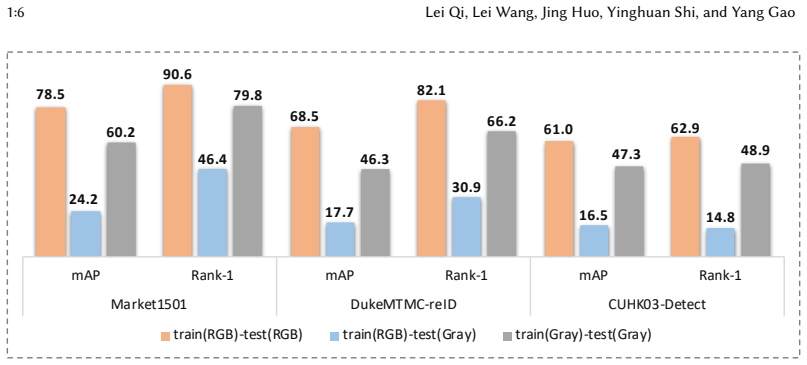
The central claim is that removing color information helps person re-identification when the grayscale view is combined with the RGB view through an explicitly fused architecture, rather than used as ordinary data augmentation. The paper supports this with three observations: RGB models lose over 44% mAP when tested on grayscale images, a grayscale-trained model recovers much of that gap, and the two models' feature response maps attend to different regions. Its network feeds RGB and grayscale versions of each image into two ResNet-50 streams, sums the last-convolution tensors into a joint branch, and concatenates the branch features; each branch is trained with its own cross-entropy plus triplet loss, and a global loss tunes the concatenation. The decisive comparison in Section 4.5 uses identical settings and reports that RGB-grey inputs outperform RGB-RGB inputs on all four benchmarks, by 0.5, 0.8, 0.3, and 1.4 mAP respectively. Greyscale images used as plain data augmentation, by contrast, degrade or fail to improve performance, which the paper takes as evidence that the fusion architecture is what extracts the value.
Load-bearing premise
The load-bearing premise is that the small, consistent improvements of the RGB-grey pair over the RGB-RGB pair are genuine training effects and not run-to-run noise, because each configuration is evaluated a single time without reported variance.
Editorial extensions
If this is right
- A cheap preprocessing step—converting RGB images to grayscale in each batch—adds a complementary stream that improves mAP and Rank-1 on all four benchmarks, with the largest gain on the largest dataset, MSMT17.
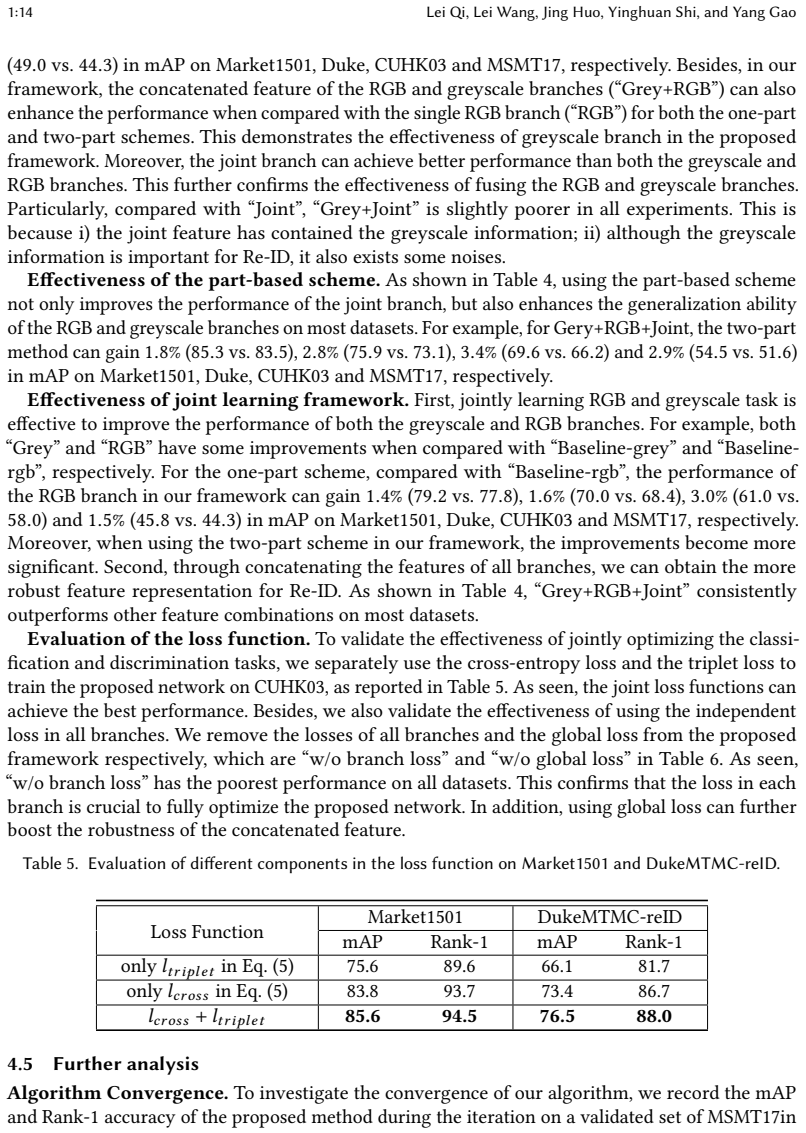
- The per-branch and global losses are necessary; removing branch losses drops mAP substantially (85.6 to 79.1 on Market1501), showing the architecture benefits from independent supervision of each modality.
- Simply mixing grayscale images into the training set as augmentation does not help (Table 13) and often hurts; the fusion into a joint branch is what captures the complementarity.
- The framework generalizes across backbones: switching ResNet-50 to ResNet-101 raises mAP on all four datasets, for example from 55.0 to 59.1 on MSMT17.
- Because the grayscale conversion is a fixed pixel operation that requires no extra training data or generative models, the approach can be attached to existing part-based or attention-based Re-ID backbones.
Reading between the lines
- Our inference: the consistent RGB-grey advantage over RGB-RGB suggests the grayscale stream acts as a regularizer against color over-fitting, and the same idea could be tested in other retrieval tasks where color is dominant but noisy, such as vehicle re-identification.
- Our inference: since the paper runs each configuration once, practitioners should rerun the RGB-grey versus RGB-RGB comparison with multiple seeds before treating the 0.3–1.4 mAP gaps as deployment guarantees; the reported pattern is directionally consistent but variance is unreported.
- A testable extension the paper does not explore is replacing the grayscale stream with other color-invariant views, such as Lab lightness or an adversarially color-perturbed stream, to see whether the benefit comes specifically from grayscale or from any view that suppresses color.
- The two-stream idea could be adapted to RGB-infrared cross-modality Re-ID by using the grayscale branch as a shared intermediate representation, although the paper explicitly distinguishes its same-modality task from cross-modality matching.
Signed reviews
Editorial analysis
A structured set of objections, weighed in public.
Referee Report
Summary. The paper proposes GreyReID, a two-stream deep framework for person re-identification that jointly exploits RGB and grayscale images. RGB images are converted to grayscale using a standard luminance formula; the two modalities are processed by separate ResNet-50 branches, fused into a joint branch with part-based pooling, and the features of all three branches are concatenated for retrieval. Training uses per-branch and global losses combining cross-entropy and hard-mining triplet loss. Experiments on Market1501, DukeMTMC-reID, CUHK03-NP, and MSMT17 report gains over a single-stream baseline, comparisons with state-of-the-art methods, and an ablation showing that the RGB-grey input pair outperforms an RGB-RGB pair in the same architecture. The central claim is that RGB and grayscale information are complementary for person Re-ID.
Significance. If the empirical claim holds, the paper makes a simple and practical contribution: it identifies color over-fitting as a failure mode in Re-ID and shows that a conversion-based grayscale stream, requiring no extra annotations or learned generation, can improve accuracy when fused with the RGB stream. The experimental design is commendable: the RGB-RGB pair condition isolates the effect of the grayscale input by keeping the architecture and training pipeline fixed, and the results are directionally consistent across four benchmarks. The paper is also transparent in reporting ablations over loss components, fusion schemes, feature dimensions, backbones, and conversion methods, and it does not rely on fitted constants or circular derivations. However, the magnitude of the central effect (0.3–1.4 mAP) is small relative to typical training noise, and the paper provides no error bars, seeds, or significance tests, which currently limits the strength of the conclusion.
major comments (2)
- [Section 4.5, Table 8] The central claim that RGB-grey input is complementary to RGB input rests entirely on the comparison between the 'RGB-RGB pair' and 'RGB-grey pair' rows in Table 8, where the gains are 0.5/0.8/0.3/1.4 mAP and 0.5/0.5/0.9/1.3 Rank-1 on Market1501/Duke/CUHK03/MSMT17. The paper reports only single-run results with no standard deviations, no seeds, and no significance tests, and these margins are within the run-to-run variance commonly observed in deep Re-ID training. As written, the evidence does not rule out the possibility that the apparent improvement from grayscale is noise; the authors should report mean and standard deviation over at least five independent runs with fixed seeds and apply a paired significance test to the RGB-grey versus RGB-RGB comparison.
- [Section 4.4, Table 4; Section 4.5, Table 8] The manuscript contains an internal inconsistency that bears directly on the central claim. The 'Two-part Grey+RGB+Joint' row in Table 4 should describe the same configuration as the 'RGB-grey pair' row in Table 8 (two-part architecture with all three branch features concatenated), yet the reported numbers differ on every dataset: Market1501 85.3 versus 85.6 mAP, Duke 75.9 versus 76.5, CUHK03 69.6 versus 69.9, MSMT17 54.5 versus 55.0. In addition, Table 12 lists '256+512+512=1280' with 86.0 mAP on Market1501, while the main results report 85.6 for the same nominal feature configuration. The authors need to state explicitly whether these are different runs, different hyperparameters (e.g., λ or feature dimensions), or different data splits, and to make the configuration used for each reported number unambiguous; the observed gaps are of the same order as the claimed RGB-grey advantage and currently undermine the reliability of the comparison.
minor comments (7)
- [Section 4.3, Table 1] The table header contains the typo 'Mehods'; please change to 'Methods'. Also, 'CHUK03' in the captions of Tables 4, 6, and 8 should be 'CUHK03'.
- [Section 4.2] The phrase 'This can be excerpted because' should read 'This can be expected because'.
- [Section 4.5] In the discussion of Table 9, 'smilar' and 'RBG' should be 'similar' and 'RGB'; additionally, the sentence 'as a RBG image does' is grammatically unclear.
- [Section 3.3] The heading 'The different between the proposed method and the cross-modal method' should be 'The difference between the proposed method and cross-modal methods'.
- [Section 4.1] It would help reproducibility to state whether random erasing is applied before or after the RGB-to-grayscale conversion, and whether the grayscale branch receives three replicated channels (as mentioned in Section 3.1) with the same normalization statistics as the RGB branch.
- [Section 4.5, Fig. 3] The caption of Fig. 3 is confusing: the parenthetical color descriptions for the bars (orange, grey, blue) do not match the visible bar labels in the figure, and the sentence 'Blue bars represent using RGB and greyscale images to train and test the ResNet-50 model, respectively' should be reworded to identify which model is evaluated on which modality.
- [Section 4.3] The state-of-the-art comparison tables list mostly methods from 2018 and earlier; to support the 'state-of-the-art' claim, the authors should add contemporary baselines or soften the wording in Section 4.3.
Circularity Check
No circularity: GreyReID's claims rest on held-out benchmark experiments, not on self-citation or fitted inputs.
full rationale
The paper's central claim is empirical: that RGB and greyscale inputs are complementary for person Re-ID, demonstrated by comparing the same two-stream architecture with RGB-grey versus RGB-RGB inputs (Section 4.5, Table 8) and by ablation studies (Table 4). The greyscale conversion in Eq. (1) is a standard luminance transform with fixed coefficients, and no parameter is fit to the test-set metrics. Hyperparameters such as lambda, margin, and feature dimensions are tuned or ablated on validation experiments (Tables 7 and 12), which is ordinary model selection, not circular reasoning. Self-citations appear only in the related-work discussion (references [20,21,22]) and are not load-bearing for the proposed method or its evaluation. The claimed improvement of RGB-grey over RGB-RGB is a direct experimental comparison on held-out benchmark splits, not an identity by construction. The noted inconsistency between Table 4's 'Grey+RGB+Joint' row and Table 8's 'RGB-grey pair' row is a reproducibility or statistical-power concern about single unseeded runs, but inconsistency is not circularity. No derivation step in this paper reduces, by the paper's own equations or by self-citation, to its own inputs.
Assumptions & free parameters
free parameters (5)
- lambda (loss trade-off weight) =
1.0
- Triplet margin m =
0.3
- Batch sampling P and K =
P=32, K=4
- Branch feature dimensions =
256 (grey), 512 (RGB), 512 (joint)
- Number of joint parts =
2
assumptions (4)
- domain assumption ImageNet-pretrained ResNet-50 provides a transferable feature backbone for person images.
- domain assumption Combining cross-entropy classification with hard-mining triplet loss is an effective training objective for Re-ID.
- domain assumption Luma grayscale conversion preserves the structure and texture information needed to complement color cues.
- domain assumption The four benchmark datasets and CMC/mAP metrics are representative of real person Re-ID performance.
Cite this review
Pith. "Pith review of GreyReID: A Two-stream Deep Framework with RGB-grey Information for Person Re-identification." pith.science (2026). https://pith.science/paper/YICUNLQJ
@misc{pith2026190805142,
  author       = {Pith},
  title        = {Pith review of: GreyReID: A Two-stream Deep Framework with RGB-grey Information for Person Re-identification},
  year         = {2026},
  howpublished = {\url{https://pith.science/paper/YICUNLQJ}},
  note         = {Machine review of arXiv:1908.05142}
}
read the original abstract
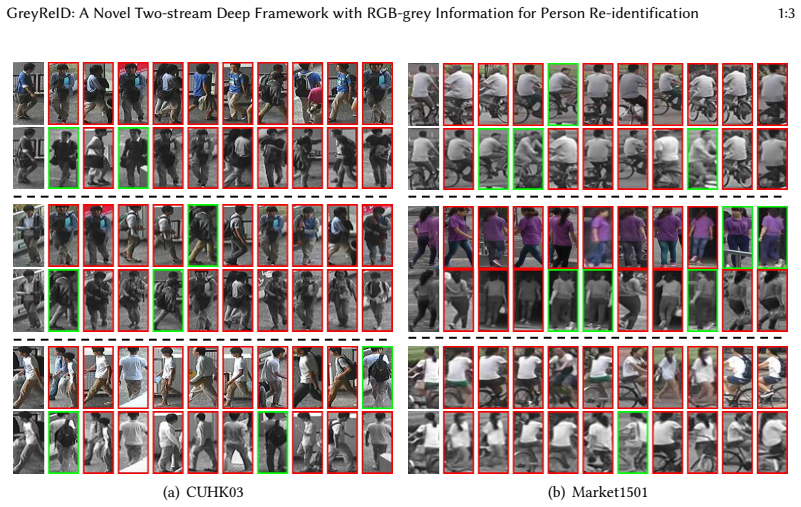
In this paper, we observe that most false positive images (i.e., different identities with query images) in the top ranking list usually have the similar color information with the query image in person re-identification (Re-ID). Meanwhile, when we use the greyscale images generated from RGB images to conduct the person Re-ID task, some hard query images can obtain better performance compared with using RGB images. Therefore, RGB and greyscale images seem to be complementary to each other for person Re-ID. In this paper, we aim to utilize both RGB and greyscale images to improve the person Re-ID performance. To this end, we propose a novel two-stream deep neural network with RGB-grey information, which can effectively fuse RGB and greyscale feature representations to enhance the generalization ability of Re-ID. Firstly, we convert RGB images to greyscale images in each training batch. Based on these RGB and greyscale images, we train the RGB and greyscale branches, respectively. Secondly, to build up connections between RGB and greyscale branches, we merge the RGB and greyscale branches into a new joint branch. Finally, we concatenate the features of all three branches as the final feature representation for Re-ID. Moreover, in the training process, we adopt the joint learning scheme to simultaneously train each branch by the independent loss function, which can enhance the generalization ability of each branch. Besides, a global loss function is utilized to further fine-tune the final concatenated feature. The extensive experiments on multiple benchmark datasets fully show that the proposed method can outperform the state-of-the-art person Re-ID methods. Furthermore, using greyscale images can indeed improve the person Re-ID performance.
Figures

Figures from the paper (8 more)




Reference graph
Works this paper leans on
-
[1]
Mixed high-order attention network for person re-identification
Chen, B., Deng, W., and Hu, J. Mixed high-order attention network for person re-identification. In IEEE International Conference on Computer Vision (ICCV) (2019)
work page 2019
-
[2]
Beyond triplet loss: a deep quadruplet network for person re- identification
Chen, W., Chen, X., Zhang, J., and Huang, K. Beyond triplet loss: a deep quadruplet network for person re- identification. In IEEE Conference on Computer Vision and Pattern Recognition (CVPR) (2017)
work page 2017
-
[3]
Person re-identification by multi-channel parts-based cnn with improved triplet loss function
Cheng, D., Gong, Y., Zhou, S., W ang, J., and Zheng, N. Person re-identification by multi-channel parts-based cnn with improved triplet loss function. In IEEE conference on computer vision and pattern recognition (CVPR) (2016)
work page 2016
-
[4]
Batch feature erasing for person re-identification and beyond
Dai, Z., Chen, M., Zhu, S., and Tan, P. Batch feature erasing for person re-identification and beyond. arXiv (2018)
work page 2018
-
[5]
Imagenet: A large-scale hierarchical image database
Deng, J., Dong, W., Socher, R., Li, L., Li, K., and Li, F. Imagenet: A large-scale hierarchical image database. In IEEE Computer Society Conference on Computer Vision and Pattern Recognition (CVPR) (2009)
work page 2009
-
[6]
ACM Transactions on Multimedia Computing, Communications, and Applications (TOMM) (2018)
Fan, H., Zheng, L., Y an, C., and Y ang, Y.Unsupervised person re-identification: clustering and fine-tuning. ACM Transactions on Multimedia Computing, Communications, and Applications (TOMM) (2018)
work page 2018
-
[7]
In IEEE International Conference on Computer Vision (ICCV) (2019)
Guo, J., Yuan, Y., Huang, L., Zhang, C., Y ao, J.-G., and Han, K.Beyond human parts: Dual part-aligned representations for person re-identification. In IEEE International Conference on Computer Vision (ICCV) (2019)
work page 2019
-
[8]
Dimensionality reduction by learning an invariant mapping
Hadsell, R., Chopra, S., and LeCun, Y. Dimensionality reduction by learning an invariant mapping. InIEEE Conference on Computer Vision and Pattern Recognition (CVPR) (2006)
work page 2006
Show all 54 references
-
[9]
Attribute-aware attention model for fine-grained representation learning
Han, K., Guo, J., Zhang, C., and Zhu, M. Attribute-aware attention model for fine-grained representation learning. In ACM Multimedia Conference on Multimedia Conference (ACM MM) (2018)
2018
-
[10]
Deep residual learning for image recognition
He, K., Zhang, X., Ren, S., and Sun, J. Deep residual learning for image recognition. In IEEE Conference on Computer Vision and Pattern Recognition (CVPR) (2016)
2016
-
[11]
In defense of the triplet loss for person re-identification
Hermans, A., Beyer, L., and Leibe, B. In defense of the triplet loss for person re-identification. arXiv (2017)
2017
-
[12]
Interaction-and-aggregation network for person re- identification
Hou, R., Ma, B., Chang, H., Gu, X., Shan, S., and Chen, X. Interaction-and-aggregation network for person re- identification. In IEEE Conference on Computer Vision and Pattern Recognition (CVPR) (2019)
2019
-
[13]
Squeeze-and-excitation networks
Hu, J., Shen, L., and Sun, G. Squeeze-and-excitation networks. In IEEE Conference on Computer Vision and Pattern Recognition (CVPR) (2018)
2018
-
[14]
M., Basaran, E., Gökmen, M., Kamasak, M
Kalayeh, M. M., Basaran, E., Gökmen, M., Kamasak, M. E., and Shah, M. Human semantic parsing for person re-identification. In IEEE Conference on Computer Vision and Pattern Recognition (CVPR) (2018)
2018
-
[15]
Deepreid: Deep filter pairing neural network for person re-identification
Li, W., Zhao, R., Xiao, T., and W ang, X. Deepreid: Deep filter pairing neural network for person re-identification. In IEEE Conference on Computer Vision and Pattern Recognition (CVPR) (2014)
2014
-
[16]
Person re-identification by deep joint learning of multi-loss classification
Li, W., Zhu, X., and Gong, S. Person re-identification by deep joint learning of multi-loss classification. arXiv (2017)
2017
-
[17]
End-to-end comparative attention networks for person re-identification
Liu, H., Feng, J., Qi, M., Jiang, J., and Y an, S. End-to-end comparative attention networks for person re-identification. IEEE Transactions on Image Processing (TIP) (2017)
2017
-
[18]
Pose transferrable person re-identification
Liu, J., Ni, B., Y an, Y., Zhou, P., Cheng, S., and Hu, J. Pose transferrable person re-identification. In IEEE Conference on Computer Vision and Pattern Recognition (CVPR) (2018)
2018
-
[19]
Ca3net: Contextual-attentional attribute-appearance network for person re-identification
Liu, J., Zha, Z., Xie, H., Xiong, Z., and Zhang, Y. Ca3net: Contextual-attentional attribute-appearance network for person re-identification. In ACM Multimedia Conference on Multimedia Conference (ACM MM) (2018)
2018
-
[20]
Unsupervised joint subspace and dictionary learning for enhanced cross-domain person re-identification
Qi, L., Huo, J., Fan, X., Shi, Y., and Gao, Y. Unsupervised joint subspace and dictionary learning for enhanced cross-domain person re-identification. IEEE Journal of Selected Topics in Signal Processing (JSTSP) (2018)
2018
-
[21]
Maskreid: A mask based deep ranking neural network for person re-identification
Qi, L., Huo, J., W ang, L., Shi, Y., and Gao, Y. Maskreid: A mask based deep ranking neural network for person re-identification. arXiv (2018). ACM Trans. Multimedia Comput. Commun. Appl., Vol. 1, No. 1, Article 1. Publication date: January 2020. GreyReID: A Novel Two-stream D...
2018
-
[22]
A novel unsupervised camera-aware domain adaptation framework for person re-identification
Qi, L., W ang, L., Huo, J., Zhou, L., Shi, Y., and Gao, Y. A novel unsupervised camera-aware domain adaptation framework for person re-identification. arXiv (2019)
2019
-
[23]
Unsupervised representation learning with deep convolutional generative adversarial networks
Radford, A., Metz, L., and Chintala, S. Unsupervised representation learning with deep convolutional generative adversarial networks. In International Conference on Learning Representations (ICLR) (2016)
2016
-
[24]
Performance measures and a data set for multi-target, multi-camera tracking
Ristani, E., Solera, F., Zou, R., Cucchiara, R., and Tomasi, C. Performance measures and a data set for multi-target, multi-camera tracking. In The European Conference on Computer Vision (ECCV) (2016)
2016
-
[25]
C., and W ang, G
Si, J., Zhang, H., Li, C.-G., Kuen, J., Kong, X., Kot, A. C., and W ang, G. Dual attention matching network for context-aware feature sequence based person re-identification. In IEEE Conference on Computer Vision and Pattern Recognition (CVPR) (2018)
2018
-
[26]
Mask-guided contrastive attention model for person re-identification
Song, C., Huang, Y., Ouyang, W., and W ang, L. Mask-guided contrastive attention model for person re-identification. In IEEE Conference on Computer Vision and Pattern Recognition (CVPR) (2018)
2018
-
[27]
Unsupervised person image generation with semantic parsing transformation
Song, S., Zhang, W., Liu, J., and Mei, T. Unsupervised person image generation with semantic parsing transformation. In IEEE Conference on Computer Vision and Pattern Recognition (CVPR) (2019)
2019
-
[28]
Pose-driven deep convolutional model for person re- identification
Su, C., Li, J., Zhang, S., Xing, J., Gao, W., and Tian, Q. Pose-driven deep convolutional model for person re- identification. In IEEE International Conference on Computer Vision (CVPR) (2017)
2017
-
[29]
In The European Conference on Computer Vision (ECCV) (2018)
Sun, Y., Zheng, L., Y ang, Y., Tian, Q., and W ang, S.Beyond part models: Person retrieval with refined part pooling (and A strong convolutional baseline). In The European Conference on Computer Vision (ECCV) (2018)
2018
-
[30]
Aanet: Attribute attention network for person re-identifications
Tay, C.-P., Roy, S., and Y ap, K.-H. Aanet: Attribute attention network for person re-identifications. In IEEE Conference on Computer Vision and Pattern Recognition (CVPR) (2019)
2019
-
[31]
Eliminating background-bias for robust person re-identification
Tian, M., Yi, S., Li, H., Li, S., Zhang, X., Shi, J., Y an, J., and W ang, X. Eliminating background-bias for robust person re-identification. In IEEE Conference on Computer Vision and Pattern Recognition (CVPR) (2018)
2018
-
[32]
R., Shuai, B., Lu, J., Xu, D., and W ang, G
V arior, R. R., Shuai, B., Lu, J., Xu, D., and W ang, G. A siamese long short-term memory architecture for human re-identification. In European conference on computer vision (ECCV) (2016)
2016
-
[33]
In The European Conference on Computer Vision (ECCV) (2018)
W ang, C., Zhang, Q., Huang, C., Liu, W., and W ang, X.Mancs: A multi-task attentional network with curriculum sampling for person re-identification. In The European Conference on Computer Vision (ECCV) (2018)
2018
-
[34]
Person transfer GAN to bridge domain gap for person re-identification
Wei, L., Zhang, S., Gao, W., and Tian, Q. Person transfer GAN to bridge domain gap for person re-identification. In IEEE Conference on Computer Vision and Pattern Recognition (CVPR) (2018)
2018
-
[35]
Person transfer gan to bridge domain gap for person re-identification
Wei, L., Zhang, S., Gao, W., and Tian, Q. Person transfer gan to bridge domain gap for person re-identification. In IEEE Conference on Computer Vision and Pattern Recognition (CVPR) (2018)
2018
-
[36]
GLAD: global-local-alignment descriptor for pedestrian retrieval
Wei, L., Zhang, S., Y ao, H., Gao, W., and Tian, Q. GLAD: global-local-alignment descriptor for pedestrian retrieval. In ACM Multimedia Conference on Multimedia Conference (ACM MM) (2017)
2017
-
[37]
Rgb-ir person re-identification by cross-modality similarity preservation
Wu, A., Zheng, W.-S., Gong, S., and Lai, J. Rgb-ir person re-identification by cross-modality similarity preservation. International Journal of Computer Vision (IJCV) (2020)
2020
-
[38]
Rgb-infrared cross-modality person re-identification
Wu, A., Zheng, W.-S., Yu, H.-X., Gong, S., and Lai, J. Rgb-infrared cross-modality person re-identification. In IEEE International Conference on Computer Vision (ICCV) (2017)
2017
-
[39]
Learning deep feature representations with domain guided dropout for person re-identification
Xiao, T., Li, H., Ouyang, W., and W ang, X. Learning deep feature representations with domain guided dropout for person re-identification. In IEEE Conference on Computer Vision and Pattern Recognition (CVPR) (2016)
2016
-
[40]
Towards rich feature discovery with class activation maps augmentation for person re-identification
Y ang, W., Huang, H., Zhang, Z., Chen, X., Huang, K., and Zhang, S. Towards rich feature discovery with class activation maps augmentation for person re-identification. In IEEE Conference on Computer Vision and Pattern Recognition (CVPR) (2019)
2019
-
[41]
Yi, D., Lei, Z., Liao, S., and Li, S. Z. Deep metric learning for person re-identification. In International Conference on Pattern Recognition (ICPR) (2014)
2014
-
[42]
In Chinese Conference on Biometric Recognition (CCBR) (2019)
Zhang, Q., Cheng, H., Lai, J., and Xie, X.Dhml: Deep heterogeneous metric learning for vis-nir person re-identification. In Chinese Conference on Biometric Recognition (CCBR) (2019)
2019
-
[43]
Spindle net: Person re-identification with human body region guided feature decomposition and fusion
Zhao, H., Tian, M., Sun, S., Shao, J., Y an, J., Yi, S., W ang, X., and Tang, X. Spindle net: Person re-identification with human body region guided feature decomposition and fusion. In IEEE Conference on Computer Vision and Pattern Recognition (CVPR) (2017)
2017
-
[44]
Attribute-driven feature disentangling and temporal aggregation for video person re-identification
Zhao, Y., Shen, X., Jin, Z., Lu, H., and Hua, X.-s. Attribute-driven feature disentangling and temporal aggregation for video person re-identification. In IEEE Conference on Computer Vision and Pattern Recognition (CVPR) (2019)
2019
-
[45]
Scalable person re-identification: A benchmark
Zheng, L., Shen, L., Tian, L., W ang, S., W ang, J., and Tian, Q. Scalable person re-identification: A benchmark. In IEEE International Conference on Computer Vision (CVPR) (2015)
2015
-
[46]
Zheng, M., Karanam, S., Wu, Z., and Radke, R. J. Re-identification with consistent attentive siamese networks. In IEEE Conference on Computer Vision and Pattern Recognition (CVPR) (2019)
2019
-
[47]
Joint discriminative and generative learning for person re-identification
Zheng, Z., Y ang, X., Yu, Z., Zheng, L., Y ang, Y., and Kautz, J. Joint discriminative and generative learning for person re-identification. In IEEE Conference on Computer Vision and Pattern Recognition (CVPR) (2019)
2019
-
[48]
In IEEE International Conference on Computer Vision (ICCV) (2017)
Zheng, Z., Zheng, L., and Y ang, Y.Unlabeled samples generated by GAN improve the person re-identification baseline in vitro. In IEEE International Conference on Computer Vision (ICCV) (2017). ACM Trans. Multimedia Comput. Commun. Appl., Vol. 1, No. 1, Article 1. Publication d...
2017
-
[49]
Unlabeled samples generated by gan improve the person re-identification baseline in vitro
Zheng, Z., Zheng, L., and Y ang, Y. Unlabeled samples generated by gan improve the person re-identification baseline in vitro. In IEEE International Conference on Computer Vision (ICCV) (2017)
2017
-
[50]
A discriminatively learned cnn embedding for person reidentification
Zheng, Z., Zheng, L., and Y ang, Y. A discriminatively learned cnn embedding for person reidentification. ACM Transactions on Multimedia Computing, Communications, and Applications (TOMM) (2018)
2018
-
[51]
Re-ranking person re-identification with k-reciprocal encoding
Zhong, Z., Zheng, L., Cao, D., and Li, S. Re-ranking person re-identification with k-reciprocal encoding. In IEEE Conference on Computer Vision and Pattern Recognition (CVPR) (2017)
2017
-
[52]
Random erasing data augmentation
Zhong, Z., Zheng, L., Kang, G., Li, S., and Y ang, Y. Random erasing data augmentation. arXiv (2017)
2017
-
[53]
Generalizing a person retrieval model hetero-and homogeneously
Zhong, Z., Zheng, L., Li, S., and Y ang, Y. Generalizing a person retrieval model hetero-and homogeneously. In The European Conference on Computer Vision (ECCV) (2018)
2018
-
[54]
Camera style adaptation for person re-identification
Zhong, Z., Zheng, L., Zheng, Z., Li, S., and Y ang, Y. Camera style adaptation for person re-identification. In IEEE Conference on Computer Vision and Pattern Recognition (CVPR) (2018). ACM Trans. Multimedia Comput. Commun. Appl., Vol. 1, No. 1, Article 1. Publication date: Ja...
2018
Reviewed August 14, 2026 · model on record in the stance chip above.
Discussion (0). Continue with ORCID to comment.