SAOImageDS9: An Essential Tool for Astronomical Exploration
Pith reviewed 2026-07-01 01:17 UTC · model grok-4.3
The pith
DS9 has stayed useful in astronomy by supporting many file formats, coordinate systems, event data, image cubes, region analysis, and external tool communication.
A machine-rendered reading of the paper's core claim, the machinery that carries it, and where it could break.
Core claim
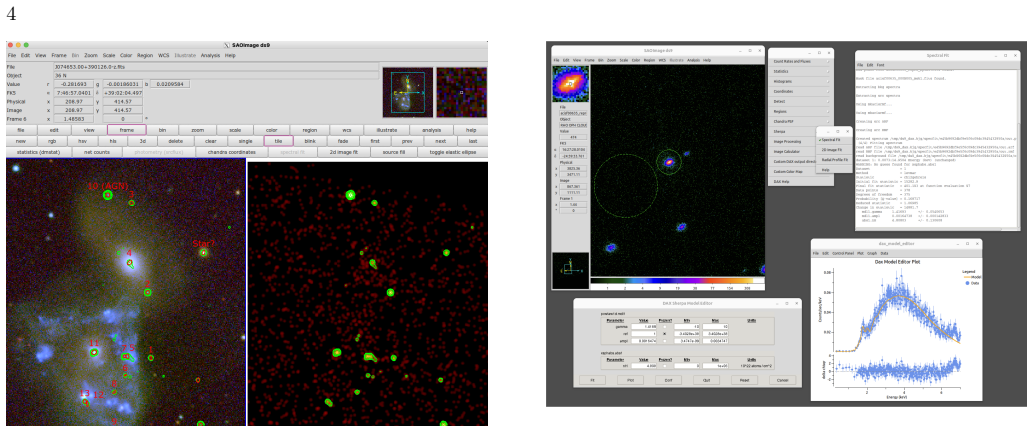
SAOImageDS9 is an open-source, cross-platform application for the visualization and analysis of astronomical data that supports many astronomical file formats and coordinate systems, can work directly with event data and image cubes, provides interactive region-based analysis, and can communicate with external tools through command-line and messaging interfaces, and is used in research, mission operations, and education across a range of wavelengths and at both ground- and space-based observatories.
What carries the argument
DS9's collection of capabilities for handling multiple file formats and coordinate systems, direct access to event data and image cubes, region-based interactive analysis, and command-line plus messaging interfaces with external tools.
If this is right
- Astronomers can analyze event lists and multi-dimensional image data directly without format conversion steps.
- Mission teams can use the same display environment for both planning and real-time data review.
- Educators can demonstrate data handling from ground-based and space-based sources in one interface.
- The architecture described in the appendix has enabled continued updates without breaking core functionality.
Where Pith is reading between the lines
- The same interfaces that link DS9 to external tools could allow tighter coupling with automated pipelines that process large survey datasets.
- Its support for many coordinate systems suggests it could serve as a reference implementation when new reference frames are adopted by the community.
Load-bearing premise
The paper assumes its summary of capabilities and community impact accurately reflects real usage patterns and that the listed technical features are the main drivers of adoption, without supplying independent usage statistics or comparative benchmarks.
What would settle it
Independent download statistics or a user survey showing that most astronomers primarily rely on other visualization programs instead of DS9 would challenge the description of its essential status.
Figures

read the original abstract
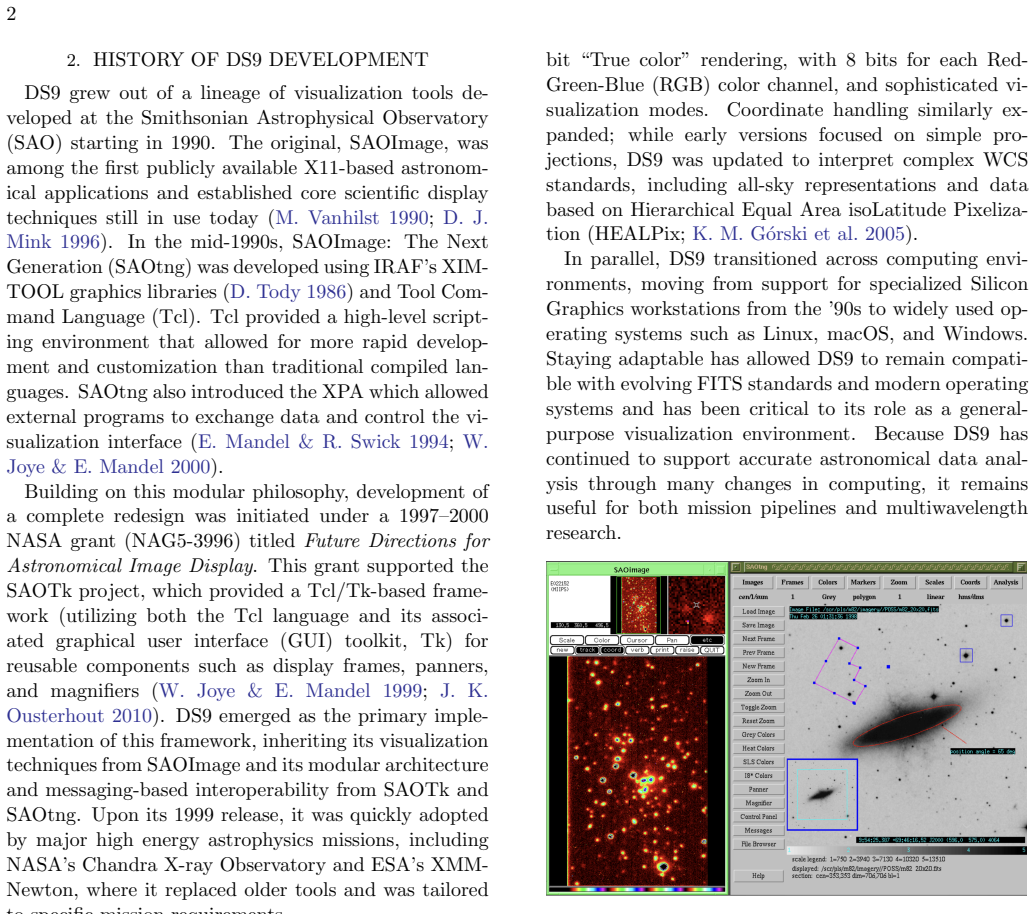
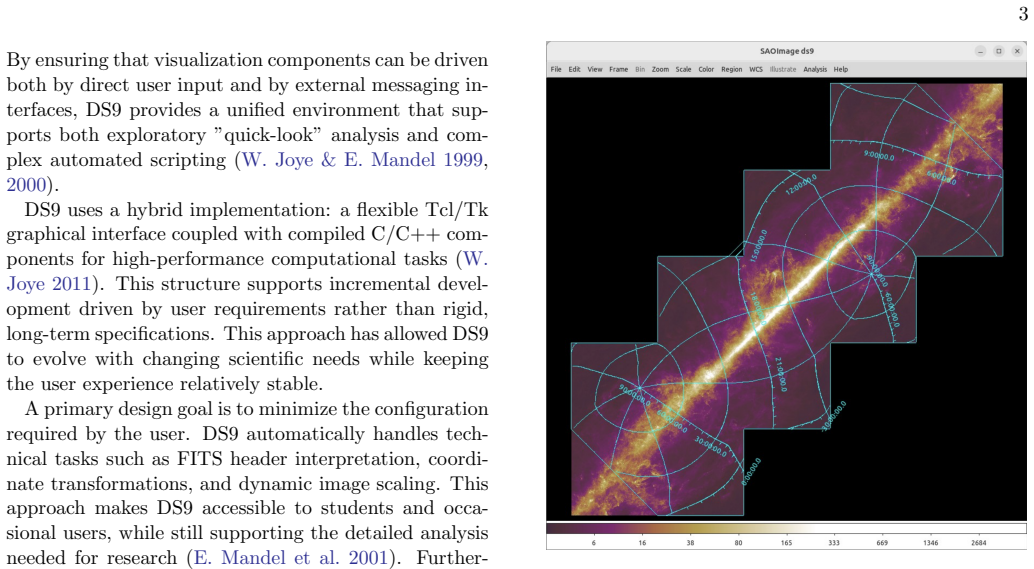
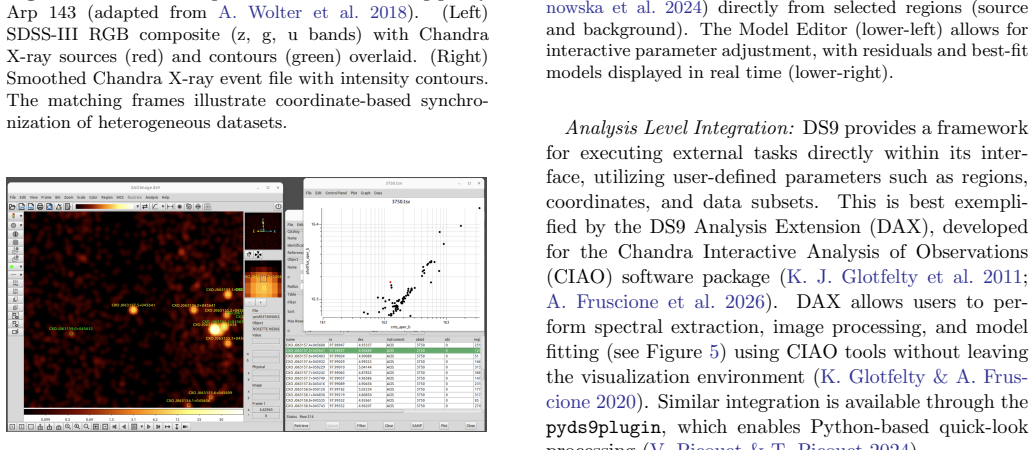
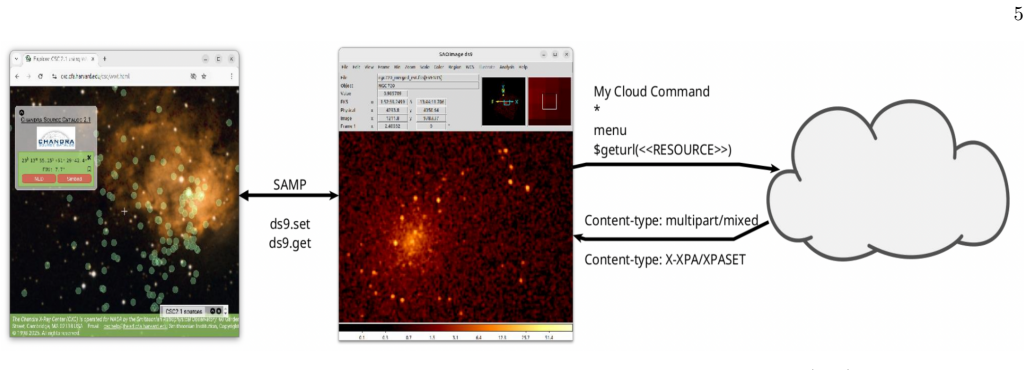
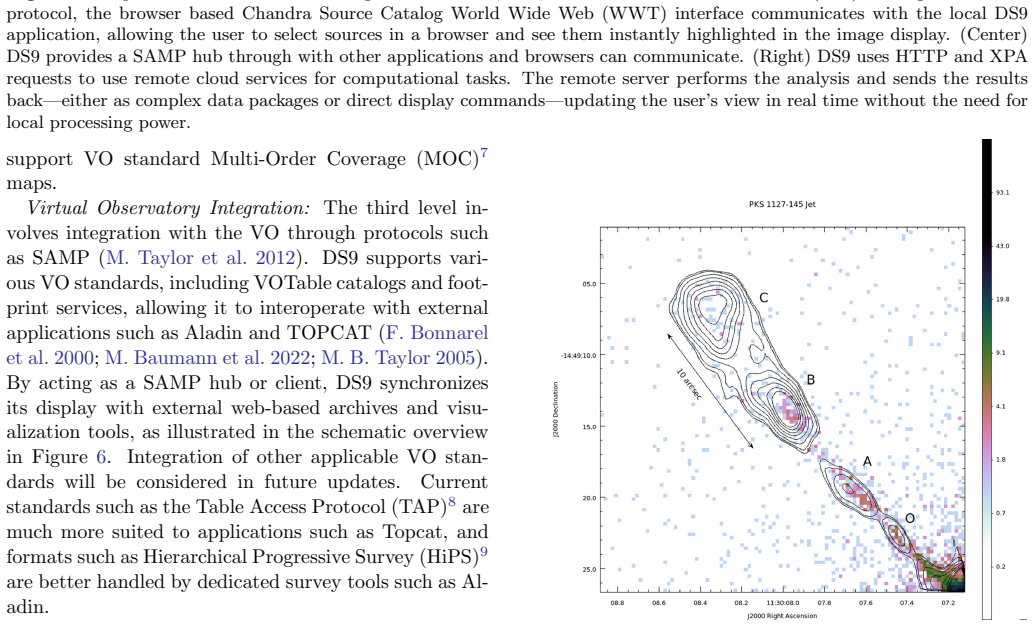
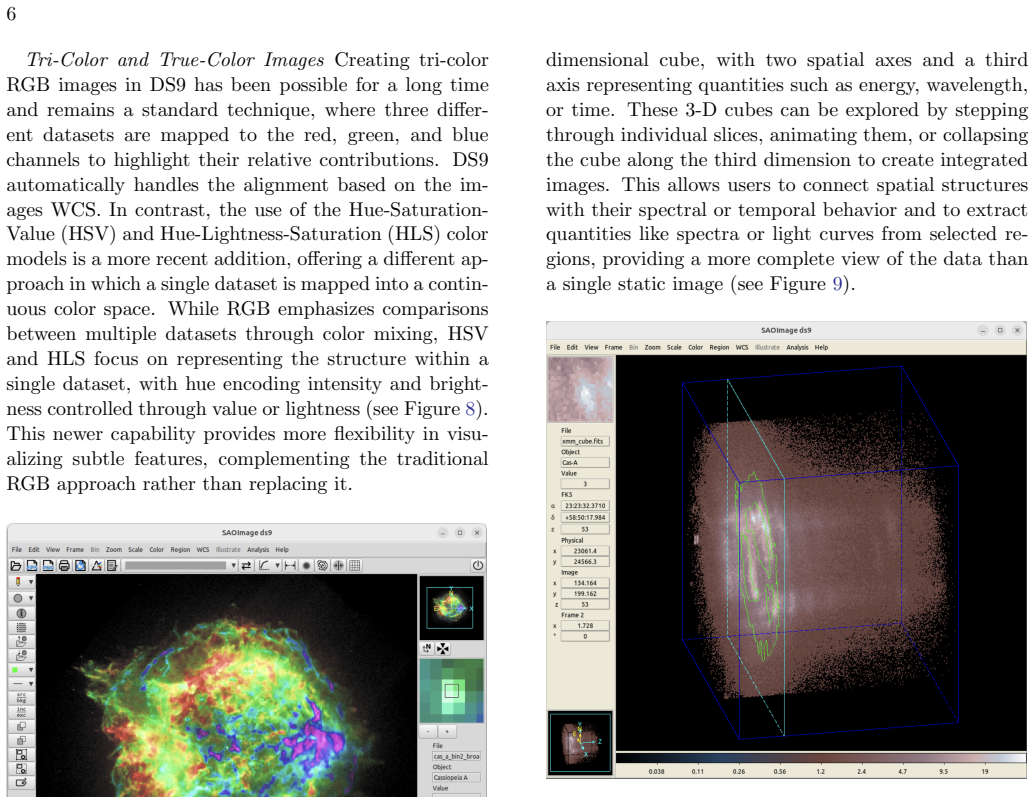
SAOImageDS9 (DS9) is an open-source, cross-platform application for the visualization and analysis of astronomical data. Developed at the Smithsonian Astrophysical Observatory, DS9 evolved from an example implementation of reusable imaging components into one of the most widely used astronomical display environments. It has remained useful because it supports many astronomical file formats and coordinate systems, can work directly with event data and image cubes, provides interactive region-based analysis, and can communicate with external tools through command-line and messaging interfaces. DS9 is used in research, mission operations, and education across a range of wavelengths and at both ground- and space-based observatories. This paper summarizes the historical development of DS9, its principal capabilities, and its impact on the astronomical community, and concludes with an appendix describing the internal architecture that has supported its long-term sustainability.
Editorial analysis
A structured set of objections, weighed in public.
Referee Report
Summary. The manuscript describes the historical development of SAOImageDS9 (DS9) from an example implementation into a widely used open-source astronomical visualization and analysis tool, details its core capabilities (support for many file formats and coordinate systems, direct handling of event data and image cubes, interactive region-based analysis, and command-line/messaging interfaces with external tools), notes its use across research, mission operations, and education at ground- and space-based observatories, and includes an appendix on the internal architecture supporting long-term sustainability.
Significance. If the factual account is accurate, the paper supplies a concise archival reference on a long-lived community tool whose design choices (format support, event-data handling, regions, and interoperability) have enabled sustained adoption; the architecture appendix provides concrete information on maintainability that is rarely documented for astronomical software.
minor comments (1)
- The abstract and introduction both state that DS9 'has remained useful because' of the listed features; a brief sentence clarifying that these reasons are drawn from developer experience rather than from new quantitative usage data would avoid any implication of causal proof.
Simulated Author's Rebuttal
We thank the referee for their positive review of the manuscript, their accurate summary of its content, and their recommendation to accept.
Circularity Check
No significant circularity
full rationale
The paper is a purely descriptive account of DS9 software history, file-format support, region analysis, and messaging interfaces. It contains no equations, no fitted parameters, no predictions, and no load-bearing derivations. All statements are presented as factual summaries of capabilities and development rather than causal claims that reduce to self-citation chains or definitional identities. The text is therefore self-contained within the standard genre of instrumentation papers and receives the default non-circularity finding.
Axiom & Free-Parameter Ledger
Reference graph
Works this paper leans on
-
[1]
2022, in Astronomical Society of the Pacific Conference Series, Vol
Baumann, M., Boch, T., Pineau, F.-X., et al. 2022, in Astronomical Society of the Pacific Conference Series, Vol. 532, Astronomical Data Analysis Software and Systems XXX, ed. J. E. Ruiz, F. Pierfedereci, & P. Teuben, 7
2022
-
[2]
2000, A&AS, 143, 33, doi: 10.1051/aas:2000331
Bonnarel, F., Fernique, P., Bienaym´ e, O., et al. 2000, A&AS, 143, 33, doi: 10.1051/aas:2000331
-
[3]
Bouquin, D. R., Chivvis, D. A., Henneken, E., et al. 2020, ApJS, 249, 8, doi: 10.3847/1538-4365/ab7be6
-
[4]
2019, in Society of Photo-Optical Instrumentation Engineers (SPIE) Conference Series, Vol
Burwitz, V., Bavdaz, M., Wille, E., et al. 2019, in Society of Photo-Optical Instrumentation Engineers (SPIE) Conference Series, Vol. 11180, International Conference on Space Optics — ICSO 2018, ed. Z. Sodnik, N. Karafolas, & B. Cugny, 1118024, doi: 10.1117/12.2535995
-
[5]
L., & Joye, W
Clarke, D., Allen, S. L., & Joye, W. A. 2005, in Astronomical Society of the Pacific Conference Series, Vol. 347, Astronomical Data Analysis Software and Systems XIV, ed. P. Shopbell, M. Britton, & R. Ebert, 114
2005
-
[6]
Diehl, H. T., Neilsen, E., Gruendl, R. A., et al. 2018, in Society of Photo-Optical Instrumentation Engineers (SPIE) Conference Series, Vol. 10704, Observatory Operations: Strategies, Processes, and Systems VII, 107040D, doi: 10.1117/12.2312113
-
[7]
Durda, D. D., Chapman, C. R., Merline, W. J., & Enke, B. L. 2012, M&PS, 47, 1087, doi: 10.1111/j.1945-5100.2012.01380.x
-
[8]
2026, ApJ, submitted
Fruscione, A., et al. 2026, ApJ, submitted
2026
-
[9]
O., Kruk, S., Cornen, C., et al
Garvin, E. O., Kruk, S., Cornen, C., et al. 2022, A&A, 667, A141, doi: 10.1051/0004-6361/202243745
-
[10]
2020, Chandra News, 28, 7
Glotfelty, K., & Fruscione, A. 2020, Chandra News, 28, 7
2020
-
[11]
2024, SAOImageDS9 and Chandra - 25 Years of Synergy,, Poster presented at the CXC Symposium 2024 https://cxc.cfa.harvard.edu/cdo/ symposium 2024/posters/CXC--SAOImageDS9--C25.pdf
Glotfelty, K., & Joye, W. 2024, SAOImageDS9 and Chandra - 25 Years of Synergy,, Poster presented at the CXC Symposium 2024 https://cxc.cfa.harvard.edu/cdo/ symposium 2024/posters/CXC--SAOImageDS9--C25.pdf
2024
-
[12]
Glotfelty, K. J., Miller, J., & Chen, J. 2011, in Astronomical Society of the Pacific Conference Series, Vol. 442, Astronomical Data Analysis Software and Systems XX, ed. I. N. Evans, A. Accomazzi, D. J. Mink, & A. H. Rots, 629 G´ orski, K. M., Hivon, E., Banday, A. J., et al. 2005, ApJ, 622, 759, doi: 10.1086/427976
work page internal anchor Pith review doi:10.1086/427976 2011
-
[13]
Greisen, E. W., & Calabretta, M. R. 2002, A&A, 395, 1061, doi: 10.1051/0004-6361:20021326
-
[14]
2024, in Society of Photo-Optical Instrumentation Engineers (SPIE) Conference Series, Vol
Heinis, D., Carballedo, A., Van Eeckhout, A., et al. 2024, in Society of Photo-Optical Instrumentation Engineers (SPIE) Conference Series, Vol. 13093, Space Telescopes and Instrumentation 2024: Ultraviolet to Gamma Ray, ed. J.-W. A. den Herder, S. Nikzad, & K. Nakazawa, 130934X, doi: 10.1117/12.3017800
-
[15]
2011, in Astronomical Society of the Pacific Conference Series, Vol
Joye, W. 2011, in Astronomical Society of the Pacific Conference Series, Vol. 442, Astronomical Data Analysis Software and Systems XX, ed. I. N. Evans, A. Accomazzi, D. J. Mink, & A. H. Rots, 633 16
2011
-
[16]
1999, in Astronomical Society of the Pacific Conference Series, Vol
Joye, W., & Mandel, E. 1999, in Astronomical Society of the Pacific Conference Series, Vol. 172, Astronomical Data Analysis Software and Systems VIII, ed. D. M
1999
-
[17]
2000, in Astronomical Society of the Pacific Conference Series, Vol
Joye, W., & Mandel, E. 2000, in Astronomical Society of the Pacific Conference Series, Vol. 216, Astronomical Data Analysis Software and Systems IX, ed. N. Manset, C. Veillet, & D. Crabtree, 91
2000
-
[18]
A., & Mandel, E
Joye, W. A., & Mandel, E. 2003, in Astronomical Society of the Pacific Conference Series, Vol. 295, Astronomical Data Analysis Software and Systems XII, ed. H. E
2003
-
[19]
A., & Mandel, E
Joye, W. A., & Mandel, E. 2004, in Astronomical Society of the Pacific Conference Series, Vol. 314, Astronomical Data Analysis Software and Systems (ADASS) XIII, ed. F. Ochsenbein, M. G. Allen, & D. Egret, 505
2004
-
[20]
A., & Mandel, E
Joye, W. A., & Mandel, E. 2005, in Astronomical Society of the Pacific Conference Series, Vol. 347, Astronomical Data Analysis Software and Systems XIV, ed. P. Shopbell, M. Britton, & R. Ebert, 110
2005
-
[21]
S., Mozena, M., Kocevski, D., et al
Kartaltepe, J. S., Mozena, M., Kocevski, D., et al. 2015, ApJS, 221, 11, doi: 10.1088/0067-0049/221/1/11
-
[22]
S., Steidel, C
Kassis, M., McLean, I. S., Steidel, C. C., et al. 2016, in Society of Photo-Optical Instrumentation Engineers (SPIE) Conference Series, Vol. 9908, Ground-based and Airborne Instrumentation for Astronomy VI, ed. C. J
2016
-
[23]
Evans, L. Simard, & H. Takami, 99080E, doi: 10.1117/12.2233006
-
[24]
2024, Journal of Synchrotron Radiation, 31, 716, doi: 10.1107/S1600577524004090
Krumrey, M., Skroblin, D., Cibik, L., et al. 2024, Journal of Synchrotron Radiation, 31, 716, doi: 10.1107/S1600577524004090
-
[25]
S., & Roll, J
Mandel, E., Murray, S. S., & Roll, J. B. 2001, in Astronomical Society of the Pacific Conference Series, Vol. 238, Astronomical Data Analysis Software and Systems X, ed. F. R. Harnden, Jr., F. A. Primini, & H. E. Payne, 225
2001
-
[26]
1994, in Astronomical Society of the Pacific Conference Series, Vol
Mandel, E., & Swick, R. 1994, in Astronomical Society of the Pacific Conference Series, Vol. 61, Astronomical Data Analysis Software and Systems III, ed. D. R. Crabtree, R. J. Hanisch, & J. Barnes, 507
1994
-
[27]
Marmo, C., Hare, T. M., Erard, S., et al. 2018, Earth and Space Science, 5, 640, doi: 10.1029/2018EA000388
-
[28]
2004, in American Astronomical Society Meeting
Matilsky, T., Etkina, E., Lestition, K., Mandel, E., & Joye, W. 2004, in American Astronomical Society Meeting
2004
-
[29]
Mink, D. J. 1996, in Astronomical Society of the Pacific Conference Series, Vol. 101, Astronomical Data Analysis Software and Systems V, ed. G. H. Jacoby & J. Barnes, 96
1996
-
[30]
2025, VOTable Format Definition Version 1.5,, IVOA Recommendation 16 January 2025
Ochsenbein, F., Taylor, M., Donaldson, T., et al. 2025, VOTable Format Definition Version 1.5,, IVOA Recommendation 16 January 2025
2025
-
[31]
2024, A&A, 687, A287, doi: 10.1051/0004-6361/202449286
Migliori, G. 2024, A&A, 687, A287, doi: 10.1051/0004-6361/202449286
-
[32]
Ousterhout, J. K. 2010, Tcl and the Tk Toolkit (2nd Edition) (Addison-Wesley)
2010
-
[33]
2024, in Astronomical Society of the Pacific Conference Series, Vol
Picouet, V., & Picouet, T. 2024, in Astronomical Society of the Pacific Conference Series, Vol. 535, Astronomical Data Analysis Software and Systems XXXI, ed. B. V
2024
-
[34]
2023, Publications of the Astronomical Society of the Pacific, 135, 048001, 10.1088/1538-3873/acb293
Rigby, J., Perrin, M., McElwain, M., et al. 2023, PASP, 135, 048001, doi: 10.1088/1538-3873/acb293
-
[35]
Rigby, J. R., Vieira, J. D., Phadke, K. A., et al. 2025, ApJ, 978, 108, doi: 10.3847/1538-4357/ad7501
-
[36]
2006, in Society of Photo-Optical Instrumentation Engineers (SPIE) Conference Series, Vol
Rossetti, E., Montegriffo, P., Baffa, C., et al. 2006, in Society of Photo-Optical Instrumentation Engineers (SPIE) Conference Series, Vol. 6274, Advanced Software and Control for Astronomy, ed. H. Lewis & A. Bridger, 627425, doi: 10.1117/12.668892
-
[37]
Siemiginowska, A., Burke, D., G¨ unther, H. M., et al. 2024, ApJS, 274, 43, doi: 10.3847/1538-4365/ad7bab
-
[38]
M., G¨ ossl, C., Kodric, M., et al
Snigula, J. M., G¨ ossl, C., Kodric, M., et al. 2016, in Society of Photo-Optical Instrumentation Engineers (SPIE) Conference Series, Vol. 9913, Software and Cyberinfrastructure for Astronomy IV, ed. G. Chiozzi & J. C. Guzman, 99132G, doi: 10.1117/12.2231399
-
[39]
Taylor, M., Boch, T., Fitzpatrick, M., et al. 2012, Simple Application Messaging Protocol Version 1.3,, IVOA Recommendation 11 April 2012 doi: 10.5479/ADS/bib/2012ivoa.spec.1104T
-
[40]
Taylor, M. B. 2005, in Astronomical Society of the Pacific Conference Series, Vol. 347, Astronomical Data Analysis Software and Systems XIV, ed. P. Shopbell, M. Britton, & R. Ebert, 29
2005
-
[41]
doi:10.1117/12.968154 , editor =
Tody, D. 1986, 627, 733, doi: 10.1117/12.968154
-
[42]
1990, in Bulletin of the American Astronomical Society, Vol
Vanhilst, M. 1990, in Bulletin of the American Astronomical Society, Vol. 22, 935
1990
-
[43]
C., Greisen, E
Wells, D. C., Greisen, E. W., & Harten, R. H. 1981, A&AS, 44, 363
1981
-
[44]
2018, ApJ, 863, 43, doi: 10.3847/1538-4357/aacb34
Wolter, A., Fruscione, A., & Mapelli, M. 2018, ApJ, 863, 43, doi: 10.3847/1538-4357/aacb34
discussion (0)
Sign in with ORCID, Apple, or X to comment. Anyone can read and Pith papers without signing in.