REVIEW 3 major objections 5 minor 129 references
Diagnosing Systematic Effects Using the Inferred Initial Power Spectrum
T0 review · 3 major / 5 minor · reviewed 2026-08-11 · deepseek-v4-flash
Pith's one-line read The inferred initial power spectrum can expose hidden survey biases before cosmological parameters are fitted.
desk verdict A genuinely useful SELFI-based misspecification diagnostic with an uncalibrated detection rule; deserves peer review, but the 'unambiguous' claim needs a null distribution. read the letter →
The pith
A machine-rendered reading of the paper's core claim, the machinery that carries it, and where it could break.
The reading
What carries the argument
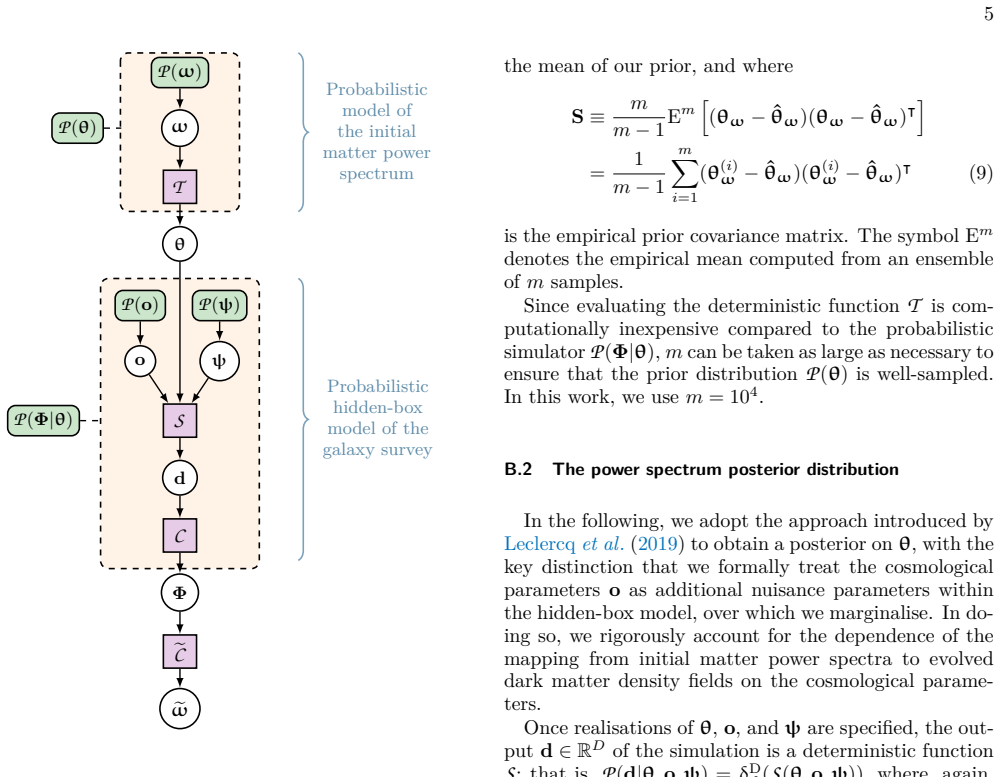
The carrying object is the SELFI effective posterior for the initial matter power spectrum, a Gaussian with mean $\gamma = \theta_0 + \Gamma (\nabla_\theta f_0)^\top C_0^{-1} (\Phi_O - f_0) + \Gamma S^{-1}\Delta$ and covariance $\Gamma = [(\nabla_\theta f_0)^\top C_0^{-1} \nabla_\theta f_0 + S^{-1}]^{-1}$, where $f_0$ and $C_0$ are the empirical mean and covariance of the hidden-box model at the expansion point, $\nabla_\theta f_0$ is the finite-difference gradient, and $S$ is the prior covariance on the spectrum obtained by sampling cosmological parameters through a Boltzmann solver. A Mahalanobis distance between the posterior mean and the prior, $d_M(\gamma,\theta_0|S)$, is the quantitative misspecification check. The same linearisation also defines the score compressor $\tilde{\omega} = \omega_0 + F_0^{-1}(\nabla_\omega f_0)^\top C_0^{-1}(\Phi - f_0)$ for the second inference step. This machinery turns one set of $N$-body simulations into both a systematic-effect scan and a data compressor, which is what makes the diagnostic affordable.
What would settle it
Build a forward model whose only misspecification adds a component to the galaxy power spectra that lies in the null space of $(\nabla_\theta f_0)^\top C_0^{-1}$, so the inferred initial power spectrum posterior is unchanged, and show with the paper's ABC-PMC pipeline that $(\Omega_\mathrm{m}, \sigma_8)$ still shifts by more than $2\sigma$; that would refute the diagnostic premise.
Extended reading notes
Core claim
The central claim is that the SELFI posterior of the initial matter power spectrum can flag systematic effects that would otherwise bias a field-based implicit likelihood inference. In the two-step framework, the latent initial power spectrum $\theta$ is inferred first via a Gaussian effective likelihood built from a first-order Taylor expansion of the forward model around a fiducial spectrum; the simulations used for that step also yield a score compressor for the second step, in which ABC-PMC produces the cosmological parameter posterior. The well-specified model recovers an unbiased initial power spectrum, while the misspecified model produces an implausible posterior with roughly $2\sigma$ excess power at large scales and a matching deficit at small scales. The paper's headline demonstration is that the same misspecification induces a bias exceeding $2\sigma$ in the $(\Omega_\mathrm{m}, \sigma_8)$ plane, so the latent-spectrum posterior catches the problem before cosmological parameter inference.
Load-bearing premise
The load-bearing premise is that any systematic effect strong enough to bias the cosmological parameter posterior will also leave a detectable imprint on the inferred initial matter power spectrum; the paper demonstrates this for the effects it studies and explicitly notes that systematics bypassing the initial power spectrum are outside its scope.
Editorial extensions
If this is right
- The same simulation set used for the diagnostic can be recycled for score compression, so the pre-inference check adds no separate simulation campaign.
- Individual systematic effects can be separated by their scale-dependent signatures in the inferred spectrum, even when the direct galaxy power spectra of the well- and misspecified models look nearly identical.
- Gravity-solver approximations that are invisible at the percent level in galaxy power spectra can produce percent-level errors in the inferred initial power spectrum, forcing a stricter accuracy target for forward models.
- Using 2LPT instead of full N-body evolution over the scales studied rejects the ground truth by almost $2\sigma$, so non-linear gravitational evolution is required for the inferred initial spectrum to be trusted.
Reading between the lines
- Because the diagnostic sees only misspecifications that move summary statistics along directions captured by $\nabla_\theta f_0$, a systematic effect whose main influence is orthogonal to that gradient would be invisible here even if it biased cosmological parameters.
- A direct test of how far the diagnostic reaches would be to inject a known systematic into real or realistic survey data and measure the smallest bias in $(\Omega_\mathrm{m}, \sigma_8)$ that still triggers a Mahalanobis-distance alarm calibrated on the prior.
- For surveys like DESI, Euclid, and LSST, the framework's practical bottleneck is the $O(10^5)$-simulation ABC step, so the largest gain comes from letting the $O(10^3)$-simulation diagnostic screen model choices before the expensive parameter step is launched.
- The same two-step latent-function logic could transfer to other theoretically predictable summaries, such as the bispectrum or wavelet coefficients, if one wants a diagnostic sensitive to systematics that miss the power spectrum.
Editorial analysis
A structured set of objections, weighed in public.
Referee Report
Summary. This paper proposes a two-step framework for diagnosing model misspecification in field-based implicit-likelihood cosmological inference. In the first step, the SELFI algorithm is used to infer the initial matter power spectrum from a hidden-box forward model of a spectroscopic galaxy survey, with cosmological parameters treated as nuisance parameters inside the simulator. The inferred latent spectrum is then proposed as a diagnostic: systematic effects that bias the cosmological parameter posterior are expected to leave an imprint on the inferred initial power spectrum. In the second step, the simulations used for SELFI are recycled to build a score compressor, and ABC-PMC is used to infer cosmological parameters from the compressed summaries. The method is demonstrated on a mock survey with a well-specified model (Model A) and a subtly misspecified model (Model B), differing at the percent level in galaxy bias, selection-function amplitudes, and extinction. The authors show that Model A yields an unbiased SELFI posterior and an unbiased cosmological posterior, while Model B yields a SELFI posterior that departs from the prior and a >2σ bias in the (Ωm, σ8) plane. They also provide a practical guide to diagnosing individual systematics: galaxy bias, extinction, selection functions, masks, redshift errors, and gravity-solver choices.
Significance. If the central claim is established, this would be a practically valuable tool for upcoming surveys such as DESI, Euclid, and LSST, because field-based implicit likelihood pipelines currently have little protection against model misspecification. The paper has clear strengths: the method is validated on mocks with a known ground truth, a wiggle-less prior test recovers BAOs, ten ground-truth draws are reported as consistency checks, and the code and data are publicly available. Reusing a single set of N-body simulations for both the SELFI step and the score compressor is an attractive feature. However, the headline claim that misspecification can be 'unambiguously detected and avoided' is not yet supported by a calibrated decision rule, and the quantitative evidence for the >2σ bias rests on a single synthetic realization. These issues are fixable and do not undermine the overall idea, but they are load-bearing for the strongest claim in the abstract.
major comments (3)
- [IVA1 (Eq. 24, Fig. 8)] The quantitative detection criterion is not calibrated. Equation (24) defines d_M(γ, θ0|S) for the posterior mean γ, but the reference distribution in Fig. 8 is the distribution of d_M(θ_n, θ0|S) for 5,000 draws θ_n = T(ω_n) from the prior. Under the well-specified model, γ is not a draw from P(θ); using the Gaussian effective likelihood, the posterior covariance is Γ = [(∇f0)^T C0^{-1} ∇f0 + S^{-1}]^{-1} (Eq. 21), which is generally tighter than S. The null distribution of d_M(γ_A, θ0|S) over noise and phase realizations is therefore narrower than the prior-draw histogram shown. The paper reports d_M(γ_A)=1.816 and d_M(γ_B)=2.827, but with no threshold and no false-positive rate derived from the distribution of γ under a well-specified model, one cannot determine whether 2.827 is an unambiguous misspecification signal or a tail fluctuation. The abstract's 'unambiguously detected' claim requires either a posterior predictive check or a decision rule calibrated on the null distribution of γ, not on prior draws.
- [IVB (Fig. 12)] The 'avoided before parameter inference' step is not demonstrated through a decision procedure. Section IVB shows that running ABC-PMC with the misspecified Model B produces a >2σ bias in the (Ωm, σ8) plane, but this posterior is only obtained by performing the very inference step that the framework is supposed to avoid. The paper never specifies the rule by which a user, seeing only the SELFI diagnostics of Section IVA, would select Model A over Model B, nor does it quantify the false-positive and false-negative rates of such a rule. Without this, the workflow demonstration is incomplete: the reader sees that Model B is detectable in hindsight but not how it would be excluded prospectively.
- [IVB and Fig. 12] The 'bias exceeding 2σ in the (Ωm, σ8) plane' is established from a single synthetic observation. Under a well-specified model, a 95% credible region excludes the true parameter 5% of the time, so one realization cannot by itself distinguish a systematic bias from a rare statistical fluctuation. The paper reports that the Model A posterior is unbiased, but no repeated-realization or coverage test is shown for the ABC-PMC stage. To support the bias claim, the authors should either show the distribution of ABC posterior means over multiple ΦO realizations for Models A and B, or demonstrate empirically that the Model A posterior has correct frequentist coverage in this setup.
minor comments (5)
- [Appendix C1] The ten-universe unbiasedness check is described in a single sentence; please include a figure or table showing the ten SELFI posteriors or at least their means and credible intervals, so the 'visually and quantitatively' claim can be inspected.
- [IIB3 (Eq. 24)] The text says d_M measures deviation from 'the prior distribution', but the formula is evaluated with respect to θ0, the expansion point, not the prior mean θ̂ω of Eq. (8). Please clarify this distinction and report Δ = θ̂ω - θ0, since a nonzero shift enters d_M directly.
- [V] The scope limitation that some systematics may not imprint on the initial matter power spectrum, while still biasing cosmological inference, is important and currently appears only near the end of the paper; consider stating it explicitly in the abstract or introduction to prevent over-generalization.
- [Fig. 9] The caption is very long, and the color-scale definitions for each sub-panel are only given in the caption; labeling the color bars inside each panel or adding a legend would greatly improve readability.
- [IVA1] The reported d_M values are point estimates that inherit noise from the finite numbers of simulations used to estimate f0, C0, and ∇f0; a bootstrap over the N0=500 expansion-point simulations would quantify the uncertainty on d_M and make the comparison more informative.
Circularity Check
No significant circularity: the central demonstration is an external mock benchmark and the self-citations are not load-bearing.
full rationale
Walking the derivation chain, the SELFI posterior mean and covariance (Eqs. 20 and 21) are derived in the paper from a stated Gaussian effective likelihood and a first-order expansion of the hidden-box model (Eqs. 15 and 18), with the general prior-mean case rederived in Appendix B rather than imported only from Leclercq et al. (2019). The misspecification check dM(gamma, theta0 | S) in Eq. 24 is compared with prior draws, and although the detection threshold is not calibrated under the null distribution of posterior means (a statistical correctness concern, not a circularity), the comparison is not a fitted parameter renamed as a prediction. The second-step ABC posterior is obtained by running the actual simulators through the score compressor, so the reported >2 sigma bias in the (Omega_m, sigma_8) plane is an empirical output of the misspecified forward model, not a consequence of the SELFI fit. Reusing one N-body simulation set for the SELFI step, the systematic-variation maps, and the score compressor is computational recycling, not a definitional identity: the bias is read off from the simulations rather than imposed by construction. Citations to Leclercq (2022) and Leclercq et al. (2019) attribute the methodological framework, but the relevant equations are self-contained and the implementation is publicly available; no uniqueness theorem is invoked to forbid alternative models. The paper's explicit limitation that systematic effects that do not affect the initial matter power spectrum fall outside scope is an honest boundary rather than a circular rescue. No claimed prediction reduces to its own inputs, so no circular step is identified.
Assumptions & free parameters
free parameters (2)
- kcorr =
0.012458 h Mpc^-1
- theta_norm =
0.034743
assumptions (5)
- domain assumption The probabilistic forward model is sufficiently linear in the initial power spectrum θ around the expansion point θ0 over the prior support; the likelihood is effectively Gaussian; and the covariance of summary statistics is independent of θ near θ0.
- domain assumption The Gaussian prior on θ (Eq. 7) with mean and covariance estimated from m=10^4 draws from P(ω) propagated through CLASS adequately represents the prior information on the initial power spectrum.
- domain assumption Any systematic effect that biases the implicit likelihood inference of cosmological parameters leaves a detectable imprint on the posterior of θ.
- standard math The score compression (Eq. 26) is a sufficient statistic for the Gaussianised likelihood at the expansion point, following Alsing and Wandelt (2018).
- standard math The ABC-PMC tolerance sequence and stopping rule (Simola et al. 2021) yield a convergent approximation to the posterior.
Cite this review
Pith. "Pith review of Diagnosing Systematic Effects Using the Inferred Initial Power Spectrum." pith.science (2026). https://pith.science/paper/YIUS64OB
@misc{pith2026241204443,
  author       = {Pith},
  title        = {Pith review of: Diagnosing Systematic Effects Using the Inferred Initial Power Spectrum},
  year         = {2026},
  howpublished = {\url{https://pith.science/paper/YIUS64OB}},
  note         = {Machine review of arXiv:2412.04443}
}
abstract
The next generation of galaxy surveys has the potential to substantially deepen our understanding of the Universe. This potential hinges on our ability to rigorously address systematic uncertainties. Until now, diagnosing systematic effects prior to inferring cosmological parameters has been out of reach in field-based implicit likelihood cosmological inference frameworks. As a solution, we aim to diagnose a variety of systematic effects in galaxy surveys prior to inferring cosmological parameters, using the inferred initial matter power spectrum. Our approach is built upon a two-step framework. First, we employed the SELFI algorithm to infer the initial matter power spectrum, which we utilised to thoroughly investigate the impact of systematic effects. This investigation relies on a single set of $N$-body simulations. Second, we obtained a posterior on cosmological parameters via implicit likelihood inference, recycling the simulations from the first step for data compression. For demonstration, we relied on a model of large-scale spectroscopic galaxy surveys that incorporates fully non-linear gravitational evolution with COLA and simulates multiple systematic effects encountered in real surveys. We provide a practical guide on how the SELFI posterior can be used to assess the impact of misspecified galaxy bias parameters, selection functions, survey masks, inaccurate redshifts, and approximate gravity models on the inferred initial matter power spectrum. We show that a subtly misspecified model can lead to a bias exceeding $2\sigma$ in the $(\Omega_\mathrm{m}, \sigma_8)$ plane, which we are able to detect and avoid prior to inferring the cosmological parameters. This framework has the potential to significantly enhance the robustness of physical information extraction from full forward models of large-scale galaxy surveys such as DESI, Euclid, and LSST.
Figures


Figures from the paper (11 more)


Reference graph
Works this paper leans on
- [4]
-
[5]
J. Alsing, T. Charnock, S. Feeney, B. Wan- delt, Fast likelihood-free cosmology with neural density estima- tors and active learning, Mon. Not. R. Astron. Soc.488, 4440 (2019), arXiv:1903.00007 [astro-ph.CO]. (Alsinget al., 2016)J.Alsing, A.Heavens, A.H.Jaffe, A.Kiessling, B. Wandelt, T. Hoffmann,Hierarchical cosmic shear power spec- trum inference, Mon. ...
arXiv 2019
-
[9]
E. Ayçoberry, V. Ajani, A. Guinot, M. Kil- binger, V. Pettorino, S. Farrens, J.-L. Starck, R. Gavazzi, M. J. Hudson, UNIONS: The impact of systematic errors on weak- lensing peak counts, Astron. & Astrophys. 671, A17 (2023), arXiv:2204.06280 [astro-ph.CO]. (Balkenhol et al.,
arXiv 2023
-
[10]
L. Balkenhol, D. Dutcher, A. Spurio Mancini, A. Doussot, K. Benabed, S. Galli, P. A. R. Ade, A. J. Anderson, B. Ansarinejad, M. Archipley,et al., Measure- ment of the CMB temperature power spectrum and constraints on cosmology from the SPT-3G 2018 T T , T E , and E E dataset, Phys. Rev. D 108, 023510 (2023), arXiv:2212.05642 [astro-ph.CO]. (Bardeen et al.,
arXiv 2023
-
[14]
A. Barreira, G. Cabass, K. D. Lozanov, F. Schmidt, Compensated isocurvature perturbations in the galaxy power spectrum, J. Cosmology Astropart. Phys. 2020, 049 (2020), arXiv:2002.12931 [astro-ph.CO]. (Bartlett, Ho & Wandelt,
arXiv 2020
-
[18]
A. M. Berti, K. S. Dawson, W. Dominguez, The Galaxy-Halo Connection of DESI Lumi- nous Red Galaxies with Subhalo Abundance Matching, Astro- phys. J. 954, 131 (2023), arXiv:2303.16096 [astro-ph.CO]. (Beutler et al.,
arXiv 2023
-
[20]
Beyond-2pt Collaboration, A Parameter-Masked Mock Data Challenge for Beyond- Two-Point Galaxy Clustering Statistics , arXiv e-prints , arXiv:2405.02252 (2024), arXiv:2405.02252 [astro-ph.CO]. (Blas, Lesgourgues & Tram,
arXiv 2024
-
[25]
J. Bovy, H.-W. Rix, G. M. Green, E. F. Schlafly, D. P. Finkbeiner, On Galactic Density Modeling in the Presence of Dust Extinction, Astrophys. J.818, 130 (2016), arXiv:1509.06751 [astro-ph.GA]. (Brehmer et al .,
arXiv 2016
Show all 129 references
-
[26]
Brehmer, G
J. Brehmer, G. Louppe, J. Pavez, K. Cranmer, Mining gold from implicit models to improve likelihood-free inference, arXiv e-prints , arXiv:1805.12244 (2018), arXiv:1805.12244 [stat.ML]. (Brout & Riess,
2018 arXiv
-
[27]
Brout, A
D. Brout, A. Riess, The Impact of Dust on Cepheid and Type Ia Supernova Distances, arXiv e-prints , arXiv:2311.08253 (2023), arXiv:2311.08253 [astro-ph.CO]. (Campagne et al.,
2023 arXiv
-
[28]
Campagne, F
J.-E. Campagne, F. Lanusse, J. Zuntz, A. Boucaud, S. Casas, M. Karamanis, D. Kirkby, D. Lanzieri, A. Peel, Y. Li,JAX-COSMO: An End-to-End Differentiable and GPU Accelerated Cosmology Library, The Open Journal of As- trophysics 6, 15 (2023), arXiv:2302.05163 [astro-ph.CO]. (Car...
2023 arXiv
-
[29]
Carreres, J
B. Carreres, J. E. Bautista, F. Feinstein, D. Fouchez, B. Racine, M. Smith, M. Amenouche, M. Aubert, S. Dhawan, M. Ginolin,et al., Growth-rate measurement with type-Ia supernovae using ZTF survey simulations, Astron. & Astrophys. 674, A197 (2023), arXiv:2303.01198 [astro-ph.CO...
2023 arXiv
-
[30]
Charnock, G
T. Charnock, G. Lavaux, B. D. Wandelt,Automatic physical inference with information maximizing neural networks, Phys. Rev. D97, 083004 (2018), arXiv:1802.03537 [astro-ph.IM]. (Colless et al.,
2018 arXiv
-
[32]
P. S. Corasaniti, The impact of cosmic dust on supernova cosmology, Mon. Not. R. Astron. Soc. 372, 191 (2006), arXiv:astro-ph/0603833 [astro-ph]. (Cranmer, Brehmer & Louppe,
2006 arXiv
-
[33]
Cranmer, J
K. Cranmer, J. Brehmer, G. Louppe,The frontier of simulation-based inference, Proceed- ings of the National Academy of Science 117, 30055 (2020), arXiv:1911.01429 [stat.ML]. (Davis et al .,
2020 arXiv
-
[34]
T. M. Davis, L. Hui, J. A. Frieman, T. Haugbølle, R. Kessler, B. Sinclair, J. Sollerman, B. Bassett, J. Marriner, E. Mörtsell, et al., The Effect of Peculiar Veloc- ities on Supernova Cosmology, Astrophys. J. 741, 67 (2011), arXiv:1012.2912 [astro-ph.CO]. (DESI Collaboration,
2011 arXiv
-
[35]
(Desjacques, Jeong & Schmidt,
DESI Collaboration, The DESI Ex- periment Part I: Science,Targeting, and Survey Design, arXiv e-prints , arXiv:1611.00036 (2016), arXiv:1611.00036 [astro- ph.IM]. (Desjacques, Jeong & Schmidt,
2016 arXiv
-
[36]
Desjacques, D
V. Desjacques, D. Jeong, F. Schmidt,Large-scale galaxy bias, Phys. Rep. 733, 1 (2018), arXiv:1611.09787 [astro-ph.CO]. (Ding, Lavaux & Jasche,
2018 arXiv
-
[37]
S. Ding, G. Lavaux, J. Jasche,Pine- Tree: A generative, fast, and differentiable halo model for wide- field galaxy surveys, Astron. & Astrophys. 690, A236 (2024), arXiv:2407.01391 [astro-ph.CO]. (Doeser et al .,
2024 arXiv
-
[38]
Doeser, D
L. Doeser, D. Jamieson, S. Stopyra, G. Lavaux, F. Leclercq, J. Jasche,Bayesian inference of ini- tial conditions from non-linear cosmic structures using field- level emulators, Mon. Not. R. Astron. Soc. 535, 1258 (2024), arXiv:2312.09271 [astro-ph.CO]. (Duane et al.,
2024 arXiv
-
[42]
Euclid Collaboration, Eu- clid. I. Overview of the Euclid mission , arXiv e-prints , arXiv:2405.13491 (2024), arXiv:2405.13491 [astro-ph.CO]. (Euclid Collaboration,
2024
-
[43]
Euclid Collaboration,Euclid prepara- tion. VII. Forecast validation for Euclid cosmological probes, As- tron. & Astrophys.642, A191 (2020), arXiv:1910.09273 [astro- ph.CO]. (Fazolo, Amendola & Velten,
2020 arXiv
-
[46]
Galametz, R
A. Galametz, R. Saglia, S. Paltani, N. Apostolakos, P. Dubath,SED-dependent galactic extinction prescription for Euclid and future cosmological surveys, Astron. & Astrophys.598, A20 (2017), arXiv:1609.08624 [astro-ph.CO]. (Gavazzi & Jaffe,
2017 arXiv
-
[47]
Gavazzi, W
G. Gavazzi, W. Jaffe,Radio Continuum Survey of the Coma/A1367 Supercluster. III. Radio Properties of Galaxies in Different Density Environments, Astrophys. J. 310, 53 (1986). (Gil-Marín et al.,
1986
-
[48]
Gil-Marín, J
H. Gil-Marín, J. Noreña, L. Verde, W. J. Percival, C. Wagner, M. Manera, D. P. Schneider,The power spectrum and bispectrum of SDSS DR11 BOSS galaxies - I. Bias and gravity, Mon. Not. R. Astron. Soc.451, 539 (2015), arXiv:1407.5668 [astro-ph.CO]. (Glanville, Howlett & Davis,
2015 arXiv
-
[49]
Glanville, C
A. Glanville, C. Howlett, T. M. Davis, The effect of systematic redshift biases in BAO cosmology, Mon. Not. R. Astron. Soc. 503, 3510 (2021), arXiv:2011.04210 [astro-ph.CO]. (Goldstein et al.,
2021 arXiv
-
[50]
Goldstein, M
S. Goldstein, M. Park, M. Raveri, B. Jain, L. Samushia, Beyond dark energy Fisher forecasts: How the Dark Energy Spectroscopic Instrument will constrain LCDM and quintessence models, Phys. Rev. D 107, 063530 (2023), arXiv:2207.01612 [astro-ph.CO]. (Hahn, List & Porqueres,
2023 arXiv
-
[51]
O. Hahn, F. List, N. Porqueres, DISCO-DJ I: a differentiable Einstein-Boltzmann solver for cosmology, J. Cosmology Astropart. Phys. 2024, 063 (2024), arXiv:2311.03291 [astro-ph.CO]. (Hartlap, Simon & Schneider,
2024 arXiv
-
[54]
M. Ho, D. J. Bartlett, N. Chartier, C. Cuesta- Lazaro, S.Ding, A.Lapel, P.Lemos, C.C.Lovell, T.L.Makinen, C. Modi,et al., LtU-ILI: An All-in-One Framework for Implicit Inference in Astrophysics and Cosmology, The Open Journal of Astrophysics 7, 54 (2024), arXiv:2402.05137 [ast...
2024 arXiv
-
[55]
S. Ho, N. Agarwal, A. D. Myers, R. Lyons, A. Disbrow, H.-J. Seo, A. Ross, C. Hirata, N. Padmanab- han, R. O’Connell, et al., Sloan Digital Sky Survey III pho- tometric quasar clustering: probing the initial conditions of the Universe, J. Cosmology Astropart. Phys.2015, 040 (20...
2015 arXiv
-
[57]
Howlett, A
C. Howlett, A. J. Ross, L. Samushia, W. J. Percival, M. Manera,The clustering of the SDSS main galaxy sample - II. Mock galaxy catalogues and a measurement of the growth of structure from redshift space distortions at z = 0.15, Mon. Not. R. Astron. Soc. 449, 848 (2015), arXiv:...
2015 arXiv
-
[59]
E. E. Ishida, S. D. Vitenti, M. Penna-Lima, J. Cisewski, R. S. de Souza, A. M. Trindade, E. Cameron, V. C. Busti, C. collaboration, others,Cosmoabc: likelihood-free infer- ence via population Monte Carlo approximate Bayesian compu- tation, Astronomy and Computing13, 1 (2015). ...
2015
-
[60]
Ivezić, S
Ž. Ivezić, S. M. Kahn, J. A. Tyson, B. Abel, E. Acosta, R. Allsman, D. Alonso, Y. AlSayyad, S. F. Anderson, J. Andrew,et al.,LSST: from science drivers to reference design and anticipated data products, The Astrophysical Journal873, 111 (2019). (Jasche & Lavaux,
2019
-
[61]
Jasche, G
J. Jasche, G. Lavaux,Physical Bayesian modelling of the non-linear matter distribution: New insights into the nearby universe, Astron. & Astrophys.625, A64 (2019), arXiv:1806.11117 [astro-ph.CO]. 27 (Jasche & Wandelt,
2019 arXiv
-
[62]
Jasche, B
J. Jasche, B. D. Wandelt, Bayesian physical reconstruction of initial conditions from large-scale structure surveys, Mon. Not. R. Astron. Soc.432, 894 (2013), arXiv:1203.3639 [astro-ph.CO]. (Jasche & Lavaux,
2013 arXiv
-
[63]
Jasche, G
J. Jasche, G. Lavaux, Bayesian power spectrum inference with foreground and target contam- ination treatment, Astron. & Astrophys. 606, A37 (2017), arXiv:1706.08971 [astro-ph.CO]. (Jasche et al.,
2017 arXiv
-
[65]
Kaiser,On the spatial correlations of Abell clus- ters., Astrophys
N. Kaiser,On the spatial correlations of Abell clus- ters., Astrophys. J. Lett.284, L9 (1984). (Karchev et al.,
1984
-
[66]
Karchev, M
K. Karchev, M. Grayling, B. M. Boyd, R. Trotta, K. S. Mandel, C. Weniger, SIDE-real: Supernova Ia Dust Extinction with truncated marginal neural ratio estima- tion applied to real data, Mon. Not. R. Astron. Soc.530, 3881 (2024), arXiv:2403.07871 [astro-ph.CO]. (Kim et al.,
2024 arXiv
-
[69]
T. D. Kitching, L. Verde, A. F. Heavens, R.Jimenez, Discrepancies between CFHTLenS cosmic shear and Planck: new physics or systematic effects?, Mon. Not. R. As- tron. Soc. 459, 971 (2016), arXiv:1602.02960 [astro-ph.CO]. (Kostić et al.,
2016 arXiv
-
[70]
Kostić, N.-M
A. Kostić, N.-M. Nguyen, F. Schmidt, M. Rei- necke, Consistency tests of field level inference with the EFT likelihood, J. Cosmology Astropart. Phys. 2023, 063 (2023), arXiv:2212.07875 [astro-ph.CO]. (Kullback & Leibler,
2023 arXiv
-
[72]
Lanzieri, J
D. Lanzieri, J. Zeghal, T. L. Makinen, A. Boucaud, J.-L. Starck, F. Lanusse,Optimal Neural Summari- sation for Full-Field Weak Lensing Cosmological Implicit Infer- ence, arXiv e-prints , arXiv:2407.10877 (2024), arXiv:2407.10877 [astro-ph.CO]. (Laureijs et al.,
2024 arXiv
-
[73]
Laureijs, J
R. Laureijs, J. Amiaux, S. Arduini, J. L. Au- guères, J. Brinchmann, R. Cole, M. Cropper, C. Dabin, L. Du- vet, A. Ealet, et al., Euclid Definition Study Report, arXiv e- prints , arXiv:1110.3193 (2011), arXiv:1110.3193 [astro-ph.CO]. (Leclercq,
2011 arXiv
-
[74]
Leclercq,Bayesian optimization for likelihood- free cosmological inference, Phys
F. Leclercq,Bayesian optimization for likelihood- free cosmological inference, Phys. Rev. D 98, 063511 (2018), arXiv:1805.07152 [astro-ph.CO]. (Leclercq,
2018 arXiv
-
[75]
Leclercq, Simulation-Based Inference of Bayesian Hierarchical Models While Checking for Model Mis- specification, inMaxEnt 2022 (MDPI, 2022)
F. Leclercq, Simulation-Based Inference of Bayesian Hierarchical Models While Checking for Model Mis- specification, inMaxEnt 2022 (MDPI, 2022). (Leclercq, Jasche & Wandelt,
2022
-
[76]
Leclercq, J
F. Leclercq, J. Jasche, B. Wan- delt, Bayesian analysis of the dynamic cosmic web in the SDSS galaxy survey, J. Cosmology Astropart. Phys.2015, 015 (2015), arXiv:1502.02690 [astro-ph.CO]. (Leclercq et al.,
2015 arXiv
-
[77]
Leclercq, W
F. Leclercq, W. Enzi, J. Jasche, A. Heav- ens, Primordial power spectrum and cosmology from black-box galaxy surveys, Mon. Not. R. Astron. Soc. 490, 4237 (2019), arXiv:1902.10149 [astro-ph.CO]. (Leistedt & Peiris,
2019 arXiv
-
[78]
Leistedt, H
B. Leistedt, H. V. Peiris,Exploiting the full potential of photometric quasar surveys: optimal power spectra through blind mitigation of systematics, Mon. Not. R. Astron. Soc. 444, 2 (2014), arXiv:1404.6530 [astro-ph.CO]. (Lewis & Challinor,
2014 arXiv
-
[79]
Lewis, A
A. Lewis, A. Challinor,CAMB: Code for Anisotropies in the Microwave Background, Astrophysics Source Code Library , ascl:1102.026 (2011). (Lintusaari et al.,
2011
-
[80]
Lintusaari, M
J. Lintusaari, M. U. Gutmann, R. Dutta, S. Kaski, J. Corander,Fundamentals and recent developments in approximate Bayesian computation, Systematic biology 66, e66 (2017). (Lintusaari et al.,
2017
-
[81]
Lintusaari, H
J. Lintusaari, H. Vuollekoski, A. Kangas- rääsiö, K. Skytén, M. Järvenpää, P. Marttinen, M. U. Gutmann, A. Vehtari, J. Corander, S. Kaski,ELFI: Engine for Likelihood- Free Inference, Journal of Machine Learning Research 19, 1 (2018). (Liu & Nocedal,
2018
-
[83]
Loureiro, L
A. Loureiro, L. Whiteway, E. Sellentin, J. Silva Lafaurie, A. H. Jaffe, A. F. Heavens,Almanac: Weak Lensing power spectra and map inference on the masked sphere, The Open Journal of Astrophysics6, 6 (2023), arXiv:2210.13260 [astro-ph.CO]. (LSST Dark Energy Science Collaboration,
2023 arXiv
-
[84]
(Makinen et al.,
LSST Dark Energy Science Collaboration, Large synoptic survey tele- scope: dark energy science collaboration , arXiv preprint arXiv:1211.0310 (2012). (Makinen et al.,
2012 arXiv
-
[85]
T. L. Makinen, T. Charnock, J. Alsing, B. D. Wandelt, Lossless, scalable implicit likelihood inference for cosmological fields, J. Cosmology Astropart. Phys.2021, 049 (2021), arXiv:2107.07405 [astro-ph.CO]. (Makinen et al.,
2021 arXiv
-
[86]
T. L. Makinen, A. Heavens, N. Porqueres, T. Charnock, A. Lapel, B. D. Wandelt,Hybrid summary statis- tics: neural weak lensing inference beyond the power spectrum, arXiv e-prints , arXiv:2407.18909 (2024), arXiv:2407.18909 [astro-ph.CO]. (Massara et al.,
2024 arXiv
-
[87]
Massara, S
E. Massara, S. Ho, C. M. Hirata, J. DeRose, R. H. Wechsler, X. Fang,Line confusion in spectroscopic sur- veys and its possible effects: shifts in Baryon Acoustic Oscil- lations position, Mon. Not. R. Astron. Soc.508, 4193 (2021), arXiv:2010.00047 [astro-ph.CO]. (Meiksin, White...
2021 arXiv
-
[89]
Ménard, D
B. Ménard, D. Nestor, D. Turnshek, A. Quider, G. Richards, D. Chelouche, S. Rao,Lensing, red- dening and extinction effects of Mg ii absorbers from z= 0.4 to 2, Monthly Notices of the Royal Astronomical Society385, 1053 (2008). (Metropolis et al.,
2008
-
[91]
Mishra-Sharma, D
S. Mishra-Sharma, D. Alonso, J. Dunkley, Neutrino masses and beyond- Λ CDM cosmology with LSST and future CMB experiments , Phys. Rev. D 97, 123544 (2018), arXiv:1803.07561 [astro- ph.CO]. (Modi, Lanusse & Seljak,
2018 arXiv
-
[92]
C. Modi, F. Lanusse, U. Sel- jak, FlowPM: Distributed TensorFlow implementation of the FastPM cosmological N-body solver, Astronomy and Computing 37, 100505 (2021), arXiv:2010.11847 [astro-ph.CO]. (Mootoovaloo et al.,
2021 arXiv
-
[93]
Mootoovaloo, A
A. Mootoovaloo, A. H. Jaffe, A. F. Heavens, F. Leclercq,Kernel-based emulator for the 3D matter power spectrum from CLASS, Astronomy and Computing 38, 100508 (2022), arXiv:2105.02256 [astro-ph.CO]. (More, Bovy & Hogg,
2022 arXiv
-
[94]
S. More, J. Bovy, D. W. Hogg, Cosmic Transparency: A Test with the Baryon Acoustic Fea- ture and Type Ia Supernovae, Astrophys. J. 696, 1727 (2009), arXiv:0810.5553 [astro-ph]. (Moutarde et al.,
2009 arXiv
-
[96]
Neumann,Various techniques used in connec- tion with random digits, Notes by GE Forsythe , 36 (1951)
V. Neumann,Various techniques used in connec- tion with random digits, Notes by GE Forsythe , 36 (1951). (Nguyen et al.,
1951
-
[97]
Nguyen, F
N.-M. Nguyen, F. Schmidt, G. Lavaux, J. Jasche, Impacts of the physical data model on the forward 28 inference of initial conditions from biased tracers, J. Cosmol- ogy Astropart. Phys.2021, 058 (2021), arXiv:2011.06587 [astro- ph.CO]. (Nguyenet al.,
2021 arXiv
-
[98]
Nguyen, F
N.-M. Nguyen, F. Schmidt, B. Tucci, M. Rei- necke, A.Kostić,How Much Information Can Be Extracted from Galaxy Clustering at the Field Level?, Phys. Rev. Lett. 133, 221006 (2024), arXiv:2403.03220 [astro-ph.CO]. (Parzen,
2024 arXiv
-
[101]
O. H. E. Philcox, M. M. Ivanov, BOSS DR12 full-shape cosmology: Λ CDM constraints from the large-scale galaxy power spectrum and bispectrum monopole, Phys. Rev. D 105, 043517 (2022), arXiv:2112.04515 [astro- ph.CO]. (Planck Collaboration,
2022 arXiv
-
[102]
Planck Collaboration, Planck 2018 results. VI. Cosmological parameters,Astron.&Astrophys. 641, A6 (2020), arXiv:1807.06209 [astro-ph.CO]. (Porqueres et al.,
2020 arXiv
-
[103]
Porqueres, A
N. Porqueres, A. Heavens, D. Mort- lock, G. Lavaux,Lifting weak lensing degeneracies with a field- based likelihood, Mon. Not. R. Astron. Soc. 509, 3194 (2022), arXiv:2108.04825 [astro-ph.CO]. (Porquereset al.,
2022 arXiv
-
[104]
Porqueres, D
N. Porqueres, D. Kodi Ramanah, J. Jasche, G. Lavaux,Explicit Bayesian treatment of unknown foreground contaminations in galaxy surveys, Astron. & Astrophys. 624, A115 (2019), arXiv:1812.05113 [astro-ph.CO]. (Prideaux-Ghee et al .,
2019 arXiv
-
[105]
Prideaux-Ghee, F
J. Prideaux-Ghee, F. Leclercq, G. Lavaux, A. Heavens, J. Jasche,Field-based physical infer- ence from peculiar velocity tracers, Mon. Not. R. Astron. Soc. 518, 4191 (2023), arXiv:2204.00023 [astro-ph.CO]. (Pullen et al.,
2023 arXiv
-
[106]
A. R. Pullen, C. M. Hirata, O. Doré, A. Rac- canelli, Interloper bias in future large-scale structure surveys, Pub. Astron. Soc. Japan68, 12 (2016), arXiv:1507.05092 [astro- ph.CO]. (Ramanah et al.,
2016 arXiv
-
[107]
D. K. Ramanah, G. Lavaux, J. Jasche, B. D. Wandelt,Cosmological inference from Bayesian forward modelling of deep galaxy redshift surveys, Astron. & Astrophys. 621, A69 (2019), arXiv:1808.07496 [astro-ph.CO]. (Régaldo-Saint Blancardet al.,
2019 arXiv
-
[108]
Régaldo-Saint Blancard, C
B. Régaldo-Saint Blancard, C. Hahn, S. Ho, J. Hou, P. Lemos, E. Massara, C. Modi, A. M. Dizgah, L. Parker, Y. Yao,et al.,Galaxy clustering analysis with SimBIG and the wavelet scattering transform, Physical Review D 109, 083535 (2024). (Repp & Szapudi,
2024
-
[109]
A. Repp, I. Szapudi,Galaxy bias andσ8 from counts in cells from the SDSS main sample, Mon. Not. R. Astron. Soc. 498, L125 (2020), arXiv:2006.01146 [astro-ph.CO]. (Rosenblatt,
2020 arXiv
-
[111]
A. J. Ross, W. J. Percival, A. Carnero, G.- b. Zhao, M. Manera, A. Raccanelli, E. Aubourg, D. Bizyaev, H. Brewington, J. Brinkmann,et al., The clustering of galaxies in the SDSS-III DR9 Baryon Oscillation Spectroscopic Survey: constraints on primordial non-Gaussianity, Mon. No...
2013 arXiv
-
[112]
K. Said, M. Colless, C. Magoulas, J. R. Lucey, M. J. Hudson,Joint analysis of 6dFGS and SDSS peculiar veloc- ities for the growth rate of cosmic structure and tests of gravity, Mon. Not. R. Astron. Soc.497, 1275 (2020), arXiv:2007.04993 [astro-ph.CO]. (Salvati, Douspis & Aghanim,
2020 arXiv
-
[113]
Salvati, M
L. Salvati, M. Douspis, N. Aghanim,Impact of systematics on cosmological parameters from future galaxy cluster surveys, Astron. & Astrophys.643, A20 (2020), arXiv:2005.10204 [astro-ph.CO]. (Sellentinet al.,
2020 arXiv
-
[114]
Sellentin, A
E. Sellentin, A. Loureiro, L. Whiteway, J. S. Lafaurie, S. T. Balan, M. Olamaie, A. H. Jaffe, A. F. Heavens, Almanac: MCMC-based signal extraction of power spectra and maps on the sphere, The Open Journal of Astrophysics 6, 31 (2023), arXiv:2305.16134 [astro-ph.CO]. (Simola et al.,
2023
-
[115]
Simola, J
U. Simola, J. Cisewski-Kehe, M. U. Gutmann, J. Corander,Adaptive Approximate Bayesian Computation Tol- erance Selection, Bayesian Analysis16, 397 (2021). (Spurio Manciniet al.,
2021
-
[116]
Spurio Mancini, D
A. Spurio Mancini, D. Piras, J. Als- ing, B. Joachimi, M. P. Hobson,COSMOPOWER: emulating cosmological power spectra for accelerated Bayesian inference from next-generation surveys, Mon. Not. R. Astron. Soc.511, 1771 (2022), arXiv:2106.03846 [astro-ph.CO]. (Sunnåker et al.,
2022 arXiv
-
[117]
Sunnåker, A
M. Sunnåker, A. G. Busetto, E. Nummi- nen, J. Corander, M. Foll, C. Dessimoz,Approximate Bayesian Computation, PLoS Computational Biology9, e1002803 (2013). (Tassev, Zaldarriaga & Eisenstein,
2013
-
[118]
Tassev, M
S. Tassev, M. Zaldarriaga, D. J. Eisenstein,Solving large scale structure in ten easy steps with COLA, J. Cosmology Astropart. Phys.2013, 036 (2013), arXiv:1301.0322 [astro-ph.CO]. (Tayloret al.,
2013 arXiv
-
[119]
P. L. Taylor, T. D. Kitching, J. Alsing, B. D. Wandelt, S. M. Feeney, J. D. McEwen,Cosmic shear: Infer- ence from forward models, Phys. Rev. D 100, 023519 (2019), arXiv:1904.05364 [astro-ph.CO]. (Tegmark et al.,
2019 arXiv
-
[120]
Tegmark, M
M. Tegmark, M. A. Strauss, M. R. Blan- ton, K. Abazajian, S. Dodelson, H. Sandvik, X. Wang, D. H. Weinberg, I. Zehavi, N. A. Bahcall,et al., Cosmological param- eters from SDSS and WMAP, Phys. Rev. D69, 103501 (2004), arXiv:astro-ph/0310723 [astro-ph]. (Thomas et al.,
2004 arXiv
-
[121]
Thomas, R
O. Thomas, R. Sá-Leão, H. de Lencas- tre, S. Kaski, J. Corander, H. Pesonen,Misspecification-robust likelihood-free inference in high dimensions , arXiv preprint arXiv:2002.09377 (2020). (Tucci & Schmidt,
2020 arXiv
-
[122]
Tucci, F
B. Tucci, F. Schmidt,EFTofLSS meets simulation-based inference:σ 8 from biased tracers, J. Cosmol- ogy Astropart. Phys.2024, 063 (2024), arXiv:2310.03741 [astro- ph.CO]. (Wandelt, Larson & Lakshminarayanan,
2024 arXiv
-
[123]
B. D. Wandelt, D. L. Larson, A. Lakshminarayanan, Global, exact cosmic microwave background data analysis using Gibbs sampling , Phys. Rev. D70, 083511 (2004), arXiv:astro-ph/0310080 [astro- ph]. (Wang et al.,
2004 arXiv
-
[124]
H. Wang, H. J. Mo, X. Yang, Y. P. Jing, W. P. Lin,ELUCID—Exploring the Local Universe with the Re- constructed Initial Density Field. I. Hamiltonian Markov Chain Monte Carlo Method with Particle Mesh Dynamics, Astrophys. J. 794, 94 (2014), arXiv:1407.3451 [astro-ph.CO]. (Wanget al.,
2014 arXiv
-
[125]
H. Wang, H. J. Mo, X. Yang, Y. Zhang, J. Shi, Y. P. Jing, C. Liu, S. Li, X. Kang, Y. Gao,ELUCID - Exploring the Local Universe with ReConstructed Initial Density Field III: Constrained Simulation in the SDSS Volume,Astrophys.J. 831, 164 (2016), arXiv:1608.01763 [astro-ph.CO]. ...
2016 arXiv
-
[126]
Weyant, C
A. Weyant, C. Schafer, W. M. Wood-Vasey,Likelihood-free Cosmological Inference with Type Ia Supernovae: Approximate Bayesian Computation for a Complete Treatment of Uncertainty, Astrophys. J. 764, 116 (2013), arXiv:1206.2563 [astro-ph.CO]. (Zeghal et al.,
2013 arXiv
-
[127]
Zeghal, D
J. Zeghal, D. Lanzieri, F. Lanusse, A. Bou- caud, G. Louppe, E. Aubourg, A. E. Bayer, The LSST Dark En- ergy Science Collaboration,Simulation-Based Inference Bench- mark for LSST Weak Lensing Cosmology , arXiv e-prints , arXiv:2409.17975 (2024), arXiv:2409.17975 [astro-ph.CO]....
2024 arXiv
-
[128]
A. J. Zhou, X. Li, S. Dodelson, R. Mandel- baum, Accurate field-level weak lensing inference for precision cosmology, Phys. Rev. D110, 023539 (2024), arXiv:2312.08934 [astro-ph.CO]. (Zhou et al.,
2024 arXiv
-
[129]
R. Zhou, B. Dey, J. A. Newman, D. J. Eisen- stein, K.Dawson, S.Bailey, A.Berti, J.Guy, T.-W.Lan, H.Zou, et al., Target Selection and Validation of DESI Luminous Red Galaxies, Astron. J. 165, 58 (2023), arXiv:2208.08515 [astro- ph.CO]
2023 arXiv
-
[1951]
Kullback, R
S. Kullback, R. A. Leibler,On informa- tion and sufficiency, The annals of mathematical statistics22, 79 (1951). (Lanzieri et al.,
1951
-
[1953]
Metropolis, A
N. Metropolis, A. W. Rosenbluth, M. N. Rosenbluth, A. H. Teller, E. Teller, Equation of state calcu- lations by fast computing machines, The journal of chemical physics 21, 1087 (1953). (Mishra-Sharma, Alonso & Dunkley,
1953
-
[1956]
Rosenblatt,Remarks on Some Nonparamet- ric Estimates of a Density Function, The Annals of Mathemat- ical Statistics 27, 832 (1956)
M. Rosenblatt,Remarks on Some Nonparamet- ric Estimates of a Density Function, The Annals of Mathemat- ical Statistics 27, 832 (1956). (Ross et al.,
1956
-
[1962]
Parzen,On estimation of a probability density function and mode, The annals of mathematical statistics33, 1065 (1962)
E. Parzen,On estimation of a probability density function and mode, The annals of mathematical statistics33, 1065 (1962). (Peebles,
1962
-
[1980]
P. J. E. Peebles,The large-scale structure of the universe (Princeton University Press, 1980). (Philcox & Ivanov,
1980
-
[1984]
G. R. Blumenthal, S. M. Faber, J. R. Pri- mack, M. J. Rees,Formation of galaxies and large-scale struc- ture with cold dark matter., Nature 311, 517 (1984). (Bouchet et al.,
1984
-
[1986]
J. M. Bardeen, J. R. Bond, N. Kaiser, A. S. Szalay,The Statistics of Peaks of Gaussian Random Fields, As- trophys. J. 304, 15 (1986). (Barreira,
1986
-
[1987]
Duane, A
S. Duane, A. D. Kennedy, B. J. Pendleton, D. Roweth, Hybrid Monte Carlo, Physics Letters B 195, 216 (1987). (Eisenstein,
1987
-
[1988]
R. W. Hockney, J. W. Eastwood, Computer simulation using particles(Taylor & Francis Group, 1988). (Howlett et al.,
1988
-
[1989]
D. C. Liu, J. Nocedal,On the limited mem- ory BFGS method for large scale optimization, Mathematical programming 45, 503 (1989). (Loureiro et al.,
1989
-
[1991]
Moutarde, J
F. Moutarde, J. M. Alimi, F. R. Bouchet, R. Pellat, A. Ramani,Precollapse Scale Invariance in Gravita- tional Instability, Astrophys. J.382, 377 (1991). (Neumann,
1991
-
[1995]
F. R. Bouchet, S. Colombi, E. Hivon, R. Juszkiewicz, Perturbative Lagrangian approach to gravi- tational instability., Astron. & Astrophys. 296, 575 (1995), arXiv:astro-ph/9406013 [astro-ph]. (Boulanger et al.,
1995 arXiv
-
[1996]
Boulanger, A
F. Boulanger, A. Abergel, J. P. Bernard, W. B. Burton, F. X. Desert, D. Hartmann, G. Lagache, J. L. Puget, The dust/gas correlation at high Galactic latitude., As- tron. & Astrophys.312, 256 (1996). (Bovy et al.,
1996
-
[1999]
Meiksin, M
A. Meiksin, M. White, J. A. Peacock,Baryonic signatures in large-scale structure, Mon. Not. R. Astron. Soc.304, 851 (1999), arXiv:astro-ph/9812214 [astro- ph]. (Ménard et al.,
1999 arXiv
-
[2000]
A. F. Heavens, R. Jimenez, O. Lahav, Massive lossless data compression and multiple pa- rameter estimation from galaxy spectra, Mon. Not. R. Astron. Soc. 317, 965 (2000), arXiv:astro-ph/9911102 [astro-ph]. (Ho et al.,
2000 arXiv
-
[2001]
Colless, G
M. Colless, G. Dalton, S. Maddox, W. Suther- land, P. Norberg, S. Cole, J. Bland-Hawthorn, T. Bridges, 26 R. Cannon, C. Collins, et al., The 2df galaxy redshift survey: spectra and redshifts, Monthly Notices of the Royal Astronomi- cal Society 328, 1039 (2001). (Corasaniti,
2001
-
[2002]
M. A. Beaumont, W. Zhang, D. J. Balding,Approximate Bayesian Computation in Popula- tion Genetics, Genetics 162, 2025 (2002). (Beaumont et al .,
2002
-
[2004]
A. G. Kim, E. V. Linder, R. Miquel, N. Mostek, Effects of systematic uncertainties on the supernova determina- tion of cosmological parameters, Mon. Not. R. Astron. Soc.347, 909 (2004), arXiv:astro-ph/0304509 [astro-ph]. (Kitching, Taylor & Heavens,
2004 arXiv
-
[2005]
D. J. Eisenstein, I. Zehavi, D. W. Hogg, R. Scoccimarro, M. R. Blanton, R. C. Nichol, R. Scranton, H.-J. Seo, M. Tegmark, Z. Zheng, et al., Detection of the Baryon Acoustic Peak in the Large-Scale Correlation Function of SDSS Luminous Red Galaxies, Astrophys. J.633, 560 (2005)...
2005 arXiv
- [2006]
-
[2007]
Hartlap, P
J. Hartlap, P. Simon, P. Schneider,Why your model parameter confidences might be too optimistic. Unbiased estimation of the inverse covariance matrix, Astron. & Astrophys. 464, 399 (2007), arXiv:astro- ph/0608064 [astro-ph]. (Heavens, Jimenez & Lahav,
2007
-
[2008]
T. D. Kitching, A. N. Tay- lor, A. F. Heavens, Systematic effects on dark energy from 3D weak shear, Mon. Not. R. Astron. Soc. 389, 173 (2008), arXiv:0801.3270 [astro-ph]. (Kitching et al.,
2008 arXiv
-
[2009]
M. A. Beaumont, J.-M. Cor- nuet, J.-M. Marin, C. P. Robert, Adaptive ap- proximate Bayesian computation , Biometrika 96, 983 (2009), https://academic.oup.com/biomet/article- pdf/96/4/983/588237/asp052.pdf. (Berti, Dawson & Dominguez,
2009
-
[2010]
Jasche, F
J. Jasche, F. S. Kitaura, B. D. Wandelt, T. A. Enßlin, Bayesian power-spectrum inference for large- scale structure data, Mon. Not. R. Astron. Soc.406, 60 (2010), arXiv:0911.2493 [astro-ph.CO]. (Kaiser,
2010 arXiv
-
[2011]
D. Blas, J. Lesgourgues, T. Tram, The Cosmic Linear Anisotropy Solving System (CLASS). Part II: Approximation schemes, J. Cosmology As- tropart. Phys.2011, 034 (2011), arXiv:1104.2933 [astro-ph.CO]. (Blumenthalet al.,
2011 arXiv
-
[2012]
Beutler, C
F. Beutler, C. Blake, M. Colless, D. H. Jones, L. Staveley-Smith, G. B. Poole, L. Campbell, Q. Parker, W. Saunders, F. Watson,The 6dF Galaxy Survey: z≈ 0 mea- surements of the growth rate andσ8, Mon. Not. R. Astron. Soc. 423, 3430 (2012), arXiv:1204.4725 [astro-ph.CO]. (Beyond...
2012 arXiv
-
[2013]
Huterer, C
D. Huterer, C. E. Cunha, W. Fang, Calibration errors unleashed: effects on cosmological parameters and requirements for large-scale structure surveys, Mon. Not. R. Astron. Soc. 432, 2945 (2013), arXiv:1211.1015 [astro-ph.CO]. (Ishida et al.,
2013 arXiv
-
[2014]
Anderson, É
L. Anderson, É. Aubourg, S. Bai- ley, F. Beutler, V. Bhardwaj, M. Blanton, A. S. Bolton, J. Brinkmann, J. R. Brownstein, A. Burden,et al., The clus- tering of galaxies in the SDSS-III Baryon Oscillation Spectro- scopic Survey: baryon acoustic oscillations in the Data Releases ...
2014 arXiv
-
[2015]
Eisenstein,The Baryon Oscillation Spectro- scopic Survey (BOSS): Dark Energy from the World’s Largest Redshift Survey, inAPS April Meeting Abstracts, APS Meeting Abstracts, Vol
D. Eisenstein,The Baryon Oscillation Spectro- scopic Survey (BOSS): Dark Energy from the World’s Largest Redshift Survey, inAPS April Meeting Abstracts, APS Meeting Abstracts, Vol. 2015 (2015) p. Z2.001. (Eisenstein&Hu, 1998)D.J.Eisenstein, W.Hu, Baryonic Features in the Matte...
2015 arXiv
-
[2016]
Arnalte-Mur, P
P. Arnalte-Mur, P. Vielva, V. J. Martínez, J. L. Sanz, E. Saar, S. Paredes, Joint constraints on galaxy bias and σ8 through the N-pdf of the galaxy num- ber density, J. Cosmology Astropart. Phys. 2016, 005 (2016), arXiv:1506.07794 [astro-ph.CO]. (Ayçoberryet al.,
2016 arXiv
-
[2017]
D. T. Frazier, C. P. Robert, J. Rousseau, Model Misspecification in ABC: Consequences and Diagnostics, arXiv e-prints , arXiv:1708.01974 (2017), arXiv:1708.01974 [math.ST]. (Galametz et al.,
2017 arXiv
-
[2018]
Alsing, B
J. Alsing, B. Wandelt,Generalized mas- sive optimal data compression, Mon. Not. R. Astron. Soc.476, L60 (2018), arXiv:1712.00012 [astro-ph.CO]. (Alsing, Wandelt & Feeney,
2018 arXiv
-
[2019]
G. E. Addison, C. L. Bennett, D. Jeong, E. Komatsu, J. L. Weiland, The Impact of Line Misidenti- fication on Cosmological Constraints from Euclid and Other Spectroscopic Galaxy Surveys, Astrophys. J. 879, 15 (2019), arXiv:1811.10668 [astro-ph.CO]. (Albrecht et al.,
2019 arXiv
-
[2020]
Barreira,On the impact of galaxy bias uncer- tainties on primordial non-Gaussianity constraints, J
A. Barreira,On the impact of galaxy bias uncer- tainties on primordial non-Gaussianity constraints, J. Cosmol- ogy Astropart. Phys.2020, 031 (2020), arXiv:2009.06622 [astro- ph.CO]. (Barreira, Lazeyras & Schmidt,
2020 arXiv
-
[2021]
Barreira, T
A. Barreira, T. Lazeyras, F. Schmidt, Galaxy bias from forward models: linear and second-order bias of IllustrisTNG galaxies, J. Cosmology As- tropart. Phys. 2021, 029 (2021), arXiv:2105.02876 [astro- ph.CO]. (Barreira et al.,
2021 arXiv
-
[2022]
R. E. Fazolo, L. Amendola, H. Velten, Skewness as a test of dark energy perturbations, Phys. Rev. D105, 103521 (2022). (Frazier, Robert & Rousseau,
2022
-
[2023]
Andrews, J
A. Andrews, J. Jasche, G. Lavaux, F. Schmidt, Bayesian field-level inference of primordial non- Gaussianity using next-generation galaxy surveys, Mon. Not. R. Astron. Soc. 520, 5746 (2023), arXiv:2203.08838 [astro-ph.CO]. (Arnalte-Mur et al.,
2023 arXiv
-
[2024]
D. J. Bartlett, M. Ho, B. D. Wandelt,Bye-bye, Local-in-matter-density Bias: The Statistics of the Halo Field Are Poorly Determined by the Local Mass Density, Astrophys. J. Lett.977, L44 (2024), arXiv:2405.00635 [astro-ph.CO]. (Beaumont, Zhang & Balding,
2024 arXiv
Reviewed August 11, 2026 · model on record in the stance chip above.
Discussion (0). Continue with ORCID to comment.