REVIEW 3 major objections 20 references
Boltzmann-constrained extraction of spin splitting and momentum relaxation in d-wave altermagnets
T0 review · 3 major / 0 minor · reviewed 2026-06-26 · grok-4.3
Pith's one-line read A physics-informed neural network extracts altermagnetic coupling and momentum relaxation time simultaneously from conductance spectra.
desk verdict The paper uses a constrained PINN as a Boltzmann solver to break the α–τ₀ degeneracy in d-wave altermagnet transport, but the sub-percent accuracy claim rests on unshown results. read the letter →
The pith
A machine-rendered reading of the paper's core claim, the machinery that carries it, and where it could break.
The reading
What carries the argument
physics-informed neural network as differentiable Boltzmann solver enforcing contact injection, local particle conservation, and global current continuity
What would settle it
Direct comparison of the extracted altermagnetic coupling α against independent angle-resolved photoemission spectroscopy measurements on the same samples to verify agreement within sub-percent accuracy.
Extended reading notes
Core claim
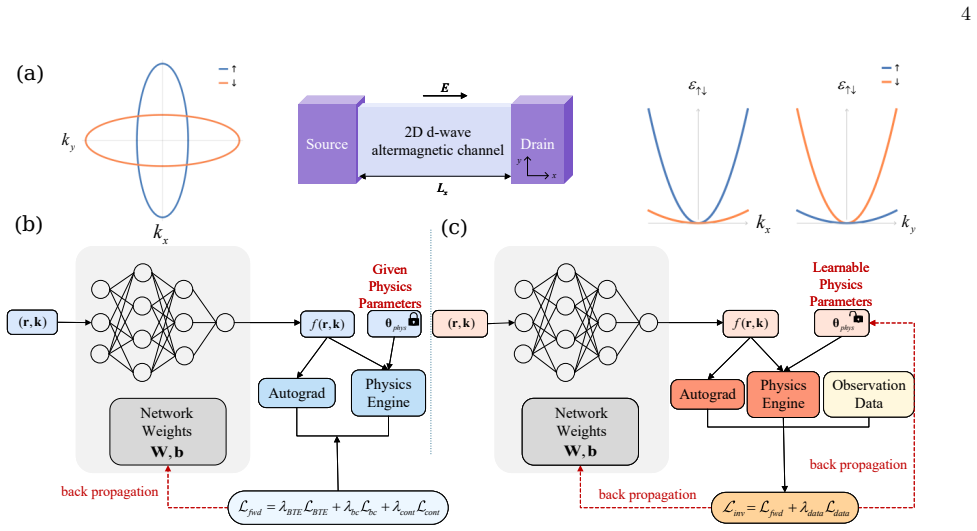
In a two-dimensional d-wave altermagnet the spin-dependent Fermi-surface anisotropy produces markedly different effective relaxation lengths for the two spin channels within the same device geometry. However the altermagnetic coupling α and the momentum relaxation time τ₀ compensate each other in longitudinal conductance. A physics-informed neural network formulated as a differentiable Boltzmann solver that strictly enforces contact injection, local particle conservation, and global current continuity leverages the Fermi-level dependence of transport to extract both parameters simultaneously from sparse conductance spectra, achieving sub-percent accuracy even under moderate measurement noise
Load-bearing premise
The semiclassical Boltzmann transport equation in the unified ballistic-to-diffusive framework accurately captures the size effect and Fermi-level dependence without significant quantum corrections or geometry-specific effects beyond those modeled.
Editorial extensions
If this is right
- The pronounced size effect arises because the two spin channels experience vastly different longitudinal velocities and therefore different effective relaxation lengths in identical geometry.
- Longitudinal conductance measurements alone cannot separate α from τ₀ due to strong mutual compensation.
- Incorporating the Fermi-level dependence of transport into the constrained solver removes the degeneracy.
- Sub-percent extraction accuracy persists when the input consists of sparse spectra subject to moderate measurement noise.
Reading between the lines
- The constrained neural-solver approach could be applied to inverse transport problems in other materials that exhibit similar parameter degeneracies between intrinsic band features and scattering.
- Experimental validation on fabricated altermagnetic devices would test whether real-device geometry and contact effects remain within the modeled semiclassical regime.
- The method suggests a general route for using physics-constrained networks to solve parameter-extraction tasks in mesoscopic transport where direct fitting fails.
Signed reviews
Editorial analysis
A structured set of objections, weighed in public.
Referee Report
Summary. The manuscript develops a physics-informed neural network (PINN) that functions as a differentiable solver for the semiclassical Boltzmann transport equation in a unified ballistic-to-diffusive regime. Applied to a 2D d-wave altermagnet, it claims to simultaneously extract the altermagnetic coupling α and momentum relaxation time τ₀ from sparse conductance spectra by enforcing contact injection, particle conservation, and current continuity, thereby lifting the degeneracy between spin splitting and scattering and achieving sub-percent accuracy even with moderate noise.
Significance. If the reported accuracy is independently validated, the approach would provide a practical route to disentangle intrinsic altermagnetic spin splitting from extrinsic scattering using transport data alone. The strict enforcement of physical constraints within the neural solver is a methodological strength that could generalize to other degenerate transport problems in mesoscopic systems.
major comments (3)
- [Abstract] Abstract: the central claim of sub-percent accuracy in extracting α and τ₀ is asserted without any numerical results, validation plots, noise models, or comparison baselines supplied in the available manuscript text; this absence makes the accuracy statement impossible to evaluate.
- The extraction procedure is performed entirely inside the same semiclassical Boltzmann model used to generate the synthetic conductance spectra; while constraints are enforced, this setup yields an internal consistency check rather than an external benchmark against independent data or more microscopic calculations.
- The semiclassical Boltzmann framework is taken to accurately reproduce Fermi-level-dependent conductance without quantum corrections; however, in 2D mesoscopic geometries near band edges or when device size approaches the coherence length, phase-coherent interference and interband scattering omitted by the model could alter the spectra precisely in the regime where degeneracy lifting is claimed.
Simulated Author's Rebuttal
We thank the referee for the careful and constructive report. We respond point-by-point to the major comments below. Where the comments identify needed clarifications or additions, we have revised the manuscript accordingly.
read point-by-point responses
-
Referee: [Abstract] Abstract: the central claim of sub-percent accuracy in extracting α and τ₀ is asserted without any numerical results, validation plots, noise models, or comparison baselines supplied in the available manuscript text; this absence makes the accuracy statement impossible to evaluate.
Authors: The full manuscript contains the requested numerical results, validation plots, noise models, and baselines in Sections III and IV together with the supplementary material. The abstract summarizes these findings. We have revised the abstract to include a short clause directing readers to the supporting results. revision: yes
-
Referee: The extraction procedure is performed entirely inside the same semiclassical Boltzmann model used to generate the synthetic conductance spectra; while constraints are enforced, this setup yields an internal consistency check rather than an external benchmark against independent data or more microscopic calculations.
Authors: We agree that the present validation uses synthetic data generated from the identical Boltzmann model and therefore constitutes an internal consistency test. This is the conventional first step for assessing parameter identifiability in inverse transport problems. We have added an explicit discussion paragraph stating this limitation and outlining planned comparisons with experimental data and microscopic calculations. revision: yes
-
Referee: The semiclassical Boltzmann framework is taken to accurately reproduce Fermi-level-dependent conductance without quantum corrections; however, in 2D mesoscopic geometries near band edges or when device size approaches the coherence length, phase-coherent interference and interband scattering omitted by the model could alter the spectra precisely in the regime where degeneracy lifting is claimed.
Authors: The manuscript is restricted to the semiclassical regime in which the Boltzmann equation applies (device size ≫ coherence length). We have inserted additional statements in the introduction and methods clarifying the validity range and noting that quantum corrections lie outside the present scope. The degeneracy-lifting demonstration is performed and reported strictly within the semiclassical model. revision: partial
Circularity Check
No significant circularity; derivation self-contained
full rationale
The paper presents a PINN method that enforces the semiclassical Boltzmann transport equation as a differentiable solver to invert for α and τ₀ from conductance spectra. The reported sub-percent accuracy is demonstrated on synthetic data generated from the same forward model, which is standard practice for validating an inverse solver and does not reduce the central claim to a tautology. The degeneracy lifting arises from the model's own Fermi-level dependence and physical constraints (contact injection, particle conservation, current continuity), which are independently stated and not derived from the extraction result itself. No self-citation load-bearing steps, ansatz smuggling, or renaming of known results appear in the provided text. The method's performance on internal benchmarks does not equate the output to the inputs by construction.
Assumptions & free parameters
free parameters (2)
- altermagnetic coupling α
- momentum relaxation time τ₀
assumptions (1)
- domain assumption Semiclassical Boltzmann transport equation accurately describes the system from ballistic to diffusive regimes in 2D d-wave altermagnets.
Cite this review
Pith. "Pith review of Boltzmann-constrained extraction of spin splitting and momentum relaxation in d-wave altermagnets." pith.science (2026). https://pith.science/paper/YIVWJYKP
@misc{pith2026260619785,
  author       = {Pith},
  title        = {Pith review of: Boltzmann-constrained extraction of spin splitting and momentum relaxation in d-wave altermagnets},
  year         = {2026},
  howpublished = {\url{https://pith.science/paper/YIVWJYKP}},
  note         = {Machine review of arXiv:2606.19785}
}
abstract
Altermagnets exhibit spin-split electronic structure without requiring spin-orbit coupling, but transport measurements generally mix intrinsic spin splitting with extrinsic scattering. We examine this identifiability problem for a two-dimensional d-wave altermagnet within a unified semiclassical framework spanning ballistic to diffusive transport. The spin-dependent Fermi-surface anisotropy produces a pronounced size effect, where vastly different longitudinal velocities cause the two spin channels to exhibit markedly different effective relaxation lengths within the same device geometry. However, the altermagnetic coupling $\alpha$ and the momentum relaxation time $\tau_0$ strongly compensate each other in longitudinal conductance, creating a severe parameter degeneracy. To lift this degeneracy, we formulate a physics-informed neural network (PINN) to act as a differentiable Boltzmann solver that strictly enforces contact injection, local particle conservation, and global current continuity. Driven by sparse conductance spectra, this neural solver leverages the Fermi-level dependence of transport to unlock the coupled parameters simultaneously, achieving sub-percent accuracy even under moderate measurement noise. These results show that combining the Fermi-level dependence of transport with strict physical constraints provides a robust route to separating spin splitting from scattering in altermagnetic conductors.
Figures


Figures from the paper (4 more)


Reference graph
Works this paper leans on
-
[1]
ˇSmejkal, J
L. ˇSmejkal, J. Sinova, and T. Jungwirth, Beyond conven- tional ferromagnetism and antiferromagnetism: A phase with nonrelativistic spin and crystal rotation symmetry, Phys. Rev. X12, 031042 (2022)
2022
-
[2]
Mazin, Editorial: Altermagnetism - a new punch line of fundamental magnetism, Phys
I. Mazin, Editorial: Altermagnetism - a new punch line of fundamental magnetism, Phys. Rev. X12, 040002 (2022)
2022
-
[3]
ˇSmejkal, J
L. ˇSmejkal, J. Sinova, and T. Jungwirth, Emerging re- search landscape of altermagnetism, Phys. Rev. X12, 040501 (2022)
2022
-
[4]
M. Roig, A. Kreisel, Y. Yu, B. M. Andersen, and D. F. Agterberg, Minimal models for altermagnetism, Phys. Rev. B110, 144412 (2024)
2024
-
[5]
I. H. Choi, S. G. Jeong, B. Jalan, and J. S. Lee, Exploring altermagnetism in ruo2: from conflicting experiments to emerging consensus, Nano Convergence13, 1 (2026)
2026
-
[6]
C. T. Liao, Y. C. Wang, Y. C. Tien, S. Y. Huang, and D. Qu, Separation of inverse altermagnetic spin-splitting effect from inverse spin hall effect in ruo2, Phys. Rev. Lett. 133, 056701 (2024). 10
2024
-
[7]
J. M. Ziman,Electrons and phonons: the theory of trans- port phenomena in solids(Oxford University Press, 2001)
2001
-
[8]
N. W. Ashcroft and N. D. Mermin,Solid State Physics (Holt, Rinehart and Winston, New York, 1976)
1976
Show all 20 references
-
[9]
H. Geng, W. Y. Deng, Y. J. Ren, L. Sheng, and D. Y. Xing, Unified semiclassical approach to electronic transport from diffusive to ballistic regimes, Chin. Phys. B25, 097201 (2016)
2016
-
[10]
Sheng, H
L. Sheng, H. Teng, and D. Xing, Boltzmann equation for spin-dependent transport in magnetic inhomogeneous systems, Phys. Rev. B58, 6428 (1998)
1998
-
[11]
X. Y. Liu, H. Z. Liao, G. Y. Qi, R. Ma, H. Geng, L. Sheng, and D. Y. Xing, Unified semiclassical theory of the nonlin- ear hall effect: Bridging ballistic and diffusive transport regimes, Phys. Rev. B113, 075424 (2026)
2026
-
[12]
Raissi, P
M. Raissi, P. Perdikaris, and G. E. Karniadakis, Physics- informed neural networks: A deep learning framework for solving forward and inverse problems involving nonlinear partial differential equations, J. Comput. Phys.378, 686 (2019)
2019
-
[13]
Cuomo, V
S. Cuomo, V. S. Di Cola, F. Giampaolo, G. Rozza, M. Raissi, and F. Piccialli, Scientific machine learning through physics–informed neural networks: Where we are and what’s next, J. Sci. Comput.92, 88 (2022)
2022
-
[14]
S. Cai, Z. Mao, Z. Wang, M. Yin, and G. E. Karniadakis, Physics-informed neural networks (pinns) for fluid me- chanics: a review, Acta Mech. Sin.37, 1727 (2021)
2021
-
[15]
R. Li, E. Lee, and T. Luo, Physics-informed deep learn- ing for solving coupled electron and phonon boltzmann transport equations, Phys. Rev. Appl.19, 064049 (2023)
2023
-
[16]
J. Zhou, R. Li, and T. Luo, Physics-informed neural net- works for solving time-dependent mode-resolved phonon boltzmann transport equation, npj Comput. Mater.9, 218 (2023)
2023
-
[17]
P. Liu, J. Zhou, L. Zhang, Z. Wang, H. Weng, and C. Fang, Spin-group symmetry in magnetic materials and its ap- plications, Phys. Rev. X12, 021016 (2022)
2022
-
[18]
Y. Liu, X. Chen, Y. Yu, J. Etxebarria, J. M. Perez-Mato, and Q. Liu, Symmetry classification of magnetic orders using oriented spin space groups, Nature652, 869 (2026)
2026
-
[19]
Varjas, T
D. Varjas, T. ¨O. Rosdahl, and A. R. Akhmerov, Qsymm: algorithmic symmetry finding and symmetric hamiltonian generation, New J. Phys.20, 113011 (2018)
2018
-
[20]
Christen and M
T. Christen and M. B¨ uttiker, Gauge-invariant nonlinear electric transport in mesoscopic conductors, Europhys. Lett.35, 523 (1996)
1996
Reviewed June 26, 2026 · model on record in the stance chip above.
Discussion (0). Continue with ORCID to comment.