Direct observation of interfacial exchange coupling in a magnetic tunnel junction through spin-polarized quasiparticle interference
Pith reviewed 2026-06-30 09:09 UTC · model grok-4.3
The pith
Ferromagnetic tip induces up to 10 meV shifts in Cr(001) surface states via interfacial exchange coupling.
A machine-rendered reading of the paper's core claim, the machinery that carries it, and where it could break.
Core claim
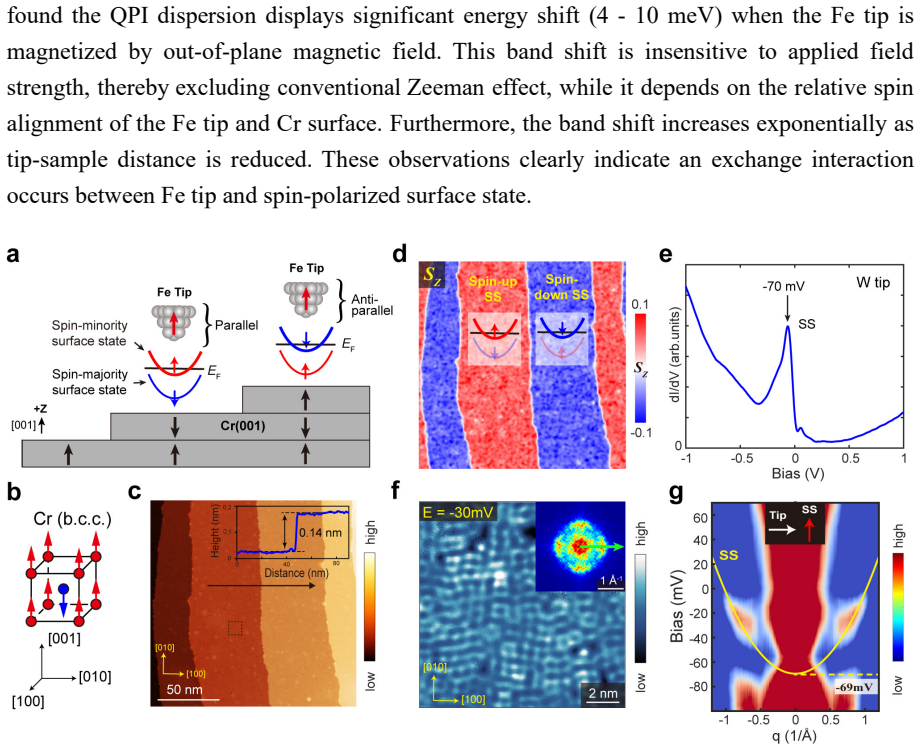
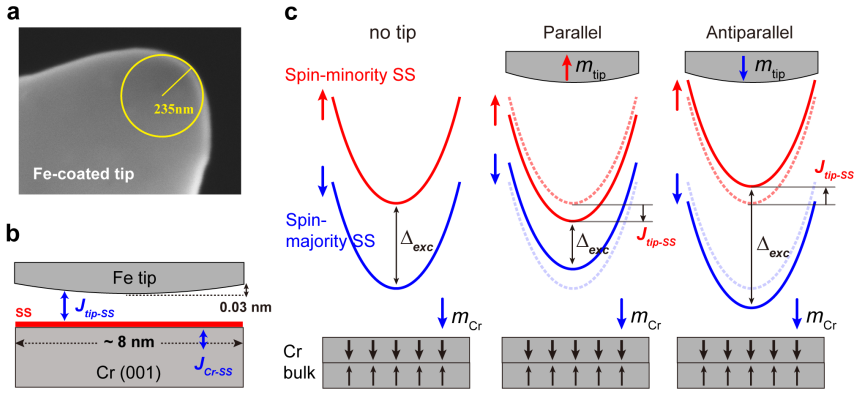
Using spin-polarized scanning tunneling microscopy and quasiparticle interference, the authors directly observed interfacial exchange coupling in a junction formed by an Fe-coated tip and a Cr(001) surface. The ferromagnetic tip induces energy shifts of up to 10 meV in the spin-polarized surface state of Cr(001). These shifts are highly sensitive to tip-surface distance and to the spin alignment between the Fe tip and Cr surface; the alignment can be switched by an external magnetic field. The observations demonstrate that the extended 2D surface states mediate the exchange coupling across the heterojunction.
What carries the argument
The spin-polarized surface states of Cr(001), whose quasiparticle interference patterns reveal distance- and alignment-dependent energy shifts induced by the Fe tip.
If this is right
- Extended 2D surface states can transmit strong exchange coupling across a magnetic heterojunction.
- The coupling strength and sign can be locally controlled by adjusting tip-surface distance or by switching spin alignment with an external field.
- This mediation mechanism enables local tuning of phenomena that rely on interfacial exchange, such as spin-triplet superconductivity or quantum anomalous Hall effects in heterostructures.
Where Pith is reading between the lines
- Similar surface-state mediation could be tested in other antiferromagnetic or ferromagnetic surfaces that host extended 2D states.
- The distance sensitivity suggests a practical knob for engineering exchange strength in device-scale junctions without changing material composition.
- If the coupling persists in multilayer stacks, it may provide a way to imprint spin textures from a tip or probe onto buried interfaces.
Load-bearing premise
The observed energy shifts arise from interfacial exchange coupling mediated by the Cr surface states rather than from tip stray fields, mechanical artifacts, or other non-exchange effects.
What would settle it
Absence of the energy shift when the tip is replaced by a non-magnetic probe or when tip-surface distance is increased beyond the range where tunneling occurs, while keeping all other conditions fixed.
Figures
read the original abstract
Interfacial exchange coupling plays a critical role in enabling novel phenomena in magnetic heterostructures, such as spin triplet superconductivity, quantum anomalous Hall effect (QAHE), and advanced spintronic functionalities. While microscopic characterization of this coupling is essential for elucidating the underlying mechanism, it remains technically challenging. Here, using spin-polarized scanning tunneling microscopy (SP-STM) and quasiparticle interference, we directly observed interfacial exchange coupling in a magnetic tunnel junction formed by an Fe coated tip and a Cr(001) surface. We found the ferromagnetic tip induces significant energy shift (up to 10 meV) in the spin-polarized surface state of Cr(001). This shift is highly sensitive to the tip-surface distance and the spin-alignment between Fe tip and Cr surface, which can be switched by external magnetic field. Our results demonstrate that extended 2D surface states can mediate strong exchange coupling across a heterojunction, enabling local control of interfacial exchange interaction induced phenomena.
Editorial analysis
A structured set of objections, weighed in public.
Referee Report
Summary. The manuscript reports using spin-polarized STM and quasiparticle interference to observe an energy shift of up to 10 meV in the spin-polarized surface state on Cr(001) induced by an Fe-coated ferromagnetic tip in a magnetic tunnel junction geometry. The shift is shown to depend on tip-surface distance and to reverse with external-field control of the relative spin alignment between tip and surface; the authors attribute the effect to interfacial exchange coupling mediated by the extended 2D Cr surface states.
Significance. If the attribution to exchange coupling holds after quantitative checks, the result supplies direct microscopic evidence that 2D surface states can transmit strong, locally tunable exchange across a heterojunction, with relevance to spintronic devices and phenomena such as QAHE or triplet superconductivity.
major comments (1)
- [Results/Discussion] Results/Discussion (energy-shift attribution): the observed 10 meV shift is stated to arise from interfacial exchange rather than tip stray fields, yet no dipole or monopole calculation of the expected Zeeman shift (using reported tip coating thickness, saturation magnetization, or geometry) is supplied to demonstrate that the stray-field contribution is negligible or has a measurably different distance dependence. The distance and field-reversal signatures alone do not discriminate the two mechanisms.
Simulated Author's Rebuttal
We thank the referee for their careful reading of the manuscript and for highlighting the need for a quantitative assessment of stray-field effects. We address the single major comment below and will revise the manuscript to incorporate the requested analysis.
read point-by-point responses
-
Referee: [Results/Discussion] Results/Discussion (energy-shift attribution): the observed 10 meV shift is stated to arise from interfacial exchange rather than tip stray fields, yet no dipole or monopole calculation of the expected Zeeman shift (using reported tip coating thickness, saturation magnetization, or geometry) is supplied to demonstrate that the stray-field contribution is negligible or has a measurably different distance dependence. The distance and field-reversal signatures alone do not discriminate the two mechanisms.
Authors: We agree that an explicit calculation of the stray-field contribution is necessary to strengthen the attribution. The current manuscript relies on the observed dependence on tip-surface distance and the reversal upon switching the relative spin alignment via external field to argue for exchange coupling mediated by the 2D Cr surface states. However, we acknowledge that these signatures alone leave open the possibility of stray-field contributions. In the revised manuscript we will add a quantitative estimate using both dipole and monopole models, employing the Fe coating thickness, saturation magnetization, and junction geometry as reported in the experimental section. The calculated Zeeman shifts will be compared directly with the measured 10 meV energy shift and its distance dependence. This addition will allow readers to evaluate whether stray fields can be ruled out on quantitative grounds. revision: yes
Circularity Check
No circularity: purely experimental observation without derivation chain
full rationale
The paper reports direct experimental measurements via SP-STM and quasiparticle interference of energy shifts (up to 10 meV) in the Cr(001) spin-polarized surface state induced by an Fe-coated tip. The abstract and provided text contain no equations, fitted parameters, predictions, or first-principles derivations that could reduce to inputs by construction. Claims rest on observed distance and field dependence of shifts, with attribution to exchange coupling presented as an interpretation of data rather than a self-referential or fitted result. No self-citation load-bearing steps or ansatz smuggling are present in the described content. This is a standard experimental report whose central result is independent of any internal derivation.
Axiom & Free-Parameter Ledger
Reference graph
Works this paper leans on
-
[1]
https://doi.org/10.1038/s41467-020-15024-2. (36) Fawcett, E. Spin-Density-Wave Antiferromagnetism in Chromium. Rev. Mod. Phys. 1988, 60 (1), 209–
-
[2]
https://doi.org/10.1103/RevModPhys.60.209. (37) Fawcett, E.; Alberts, H. L.; Galkin, V . Yu.; Noakes, D. R.; Yakhmi, J. V . Spin -Density-Wave Antiferromagnetism in Chromium Alloys. Rev. Mod. Phys. 1994, 66 (1), 25–127. https://doi.org/10.1103/RevModPhys.66.25. (38) Zabel, H. Magnetism of Chromium at Surfaces, at Interfaces and in Thin Films. J. Phys.: Co...
discussion (0)
Sign in with ORCID, Apple, or X to comment. Anyone can read and Pith papers without signing in.