REVIEW 4 major objections 5 minor 108 references
Programmable In-Network Security for Context-aware BYOD Policies
T0 review · 4 major / 5 minor · reviewed 2026-08-14 · deepseek-v4-flash
Pith's one-line read Poise claims that context-aware BYOD security can be enforced entirely inside programmable switch hardware, eliminating the remote controller from the decision path and surviving floods that saturate OpenFlow-based SDN defenses.
desk verdict Solid hardware-backed systems paper showing context-aware BYOD enforcement can live in the data plane; the replay/binding gap is real but disclosed, and the missing switch-CPU numbers are the main revision item. read the letter →
The pith
A machine-rendered reading of the paper's core claim, the machinery that carries it, and where it could break.
The reading
What carries the argument
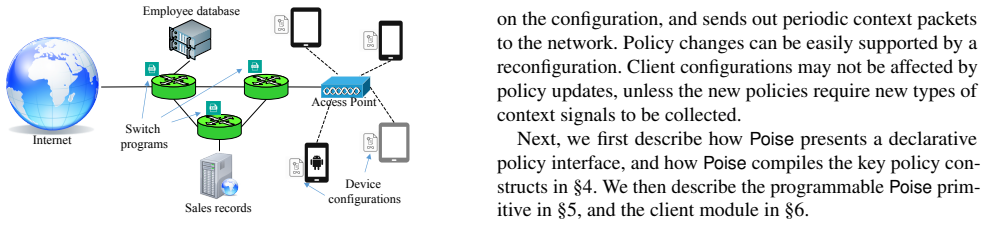
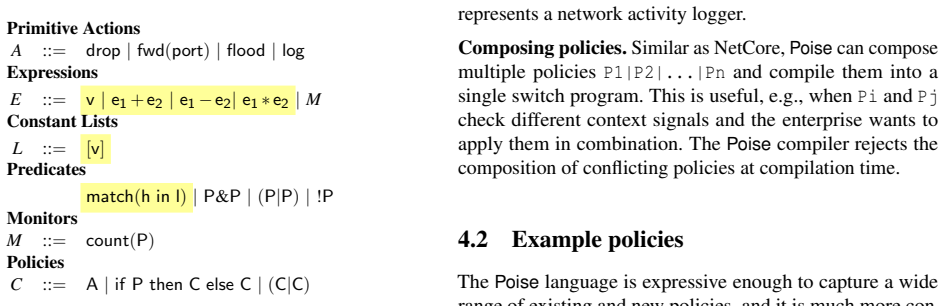
The load-bearing mechanism is the in-network security primitive, a hardware pipeline instantiated in P4 from four components: custom context headers that the switch parser extracts from client traffic; match/action tables that evaluate policy predicates, including arithmetic over GPS coordinates and membership tests against constant lists; stateful registers implementing monitors such as count(pred), which let a packet's fate depend on network-wide state like whether an admin is online; and a key/value store that approximates per-flow state without per-flow memory. That store combines a FullConn match/action table, a small CRC-indexed Cache that buffers decisions for new connections while the control plane installs entries, and a Bloom filter that blacklists recently violating source addresses so they are denied early. The cache-and-bloom-filter design is what allows the switch to keep making correct decisions during the control-plane insertion window, and the compiler translates NetCore-style policies into instantiations of this primitive using table deduplication, table merging, and packet recirculation when policies exceed the available hardware stages.
What would settle it
Root a device running PoiseDroid, forge a context packet that claims a safe location, an online admin, or a patched library while the device's true state is the opposite, and observe whether the switch grants access; the paper's trust model predicts the switch enforces the forged decision, and any detection-and-drop behavior would contradict the model. A second test targets the cache: an attacker who learns the CRC hash could flood context packets to evict a victim's cache entry, and the victim's data packets should then suffer recirculation-induced latency or spurious drops if the heuristic countermeasure fails.
Extended reading notes
Core claim
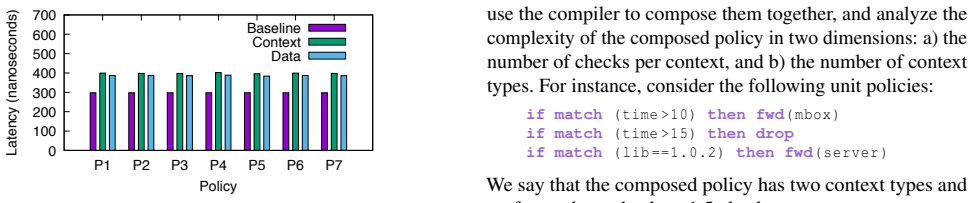
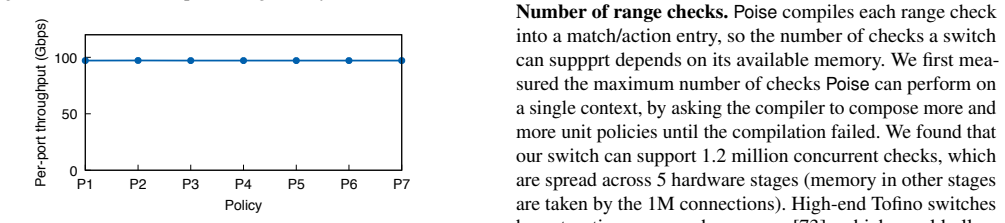
The central claim is that the end-node problem of BYOD security can be solved by a switch primitive that performs context-aware access control in hardware on the data plane. Poise defines a property called subflow-level security: a context packet, which carries the device's current signals, refreshes the stored decision for a flow, and all subsequent data packets of that flow are governed by that decision until the next context packet arrives. The context-packet frequency is tunable, so the operator trades security granularity against overhead, from per-flow to near-per-packet. Because decisions are made by match/action tables and stateful registers rather than by a software controller, the paper argues that the resulting defenses are efficient, programmable, highly agile, and resilient to control plane saturation attacks. The prototype evaluation on a Tofino switch reports full per-port line rate, roughly 88 to 100 nanoseconds of added latency, constant connection success during a one-million-connections-per-second saturation attack, and security-posture-change times below 500 nanoseconds.
Load-bearing premise
Poise's trust model, stated in Section 2.2, assumes the Android kernel and firmware, including the pre-installed PoiseDroid module, are trusted so that malicious apps cannot obtain root privileges or forge the context headers that drive every switch decision; if an attacker compromises that kernel code, each downstream allow-or-deny decision can be trivially bypassed.
Editorial extensions
If this is right
- Enterprise access control can react to a device leaving an authorized area, an app moving to the background, or an admin going offline within hundreds of nanoseconds, shrinking the exploitable window in which a stale allow decision still stands.
- Connection floods no longer translate into security failure: new connections are cached at line rate while the control plane installs entries asynchronously, so legitimate clients keep connecting even under a one-million-connections-per-second attack.
- Operators can change policy as a recomputation: the compiler turns a few declarative lines into hardware programs in under one second, replacing hand-written P4 and hardware upgrades.
- Policies that depend on network-wide state, such as denying access to sales records unless the sales manager is online, become expressible and enforceable in hardware, which client-only or stateless in-network designs cannot do.
- The measured resource headroom of about 43 percent SRAM, under 1.1 percent TCAM, and under 7 percent VLIW utilization indicates the security primitive can coexist with other switch functionality on the same chip.
Reading between the lines
- My inference: the same subflow-level pattern could carry dynamic attributes beyond BYOD context, such as IoT device state, threat-intelligence score feeds, or per-tenant quota usage, since any attribute that fits in a periodically refreshed header can ride the same primitive.
- My inference: the agility advantage only matters if the context signals are authentic, so the natural stress test is a rooted or kernel-compromised device forging a context header; the paper's own trust model concedes such a device would defeat every switch-side check.
- My inference: the cache-eviction defense is heuristic, since collisions between different source IPs are only opportunistically resolved, so an attacker who can probe the CRC hash behavior might still single out a victim's cache entry and force repeated recirculations that degrade that victim's throughput.
- My inference: if programmable switches become standard enterprise edge equipment, the broader architectural consequence is that security enforcement migrates from controller software and middleboxes into the forwarding fabric itself, which would simplify BYOD and IoT architectures but concentrate new trust in the switch.
Signed reviews
Editorial analysis
A structured set of objections, weighed in public.
Referee Report
Summary. Poise proposes a new paradigm for context-aware BYOD security in which access-control decisions are enforced entirely in programmable switch hardware rather than by a remote SDN controller. The paper presents a high-level policy language with a compiler that generates P4 programs for a stateful in-network security primitive; a client-side kernel module (PoiseDroid) that collects and embeds context signals; and an orchestration controller. The prototype is evaluated on a Wedge 100BF Tofino switch with measurements showing 88–100 ns added packet-processing latency, full 100 Gbps per-port throughput, sub-500 ns agility in changing security posture, and stable connection success during a 1M-connection-per-second attack that collapses an OpenFlow/OpenvSwitch baseline. The central claim is that programmable in-network enforcement avoids the control-plane bottleneck and dramatically improves defense agility compared to centralized SDN defenses.
Significance. If the security-binding and comparison-fairness concerns below are addressed, this is a strong systems contribution. The paper ships a real hardware prototype, reports direct measurements on a Tofino switch, and makes concrete, falsifiable performance claims (added latency, line-rate throughput, saturation resilience). The compiler-based mapping from a declarative policy language to P4 is a useful artifact in its own right, and the identified design space—subflow-level security with tunable context frequency—is well motivated. The work also has no fitted parameters or circular derivations, and the comparison against a real OpenFlow controller gives the performance claims evidentiary weight. The main weakness is that the security argument around context-packet binding and replay is incomplete, and the SDN comparison does not impose the same context-packet workload on the baseline.
major comments (4)
- [§5.1, Fig. 5] The FullConn key is only [sip, sport, proto], so the switch cannot bind a context decision to a specific connection instance. A client can reuse the same source port for a new connection (or maintain simultaneous connections that share the 3-tuple but differ in destination), and the decision from the previous connection's context packet will be applied to the new connection. Section 5.1 acknowledges this inaccuracy but mitigates only the deny-to-allow case by blacklisting the source IP. A stale allow decision can persist and grant access after the device's context has changed to deny, and a stale deny can cause availability loss. The paper needs either a stronger binding mechanism (e.g., including a connection/flow identifier and checking freshness at the switch) or an explicit security analysis of the residual stale-decision window.
- [§2.2, §6] The trust model says malicious apps cannot compromise the kernel or obtain root, but it does not specify what a non-root malicious app can do to the context-packet stream. PoiseDroid generates context packets in the kernel network submodule, yet the paper does not analyze whether a malicious app can trigger, delay, reorder, or suppress context packets for its own sockets, or whether such actions can refresh an allow decision or evict cache entries for other connections. WPA3/MACsec protect the context packet on the link, but they do not protect against an adversary that controls an unprivileged app on the same device. The paper should either bound the app's influence on context-packet generation or add a concrete mechanism (e.g., per-connection nonces and switch-side freshness checks) before the subflow-level security claim is justified.
- [§7.7, Fig. 11] The control-plane saturation comparison does not impose the same context-packet workload on the SDN baseline as on Poise. In the Poise design, each new socket and each periodic context refresh generates a context packet that must be processed; in the OpenFlow baseline, those same client context updates would arrive at the controller and trigger FlowMod processing. The reported attack only measures new-connection PacketIn load, not the additional context-change load that a real Poise deployment would generate. Without measuring the baseline under the same per-connection and per-context-refresh load, the claim that Poise is 'resilient to control plane saturation attacks' relative to SDN is not fully established. Please add the context-change workload to the baseline and report both new-connection and context-change success rates.
- [§5.2] The cache-eviction attack defense relies on the attacker not knowing the CRC hash seed, but CRC-16 is not a keyed cryptographic hash and has only 2^16 possible outputs. An attacker who can observe hash behavior or brute-force the seed can predict which source-port values collide, undermining the claim that 'the attacker may not know the hash seed, therefore cannot predict who would be the victim.' The paper should either use a keyed/secret hash for cache indexing or provide a quantitative analysis of the residual DoS damage when the hash seed is known.
minor comments (5)
- [§3.1] The phrase 'and and deep packet inspection' contains a duplicated conjunction; please fix the typo.
- [§7.5] The word 'suppprt' in the sentence about the number of checks should be 'support'.
- [References [90]] The reference to Shin et al. appears as 'V ANTGUARD' in the text; the correct paper title is 'AVANT-GUARD: Scalable and Vigilant Switch Flow Management in Software-Defined Networks.'
- [§5.2] The stated cache size arithmetic is inconsistent: 2^16 entries with the described entry format yields approximately 0.5 MB, not the reported 0.38 MB. Please reconcile the entry-size accounting.
- [§7.2] The sentence 'four 25 Gbps Ethernet ports, which collectively can emulate eight forwarding decisions' is unclear; please specify how eight decisions follow from four ports.
Circularity Check
No significant circularity: Poise is a self-contained systems construction with external measurements, and its only self-citation is non-load-bearing.
full rationale
No circularity found. Poise's central claim is a systems construction: a declarative policy language is compiled into P4 programs implementing a switch primitive (§4.3, Figure 4), and the evaluation (§7) directly measures the generated programs' latency, throughput, scalability, client overhead, and behavior under control-plane saturation attacks against an external Floodlight/OpenvSwitch SDN baseline (§7.7). No predicted quantity is obtained by fitting to the same data, and no design parameter is renamed as a result. The only self-citation is the HotCloud position paper [76], which the paper explicitly describes as closest related work that "neither has a full system implementation nor evaluation"; it is not used to justify any load-bearing inference. The trust model is inherited from external prior work [62, 98] and is explicitly stated as an assumption rather than derived. Subflow-level security is a stated design property implemented through the FullConn/Cache key-value store, not a theorem derived from its own definition. Accordingly, the derivation chain is self-contained and the paper earns a circularity score of 0.
Assumptions & free parameters
free parameters (3)
- Cache size =
2^16 entries
- Recirculation limit k =
not specified
- Context packet frequency f =
1 packet per second
assumptions (6)
- domain assumption P4 programs that compile successfully are guaranteed to run at linespeed; programs exceeding hardware resources are rejected.
- domain assumption Malicious apps cannot compromise the Android kernel or obtain root privileges; the kernel and firmware are trusted.
- domain assumption Context packets are protected from masquerading and replay by WPA3 and MACsec on the links they traverse.
- standard math A Bloom filter never produces false negatives, only false positives.
- domain assumption Enterprise networks can prevent source IP spoofing, so per-IP connection limits and blacklists are effective.
- domain assumption A context packet is generated when a new socket opens or a dormant socket reactivates, so it generally precedes data packets of a new flow.
Cite this review
Pith. "Pith review of Programmable In-Network Security for Context-aware BYOD Policies." pith.science (2026). https://pith.science/paper/YJTF3WNK
@misc{pith2026190801405,
  author       = {Pith},
  title        = {Pith review of: Programmable In-Network Security for Context-aware BYOD Policies},
  year         = {2026},
  howpublished = {\url{https://pith.science/paper/YJTF3WNK}},
  note         = {Machine review of arXiv:1908.01405}
}
read the original abstract
Bring Your Own Device (BYOD) has become the new norm in enterprise networks, but BYOD security remains a top concern. Context-aware security, which enforces access control based on dynamic runtime context, holds much promise. Recent work has developed SDN solutions to collect device context for network-wide access control in a central controller. However, the central controller poses a bottleneck that can become an attack target, and processing context changes at remote software has low agility. We present a new paradigm, programmable in-network security (Poise), which is enabled by the emergence of programmable switches. At the heart of Poise is a novel switch primitive, which can be programmed to support a wide range of context-aware policies in hardware. Users of Poise specify concise policies, and Poise compiles them into different instantiations of the security primitive in P4. Compared to centralized SDN defenses, Poise is resilient to control plane saturation attacks, and it dramatically increases defense agility.
Figures

Figures from the paper (7 more)





Reference graph
Works this paper leans on
-
[1]
http://www.lysesoft.com/products/ andftp/
AndFTP. http://www.lysesoft.com/products/ andftp/
-
[2]
https://www.android.com/en terprise/employees/
Android for Work. https://www.android.com/en terprise/employees/
-
[3]
https: //www.securewirelessworks.com/datashee ts/Access-Points/DS_AP220Series.pdf
Aruba 220 series access points. https: //www.securewirelessworks.com/datashee ts/Access-Points/DS_AP220Series.pdf
-
[4]
https://www.barefootnetworks .com/technology/#tofino
Barefoot Tofino. https://www.barefootnetworks .com/technology/#tofino
-
[5]
https://goo.gl/y m9ATg
The benefits and risks of BYOD. https://goo.gl/y m9ATg
-
[6]
https://www.blackberry.com /us/en/solutions/enterprise-mobility-man agement-emm
Blackberry EMM. https://www.blackberry.com /us/en/solutions/enterprise-mobility-man agement-emm
-
[7]
https://goo.gl /bn1rN4
Bring your own risk with BYOD. https://goo.gl /bn1rN4
-
[8]
https://goo.gl/BTr Sm4
BYOD: A global perspective. https://goo.gl/BTr Sm4
Show all 108 references
-
[9]
ht tps://goo.gl/phTav6
BYOD: Mobile devices threats and vulnerabilities. ht tps://goo.gl/phTav6
-
[10]
https://www.cavium.com/xplia nt-ethernet-switch-product-family.html
Cavium XPliant. https://www.cavium.com/xplia nt-ethernet-switch-product-family.html
-
[11]
https: //www.cisco.com/c/en/us/products/switc hes/nexus-3000-series-switches/models-co mparison.html#~tab-nexus3400
Cisco nexus 3400 series switches. https: //www.cisco.com/c/en/us/products/switc hes/nexus-3000-series-switches/models-co mparison.html#~tab-nexus3400
-
[12]
https://goo.gl/D99C39
End node. https://goo.gl/D99C39
-
[13]
https://goo
How to solve the end node problem. https://goo. gl/9wWqJr
-
[14]
https://goo.gl/zafGxN
IBM Mobile: BYOD. https://goo.gl/zafGxN
-
[15]
https://goo.gl/WBn3vP
IBM opens up smartphone, tablet support for its work- ers. https://goo.gl/WBn3vP
-
[16]
https://1.ieee802
IEEE 802.1ae: MAC security. https://1.ieee802. org/security/802-1ae/
-
[17]
https://www.intel.com/conten t/www/us/en/products/network-io/ethernet /switches.html
Intel FlexPipe. https://www.intel.com/conten t/www/us/en/products/network-io/ethernet /switches.html
-
[18]
https://goo.gl/25SX7K
Market reports. https://goo.gl/25SX7K
-
[19]
https://github.com /p4lang
The P4 language repositories. https://github.com /p4lang
-
[20]
https://www.druva.co m/blog/the-rise-and-risk-of-byod/
The rise and risk of BYOD. https://www.druva.co m/blog/the-rise-and-risk-of-byod/
-
[21]
https://goo.gl/GmZ1i o
Samsung BYOD solutions. https://goo.gl/GmZ1i o
-
[22]
http://www.samsung.com/global /business/mobile/solution/security/samsung -knox
Samsung Knox. http://www.samsung.com/global /business/mobile/solution/security/samsung -knox
-
[23]
ht tps://goo.gl/Z769MG
Securing your weakest link: Your mobile devices. ht tps://goo.gl/Z769MG
-
[24]
https://goo.gl/zTJaUL
Security configuration guide: Access control lists, Cisco IOS XE Release 3S. https://goo.gl/zTJaUL
-
[25]
https://www.symantec.com/con tent/dam/symantec/docs/data-sheets/endpo int-protection-mobile-for-emm-en.pdf
Symantec EMM. https://www.symantec.com/con tent/dam/symantec/docs/data-sheets/endpo int-protection-mobile-for-emm-en.pdf
-
[26]
https://community.arm.com/developer/ip-p roducts/processors/b/processors-ip-blog/ posts/a-technical-report-on-tee-and-arm- trustzone
A technical report on TEE and ARM TrustZone. https://community.arm.com/developer/ip-p roducts/processors/b/processors-ip-blog/ posts/a-technical-report-on-tee-and-arm- trustzone
-
[27]
https://go o.gl/MuRr66
Top 21 companies in the BYOD market. https://go o.gl/MuRr66
-
[28]
https://source.android.com/security/verifi edboot/
Verified Boot: Android Open Source Project. https://source.android.com/security/verifi edboot/
-
[29]
https://www.air-watch.com/ capabilities/enterprise-mobility-managem ent/
VMware Airwatch. https://www.air-watch.com/ capabilities/enterprise-mobility-managem ent/
-
[30]
What is BYOD and why is it important? https://go o.gl/H71Nji
-
[31]
IEEE 802.1x remote authentication dial in user service (RADIUS) usage guidelines, RFC 3580. 2003. https: //www.rfc-editor.org/info/rfc3580
2003
-
[32]
https://github.com/noxrepo/nox, 2012
Nox. https://github.com/noxrepo/nox, 2012
2012
-
[33]
https://www.sdxcentral.com/project s/beacon/, 2013
Beacon. https://www.sdxcentral.com/project s/beacon/, 2013
2013
-
[34]
https://noxrepo.github.io/pox-doc/ht ml/, 2017
Pox. https://noxrepo.github.io/pox-doc/ht ml/, 2017
2017
-
[35]
https://developer.android.com/stud io/command-line/dumpsys, 2018
dumpsys. https://developer.android.com/stud io/command-line/dumpsys, 2018
2018
-
[36]
https://www.opendaylight.org/, 2018
OpenDaylight. https://www.opendaylight.org/, 2018. 14
2018
-
[37]
https: //play.google.com/store/apps/details?i d=com.futuremark.pcmark.android.benchmark, 2018
Pcmark for android benchmark. https: //play.google.com/store/apps/details?i d=com.futuremark.pcmark.android.benchmark, 2018
2018
-
[38]
Aditya, R
P. Aditya, R. Sen, P. Druschel, S. Joon Oh, R. Benenson, M. Fritz, B. Schiele, B. Bhattacharjee, and T. T. Wu. I-pic: A platform for privacy-compliant image capture. In Proc. MobiSys, 2016
2016
-
[39]
Alzubaidi and J
A. Alzubaidi and J. Kalita. Authentication of smart- phone users using behavioral biometrics. IEEE Com- munications Surveys& Tutorials,, 18, 2016
2016
-
[40]
C. J. Anderson, N. Foster, A. Guha, J.-B. Jeannin, D. Kozen, C. Schlesinger, and D. Walker. NetKAT: Semantic foundations for networks. In Proc. POPL, 2014
2014
-
[41]
Apthorpe, Y
N. Apthorpe, Y . Shvartzshnaider, A. Mathur, D. Reis- man, and N. Feamster. Discovering smart home Inter- net of Things privacy norms using contextual integrity. Proceedings of the ACM on Interactive, Mobile, Wear- able and Ubiquitous Technologies (IMWUT), 2, 2018
2018
-
[42]
Backes, S
M. Backes, S. Bugiel, S. Gerling, and P. von Styp- Rekowsky. Android security framework: Extensible multi-layered access control on android. In Proc. AC- SAC, 2014
2014
-
[43]
Barth, A
A. Barth, A. Datta, J. C. Mitchell, and H. Nissenbaum. Privacy and contextual integrity: Framework and ap- plications. In Proc. IEEE Symposium on Security and Privacy, 2006
2006
-
[44]
Beckett, R
R. Beckett, R. Mahajan, T. Millstein, J. Padhye, and D. Walker. Don’t mind the gap: Bridging network- wide objectives and device-level configurations. In Proc. SIGCOMM, 2016
2016
-
[45]
Bosshart, D
P. Bosshart, D. Daly, G. Gibb, M. Izzard, N. McKe- own, J. Rexford, C. Schlesinger, D. Talayco, A. Vah- dat, G. Varghese, and D. Walker. P4: Programming protocol-independent packet processors. ACM SIG- COMM CCR, 44(3), 2014
2014
-
[46]
Bosshart, G
P. Bosshart, G. Gibb, H.-S. Kim, G. Varghese, N. McK- eown, M. Izzard, F. Mujica, and M. Horowitz. Forward- ing metamorphosis: Fast programmable match-action processing in hardware for SDN. In Proc. SIGCOMM, 2013
2013
-
[47]
Casado, M
M. Casado, M. J. Freedman, J. Pettit, J. Luo, N. McK- eown, and S. Shenker. Ethane: Taking control of the enterprise. In Proc. SIGCOMM, 2007
2007
-
[48]
Casado, T
M. Casado, T. Garfinkel, A. Akella, M. Freedman, D. Boneh, N. McKeown, and S. Shenker. SANE: A protection architecture for enterprise networks. InProc. USENIX Security, 2006
2006
-
[49]
Dang-Pham and S
D. Dang-Pham and S. Pittayachawan. Comparing in- tention to avoid malware across contexts in a BYOD- enabled Australian university: A protection motivation theory approach. Computers & Security, 48, Feb. 2015
2015
-
[50]
Dautenhahn, T
N. Dautenhahn, T. Kasampalis, W. Dietz, J. Criswell, and V . Adve. Nested kernel: An operating system architecture for intra-kernel privilege separation. In Proc. ASPLOS, 2015
2015
-
[51]
Eberz, K
S. Eberz, K. B. Rasmussen, V . Lenders, and I. Marti- novic. Evaluating behavioral biometrics for continuous authentication: Challenges and metrics. In Proc. Asi- aCCS, 2017
2017
-
[52]
Ehatisham -ul-Haqa, M
M. Ehatisham -ul-Haqa, M. A. Azama, U. Naeemb, Y . Amina, and J. Looc. Continuous authentication of smartphone users based on activity pattern recognition using passive mobile sensing. Journal of Network and Computer Applications, 109, 2018
2018
-
[53]
S. K. Fayaz, Y . Tobioka, V . Sekar, and M. Bailey. Bo- hatei: Flexible and elastic DDoS defense. In Proc. USENIX Security, 2015
2015
-
[54]
Fernandes, J
E. Fernandes, J. Paupore, A. Rahmati, D. Simionato, M. Conti, and A. Prakash. FlowFence: Practical data protection for emerging IoT application frameworks. In Proc. USENIX Security, 2016
2016
-
[55]
D. F. Ferraiolo, D. R. Kuhn, and R. Chandramouli. Role-Based Access Control. Artech House, 2007
2007
-
[56]
D. F. Ferraiolo, R. Sandhu, S. Gavrila, D. R. Kuhn, and R. Chandramouli. Proposed NIST standard for role-based access control. ACM Transactions on Infor- mation and System Security (TISSEC), 3, 2001
2001
-
[57]
Foster, R
N. Foster, R. Harrison, M. Freedman, C. Monsanto, J. Rexford, A. Story, and D. Walker. Frenetic: A net- work programming language. In Proc. ICFP, 2011
2011
-
[58]
Fratantonio, C
Y . Fratantonio, C. Qian, P. Chung, and W. Lee. Cloak and dagger: From two permissions to complete control of the UI feedback loop. In Proc. IEEE S&P, 2017
2017
-
[59]
C. K. Georgiadis, I. Mavridis, G. Pangalos, and R. K. Thomas. Flexible team-based access control using contexts. In Proc. SACMAT, 2001
2001
-
[60]
D. Harkins. Simultaneous authentication of equals: A secure, password-based key exchange for mesh net- works. In Proc. SensorComm, 2008. 15
2008
-
[61]
C.-Y . Hong, S. Kandula, R. Mahajan, M. Zhang, V . Gill, M. Nanduri, and R. Wattenhofer. Achieving high uti- lization with software-driven WAN. In Proc. SIG- COMM, 2013
2013
-
[62]
S. Hong, R. Baykov, L. Xu, S. Nadimpalli, and G. Gu. Towards SDN-defined programmable BYOD (bring your own device) security. In Proc. NDSS, 2016
2016
-
[63]
S. Hong, L. Xu, H. Wang, and G. Gu. Poisoning net- work visibility in software-defined networks: New at- tacks and countermeasures. In Proc. NDSS, 2015
2015
-
[64]
S. Jain, A. Kumar, S. Mandal, J. Ong, L. Poutievski, A. Singh, S. Venkata, J. Wanderer, J. Zhou, M. Zhu, J. Zolla, U. Hölzle, S. Stuart, and A. Vahdat. B4: Expe- rience with a globally-deployed software defined W AN. In Proc. SIGCOMM, 2013
2013
-
[65]
Y . J. Jia, Q. A. Chen, S. Wang, A. Rahmati, E. Fer- nandes, Z. M. Mao, and A. Prakash. ContexIoT: To- wards providing contextual integrity to appified IoT platforms. In Proc. NDSS, 2016
2016
-
[66]
X. Jin, X. Li, H. Zhang, N. Foster, J. Lee, R. Soule, C. Kim, and I. Stoica. NetChain: Scale-free sub-RTT coordination. In Proc. NSDI, 2018
2018
-
[67]
X. Jin, X. Li, H. Zhang, R. Soulé, J. Lee, N. Foster, C. Kim, and I. Stoica. NetCache: Balancing key-value stores with fast in-network caching. In Proc. SOSP, 2017
2017
-
[68]
M. T. Jones. Invoking user-space applications from the kernel. https://www.ibm.com/developerworks/l ibrary/l-user-space-apps/index.html , 2018
2018
-
[69]
L. Jose, L. Yan, G. Varghese, and N. McKeown. Com- piling packet programs to reconfigurable switches. In Proc. NSDI, 2015
2015
-
[70]
Katta, M
N. Katta, M. Hira, C. Kim, A. Sivaraman, and J. Rex- ford. HULA: Scalable load balancing using pro- grammable data planes. In Proc. SOSR, 2016
2016
-
[71]
M. Liu, L. Luo, J. Nelson, L. Ceze, A. Krishnamurthy, and K. Atreya. IncBricks: Toward in-network compu- tation with an in-network cache. In Proc. ASPLOS, 2017
2017
-
[72]
McKeown, T
N. McKeown, T. Anderson, H. Balakrishnan, G. Parulkar, L. Peterson, J. Rexford, S. Shenker, and J. Turner. OpenFlow: Enabling innovation in campus networks. ACM SIGCOMM Computer Communication Review, 38, 2008
2008
-
[73]
R. Miao, H. Zeng, C. Kim, J. Lee, and M. Yu. SilkRoad: Making stateful layer-4 load balancing fast and cheap using switching ASICs. In Proc. SIGCOMM, 2017
2017
-
[74]
Monsanto, N
C. Monsanto, N. Foster, R. Harrison, and D. Walker. A compiler and run-time system for network program- ming languages. In Proc. POPL, 2012
2012
-
[75]
Monsanto, J
C. Monsanto, J. Reich, N. Foster, J. Rexford, and D. Walker. Composing software-defined networks. In Proc. NDSI, 2013
2013
-
[76]
Morrison, L
A. Morrison, L. Xue, A. Chen, and X. Luo. Enforcing context-aware BYOD policies with in-network security. In Proc. HotCloud, July 2018
2018
-
[77]
M’Raihi, S
D. M’Raihi, S. Machani, M. Pei, and J. Rydell. Rfc 6238-totp: Time-based one-time password algorithm. tools.ietf.org, 2011
2011
-
[78]
Nadkarni and W
A. Nadkarni and W. Enck. ASM: A programmable interface for extending Android security. In Proc. USENIX security, 2014
2014
-
[79]
Narayana, A
S. Narayana, A. Sivaraman, V . Nathan, P. Goyal, V . Arun, M. Alizadeh, V . Jeyakumar, and C. Kim. Language-directed hardware design for network per- formance monitoring. In Proc. SIGCOMM, 2017
2017
-
[80]
Nauman, S
M. Nauman, S. Khan, X. Zhang, and J.-P. Seifert. Be- yond kernel-level integrity measurement: Enabling re- mote attestation for the Android platform. In Proc. International Conference on Trust and Trustworthy Computing, 2010
2010
-
[81]
OConnor, W
T. OConnor, W. Enck, W. M. Petullo, and A. Verma. PivotWall: SDN-based information flow control. In Proc. SOSR, 2018
2018
-
[82]
Parducci
B. Parducci. eXtensible Access Control Markup Lan- guage (XACML) specification. 2005
2005
-
[83]
S. G. plc. Synchronized security: Best-of-breed defense that’s more coordinated than attacks. https://www.sophos.com/en-us/medialibrary/ gated-assets/white-papers/sophos-security- heartbeat-wpna.pdf
-
[84]
Porras, S
P. Porras, S. Shin, V . Yegneswaran, M. Fong, M. Tyson, and G. Gu. A security enforcement kernel for Open- Flow networks. In Proc. HotSDN, 2012
2012
-
[85]
Reitblatt, M
M. Reitblatt, M. Canini, A. Guha, and N. Foster. Fat- tire: Declarative fault tolerance for software-defined networks. In Proc. HotSDN, 2013
2013
-
[86]
Schlesinger, M
C. Schlesinger, M. Greenberg, and D. Walker. Con- current NetCore: From policies to pipelines. In Proc. ICFP, 2014
2014
-
[87]
Y . Shao, X. Luo, and C. Qian. Rootguard: Protecting rooted android phones. IEEE Computer, 47(6), 2014. 16
2014
-
[88]
Shin and G
S. Shin and G. Gu. Cloudwatcher: Network secu- rity monitoring using OpenFlow in dynamic cloud net- works (or: How to provide security monitoring as a service in clouds?). In Proc. ICNP, 2012
2012
-
[89]
S. Shin, P. Porras, V . Yegneswaran, M. Fong, G. Gu, and M. Tyson. Fresco: Modular composable security services for software-defined networks. In Proc. NDSS, 2013
2013
-
[90]
S. Shin, V . Yegneswaran, P. Porras, and G. Gu. A V ANT- GUARD: Scalable and vigilant switch flow manage- ment in software-defined networks. In Proc. CCS, 2013
2013
-
[91]
Skowyra, L
R. Skowyra, L. Xu, G. Gu, T. Hobson, V . Dedhia, J. Landry, and H. Okhravi. Effective topology tamper- ing attacks and defenses in software-defined networks. In Proc. DSN, 2018
2018
-
[92]
Sonchack, A
J. Sonchack, A. Aviv, E. Keller, and J. Smith. Enabling practical software-defined networking security appli- cations with OFX. In Proc. NDSS, 2016
2016
-
[93]
H. Song. Protocol-oblivious forwarding: Unleash the power of SDN through a future-proof forwarding plane. In Proc. HotSDN, 2013
2013
-
[94]
Tolone, G.-J
W. Tolone, G.-J. Ahn, and T. Pai. Access control in collaborative systems. ACM Computing Surveys, 37, 2005
2005
-
[95]
Ulltveit-Moe and V
N. Ulltveit-Moe and V . Oleshchuk. Enforcing mobile security with location-aware role-based access control. Security and Communication Networks, 9, 2016
2016
-
[96]
Next generation security with VMware NSX and Palo Alto Networks VM-series
VMware. Next generation security with VMware NSX and Palo Alto Networks VM-series. In White Paper, 2013
2013
-
[97]
V oellmy, A
A. V oellmy, A. Agarwal, P. Hudak, N. Feamster, S. Bur- nett, and J. Launchbury. Don’t configure the network, program it! Domain-specific programming languages for network systems. In Proc. SIGCOMM, 2010
2010
-
[98]
X. Wang, K. Sun, Y . Wang, and J. Jing. Deepdroid: Dynamically enforcing enterprise policy on Android devices. In Proc. NDSS, 2015
2015
-
[99]
X. Wang, T. Yu, O. Mengshoel, and P. Tague. Towards continuous and passive authentication across mobile devices: an empirical study. In Proc. WiSec, 2017
2017
-
[100]
Z. Wang, Z. Qian, Q. Xu, Z. M. Mao, and M. Zhang. An untold story of middleboxes in cellular networks. In Proc. SIGCOMM, 2011
2011
-
[101]
Ward and B
R. Ward and B. Beyer. BeyondCorp: A new approach to enterprise security. USENIX ;login:, 39, 2014
2014
-
[102]
https://www.wi-fi.org/news-events/ newsroom/wi-fi-alliance-introduces-wi-fi -certified-wpa3-security
Wi-Fi Alliance introduces Wi-Fi Certified WPA3 security. https://www.wi-fi.org/news-events/ newsroom/wi-fi-alliance-introduces-wi-fi -certified-wpa3-security
-
[103]
L. Xu, J. Huang, S. Hong, J. Zhang, and G. Gu. At- tacking the brain: Races in the SDN control plane. In Proc. USENIX Security, 2017
2017
-
[104]
R. Ye. Android System Programming: Porting, cus- tomizing, and debugging Android HAL. Packt Publish- ing, 2017
2017
-
[105]
T. Yu, S. K. Fayaz, M. Collins, V . Sekar, and S. Seshan. PSI: Precise security instrumentation for enterprise networks. In Proc. NDSS, 2017
2017
-
[106]
T. Yu, V . Sekar, S. Seshan, Y . Agarwal, and C. Xu. Han- dling a trillion (unfixable) flaws on a billion devices: Rethinking network security for the Internet-of-Things. In Proc. HotNets, 2016
2016
-
[107]
Y . Yuan, D. Lin, R. Alur, and B. T. Loo. Scenario-based programming for SDN policies. In Proc. CoNEXT, 2015
2015
-
[108]
Zahadat, P
N. Zahadat, P. Blessner, T. Blackburn, and B. Olson. BYOD security engineering: A framework and its anal- ysis. Computers & Security, 55, Nov. 2015. 17
2015
Reviewed August 14, 2026 · model on record in the stance chip above.
Discussion (0). Continue with ORCID to comment.