REVIEW 4 major objections 6 minor 1 cited by
Spatially patterned phases in a reaction-time-symmetry-broken model of flocking
T0 review · 4 major / 6 minor · reviewed 2026-08-15 · deepseek-v4-flash
Pith's one-line read Time-delayed alignment splits an ordered flock into counter-moving bands.
desk verdict A genuinely new computational observation of a second, spatially modulated phase deep in the polar flocking state, driven by an index-ordered time-asymmetric update; the main weakness is the lack of thermodynamic-limit evidence. read the letter →
The pith
A machine-rendered reading of the paper's core claim, the machinery that carries it, and where it could break.
The reading
What carries the argument
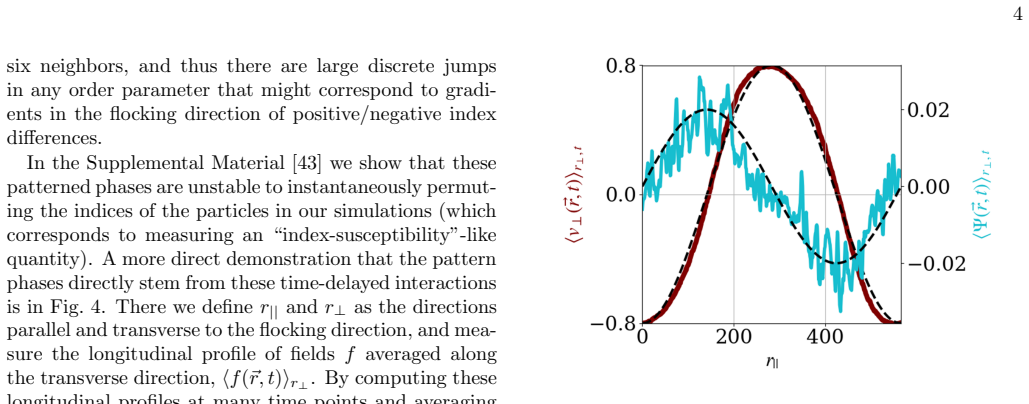
The central object is the index-ordered update rule (Eq. 4): within each timestep, particle i receives time-local information from lower-index neighbors and one-timestep-delayed information from higher-index neighbors. This creates a non-reciprocal, reaction-time-asymmetric interaction. The load-bearing quantity is the spatial organization of the particle index field—the relative index differences between neighboring particles—which the paper argues organizes along the flocking direction and relaxes slowly, although it cannot be measured directly beyond noise. Its effect is captured by Ψ, the difference between the torques actually applied and the torques a time-local Hamiltonian would produce; the sinusoidal longitudinal profile of Ψ supplies the persistent torque that keeps the two bands from aligning into one homogeneous flock.
What would settle it
Simulate the model with the same parameters but replace the full index-ordered update with a two-species rule (half the particles react instantly, half with a one-timestep delay) and measure the transverse-velocity order parameter; if no bimodal banded phase appears in that simpler rule, the slow-relaxing index-order mechanism—not mere time delay—is what the phase depends on. Alternatively, directly measure the autocorrelation time of a local index-gradient observable; if it decays on a timescale much shorter than the lifetime of the bands, the proposed mechanism fails.
Extended reading notes
Core claim
In a Vicsek-like flocking model with torques derived from a ferromagnetic Hamiltonian and Voronoi neighbor lists, the authors replace the simultaneous update rule with an index-ordered rule in which particle i aligns to lower-index neighbors using their updated orientations and to higher-index neighbors using their old orientations. This breaks reaction-time symmetry within a single timestep. Below the usual flocking transition, at low noise, the system develops a new phase in which the flock remains globally polarized but separates into two dense bands with opposite transverse velocities. The Binder cumulant of angles relative to the flocking direction becomes positive for large systems (N ≳ $2^{16}$), indicating a genuinely bimodal distribution rather than long tails, and giant number fluctuations persist. The authors show the phase is unstable to random permutation of particle indices and that the longitudinal profile of Ψ—the difference between the index-ordered torques and the time-local Hamiltonian torques—is sinusoidal and out of phase with the transverse-velocity profile. They conclude that a slowly relaxing spatial organization of the index-order field sustains the counter-propagating bands.
Load-bearing premise
The patterned phase survives only if the spatial ordering of particle indices persists over long times; the paper states this index-order field is prohibitively difficult to measure beyond noise, so its stability is inferred indirectly from the destruction of the pattern under index permutation and from the sinusoidal torque field Ψ.
Editorial extensions
If this is right
- The standard disorder-to-order transition survives the reaction-time asymmetry, so the patterned phase is an additional ordering transition nested inside the polar flocking phase rather than a replacement for it.
- The pattern requires large systems: Binder cumulants show bimodality only for N ≳ 2^16, so smaller simulations would miss the phase entirely.
- Because random permutation of indices destroys the bands, any model that labels particles symmetrically cannot produce this phase; the index ordering is a genuine degree of freedom.
- A metric version of the model shows similar but spatially more complex banded phases, suggesting the mechanism is not an artifact of Voronoi neighbor lists.
- The sinusoidal, out-of-phase relationship between Ψ and the transverse velocity provides a coarse-grained signature that could be measured in other time-delayed flocking models.
Reading between the lines
- A direct testable extension: a two-species version of the model (one species delayed by one timestep, the other reacting instantly) should reproduce the patterned phase if reaction-time asymmetry is the operative ingredient; the paper flags this as future work.
- The Ψ measurement implies that time-delayed alignment is equivalent, at a coarse-grained level, to time-local non-reciprocal torques; if so, other models with explicit non-reciprocal alignment should exhibit analogous banded phases, and an analytic mapping might be derivable via Markovian embedding.
- Because the index-order field is slow-relaxing yet unmeasurable, the patterned phase could represent a genuinely new universality class whose hydrodynamic description couples to an index-gradient field rather than standard polar-flock fields; a continuum derivation would be the next step.
- The finite-size requirement (N ≳ 2^16) suggests the phase may be hard to observe in small experimental groups; detecting it would require large flocks with measurable reaction-time distributions.
Signed reviews
Editorial analysis
A structured set of objections, weighed in public.
Referee Report
Summary. The paper introduces a Vicsek-like model with an index-ordered update rule (Eq. 4) that breaks reaction-time symmetry within a single timestep, mimicking a distribution of reaction times. The authors report that, in addition to the usual disorder-to-order transition, the model exhibits a second transition deep inside the polar flocking phase to a spatially patterned state: two high-density bands propagate together in the global flocking direction with opposite transverse velocities. The transition is characterized with a Binder cumulant of angles relative to the flocking direction (Fig. 3), number fluctuations (Fig. 2), sinusoidal longitudinal profiles of transverse velocity and of the non-reciprocal torque field Ψ (Fig. 4), and a susceptibility to random permutations of particle indices (Supplemental Fig. 5). The paper argues that the patterned phase is stabilized by a slow-relaxing spatial organization of the particle-index field.
Significance. If the second transition survives the thermodynamic limit, this is a genuinely interesting result: it shows that a minimal, seemingly innocuous temporal asymmetry in agent updates can produce a new collective phase beyond the standard Vicsek phenomenology, with potential implications for hydrodynamic descriptions of time-delayed active matter. The work uses large-scale GPU simulations (up to N=2^17, and N=8e5 for the metric model) and includes an independent permutation-based control that ties the patterned phase to index ordering. These are real strengths. However, the central claim of a thermodynamic transition currently rests on finite-size evidence that is not yet quantitatively established, and the proposed index-field mechanism is explicitly acknowledged in the text to be difficult to measure and not analytically mapped. The paper is therefore a promising candidate for publication after substantial revision, but the evidence as presented is not yet conclusive.
major comments (4)
- [Fig. 3 and 'Order parameters for the spatially patterned flocking phase'] The central claim of a second thermodynamic transition is not yet established. The Binder cumulant U_L changes sign only for N >= 2^16, no error bars are shown, and there is no finite-size scaling or crossing analysis that would extrapolate the behavior to L -> infinity. Given the authors' own statement that Vicsek-like models are notoriously sensitive to finite-size effects, a sign change at the largest sizes could be a finite-size crossover rather than a bulk phase transition. Please provide U_L vs. noise for several sizes with statistical uncertainties, and either a finite-size collapse or an explicit discussion of how the transition point and order-parameter distribution behave as L grows.
- [Figs. 1 and 4] The order parameter used in Fig. 3 is a Binder cumulant of scalar relative angles, which does not directly probe the spatial modulation that defines the patterned phase. The manuscript never reports the wavelength or dominant Fourier mode of the transverse-velocity pattern as a function of system size L. In Fig. 1 and Fig. 4 the pattern appears as a single sinusoidal mode across the box; if the dominant mode scales as k_max ~ 1/L, the state is better described as macroscopic two-domain coexistence (a bulk phase separation into two oppositely moving bands) rather than a finite-wavelength spatially patterned phase. Please report the L-dependence of the pattern wavelength and, if possible, the number of bands in larger systems.
- [Discussion of the index field and Supplemental Fig. 5] The mechanistic explanation in the abstract and main text is stronger than the evidence. The text states that the relative index field is 'prohibitively difficult to measure at levels beyond the noise' and that there is 'no clear mechanism' by which negative damping would create spatial structure in the index field. The permutation susceptibility in Supplemental Fig. 5 demonstrates only that the patterned phase requires fixed index labels; it does not directly establish the existence of a persistent, slowly relaxing spatial index-order field. The claim that stability is 'directly tied to a subtle spatial organization' of an index-order field therefore needs either a direct measurement of a coarse-grained index gradient (or a proxy that tracks index-order persistence over time), or a more cautious statement that the mechanism is a plausible but unverified hypothesis.
- [Figs. 2 and 3] The paper does not report statistical uncertainties for any of the key order parameters: the Binder cumulant U_L, the sinusoidal amplitude A in the Fig. 2 inset, and the profiles in Fig. 4. Because the sign of U_L at large N is the primary quantitative evidence for the transition, error bars or block-averaged standard errors are necessary to determine whether the sign change is robust and to support any subsequent finite-size analysis. Please add error bars and specify how many independent runs or blocks were used.
minor comments (6)
- [Eq. (2)] Equation (2) appears to be missing the current angle theta_i(t) on the right-hand side; the orientation update should read theta_i(t + dt) = theta_i(t) + dt * tau_i + eta sqrt(dt) * zeta_i(t), or the definitions should be clarified.
- [Fig. 1 caption] The caption reads 'N = 217 particles'; this should be 'N = 2^17 particles' (or the equivalent superscript notation) to match the text.
- [Fig. 5 caption] The caption of Fig. 5 does not define whether the plotted change in the global order parameter is the absolute value, the signed difference, or an ensemble-averaged magnitude, nor over what time window it is measured. Please clarify.
- [Fig. 2 top panel] The definition 'theta_i = arcsin(n_i . v_perp)' gives only the transverse component of the unit director, not a signed angle about v_parallel; using atan2 of the transverse and parallel components would be more transparent and would make the bimodal distributions easier to interpret.
- [References] Reference [43] is listed as '[url to be inserted by publisher]'; in the current preprint this should point to the actual Supplemental Material or be replaced by a stable identifier.
- [Eq. (4)] The text should state explicitly that the update in Eq. (4) is performed sequentially in increasing index order, so that the theta_j(t + dt) term for i > j refers to neighbors updated earlier in the same timestep; this is clear from context but would benefit from being stated directly.
Circularity Check
No significant circularity: the patterned phase is discovered by direct simulation and independent diagnostics; self-citations are background and not load-bearing.
full rationale
The central finding — a second transition into a spatially patterned flocking phase — is obtained by direct agent-based simulation of Eq. (4), a model defined in the paper, and is characterized by standard, independently computed diagnostics (angle distributions, Binder cumulants, number fluctuations, and a permutation susceptibility). No step in the derivation chain fits a parameter to the target observable and then presents that fit as a prediction. The sinusoidal profiles for v⊥ and Ψ in Fig. 4 are descriptive characterizations of the steady state, not inputs that force the transition. The unmeasured 'index-order field' is openly acknowledged as prohibitively difficult to measure, and no analytical mapping is claimed; these are stated limitations rather than circular reductions. Prior self-citations (refs. 8, 26, 41, 42) are used for background, modeling choices, and GPU code, and none carries the load of the central claim. Finite-size concerns (Binder cumulant sign change only at large N, lack of wavelength-vs-L analysis) are legitimate correctness risks, but they are not circularity. Therefore no circular step is exhibited.
Assumptions & free parameters
free parameters (4)
- alignment strength alpha =
4
- self-propulsion speed v0 =
0.5
- number density rho =
1.0
- time step delta t =
1
assumptions (5)
- domain assumption The XY-Hamiltonian torque in Eq. (3) together with Voronoi neighbor lists captures the standard Vicsek alignment and its disorder-to-order transition.
- domain assumption The index-ordered update rule in Eq. (4) faithfully represents a distribution of reaction-time delays with time-scale separation.
- standard math The Binder cumulant U_L = 1 - (theta^4)/(3(theta^2)^2) is a valid order parameter for locating the transition to the patterned phase.
- domain assumption The torques from Eq. (4) can be meaningfully compared to time-local torques from Eq. (3) to define the non-reciprocal field Psi.
- domain assumption Periodic boundary conditions and finite system sizes up to N=2^17 are sufficient to access the thermodynamic limit behavior of the phase.
invented entities (1)
-
Hydrodynamic index-order field (index field)
Cite this review
Pith. "Pith review of Spatially patterned phases in a reaction-time-symmetry-broken model of flocking." pith.science (2026). https://pith.science/paper/YJZKMJPM
@misc{pith2026250510657,
  author       = {Pith},
  title        = {Pith review of: Spatially patterned phases in a reaction-time-symmetry-broken model of flocking},
  year         = {2026},
  howpublished = {\url{https://pith.science/paper/YJZKMJPM}},
  note         = {Machine review of arXiv:2505.10657}
}
read the original abstract
We introduce a Vicsek-like flocking model with a minimal form of time-delayed orientational interactions, in which the delays occur on a time scale that is well-separated from other time scales in the model. We achieve this by implementing an ``index-ordered'' update rule, mimicking a scenario in which agents have a distribution of times with which they react to information. This model retains the usual disorder-to-order transition common in flocking models, but we show that it also possesses a second transition, deep in the polar flocking phase, to a state with spatially patterned transverse velocities. We characterize this transition and its sensitivity to finite-size effects using the Binder cumulant, and demonstrate -- via direct measurements and by measuring a susceptibility of the phase to particle index permutations -- that the stability of this phase is directly tied to a subtle spatial organization of a slow-relaxing index-order field. These results highlight the potential for even seemingly insignificant temporal asymmetries to fundamentally alter the collective behavior of active matter.
Figures


Figures from the paper (3 more)


Forward citations
Cited by 1 Pith paper
-
Gigantic dynamical spreading and anomalous diffusion of jerky active particles
A linear third-order 'jerk' equation driven by active Ornstein-Uhlenbeck noise yields mean-square displacement scaling with time exponents 6, 5, 4, or 3, and can destabilize harmonic confinement.
Reference graph
Works this paper leans on
-
[1]
M. C. Marchetti, J.-F. Joanny, S. Ramaswamy, T. B. Liverpool, J. Prost, M. Rao, and R. A. Simha, Hydrody- namics of soft active matter, Reviews of modern physics 85, 1143 (2013)
2013
-
[2]
C. W. Reynolds, Flocks, herds and schools: A distributed behavioral model, in Proceedings of the 14th annual con- ference on Computer graphics and interactive techniques (1987) pp. 25–34
work page 1987
-
[3]
Vicsek, A
T. Vicsek, A. Czir´ ok, E. Ben-Jacob, I. Cohen, and O. Shochet, Novel Type of Phase Transition in a Sys- tem of Self-Driven Particles, Physical Review Letters 75, 1226 (1995)
1995
-
[4]
Jentsch and C
P. Jentsch and C. F. Lee, New Universality Class De- scribes Vicsek’s Flocking Phase in Physical Dimensions, Physical Review Letters 133, 128301 (2024)
2024
-
[5]
B. Mahault, F. Ginelli, and H. Chat´ e, Quantitative As- sessment of the Toner and Tu Theory of Polar Flocks, Physical Review Letters 123, 218001 (2019)
work page 2019
- [6]
-
[7]
F. Ginelli and H. Chat´ e, Relevance of Metric-Free Inter- actions in Flocking Phenomena, Physical Review Letters 105, 168103 (2010)
work page 2010
-
[8]
C. R. Packard and D. M. Sussman, Banded phases in topological flocks (2024), arXiv:2409.05198 [cond-mat]
arXiv 2024
Show all 48 references
-
[9]
Toner and Y
J. Toner and Y. Tu, Long-Range Order in a Two- Dimensional Dynamical $\mathrm{XY}$ Model: How Birds Fly Together, Physical Review Letters 75, 4326 (1995)
1995
-
[10]
Toner and Y
J. Toner and Y. Tu, Flocks, herds, and schools: A quan- titative theory of flocking, Physical Review E 58, 4828 (1998)
1998
-
[11]
Toner, The physics of flocking: birth, death, and flight in active matter (Cambridge University Press, 2024)
J. Toner, The physics of flocking: birth, death, and flight in active matter (Cambridge University Press, 2024)
2024
-
[12]
Toner, Why walking is easier than pointing: Hydro- dynamics of dry active matter (2018), arXiv:1812.00310 [cond-mat]
J. Toner, Why walking is easier than pointing: Hydro- dynamics of dry active matter (2018), arXiv:1812.00310 [cond-mat]
2018 arXiv
-
[13]
Bertin, M
E. Bertin, M. Droz, and G. Gr´ egoire, Boltzmann and hy- drodynamic description for self-propelled particles, Phys- ical Review E—Statistical, Nonlinear, and Soft Matter Physics 74, 022101 (2006)
2006
-
[14]
Ihle, Kinetic theory of flocking: Derivation of hydro- dynamic equations, Physical Review E—Statistical, Non- linear, and Soft Matter Physics 83, 030901 (2011)
T. Ihle, Kinetic theory of flocking: Derivation of hydro- dynamic equations, Physical Review E—Statistical, Non- linear, and Soft Matter Physics 83, 030901 (2011)
2011
-
[15]
Geyer, A
D. Geyer, A. Morin, and D. Bartolo, Sounds and hydro- dynamics of polar active fluids, Nature materials 17, 789 (2018)
2018
-
[16]
Maitra, P
A. Maitra, P. Jentsch, L. Chen, C. F. Lee, J. Toner, and S. Ramaswamy, The inconvenient truth about flocks (2025), arXiv:2503.17064 [cond-mat.soft]
2025 arXiv
-
[17]
Chepizhko, D
O. Chepizhko, D. Saintillan, and F. Peruani, Revisiting the emergence of order in active matter, Soft Matter 17, 3113 (2021)
2021
-
[18]
Toner, Birth, Death, and Flight: A Theory of Malthu- sian Flocks, Physical Review Letters 108, 088102 (2012)
J. Toner, Birth, Death, and Flight: A Theory of Malthu- sian Flocks, Physical Review Letters 108, 088102 (2012)
2012
-
[19]
Cavagna, L
A. Cavagna, L. Di Carlo, I. Giardina, T. S. Grigera, S. Melillo, L. Parisi, G. Pisegna, and M. Scandolo, Natu- ral swarms in 3.99 dimensions, Nature Physics 19, 1043 (2023)
2023
-
[20]
L. P. Dadhichi, J. Kethapelli, R. Chajwa, S. Ramaswamy, and A. Maitra, Nonmutual torques and the unimportance of motility for long-range order in two-dimensional flocks, Physical Review E 101, 052601 (2020)
2020
-
[21]
Q.-s. Chen, A. Patelli, H. Chat´ e, Y.-q. Ma, and X.-q. Shi, Fore-aft asymmetric flocking, Physical Review E 96, 020601 (2017)
2017
-
[22]
Mangeat, S
M. Mangeat, S. Chatterjee, J. D. Noh, and H. Rieger, Emergent complex phases in a discrete flocking model with reciprocal and non-reciprocal interactions, arXiv preprint arXiv:2412.02501 (2024)
2024 arXiv
-
[23]
Sinha and D
A. Sinha and D. Chaudhuri, How reciprocity impacts ordering and phase separation in active nematics?, Soft Matter 20, 788 (2024)
2024
-
[24]
Fruchart, R
M. Fruchart, R. Hanai, P. B. Littlewood, and V. Vitelli, Non-reciprocal phase transitions, Nature 592, 363 (2021)
2021
-
[25]
Ballerini, N
M. Ballerini, N. Cabibbo, R. Candelier, A. Cavagna, E. Cisbani, I. Giardina, V. Lecomte, A. Orlandi, G. Parisi, A. Procaccini, et al. , Interaction ruling an- imal collective behavior depends on topological rather than metric distance: Evidence from a field study, Pro- ceeding...
2008
-
[26]
D. M. Sussman, Non-metric interaction rules in models of active matter (2021), arXiv:2103.10239 [cond-mat]
2021 arXiv
-
[27]
M. Nagy, Z. ´Akos, D. Biro, and T. Vicsek, Hierarchical group dynamics in pigeon flocks, Nature 464, 890 (2010). 7
2010
-
[28]
G´ omez-Nava, R
L. G´ omez-Nava, R. Bon, and F. Peruani, Intermittent collective motion in sheep results from alternating the role of leader and follower, Nature Physics 18, 1494 (2022)
2022
-
[29]
Y. Sun, W. Lin, and R. Erban, Time delay can facili- tate coherence in self-driven interacting-particle systems, Physical Review E 90, 062708 (2014)
2014
-
[30]
Erban, J
R. Erban, J. Haskovec, and Y. Sun, A cucker–smale model with noise and delay, SIAM Journal on Applied Mathematics 76, 1535 (2016)
2016
-
[31]
Durve, A
M. Durve, A. Saha, and A. Sayeed, Active particle con- densation by non-reciprocal and time-delayed interac- tions, The European Physical Journal E 41, 49 (2018)
2018
-
[32]
Choi and J
Y.-P. Choi and J. Haskovec, Hydrodynamic cucker–smale model with normalized communication weights and time delay, SIAM Journal on Mathematical Analysis 51, 2660 (2019)
2019
-
[33]
D. Chen, M. Kang, and W. Yu, Probabilistic causal in- ference for coordinated movement of pigeon flocks, Euro- physics Letters 130, 28004 (2020)
2020
-
[34]
Chen and Y
Z. Chen and Y. Zheng, Persistent and responsive collec- tive motion with adaptive time delay, Science Advances 10, eadk3914 (2024)
2024
-
[35]
Holubec, D
V. Holubec, D. Geiss, S. A. M. Loos, K. Kroy, and F. Ci- chos, Finite-Size Scaling at the Edge of Disorder in a Time-Delay Vicsek Model, Physical Review Letters 127, 258001 (2021)
2021
-
[36]
Wang, P.-C
X. Wang, P.-C. Chen, K. Kroy, V. Holubec, and F. Ci- chos, Spontaneous vortex formation by microswimmers with retarded attractions, Nature Communications 14, 56 (2023)
2023
-
[37]
D. Geiß, K. Kroy, and V. Holubec, Signal propagation and linear response in the delay Vicsek model, Physical Review E 106, 054612 (2022)
2022
-
[38]
Pakpour and T
F. Pakpour and T. Vicsek, Delay-induced phase transi- tions in active matter, Physica A: Statistical Mechanics and its Applications 634, 129453 (2024)
2024
-
[39]
Giuggioli, T
L. Giuggioli, T. J. McKetterick, and M. Holderied, De- layed response and biosonar perception explain move- ment coordination in trawling bats, PLoS computational biology 11, e1004089 (2015)
2015
-
[40]
Zhang, S
Y. Zhang, S. Wang, D.-b. Pan, and G. Zhang, Stability analysis for a new lattice hydrodynamic model with time- varying delay in sensing traffic flux, Physica A: Statistical Mechanics and Its Applications 561, 125269 (2021)
2021
-
[41]
Packard and D
C. Packard and D. M. Sussman, Non-reciprocal forces and exceptional phase transitions in metric and topolog- ical flocks, arXiv preprint arXiv:2208.09461 (2022)
2022 arXiv
-
[42]
D. M. Sussman, cellGPU: Massively parallel simulations of dynamic vertex models, Computer Physics Communi- cations 219, 400 (2017)
2017
-
[43]
[url to be inserted by publisher] (2025)
2025
-
[44]
Ginelli, The physics of the vicsek model, The Euro- pean Physical Journal Special Topics 225, 2099 (2016)
F. Ginelli, The physics of the vicsek model, The Euro- pean Physical Journal Special Topics 225, 2099 (2016)
2016
-
[45]
Chat´ e, F
H. Chat´ e, F. Ginelli, G. Gr´ egoire, and F. Raynaud, Col- lective motion of self-propelled particles interacting with- out cohesion, Physical Review E—Statistical, Nonlinear, and Soft Matter Physics 77, 046113 (2008)
2008
-
[46]
S. A. Loos and S. H. Klapp, Fokker–planck equations for time-delayed systems via markovian embedding, Journal of Statistical Physics 177, 95 (2019)
2019
-
[47]
S. A. Loos, Stochastic systems with time delay: probabilis- tic and thermodynamic descriptions of non-Markovian processes far from equilibrium (Springer Nature, 2021)
2021
-
[48]
Jenkins, Self-oscillation, Physics Reports Self- Oscillation, 525, 167 (2013)
A. Jenkins, Self-oscillation, Physics Reports Self- Oscillation, 525, 167 (2013)
2013
Reviewed August 15, 2026 · model on record in the stance chip above.
Discussion (0). Continue with ORCID to comment.