REVIEW 4 major objections 6 minor 44 references
WATCHED: A Web AI Agent Tool for Combating Hate Speech by Expanding Data
T0 review · 4 major / 6 minor · reviewed 2026-08-05 · deepseek-v4-flash
Pith's one-line read An AI agent that combines four tools beats standalone hate-speech detectors, reaching macro F1 of 0.91.
desk verdict The system is a sensible engineering integration, but the SOTA claim is unsupported: Table 2's baseline numbers are the original MetaHate scores, not recomputed on the reannotated labels. read the letter →
The pith
A machine-rendered reading of the paper's core claim, the machinery that carries it, and where it could break.
The reading
What carries the argument
The carrying mechanism is the agent itself: a small instruction-tuned LLM (qwen2.5:7b-instruct) that decides which tools to call for each input. The tools are a MetaHateBERT hate-speech classifier, a Qdrant vector search over 1,164,586 MetaHate posts, an Urban Dictionary lookup for informal or evolving language, a call to the distilled reasoning model Distil MetaHate, and a guidelines database used to attach policy references to explanations. The agent synthesizes tool outputs and chain-of-thought reasoning into a binary label, a confidence score, and an explanation.
What would settle it
Run WATCHED and all baselines on the reannotated 2,001-example test set using the released labels and also using the original MetaHate labels, and report the inter-annotator agreement between the two experts; if the baselines tie or beat WATCHED on the original labels, or if the new labels disagree with the original labels beyond expected noise, the paper's margin disappears.
Extended reading notes
Core claim
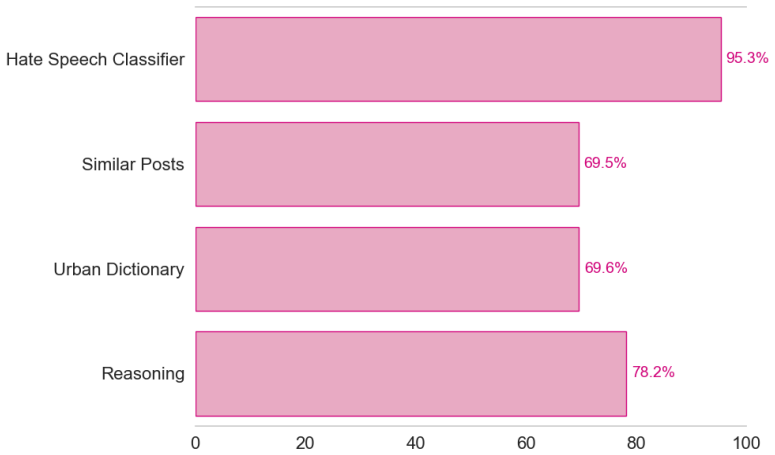
The central claim is that an LLM-driven agent with access to four specialized tools outperforms every standalone baseline it is compared against, including the previous state-of-the-art hate-speech models, on the same evaluation data. WATCHED reaches a macro F1 of 0.9139 versus 0.8807 for Distil MetaHate and 0.8801 for MetaHateBERT. Ablation results show that removing any single tool lowers performance: dropping the BERT classifier causes the largest drop (macro F1 0.8571), removing similar-post retrieval gives 0.8733, removing Urban Dictionary gives 0.8753, and removing the reasoning tool gives 0.8853; removing all tools drops macro F1 to 0.8053. The authors interpret this as evidence that
Load-bearing premise
The comparison rests on the 2,001-example reannotation: if the two experts' new labels drifted toward WATCHED's outputs, or if baseline scores were computed on different labels than the agent's, the claimed superiority would not hold.
Editorial extensions
If this is right
- If the result replicates, moderator-support tools can offer higher accuracy and explanations in a single interface, rather than a black-box classifier plus a separate explanation step.
- Human feedback on each decision can be written back into the retrieval database, letting the system adapt to new slang and edge cases without retraining.
- The ablation ordering suggests that a strong domain-specific classifier is the largest single contributor, but retrieval and slang lookup add measurable value—so simpler pipelines can be improved by adding these components.
- The modular design implies the same agent pattern can be adapted to other online harms by swapping the classifier and guideline sources.
Reading between the lines
- The reported margin may depend on the reannotation: if the new labels systematically favor WATCHED's outputs, or if baseline numbers were taken from prior publications rather than recomputed on the same labels, the 0.91 figure could overstate the gain; this can be checked directly with the released labels.
- The Urban Dictionary tool is intended to reduce false positives on AAVE and informal dialects, but its effect is not measured separately by dialect; a controlled error-rate analysis by language variety would test that mechanism.
- The reasoning tool takes about 30 seconds per query, which is a practical bottleneck for real-time moderation; a faster distilled reasoner or caching of repeated evidence could make the approach deployment-ready.
Editorial analysis
A structured set of objections, weighed in public.
Referee Report
Summary. The paper presents WATCHED, an AI-agent system for hate speech detection that combines a fine-tuned BERT classifier (MetaHateBERT), retrieval-augmented generation over a vector database of MetaHate posts, Urban Dictionary lookups, a distilled reasoning LLM (Distil MetaHate), and social-network guideline retrieval. The agent produces a binary hate-speech label, a confidence score, and an explanation grounded in retrieved examples and policies. The authors evaluate on a 2,001-example subset of MetaHate that they reannotated with two expert annotators, reporting a macro F1 of 0.9139, which they claim surpasses existing state-of-the-art methods. An ablation study shows that removing any single tool degrades performance. The paper includes open-source code and releases the reannotated labels.
Significance. If the evaluation were sound, WATCHED would be a practically valuable contribution: it combines several complementary evidence sources (classifier, retrieval, slang definitions, reasoning, policy) into a single transparent moderation tool, and it reports a substantial improvement over strong MetaHate-trained baselines. The open-source release and the decision to reannotate the test subset to improve label reliability are commendable. However, the central claim of superiority is not supported by the evidence as presented: the baseline numbers appear to have been taken from prior publications rather than recomputed on the reannotated labels, and the single-run evaluation lacks any measure of variability. These are load-bearing issues that must be resolved before the result can be accepted.
major comments (4)
- [Section 2.3.4, Table 2] The F1_MACRO values for MetaHateBERT (0.8801) and Distil MetaHate (0.8807) reported in Table 2 are numerically identical to the values from the original publications [31] and [32] quoted in the same section. Since Section 2.3.1 states that the 2,001-instance evaluation sample was reannotated by two independent experts, any label changes would be expected to alter these scores at least at the fourth decimal. The exact equality indicates that the baselines were not evaluated on the reannotated labels but rather copied from prior results. Consequently, WATCHED's 0.9139 is measured against a different ground truth than the baseline scores, invalidating the 'surpasses existing state-of-the-art' claim in the abstract and Section 5. The authors must rerun all baselines on the same reannotated labels and report those numbers.
- [Section 2.3.3] The sentence 'we adopt the baselines and experimental settings from [32], and we report the metrics on the reannotated test split' is ambiguous. It could mean that all baselines were recomputed on the reannotated split, or that the metrics are simply reported as in [32]. The ambiguity is consequential: if the baselines were recomputed, the authors should explain why the scores coincide exactly with [32]; if not, they must state that explicitly and provide a rerun. Releasing the reannotated labels makes such a rerun feasible.
- [Section 2.3.1] No inter-annotator agreement is reported for the reannotation of the 2,001-instance evaluation sample. The sentence 'Two domain experts independently annotated the data' is insufficient. The authors should report Cohen's kappa or an equivalent agreement measure, describe the annotators' expertise and the annotation guidelines, and state the number and resolution of disagreements. Without this information, the reliability of the reannotated ground truth—and hence the validity of every comparison—cannot be assessed.
- [Section 2.3.4 and Section 2.3.5] All results, including the main comparison and the ablations, come from a single evaluation run. The agent uses stochastic LLM inference (qwen2.5:7b and Llama-3-8B) and tool calls, so run-to-run variability is expected. No confidence intervals, significance tests (e.g., McNemar or bootstrap), or repeated runs are reported. The observed gap between WATCHED (0.9139) and Distil MetaHate (0.8807) could be within this variability. The authors should report means and standard deviations over multiple runs and apply a significance test to the key comparisons.
minor comments (6)
- [Tables 2 and 3] The tables are numbered 'Table 2.3.4' and 'Table 2.3.5' in the text; they should be numbered continuously (e.g., Table 2 and Table 3).
- [Abstract] Typo: 'W ATCHEDa chatbot' should be 'WATCHED, a chatbot'.
- [Section 2.3.2] The Llama 3 8B and Llama 3 70B baselines are described as 'general-purpose LLMs', but no prompting strategy or number of few-shot examples is specified. This information should be provided in Section 2.3.3 for reproducibility.
- [Section 2.3.2] The Perspective API output is binarized with a 0.5 threshold without justification. Report sensitivity to this threshold or cite a standard choice.
- [Section 5] Typo: 'whether the input constitutes hate speech or note' should be 'or not'.
- [Figure 1] The figure is difficult to read at the current resolution; a vector version would improve clarity.
Circularity Check
No circular derivation: WATCHED is evaluated in-domain with self-citations, but no claimed prediction reduces to its fitted inputs by construction.
full rationale
The paper's central claim is an empirical performance comparison, not a derivation in which an output is defined as equivalent to an input. WATCHED combines an LLM agent with tools built on public resources; its RAG corpus is constructed from the MetaHate train split, and the evaluation is performed on a held-out 2,001-instance subsample that is explicitly excluded from the RAG database and from the training of the component models. The reannotated evaluation labels were produced by two independent human experts with consensus, and no text indicates that WATCHED influenced those labels, so the ground truth is not derived from the system's own outputs. The system does rely heavily on the authors' prior work (MetaHate and Distil MetaHate), and the baselines are the authors' own prior models, but self-citation alone is not circularity: those artifacts are public, externally usable components and the comparison is a legitimate empirical benchmark. A notable evaluation concern is that Table 2 reports baseline F1_MACRO values identical to those in [32] despite claiming all metrics are on the reannotated subset, which suggests the baselines may have been scored on different labels; however, that is a threat to the validity of the comparison, not a circularity in which WATCHED's prediction is equivalent to its inputs by construction. No specific reduction of a claimed result to its fitted inputs can be exhibited from the paper's text, so the appropriate circularity score is low.
Assumptions & free parameters
free parameters (3)
- Number of retrieved similar posts (top-k) =
5
- Agent retry limit =
5
- Perspective API binarization threshold =
0.5
assumptions (3)
- domain assumption MetaHate dataset labels are a valid ground truth for hate speech, and the reannotated expert labels improve reliability.
- domain assumption Posts similar in embedding space to query posts are semantically relevant exemplars for classification.
- domain assumption Urban Dictionary definitions mitigate false positives for slang and AAVE.
Cite this review
Pith. "Pith review of WATCHED: A Web AI Agent Tool for Combating Hate Speech by Expanding Data." pith.science (2026). https://pith.science/paper/YJZLIC2J
@misc{pith2026250901379,
  author       = {Pith},
  title        = {Pith review of: WATCHED: A Web AI Agent Tool for Combating Hate Speech by Expanding Data},
  year         = {2026},
  howpublished = {\url{https://pith.science/paper/YJZLIC2J}},
  note         = {Machine review of arXiv:2509.01379}
}
read the original abstract
Online harms are a growing problem in digital spaces, putting user safety at risk and reducing trust in social media platforms. One of the most persistent forms of harm is hate speech. To address this, we need tools that combine the speed and scale of automated systems with the judgment and insight of human moderators. These tools should not only find harmful content but also explain their decisions clearly, helping to build trust and understanding. In this paper, we present WATCHED, a chatbot designed to support content moderators in tackling hate speech. The chatbot is built as an Artificial Intelligence Agent system that uses Large Language Models along with several specialised tools. It compares new posts with real examples of hate speech and neutral content, uses a BERT-based classifier to help flag harmful messages, looks up slang and informal language using sources like Urban Dictionary, generates chain-of-thought reasoning, and checks platform guidelines to explain and support its decisions. This combination allows the chatbot not only to detect hate speech but to explain why content is considered harmful, grounded in both precedent and policy. Experimental results show that our proposed method surpasses existing state-of-the-art methods, reaching a macro F1 score of 0.91. Designed for moderators, safety teams, and researchers, the tool helps reduce online harms by supporting collaboration between AI and human oversight.
Figures


Figures from the paper (2 more)


Reference graph
Works this paper leans on
-
[31]
P. Piot, P. Mart ´ ın-Rodilla, J. Parapar, Metahate: A dataset for unify- ing efforts on hate speech detection, Proceedings of the International AAAI Conference on Web and Social Media 18 (1) (2024) 2025–2039. doi:10.1609/icwsm.v18i1.31445. URL https://ojs.aaai.org/index.php/ICWSM/article/view/ 31445
-
[32]
P. Piot, J. Parapar, Towards Efficient and Explainable Hate Speech Detection via Model Distillation, Springer Nature Switzerland, 2025, p. 376–392. doi:10.1007/978-3-031-88711-6_24 . URL http://dx.doi.org/10.1007/978-3-031-88711-6_24
-
[1]
A. Founta, C. Djouvas, D. Chatzakou, I. Leontiadis, J. Blackburn, G. Stringhini, ..., N. Kourtellis, Large scale crowdsourcing and charac- terization of twitter abusive behavior, Proceedings of the ICWSM 2018 12 (1) (Jun. 2018). doi:10.1609/icwsm.v12i1.14991. 14
-
[2]
T. Davidson, D. Warmsley, M. Macy, I. Weber, Automated hate speech detection and the problem of offensive language, Proceedings of the ICWSM 2017 11 (1) (2017) 512–515. doi:10.1609/icwsm.v11i1. 14955
-
[3]
M. ElSherief, V. Kulkarni, D. Nguyen, W. Yang Wang, E. Belding, Hate lingo: A target-based linguistic analysis of hate speech in social media, Proceedings of the ICWSM 2018 12 (1) (Jun. 2018). doi:10.1609/ icwsm.v12i1.15041
work page 2018
-
[4]
M. ElSherief, S. Nilizadeh, D. Nguyen, G. Vigna, E. Belding, Peer to peer hate: Hate speech instigators and their targets, Proceedings of the ICWSM 2018 12 (1) (Jun. 2018). doi:10.1609/icwsm.v12i1.15038
-
[5]
M. Das, R. Raj, P. Saha, B. Mathew, M. Gupta, A. Mukherjee, Hatemm: A multi-modal dataset for hate video classification, Proceedings of the ICWSM 2023 17 (2023) 1014–1023. doi:10.1609/icwsm.v17i1.22209
-
[6]
S. Gonz´ alez-Bail´ on, Y. Lelkes, Do social media undermine social cohe- sion? a critical review, Social Issues and Policy Review 17 (1) (2022) 155–180. doi:10.1111/sipr.12091. URL http://dx.doi.org/10.1111/sipr.12091
Show all 44 references
-
[7]
Kansok-Dusche, C
J. Kansok-Dusche, C. Ballaschk, N. Krause, A. Zeißig, L. Seemann- Herz, S. Wachs, L. Bilz, A systematic review on hate speech among children and adolescents: Definitions, prevalence, and overlap with re- lated phenomena, Trauma, Violence, & Abuse 24 (4) (2022) 2598–2615. doi:1...
2022 doi
-
[8]
URL https://www.adl.org/resources/report/ online-hate-and-harassment-american-experience-2024
Anti-Defamation League, Online hate and harassment: The american experience 2024, accessed: 03/01/2024 (2024). URL https://www.adl.org/resources/report/ online-hate-and-harassment-american-experience-2024
2024
-
[9]
R. Booth, Meta to get rid of factcheckers and rec- ommend more political content — theguardian.com, https://www.theguardian.com/technology/2025/jan/07/ meta-facebook-instagram-threads-mark-zuckerberg-remove-fact-checkers-recommend-political-content , [Accessed 03-02-2025] (2025)
2025
-
[10]
Waseem, D
Z. Waseem, D. Hovy, Hateful symbols or hateful people? predictive fea- tures for hate speech detection on Twitter, in: J. Andreas, E. Choi, 15 A. Lazaridou (Eds.), Proceedings of the NAACL Student Research Workshop, Association for Computational Linguistics, San Diego, Cali- f...
2016 doi
-
[11]
Davidson, D
T. Davidson, D. Warmsley, M. Macy, I. Weber, Automated hate speech detection and the problem of offensive language, Proceedings of the International AAAI Conference on Web and Social Media 11 (1) (2017) 512–515. doi:10.1609/icwsm.v11i1.14955. URL https://ojs.aaai.org/index.php...
2017 doi
-
[12]
Chatzakou, N
D. Chatzakou, N. Kourtellis, J. Blackburn, E. De Cristofaro, G. Stringh- ini, A. Vakali, Mean birds: Detecting aggression and bullying on twitter, in: Proceedings of the 2017 ACM on Web Science Conference, WebSci ’17, Association for Computing Machinery, New York, NY, USA, 201...
2017
-
[13]
Tahmasbi, E
N. Tahmasbi, E. Rastegari, A socio-contextual approach in automated detection of public cyberbullying on twitter, ACM Transactions on So- cial Computing 1 (4) (2018) 1–22. doi:10.1145/3290838. URL http://dx.doi.org/10.1145/3290838
2018 doi
-
[14]
J. Qian, A. Bethke, Y. Liu, E. Belding, W. Y. Wang, A benchmark dataset for learning to intervene in online hate speech, in: K. Inui, J. Jiang, V. Ng, X. Wan (Eds.), Proceedings of the 2019 Confer- ence on Empirical Methods in Natural Language Processing and the 9th Internatio...
2019 doi
-
[16]
Grimminger, R
L. Grimminger, R. Klinger, Hate towards the political opponent: A Twitter corpus study of the 2020 US elections on the basis of offensive speech and stance detection, in: O. De Clercq, A. Balahur, J. Sedoc, V. Barriere, S. Tafreshi, S. Buechel, V. Hoste (Eds.), Proceedings of ...
2020
-
[17]
Glavaˇ s, V
G. Glavaˇ s, V. M. Karan, I. Vuli´ c, XHate-999: Analyzing and detecting abusive language across domains and languages, in: D. Scott, N. Bel, C. Zong (Eds.), Proceedings of the 28th International Conference on Computational Linguistics, International Committee on Computational...
2020
-
[18]
F. M. Plaza-del arco, D. Nozza, D. Hovy, Respectful or toxic? using zero-shot learning with language models to detect hate speech, in: Y.-l. Chung, P. R {\”ottger}, D. Nozza, Z. Talat, A. Mostafazadeh Davani (Eds.), The 7th Workshop on Online Abuse and Harms (WOAH), As- sociat...
2023 doi
-
[19]
S. Roy, A. Harshvardhan, A. Mukherjee, P. Saha, Probing LLMs for hate speech detection: strengths and vulnerabilities, in: H. Bouamor, J. Pino, K. Bali (Eds.), Findings of the Association for Computational Linguis- tics: EMNLP 2023, Association for Computational Linguistics, S...
2023 doi
-
[20]
Y.-S. Wang, Y. Chang, Toxicity detection with generative prompt-based inference (2022). arXiv:2205.12390. URL https://arxiv.org/abs/2205.12390
2022 arXiv
-
[21]
P. Piot, J. Parapar, Decoding hate: Exploring language models’ reac- tions to hate speech, in: L. Chiruzzo, A. Ritter, L. Wang (Eds.), Pro- ceedings of the 2025 Conference of the Nations of the Americas Chap- ter of the Association for Computational Linguistics: Human Language...
2025
-
[22]
A. P. Wright, O. Shaikh, H. Park, W. Epperson, M. Ahmed, S. Pinel, D. H. P. Chau, D. Yang, Recast: Enabling user recourse and in- 17 terpretability of toxicity detection models with interactive visualiza- tion, Proc. ACM Hum.-Comput. Interact. 5 (CSCW1) (Apr. 2021). doi:10.114...
2021 doi
-
[23]
Ranasinghe, M
T. Ranasinghe, M. Zampieri, MUDES: Multilingual detection of of- fensive spans, in: Proceedings of the 2021 NAACL: Human Lan- guage Technologies: Demonstrations, ACL, Online, 2021, pp. 144–152. doi:10.18653/v1/2021.naacl-demos.17. URL https://aclanthology.org/2021.naacl-demos.17
2021 doi
-
[24]
Camacho-collados, K
J. Camacho-collados, K. Rezaee, T. Riahi, A. Ushio, D. Loureiro, D. An- typas, J. Boisson, L. Espinosa Anke, F. Liu, E. Mart ´ ınez C´ amara, TweetNLP: Cutting-edge natural language processing for social media, in: Proceedings of the 2022 Conference on EMNLP: System Demon- str...
2022 doi
-
[25]
Tillmann, A
C. Tillmann, A. Trivedi, S. Rosenthal, S. Borse, R. Zhang, A. Sil, B. Bhattacharjee, Muted: Multilingual targeted offensive speech iden- tification and visualization, in: Proceedings of the 2023 Conference on EMNLP: System Demonstrations, ACL, Singapore, 2023, pp. 229–236. doi...
2023 doi
-
[26]
T. Le, Y. Ye, Y. Hu, D. Lee, Cryptext: Database and interactive toolkit of human-written text perturbations in the wild, in: 2023 IEEE 39th International Conference on Data Engineering (ICDE), IEEE, 2023, p. 3639–3642. doi:10.1109/icde55515.2023.00287. URL http://dx.doi.org/10...
2023
-
[27]
Mosca, D
E. Mosca, D. Dementieva, T. Ebrahim Ajdari, M. Kummeth, K. Gringauz, Y. Zhou, G. Groh, IF AN: An explainability-focused in- teraction framework for humans and NLP models, in: Proceedings of the 13th IJCNLP — AACL: System Demonstrations, ACL, Bali, In- donesia, 2023, pp. 59–76....
2023 doi
-
[28]
G. Damo, N. B. Ocampo, E. Cabrio, S. Villata, PEACE: Providing Explanations and Analysis for Combating Hate Expressions, in: 27th ECAI 2024, Santiago de Compostela, Spain, 2024. URL https://hal.science/hal-04684950 18
2024
-
[29]
Rayhan, M
N. Rayhan, M. Ashrafuzzaman, Llm enhancer: Merged approach using vector embedding for reducing large language model hallucinations with external knowledge (2025). arXiv:2504.21132. URL https://arxiv.org/abs/2504.21132
2025 arXiv
-
[30]
Sapkota, K
R. Sapkota, K. I. Roumeliotis, M. Karkee, Ai agents vs. agentic ai: A conceptual taxonomy, applications and challenges (2025). arXiv: 2505.10468. URL https://arxiv.org/abs/2505.10468
2025
-
[33]
Lewis, E
P. Lewis, E. Perez, A. Piktus, F. Petroni, V. Karpukhin, N. Goyal, H. K¨ uttler, M. Lewis, W.-t. Yih, T. Rockt¨ aschel, S. Riedel, D. Kiela, Retrieval-augmented generation for knowledge-intensive nlp tasks, in: H. Larochelle, M. Ranzato, R. Hadsell, M. Balcan, H. Lin (Eds.), A...
2020
-
[34]
co/docs/smolagents/en/examples/rag, [Accessed 27-05-2025] (2025)
Hugging Face, Agentic RAG — huggingface.co, https://huggingface. co/docs/smolagents/en/examples/rag, [Accessed 27-05-2025] (2025)
2025
-
[35]
URL https://github.com/qdrant/qdrant
Qdrant Team, Qdrant: Vector database, accessed: 2025-05-27 (2025). URL https://github.com/qdrant/qdrant
2025
-
[36]
Sturua, I
S. Sturua, I. Mohr, M. Kalim Akram, M. G¨ unther, B. Wang, M. Krim- mel, F. Wang, G. Mastrapas, A. Koukounas, N. Wang, H. Xiao, Jina embeddings v3: Multilingual text encoder with low-rank adaptations, in: Advances in Information Retrieval: 47th European Conference on Informati...
2025 doi
-
[37]
Aum¨ uller, E
M. Aum¨ uller, E. Bernhardsson, A. Faithfull, Ann-benchmarks: A bench- marking tool for approximate nearest neighbor algorithms, Information Systems 87 (2020) 101374. doi:10.1016/j.is.2019.02.006. URL http://dx.doi.org/10.1016/j.is.2019.02.006
2020 doi
-
[38]
Jina AI, Jina Embeddings v3: A Frontier Multilingual Embedding Model — jina.ai, https://jina.ai/news/ jina-embeddings-v3-a-frontier-multilingual-embedding-model/ , [Accessed 27-05-2025] (2024)
2025
-
[39]
Dictionary, Urban dictionary, https://www.urbandictionary.com, accessed: 2025-05-27 (2025)
U. Dictionary, Urban dictionary, https://www.urbandictionary.com, accessed: 2025-05-27 (2025)
2025
-
[40]
L. L. Panjaitan, A. N. Patria, Social media and language evolution: The impact of digital communication on language change, International Journal of Linguistics, Literature and Translation 7 (12) (2024) 53–57. doi:10.32996/ijllt.2024.7.12.8. URL http://dx.doi.org/10.32996/ijll...
2024 doi
-
[41]
Malik, F
B. Malik, F. Iftikhar, T. Gurmani, Transformative impact of social me- dia platforms on language evolution: Creation and adoption of emerging lexicon, Journal of Arts and Linguistics Studies 3 (1) (2025) 249–268. doi:10.71281/jals.v3i1.218. URL https://jals.miard.org/index.php...
2025 doi
-
[42]
M. Sap, D. Card, S. Gabriel, Y. Choi, N. A. Smith, The risk of racial bias in hate speech detection, in: A. Korhonen, D. Traum, L. M` arquez (Eds.), Proceedings of the 57th Annual Meeting of the Association for Computational Linguistics, Association for Computational Linguisti...
2019 doi
-
[43]
Davidson, D
T. Davidson, D. Bhattacharya, I. Weber, Racial bias in hate speech and abusive language detection datasets, in: S. T. Roberts, J. Tetreault, V. Prabhakaran, Z. Waseem (Eds.), Proceedings of the Third Workshop on Abusive Language Online, Association for Computational Linguis- t...
2019 doi
-
[44]
A. Lees, V. Q. Tran, Y. Tay, J. Sorensen, J. Gupta, D. Metzler, L. Vasserman, A new generation of perspective api: Efficient multi- lingual character-level transformers, in: Proceedings of the 28th ACM SIGKDD Conference on Knowledge Discovery and Data Mining, KDD ’22, ACM, 202...
2022
-
[45]
Lacoste, A
A. Lacoste, A. Luccioni, V. Schmidt, T. Dandres, Quantifying the car- bon emissions of machine learning, arXiv preprint arXiv:1910.09700 (2019). 21
1910 arXiv
Reviewed August 5, 2026 · model on record in the stance chip above.
Discussion (0). Continue with ORCID to comment.