High-Eccentricity Tidal Migration Driven by Secular Chaos in Wide-Binary Systems
Pith reviewed 2026-06-27 01:55 UTC · model grok-4.3
The pith
Secular chaos in 3+1 systems drives high-eccentricity tidal migration even at modest inclinations when the ZLK timescale ratio is near unity.
A machine-rendered reading of the paper's core claim, the machinery that carries it, and where it could break.
Core claim
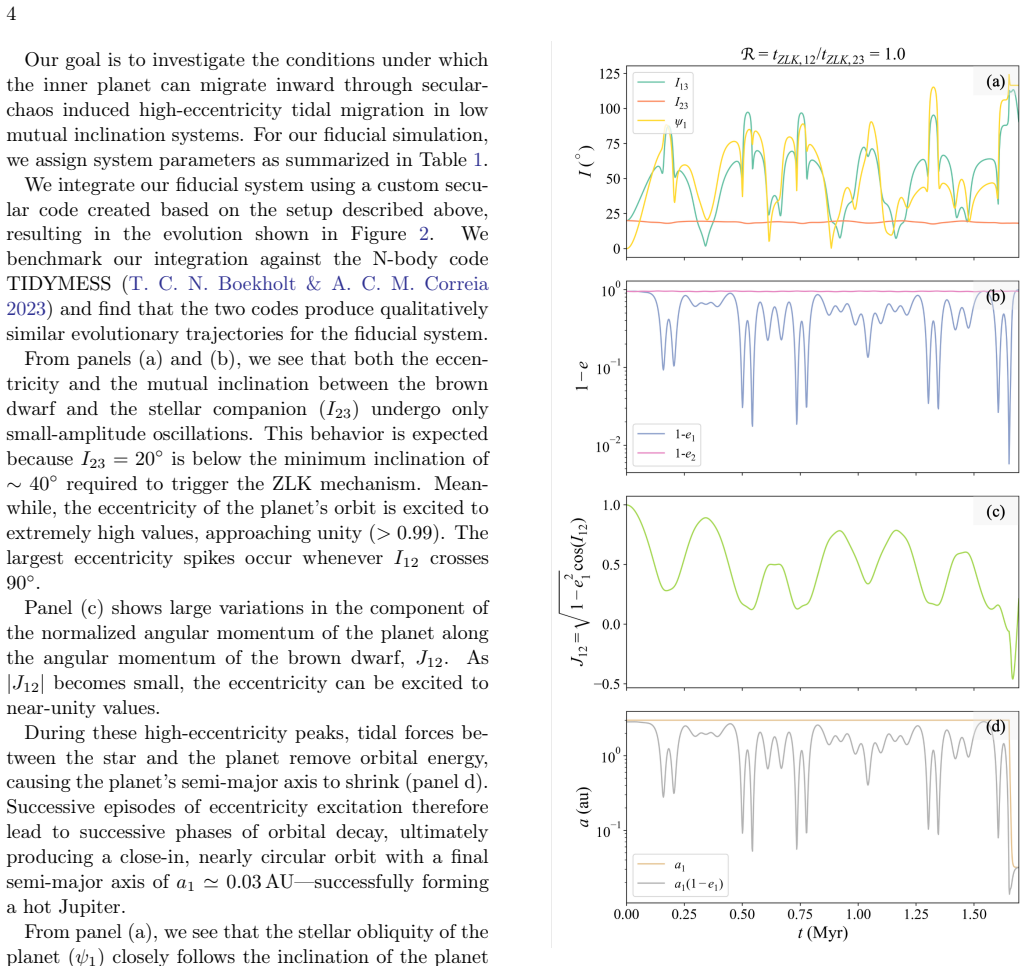
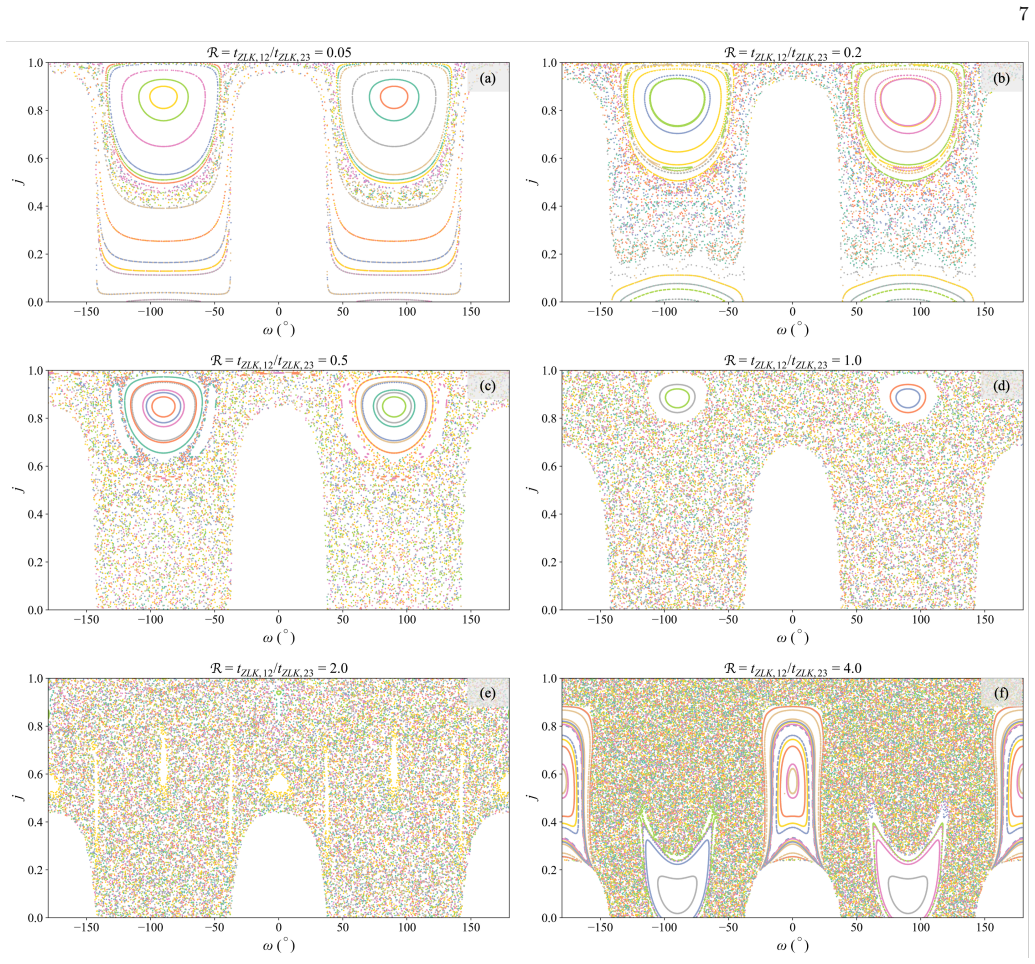
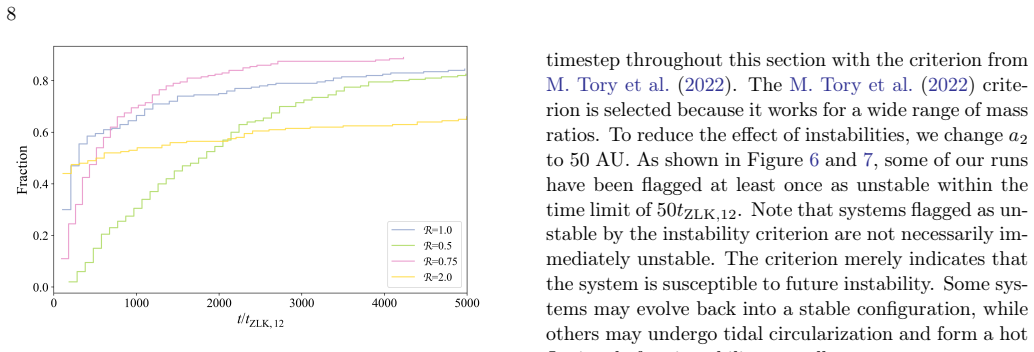
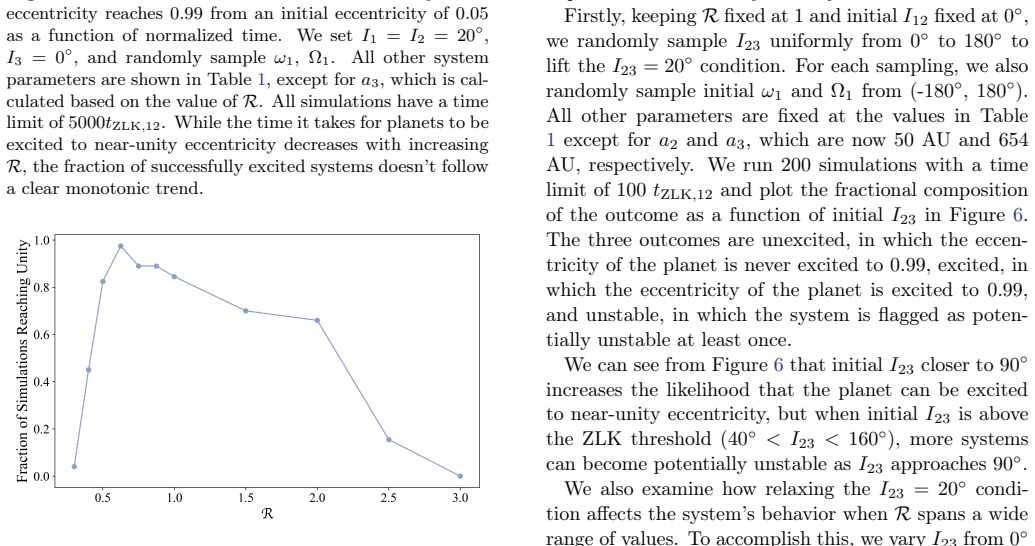
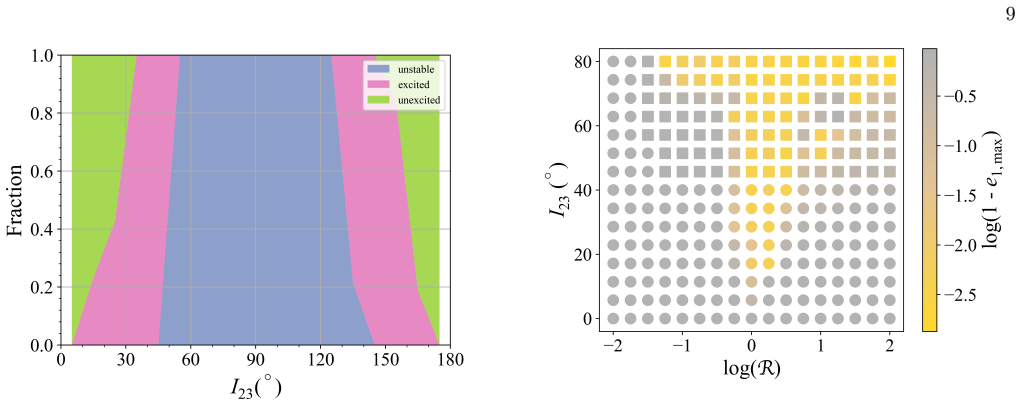
In hierarchical 3+1 systems, the onset of secular chaos is regulated by the ratio R of the von-Zeipel-Lidov-Kozai timescales of the inner and outer orbits. When R is approximately 0.5-2, most systems undergo high-eccentricity tidal migration even with mutual inclinations below 39.2 degrees, with diffusion timescales spanning a broad range up to thousands of inner-orbit ZLK timescales. At larger inclinations secular migration operates over R from 0.05-100 but most pathways become non-secular and potentially unstable.
What carries the argument
The ratio R of the von-Zeipel-Lidov-Kozai (ZLK) timescales of the inner and outer orbits, which sets the condition for secular chaos to excite eccentricity.
If this is right
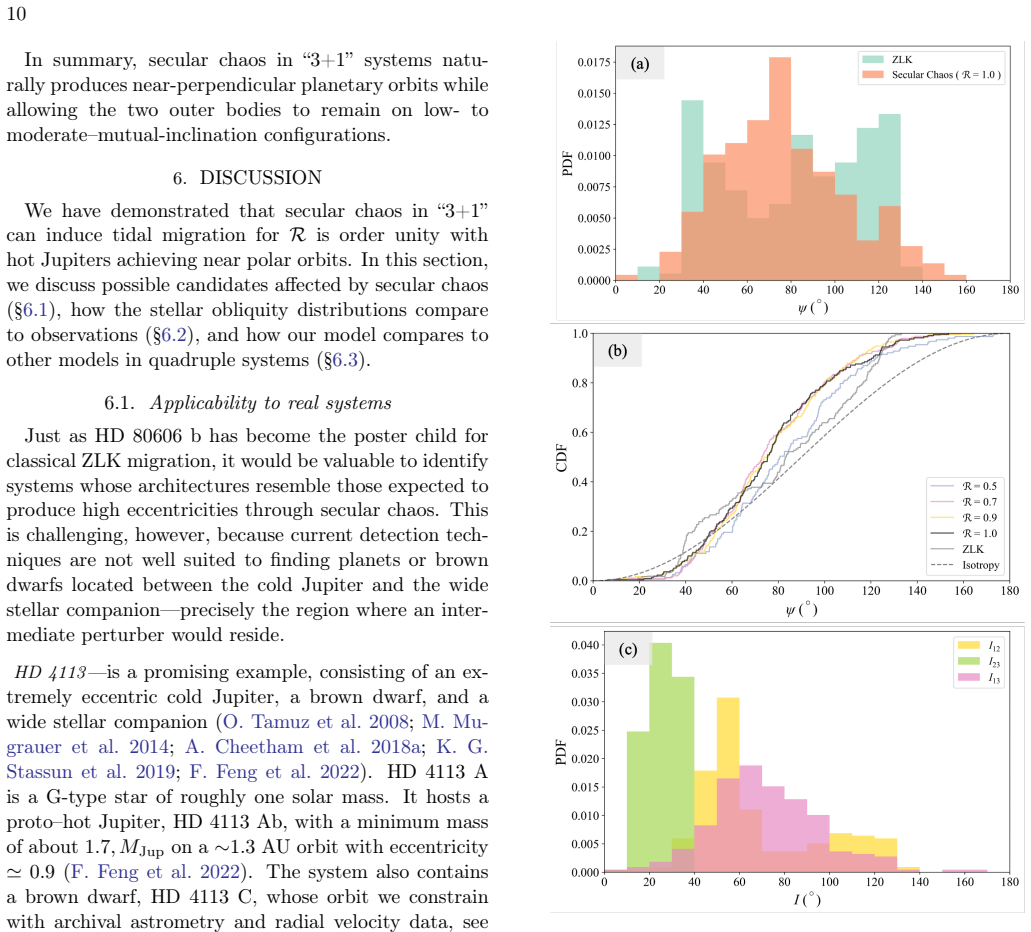
- Hot Jupiters form with stellar obliquities of 60-120 degrees relative to the host star's equator.
- Migration occurs over a wide range of diffusion timescales up to thousands of inner ZLK periods when R is near 0.5-2.
- At inclinations above the ZLK critical angle most pathways shift to non-secular and potentially unstable regimes.
- Additional 3+1 systems discovered by Gaia and long-term radial velocity monitoring can test the predicted polar orbits.
Where Pith is reading between the lines
- The mechanism suggests intermediate-mass companions may be common in systems that produce misaligned hot Jupiters.
- It could be tested by checking whether known hot Jupiters with high obliquities show evidence of wide outer companions.
- Secular chaos of this type might operate in other hierarchical exoplanet architectures beyond wide binaries.
- Numerical N-body integrations of specific 3+1 systems could map the exact boundaries of the R~0.5-2 window.
Load-bearing premise
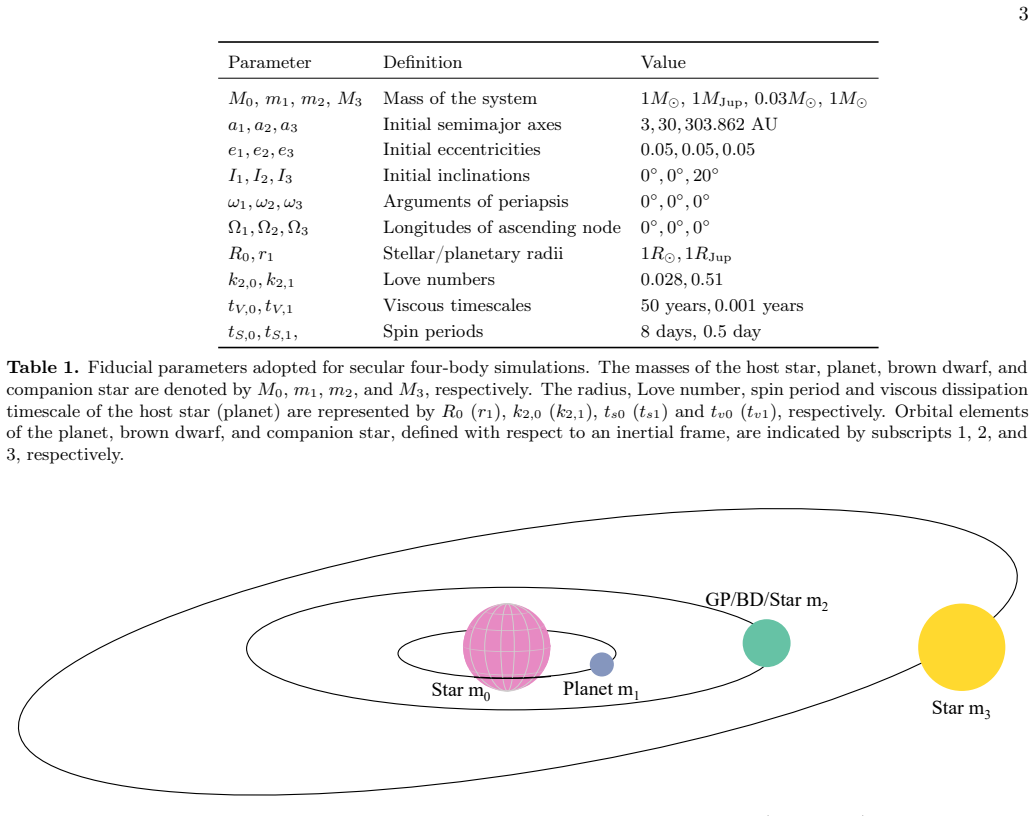
The hierarchical configuration and secular approximation remain valid throughout the evolution without close encounters or non-secular effects dominating before tidal migration finishes.
What would settle it
A survey of confirmed 3+1 systems that finds no hot Jupiters with stellar obliquities between 60 and 120 degrees or no outer companions around known polar hot Jupiters would contradict the predicted migration channel.
Figures
read the original abstract
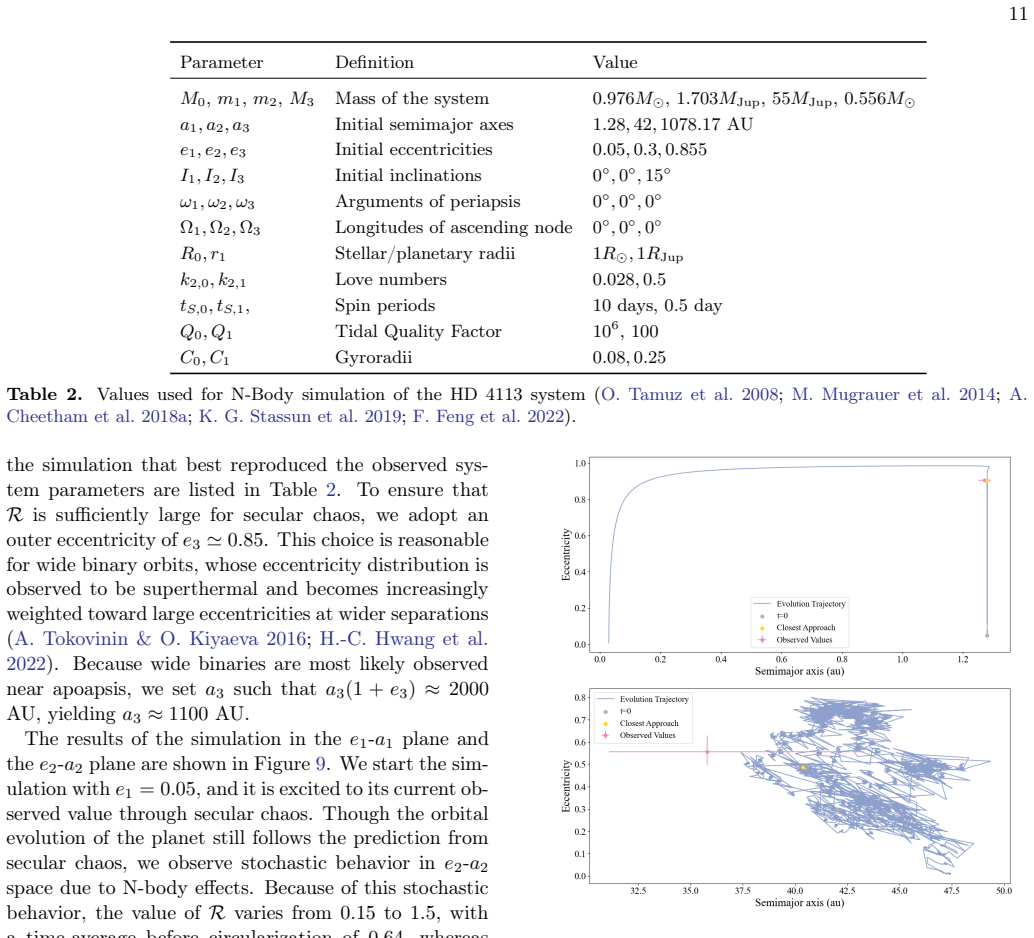
High-eccentricity tidal migration driven by a distant stellar companion offers a natural pathway for producing some hot Jupiters; yet, most theoretical work has relied on an idealized three-body configuration whose simplicity makes the problem especially tractable. In reality, many cold-Jupiter systems may host additional planets or substellar objects, whose interactions can dramatically alter the pathways to secularly excite extreme eccentricities. We investigate how secular chaos can drive high-eccentricity tidal migration in hierarchical ``3+1'' systems--stellar binaries hosting a planet and an additional intermediate companion orbiting the primary star. We show that the onset of secular chaos is regulated by the ratio of the von-Zeipel-Lidov-Kozai (ZLK) timescales of the inner and outer orbits $\mathcal{R}$. When $\mathcal{R}\sim 0.5-2$, most systems can undergo migration even when their mutual inclinations remain modest--below the $39.2^\circ$ critical angle for ZLK oscillations--with diffusion timescales spanning a broad range, up to thousands of inner orbit ZLK timescales. For larger mutual inclinations, secular migration operates over a much broader region of parameter space with $\mathcal{R} \sim 0.05-100$, but most evolutionary pathways become non-secular and potentially unstable--behavior recently identified as an alternative pathway to tidal migration. Our model predicts hot Jupiters in nearly polar orbits relative to both the host star's stellar equator (stellar obliquities $\sim 60^\circ-120^\circ$) and the orbits of the outer two companions. Future Gaia releases and long-term radial velocity campaigns are likely to uncover additional ``3+1'' systems, providing valuable opportunities to test this migration pathway.
Editorial analysis
A structured set of objections, weighed in public.
Referee Report
Summary. The manuscript claims that in hierarchical 3+1 systems (star + planet + intermediate companion + distant binary), secular chaos regulated by the ratio R of inner-to-outer ZLK timescales enables high-eccentricity tidal migration for R ∼ 0.5–2 even at modest inclinations below the 39.2° ZLK critical angle, with diffusion timescales ranging up to thousands of inner-orbit ZLK periods. For larger inclinations the accessible parameter space widens to R ∼ 0.05–100 but most pathways become non-secular. The model predicts hot Jupiters on nearly polar orbits relative to both the stellar equator and the outer companions.
Significance. If the central results hold, the work identifies a new secular-chaos pathway for hot-Jupiter formation that operates at modest inclinations in systems with additional companions, extending beyond the classical three-body ZLK mechanism. The regulating parameter is the timescale ratio R with no additional free parameters, yielding falsifiable predictions for stellar obliquities of ∼60°–120° that can be tested with future Gaia releases and long-term RV monitoring. This strengthens the dynamical inventory of migration channels in multi-body exoplanet systems.
major comments (2)
- [Abstract and §3 (model and diffusion timescale derivation)] The claim that secular chaos drives migration for R ∼ 0.5–2 at inclinations < 39.2° (abstract) is load-bearing and rests on the assumption that the secular averaging over ZLK timescales remains valid throughout the diffusion process. When inner and outer ZLK timescales are comparable, chaotic eccentricity excursions can produce pericenter distances small enough for close encounters or mean-motion resonance overlap to dominate before tidal migration completes; the manuscript provides no explicit N-body validation or analytic estimate showing that the reported diffusion timescales (up to thousands of inner ZLK periods) are reached while the hierarchical secular regime still holds.
- [Results section on R regimes] Table or figure presenting the R–inclination regimes (presumably in the results section) reports that most systems undergo migration for R ∼ 0.5–2 at modest inclinations, yet the boundary between secular and non-secular evolution is stated only qualitatively. A quantitative criterion (e.g., minimum pericenter distance or resonance overlap condition) is needed to demarcate where the secular diffusion calculation ceases to apply.
minor comments (1)
- [Abstract] The symbol ℛ for the ZLK timescale ratio is introduced in the abstract without an explicit definition; a parenthetical definition on first use would improve readability.
Simulated Author's Rebuttal
We thank the referee for their constructive and detailed comments, which have helped us identify areas where the assumptions and boundaries of our secular model require further clarification. We address each major comment below and outline the revisions we will make.
read point-by-point responses
-
Referee: [Abstract and §3 (model and diffusion timescale derivation)] The claim that secular chaos drives migration for R ∼ 0.5–2 at inclinations < 39.2° (abstract) is load-bearing and rests on the assumption that the secular averaging over ZLK timescales remains valid throughout the diffusion process. When inner and outer ZLK timescales are comparable, chaotic eccentricity excursions can produce pericenter distances small enough for close encounters or mean-motion resonance overlap to dominate before tidal migration completes; the manuscript provides no explicit N-body validation or analytic estimate showing that the reported diffusion timescales (up to thousands of inner-orbit ZLK periods) are reached while the hierarchical secular regime still holds.
Authors: We agree that the validity of the secular approximation during diffusion is central to the claims for R ∼ 0.5–2. The diffusion timescales reported in §3 are obtained by direct integration of the secular equations under the hierarchical assumption. In the revised manuscript we will add an analytic estimate of the minimum pericenter distance reached during the diffusion process (based on the random-walk scaling of eccentricity) to show that, for the parameter range and timescales considered, close encounters or resonance overlap are not expected to intervene before the secular diffusion completes. We will also add an explicit statement that full N-body validation lies beyond the scope of this secular study but is a natural direction for future work. revision: partial
-
Referee: [Results section on R regimes] Table or figure presenting the R–inclination regimes (presumably in the results section) reports that most systems undergo migration for R ∼ 0.5–2 at modest inclinations, yet the boundary between secular and non-secular evolution is stated only qualitatively. A quantitative criterion (e.g., minimum pericenter distance or resonance overlap condition) is needed to demarcate where the secular diffusion calculation ceases to apply.
Authors: We concur that a quantitative demarcation would strengthen the presentation of the R regimes. In the revised manuscript we will introduce an explicit criterion based on the minimum pericenter distance q_min remaining above a threshold (e.g., q_min > 0.05 AU, chosen so that mean-motion resonance overlap or close encounters remain negligible) and will apply this threshold to delineate the secular versus non-secular regions in the relevant figure and accompanying table. This will replace the current qualitative description. revision: yes
Circularity Check
No significant circularity in derivation chain
full rationale
The paper defines migration regimes via the dynamical ratio R of inner/outer ZLK timescales and analyzes secular chaos diffusion of eccentricity. These regimes and the claim of migration at modest inclinations for R~0.5-2 emerge from the secular model equations rather than being fitted to the target outcome or defined in terms of the result itself. No load-bearing self-citations, uniqueness theorems from the same authors, or ansatzes smuggled via prior work are visible in the abstract or described structure that would reduce the central prediction to its inputs by construction. The derivation remains self-contained against external dynamical benchmarks.
Axiom & Free-Parameter Ledger
axioms (2)
- standard math Newtonian gravity and hierarchical orbital separation
- domain assumption Secular approximation remains valid until tidal migration occurs
Reference graph
Works this paper leans on
-
[1]
Albrecht, S. H., Marcussen, M. L., Winn, J. N., Dawson, R. I., & Knudstrup, E. 2021, ApJL, 916, L1, doi: 10.3847/2041-8213/ac0f03 Ávila-Bravo, M., Charalambous, C., & Aguilera-Gómez, C. 2025, arXiv e-prints, arXiv:2511.09676. https://arxiv.org/abs/2511.09676
-
[2]
2012, Nature, 491, 418, doi: 10.1038/nature11560
Batygin, K. 2012, Nature, 491, 418, doi: 10.1038/nature11560
-
[3]
2011, A&A, 533, A7, doi: 10.1051/0004-6361/201117193
Batygin, K., Morbidelli, A., & Tsiganis, K. 2011, A&A, 533, A7, doi: 10.1051/0004-6361/201117193
-
[4]
Bernstein, R., Shectman, S. A., Gunnels, S. M., Mochnacki, S., & Athey, A. E. 2003, in Society of Photo-Optical Instrumentation Engineers (SPIE) Conference Series, Vol. 4841, Instrument Design and Performance for Optical/Infrared Ground-based Telescopes, ed. M. Iye & A. F. M. Moorwood, 1694–1704, doi: 10.1117/12.461502
-
[5]
2013, in European Planetary Science
Beuzit, J.-L. 2013, in European Planetary Science
2013
-
[6]
Bhaskar, H. G., & Perets, H. 2024, ApJ, 973, 108, doi: 10.3847/1538-4357/ad62f9
-
[7]
2025, Nature, 644, 356, doi: 10.1038/s41586-025-09324-0
Wu, Y.-L. 2025, Nature, 644, 356, doi: 10.1038/s41586-025-09324-0
-
[8]
Boekholt, T. C. N., & Correia, A. C. M. 2023, MNRAS, 522, 2885, doi: 10.1093/mnras/stad1133
-
[9]
Braak, C. J. T. 2006, Statistics and Computing, 16, 239
2006
-
[10]
Brandt, T. D. 2018, ApJS, 239, 31, doi: 10.3847/1538-4365/aaec06
-
[11]
Brandt, T. D., Dupuy, T. J., Li, Y., et al. 2021, AJ, 162, 186, doi: 10.3847/1538-3881/ac042e
-
[12]
Butler, R. P., Wright, J. T., Marcy, G. W., et al. 2006, ApJ, 646, 505, doi: 10.1086/504701
-
[13]
2022, MNRAS, 511, 457, doi: 10.1093/mnras/stac033
Cadman, J., Hall, C., Fontanive, C., & Rice, K. 2022, MNRAS, 511, 457, doi: 10.1093/mnras/stac033
-
[15]
2018b, A&A, 614, A16, doi: 10.1051/0004-6361/201630136
Cheetham, A., Ségransan, D., Peretti, S., et al. 2018b, A&A, 614, A16, doi: 10.1051/0004-6361/201630136
-
[16]
MESA Isochrones and Stellar Tracks (MIST). I: Solar-Scaled Models
Choi, J., Dotter, A., Conroy, C., et al. 2016, ApJ, 823, 102, doi: 10.3847/0004-637X/823/2/102
work page internal anchor Pith review doi:10.3847/0004-637x/823/2/102 2016
-
[17]
2022, AJ, 163, 207
Christian, S., Vanderburg, A., Becker, J., et al. 2022, AJ, 163, 207
2022
-
[18]
Cochran, W. D., Hatzes, A. P., Butler, R. P., & Marcy, G. W. 1997, ApJ, 483, 457, doi: 10.1086/304245
-
[19]
Crane, J. D., Shectman, S. A., & Butler, R. P. 2006, in Society of Photo-Optical Instrumentation Engineers (SPIE) Conference Series, Vol. 6269, Society of Photo-Optical Instrumentation Engineers (SPIE) Conference Series, ed. I. S. McLean & M. Iye, 626931, doi: 10.1117/12.672339
-
[20]
D., Shectman, S
Crane, J. D., Shectman, S. A., Butler, R. P., et al. 2010, in Ground-based and Airborne Instrumentation for Astronomy III, Vol. 7735, SPIE, 1909–1923
2010
-
[21]
D., Shectman, S
Crane, J. D., Shectman, S. A., Butler, R. P., Thompson, I. B., & Burley, G. S. 2008, in Ground-based and Airborne Instrumentation for Astronomy II, Vol. 7014, SPIE, 2484–2493
2008
-
[22]
I., & Johnson, J
Dawson, R. I., & Johnson, J. A. 2018, ARA&A, 56, 175
2018
-
[23]
2023, A&A, 675, A158, doi: 10.1051/0004-6361/202244611
Desidera, S., Damasso, M., Gratton, R., et al. 2023, A&A, 675, A158, doi: 10.1051/0004-6361/202244611
-
[24]
2023, AJ, 166, 112, doi: 10.3847/1538-3881/ace105
Dong, J., & Foreman-Mackey, D. 2023, AJ, 166, 112, doi: 10.3847/1538-3881/ace105
-
[25]
MESA Isochrones and Stellar Tracks (MIST) 0: Methods for the construction of stellar isochrones
Dotter, A. 2016, ApJS, 222, 8, doi: 10.3847/0067-0049/222/1/8
work page internal anchor Pith review doi:10.3847/0067-0049/222/1/8 2016
-
[26]
2025, arXiv e-prints, arXiv:2510.20740, doi: 10.48550/arXiv.2510.20740
Dugan, E., Wang, X.-Y., Heron, A., et al. 2025, arXiv e-prints, arXiv:2510.20740, doi: 10.48550/arXiv.2510.20740
-
[27]
J., Kraus, A
Dupuy, T. J., Kraus, A. L., Kratter, K. M., et al. 2022, MNRAS, 512, 648
2022
-
[28]
2017, http://ascl.net/1710.003
Eastman, J. 2017, http://ascl.net/1710.003
2017
-
[29]
Eastman, J. D., Rodriguez, J. E., Agol, E., et al. 2019, arXiv e-prints, arXiv:1907.09480. https://arxiv.org/abs/1907.09480
Pith/arXiv arXiv 2019
-
[30]
Eggleton, P. P., Kiseleva, L. G., & Hut, P. 1998, ApJ, 499, 853, doi: 10.1086/305670 17
-
[31]
Eggleton, P. P., & Kiseleva-Eggleton, L. 2001, ApJ, 562, 1012, doi: 10.1086/323843
-
[32]
I., Brahm, R., Petrovich, C., et al
Espinoza-Retamal, J. I., Brahm, R., Petrovich, C., et al. 2023, ApJL, 958, L20, doi: 10.3847/2041-8213/ad096d
-
[33]
I., Stefánsson, G., Petrovich, C., et al
Espinoza-Retamal, J. I., Stefánsson, G., Petrovich, C., et al. 2024, AJ, 168, 185, doi: 10.3847/1538-3881/ad70b8
-
[34]
2007, ApJ, 669, 1298, doi: 10.1086/521702
Fabrycky, D., & Tremaine, S. 2007, ApJ, 669, 1298, doi: 10.1086/521702
-
[35]
2007, ApJ, 669, 1298
Fabrycky, D., & Tremaine, S. 2007, ApJ, 669, 1298
2007
-
[36]
2026, The Astrophysical Journal Letters, 1003, L7, doi: 10.3847/2041-8213/ae6659
Fan, Q., & Liu, S.-F. 2026, The Astrophysical Journal Letters, 1003, L7, doi: 10.3847/2041-8213/ae6659
-
[37]
Feng, F., Butler, R. P., Vogt, S. S., et al. 2022, ApJS, 262, 21, doi: 10.3847/1538-4365/ac7e57
-
[38]
Fielding, D. B., McKee, C. F., Socrates, A., Cunningham, A. J., & Klein, R. I. 2015, MNRAS, 450, 3306, doi: 10.1093/mnras/stv836
-
[39]
Fontanive, C., & Bardalez Gagliuffi, D. 2021, Frontiers in Astronomy and Space Sciences, 8, 16, doi: 10.3389/fspas.2021.625250 Gaia Collaboration, Vallenari, A., Brown, A. G. A., et al. 2023, A&A, 674, A1, doi: 10.1051/0004-6361/202243940
-
[40]
Grishin, E., Lai, D., & Perets, H. B. 2018, MNRAS, 474, 3547, doi: 10.1093/mnras/stx3005
-
[41]
, year = 2024, month = aug, volume =
Gupta, A. F., Millholland, S. C., Im, H., et al. 2024, Nature, 632, 50, doi: 10.1038/s41586-024-07688-3
-
[42]
2018, AJ, 156, 95, doi: 10.3847/1538-3881/aad32c
Hadden, S., & Lithwick, Y. 2018, AJ, 156, 95, doi: 10.3847/1538-3881/aad32c
-
[43]
Hamers, A. S., & Lai, D. 2017, MNRAS, 470, 1657, doi: 10.1093/mnras/stx1319
-
[44]
Zwart, S. F. 2015, MNRAS, 449, 4221, doi: 10.1093/mnras/stv452
-
[45]
1997, Nature, 386, 254, doi: 10.1038/386254a0
Holman, M., Touma, J., & Tremaine, S. 1997, Nature, 386, 254, doi: 10.1038/386254a0
-
[46]
Hwang, H.-C., Ting, Y.-S., & Zakamska, N. L. 2022, MNRAS, 512, 3383, doi: 10.1093/mnras/stac675
-
[47]
Ida, S., Lin, D. N. C., & Nagasawa, M. 2013, ApJ, 775, 42, doi: 10.1088/0004-637X/775/1/42
-
[48]
Innanen, K. A., Zheng, J. Q., Mikkola, S., & Valtonen, M. J. 1997, AJ, 113, 1915, doi: 10.1086/118405 Jurić, M., & Tremaine, S. 2008, ApJ, 686, 603, doi: 10.1086/590047
-
[49]
Kane, S. R., Ciardi, D. R., Gelino, D. M., & von Braun, K. 2012, MNRAS, 425, 757, doi: 10.1111/j.1365-2966.2012.21627.x
-
[50]
Kane, S. R., & Wittenmyer, R. A. 2024, ApJL, 962, L21, doi: 10.3847/2041-8213/ad2463
-
[51]
Klein, Y. Y., & Katz, B. 2023, ApJL, 953, L10, doi: 10.3847/2041-8213/aceae7
-
[52]
Klein, Y. Y., & Katz, B. 2024, AJ, 167, 80, doi: 10.3847/1538-3881/ad18b6
-
[53]
Klein, Y. Y., & Katz, B. 2025, MNRAS, 539, L7, doi: 10.1093/mnrasl/slaf017
-
[54]
Knudstrup, E., Albrecht, S. H., Winn, J. N., et al. 2024, A&A, 690, A379, doi: 10.1051/0004-6361/202450627
-
[55]
Knutson, H. A., Fulton, B. J., Montet, B. T., et al. 2014, ApJ, 785, 126, doi: 10.1088/0004-637X/785/2/126
-
[56]
2012, ApJ, 745, 19, doi: 10.1088/0004-637X/745/1/19
Martinache, F. 2012, ApJ, 745, 19, doi: 10.1088/0004-637X/745/1/19
-
[57]
Lai, D. 2012, MNRAS, 423, 486, doi: 10.1111/j.1365-2966.2012.20893.x
-
[58]
2014, MNRAS, 440, 3532, doi: 10.1093/mnras/stu485
Lai, D. 2014, MNRAS, 440, 3532, doi: 10.1093/mnras/stu485
-
[59]
Lai, D., Foucart, F., & Lin, D. N. C. 2011, MNRAS, 412, 2790, doi: 10.1111/j.1365-2966.2010.18127.x
-
[60]
Lester, K. V., Matson, R. A., Howell, S. B., et al. 2021, AJ, 162, 75, doi: 10.3847/1538-3881/ac0d06
-
[61]
Lester, K. V., Howell, S. B., Matson, R. A., et al. 2023, AJ, 166, 166, doi: 10.3847/1538-3881/acf563
-
[62]
Lidov, M. L. 1962, Planetary and Space Science, 9, 719
1962
-
[63]
2021, A&A, 649, A4, doi: 10.1051/0004-6361/202039653
Lindegren, L., Bastian, U., Biermann, M., et al. 2021, A&A, 649, A4, doi: 10.1051/0004-6361/202039653
-
[64]
Liu, B., Muñoz, D. J., & Lai, D. 2015, MNRAS, 447, 747, doi: 10.1093/mnras/stu2396
-
[65]
Liveoak, D., Millholland, S. C., Vick, M., & Tamayo, D. 2025, ApJ, 989, 35, doi: 10.3847/1538-4357/adefe7
-
[66]
Louden, E. M., & Millholland, S. C. 2024, ApJ, 974, 304, doi: 10.3847/1538-4357/ad74ff
-
[67]
2025, ApJ, 979, 218, doi: 10.3847/1538-4357/ad9b79
Lu, T., An, Q., Li, G., et al. 2025, ApJ, 979, 218, doi: 10.3847/1538-4357/ad9b79
-
[68]
2023, ApJ, 948, 41, doi: 10.3847/1538-4357/acc06d
Lu, T., Rein, H., Tamayo, D., et al. 2023, ApJ, 948, 41, doi: 10.3847/1538-4357/acc06d
-
[69]
2022, MNRAS, 510, 5050, doi: 10.1093/mnras/stab3602
Marzari, F., Nagasawa, M., & Goździewski, K. 2022, MNRAS, 510, 5050, doi: 10.1093/mnras/stab3602
-
[70]
2005, ApJ, 618, 502, doi: 10.1086/425976
Granata, V. 2005, ApJ, 618, 502, doi: 10.1086/425976
-
[71]
2021, A&A, 650, A116, doi: 10.1051/0004-6361/202039210
Matsumura, S., Brasser, R., & Ida, S. 2021, A&A, 650, A116, doi: 10.1051/0004-6361/202039210
-
[72]
Matsumura, S., Peale, S. J., & Rasio, F. A. 2010, ApJ, 725, 1995, doi: 10.1088/0004-637X/725/2/1995
-
[73]
Moe, M., & Kratter, K. M. 2021, MNRAS, 507, 3593, doi: 10.1093/mnras/stab2328
-
[74]
2014, MNRAS, 439, 1063, doi: 10.1093/mnras/stu044
Mugrauer, M., Ginski, C., & Seeliger, M. 2014, MNRAS, 439, 1063, doi: 10.1093/mnras/stu044
-
[75]
Mustill, A. J., Davies, M. B., & Johansen, A. 2017, MNRAS, 468, 3000, doi: 10.1093/mnras/stx693 18
-
[76]
Naef, D., Latham, D. W., Mayor, M., et al. 2001, A&A, 375, L27, doi: 10.1051/0004-6361:20010853
-
[77]
2011, Nature, 473, 187
Teyssandier, J. 2011, Nature, 473, 187
2011
-
[78]
M., & Rasio, F
Naoz, S., Farr, W. M., & Rasio, F. A. 2012, ApJL, 754, L36
2012
-
[79]
X., Standish, E
Newhall, X. X., Standish, E. M., & Williams, J. G. 1983, A&A, 125, 150
1983
-
[80]
Ngo, H., Knutson, H. A., Hinkley, S., et al. 2015, ApJ, 800, 138, doi: 10.1088/0004-637X/800/2/138
-
[81]
Paegert, M., Stassun, K. G., Collins, K. A., et al. 2021, arXiv e-prints, arXiv:2108.04778, doi: 10.48550/arXiv.2108.04778
discussion (0)
Sign in with ORCID, Apple, or X to comment. Anyone can read and Pith papers without signing in.