REVIEW 4 major objections 5 minor 41 references
1-2-1: Renaissance of Single-Network Paradigm for Virtual Try-On
T0 review · 4 major / 5 minor · reviewed 2026-08-10 · deepseek-v4-flash
Pith's one-line read A single diffusion network with modality-specific normalization matches or beats dual-network virtual try-on on image and video benchmarks while cutting trainable parameters.
desk verdict A clean normalization idea with consistently strong benchmark numbers, but the only controlled comparison against ReferenceNet is corrupted by an LPIPS unit error and the efficiency claim does not hold for the final DiT model. read the letter →
The pith
A machine-rendered reading of the paper's core claim, the machinery that carries it, and where it could break.
The reading
What carries the argument
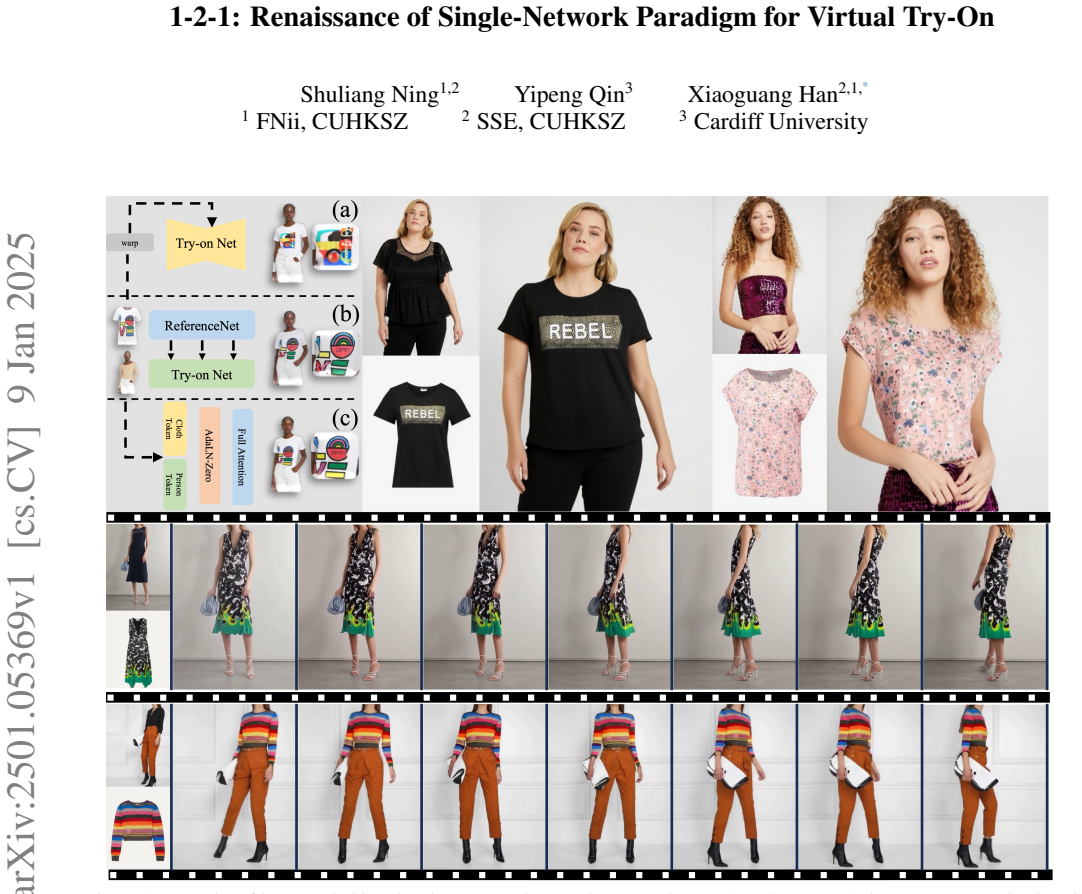
The central object is Modality-Specific Normalization: the network's token features are partitioned by input modality, with text tokens normalized by one AdaLN-zero layer and garment and target image/video tokens concatenated and normalized by another, before all tokens enter shared self-attention. This implements the split-and-fusion idea of Eq. (5) with a modality-based splitting rule (Eqs. (6)–(7)). The design preserves the relative relationships within a multimodal distribution and keeps garment and target information throughout the layers, so a single network can play the role that ReferenceNet played in prior work.
What would settle it
Run the same MN-VTON pipeline with the alternative three-way split (text, garment, target each normalized independently) on VITONHD and VIVID test sets. If that configuration matches or beats the proposed two-way grouping on SSIM/LPIPS/VFID, the central claim that garment and target must share normalization collapses.
Extended reading notes
Core claim
MN-VTON shows that the supposed need for a dedicated ReferenceNet is an artifact of how features are normalized and fused, not a fundamental requirement. By splitting the shared token sequence into a text stream and a visual stream (garment plus target), applying separate AdaLN-zero normalization to each, and then running shared self-attention over all tokens, a single trainable network can preserve fine garment detail and temporal coherence. On image benchmarks the method reports the best SSIM, LPIPS, FID, and KID among compared methods, and on video benchmarks it improves SSIM, LPIPS, and VFID over dedicated video try-on systems. The authors interpret this as a "renaissance" of the single-network paradigm, with the dual-network approach as an unnecessary computational overhead.
Load-bearing premise
The whole method hinges on the assumption that garment tokens and target person tokens belong to the same "visual" modality and should be normalized together, while text tokens should be normalized separately; the paper supports this with visualizations and a single ablation rather than a mechanism or exhaustive search.
Editorial extensions
If this is right
- A single architecture can now serve both image and video virtual try-on, with one model trained jointly on image and video data via position-embedding interpolation.
- Without a ReferenceNet, trainable parameters drop substantially (e.g., 859.57M vs 1700.25M in the UNet comparison), so higher resolutions and longer clips become feasible.
- The modality-split normalization rule transfers across backbone architectures: the same design works in a UNet and in a diffusion transformer, with the transformer version performing best.
- Mask-free virtual try-on becomes practical: the trained model can generate paired video data that would otherwise be unavailable, enabling parsing-free video VTON.
Reading between the lines
- The same "normalize similar modalities together, separate dissimilar ones" principle could apply to other multi-modal generation tasks, such as text-to-image editing or audio-visual generation, where a reference condition and a target share a modality.
- The paper justifies the grouping with PCA visualizations and one ablation; an automated search over token-grouping strategies might find even better partitions when more modalities are added.
- If the efficiency gain holds at production scale, the single-network paradigm could shift the cost model of e-commerce try-on services, since the ReferenceNet's memory and compute overhead is eliminated.
- The claim that garment and target tokens should be normalized together is task-specific; for other tasks where the reference and target are not visually similar, the optimal grouping may differ.
Editorial analysis
A structured set of objections, weighed in public.
Referee Report
Summary. The paper proposes MN-VTON, a single-network virtual try-on method for both images and videos. The core idea is a Modality-specific Normalization strategy: text tokens and visual tokens (garment image plus target image/video) are normalized and modulated separately with AdaLN-zero, while all tokens share the same attention layers in a diffusion Transformer built on CogVideoX. The authors argue that this addresses the three limitations they attribute to earlier single-network methods and removes the need for a dual-network ReferenceNet. They report quantitative comparisons on VITONHD and DressCode for image VTON and on VVT and VIVID for video VTON, together with an architecture-generalization experiment, ablations, and a user study, concluding that a single network can match or surpass dual-network approaches with reduced computational overhead.
Significance. If the claims are correct, the result is practically significant: it would challenge the current ReferenceNet-based dual-network consensus in VTON and offer a simpler, more scalable architecture for high-resolution image and video try-on. The paper is clearly written, the proposed normalization split is simple and easy to understand, and the experimental campaign covers four benchmarks plus a user study. The core derivation in Eqs. (4)-(7) is not circular and the approach is validated on held-out test sets. However, the central architecture-selection evidence and the efficiency claim currently rest on inconsistent metric reporting in Table 1, and the video comparison in Table 3 contains duplicated rows with conflicting values. These issues must be corrected before the significance of the single-network claim can be properly assessed. No code or weights are provided, which also limits reproducibility.
major comments (4)
- [§4.2, Table 1] The LPIPS column mixes incompatible units: the entries 5.412 and 5.357 for Reference-UNet and Ours(UNet) are two orders of magnitude larger than every other LPIPS value in the paper, which ranges roughly from 0.019 to 0.283 in Tables 2 and 3. If the 5.4 entries are LPIPS multiplied by 100, then Ours(DiT) at 0.0632 is actually worse on LPIPS than both UNet variants, contradicting the statement that Ours(DiT) significantly outperforms ReferenceNet; if the 5.4 entries are FID, the column is mislabeled and the DiT row lacks an LPIPS value. Since this table is the only controlled ReferenceNet-versus-single-network comparison in the paper, the architecture selection and the central single-network claim depend on correcting these numbers, stating the metric definitions, and describing which split (validation vs. test) was used for model selection.
- [§4.2 and §5] The claim that the method 'significantly reduces computational overhead' is not supported by the reported parameter counts. Ours(DiT) has 1694.28M trainable parameters versus 1700.25M for Reference-UNet, which is essentially the same; only the Ours(UNet) variant halves the parameter count. The paper should either restrict the efficiency claim to the UNet variant or report inference FLOPs, latency, or peak memory for the selected DiT configuration.
- [Table 3] The rows for VIVID and Ours are each duplicated with substantially different metric values (VIVID SSIM 0.949 vs. 0.8747; Ours SSIM 0.971 vs. 0.8879), and the text does not explain which numbers come from the original publications and which are the authors' re-evaluations under a common protocol. Without a clear statement distinguishing cited baselines from recomputed numbers, the video VTON comparison and the claimed improvements are ambiguous and should be clarified.
- [§4.4 and Fig. 7] The central design choice in Eqs. (6)-(7) is ablated only qualitatively; no quantitative metrics (SSIM, LPIPS, FVD) are reported for configurations (a)-(f). Given that the modality-specific grouping is the key novelty and the paper explicitly argues that grouping garment and target tokens while separating text is the most effective approach, a quantitative ablation table on VIVID or VITONHD is needed to support this claim.
minor comments (5)
- [Table 2 caption] The header 'VTIONHD' is a typo and should read 'VITONHD'.
- [References [36] and [37]] References [36] and [37] are duplicate entries for the same VITON-DiT paper, and the in-text citation switches between [36] in Section 2 and [37] in Section 4.3; these should be merged.
- [§3.3] The text refers to supplementary material for the experiment on splitting each of the three modalities independently, but the arXiv v1 does not include supplementary text; please include the supplement or summarize the result in the main paper.
- [§4.5] The user study section reports preference percentages but does not specify the number of participants per study, the exact question format, or whether the preference differences are statistically significant; these details should be added.
- [General] No code or pretrained weights are provided. For a method whose main contribution is an architectural design, releasing code and weights would substantially improve reproducibility and would also allow independent verification of the Table 1 and Table 3 metric issues.
Circularity Check
No significant circularity: the central architecture claim is validated on held-out benchmarks and no fitted quantity is relabeled as a prediction.
full rationale
The paper's central claim is an architectural proposal, not a derivation from an input that already contains the output. The modality-specific normalization split in Eqs. (6)-(7) is a fixed design choice; it is not optimized against the test metrics, and the reported gains are measured on held-out test splits of VITONHD, DressCode, VVT, and VIVID relative to external baselines. The PCA visualization in Fig. 3 is used post hoc to explain the chosen split, but it does not define the split or force the numerical outcome. There is no load-bearing self-citation chain: the authors' own prior work is not used to justify the method, and the paper does not invoke a uniqueness theorem from the authors. The only substantive concern is the apparent LPIPS units inconsistency in Table 1, but that is an evidence-quality and measurement-validity issue, not an instance of a prediction reducing to its inputs by construction. Accordingly, the derivation chain is self-contained and no circular step is exhibited.
Assumptions & free parameters
free parameters (4)
- Modality split choice (text vs garment+target) =
hand-chosen
- AdaLN-zero scales and shifts for text and visual streams =
learned during training
- Architecture choice (DiT vs UNet) =
DiT
- Position embedding interpolation factor =
not specified
assumptions (6)
- domain assumption The pre-trained CogVideoX DiT backbone provides a sufficiently strong generative prior for VTON.
- domain assumption CLIP-based text and garment embeddings preserve enough semantic and visual information for try-on.
- domain assumption Off-the-shelf warping, parsing, and mask modules produce accurate Im, M, P, and G_w inputs.
- domain assumption FID, SSIM, LPIPS, and VFID are accepted proxies for VTON quality.
- ad hoc to paper PCA visualizations of single feature maps reflect generation quality.
- domain assumption Image-video joint training does not degrade image-only quality.
Cite this review
Pith. "Pith review of 1-2-1: Renaissance of Single-Network Paradigm for Virtual Try-On." pith.science (2026). https://pith.science/paper/YKPWF6DM
@misc{pith2026250105369,
  author       = {Pith},
  title        = {Pith review of: 1-2-1: Renaissance of Single-Network Paradigm for Virtual Try-On},
  year         = {2026},
  howpublished = {\url{https://pith.science/paper/YKPWF6DM}},
  note         = {Machine review of arXiv:2501.05369}
}
read the original abstract
Virtual Try-On (VTON) has become a crucial tool in ecommerce, enabling the realistic simulation of garments on individuals while preserving their original appearance and pose. Early VTON methods relied on single generative networks, but challenges remain in preserving fine-grained garment details due to limitations in feature extraction and fusion. To address these issues, recent approaches have adopted a dual-network paradigm, incorporating a complementary "ReferenceNet" to enhance garment feature extraction and fusion. While effective, this dual-network approach introduces significant computational overhead, limiting its scalability for high-resolution and long-duration image/video VTON applications. In this paper, we challenge the dual-network paradigm by proposing a novel single-network VTON method that overcomes the limitations of existing techniques. Our method, namely MNVTON, introduces a Modality-specific Normalization strategy that separately processes text, image and video inputs, enabling them to share the same attention layers in a VTON network. Extensive experimental results demonstrate the effectiveness of our approach, showing that it consistently achieves higher-quality, more detailed results for both image and video VTON tasks. Our results suggest that the single-network paradigm can rival the performance of dualnetwork approaches, offering a more efficient alternative for high-quality, scalable VTON applications.
Figures


Figures from the paper (5 more)


Reference graph
Works this paper leans on
-
[1]
Pixart: Fast training of diffusion transformer for photorealistic text-to-image synthesis
Junsong Chen, Jincheng Yu, Chongjian Ge, Lewei Yao, Enze Xie, Yue Wu, Zhongdao Wang, James Kwok, Ping Luo, Huchuan Lu, et al. Pixart: Fast training of diffusion transformer for photorealistic text-to-image synthesis. arXiv preprint arXiv:2310.00426, 2023. 5
-
[2]
Viton-hd: High-resolution virtual try-on via misalignment-aware normalization
Seunghwan Choi, Sunghyun Park, Minsoo Lee, and Jaegul Choo. Viton-hd: High-resolution virtual try-on via misalignment-aware normalization. In Proc. of the IEEE conference on computer vision and pattern recognition (CVPR), 2021. 1, 2, 5
work page 2021
-
[3]
Improving diffusion mod- els for authentic virtual try-on in the wild
Yisol Choi, Sangkyung Kwak, Kyungmin Lee, Hyung- won Choi, and Jinwoo Shin. Improving diffusion mod- els for authentic virtual try-on in the wild. arXiv preprint arXiv:2403.05139, 2024. 2, 3, 7, 8
arXiv 2024
-
[4]
Catvton: Concatenation is all you need for virtual try-on with diffusion models, 2024
Zheng Chong, Xiao Dong, Haoxiang Li, Shiyue Zhang, Wenqing Zhang, Xujie Zhang, Hanqing Zhao, and Xiaodan Liang. Catvton: Concatenation is all you need for virtual try-on with diffusion models, 2024. 3, 7, 8
work page 2024
-
[5]
Vivid: Video virtual try-on using diffusion models
Zixun Fang, Wei Zhai, Aimin Su, Hongliang Song, Kai Zhu, Mao Wang, Yu Chen, Zhiheng Liu, Yang Cao, and Zheng- Jun Zha. Vivid: Video virtual try-on using diffusion models. arXiv preprint arXiv:2405.11794, 2024. 1, 2, 3, 5, 6, 7, 8
arXiv 2024
-
[6]
Parser-free virtual try-on via distilling appearance flows, 2021
Yuying Ge, Yibing Song, Ruimao Zhang, Chongjian Ge, Wei Liu, and Ping Luo. Parser-free virtual try-on via distilling appearance flows, 2021. 3
work page 2021
-
[7]
Generative adversarial nets
Ian Goodfellow, Jean Pouget-Abadie, Mehdi Mirza, Bing Xu, David Warde-Farley, Sherjil Ozair, Aaron Courville, and Yoshua Bengio. Generative adversarial nets. Advances in neural information processing systems, 27, 2014. 2
2014
-
[8]
Taming the power of diffusion models for high-quality virtual try-on with appearance flow
Junhong Gou, Siyu Sun, Jianfu Zhang, Jianlou Si, Chen Qian, and Liqing Zhang. Taming the power of diffusion models for high-quality virtual try-on with appearance flow. In Proceedings of the 31st ACM International Conference on Multimedia, pages 7599–7607, 2023. 2, 3, 7
work page 2023
Show all 41 references
-
[9]
Viton: An image-based virtual try-on network
Xintong Han, Zuxuan Wu, Zhe Wu, Ruichi Yu, and Larry S Davis. Viton: An image-based virtual try-on network. In CVPR, 2018. 2, 3
2018
-
[10]
Animate anyone: Consistent and controllable image- to-video synthesis for character animation
Li Hu. Animate anyone: Consistent and controllable image- to-video synthesis for character animation. InProceedings of the IEEE/CVF Conference on Computer Vision and Pattern Recognition, pages 8153–8163, 2024. 3
2024
-
[11]
Animate anyone: Consistent and controllable image-to-video synthesis for character animation, 2024
Li Hu, Xin Gao, Peng Zhang, Ke Sun, Bang Zhang, and Liefeng Bo. Animate anyone: Consistent and controllable image-to-video synthesis for character animation, 2024. 3
2024
-
[12]
Cloth- former: Taming video virtual try-on in all module
Jianbin Jiang, Tan Wang, He Yan, and Junhui Liu. Cloth- former: Taming video virtual try-on in all module. In Pro- ceedings of the IEEE/CVF Conference on Computer Vision and Pattern Recognition, pages 10799–10808, 2022. 7
2022
-
[13]
Stableviton: Learning semantic correspon- dence with latent diffusion model for virtual try-on, 2023
Jeongho Kim, Gyojung Gu, Minho Park, Sunghyun Park, and Jaegul Choo. Stableviton: Learning semantic correspon- dence with latent diffusion model for virtual try-on, 2023. 3
2023
-
[14]
Stableviton: Learning semantic correspon- dence with latent diffusion model for virtual try-on
Jeongho Kim, Guojung Gu, Minho Park, Sunghyun Park, and Jaegul Choo. Stableviton: Learning semantic correspon- dence with latent diffusion model for virtual try-on. In Pro- ceedings of the IEEE/CVF Conference on Computer Vision and Pattern Recognition, pages 8176–8185, 2024. 2, 3, 7
2024
-
[15]
High-resolution virtual try-on with misalignment and occlusion-handled conditions
Sangyun Lee, Gyojung Gu, Sunghyun Park, Seunghwan Choi, and Jaegul Choo. High-resolution virtual try-on with misalignment and occlusion-handled conditions. arXiv preprint arXiv:2206.14180, 2022. 2
2022 arXiv
-
[16]
Dress Code: High- Resolution Multi-Category Virtual Try-On
Davide Morelli, Matteo Fincato, Marcella Cornia, Federico Landi, Fabio Cesari, and Rita Cucchiara. Dress Code: High- Resolution Multi-Category Virtual Try-On. In Proceedings of the European Conference on Computer Vision, 2022. 2, 5
2022
-
[17]
LaDI- VTON: Latent Diffusion Textual-Inversion Enhanced Virtual Try-On
Davide Morelli, Alberto Baldrati, Giuseppe Cartella, Mar- cella Cornia, Marco Bertini, and Rita Cucchiara. LaDI- VTON: Latent Diffusion Textual-Inversion Enhanced Virtual Try-On. In Proceedings of the ACM International Confer- ence on Multimedia, 2023. 2, 3, 4, 7
2023
-
[18]
Ladi-vton: Latent diffusion textual-inversion enhanced virtual try-on,
Davide Morelli, Alberto Baldrati, Giuseppe Cartella, Mar- cella Cornia, Marco Bertini, and Rita Cucchiara. Ladi-vton: Latent diffusion textual-inversion enhanced virtual try-on,
-
[19]
Semantic image synthesis with spatially-adaptive nor- malization
Taesung Park, Ming-Yu Liu, Ting-Chun Wang, and Jun-Yan Zhu. Semantic image synthesis with spatially-adaptive nor- malization. In Proceedings of the IEEE/CVF conference on computer vision and pattern recognition, pages 2337–2346,
-
[20]
Scalable diffusion models with transformers, 2023
William Peebles and Saining Xie. Scalable diffusion models with transformers, 2023. 3
2023
-
[21]
Learning transferable visual models from natural language supervi- sion
Alec Radford, Jong Wook Kim, Chris Hallacy, Aditya Ramesh, Gabriel Goh, Sandhini Agarwal, Girish Sastry, Amanda Askell, Pamela Mishkin, Jack Clark, et al. Learning transferable visual models from natural language supervi- sion. In International conference on machine learning, ...
2021
-
[22]
Outfitanyone: Ultra-high quality virtual try-on for any clothing and any person, 2024
Ke Sun, Jian Cao, Qi Wang, Linrui Tian, Xindi Zhang, Lian Zhuo, Bang Zhang, Liefeng Bo, Wenbo Zhou, Weiming Zhang, and Daiheng Gao. Outfitanyone: Ultra-high quality virtual try-on for any clothing and any person, 2024. 3
2024
-
[23]
Toward characteristic-preserving image- based virtual try-on network
Bochao Wang, Huabin Zheng, Xiaodan Liang, Yimin Chen, and Liang Lin. Toward characteristic-preserving image- based virtual try-on network. In Proceedings of the Euro- pean Conference on Computer Vision (ECCV) , pages 589– 604, 2018. 2
2018
-
[24]
Toward characteristic- preserving image-based virtual try-on network, 2018
Bochao Wang, Huabin Zheng, Xiaodan Liang, Yimin Chen, Liang Lin, and Meng Yang. Toward characteristic- preserving image-based virtual try-on network, 2018. 3
2018
-
[25]
Fw-gan: Underwater image enhance- ment using generative adversarial network with multi-scale fusion
Junjun Wu, Xilin Liu, Qinghua Lu, Zeqin Lin, Ningwei Qin, and Qingwu Shi. Fw-gan: Underwater image enhance- ment using generative adversarial network with multi-scale fusion. Signal Processing: Image Communication , 109: 116855, 2022. 2, 5, 6, 7
2022
-
[26]
Towards scalable unpaired virtual try-on via patch-routed spatially- adaptive gan
Zhenyu Xie, Zaiyu Huang, Fuwei Zhao, Haoye Dong, Michael Kampffmeyer, and Xiaodan Liang. Towards scalable unpaired virtual try-on via patch-routed spatially- adaptive gan. Advances in Neural Information Processing Systems, 34:2598–2610, 2021. 2
2021
-
[27]
Gp- vton: Towards general purpose virtual try-on via collabora- tive local-flow global-parsing learning, 2023
Zhenyu Xie, Zaiyu Huang, Xin Dong, Fuwei Zhao, Haoye Dong, Xijin Zhang, Feida Zhu, and Xiaodan Liang. Gp- vton: Towards general purpose virtual try-on via collabora- tive local-flow global-parsing learning, 2023. 3 9
2023
-
[28]
Oot- diffusion: Outfitting fusion based latent diffusion for control- lable virtual try-on
Yuhao Xu, Tao Gu, Weifeng Chen, and Chengcai Chen. Oot- diffusion: Outfitting fusion based latent diffusion for control- lable virtual try-on. arXiv preprint arXiv:2403.01779, 2024. 2, 3, 5, 7, 8
2024 arXiv
-
[29]
Oot- diffusion: Outfitting fusion based latent diffusion for control- lable virtual try-on, 2024
Yuhao Xu, Tao Gu, Weifeng Chen, and Chengcai Chen. Oot- diffusion: Outfitting fusion based latent diffusion for control- lable virtual try-on, 2024. 3
2024
-
[30]
Tunnel try-on: Excavating spatial-temporal tunnels for high-quality virtual try-on in videos
Zhengze Xu, Mengting Chen, Zhao Wang, Linyu Xing, Zhonghua Zhai, Nong Sang, Jinsong Lan, Shuai Xiao, and Changxin Gao. Tunnel try-on: Excavating spatial-temporal tunnels for high-quality virtual try-on in videos. arXiv preprint arXiv:2404.17571, 2024. 2, 3, 7, 8
2024 arXiv
-
[31]
Warpdiffusion: Efficient diffusion model for high-fidelity virtual try-on, 2023
xujie zhang, Xiu Li, Michael Kampffmeyer, Xin Dong, Zhenyu Xie, Feida Zhu, Haoye Dong, and Xiaodan Liang. Warpdiffusion: Efficient diffusion model for high-fidelity virtual try-on, 2023. 3
2023
-
[32]
Cogvideox: Text-to-video diffusion models with an expert transformer
Zhuoyi Yang, Jiayan Teng, Wendi Zheng, Ming Ding, Shiyu Huang, Jiazheng Xu, Yuanming Yang, Wenyi Hong, Xiao- han Zhang, Guanyu Feng, et al. Cogvideox: Text-to-video diffusion models with an expert transformer. arXiv preprint arXiv:2408.06072, 2024. 3, 5
2024 arXiv
-
[33]
Mmtryon: Multi-modal multi-reference control for high-quality fashion generation
Xujie Zhang, Ente Lin, Xiu Li, Yuxuan Luo, Michael Kampffmeyer, Xin Dong, and Xiaodan Liang. Mmtryon: Multi-modal multi-reference control for high-quality fashion generation. arXiv preprint arXiv:2405.00448, 2024. 2, 3
2024 arXiv
-
[34]
Mmtryon: Multi-modal multi-reference control for high-quality fashion generation, 2024
Xujie Zhang, Ente Lin, Xiu Li, Yuxuan Luo, Michael Kampffmeyer, Xin Dong, and Xiaodan Liang. Mmtryon: Multi-modal multi-reference control for high-quality fashion generation, 2024. 3
2024
-
[35]
M3d-vton: A monocular-to-3d virtual try- on network
Fuwei Zhao, Zhenyu Xie, Michael Kampffmeyer, Haoye Dong, Songfang Han, Tianxiang Zheng, Tao Zhang, and Xiaodan Liang. M3d-vton: A monocular-to-3d virtual try- on network. In Proceedings of the IEEE/CVF International Conference on Computer Vision, pages 13239–13249, 2021. 2
2021
-
[36]
Viton-dit: Learning in-the-wild video try-on from human dance videos via diffusion transformers
Jun Zheng, Fuwei Zhao, Youjiang Xu, Xin Dong, and Xi- aodan Liang. Viton-dit: Learning in-the-wild video try-on from human dance videos via diffusion transformers. arXiv preprint arXiv:2405.18326, 2024. 2, 7
2024 arXiv
-
[37]
Viton-dit: Learning in-the-wild video try-on from human dance videos via diffusion transformers, 2024
Jun Zheng, Fuwei Zhao, Youjiang Xu, Xin Dong, and Xi- aodan Liang. Viton-dit: Learning in-the-wild video try-on from human dance videos via diffusion transformers, 2024. 3, 7
2024
-
[38]
Open-sora: Democratizing efficient video production for all, 2024
Zangwei Zheng, Xiangyu Peng, Tianji Yang, Chenhui Shen, Shenggui Li, Hongxin Liu, Yukun Zhou, Tianyi Li, and Yang You. Open-sora: Democratizing efficient video production for all, 2024. 3
2024
-
[39]
Gp- vton: Towards general purpose virtual try-on via collabora- tive local-flow global-parsing learning
Xie Zhenyu, Huang Zaiyu, Dong Xin, Zhao Fuwei, Dong Haoye, Zhang Xijin, Zhu Feida, and Liang Xiaodan. Gp- vton: Towards general purpose virtual try-on via collabora- tive local-flow global-parsing learning. In Proceedings of the IEEE/CVF Conference on Computer Vision and Patte...
2023
-
[40]
Tryondiffusion: A tale of two un- ets, 2023
Luyang Zhu, Dawei Yang, Tyler Zhu, Fitsum Reda, William Chan, Chitwan Saharia, Mohammad Norouzi, and Ira Kemelmacher-Shlizerman. Tryondiffusion: A tale of two un- ets, 2023. 2, 3
2023
-
[41]
M&m vto: Multi- garment virtual try-on and editing
Luyang Zhu, Yingwei Li, Nan Liu, Hao Peng, Dawei Yang, and Ira Kemelmacher-Shlizerman. M&m vto: Multi- garment virtual try-on and editing. In Proceedings of the IEEE/CVF Conference on Computer Vision and Pattern Recognition, pages 1346–1356, 2024. 2 10
2024
Reviewed August 10, 2026 · model on record in the stance chip above.
Discussion (0). Continue with ORCID to comment.