Clumps in a Cocoon: Geometry and Mixing Set the Universal X-ray to Hα Surface Brightness Ratio
Pith reviewed 2026-06-27 21:12 UTC · model grok-4.3
The pith
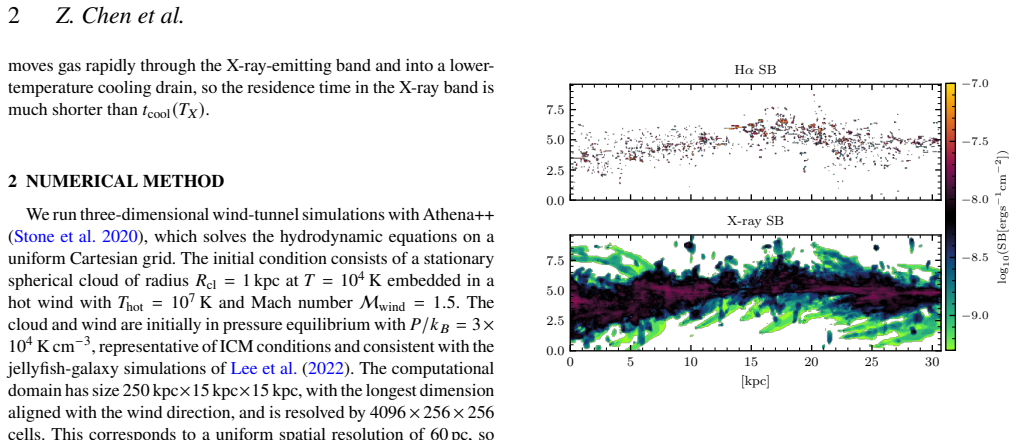
High density contrast shatters cold gas into Hα clumps inside a volume-filling X-ray cocoon, producing the observed surface brightness ratio of ~3.
A machine-rendered reading of the paper's core claim, the machinery that carries it, and where it could break.
Core claim
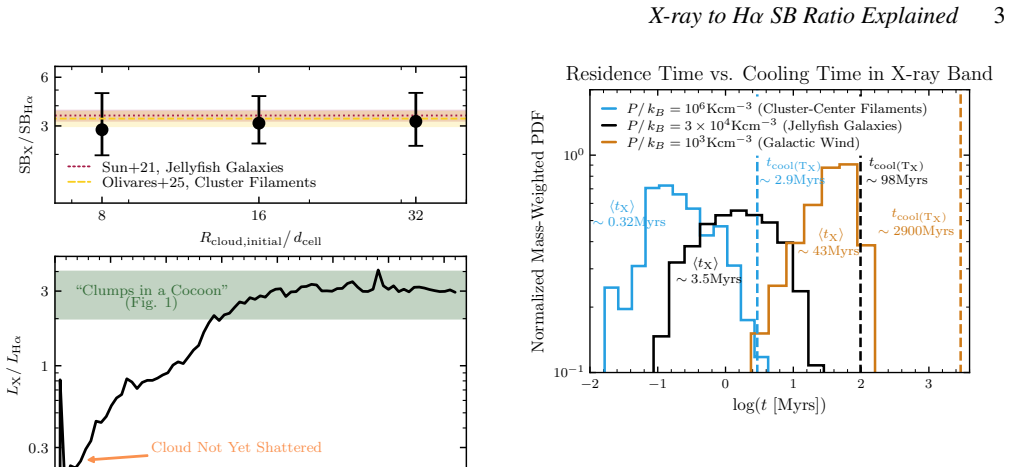
In the high density contrast regime with χ ~ 10^3, the cold phase shatters into many small Hα-emitting clumps embedded in a volume-filling X-ray cocoon. After smoothing on the tail-width scale, the measured surface-brightness ratio SB_X / SB_Hα converges to the observed value of ~3. The Hα luminosity fraction is set by atomic physics, whereas the X-ray luminosity fraction is set by the residence time of gas in the X-ray-emitting band. This residence time is much shorter than the cooling time at X-ray temperatures, but scales roughly inversely with pressure, suggesting that it is tied to the cooling time at a lower-temperature outlet of the mixing cascade. This framework naturally explains wh
What carries the argument
The shattered cold phase of many small Hα-emitting clumps embedded in a volume-filling X-ray cocoon, whose X-ray residence time scales inversely with pressure.
If this is right
- The ratio converges to the observed value after smoothing on the tail-width scale across galactic winds, ram-pressure stripped tails, and cluster filaments.
- Hα luminosity is fixed by atomic physics while X-ray luminosity is controlled by residence time rather than the X-ray cooling time itself.
- The inverse scaling of residence time with pressure keeps the ratio order unity even when pressure changes.
- The result holds when the cold phase consists of many small clumps inside a volume-filling hot cocoon.
Where Pith is reading between the lines
- The same geometric control of the temperature PDF could apply to other multiphase flows where emission is dominated by mixing layers rather than bulk cooling.
- Observational tests in environments spanning a wide range of pressures could confirm whether the ratio remains constant as predicted.
- The residence-time interpretation suggests that emission ratios in other temperature bands might also be set by the outlet temperature of the mixing cascade.
- If the shattering picture is correct, the small-scale clump distribution should be detectable with sufficiently high-resolution observations or simulations.
Load-bearing premise
The high density contrast regime produces a shattered cold phase of many small Hα clumps inside a volume-filling X-ray cocoon whose residence-time scaling with pressure is independent of the specific numerical setup.
What would settle it
A measurement of the smoothed surface brightness ratio in a system with density contrast χ much below 10^3 that deviates significantly from ~3, or a simulation in the same high-contrast regime that fails to produce the inverse-with-pressure residence-time scaling.
Figures
read the original abstract
Recent observations reveal a universal X-ray to H$\alpha$ surface-brightness ratio, ${\rm SB}_{\rm X}/{\rm SB}_{\rm H\alpha}\sim 3$, in galactic winds, ram-pressure stripped tails, and cluster filaments. This is surprising because H$\alpha$ traces cold ($\sim 10^4$ K) gas while X-rays trace much hotter ($\sim 10^{6}$--$10^{7}$ K) gas. Plane-parallel mixing-layer models do not recover this ratio, and can be off by orders of magnitude. Motivated by recent work showing that geometry controls the temperature PDF of multiphase gas (Chen & Oh 2026), we run 3D wind-tunnel simulations in the high density contrast ($\chi\sim 10^3$) regime. In this limit, the cold phase shatters into many small H$\alpha$-emitting clumps, while X-ray-emitting gas forms a volume-filling cocoon around them. After smoothing on the tail-width scale, the measured surface-brightness ratio converges to the observed value, which can be understood theoretically. The H$\alpha$ luminosity fraction is set by atomic physics, whereas the X-ray luminosity fraction is set by the residence time of gas in the X-ray-emitting band. This residence time is much shorter than the cooling time at X-ray temperatures, but scales roughly inversely with pressure, suggesting that it is tied to the cooling time at a lower-temperature outlet of the mixing cascade. This framework naturally explains why the observed ratio is order unity, and robust to changes in gas pressure.
Editorial analysis
A structured set of objections, weighed in public.
Referee Report
Summary. The manuscript claims that 3D wind-tunnel simulations in the high-density-contrast regime (χ∼10^3) produce a shattered cold phase consisting of many small Hα-emitting clumps embedded in a volume-filling X-ray cocoon. After smoothing the surface brightness on the tail-width scale, the measured X-ray to Hα surface-brightness ratio converges to the observed universal value ∼3. This is explained theoretically: the Hα luminosity fraction is set by atomic physics, while the X-ray luminosity fraction is set by the residence time of gas in the X-ray-emitting temperature band. This residence time is much shorter than the X-ray cooling time but scales roughly inversely with pressure, suggesting it is tied to the cooling time at a lower-temperature outlet of the mixing cascade. The framework accounts for the order-unity ratio being robust to changes in gas pressure.
Significance. If the central result holds, the work provides a geometric explanation for the observed universal X-ray/Hα surface-brightness ratio in galactic winds, ram-pressure-stripped tails, and cluster filaments, emphasizing the role of 3D shattering and mixing-layer geometry over plane-parallel models. The connection to prior work on temperature PDFs (Chen & Oh 2026) and the residence-time interpretation tied to the mixing cascade represent a potentially important conceptual advance. The simulations' ability to recover an order-unity ratio without free parameters is a strength if convergence can be demonstrated.
major comments (2)
- [Simulation results paragraph] Simulation results paragraph (abstract and main text description of wind-tunnel runs): the claim that the surface-brightness ratio converges to the observed value after smoothing on the tail-width scale is presented without quantitative error bars, resolution study, or convergence tests with respect to grid resolution, artificial viscosity, or sub-grid mixing parameters. This is load-bearing for the assertion that the residence-time scaling with pressure is independent of the specific numerical setup in the χ∼10^3 shattered-clump regime.
- [Theoretical interpretation paragraph] Theoretical interpretation paragraph: the residence time is stated to scale 'roughly inversely with pressure' and to 'suggest' a link to the cooling time at a lower-temperature outlet of the mixing cascade, but no explicit derivation of the scaling, quantitative comparison to the cooling function, or analytic relation is provided. This is central to the claim that the ratio is order unity and robust to pressure variations.
minor comments (1)
- [Abstract] The abstract references 'Chen & Oh 2026' without a corresponding entry in the bibliography; the full citation should be added for completeness.
Simulated Author's Rebuttal
We thank the referee for their constructive report and for recognizing the potential significance of the geometric explanation for the universal surface-brightness ratio. We address each major comment below. Where the comments identify areas needing additional quantitative support, we will revise the manuscript accordingly.
read point-by-point responses
-
Referee: Simulation results paragraph (abstract and main text description of wind-tunnel runs): the claim that the surface-brightness ratio converges to the observed value after smoothing on the tail-width scale is presented without quantitative error bars, resolution study, or convergence tests with respect to grid resolution, artificial viscosity, or sub-grid mixing parameters. This is load-bearing for the assertion that the residence-time scaling with pressure is independent of the specific numerical setup in the χ∼10^3 shattered-clump regime.
Authors: We agree that the current presentation would benefit from explicit quantitative support. In the revised manuscript we will add error bars derived from multiple snapshots and independent runs, together with a dedicated resolution study (including variations in grid resolution and artificial viscosity) demonstrating that the measured SB_X/SB_Hα ratio and its pressure scaling remain stable in the χ∼10^3 regime once the tail-width smoothing scale is reached. These additions will be placed in the main text or a new appendix. revision: yes
-
Referee: Theoretical interpretation paragraph: the residence time is stated to scale 'roughly inversely with pressure' and to 'suggest' a link to the cooling time at a lower-temperature outlet of the mixing cascade, but no explicit derivation of the scaling, quantitative comparison to the cooling function, or analytic relation is provided. This is central to the claim that the ratio is order unity and robust to pressure variations.
Authors: The referee is correct that the scaling is currently presented on the basis of the simulation measurements without a full analytic derivation. We will revise the theoretical section to include an explicit derivation showing how the residence time in the X-ray band scales as τ_res ∝ P^{-1} when tied to the cooling time at the lower-temperature outlet of the mixing cascade, together with a direct quantitative comparison to the cooling function Λ(T) at the relevant temperatures. This will make the connection to the order-unity ratio and its robustness to pressure fully analytic. revision: yes
Circularity Check
No significant circularity; derivation relies on new simulations and atomic physics
full rationale
The paper's central result is obtained from new 3D wind-tunnel simulations in the χ~10^3 regime, where the measured SB_X/SB_Hα ratio after tail-width smoothing converges to the observed ~3 value. The theoretical split attributes Hα luminosity to atomic physics and X-ray luminosity to a residence-time scaling (~1/P) extracted from those simulations, with the link to lower-temperature cooling time presented as a suggestion rather than a closed derivation. The citation to Chen & Oh 2026 is used only for motivation on geometry controlling the temperature PDF and is not required to establish the SB ratio or its pressure robustness; no equation reduces by construction to a fitted input, self-definition, or prior self-citation chain. The work is therefore self-contained against the external observational benchmark.
Axiom & Free-Parameter Ledger
axioms (2)
- domain assumption High density contrast χ~10^3 produces shattering of cold phase into small clumps with volume-filling X-ray cocoon
- domain assumption X-ray luminosity fraction is controlled by residence time in the X-ray band rather than cooling time at X-ray temperatures
Reference graph
Works this paper leans on
-
[1]
arXiv , author =:2505.08907 , journal =
doi:10.3847/1538-4357/ade711 , eid =. arXiv , author =:2505.08907 , journal =
-
[2]
doi:10.1093/mnras/stad3125 , eprint =
, keywords =. doi:10.1093/mnras/stad3125 , eprint =
-
[3]
doi:10.1093/mnras/stad3011 , eprint =
, keywords =. doi:10.1093/mnras/stad3011 , eprint =
-
[4]
doi:10.1093/mnras/stad1716 , eprint =
, keywords =. doi:10.1093/mnras/stad1716 , eprint =
-
[5]
Transport, Collective Motion, and Brownian Motion , volume =
Mori, Hazime , date-added =. Transport, Collective Motion, and Brownian Motion , volume =. 1965 , bdsk-url-1 =. doi:10.1143/PTP.33.423 , journal =
-
[6]
and Gariepy, Ronald F
Evans, Lawrence C. and Gariepy, Ronald F. , date-added =. Measure Theory and Fine Properties of Functions , year =
-
[7]
arXiv , author =:2509.03802 , journal =
doi:10.48550/arXiv.2509.03802 , eid =. arXiv , author =:2509.03802 , journal =
-
[8]
First passage and first hitting times of L
Palyulin, Vladimir V and Blackburn, George and Lomholt, Michael A and Watkins, Nicholas W and Metzler, Ralf and Klages, Rainer and Chechkin, Aleksei V , date-added =. First passage and first hitting times of L. New Journal of Physics , number =
-
[9]
Molecular hydrodynamics , year =
Boon, Jean Pierre and Yip, Sidney , date-added =. Molecular hydrodynamics , year =
-
[10]
Hybrid Simulations of Supersonic Shear Flows: I) Particle Acceleration , url =. 2025 , bdsk-url-1 =. arXiv , author =:2511.10739 , primaryclass =
arXiv 2025
-
[11]
Approximation by exponential sums revisited , volume =
Beylkin, Gregory and Monz. Approximation by exponential sums revisited , volume =. Applied and Computational Harmonic Analysis , number =
-
[12]
Jiang, Shidong and Zhang, Jiwei and Zhang, Qian and Zhang, Zhimin , date-added =. Fast Evaluation of the Caputo Fractional Derivative and its Applications to Fractional Diffusion Equations , volume =. 2017 , bdsk-url-1 =. doi:10.4208/cicp.OA-2016-0136 , journal =
-
[13]
Discretized fractional calculus , volume =
Lubich, Ch , date-added =. Discretized fractional calculus , volume =. SIAM Journal on Mathematical Analysis , number =
-
[14]
arXiv , author =:2502.01726 , journal =
doi:10.3847/1538-4357/adbca7 , eid =. arXiv , author =:2502.01726 , journal =
-
[15]
arXiv , author =:2205.01986 , journal =
doi:10.1103/PhysRevE.107.065206 , eid =. arXiv , author =:2205.01986 , journal =
-
[16]
doi:10.48550/arXiv.2409.16053 , eid =. arXiv , author =:2409.16053 , journal =
-
[17]
doi:10.1038/s41550-022-01868-9 , eprint =
Nature Astronomy , keywords =. doi:10.1038/s41550-022-01868-9 , eprint =
-
[18]
doi:10.1038/s41550-019-0724-0 , eprint =
Nature Astronomy , keywords =. doi:10.1038/s41550-019-0724-0 , eprint =
-
[19]
Cosmic Rays on Galaxy Scales: Progress and Pitfalls for CR-MHD Dynamical Models
doi:10.48550/arXiv.2509.07104 , eid =. arXiv , author =:2509.07104 , journal =
work page internal anchor Pith review Pith/arXiv arXiv doi:10.48550/arxiv.2509.07104
-
[20]
doi:10.1093/mnras/stz2760 , eprint =
, keywords =. doi:10.1093/mnras/stz2760 , eprint =
-
[21]
doi:10.1086/502676 , journal =
-
[22]
doi:10.1086/344687 , journal =
-
[23]
Modeling Emission-Line Surface Brightness in a Multiphase Galactic Wind: An O VI Case Study
doi:10.48550/arXiv.2510.02443 , eid =. arXiv , author =:2510.02443 , journal =
work page internal anchor Pith review Pith/arXiv arXiv doi:10.48550/arxiv.2510.02443
-
[24]
arXiv , author =:2503.02329 , journal =
doi:10.3847/1538-4357/ade0bc , eid =. arXiv , author =:2503.02329 , journal =
-
[25]
The (Limited) Effect of Viscosity in Multiphase Turbulent Mixing
doi:10.48550/arXiv.2504.15345 , eid =. arXiv , author =:2504.15345 , journal =
work page internal anchor Pith review Pith/arXiv arXiv doi:10.48550/arxiv.2504.15345
-
[26]
arXiv , author =:2507.00136 , journal =
doi:10.48550/arXiv.2507.00136 , eid =. arXiv , author =:2507.00136 , journal =
-
[27]
doi:10.1093/mnras/staf1474 , eprint =
, keywords =. doi:10.1093/mnras/staf1474 , eprint =
-
[28]
arXiv , author =:2505.18155 , journal =
doi:10.48550/arXiv.2505.18155 , eid =. arXiv , author =:2505.18155 , journal =
-
[29]
arXiv , author =:2509.15320 , journal =
doi:10.48550/arXiv.2509.15320 , eid =. arXiv , author =:2509.15320 , journal =
-
[30]
Solution to the Cosmic Ray Anisotropy Problem , url =
Mertsch, Philipp and Funk, Stefan , date-added =. Solution to the Cosmic Ray Anisotropy Problem , url =. Physical Review Letters , month = jan, number =. 2015 , bdsk-url-1 =. doi:10.1103/physrevlett.114.021101 , issn =
-
[32]
doi:10.1093/mnras/stac3207 , eprint =
, keywords =. doi:10.1093/mnras/stac3207 , eprint =
-
[33]
arXiv , author =:2411.16415 , journal =
doi:10.3847/1538-4357/ad96af , eid =. arXiv , author =:2411.16415 , journal =
-
[34]
arXiv , author =:2107.07569 , journal =
doi:10.1051/0004-6361/202140665 , eid =. arXiv , author =:2107.07569 , journal =
-
[35]
James J. Quirk , date-added =. An alternative to unstructured grids for computing gas dynamic flows around arbitrarily complex two-dimensional bodies , url =. Computers & Fluids , number =. 1994 , bdsk-url-1 =. doi:https://doi.org/10.1016/0045-7930(94)90031-0 , issn =
-
[36]
arXiv , author =:2203.06479 , journal =
doi:10.3389/fphy.2022.858841 , eid =. arXiv , author =:2203.06479 , journal =
-
[37]
arXiv , author =:2507.19044 , journal =
doi:10.48550/arXiv.2507.19044 , eid =. arXiv , author =:2507.19044 , journal =
-
[38]
doi:10.1093/mnras/stac2909 , eprint =
, keywords =. doi:10.1093/mnras/stac2909 , eprint =
-
[39]
Reichherzer, Patrick and Bott, Archie F. A. and Ewart, Robert J. and Gregori, Gianluca and Kempski, Philipp and Kunz, Matthew W. and Schekochihin, Alexander A. , date-added =. Efficient micromirror confinement of sub-teraelectronvolt cosmic rays in galaxy clusters , volume =. 2025 , bdsk-url-1 =. doi:10.1038/s41550-024-02442-1 , journal =
-
[40]
, date-added =
Doob, Joseph L. , date-added =. Stochastic Processes , year =
-
[41]
arXiv , author =:2507.10651 , journal =
doi:10.48550/arXiv.2507.10651 , eid =. arXiv , author =:2507.10651 , journal =
-
[42]
arXiv , author =:2506.10277 , journal =
doi:10.48550/arXiv.2506.10277 , eid =. arXiv , author =:2506.10277 , journal =
-
[43]
arXiv , author =:2104.03089 , journal =
doi:10.1051/0004-6361/202140611 , eid =. arXiv , author =:2104.03089 , journal =
-
[44]
Vector magnetic field measurements along a cooled stereo-imaged coronal loop
doi:10.3847/0004-637X/833/1/5 , eid =. arXiv , author =:1610.05332 , journal =
work page internal anchor Pith review Pith/arXiv arXiv doi:10.3847/0004-637x/833/1/5
-
[45]
The multi-thermal and multi-stranded nature of coronal rain
doi:10.1088/0004-637X/806/1/81 , eid =. arXiv , author =:1504.04418 , journal =
work page internal anchor Pith review Pith/arXiv arXiv doi:10.1088/0004-637x/806/1/81
-
[46]
doi:10.1007/978-3-319-10416-4 , editor =
Solar Prominences , date-added =. doi:10.1007/978-3-319-10416-4 , editor =
-
[47]
arXiv , author =:2002.12539 , journal =
doi:10.3847/2041-8213/ab7824 , eid =. arXiv , author =:2002.12539 , journal =
-
[48]
, keywords =. doi:10.1086/503668 , eprint =
-
[49]
arXiv , author =:2412.03649 , journal =
doi:10.48550/arXiv.2412.03649 , eid =. arXiv , author =:2412.03649 , journal =
-
[50]
arXiv , author =:2502.17549 , journal =
doi:10.48550/arXiv.2502.17549 , eid =. arXiv , author =:2502.17549 , journal =
-
[51]
doi:10.1093/mnras/stae2771 , eprint =
, keywords =. doi:10.1093/mnras/stae2771 , eprint =
-
[52]
arXiv , author =:2306.03141 , journal =
doi:10.1007/s00159-023-00149-2 , eid =. arXiv , author =:2306.03141 , journal =
-
[53]
doi:10.1103/PhysRevD.77.123003 , eid =. arXiv , author =:0801.1450 , journal =
work page internal anchor Pith review Pith/arXiv arXiv doi:10.1103/physrevd.77.123003
-
[54]
doi:10.1126/science.aan4880 , eprint =
Science , keywords =. doi:10.1126/science.aan4880 , eprint =
-
[55]
HAWC Observations Strongly Favor Pulsar Interpretations of the Cosmic-Ray Positron Excess
doi:10.1103/PhysRevD.96.103013 , eid =. arXiv , author =:1702.08436 , journal =
work page internal anchor Pith review Pith/arXiv arXiv doi:10.1103/physrevd.96.103013
-
[56]
doi:10.1051/0004-6361/202449334 , eid =
, keywords =. doi:10.1051/0004-6361/202449334 , eid =
-
[57]
doi:10.1088/0004-637X/693/2/L118 , journal =
-
[58]
doi:10.1086/525523 , journal =
-
[59]
arXiv , author =:2101.01438 , journal =
doi:10.1103/PhysRevD.103.063035 , eid =. arXiv , author =:2101.01438 , journal =
-
[60]
arXiv , author =:2501.18696 , journal =
doi:10.48550/arXiv.2501.18696 , eid =. arXiv , author =:2501.18696 , journal =
-
[61]
doi:10.1093/mnrasl/slae074 , eprint =
, keywords =. doi:10.1093/mnrasl/slae074 , eprint =
-
[62]
doi:10.1086/151503 , journal =
-
[63]
, keywords =. doi:10.1086/499219 , eprint =
-
[64]
Barthelemy, Pierre and Bertolotti, Jacopo and Wiersma, Diederik S , date-added =. A L. Nature , number =
-
[65]
doi:10.1088/0004-637X/778/1/35 , eid =
, keywords =. doi:10.1088/0004-637X/778/1/35 , eid =
-
[66]
Particle Acceleration and Fractional Transport in Turbulent Reconnection
doi:10.3847/1538-4357/aa8ee8 , eid =. arXiv , author =:1709.08269 , journal =
work page internal anchor Pith review Pith/arXiv arXiv doi:10.3847/1538-4357/aa8ee8
-
[67]
arXiv , author =:1901.03439 , journal =
doi:10.3847/2041-8213/ab8122 , eid =. arXiv , author =:1901.03439 , journal =
-
[68]
Kinetic turbulence in relativistic plasma: from thermal bath to non-thermal continuum
doi:10.1103/PhysRevLett.118.055103 , eid =. arXiv , author =:1609.04851 , journal =
work page internal anchor Pith review Pith/arXiv arXiv doi:10.1103/physrevlett.118.055103
-
[69]
Particle Acceleration in Relativistic Plasma Turbulence
doi:10.1103/PhysRevLett.121.255101 , eid =. arXiv , author =:1809.01168 , journal =
work page internal anchor Pith review Pith/arXiv arXiv doi:10.1103/physrevlett.121.255101
-
[70]
Dmitry V. Vinogradov , date-added =. Cumulant approach of arbitrary truncated Levy flight , url =. Physica A: Statistical Mechanics and its Applications , keywords =. 2010 , bdsk-url-1 =. doi:https://doi.org/10.1016/j.physa.2010.09.014 , issn =
-
[71]
arXiv , author =:2203.07265 , journal =
doi:10.1051/0004-6361/202243546 , eid =. arXiv , author =:2203.07265 , journal =
-
[72]
doi:10.1088/2041-8205/788/1/L13 , eid =. arXiv , author =:1404.5306 , journal =
work page internal anchor Pith review Pith/arXiv arXiv doi:10.1088/2041-8205/788/1/l13 2041
-
[73]
doi:10.1093/mnras/stad671 , eprint =
, keywords =. doi:10.1093/mnras/stad671 , eprint =
-
[74]
arXiv , author =:2104.13093 , journal =
doi:10.1007/s42452-021-04891-z , eid =. arXiv , author =:2104.13093 , journal =
-
[75]
de Burgh-Day, C. O. and Leeuwenburg, T. , date-added =. Machine learning for numerical weather and climate modelling: a review , url =. 2023 , bdsk-url-1 =. doi:10.5194/gmd-16-6433-2023 , journal =
-
[76]
arXiv , author =:2107.10858 , journal =
doi:10.3847/1538-4357/ac49e1 , eid =. arXiv , author =:2107.10858 , journal =
-
[77]
Smith, Matthew C and Fielding, Drummond B and Bryan, Greg L and Kim, Chang-Goo and Ostriker, Eve C and Somerville, Rachel S and Stern, Jonathan and Su, Kung-Yi and Weinberger, Rainer and Hu, Chia-Yu and Forbes, John C and Hernquist, Lars and Burkhart, Blakesley and Li, Yuan , date-added =. Arkenstone ‚. Monthly Notices of the Royal Astronomical Society , ...
-
[78]
doi:10.1088/0004-637X/745/2/152 , eid =. arXiv , author =:1112.0656 , journal =
work page internal anchor Pith review Pith/arXiv arXiv doi:10.1088/0004-637x/745/2/152
-
[79]
Scalar turbulence , volume =
Shraiman, Boris I and Siggia, Eric D , date-added =. Scalar turbulence , volume =. Nature , number =
-
[80]
arXiv , author =:2211.06434 , journal =
doi:10.3847/2041-8213/accf1f , eid =. arXiv , author =:2211.06434 , journal =
-
[81]
doi:10.1146/annurev-astro-120419-014455 , eprint =
, keywords =. doi:10.1146/annurev-astro-120419-014455 , eprint =
discussion (0)
Sign in with ORCID, Apple, or X to comment. Anyone can read and Pith papers without signing in.