REVIEW 3 major objections 5 minor 48 references
Enhanced negative nonlocal conductance in an interacting quantum dot connected to two ferromagnetic leads and one superconducting lead
T0 review · 3 major / 5 minor · reviewed 2026-08-14 · deepseek-v4-flash
Pith's one-line read The paper claims that strong superconducting coupling makes the nonlocal conductance negative in a Kondo quantum dot, with antiparallel ferromagnetic leads deepening the effect.
desk verdict Useful but conventional SBMF numerics for a three-terminal dot; the headline negative cross conductance is currently ambiguous because the paper's current definition contradicts its own formula and plots. read the letter →
The pith
A machine-rendered reading of the paper's core claim, the machinery that carries it, and where it could break.
The reading
What carries the argument
The central object is the decomposition of the current into three subgap tunneling processes: normal electron transfer ($I_{\rm ET}$), direct Andreev reflection ($I_{\rm DAR}$), and crossed Andreev reflection ($I_{\rm CAR}$). The linear cross conductance formula $G_C = G_{\rm ET} - G_{\rm CAR}$ is the load-bearing identity, because it shows the same crossed-Andreev amplitude that adds to the local current subtracts from the nonlocal response. These quantities are evaluated with renormalized Green functions obtained from the finite-$U$ slave-boson mean-field equations, where the proximity pairing appears as an effective $\Gamma_s$ term mixing empty and doubly occupied dot states into Andreev bound states. The competition between $\Gamma_s$ and the renormalized tunnel couplings controls whether $G_{\rm CAR}$ overtakes $G_{\rm ET}$ and thereby flips the sign of $G_C$.
What would settle it
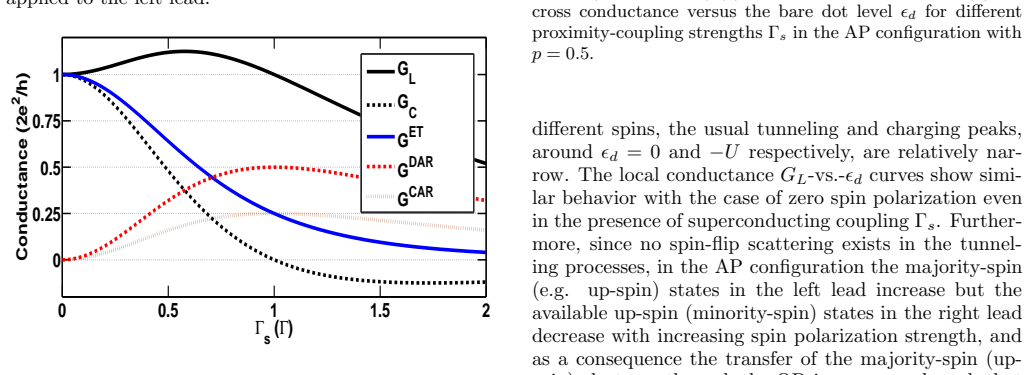
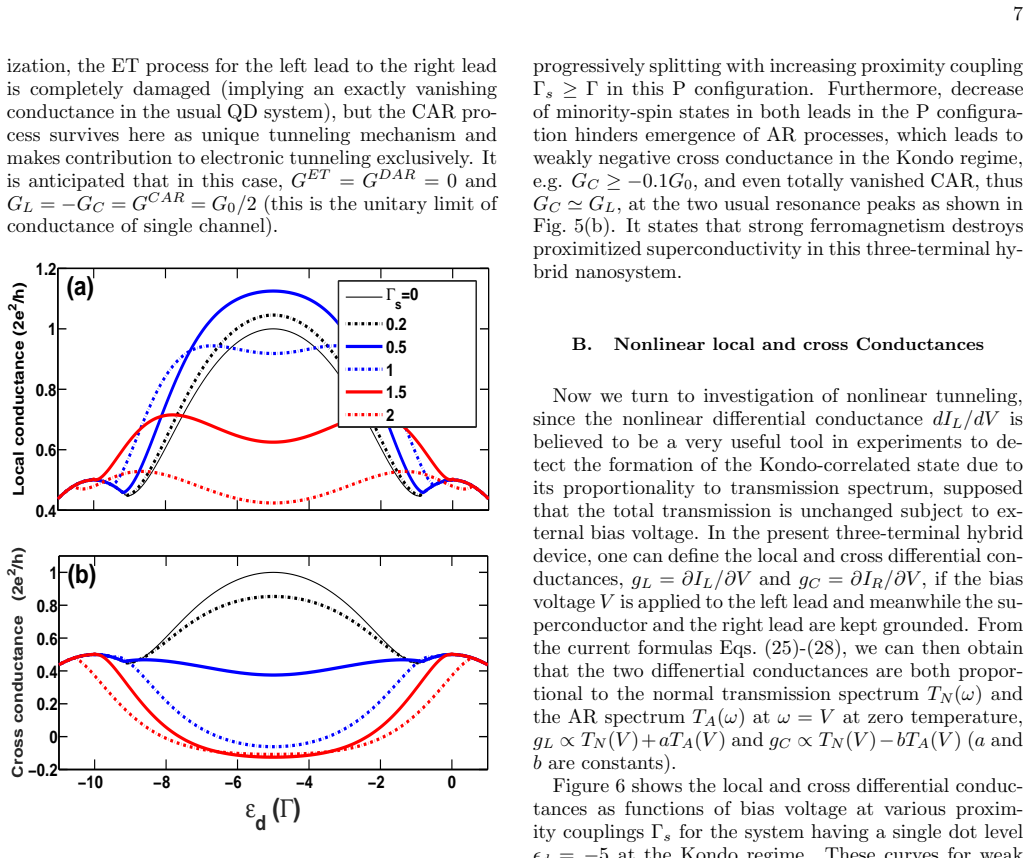
A numerically exact treatment of the same model (beyond the slave-boson mean-field level) or a low-temperature measurement on a tunable three-terminal quantum dot should check whether $G_C$ stays negative for $\Gamma_s > \Gamma$ in the Kondo plateau, whether $G_C$ passes through zero at $\Gamma_s \approx \Gamma$ at particle-hole symmetry, and whether the antiparallel polarization $p=0.5$ indeed deepens $G_C$ to $\approx -G_0/5$; any of these failing would falsify the mean-field prediction.
Extended reading notes
Core claim
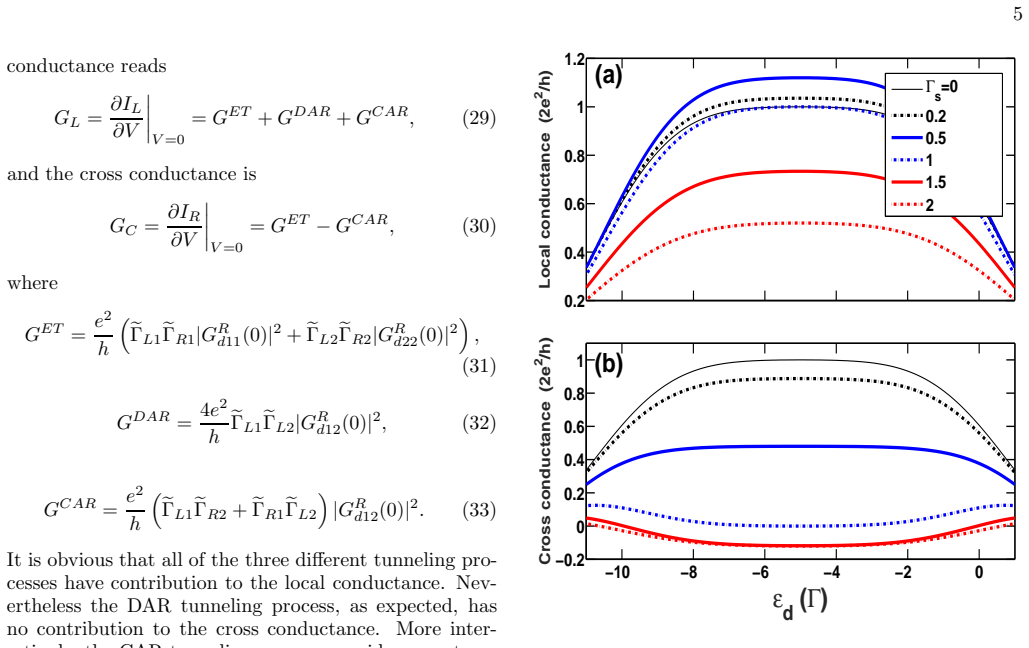
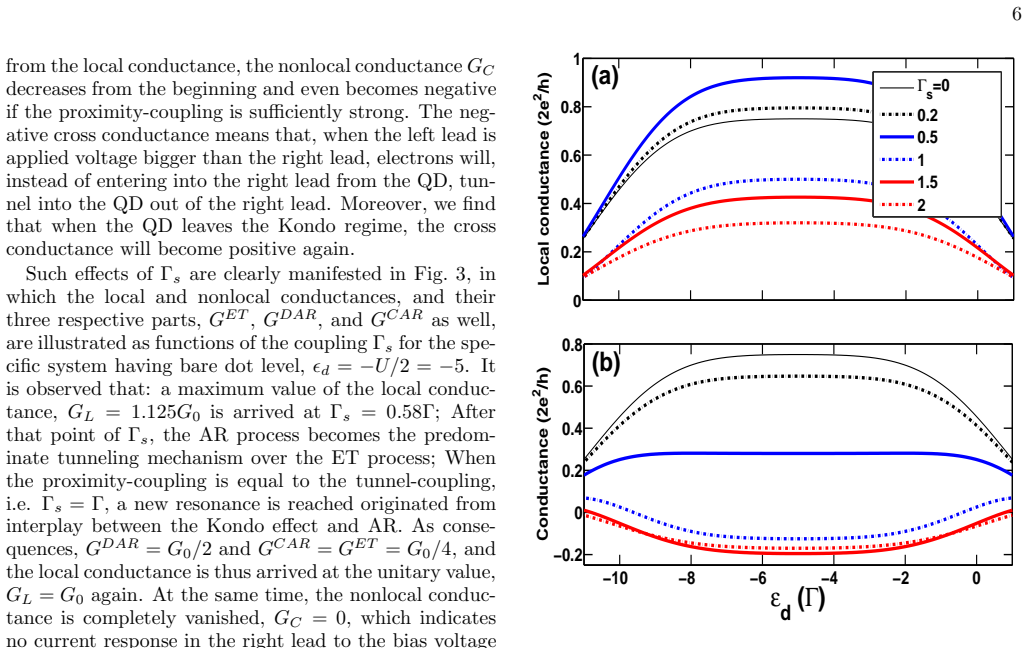
Working with a finite-$U$ slave-boson mean-field description and nonequilibrium Green functions, the paper shows that the linear cross conductance can be written as $G_C = G_{\rm ET} - G_{\rm CAR}$, while the local conductance is $G_L = G_{\rm ET} + G_{\rm DAR} + G_{\rm CAR}$. Since the crossed Andreev reflection (CAR) hole current in the right lead flows opposite to the electron transfer current, the cross conductance turns negative when $G_{\rm CAR} > G_{\rm ET}$; this happens for $\Gamma_s > \Gamma$ inside the Kondo plateau. At the particle-hole symmetric point $\epsilon_d = -U/2$ and $\Gamma_s = \Gamma$, the calculation gives $G_{\rm DAR} = G_0/2$, $G_{\rm CAR} = G_{\rm ET} = G_0/4$, so the local conductance returns to $G_0$ while the cross conductance vanishes. In the antiparallel configuration the spin-dependent availability of up and down electrons makes the CAR channel more efficient as polarization grows, producing $G_C \simeq -G_0/5$ at $p=0.5$, and in the fully polarized limit the paper argues only CAR survives, leaving $G_L = -G_C = G_{\rm CAR} = G_0/2$. In the parallel configuration, polarization splits the Kondo peak and suppresses CAR, so $G_C$ stays weakly negative and the local conductance develops a four-peak structure.
Load-bearing premise
The load-bearing premise is that the slave-boson mean-field approximation, which replaces all boson operators by their expectation values, remains quantitatively reliable for the Kondo regime when superconducting pairing and ferromagnetic leads are both present; if strong correlations renormalize the pairing or the Kondo resonance beyond this mean-field level, the predicted values, and possibly the sign, of the cross conductance could change.
Editorial extensions
If this is right
- If the central claim is right, a negative linear cross conductance in the Kondo regime is a clean experimental marker for crossed Andreev reflection, distinguishing it from sequential-tunneling mechanisms that also produce negative nonlocal responses at higher bias.
- In the antiparallel configuration the predicted polarization dependence gives a direct handle: raising $p$ toward unity should drive the device toward a pure crossed-Andreev state with $G_L = -G_C = G_0/2$.
- The vanishing of $G_C$ and the return of $G_L$ to $G_0$ at $\Gamma_s = \Gamma$ and $\epsilon_d = -U/2$ provides a specific quantitative check that could be tested by tuning gate voltage and tunnel barriers.
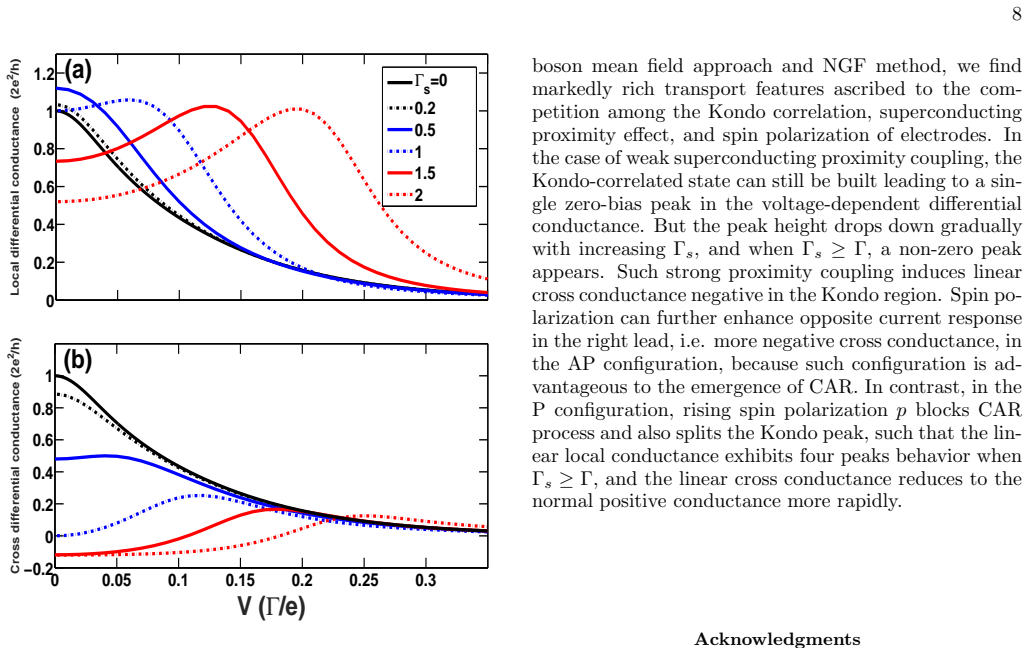
- Because the bias voltage destroys the negative response, finite-bias differential-conductance measurements should show the negative region only within the Kondo window, with recovery at large $V$.
- In the parallel configuration, the predicted drop of the cross conductance back toward the positive normal value quantifies how strongly ferromagnetism in parallel alignment suppresses proximity-induced pairing.
Reading between the lines
- A natural extension is to read the sign and magnitude of $G_C$ as a direct measure of the renormalized crossed-Andreev amplitude, so the same setup could be used as a tunable detector of nonlocal pairing correlations in quantum-dot devices.
- The mean-field prediction at $p \to 1$ in the antiparallel configuration suggests a symmetry-protected regime in which the device acts as a pure Cooper-pair splitter with equal and opposite local and nonlocal conductances; verifying this limit beyond the slave-boson approximation would test whether the mechanism survives strong correlations.
- The same decomposition $G_C = G_{\rm ET} - G_{\rm CAR}$ should apply more generally to any three-terminal hybrid with proximity pairing, so the qualitative sign-change criterion $\Gamma_s > \Gamma$ is a testable design rule for experiments and for other theoretical approaches.
Signed reviews
Editorial analysis
A structured set of objections, weighed in public.
Referee Report
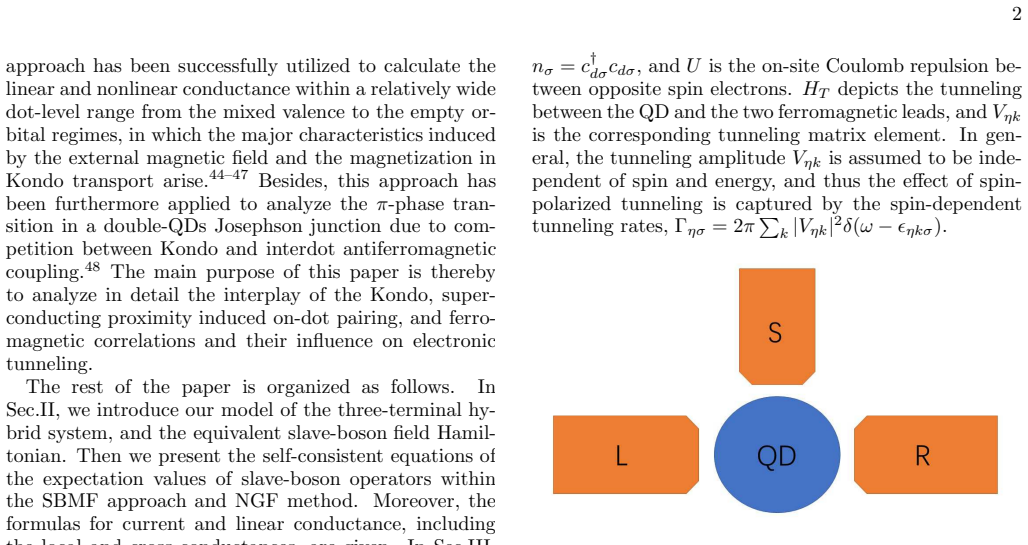
Summary. The manuscript studies the zero-temperature subgap transport of a quantum dot connected to two ferromagnetic leads and one superconducting lead in the Kondo regime. Using the finite-U Kotliar-Ruckenstein slave-boson mean-field approach combined with the nonequilibrium Green function technique, the authors compute local and cross linear conductances as functions of the dot level, the superconducting proximity coupling Γ_s, and the spin polarization p of the ferromagnetic leads. They report that a sufficiently strong superconducting coupling suppresses the local conductance and can make the linear cross conductance negative, that the antiparallel lead configuration enhances this negative cross conductance through crossed Andreev reflection, and that the parallel configuration instead splits the Kondo resonance and suppresses the negative nonlocal response. The paper also presents nonlinear differential conductance results showing Kondo zero-bias anomalies and their splitting at large Γ_s.
Significance. The central prediction—that the nonlocal current response changes sign when crossed Andreev reflection dominates elastic cotunneling—is a concrete and falsifiable statement for three-terminal hybrid devices. A clear strength is the explicit decomposition of the local and cross conductances into ET, DAR, and CAR components in Eqs. (29)-(33), which gives a transparent physical mechanism and shows that the DAR process drops out of the cross conductance while CAR enters with the opposite sign to ET. The calculation has no fitted parameters beyond the model parameters (U, Γ_s, p, ε_d, Γ), and the parameter study spans the Kondo, mixed-valence, and empty-orbital regimes. However, the significance is limited by an internal sign-convention inconsistency in the definition of the right-lead current, which must be resolved before the headline negative-cross-conductance claim can be interpreted; in addition, the slave-boson mean-field treatment is uncontrolled in the simultaneous presence of strong correlations, superconductivity, and ferromagnetism, so the quantitative values (e.g., G_C ≈ -G0/5 in Fig. 4) should be taken with caution.
major comments (3)
- [II.C, Eqs. (24)-(30)] The sign convention for the right-lead current is inconsistent, and this directly affects the central claim. Equation (24) defines I_eta = -e d/dt sum_k c†_{eta k sigma} c_{eta k sigma}, so positive I_eta corresponds to electrons leaving lead eta (the usual 'current from the lead into the dot' in the NEGF convention). Exchanging L and R in Eqs. (26)-(28) gives I_ET_R = -GET and I_CAR_R = +GCAR in the linear-response limit, and therefore G_C = dI_R/dV = -GET + GCAR, not GET - GCAR as printed in Eq. (30). The explanatory sentence after Eq. (30)—'a hole entering the right lead is physically equivalent to an electron injecting into the QD from the right lead'—indicates that the authors actually intend I_R to be the current from the QD into the right lead, which is the negative of the quantity defined by Eq. (24). Under that alternative convention Eq. (30) is correct, but then the derivation from Eqs. (26)-(28) is missing a minus sign and the definition in Eq. (24) is mislabeled. Because the abstract and Figs. 2-5 use the sign of Eq. (30) to conclude that 'when Γ_s is bigger than Γ the LCC becomes negative,' the authors must state the current-direction convention unambiguously, correct Eq. (24) or Eq. (30) accordingly, and re-examine whether their stated condition for negative cross conductance is preserved.
- [II.B, Eqs. (9)-(19)] The self-consistent equations are the basis for all numerical results, but they are stated without derivation after 'a lengthy and tedious calculation,' and Eqs. (18)-(19) appear to contain index errors. In Eq. (18), the first square bracket contains ~Γ_L1 f_L(ω) + ~Γ_R1 f_R(ω), while the second square bracket mixes ~Γ_L2 with ~Γ_R1 rather than following the same η pattern; Eq. (19) has a similar structure. As printed, these expressions cannot be checked by a reader, and the reliability of Figs. 2-6 rests on them. I request that the authors provide the derivation of the slave-boson equations of motion or at least state the origin of each term, and correct the indices and prefactors in Eqs. (18)-(19).
- [II.B and III] The SBMF approximation replaces all slave-boson operators by their expectation values, an approximation that is uncontrolled when the dot is simultaneously subject to strong Coulomb interaction, superconducting pairing with Γ_s ~ Γ, and ferromagnetic leads with p = 0.5. Since the quantitative prediction G_C ≈ -G0/5 in Fig. 4 and the sign of the cross conductance in the strong-coupling regime are central claims, the paper should benchmark the approach against known limits (for example, the normal-lead Kondo limit, or available numerical renormalization-group results for a dot coupled to a superconductor) and discuss how the mean-field decoupling may affect the ET-CAR competition.
minor comments (5)
- [Throughout] There are numerous typographical errors ('Konod', 'supercoducting', 'Adnreev', 'injuring', 'diffenertial'); the text should be carefully proofread.
- [Fig. 4] The y-axis of Fig. 4(b) is labeled 'Conductance (2e2/h)' but should be labeled 'Cross conductance (2e2/h)'.
- [After Eq. (30)] The statement that 'if Γ_s = 0 ... the cross conductance reduces to the local conductance' is only correct for the convention in which I_R is the current from the QD into the right lead; please make this convention explicit at that point.
- [Eq. (18)] The final term f_η(ω)G^A_d11(ω) in Eq. (18) appears to lack a prefactor relative to the other terms in the integrand; please verify the expression.
- [References] Reference 41 appears with corrupted text ('Micha/suppress lek') in the compiled version; please ensure all bibliographic entries are typeset correctly.
Circularity Check
No significant circularity was found. The negative cross conductance is a numerically solved model prediction, not a restatement of a fitted parameter or a self-referential definition. The self-citations are to the authors' earlier SBMF method papers and are not load-bearing for the central claim.
full rationale
The central result, that the linear cross conductance becomes negative when Gamma_s exceeds Gamma and is further enhanced in the antiparallel configuration, is obtained by solving the finite-U slave-boson mean-field equations (9)-(14) and then evaluating the conductance components GET, GDAR, and GCAR from the Green functions via Eqs. (29)-(33). No parameter is fitted to the target observable; the boson expectation values are determined self-consistently by the model equations and are not tuned to reproduce the reported sign. The decomposition GC = GET - GCAR in Eq. (30) ultimately rests on the current formulas cited to Refs. 41 and 42, and the sign of GC is not forced by that formula alone, because whether GET exceeds GCAR is a computed outcome of the Green functions rather than an input. Refs. 44-47 are self-citations used only to motivate the slave-boson mean-field method, whose origin is external (Ref. 43); they are not invoked as a uniqueness theorem and they do not substitute for the calculation. The paper does contain an internal sign-convention tension between Eq. (24), where I_eta is the current from lead eta into the dot, and Eq. (30), whose positive ET contribution matches the opposite current convention; that is a correctness or consistency concern, not circularity, because it does not make the predicted quantity equal to an input by construction. No self-definitional, fitted-input, self-citation-chain, or ansatz-smuggling circularity was found, so the appropriate finding is no significant circularity with only minor methodological self-citation.
Assumptions & free parameters
free parameters (5)
- U =
10 Γ
- Γ_s =
0 to 2 Γ (scanned)
- p =
0 and 0.5 (scanned)
- ε_d =
-10 Γ to 0 (scanned); particle-hole symmetric point -5 Γ
- Γ =
1 (energy unit)
assumptions (4)
- domain assumption The superconducting lead has an infinitely large gap, so it can be integrated out to an effective on-dot pairing term Γ_s(c†_{d1}c†_{d2} + c_{d1}c_{d2}).
- domain assumption The ferromagnetic leads are described by spin-dependent tunnel rates with no spin-flip scattering and in the wide-band limit.
- ad hoc to paper Slave-boson operators are replaced by their expectation values, the mean-field decoupling.
- standard math Zero-temperature steady-state nonequilibrium Green function formalism.
Cite this review
Pith. "Pith review of Enhanced negative nonlocal conductance in an interacting quantum dot connected to two ferromagnetic leads and one superconducting lead." pith.science (2026). https://pith.science/paper/YLF4ODNG
@misc{pith2026190803365,
  author       = {Pith},
  title        = {Pith review of: Enhanced negative nonlocal conductance in an interacting quantum dot connected to two ferromagnetic leads and one superconducting lead},
  year         = {2026},
  howpublished = {\url{https://pith.science/paper/YLF4ODNG}},
  note         = {Machine review of arXiv:1908.03365}
}
abstract
In this paper, we investigate the electronic transport properties of a quantum dot (QD) connected to two ferromagnetic leads and one superconductor lead in the Kondo regime by means of the finite-$U$ slave boson mean field approach and nonequilibrium Green function technique. In this three-terminal hybrid nano-device, we will focus our attention on the joint effects of the Konod correlation, superconducting proximity pairing, and spin polarization of leads. It is found that: the superconducting proximity effect will suppress the linear local conductance (LLC) stemming from the weakened Kondo peak, and when its coupling $\Gamma_s$ is bigger than the tunnel-coupling $\Gamma$ of two normal leads, the linear cross conductance (LCC) becomes negative in the Kondo region; for antiparallel configuration, increasing spin polarization further suppresses LLC but enhances LCC, i.e. causing larger negative values of LCC, since it is benefit for emergence of cross Andreev reflection; On the contrary, for parallel configuration, with increasing spin polarization, the LLC descends and greatly widens with the appearance of shoulders, and eventually splits into four peaks, and meanwhile the LCC reduces relatively rapidly to the normal conductance.
Figures
Figures from the paper (3 more)
Reference graph
Works this paper leans on
-
[1]
author S. Russo , author M. Kroug , author T. M. Klapwijk , and author A. F. Morpurgo , journal Phys. Rev. Lett. volume 95 , pages 027002 ( year 2005 ), ://link.aps.org/doi/10.1103/PhysRevLett.95.027002
-
[2]
author P. Cadden-Zimansky and author V. Chandrasekhar , journal Phys. Rev. Lett. volume 97 , pages 237003 ( year 2006 ), ://link.aps.org/doi/10.1103/PhysRevLett.97.237003
-
[3]
author P. Jarillo-Herrero , author J. A. Van Dam , and author L. P. Kouwenhoven , journal Nature volume 439 , pages 953 ( year 2006 )
work page 2006
-
[4]
author J. A. Van Dam , author Y. V. Nazarov , author E. P. Bakkers , author S. De Franceschi , and author L. P. Kouwenhoven , journal Nature volume 442 , pages 667 ( year 2006 )
work page 2006
-
[5]
author K. Grove-Rasmussen , author H. I. J rgensen , author B. M. Andersen , author J. Paaske , author T. S. Jespersen , author J. Nyg rd , author K. Flensberg , and author P. E. Lindelof , journal Phys. Rev. B volume 79 , pages 134518 ( year 2009 ), ://link.aps.org/doi/10.1103/PhysRevB.79.134518
-
[6]
author M. R. Buitelaar , author T. Nussbaumer , and author C. Sch\"onenberger , journal Phys. Rev. Lett. volume 89 , pages 256801 ( year 2002 ), ://link.aps.org/doi/10.1103/PhysRevLett.89.256801
-
[7]
author S. D. Franceschi , author L. Kouwenhoven , author C. Sch\"onenberger , and author W. Wernsdorfer , journal Nature Nanotechnology volume 5 , pages 703 ( year 2010 )
work page 2010
-
[8]
author K. J. Franke , author G. Schulze , and author J. I. Pascual , journal Science volume 332 , pages 940 ( year 2011 ), ISSN issn 0036-8075 , https://science.sciencemag.org/content/332/6032/940.full.pdf , ://science.sciencemag.org/content/332/6032/940
work page 2011
Show all 48 references
-
[9]
Dirks , author T
author T. Dirks , author T. L. Hughes , author S. Lal , author B. Uchoa , author Y.-F. Chen , author C. Chialvo , author P. M. Goldbart , and author N. Mason , journal Nature Physics volume 7 , pages 386 ( year 2011 )
2011
-
[10]
Schindele , author A
author J. Schindele , author A. Baumgartner , and author C. Sch\"onenberger , journal Phys. Rev. Lett. volume 109 , pages 157002 ( year 2012 ), ://link.aps.org/doi/10.1103/PhysRevLett.109.157002
2012 doi
-
[11]
Braunecker , author P
author B. Braunecker , author P. Burset , and author A. Levy Yeyati , journal Phys. Rev. Lett. volume 111 , pages 136806 ( year 2013 ), ://link.aps.org/doi/10.1103/PhysRevLett.111.136806
2013 doi
-
[12]
author E. J. H. Lee , author X. Jiang , author M. Houzet , author R. Aguado , author C. M. Lieber , and author S. D. Franceschi , journal Nature Nanotechnology volume 9 , pages 79 ( year 2014 )
2014
-
[13]
author R. S. Deacon , author A. Oiwa , author J. Sailer , author S. Baba , author Y. Kanai , author K. Shibata , author K. Hirakawa , and author S. Tarucha , journal Nature Communications volume 6 , pages 7446 ( year 2015 )
2015
-
[14]
ul\"op , author F. Dom\' nguez , author S. d'Hollosy , author A. Baumgartner , author P. Makk , author M. H. Madsen , author V. A. Guzenko , author J. Nyg rd , author C. Sch\
author G. F\"ul\"op , author F. Dom\' nguez , author S. d'Hollosy , author A. Baumgartner , author P. Makk , author M. H. Madsen , author V. A. Guzenko , author J. Nyg rd , author C. Sch\"onenberger , author A. Levy Yeyati , et al. , journal Phys. Rev. Lett. volume 115 , pages...
2015 doi
-
[15]
author S. M. Albrecht , author A. P. Higginbotham , author M. Madsen , author F. Kuemmeth , author T. S. Jespersen , author J. Nyg rd , author P. Krogstrup , and author C. M. Marcus , journal Nature volume 531 , pages 206 ( year 2016 )
2016
-
[16]
Hofstetter , author S
author L. Hofstetter , author S. Csonka , author J. Nyg rd , and author C. Sch\"onenberger , journal Nature volume 461 , pages 960 ( year 2009 )
2009
-
[17]
author R. M. Lutchyn , author J. D. Sau , and author S. Das Sarma , journal Phys. Rev. Lett. volume 105 , pages 077001 ( year 2010 ), ://link.aps.org/doi/10.1103/PhysRevLett.105.077001
2010 doi
-
[18]
Ruby , author F
author M. Ruby , author F. Pientka , author Y. Peng , author F. von Oppen , author B. W. Heinrich , and author K. J. Franke , journal Phys. Rev. Lett. volume 115 , pages 087001 ( year 2015 ), ://link.aps.org/doi/10.1103/PhysRevLett.115.087001
2015 doi
-
[19]
Ruby , author Y
author M. Ruby , author Y. Peng , author F. von Oppen , author B. W. Heinrich , and author K. J. Franke , journal Phys. Rev. Lett. volume 117 , pages 186801 ( year 2016 ), ://link.aps.org/doi/10.1103/PhysRevLett.117.186801
2016 doi
-
[20]
Sand-Jespersen , author J
author T. Sand-Jespersen , author J. Paaske , author B. M. Andersen , author K. Grove-Rasmussen , author H. I. J rgensen , author M. Aagesen , author C. B. S rensen , author P. E. Lindelof , author K. Flensberg , and author J. Nyg rd , journal Phys. Rev. Lett. volume 99 , page...
2007 doi
-
[21]
author J. C. Cuevas , author A. Levy Yeyati , and author A. Mart\' n-Rodero , journal Phys. Rev. B volume 63 , pages 094515 ( year 2001 ), ://link.aps.org/doi/10.1103/PhysRevB.63.094515
2001 doi
-
[22]
Eldridge , author M
author J. Eldridge , author M. G. Pala , author M. Governale , and author J. K\"onig , journal Phys. Rev. B volume 82 , pages 184507 ( year 2010 ), ://link.aps.org/doi/10.1103/PhysRevB.82.184507
2010 doi
-
[23]
author D. S. Golubev and author A. D. Zaikin , journal Phys. Rev. B volume 82 , pages 134508 ( year 2010 ), ://link.aps.org/doi/10.1103/PhysRevB.82.134508
2010 doi
-
[24]
author A. G. Moghaddam , author M. Governale , and author J. K\"onig , journal Phys. Rev. B volume 85 , pages 094518 ( year 2012 ), ://link.aps.org/doi/10.1103/PhysRevB.85.094518
2012 doi
-
[25]
Kir s s anskas , author M
author G. Kir s s anskas , author M. Goldstein , author K. Flensberg , author L. I. Glazman , and author J. Paaske , journal Phys. Rev. B volume 92 , pages 235422 ( year 2015 ), ://link.aps.org/doi/10.1103/PhysRevB.92.235422
2015 doi
-
[26]
Yamada , author Y
author Y. Yamada , author Y. Tanaka , and author N. Kawakami , journal Phys. Rev. B volume 84 , pages 075484 ( year 2011 ), ://link.aps.org/doi/10.1103/PhysRevB.84.075484
2011 doi
-
[27]
Koga , journal Phys
author A. Koga , journal Phys. Rev. B volume 87 , pages 115409 ( year 2013 ), ://link.aps.org/doi/10.1103/PhysRevB.87.115409
2013 doi
-
[28]
Z Z itko , journal Phys
author R. Z Z itko , journal Phys. Rev. B volume 93 , pages 195125 ( year 2016 ), ://link.aps.org/doi/10.1103/PhysRevB.93.195125
2016 doi
-
[29]
Mart\' n-Rodero and author A
author A. Mart\' n-Rodero and author A. L. Yeyati , journal Advances in Physics volume 60 , pages 899 ( year 2011 ), https://doi.org/10.1080/00018732.2011.624266 , ://doi.org/10.1080/00018732.2011.624266
2011
-
[30]
Hofstetter , author A
author L. Hofstetter , author A. Geresdi , author M. Aagesen , author J. Nyg rd , author C. Sch\"onenberger , and author S. Csonka , journal Phys. Rev. Lett. volume 104 , pages 246804 ( year 2010 ), ://link.aps.org/doi/10.1103/PhysRevLett.104.246804
2010 doi
-
[31]
Beckmann , author H
author D. Beckmann , author H. B. Weber , and author H. v. L\"ohneysen , journal Phys. Rev. Lett. volume 93 , pages 197003 ( year 2004 ), ://link.aps.org/doi/10.1103/PhysRevLett.93.197003
2004 doi
-
[32]
onig , and author G. Sch\
author J. Martinek , author Y. Utsumi , author H. Imamura , author J. Barna s \' s , author S. Maekawa , author J. K\"onig , and author G. Sch\"on , journal Phys. Rev. Lett. volume 91 , pages 127203 ( year 2003 ), ://link.aps.org/doi/10.1103/PhysRevLett.91.127203
2003 doi
-
[33]
author A. N. Pasupathy , author R. C. Bialczak , author J. Martinek , author J. E. Grose , author L. A. K. Donev , author P. L. McEuen , and author D. C. Ralph , journal Science volume 306 , pages 86 ( year 2004 ), ISSN issn 0036-8075 , https://science.sciencemag.org/content/3...
2004
-
[34]
author J. R. Hauptmann , author J. Paaske , and author P. E. Lindelof , journal Nature Physics volume 4 , pages 373 ( year 2008 )
2008
-
[35]
Gaass , author A
author M. Gaass , author A. K. H\"uttel , author K. Kang , author I. Weymann , author J. von Delft , and author C. Strunk , journal Phys. Rev. Lett. volume 107 , pages 176808 ( year 2011 ), ://link.aps.org/doi/10.1103/PhysRevLett.107.176808
2011 doi
-
[36]
Dong , author H
author B. Dong , author H. L. Cui , author S. Y. Liu , and author X. L. Lei , journal Journal of Physics: Condensed Matter volume 15 , pages 8435 ( year 2003 ), https://doi.org/10.1088
2003
-
[37]
Weymann and author K
author I. Weymann and author K. P. W\'ojcik , journal Phys. Rev. B volume 92 , pages 245307 ( year 2015 ), ://link.aps.org/doi/10.1103/PhysRevB.92.245307
2015 doi
-
[38]
Futterer , author M
author D. Futterer , author M. Governale , author M. G. Pala , and author J. K\"onig , journal Phys. Rev. B volume 79 , pages 054505 ( year 2009 ), ://link.aps.org/doi/10.1103/PhysRevB.79.054505
2009 doi
-
[39]
Futterer , author M
author D. Futterer , author M. Governale , and author J. K\"onig , journal EPL (Europhysics Letters) volume 91 , pages 47004 ( year 2010 ), https://doi.org/10.1209
2010
-
[40]
Weymann and author P
author I. Weymann and author P. Trocha , journal Phys. Rev. B volume 89 , pages 115305 ( year 2014 ), ://link.aps.org/doi/10.1103/PhysRevB.89.115305
2014 doi
-
[41]
Micha ek , author B
author G. Micha ek , author B. R. Bu ka , author T. Doma n \' n ski , and author K. I. Wysoki n \' n ski , journal Phys. Rev. B volume 88 , pages 155425 ( year 2013 ), ://link.aps.org/doi/10.1103/PhysRevB.88.155425
2013 doi
-
[42]
Micha ek , author T
author G. Micha ek , author T. Doma n \' n ski , author B. R. Bu ka , and author K. I. Wysoki n \' n ski , journal Scientific Reports volume 5 , pages 14572 ( year 2015 )
2015
-
[43]
Kotliar and author A
author G. Kotliar and author A. E. Ruckenstein , journal Phys. Rev. Lett. volume 57 , pages 1362 ( year 1986 ), ://link.aps.org/doi/10.1103/PhysRevLett.57.1362
1986 doi
-
[44]
Dong and author X
author B. Dong and author X. L. Lei , journal Phys. Rev. B volume 63 , pages 235306 ( year 2001 a ), ://link.aps.org/doi/10.1103/PhysRevB.63.235306
2001 doi
-
[45]
Dong and author X
author B. Dong and author X. L. Lei , journal Journal of Physics: Condensed Matter volume 13 , pages 9245 ( year 2001 b ), https://doi.org/10.1088
2001
-
[46]
Dong and author X
author B. Dong and author X. L. Lei , journal Phys. Rev. B volume 65 , pages 241304 ( year 2002 ), ://link.aps.org/doi/10.1103/PhysRevB.65.241304
2002 doi
-
[47]
Ma , author B
author J. Ma , author B. Dong , and author X.-L. Lei , journal Communications in Theoretical Physics volume 43 , pages 341 ( year 2005 ), https://doi.org/10.1088
2005
-
[48]
author F. S. Bergeret , author A. L. Yeyati , and author A. Mart\' n-Rodero , journal Phys. Rev. B volume 74 , pages 132505 ( year 2006 ), ://link.aps.org/doi/10.1103/PhysRevB.74.132505
2006 doi
Reviewed August 14, 2026 · model on record in the stance chip above.
Discussion (0). Continue with ORCID to comment.