REVIEW 2 major objections 5 minor 47 references
Proportionally Fair Makespan Approximation
T0 review · 2 major / 5 minor · reviewed 2026-08-11 · deepseek-v4-flash
Pith's one-line read The paper proves that a payment-based proportional schedule can always reach 3/2 of the optimal makespan, and that no proportional mechanism can do better when n ≥ m.
desk verdict Tight 3/2 price of proportionality with payments is new and mostly right, but Theorem 1's proof has a repairable gap that should be fixed before publication. read the letter →
The pith
A machine-rendered reading of the paper's core claim, the machinery that carries it, and where it could break.
The reading
What carries the argument
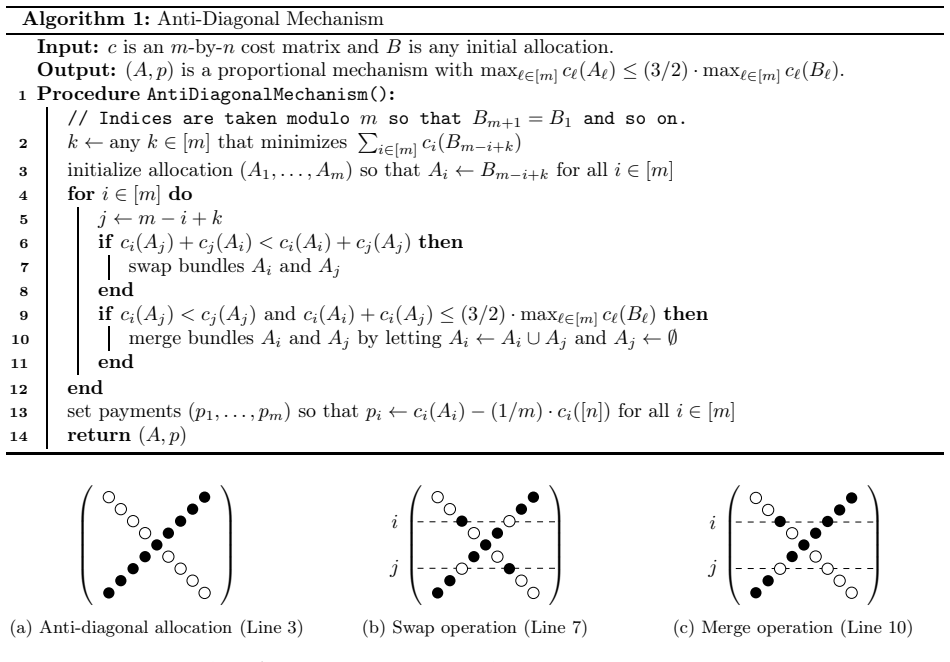
The central object is mean efficiency (Definition 3.1), a budget on the total cost of an allocation, proved equivalent to proportionability in Theorem 6 and therefore the exact condition that payments must be able to fix. The main algorithmic engine is the Anti-Diagonal Mechanism (Algorithm 1): it reads any initial allocation, forms the $m \times m$ matrix of costs of each machine for each initial bundle, and picks the anti-diagonal with minimum total cost; because the average of anti-diagonal totals equals the average of the whole matrix, this choice is mean-efficient. Subsequent swap and merge operations lower the total cost, preserving mean efficiency, while a careful case analysis bounds every machine's final bundle cost by 3/2 times the input makespan. For normalized instances, the mechanism instead takes the makespan-minimizing allocation of minimal total cost and proves mean-efficiency through a directed graph with no cycles.
What would settle it
Take the cost matrix from Theorem 2's proof: entries 1 on the diagonal, 1/2 below the diagonal, and $3/2 - \epsilon/2$ above the diagonal, with $m = n$. If any proportional mechanism (using Definition 2.4) returns an allocation whose makespan is below $(3/2 - \epsilon)$, that would falsify the tightness claim; the paper's own argument shows such an allocation would have to be the identity allocation with total cost $m$, violating mean efficiency.
Extended reading notes
Core claim
The central claim is a tight equivalence between fairness and efficiency. An allocation function is proportionable — meaning it can be paired with payments so that each machine's net cost is at most its average share — if and only if it is mean-efficient: the total cost of the allocation is no larger than the average row cost of the cost matrix times the number of machines. The theorem comes with an explicit payment formula, $p_i = c_i(A_i) - (1/m)c_i([n])$, that realizes proportionality. On top of this characterization sits the Anti-Diagonal Mechanism, which selects a cost-minimizing anti-diagonal of the matrix of machine costs under the initial allocation, then applies swap and merge operations that preserve mean-efficiency while capping makespan at 3/2 of the initial schedule's makespan. For normalized instances the paper shows the cheapest makespan-optimal allocation is mean-efficient, giving an exact proportional mechanism.
Load-bearing premise
The whole result rests on Definition 2.4's notion of proportionality, where machine i's fair share is computed from i's own costs minus the average payment; if one uses another definition of proportional fairness, the 3/2 bound is not shown to hold.
Editorial extensions
If this is right
- The price of proportionality for makespan is exactly 3/2: Theorem 1's mechanism achieves it and Theorem 2's instance rules out any $(3/2 - \epsilon)$-approximation when $n \ge m$.
- Feeding the Anti-Diagonal Mechanism with the polynomial-time 2-approximation of [37] yields a polynomial-time proportional mechanism with a 3-approximation to the optimal makespan.
- Under normalized costs, proportionality costs nothing in efficiency: a proportional mechanism attains the optimal makespan, while envy-free mechanisms still incur a logarithmic loss.
- For the goods-allocation counterpart (maximizing egalitarian welfare), no proportional mechanism can guarantee any finite approximation in general, but normalized instances admit an exact proportional mechanism.
- The cyclic lower-bound technique behind the envy-free impossibility does not extend to approximate envy-freeness: for every $\epsilon > 0$ there is a $(1-\epsilon)$-cyclic-envy-free mechanism with $1/\epsilon$ makespan approximation.
Reading between the lines
- The 3/2 ratio matches the classic inapproximability threshold for makespan minimization without any fairness constraint, which suggests that in this payment model proportionality may not be the binding obstacle to efficiency.
- Because the characterization equates proportionality with an average-cost bound, fair scheduling is effectively a bicriteria problem: fairness is guaranteed as soon as total cost is controlled, so future work can focus on allocations that simultaneously control makespan and average cost.
- The exactness for normalized instances hints that settings with comparable total costs may be qualitatively easier for fair mechanisms; a natural test is whether other fairness relaxations, such as EF1 or EFX with payments, also become constant-factor or exact in that regime.
- The lower-bound instance is highly structured, almost a triangular matrix; exploring perturbations of it could show whether 3/2 is stable or an artifact of extreme cost asymmetry.
Signed reviews
Editorial analysis
A structured set of objections, weighed in public.
Referee Report
Summary. The paper studies fair mechanisms for unrelated-machine scheduling, viewing jobs as chores and machines as agents, in a quasi-linear model with payments. It defines proportionality (Definition 2.4) and characterizes proportionable allocations by a mean-efficiency condition (Theorem 6). The main results are a proportional mechanism with a 3/2 makespan approximation for general instances (Theorem 1), a matching lower bound (Theorem 2), an exact proportional mechanism for normalized instances (Theorem 3), analogous results for goods allocation (Theorems 4 and 5), a characterization of approximately envy-freeable allocations (Theorem 8), and a result showing that the known envy-free lower-bound technique does not extend to approximate cyclic envy-freeness (Theorem 9).
Significance. If the main theorem is established, the paper gives a striking contrast with the logarithmic impossibility for envy-freeness: proportionality with payments has a tight constant price of fairness, 3/2, for the makespan objective. The mean-efficiency characterization is elegant and reduces proportionality to a simple total-cost condition with an explicit payment formula. The lower-bound construction is explicit and the normalized-instance exact result is a clean graph argument. The goods-allocation and approximate-envy-freeness results broaden the scope. However, the proof of Theorem 1 as written contains a genuine gap, so the central upper bound is not yet established; the gap appears local and repairable. All results are tied to the paper's specific Definition 2.4, and alternative payment-aware proportionality notions would not automatically inherit these bounds.
major comments (2)
- [Section 4.1, proof of Theorem 1] The case analysis for A_l = B_l ∪ B_h is incomplete. The text asserts that the only way A_l can become B_l ∪ B_h is the merge in Line 10 at iteration i = l. This is false: if at iteration i = h the merge in Line 10 creates A_h = B_l ∪ B_h and sets A_l = ∅, then at the later iteration i = l the swap in Line 7 can move that union into A_l. The written proof contains no bound on c_l(B_l ∪ B_h) for this path. The gap is repairable: the merge at i = h gives c_h(B_l ∪ B_h) ≤ 3M/2, and the swap at i = l is executed only if c_l(A_h) + c_h(A_l) < c_l(A_l) + c_h(A_h); since A_l = ∅ in this path, that inequality yields c_l(B_l ∪ B_h) < c_h(B_l ∪ B_h) ≤ 3M/2. The proof should include this case explicitly.
- [Section 4.1, proof of Theorem 1, final case] The contradiction step in the final case is not written correctly. The displayed inequality c_h(B_l) < c_l(B_l) does not by itself imply that the merge condition in Line 10 was met at iteration i = h; with no prior swap, that condition is c_h(B_h) < c_l(B_h), not c_h(B_l) < c_l(B_l). The intended contradiction does follow, but from the two facts c_h(B_h) ≤ M < 3M/2 < c_l(B_h) and c_h(B_l) ≤ M/2, which together give c_h(B_h) < c_l(B_h) and c_h(B_h) + c_h(B_l) ≤ 3M/2. The proof should be rewritten to state this reasoning explicitly.
minor comments (5)
- [Section 4.2, proof of Theorem 3] In the normalization argument, the text writes c_i([m]) where it should write c_i([n]); additionally, the displayed inequality in the cycle argument contains a self-comparison c_{i_j}(A_{i_j}) < c_{i_j}(A_{i_j}), which should read c_{i_{j+1}}(A_{i_j}) < c_{i_j}(A_{i_j}). The intended argument is clear, but these typos should be fixed.
- [Section 5, proof of Theorem 4] In the proof of Theorem 4, the average of the values for good m is (m^2 + m + 1)/m = m + 1 + 1/m, not m + 1 as printed. The conclusion is unaffected because this value is still greater than m.
- [Section 6, Definition 6.4 and Theorem 9] The phrase 'stronger version of envy-freeness' is misleading: α-cyclic-envy-freeness imposes constraints only between adjacent machines in a cycle, so it is a weaker condition than envy-freeness. The intended statement is that the lower bound is strengthened because it holds even for a weaker fairness notion; the wording should be adjusted.
- [Section 4.1, proof of Theorem 1] The assertion that if A_l = B_h at the end then A_l and A_h were neither swapped nor merged in the iterations with i = l or i = h is stated without justification. It is true, because a swap at i = h would make the reverse swap at i = l impossible (the two swap inequalities are mutually exclusive), and a merge at either iteration would change A_l away from B_h, but the proof should say so.
- [Section 4.1, Algorithm 2] The termination of Algorithm 2 is not argued. Termination follows because each reallocation strictly decreases the total cost Σ_i c_i(A_i), so the algorithm cannot cycle; this should be stated explicitly.
Circularity Check
No circularity: main results are derived from first principles; self-citations are contextual, not load-bearing.
full rationale
The central claims are proved from first principles. Theorem 6 is established by summing the proportionality inequalities and by an explicit payment construction p_i = c_i(A_i) - (1/m)c_i([n]); neither direction imports an external result. The Anti-Diagonal Mechanism's proportionality follows directly from k being the minimizer of the anti-diagonal sums plus the fact that swaps and merges only decrease total cost, and the 3/2 bound is a case analysis on the possible contents of A_l. The lower bound (Theorem 2) uses Theorem 6 and an explicit cost matrix with a forced identity allocation, so it is not fitted or definitional. Theorem 3's normalized-instance result is self-contained via an acyclicity argument, and Theorem 4 uses an explicit instance plus Corollary 5.3. Citations to work by the present authors ([23], [10], [28]) occur as background, comparison benchmarks, or as part of a list of known characterizations, and none is a premise of the main theorems. The only passage needing scrutiny is the Theorem 1 proof's assertion that 'the only way for A_l to be set to B_l union B_h is in the merge operation in Line 10 during the iteration with i = l'; if false, that is a correctness gap in a written case analysis, not a circular reduction of the conclusion to the inputs. No parameter fitting, renamed prediction, or imported uniqueness theorem appears.
Assumptions & free parameters
assumptions (4)
- domain assumption Machines have quasi-linear disutilities: disutility equals cost minus payment (Section 2.2).
- domain assumption Costs are additive over jobs (Section 2.1).
- domain assumption Proportionality is defined by comparing machine i's net cost to the average of machine i's own costs over all bundles, with payments included (Definition 2.4).
- domain assumption Payments are unrestricted real numbers and can be negative or positive (Definition 2.2).
Cite this review
Pith. "Pith review of Proportionally Fair Makespan Approximation." pith.science (2026). https://pith.science/paper/YLP3F5YI
@misc{pith2026241208572,
  author       = {Pith},
  title        = {Pith review of: Proportionally Fair Makespan Approximation},
  year         = {2026},
  howpublished = {\url{https://pith.science/paper/YLP3F5YI}},
  note         = {Machine review of arXiv:2412.08572}
}
abstract
We study fair mechanisms for the classic job scheduling problem on unrelated machines with the objective of minimizing the makespan. This problem is equivalent to minimizing the egalitarian social cost in the fair division of chores. The two prevalent fairness notions in the fair division literature are envy-freeness and proportionality. Prior work has established that no envy-free mechanism can provide better than an $\Omega(\log m/ \log \log m)$-approximation to the optimal makespan, where $m$ is the number of machines, even when payments to the machines are allowed. In strong contrast to this impossibility, our main result demonstrates that there exists a proportional mechanism (with payments) that achieves a $3/2$-approximation to the optimal makespan, and this ratio is tight. To prove this result, we provide a full characterization of allocation functions that can be made proportional with payments. Furthermore, we show that for instances with normalized costs, there exists a proportional mechanism that achieves the optimal makespan. We conclude with important directions for future research concerning other fairness notions, including relaxations of envy-freeness. Notably, we show that the technique leading to the impossibility result for envy-freeness does not extend to its relaxations.
Figures
Reference graph
Works this paper leans on
-
[1]
Approximation schemes for scheduling on parallel machines
Noga Alon, Yossi Azar, Gerhard J Woeginger, and Tal Yadid . Approximation schemes for scheduling on parallel machines. Journal of Scheduling , 1(1):55–66, 1998
work page 1998
-
[2]
Fair division of indivisib le goods: Recent progress and open questions
Georgios Amanatidis, Haris Aziz, Georgios Birmpas, Ari s Filos-Ratsikas, Bo Li, Hervé Moulin, Alexan- dros A Voudouris, and Xiaowei Wu. Fair division of indivisib le goods: Recent progress and open questions. Artificial Intelligence , 322:103965, 2023
2023
-
[3]
A derivation of the money rawlsian s olution
Enriqueta Aragones. A derivation of the money rawlsian s olution. Social Choice and Welfare , 12(3): 267–276, 1995
work page 1995
-
[4]
Aslam, April Rasala, Clifford Stein, and Neal E
Javed A. Aslam, April Rasala, Clifford Stein, and Neal E. Y oung. Improved bicriteria existence theorems for scheduling. In SODA, pages 846–847. ACM/SIAM, 1999
work page 1999
-
[5]
Optim al bounds on the price of fairness for indivisible goods
Siddharth Barman, Umang Bhaskar, and Nisarg Shah. Optim al bounds on the price of fairness for indivisible goods. In International Conference on Web and Internet Economics , pages 356–369. Springer, 2020
work page 2020
-
[6]
Achieving envy- freeness with limited subsidies under dichotomous valuati ons
Siddharth Barman, Anand Krishna, Yadati Narahari, and S oumyarup Sadhukhan. Achieving envy- freeness with limited subsidies under dichotomous valuati ons. In Proceedings of the Thirty-First Inter- national Joint Conference on Artificial Intelligence, IJCAI-22 , pages 60–66, 2022
work page 2022
-
[7]
The price of fairness for indivis- ible goods
Xiaohui Bei, Xinhang Lu, Pasin Manurangsi, and Warut Suk sompong. The price of fairness for indivis- ible goods. Theory of Computing Systems , 65:1069–1093, 2021
work page 2021
-
[8]
Dimitris Bertsimas, Vivek F Farias, and Nikolaos Tricha kis. The price of fairness. Operations research, 59(1):17–31, 2011. 14
work page 2011
Show all 47 references
-
[9]
The price of envy-freeness in machine scheduling
Vittorio Bilò, Angelo Fanelli, Michele Flammini, Gianp iero Monaco, and Luca Moscardelli. The price of envy-freeness in machine scheduling. Theor. Comput. Sci. , 613:65–78, 2016
2016
-
[10]
Narayan, Mash bat Suzuki, and Adrian Vetta
Johannes Brustle, Jack Dippel, Vishnu V. Narayan, Mash bat Suzuki, and Adrian Vetta. One dollar each eliminates envy. In EC, pages 23–39. ACM, 2020
2020
-
[11]
On the complexity of maximizing social welfare within fair allocations of indivisible good s
Xiaolin Bu, Zihao Li, Shengxin Liu, Jiaxin Song, and Bia oshuai Tao. On the complexity of maximizing social welfare within fair allocations of indivisible good s. CoRR, abs/2205.14296, 2022
2022 arXiv
-
[12]
The combinatorial assignment problem: Ap proximate competitive equilibrium from equal incomes
Eric Budish. The combinatorial assignment problem: Ap proximate competitive equilibrium from equal incomes. Journal of Political Economy , 119(6):1061 – 1103, 2011
2011
-
[13]
Computin g envy-freeable allocations with limited subsi- dies
Ioannis Caragiannis and Stavros D Ioannidis. Computin g envy-freeable allocations with limited subsi- dies. In International Conference on Web and Internet Economics , pages 522–539. Springer, 2021
2021
-
[14]
The efficiency of fair division
Ioannis Caragiannis, Christos Kaklamanis, Panagioti s Kanellopoulos, and Maria Kyropoulou. The efficiency of fair division. Theory of Computing Systems , 50:589–610, 2012
2012
-
[15]
Envy- freeness up to any item with high nash welfare: The virtue of donating items
Ioannis Caragiannis, Nick Gravin, and Xin Huang. Envy- freeness up to any item with high nash welfare: The virtue of donating items. In EC, pages 527–545. ACM, 2019
2019
-
[16]
The unreasonable fairness of maximum nash welfare
Ioannis Caragiannis, David Kurokawa, Hervé Moulin, Ar iel D Procaccia, Nisarg Shah, and Junxing Wang. The unreasonable fairness of maximum nash welfare. ACM Transactions on Economics and Computation (TEAC) , 7(3):1–32, 2019
2019
-
[17]
Egalitarian price of fairness for indivisible goods
Karen Frilya Celine, Muhammad Ayaz Dzulfikar, and Ivan A drian Koswara. Egalitarian price of fairness for indivisible goods. In Pacific Rim International Conference on Artificial Intelligence , pages 23–28. Springer, 2023
2023
-
[18]
E fx exists for three agents
Bhaskar Ray Chaudhury, Jugal Garg, and Kurt Mehlhorn. E fx exists for three agents. Journal of the ACM, 71(1):1–27, 2024
2024
-
[19]
A lower bound for scheduling mecha- nisms
George Christodoulou, Elias Koutsoupias, and Angelin a Vidali. A lower bound for scheduling mecha- nisms. In Eighteenth Annual ACM-SIAM Symposium on Discrete Algorithms , pages 1163–1170. SIAM, 2007
2007
-
[20]
On the nisan-ronen conjecture
George Christodoulou, Elias Koutsoupias, and Annamár ia Kovács. On the nisan-ronen conjecture. In 2021 IEEE 62nd Annual Symposium on Foundations of Computer Sc ience (FOCS) , pages 839–850. IEEE, 2022
2021
-
[21]
A proof of the Nisan-Ronen con- jecture
George Christodoulou, Elias Koutsoupias, and Annamár ia Kovács. A proof of the Nisan-Ronen con- jecture. In Proceedings of the 55th Annual ACM Symposium on Theory of Comp uting, pages 672–685, 2023
2023
-
[22]
An application of bin-packing to multiprocessor scheduling
Edward G Coffman, Jr, Michael R Garey, and David S Johnson . An application of bin-packing to multiprocessor scheduling. SIAM Journal on Computing , 7(1):1–17, 1978
1978
-
[23]
Envy-free makespan approximation
Edith Cohen, Michal Feldman, Amos Fiat, Haim Kaplan, an d Svetlana Olonetsky. Envy-free makespan approximation. In Proceedings of the 11th ACM conference on Electronic commer ce (EC) , pages 159– 166, 2010
2010
-
[24]
proportional chore-cut ting
Wikipedia contributors. The "proportional chore-cut ting" section of the "chore division" article. https://en.wikipedia.org/wiki/Chore_division#Proportional_chore-cutting, n.d. Accessed: 2024-12-10
2024
-
[25]
Improved lower bo unds for truthful scheduling
Shahar Dobzinski and Ariel Shaulker. Improved lower bo unds for truthful scheduling. CoRR, abs/2007.04362, 2020
2007 arXiv
-
[26]
Approximation schemes for scheduling on uniformly related and identical parallel machines
Leah Epstein and Jiri Sgall. Approximation schemes for scheduling on uniformly related and identical parallel machines. Algorithmica, 39:43–57, 2004. 15
2004
-
[27]
On the c omplexity of chore division
Alireza Farhadi and MohammadTaghi Hajiaghayi. On the c omplexity of chore division. In IJCAI, pages 226–232. ijcai.org, 2018
2018
-
[28]
On op timal tradeoffs between EFX and nash welfare
Michal Feldman, Simon Mauras, and Tomasz Ponitka. On op timal tradeoffs between EFX and nash welfare. In AAAI, pages 9688–9695. AAAI Press, 2024
2024
-
[29]
Tight lower bounds on envy-f ree makespan approximation
Amos Fiat and Ariel Levavi. Tight lower bounds on envy-f ree makespan approximation. In WINE, volume 7695 of Lecture Notes in Computer Science , pages 553–558. Springer, 2012
2012
-
[30]
D. Foley. Resource allocation and the public sector. Yale Econ Essays , 7(1):45–98, 1967
1967
-
[31]
Bounds for certain multiprocessing an omalies
Ronald L Graham. Bounds for certain multiprocessing an omalies. Bell system technical journal , 45(9): 1563–1581, 1966
1966
-
[32]
Fair division with subs idy
Daniel Halpern and Nisarg Shah. Fair division with subs idy. In SAGT, volume 11801 of Lecture Notes in Computer Science , pages 374–389. Springer, 2019
2019
-
[33]
Multi-dimensional envy-free scheduling mechanisms
Jason Hartline, Sam Ieong, Ahuva Mualem, Michael Schap ira, and A viv Zohar. Multi-dimensional envy-free scheduling mechanisms. Technical Report 1144, T he Hebrew University, 2008
2008
-
[34]
Mertzios, Hend rik Molter, Rolf Niedermeier, and Dvir Shab- tay
Klaus Heeger, Danny Hermelin, George B. Mertzios, Hend rik Molter, Rolf Niedermeier, and Dvir Shab- tay. Equitable scheduling on a single machine. J. Sched., 26(2):209–225, 2023
2023
-
[35]
Exact and approximate algorithms for scheduling nonidentical proces- sors
Ellis Horowitz and Sartaj Sahni. Exact and approximate algorithms for scheduling nonidentical proces- sors. Journal of the ACM (JACM) , 23(2):317–327, 1976
1976
-
[36]
A lower bound of 1+phi for truthful scheduling mechanisms
Elias Koutsoupias and Angelina Vidali. A lower bound of 1+phi for truthful scheduling mechanisms. In MFCS, volume 4708 of Lecture Notes in Computer Science , pages 454–464. Springer, 2007
2007
-
[37]
Appro ximation algorithms for scheduling unre- lated parallel machines
Jan Karel Lenstra, David B Shmoys, and Éva Tardos. Appro ximation algorithms for scheduling unre- lated parallel machines. Mathematical programming, 46:259–271, 1990
1990
-
[38]
A complete landscape for the price of envy-freeness
Zihao Li, Shengxin Liu, Xinhang Lu, Biaoshuai Tao, and Y ichen Tao. A complete landscape for the price of envy-freeness. In Proceedings of the 23rd International Conference on Autonomo us Agents and Multiagent Systems , pages 1183–1191, 2024
2024
-
[39]
Mixed fair division: A survey
Shengxin Liu, Xinhang Lu, Mashbat Suzuki, and Toby Wals h. Mixed fair division: A survey. In Proceedings of the AAAI Conference on Artificial Intelligence , volume 38, pages 22641–22649, 2024
2024
-
[40]
On the fair allocation of indivisible goo ds
Eric S Maskin. On the fair allocation of indivisible goo ds. In Arrow and the Foundations of the Theory of Economic Policy , pages 341–349. Springer, 1987
1987
-
[41]
Algorithmic mechanism desig n
Noam Nisan and Amir Ronen. Algorithmic mechanism desig n. In Proceedings of the thirty-first annual ACM symposium on Theory of computing , pages 129–140, 1999
1999
-
[42]
Existence theorems, lower bounds and algorithms for scheduling to meet two objectives
April Rasala, Clifford Stein, Eric Torng, and Patchrawa t Uthaisombut. Existence theorems, lower bounds and algorithms for scheduling to meet two objectives . In SODA, pages 723–731. ACM/SIAM, 2002
2002
-
[43]
Algorithms for scheduling independent tasks
Sartaj K Sahni. Algorithms for scheduling independent tasks. Journal of the ACM (JACM) , 23(1): 116–127, 1976
1976
-
[44]
On the existence of schedul es that are near-optimal for both makespan and total weighted completion time
Clifford Stein and Joel Wein. On the existence of schedul es that are near-optimal for both makespan and total weighted completion time. Oper. Res. Lett. , 21(3):115–122, 1997
1997
-
[45]
The problem of fair division
Hugo Steinhaus. The problem of fair division. Econometrica, 16:101–104, 1948
1948
-
[46]
One quarter e ach (on average) ensures proportionality
Xiaowei Wu, Cong Zhang, and Shengwei Zhou. One quarter e ach (on average) ensures proportionality. In WINE, volume 14413 of Lecture Notes in Computer Science , pages 582–599. Springer, 2023
2023
-
[47]
On the exact upper bound for the multifit proce ssor scheduling algorithm
Minyi Yue. On the exact upper bound for the multifit proce ssor scheduling algorithm. Annals of Operations Research, 24(1):233–259, 1990. 16 A Missing Proofs Lemma 4.2. Fix α ∈ (0, 1] and β ∈ [1,∞). Suppose that there is an α-envy-free mechanism for the job scheduling problem o...
1990
Reviewed August 11, 2026 · model on record in the stance chip above.
Discussion (0). Continue with ORCID to comment.