REVIEW 4 major objections 5 minor 2 cited by
When Does Visual Token Pruning Improve Calibration? The Role of Evidence Coverage in MLLMs
T0 review · 4 major / 5 minor · reviewed 2026-08-02 · deepseek-v4-flash
Pith's one-line read When visual token pruning is guided by coverage rather than saliency, it can improve calibration while preserving accuracy, cutting ECE from 0.041 to 0.016 on POPE.
desk verdict Plausible POPE result with an honest body, but the metadata abstract overclaims and the restricted-verbalizer confidence measure is an unaddressed confounder. read the letter →
The pith
A machine-rendered reading of the paper's core claim, the machinery that carries it, and where it could break.
The reading
What carries the argument
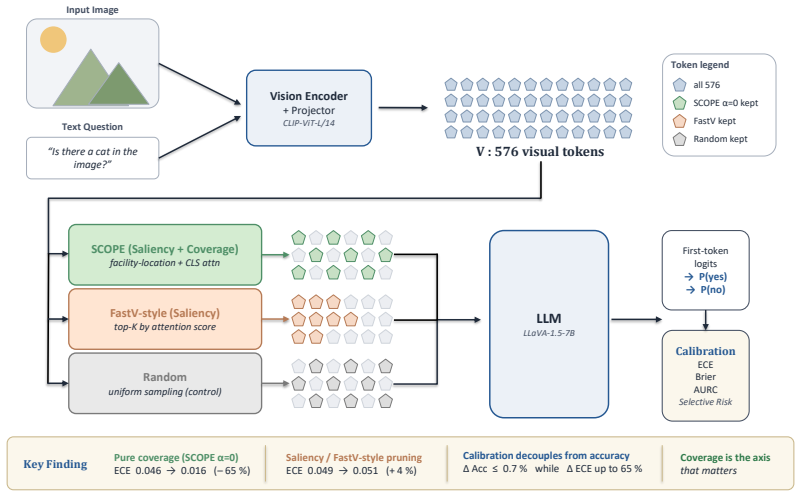
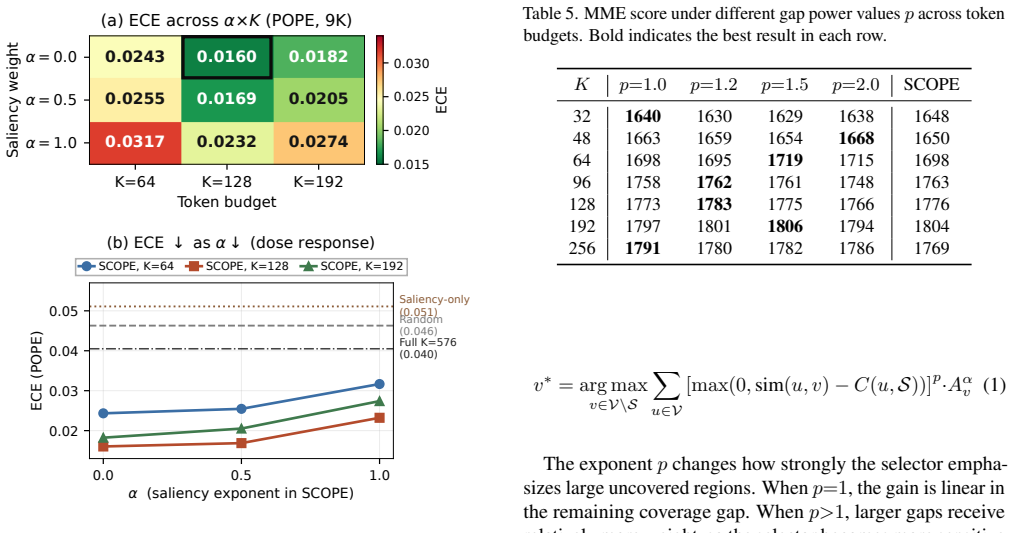
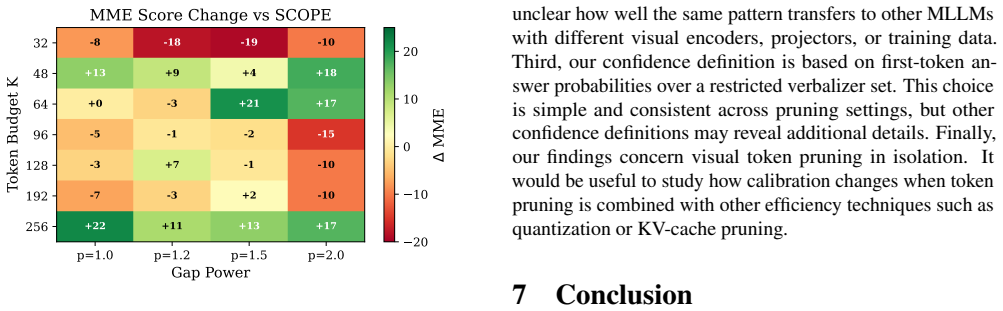
The load-bearing object is the SCOPE selection score, score(v)=Δcov(v;S)·a(v)^α, where Δcov is the facility-location coverage gain of adding token v to the selected set and a(v) is the CLS attention score. Setting α=0 isolates pure coverage; larger α pulls selection toward saliency. The α-sweep is the controlled instrument that attributes calibration changes to the selection rule. A secondary mechanism is the gap power exponent p in the coverage objective, which the paper varies over {1.0, 1.2, 1.5, 2.0} and finds is not always optimal at its default p=1. Confidence is measured from first-token logits over a restricted verbalizer (yes/no or A–D), giving a consistent but narrow definition of
What would settle it
Run the same α-sweep with a full-sequence or free-form confidence measure on another MLLM (e.g., Qwen2-VL) and check whether pure coverage still beats random pruning at matched budgets; or directly compare FastV with pruned tokens removed versus zeroed—if zeroing reproduces the 50% accuracy collapse, the saliency-is-worse conclusion needs re-examination.
Extended reading notes
Core claim
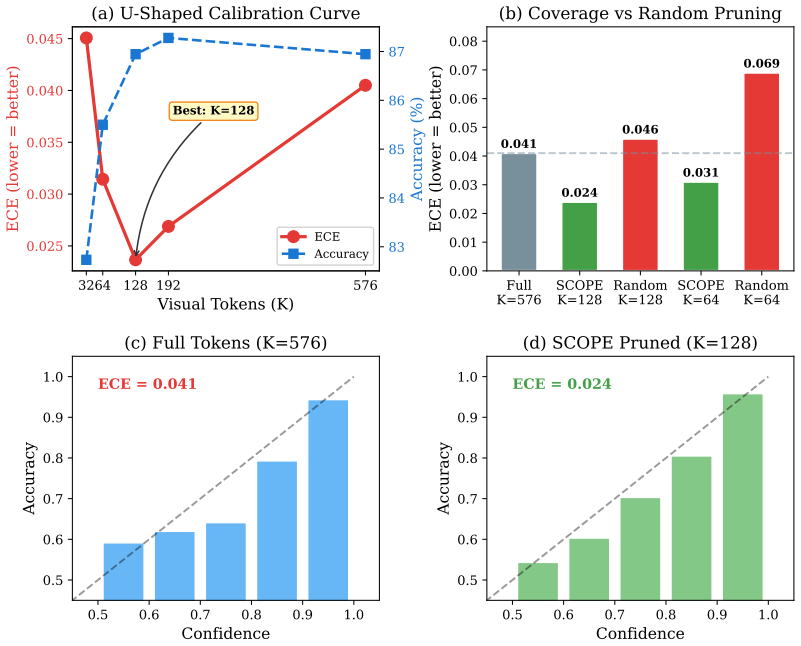
The central discovery is an empirical dissociation between accuracy and calibration under visual token pruning. With SCOPE's pure-coverage setting (α=0) at K=128, expected calibration error on POPE drops from 0.041 to 0.016 while accuracy stays at 87.1% versus 86.9% unpruned. The α-sweep within SCOPE shows a monotone trend: lowering the saliency weight improves ECE at every tested budget with accuracy moving little, while random pruning shows no such dose-response. Across pruning conditions, kept-set coverage correlates strongly with accuracy (Spearman ρ=+0.89), not at all with mean confidence (ρ=−0.03), and inversely with overconfidence (ρ=−0.92). The authors interpret this as evidence cove
Load-bearing premise
The comparison rests on treating first-token, restricted-verbalizer confidence as a valid calibration measure across pruning conditions, on LLaVA-1.5-7B on POPE being representative enough to generalize 'selection rule matters,' and on the FastV baseline being a faithful remove-tokens implementation rather than the zeroing variant that the paper warns can collapse accuracy to chance.
Editorial extensions
If this is right
- Moderate coverage-based pruning can improve calibration (ECE 0.041→0.016 on POPE) while preserving accuracy, so efficiency and reliability do not have to trade off.
- Pruning evaluations that report only accuracy can miss large changes in confidence quality; the paper argues calibration metrics (ECE, Brier, AURC) should accompany accuracy.
- Selection rule, not compression budget, drives calibration behavior: at the same budget, pure coverage beats saliency-only and random pruning on POPE.
- The calibration gain transfers to selective prediction: abstaining on low-confidence samples at 80% coverage reaches 94.2% accuracy under coverage pruning versus 92.8% unpruned.
- On ScienceQA-IMG, pruning reduces ECE with stable or slightly improved accuracy, but absolute ECE values are higher than on POPE and the paper does not claim coverage orders calibration there.
Reading between the lines
- Editorial inference: if the evidence-coverage account is right, diversity-based pruning that maximizes the spread of retained tokens should also improve calibration, which is testable with existing diversity selectors.
- Editorial inference: the FastV zeroing-versus-removal pitfall suggests published FastV calibration numbers could depend on implementation details; re-running FastV with true token removal is a direct check.
- Editorial inference: the first-token, restricted-verbalizer confidence is a narrow proxy; sequence-level or free-form confidence measures might change the magnitude of the ECE gains while leaving the selection-rule ordering intact.
- Editorial inference: the U-shaped calibration curve hints at an optimal evidence budget per task; finding that budget automatically via coverage thresholds would make the pruning-calibration benefit deployment-ready.
Editorial analysis
A structured set of objections, weighed in public.
Referee Report
Summary. The paper studies how visual token pruning affects the calibration of multimodal large language models, measured by ECE, Brier score, and AURC. Using LLaVA-1.5-7B on POPE and ScienceQA-IMG, the authors compare SCOPE variants with different saliency weights (α=0, 0.5, 1), saliency-only pruning, random pruning, and FastV across token budgets (K=32–576). The main empirical claim is that on POPE, pure-coverage SCOPE at K=128 reduces ECE from 0.041 to 0.016 with no statistically significant accuracy drop, while saliency-based selection becomes less calibrated than random pruning. The paper also analyzes the gap power exponent p in the coverage objective and finds the default p=1 is not always optimal. The authors conclude that token pruning evaluation should include calibration and that the token selection rule, not merely the compression budget, drives calibration behavior.
Significance. If the main result holds, the paper makes a useful contribution by drawing attention to calibration as an evaluation axis for visual token pruning in MLLMs. The internal α-sweep is a clean, controlled comparison within the SCOPE framework, and the finding that moderate pruning can reduce ECE without accuracy loss is non-obvious and practically relevant. The paper is honest about its limitations, including the restricted-verbalizer confidence measure. However, the contribution is entirely empirical and currently rests on a single model-benchmark pair for the headline result; broader generalizations appear only in the abstract. The manuscript also does not mention code or data release, which limits reproducibility. The paper's significance will depend on whether the abstract's additional claims can be substantiated and whether the confidence measure is robust.
major comments (4)
- [Abstract vs. full text] The abstract claims kept-set coverage correlations (ρ=+0.89, −0.03, −0.92), generalization to GQA, LLaVA-NeXT, and Qwen2-VL, and a FastV zeroing-vs-removal pitfall. None of these analyses appear in the full text, which presents only POPE and ScienceQA-IMG results with LLaVA-1.5-7B. This is a load-bearing mismatch: the abstract is the primary statement of the paper's contributions, and unsupported claims must either be moved to the body and supported or removed from the abstract.
- [§3.2, Tables 1–3, §6 Limitations] All headline ECE numbers use a restricted-verbalizer, first-token confidence obtained by normalizing softmax probabilities over 'yes'/'no' (or A–D) only. The paper's own Limitations section concedes that 'other confidence definitions may reveal additional details.' The concern is that pruning may shift probability mass onto off-verbalizer tokens differently across selection rules, so the constructed confidence could be an artifact. No analysis of off-verbalizer mass or an alternative confidence measure is reported. Because this measure underlies every method comparison, the central claim that coverage-based pruning improves calibration is not yet robustly established.
- [§4.3, Table 3] FastV is reported to achieve 50.1% accuracy at K=128, which the abstract attributes to a zeroing-vs-removal implementation pitfall. The full text, however, neither describes the precise implementation nor verifies that it follows the original FastV procedure (which removes tokens, not zeroes them). If the 50.1% figure is an artifact of zeroing, then the conclusion that saliency-based FastV is catastrophically worse than coverage-based pruning is invalid. The paper must clarify the FastV implementation and, ideally, reproduce the published FastV pipeline to confirm the reported degradation.
- [§4.3, Table 3] The comparison between SCOPE α=0, saliency-only, and random pruning at K=128 is confounded by accuracy differences (87.1% vs. 84.4% vs. 83.6%). The claim that 'the selection rule matters' is supported by the α-sweep, where accuracy differences are small, but the external-baseline comparison could reflect an accuracy–calibration trade-off rather than a selection-rule effect. The paper should report calibration at matched accuracy levels, or use selective prediction metrics (e.g., coverage–risk curves) to separate these effects.
minor comments (5)
- [Table 1 vs. Table 2/3] The default SCOPE (α=1) ECE at K=128 is reported as 0.024 in Table 1 but 0.023 in Tables 2 and 3. Please reconcile the rounding.
- [Figure 2(b)] The full unpruned model is listed as ECE=0.040 in Figure 2(b), but the text and Tables 1/3 report 0.041. Please ensure consistency.
- [Title and Abstract] The arXiv metadata title is 'When Does Visual Token Pruning Improve Calibration? The Role of Evidence Coverage in MLLMs', while the full text title is 'Does Visual Token Pruning Improve Calibration? An Empirical Study on Confidence in MLLMs'. The two abstracts also differ substantially. The manuscript should have a single, consistent title and abstract.
- [§3.2] The explanation of ECE binning and bootstrap intervals is terse. Please specify the binning scheme details (e.g., equal-width vs. equal-frequency) and report confidence intervals for all key tables, not only Table 1.
- [§5] The gap power analysis is disconnected from the calibration theme. Consider moving it to an appendix or clearly indicating that it is a secondary analysis of accuracy, not calibration.
Circularity Check
No circularity: the paper is an empirical measurement study with no derivation that reduces to its inputs.
full rationale
This paper does not present a derivation chain that could be circular. It compares empirical ECE/Brier/AURC outcomes across pruning selectors on fixed benchmarks, using a fixed confidence extraction rule (Section 3.2). The headline result—coverage-based SCOPE α=0 at K=128 lowers ECE from 0.041 to 0.016—is a measured outcome, not a consequence of how the metric is defined. The α-sweep varies a selection objective parameter and then measures calibration with an independent LLM forward pass; no parameter is fitted to the ECE values and then reported as a prediction. The FastV, saliency-only, and random baselines are externally computed comparisons, and the paper explicitly concedes in its Limitations section that 'our confidence definition is based on first-token answer probabilities over a restricted verbalizer set... other confidence definitions may reveal additional details.' That is a measurement-validity caveat, not a circular step: it does not make any reported equation equal to an input by construction. There are no load-bearing self-citations (the cited SCOPE and FastV works are by other author groups), no imported uniqueness theorem, and no ansatz smuggled in via citation. The gap-power analysis is a parameter sweep over 196 experiments, not a fitted prediction. The only related risk—that the restricted verbalizer confidence could confound cross-selector ECE comparisons—is an empirical confound, not a circularity, and would require additional off-verbalizer-mass evidence to substantiate. Thus the appropriate finding is no significant circularity.
Assumptions & free parameters
free parameters (3)
- α (SCOPE saliency exponent) =
0.0 / 0.5 / 1.0 (sweep)
- p (gap power exponent) =
1.0 / 1.2 / 1.5 / 2.0; p=1.5 highlighted
- K (token budget) =
32–576; K=128 selected as best
assumptions (4)
- domain assumption First-token normalized verbalizer probabilities are a valid measure of model confidence for calibration comparisons.
- domain assumption LLaVA-1.5-7B on POPE and ScienceQA-IMG is representative of MLLM visual token pruning generally.
- domain assumption The SCOPE scoring rule is score(v)=Δcov(v;S)·a(v)^α, matching the open-source implementation.
- domain assumption FastV's 'real, 2-pass' implementation correctly removes pruned tokens rather than zeroing them.
invented entities (1)
-
Evidence-coverage account of calibration
Cite this review
Pith. "Pith review of When Does Visual Token Pruning Improve Calibration? The Role of Evidence Coverage in MLLMs." pith.science (2026). https://pith.science/paper/YLPXIENM
@misc{pith2026260412035,
  author       = {Pith},
  title        = {Pith review of: When Does Visual Token Pruning Improve Calibration? The Role of Evidence Coverage in MLLMs},
  year         = {2026},
  howpublished = {\url{https://pith.science/paper/YLPXIENM}},
  note         = {Machine review of arXiv:2604.12035}
}
abstract
Visual token pruning is widely used to reduce the inference cost of multimodal large language models (MLLMs), but it is usually evaluated only by accuracy. We study how pruning affects calibration, defined as the agreement between confidence and correctness, and show that the selection rule matters more than the token budget alone. On POPE with LLaVA-1.5, coverage-based pruning from 576 to 128 tokens reduces expected calibration error from 0.041 to 0.016 without a statistically significant accuracy loss. In contrast, attention-based selection preserves confidence while accuracy deteriorates, becoming less calibrated than random pruning at aggressive budgets. Across pruning conditions, kept-set coverage is strongly associated with accuracy (Spearman $\rho=+0.89$) but not with mean confidence ($\rho=-0.03$), producing a strong inverse relation with overconfidence ($\rho=-0.92$); controlled kept-set interventions support this evidence-coverage account. Two boundaries limit it: query-conditioned FastV is more overconfident than its coverage predicts, and on language-prior-dominated ScienceQA, coverage ceases to order calibration. The selector ordering otherwise generalizes to GQA and LLaVA-NeXT, and coverage beats random on Qwen2-VL, although the calibration gain over the unpruned model is task- and model-dependent. We also identify an evaluation pitfall in FastV: zeroing rather than removing pruned tokens can reduce accuracy to chance. Visual token pruning therefore changes confidence quality as well as efficiency, and calibration should be evaluated alongside accuracy when comparing pruning methods.
Figures
Figures from the paper (1 more)
Forward citations
Cited by 2 Pith papers
-
Beyond Accuracy: Auditing Spatial Provenance in Visual Token Pruning for OCR-Critical MLLM Inference
For text-rich MLLMs, accuracy at a fixed token budget does not determine whether the surviving tokens retain spatial coverage of the OCR region that answers the query.
-
Beyond Accuracy: Auditing Spatial Provenance in Visual Token Pruning for OCR-Critical MLLM Inference
Same-accuracy pruned vision-language prefixes can retain very different amounts of traceable OCR support (PosECR 0.620 vs 0.270 for Target vs Random at 30% budget), so pruning evaluation should report spatial provenan...
Reference graph
Works this paper leans on
-
[1]
DivPrune: Diversity-based visual token pruning for large multimodal models
Saeed Ranjbar Alvar, Gursimran Singh, Mohammad Akbari, and Yong Zhang. DivPrune: Diversity-based visual token pruning for large multimodal models. InProceedings of the IEEE/CVF Conference on Computer Vision and Pattern Recog- nition, 2025
2025
-
[2]
Changwoo Baek, Jouwon Song, Sohyeon Kim, and Kyeongbo Kong. AgilePruner: An empirical study of attention and diver- sity for adaptive visual token pruning in large vision-language models.arXiv preprint arXiv:2603.01236, 2026
arXiv 2026
-
[3]
An image is worth 1/2 tokens after layer 2: Plug-and-play inference acceleration for large vision-language models
Liang Chen, Haozhe Zhao, Tianyu Liu, Shuai Bai, Junyang Lin, Chang Zhou, and Baobao Chang. An image is worth 1/2 tokens after layer 2: Plug-and-play inference acceleration for large vision-language models. InProceedings of the European Conference on Computer Vision, 2024. 8
2024
-
[4]
OTPrune: Distribution-aligned visual token pruning via optimal transport
Xiwen Chen, Wenhui Zhu, Gen Li, Xuanzhao Dong, Yu- jian Xiong, Hao Wang, Peijie Qiu, Qingquan Song, Zhipeng Wang, Shao Tang, Yalin Wang, and Abolfazl Razi. OTPrune: Distribution-aligned visual token pruning via optimal transport. arXiv preprint arXiv:2602.20205, 2026
arXiv 2026
-
[5]
Unveiling uncertainty: A deep dive into calibration and performance of multimodal large language models
Zijun Chen, Wenbo Hu, Guande He, Zhijie Deng, Zheng Zhang, and Richang Hong. Unveiling uncertainty: A deep dive into calibration and performance of multimodal large language models. InProceedings of the 31st International Conference on Computational Linguistics, 2025
2025
-
[6]
FLoC: Facility location-based efficient visual token compression for long video understanding
Janghoon Cho, Jungsoo Lee, Munawar Hayat, Kyuwoong Hwang, Fatih Porikli, and Sungha Choi. FLoC: Facility location-based efficient visual token compression for long video understanding. InInternational Conference on Learning Representations, 2026
2026
-
[7]
SCOPE: Saliency-coverage oriented token pruning for effi- cient multimodal LLMs
Jinhong Deng, Wen Li, Joey Tianyi Zhou, and Yang He. SCOPE: Saliency-coverage oriented token pruning for effi- cient multimodal LLMs. InAdvances in Neural Information Processing Systems, 2025
2025
-
[8]
Prune redundancy, preserve essence: Vision token compression in VLMs via synergistic importance-diversity
Zhengyao Fang, Pengyuan Lyu, Chengquan Zhang, Guang- ming Lu, Jun Yu, and Wenjie Pei. Prune redundancy, preserve essence: Vision token compression in VLMs via synergistic importance-diversity. InInternational Conference on Learning Representations, 2026
2026
Show all 19 references
-
[9]
Evaluating object hallucination in large vision-language models
Yifan Li, Yifan Du, Kun Zhou, Jinpeng Wang, Wayne Xin Zhao, and Ji-Rong Wen. Evaluating object hallucination in large vision-language models. InProceedings of the 2023 Con- ference on Empirical Methods in Natural Language Processing, 2023
2023
-
[10]
Visual instruction tuning
Haotian Liu, Chunyuan Li, Qingyang Wu, and Yong Jae Lee. Visual instruction tuning. InAdvances in Neural Information Processing Systems, 2023
2023
-
[11]
LLaV A-NeXT: Improved rea- soning, OCR, and world knowledge
Haotian Liu, Chunyuan Li, Yuheng Li, Bo Li, Yuanhan Zhang, Sheng Shen, and Yong Jae Lee. LLaV A-NeXT: Improved rea- soning, OCR, and world knowledge. https://llava-vl. github.io/blog/2024-01-30-llava-next/ ,
2024
-
[12]
Learn to explain: Multimodal reasoning via thought chains for science question answering
Pan Lu, Swaroop Mishra, Tony Xia, Liang Qiu, Kai-Wei Chang, Song-Chun Zhu, Oyvind Tafjord, Peter Clark, and Ashwin Kalyan. Learn to explain: Multimodal reasoning via thought chains for science question answering. InAdvances in Neural Information Processing Systems, 2022
2022
-
[13]
Better relia- bility compression: Model pruning with calibrated uncertainty estimation for mobile deep learning applications
Runyu Ma, Songqing Chen, and Shuochao Yao. Better relia- bility compression: Model pruning with calibrated uncertainty estimation for mobile deep learning applications. In2025 IEEE 3rd International Conference on Mobility, Operations, Services and Technologies (MOST), 2025
2025
-
[14]
Uncovering the hidden cost of model compression
Diganta Misra, Muawiz Chaudhary, Agam Goyal, Bharat Run- wal, and Pin-Yu Chen. Uncovering the hidden cost of model compression. InProceedings of the IEEE/CVF Conference on Computer Vision and Pattern Recognition Workshops, 2024
2024
-
[15]
Investigat- ing calibration and corruption robustness of post-hoc pruned perception CNNs: An image classification benchmark study
Pallavi Mitra, Gesina Schwalbe, and Nadja Klein. Investigat- ing calibration and corruption robustness of post-hoc pruned perception CNNs: An image classification benchmark study. InProceedings of the IEEE/CVF Conference on Computer Vision and Pattern Recognition Workshops, 2024
2024
-
[16]
CDPruner: Be- yond attention or similarity: Maximizing conditional diversity for token pruning in MLLMs
Qizhe Zhang, Mengzhen Liu, Lichen Li, Ming Lu, Yuan Zhang, Junwen Pan, Qi She, and Shanghang Zhang. CDPruner: Be- yond attention or similarity: Maximizing conditional diversity for token pruning in MLLMs. InAdvances in Neural Informa- tion Processing Systems, 2025
2025
-
[17]
VL- Uncertainty: Detecting hallucination in large vision- language model via uncertainty estimation.arXiv preprint arXiv:2411.11919, 2024
Ruiyang Zhang, Hu Zhang, and Zhedong Zheng. VL- Uncertainty: Detecting hallucination in large vision- language model via uncertainty estimation.arXiv preprint arXiv:2411.11919, 2024
2024 arXiv
-
[18]
Gudovskiy, Tomoyuki Okuno, Yohei Nakata, Kurt Keutzer, and Shanghang Zhang
Yuan Zhang, Chun-Kai Fan, Junpeng Ma, Wenzhao Zheng, Tao Huang, Kuan Cheng, Denis A. Gudovskiy, Tomoyuki Okuno, Yohei Nakata, Kurt Keutzer, and Shanghang Zhang. Sparse- VLM: Visual token sparsification for efficient vision-language model inference. InProceedings of the 42nd In...
2025
-
[19]
Calibrated self-rewarding vision lan- guage models
Yiyang Zhou, Zhiyuan Fan, Dongjie Cheng, Sihan Yang, Zhaorun Chen, Chenhang Cui, Xiyao Wang, Yun Li, Linjun Zhang, and Huaxiu Yao. Calibrated self-rewarding vision lan- guage models. InAdvances in Neural Information Processing Systems, 2024. 9
2024
Reviewed August 2, 2026 · model on record in the stance chip above.
Discussion (0). Sign in to comment.