Nuclear excitation via inelastic scattering of low-energy vortex electrons
Pith reviewed 2026-07-01 02:44 UTC · model grok-4.3
The pith
Vortex electrons produce angular distributions opposite to ordinary electrons when exciting nuclei.
A machine-rendered reading of the paper's core claim, the machinery that carries it, and where it could break.
Core claim
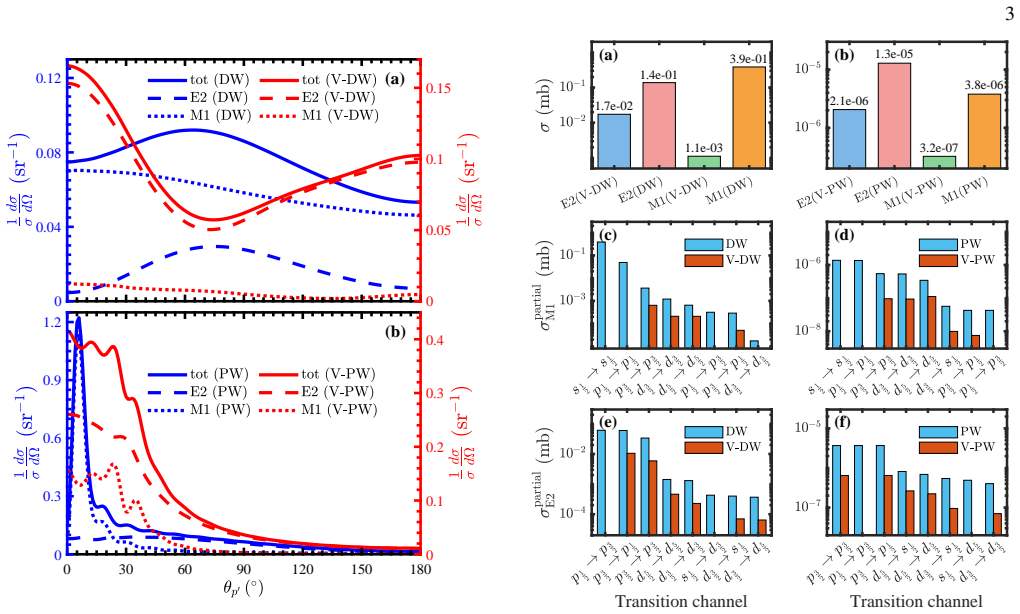
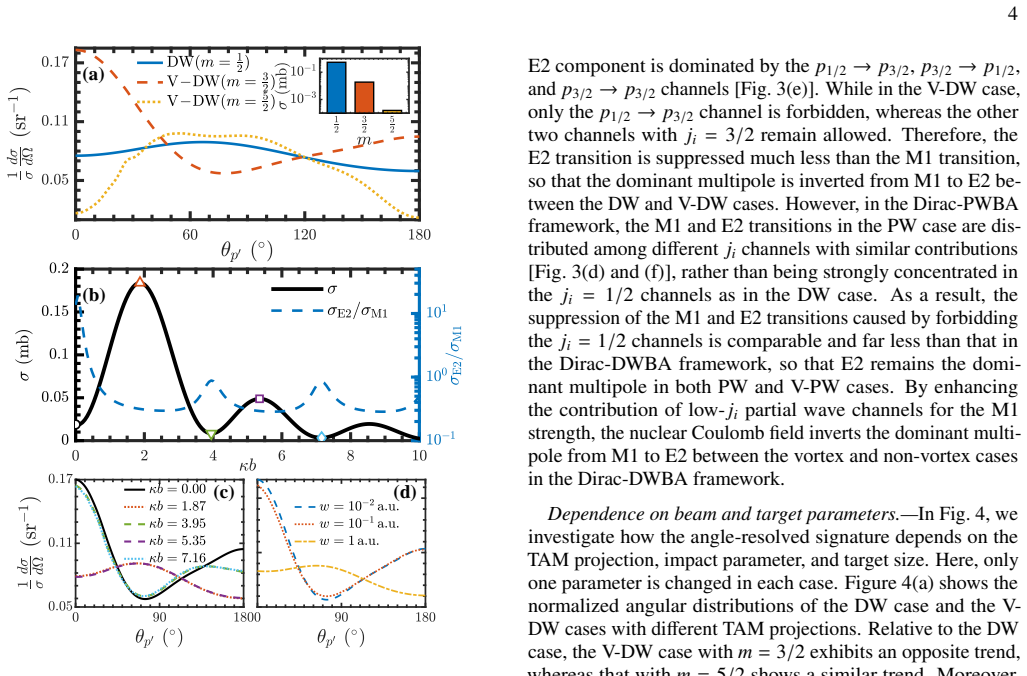
The central discovery is that inelastic scattering of low-energy vortex electrons off nuclei like 229Th produces angular distributions opposite to those from non-vortex electrons. This opposition stems from an orbital-angular-momentum-modified selection rule together with the Coulomb field's effect on partial-wave strengths. The framework also shows that vortex electrons maintain topological protection while traversing the nuclear Coulomb field.
What carries the argument
A Dirac distorted-wave Born approximation framework incorporating the incident electron's orbital angular momentum with nonperturbative Coulomb treatment.
If this is right
- An angle-resolved measurement can serve as a signature for nuclear OAM transfer.
- Vortex electrons offer a new probe for OAM effects at the nuclear scale.
- The topological protection implies vortex states persist through strong fields.
- This approach deepens understanding of vortex particle properties in nuclear interactions.
Where Pith is reading between the lines
- Similar calculations could be performed for other nuclei to test whether the opposite distribution effect holds generally.
- The method might be adapted to probe OAM transfer in scattering processes involving other charged particles.
- Direct experiments with electron beams carrying controlled orbital angular momentum could verify the predicted angular patterns.
Load-bearing premise
The Dirac distorted-wave Born approximation accurately captures the effects of the electron's orbital angular momentum and the nonperturbative Coulomb interaction to predict the angular distributions.
What would settle it
Observation of identical angular distributions for vortex and non-vortex electrons in the excitation of 229Th would contradict the predicted opposition.
Figures


read the original abstract
Vortex particles carrying orbital angular momenta (OAMs) have found important applications in broad fields. However, the experimental verification of OAM transfer at the nuclear scale remains a great challenge. Here, we put forward a novel method to probe such OAM transfer through nuclear excitation via inelastic scattering of low-energy vortex electrons. We develop a Dirac distorted-wave Born approximation framework that incorporates the incident-electron OAM and a nonperturbative treatment of the Coulomb field, and apply it to $^{229}\mathrm{Th}$. We find that the vortex and non-vortex electrons yield opposite angular distributions, attributed to the OAM-modified selection rule and the Coulomb-induced redistribution of partial-wave strengths, providing an angle-resolved signature. Moreover, the vortex electron exhibits topological protection in the nuclear Coulomb field. Our method offers a route to probing nuclear-scale OAM transfer and deepens our understanding of the topological properties of vortex particles.
Editorial analysis
A structured set of objections, weighed in public.
Referee Report
Summary. The manuscript develops a Dirac distorted-wave Born approximation (DWBA) framework for inelastic scattering of low-energy vortex electrons that incorporates incident orbital angular momentum (OAM) and treats the nuclear Coulomb field nonperturbatively. Applied to 229Th, it predicts that vortex electrons produce angular distributions opposite to those from plane-wave electrons, attributed to an OAM-modified selection rule combined with Coulomb-induced redistribution of partial-wave strengths; it further claims topological protection of the vortex electron in the nuclear Coulomb field, offering an angle-resolved signature for nuclear-scale OAM transfer.
Significance. If the DWBA implementation of OAM and the resulting angular distributions hold, the work supplies a concrete, falsifiable route to experimental verification of OAM transfer at nuclear scales—an area where direct probes remain scarce. The nonperturbative Coulomb treatment and the reported sign reversal constitute potentially useful predictions, provided the framework is shown to be robust against higher-order corrections.
major comments (2)
- [framework description] The central claim of opposite angular distributions rests on the assertion that the Dirac DWBA accurately embeds the incident OAM into the distorted waves and that first-order matrix elements suffice. The manuscript provides no explicit derivation or validation (e.g., reduction to the plane-wave limit or comparison with known OAM-free cases) demonstrating that the OAM-modified selection rule is implemented without approximation in the partial-wave content.
- [results and discussion] At the low energies considered, Coulomb distortion is strong; the paper does not quantify the size of second-order Born or multiple-scattering contributions that could alter the reported redistribution of partial-wave strengths and thereby change the sign of the angular distribution difference.
minor comments (2)
- [methods] Notation for the vortex-electron wave function and the precise definition of the OAM quantum number should be stated explicitly in the methods section to allow independent reproduction.
- [introduction] The abstract and introduction would benefit from a brief statement of the nuclear transition considered (e.g., the specific multipolarity in 229Th) to contextualize the selection-rule modification.
Simulated Author's Rebuttal
We thank the referee for the detailed and constructive review. We address each major comment below and will revise the manuscript accordingly to improve clarity and address concerns about validation and approximations.
read point-by-point responses
-
Referee: [framework description] The central claim of opposite angular distributions rests on the assertion that the Dirac DWBA accurately embeds the incident OAM into the distorted waves and that first-order matrix elements suffice. The manuscript provides no explicit derivation or validation (e.g., reduction to the plane-wave limit or comparison with known OAM-free cases) demonstrating that the OAM-modified selection rule is implemented without approximation in the partial-wave content.
Authors: We agree that an explicit derivation and validation of the OAM embedding would strengthen the manuscript. In the revised version, we will add a dedicated subsection deriving the partial-wave expansion of the vortex electron wave function in the Dirac DWBA, explicitly showing how the incident OAM is incorporated into the distorted waves and demonstrating the reduction to the standard plane-wave DWBA when the OAM quantum number vanishes. This will confirm that the OAM-modified selection rules are implemented without additional approximations. revision: yes
-
Referee: [results and discussion] At the low energies considered, Coulomb distortion is strong; the paper does not quantify the size of second-order Born or multiple-scattering contributions that could alter the reported redistribution of partial-wave strengths and thereby change the sign of the angular distribution difference.
Authors: We acknowledge the importance of assessing higher-order contributions at low energies where Coulomb distortion is significant. A complete numerical quantification of second-order Born terms lies beyond the scope of the present work. However, the partial-wave series in our calculations exhibits rapid convergence, and we will add a discussion in the revised manuscript comparing the magnitude of higher-order effects to literature results for similar low-energy electron scattering processes. We argue that the reported sign reversal originates primarily from the OAM selection rules and is unlikely to be overturned by higher-order corrections, but we will note the first-order DWBA as an approximation. revision: partial
Circularity Check
No circularity: framework developed and applied independently
full rationale
The paper develops a Dirac DWBA framework incorporating OAM and applies it to compute angular distributions for 229Th, yielding opposite patterns for vortex vs. plane-wave cases via OAM-modified selection rules and partial-wave redistribution. No equations or claims reduce by construction to fitted parameters, self-citations, or prior ansatze; the central results follow from the new framework's numerical implementation rather than tautological redefinition or load-bearing self-reference. This matches the default expectation of non-circularity for a computational application paper.
Axiom & Free-Parameter Ledger
Reference graph
Works this paper leans on
-
[1]
K. Y . Bliokh, I. P. Ivanov, G. Guzzinati, L. Clark, R. Van Boxem, A. B ´ech´e, R. Juchtmans, M. A. Alonso, P. Schattschneider, F. Nori,et al., Theory and applications of free-electron vortex states, Phys. Rep.690, 1 (2017)
work page 2017
-
[2]
S. M. Lloyd, M. Babiker, G. Thirunavukkarasu, and J. Yuan, Electron vortices: Beams with orbital angular momentum, Rev. Mod. Phys.89, 035004 (2017)
work page 2017
-
[3]
I. P. Ivanov, Promises and challenges of high-energy vortex states collisions, Prog. Part. Nucl. Phys.127, 103987 (2022)
work page 2022
- [4]
-
[5]
B. A. Knyazev and V . G. Serbo, Beams of photons with nonzero projections of orbital angular momenta: new results, Phys. Usp. 61, 449 (2018)
work page 2018
-
[6]
A. L. Fetter and A. A. Svidzinsky, V ortices in a trapped dilute Bose-Einstein condensate, J. Phys. Condens. Matter13, R135 (2001)
work page 2001
-
[7]
I. P. Ivanov, Creation of two vortex-entangled beams in a vortex- beam collision with a plane wave, Phys. Rev. A85, 033813 (2012)
work page 2012
-
[8]
A. Edstr¨om, A. Lubk, and J. Rusz, Elastic scattering of electron vortex beams in magnetic matter, Phys. Rev. Lett.116, 127203 (2016)
work page 2016
- [9]
-
[10]
M. J. Padgett, Orbital angular momentum 25 years on, Opt. Express25, 11265 (2017)
work page 2017
-
[11]
C. Hern ´andez-Garc´ıa, J. Vieira, J. T. Mendon c ¸a, L. Rego, J. San Rom´an, L. Plaja, P. R. Ribic, D. Gauthier, and A. Pic´on, Generation and applications of extreme-ultraviolet vortices, Pho- tonics4, 28 (2017)
work page 2017
-
[12]
R. Van Boxem, B. Partoens, and J. Verbeeck, Inelastic electron- vortex-beam scattering, Phys. Rev. A91, 032703 (2015)
work page 2015
-
[13]
V . K. Ivanov, A. D. Chaikovskaia, and D. V . Karlovets, Studying highly relativistic vortex-electron beams by atomic scattering, Phys. Rev. A108, 062803 (2023)
work page 2023
- [14]
- [15]
-
[16]
M. Babiker, D. L. Andrews, and V . E. Lembessis, Atoms in complex twisted light, J. Opt.21, 013001 (2018)
work page 2018
-
[17]
Y . Wu, S. Gargiulo, F. Carbone, C. H. Keitel, and A. P´alffy, Dy- namical control of nuclear isomer depletion via electron vortex beams, Phys. Rev. Lett.128, 162501 (2022)
work page 2022
-
[18]
Z.-W. Lu, L. Guo, Z.-Z. Li, M. Ababekri, F.-Q. Chen, C. Fu, C. Lv, R. Xu, X. Kong, Y .-F. Niu, and J.-X. Li, Manipulation of giant multipole resonances via vortex γ photons, Phys. Rev. Lett. 131, 202502 (2023)
work page 2023
-
[19]
Z.-W. Lu, L. Guo, M. Ababekri, J.-L. Zhang, X.-F. Weng, Y . Wu, Y .-F. Niu, and J.-X. Li, Angular momentum resolved inelastic electron scattering for nuclear giant resonances, Phys. Rev. Lett. 134, 052501 (2025)
work page 2025
-
[20]
T. Kirschbaum, T. Schumm, and A. P´alffy, Photoexcitation of the 229Th nuclear clock transition using twisted light, Phys. Rev. C110, 064326 (2024)
work page 2024
-
[21]
Z.-W. Lu, H. Zhang, T. Li, M. Ababekri, X. Wang, and J.-X. Li, Nuclear excitation and control induced by intense vortex lasers, Phys. Rev. C113, 044315 (2026)
work page 2026
-
[22]
S. A.-L. Schulz, A. A. Peshkov, R. A. M ¨uller, R. Lange, N. Huntemann, C. Tamm, E. Peik, and A. Surzhykov, Gen- eralized excitation of atomic multipole transitions by twisted light modes, Phys. Rev. A102, 012812 (2020)
work page 2020
-
[23]
Y . Duan, R. A. M¨uller, and A. Surzhykov, Selection rules for atomic excitation by twisted light, J. Phys. B: At. Mol. Opt. Phys. 52, 184002 (2019)
work page 2019
-
[24]
H. M. Scholz-Marggraf, S. Fritzsche, V . G. Serbo, A. Afanasev, and A. Surzhykov, Absorption of twisted light by hydrogenlike atoms, Phys. Rev. A90, 013425 (2014)
work page 2014
-
[25]
C. T. Schmiegelow, J. Schulz, H. Kaufmann, T. Ruster, U. G. 6 Poschinger, and F. Schmidt-Kaler, Transfer of optical orbital angular momentum to a bound electron, Nat. Commun.7, 12998 (2016)
work page 2016
-
[26]
M. Uchida and A. Tonomura, Generation of electron beams carrying orbital angular momentum, Nature464, 737 (2010)
work page 2010
-
[27]
J. Verbeeck, H. Tian, and P. Schattschneider, Production and application of electron vortex beams, Nature467, 301 (2010)
work page 2010
-
[28]
B. J. McMorran, A. Agrawal, I. M. Anderson, A. A. Herzing, H. J. Lezec, J. J. McClelland, and J. Unguris, Electron vortex beams with high quanta of orbital angular momentum, Science 331, 192 (2011)
work page 2011
-
[29]
C. W. Clark, R. Barankov, M. G. Huber, M. Arif, D. G. Cory, and D. A. Pushin, Controlling neutron orbital angular momentum, Nature525, 504 (2015)
work page 2015
-
[30]
T. Maruyama, T. Hayakawa, T. Kajino, and M.-K. Cheoun, Gen- eration of photon vortex by synchrotron radiation from electrons in Landau states under astrophysical magnetic fields, Phys. Lett. B826, 136779 (2022)
work page 2022
-
[31]
Y . Shen, X. Wang, Z. Xie, C. Min, X. Fu, Q. Liu, M. Gong, and X. Yuan, Optical vortices 30 years on: OAM manipulation from topological charge to multiple singularities, Light Sci. Appl.8, 90 (2019)
work page 2019
-
[32]
A. G. Peele, P. J. McMahon, D. Paterson, C. Q. Tran, A. P. Mancuso, K. A. Nugent, J. P. Hayes, E. Harvey, B. Lai, and I. McNulty, Observation of an x-ray vortex, Opt. Lett.27, 1752 (2002)
work page 2002
-
[33]
B. Terhalle, A. Langner, B. P ¨aiv¨anranta, V . A. Guzenko, C. David, and Y . Ekinci, Generation of extreme ultraviolet vortex beams using computer generated holograms, Opt. Lett.36, 4143 (2011)
work page 2011
-
[34]
G. Gariepy, J. Leach, K. T. Kim, T. J. Hammond, E. Frumker, R. W. Boyd, and P. B. Corkum, Creating high-harmonic beams with controlled orbital angular momentum, Phys. Rev. Lett.113, 153901 (2014)
work page 2014
-
[35]
E. Hemsing, A. Knyazik, M. Dunning, D. Xiang, A. Marinelli, C. Hast, and J. B. Rosenzweig, Coherent optical vortices from relativistic electron beams, Nat. Phys.9, 549 (2013)
work page 2013
-
[36]
G. M. Vanacore, G. Berruto, I. Madan, E. Pomarico, P. Bia- gioni, R. J. Lamb, D. McGrouther, O. Reinhardt, I. Kaminer, B. Barwick,et al., Ultrafast generation and control of an electron vortex beam via chiral plasmonic near fields, Nat. Mater.18, 573 (2019)
work page 2019
-
[37]
A. B´ech´e, R. Van Boxem, G. Van Tendeloo, and J. Verbeeck, Magnetic monopole field exposed by electrons, Nat. Phys.10, 26 (2014)
work page 2014
- [38]
-
[39]
T. ˇRih´aˇcek, M. Hor ´ak, T. Schachinger, F. Mika, M. Mat ˇejka, S. Kr´atk´y, T. Foˇrt, T. Radliˇcka, C. W. Johnson, L. Nov´ak,et al., Beam shaping and probe characterization in the scanning elec- tron microscope, Ultramicroscopy225, 113268 (2021)
work page 2021
-
[40]
M. Wei, S. Chen, Y . Wang, P.-L. He, X. Hu, M. Zhu, H. Xu, W. Zhou, J. Jia, X. Ge,et al., Experimental evidence of vortex γ photons in all-optical inverse Compton scattering, Phys. Rev. Lett.136, 025001 (2026)
work page 2026
-
[41]
M. N. Harakeh and A. Woude,Giant Resonances: Fundamental High-Frequency Modes of Nuclear Excitation, V ol. 24 (Oxford University Press on Demand, Oxford, 2001)
work page 2001
-
[42]
G. Col `o, Theoretical methods for giant resonances, inHand- book of Nuclear Physics(Springer Nature Singapore, Singapore,
- [43]
-
[44]
S. S. Baturin, D. V . Grosman, G. K. Sizykh, and D. V . Karlovets, Evolution of an accelerated charged vortex particle in an inho- mogeneous magnetic lens, Phys. Rev. A106, 042211 (2022)
work page 2022
-
[45]
G. K. Sizykh, A. D. Chaikovskaia, D. V . Grosman, I. I. Pavlov, and D. V . Karlovets, Transmission of vortex electrons through a solenoid, Phys. Rev. A109, L040201 (2024)
work page 2024
-
[46]
M. Ababekri, J.-L. Zhou, R.-T. Guo, Y .-Z. Ren, Y .-H. Kou, Q. Zhao, Z.-P. Li, and J.-X. Li, Generation of ultrarelativistic vortex leptons with large orbital angular momenta, Phys. Rev. D 110, 076024 (2024)
work page 2024
-
[47]
U. D. Jentschura and V . G. Serbo, Generation of high-energy photons with large Orbital Angular Momentum by Compton backscattering, Phys. Rev. Lett.106, 013001 (2011)
work page 2011
-
[48]
A. P´alffy, W. Scheid, and Z. Harman, Theory of nuclear excita- tion by electron capture for heavy ions, Phys. Rev. A73, 012715 (2006)
work page 2006
- [49]
-
[50]
C. J. Chiara, J. J. Carroll, M. P. Carpenter, J. P. Greene, D. J. Hartley, R. V . F. Janssens, G. J. Lane, J. C. Marsh, D. A. Matters, M. Polasik,et al., Isomer depletion as experimental evidence of nuclear excitation by electron capture, Nature554, 216 (2018)
work page 2018
-
[51]
B. Dinget al., Isomer depletion of 93mMo triggered by inelas- tic nuclear scattering rather than nuclear excitation by electron capture, Phys. Rev. Lett.136, 052502 (2026)
work page 2026
-
[52]
Y . Wu, C. H. Keitel, and A. P´alffy,93mMo isomer depletion via Beam-Based nuclear excitation by electron capture, Phys. Rev. Lett.122, 212501 (2019)
work page 2019
-
[53]
Guoet al., Probing 93mMo isomer depletion with an isomer beam, Phys
S. Guoet al., Probing 93mMo isomer depletion with an isomer beam, Phys. Rev. Lett.128, 242502 (2022)
work page 2022
- [54]
- [55]
- [56]
-
[57]
E. V . Tkalya, Excitation of229mTh at inelastic scattering of low energy electrons, Phys. Rev. Lett.124, 242501 (2020)
work page 2020
- [58]
- [59]
-
[60]
B. Seiferle, L. von der Wense, P. V . Bilous, I. Amersdorffer, C. Lemell, F. Libisch, S. Stellmer, T. Schumm, C. E. D¨ullmann, A. P´alffy, and P. G. Thirolf, Energy of the229Th nuclear clock transition, Nature573, 243 (2019)
work page 2019
-
[61]
L. A. Kroger and C. W. Reich, Features of the low-energy level scheme of 229Th as observed in the α-decay of 233U, Nucl. Phys. A259, 29 (1976)
work page 1976
-
[62]
P. G. Thirolf, S. Kraemer, D. Moritz, and K. Scharl, The thorium isomer 229mTh: review of status and perspectives after more than 50 years of research, Eur. Phys. J. Spec. Top.233, 1113 (2024)
work page 2024
-
[63]
K. Y . Bliokh, M. R. Dennis, and F. Nori, Relativistic electron 7 vortex beams: Angular momentum and spin-orbit interaction, Phys. Rev. Lett.107, 174802 (2011)
work page 2011
-
[64]
F. Salvat and J. M. Fern´andez-Varea, RADIAL: A Fortran sub- routine package for the solution of the radial Schr ¨odinger and Dirac wave equations, Comput. Phys. Commun.240, 165 (2019)
work page 2019
- [65]
- [66]
-
[67]
V . A. Zaytsev, V . G. Serbo, and V . M. Shabaev, Radiative recom- bination of twisted electrons with bare nuclei: Going beyond the Born approximation, Phys. Rev. A95, 012702 (2017)
work page 2017
-
[68]
V . P. Kosheleva, V . A. Zaytsev, A. Surzhykov, V . M. Shabaev, and T. St ¨ohlker, Elastic scattering of twisted electrons by an atomic target: Going beyond the Born approximation, Phys. Rev. A98, 022706 (2018)
work page 2018
-
[69]
M. E. Groshev, V . A. Zaytsev, V . A. Yerokhin, and V . M. Shabaev, Bremsstrahlung from twisted electrons in the field of heavy nuclei, Phys. Rev. A101, 012708 (2020)
work page 2020
-
[70]
See Supplemental Material for a detailed derivation of the in- elastic electron–nucleus scattering differential cross sections and total cross sections for non-vortex and vortex electrons, and for additional numerical results for different opening angles and incident energies
-
[71]
A. B ´ech´e, R. Juchtmans, and J. Verbeeck, Efficient creation of electron vortex beams for high resolution STEM imaging, Ultramicroscopy178, 12 (2017)
work page 2017
-
[72]
L. Reimer and H. Kohl,Transmission Electron Microscopy (Springer Science+Business Media, New York, 2008)
work page 2008
-
[73]
I. P. Ivanov, N. Korchagin, A. Pimikov, and P. Zhang, Kinematic surprises in twisted-particle collisions, Phys. Rev. D101, 016007 (2020)
work page 2020
discussion (0)
Sign in with ORCID, Apple, or X to comment. Anyone can read and Pith papers without signing in.