REVIEW 5 major objections 5 minor 1 cited by
Endangered Alert: A Field-Validated Self-Training Scheme for Detecting and Protecting Threatened Wildlife on Roads and Roadsides
T0 review · 5 major / 5 minor · reviewed 2026-08-11 · deepseek-v4-flash
Pith's one-line read The paper claims that a roadside camera system can learn to spot a rare endangered bird without any human labelling, by cycling its own detections through a cloud auto-labeller and back into the edge model.
desk verdict Real deployment, real data, but the train/eval split ambiguity threatens the headline self-training trend; needs a leakage experiment before the claim is accepted. read the letter →
The pith
A machine-rendered reading of the paper's core claim, the machinery that carries it, and where it could break.
The reading
What carries the argument
The load-bearing mechanism is Label-Augmentation Non-Maximum Suppression (LA-NMS), a pseudo-labelling step that feeds a vision-language detector both the target label and related labels (such as 'flightless bird' and 'black ratite bird' obtained from a lexical database), takes the maximum score over that expanded label set, and then applies non-maximum suppression to remove overlapping boxes. This widens the detector's coverage of a rare class it rarely saw during training, producing the auto-labels that drive the self-training loop. The complementary mechanism is selective data transfer: the edge device uploads only 1.5% of frames, prioritising true and false positive detections, so the cloud sees the most informative examples without saturating the link.
What would settle it
Recompute event-level recall with the event-triggering Bayesian aggregation layer disabled and a single fixed threshold on the raw edge-model detections; if recall drops to near the per-frame mTPR of 78.5% (and the 0.97 figure came largely from the aggregation), the system-level claim is not supported by the self-training loop.
Extended reading notes
Core claim
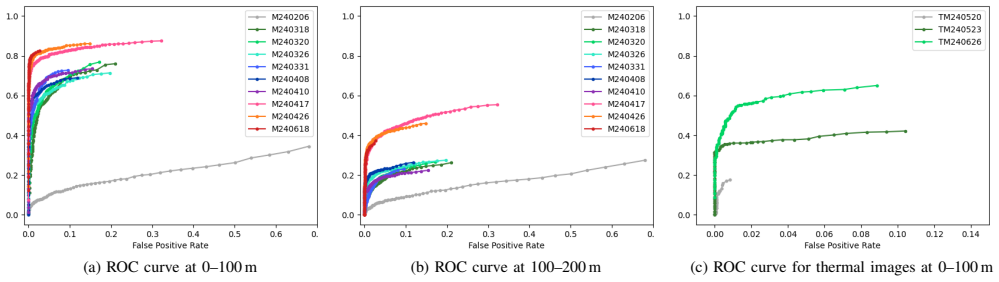
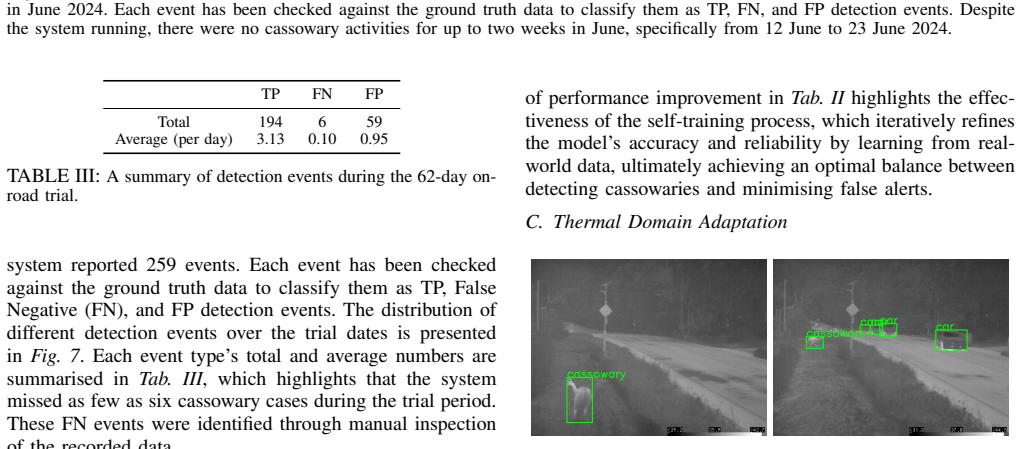
The central discovery is that self-training without manual annotation is sufficient to turn a synthetic-only detector with 4.2% mean true positive rate into a field detector with 78.5% mTPR at 0–100 m and 30.0% at 100–200 m, while keeping false positives around 0.37% of frames. The loop works by having the deployed edge model upload only 1.5% of recorded frames—chiefly its true and false positives—to the cloud, where Label-Augmentation Non-Maximum Suppression (LA-NMS) produces pseudo-labels that are then used to fine-tune the edge model. At the event level, the deployed system triggered on 194 true cassowary events and missed 6 over 62 days, yielding recall 0.97 and precision 0.77.
Load-bearing premise
The claim that the system catches 97% of cassowary events presumes that the under-described event-triggering pipeline, which aggregates Bayesian-filtered outputs from multiple cameras, is not itself tuned to the trial's ground truth; if that aggregation layer carries the recall, then the high event-level figure is not a clean measure of the self-training detector.
Editorial extensions
If this is right
- Each fine-tuning round with auto-labelled field data raises near-range detection: the final model M240618 reaches 78.5% mTPR at 0–100 m, up from 4.2% for the synthetic-only initial model.
- The approach holds false alarms roughly constant (FPR about 0.37%) while improving recall, and produced fewer than one false alert per day during the on-road trial.
- The identical scheme transfers to thermal imagery, indicating that the self-training loop adapts across camera modalities and lighting conditions.
- The deployed system missed only 6 of 200 cassowary sighting events over 62 days, a level of recall that would be necessary for driver-alert credibility.
Reading between the lines
- The label-augmentation trick should transfer to other rare-object detection tasks where the target class has semantically close relatives in a lexical database; the main risk is that poorly chosen augmentations (as the paper notes for sheep and cow) increase false positives.
- The 1.5% selective upload suggests a general bandwidth-saving principle for edge self-training: a detector's own errors are the most informative training signal, so upload policies should prioritise high-uncertainty frames rather than random sampling.
- The reported event-level recall of 0.97 is very likely inflated relative to per-frame performance because of the separate Bayesian aggregation layer; a clean evaluation of the self-training contribution would report both metrics with that layer ablated.
- The Stage 1 synthetic-only model's 4.2% mTPR suggests that synthetic pre-training alone is far too weak for safety-critical deployment, and that the value of the pipeline comes from the real auto-labelled data loop rather than the synthesis itself.
Editorial analysis
A structured set of objections, weighed in public.
Referee Report
Summary. The paper describes a self-training pipeline for detecting rare animals (cassowaries) on roads and roadsides, combining an edge-deployed YOLOv8 detector with a cloud-based vision-language-model pipeline that pseudo-labels selectively transferred field data. Stage 1 generates synthetic training data from web images, and Stage 2 iteratively fine-tunes the field model on auto-labelled field data. The authors validate LA-NMS on the VOC benchmark and report results from a five-month deployment, including a per-frame mTPR improvement from 4.2% to 78.5% across successive models and an event-level precision/recall of 0.77/0.97 during a 62-day on-road trial.
Significance. If the central claim is fully supported, the work is valuable for roadside animal detection in resource-limited environments because it demonstrates a real deployment, a manually verified evaluation set, and a concrete mechanism for reducing manual labelling effort. The paper also has concrete strengths: the five-month field trial is a genuine contribution, the manual verification of 259 events provides a useful ground-truth resource, the source code is released, and the LA-NMS idea is simple and transparently evaluated on the VOC benchmark. The main gap is that the evidence for the self-training trend itself is not yet controlled enough to separate improved data quantity from the iterative self-training mechanism, and the system-level recall depends on an under-specified aggregation stage.
major comments (5)
- [V-A, V-C.1, Table II] The paper does not specify whether the fixed evaluation set is disjoint from the dynamically updated training subset, either temporally or by sighting case. Section V-A states that the field training subset is maintained at 4,000-6,000 images while the evaluation set is a fixed collection of 4,577 cassowary images from 38 sighting cases, and Section V-C.1 only says the models were trained and validated with distinct datasets. If images or sighting cases from the evaluation period appear in the training subset of later models, the monotone mTPR increase in Table II would be expected even without any self-training benefit. The authors should state the split criterion and, ideally, re-evaluate the models on a hold-out set that is provably disjoint from all training iterations.
- [VI-B, Table II] The main evidence for self-training improvement has no controlled baseline: there is no fully supervised model trained on the same data, no comparison with a standard semi-supervised object detection method, no error bars or variance over repeats, and later models are trained on progressively more data. The observed trend conflates the self-training mechanism with simply using more training images. An ablation that trains a single model on the pooled field data available at the final date, without iterative pseudo-labelling, would directly test whether the iterative loop adds value beyond data quantity.
- [III-E, VI-A] Pseudo-label quality is not measured. The labels used for fine-tuning are produced by the OWL-VIT/LA-NMS pipeline, and the evaluation of that same pipeline in Section VI-A uses the same model family and the same field evaluation set; this creates a real risk that self-training entrenches systematic VLM errors. The authors should report pseudo-label precision/recall against a manually labelled subset of the transferred field images, and show how pseudo-label noise propagates through the fine-tuning iterations.
- [VI-B] The event-level recall of 0.97 is attributed to an 'event-triggering pipeline' that aggregates Bayesian-filtered results from multiple Wfield instances across cameras, but the Bayesian filter, its parameters, and whether it was tuned on the trial data are not described. As written, the high event recall is a system-level result that cannot be assigned to the self-training detector. The authors should document the aggregation method, or report per-camera, per-frame detector metrics as the primary claim.
- [VI-B, Table II] The comparison across models uses a post hoc FPR cut-off of 0.4%, while all reported FPR values are already clustered around 0.35-0.39%. This operation-point selection can flatter specific models and does not convey the uncertainty or the precision-recall trade-off. The authors should justify the cut-off, report ROC curves with confidence intervals, and give detector precision/recall at matched operating points.
minor comments (5)
- [VI-B] In the paragraph after Table II, the text refers to 'M240628' when the corresponding table and context consistently use 'M240618'; this should be corrected.
- [II-A, IV] There are typographical errors: 'psudo groundtruth mining' in Section II-A and 'therfore' in Section IV should be corrected.
- [V-B] The mTPR definition says it averages TPR over images in the test dataset, but Table II reports averages over sighting cases in each range group; the unit of aggregation should be stated consistently.
- [VI-A, Fig. 5] The y-axis label in Fig. 5 is missing or illegible in the provided version; adding an explicit 'mAP' label would improve readability.
- [References] Reference [18] is malformed ('Q. Y . C-mil' appears as an author), and several references lack venue or year formatting consistency; a final proofread of the bibliography is needed.
Circularity Check
No definitional circularity: the claimed self-training improvement is evaluated with a manually verified field evaluation set and an external VOC benchmark, not with the system's own pseudo-labels.
full rationale
The central claim is that the iterative self-training pipeline improves Wfield without manual labelling. The evidence for this is Tab. II, where ten chronologically trained models are evaluated on a fixed field evaluation dataset containing 4,577 manually labelled cassowary images, and Fig. 4, where LA-NMS is validated on the public VOC dataset. Neither the training objective nor the evaluation metric is defined in terms of the claimed outcome: Wfield is trained on pseudo-labels produced by an external VLM (OWL-VIT) and SAM, while the evaluation uses human-verified labels. The paper explicitly states that 'manual data inspection in this work is solely for performance evaluation,' which blocks the most direct circularity. The LA-NMS component is itself assessed against VOC and field data before being used as a label generator, so its contribution is not assumed by construction. There are no load-bearing self-citations, and no 'uniqueness' or 'ansatz' is imported from the authors' prior work. The main residual concern is experimental rather than circular: the paper does not specify a temporal or case-level disjointness guarantee between the dynamically updated training subset and the 38-sighting evaluation set, so later models such as M240618 could in principle have seen evaluation-period frames during training. If that were the case, the monotone mTPR trend in Tab. II would partly reflect training-set accuracy rather than generalization. However, that would be an evaluation-contamination or experimental-design issue, not a case where the prediction is equivalent to the input by definition. The under-specified Bayesian event-aggregation pipeline affects the system-level recall of 0.97 but is separate from the self-training claim and is not circular. Because no specific reduction from output to input can be exhibited from the text, the appropriate finding is no significant circularity.
Assumptions & free parameters
free parameters (4)
- Pseudo-label confidence threshold =
not stated (described only as 'higher threshold')
- FPR cut-off threshold =
0.4%
- Data transfer ratio =
1.5%
- Fine-tuning layer fraction =
50%
assumptions (4)
- domain assumption OWL-ViT with text prompts can produce usable pseudo-labels for cassowaries after WordNet label augmentation.
- domain assumption Synthetic images created by cut-paste with Gaussian blending are a sufficient proxy for real field images for initial training.
- domain assumption Manual inspection of recorded videos is exhaustive enough to identify all cassowary appearances, including those the system missed.
- domain assumption The Bayesian-filter event-triggering pipeline correctly aggregates per-camera detections without introducing its own tuned parameters.
Cite this review
Pith. "Pith review of Endangered Alert: A Field-Validated Self-Training Scheme for Detecting and Protecting Threatened Wildlife on Roads and Roadsides." pith.science (2026). https://pith.science/paper/YLT4NNQK
@misc{pith2026241212222,
  author       = {Pith},
  title        = {Pith review of: Endangered Alert: A Field-Validated Self-Training Scheme for Detecting and Protecting Threatened Wildlife on Roads and Roadsides},
  year         = {2026},
  howpublished = {\url{https://pith.science/paper/YLT4NNQK}},
  note         = {Machine review of arXiv:2412.12222}
}
read the original abstract
Traffic accidents are a global safety concern, resulting in numerous fatalities each year. A considerable number of these deaths are caused by animal-vehicle collisions (AVCs), which not only endanger human lives but also present serious risks to animal populations. This paper presents an innovative self-training methodology aimed at detecting rare animals, such as the cassowary in Australia, whose survival is threatened by road accidents. The proposed method addresses critical real-world challenges, including acquiring and labelling sensor data for rare animal species in resource-limited environments. It achieves this by leveraging cloud and edge computing, and automatic data labelling to improve the detection performance of the field-deployed model iteratively. Our approach introduces Label-Augmentation Non-Maximum Suppression (LA-NMS), which incorporates a vision-language model (VLM) to enable automated data labelling. During a five-month deployment, we confirmed the method's robustness and effectiveness, resulting in improved object detection accuracy and increased prediction confidence. The source code is available: https://github.com/acfr/CassDetect
Figures


Figures from the paper (5 more)



Forward citations
Cited by 1 Pith paper
-
Animal Interaction with Autonomous Mobility Systems: Designing for Multi-Species Coexistence
Animal encounters with autonomous vehicles, delivery robots, and drones cluster into five concern areas, physical impact, behavioral effects, accessibility, ethics and regulation, and urban disturbance, with design an...
Reference graph
Works this paper leans on
-
[1]
World Health Organization, 2019, accessed on October 24, 2024
World Health Organization, Global status report on road safety 2018 . World Health Organization, 2019, accessed on October 24, 2024
work page 2018
-
[2]
Wildlife road safety report reveals dangers of animal collisions,
Insurance Australia Group, “Wildlife road safety report reveals dangers of animal collisions,” https://www.iag.com.au/newsroom/community/ wildlife-road-safety-report-reveals-dangers-animal-collisions, accessed on October 24, 2024
work page 2024
-
[3]
Navtech Radar. (2023) Wildlife detection. Accessed: 2023-9-12. [On- line]. Available: https://navtechradar.com/explore/wildlife-detection/
work page 2023
-
[4]
Evaluation of an animal warning system effectiveness phase two,
M. A. Sharafsaleh, M. Huijser, C. Nowakowski, M. C. Greenwood, L. Hayden, J. Felder, and M. Wang, “Evaluation of an animal warning system effectiveness phase two,” Tech. Rep., 2012
work page 2012
-
[5]
Evaluation of a buried cable roadside an- imal detection system
C. Druta, A. S. Alden et al., “Evaluation of a buried cable roadside an- imal detection system.” Virginia Center for Transportation Innovation and Research, Tech. Rep., 2015
work page 2015
-
[6]
Preventing animal-vehicle crashes using a smart detection technology and warning system,
C. Druta and A. S. Alden, “Preventing animal-vehicle crashes using a smart detection technology and warning system,” Transportation research record, 2020
work page 2020
-
[7]
Y . Munian, A. Martinez-Molina, D. Miserlis, H. Hernandez, and M. Alamaniotis, “Intelligent system utilizing hog and cnn for thermal image-based detection of wild animals in nocturnal periods for vehicle safety,”Applied Artificial Intelligence, vol. 36, no. 1, p. 2031825, 2022
work page 2022
-
[8]
Multiple instance detection network with online instance classifier refinement,
P. Tang, X. Wang, X. Bai, and W. Liu, “Multiple instance detection network with online instance classifier refinement,” in Proc. CVPR , 2017
work page 2017
Show all 52 references
-
[9]
Object instance mining for weakly supervised object detection,
C. Lin, S. Wang, D. Xu, Y . Lu, and W. Zhang, “Object instance mining for weakly supervised object detection,” in Proc. the AAAI Conference on Artificial Intelligence , 2020
2020
-
[10]
Instance-aware, context-focused, and memory-efficient weakly supervised object detection,
Z. Ren, Z. Yu, X. Yang, M.-Y . Liu, Y . J. Lee, A. G. Schwing, and J. Kautz, “Instance-aware, context-focused, and memory-efficient weakly supervised object detection,” in Proc. CVPR, 2020
2020
-
[11]
Pcl: Proposal cluster learning for weakly supervised object detection,
P. Tang, X. Wang, S. Bai, W. Shen, X. Bai, W. Liu, and A. Yuille, “Pcl: Proposal cluster learning for weakly supervised object detection,” IEEE Transactions on Pattern Analysis and Machine Intelligence , 2018
2018
-
[12]
Instance mining with class feature banks for weakly supervised object detection,
Y . Yin, J. Deng, W. Zhou, and H. Li, “Instance mining with class feature banks for weakly supervised object detection,” in Proc. the AAAI Conference on Artificial Intelligence , 2021
2021
-
[13]
Comprehensive attention self-distillation for weakly-supervised object detection,
Z. Huang, Y . Zou, B. Kumar, and D. Huang, “Comprehensive attention self-distillation for weakly-supervised object detection,” Advances in neural information processing systems , 2020
2020
-
[14]
Cat: Weakly supervised object detection with category transfer,
T. Cao, L. Du, X. Zhang, S. Chen, Y . Zhang, and Y .-F. Wang, “Cat: Weakly supervised object detection with category transfer,” in Proc. ICCV, 2021
2021
-
[15]
Boost- ing weakly supervised object detection via learning bounding box adjusters,
B. Dong, Z. Huang, Y . Guo, Q. Wang, Z. Niu, and W. Zuo, “Boost- ing weakly supervised object detection via learning bounding box adjusters,” in Proc. ICCV, 2021
2021
-
[16]
Boosting weakly super- vised object detection with progressive knowledge transfer,
Y . Zhong, J. Wang, J. Peng, and L. Zhang, “Boosting weakly super- vised object detection with progressive knowledge transfer,” in Proc. ECCV. Springer, 2020
2020
-
[17]
Weakly supervised deep detection net- works,
H. Bilen and A. Vedaldi, “Weakly supervised deep detection net- works,” in Proc. CVPR, 2016
2016
-
[18]
Continuation multiple instance learning for weakly supervised object detection. 2019 ieee,
F. Wan, C. Liu, W. Ke, X. Ji, J. Jiao, and Q. Y . C-mil, “Continuation multiple instance learning for weakly supervised object detection. 2019 ieee,” in Proc. CVPR, 2019
2019
-
[19]
Towards human-machine cooperation: Self-supervised sample mining for object detection,
K. Wang, X. Yan, D. Zhang, L. Zhang, and L. Lin, “Towards human-machine cooperation: Self-supervised sample mining for object detection,” in Proc. CVPR, 2018
2018
-
[20]
Consistency-based semi- supervised learning for object detection,
J. Jeong, S. Lee, J. Kim, and N. Kwak, “Consistency-based semi- supervised learning for object detection,” Advances in neural infor- mation processing systems , 2019
2019
-
[21]
A simple semi-supervised learning framework for object detection,
K. Sohn, Z. Zhang, C.-L. Li, H. Zhang, C.-Y . Lee, and T. Pfister, “A simple semi-supervised learning framework for object detection,” arXiv preprint arXiv:2005.04757 , 2020
2005 arXiv
-
[22]
Unbiased teacher for semi-supervised object detection,
Y .-C. Liu, C.-Y . Ma, Z. He, C.-W. Kuo, K. Chen, P. Zhang, B. Wu, Z. Kira, and P. Vajda, “Unbiased teacher for semi-supervised object detection,” arXiv preprint arXiv:2102.09480 , 2021
2021 arXiv
-
[23]
Interactive self- training with mean teachers for semi-supervised object detection,
Q. Yang, X. Wei, B. Wang, X.-S. Hua, and L. Zhang, “Interactive self- training with mean teachers for semi-supervised object detection,” in Proc. CVPR, 2021
2021
-
[24]
Watch and learn: Semi- supervised learning for object detectors from video,
I. Misra, A. Shrivastava, and M. Hebert, “Watch and learn: Semi- supervised learning for object detectors from video,” in Proc. CVPR, 2015
2015
-
[25]
Large scale semi-supervised object detection using visual and seman- tic knowledge transfer,
Y . Tang, J. Wang, B. Gao, E. Dellandr ´ea, R. Gaizauskas, and L. Chen, “Large scale semi-supervised object detection using visual and seman- tic knowledge transfer,” in Proc. CVPR, 2016
2016
-
[26]
Automatic adaptation of object detectors to new domains using self-training,
A. RoyChowdhury, P. Chakrabarty, A. Singh, S. Jin, H. Jiang, L. Cao, and E. Learned-Miller, “Automatic adaptation of object detectors to new domains using self-training,” in Proc. CVPR, 2019
2019
-
[27]
Semi-supervised self-training of object detection models,
C. Rosenberg, M. Hebert, and H. Schneiderman, “Semi-supervised self-training of object detection models,” 2005
2005
-
[28]
Grounding dino 1.5: Advance the
T. Ren, Q. Jiang, S. Liu, Z. Zeng, W. Liu, H. Gao, H. Huang, Z. Ma, X. Jiang, Y . Chenet al., “Grounding dino 1.5: Advance the” edge” of open-set object detection,” arXiv preprint arXiv:2405.10300 , 2024
2024 arXiv
-
[29]
Grounding dino: Marrying dino with grounded pre-training for open-set object detection,
S. Liu, Z. Zeng, T. Ren, F. Li, H. Zhang, J. Yang, C. Li, J. Yang, H. Su, J. Zhu et al. , “Grounding dino: Marrying dino with grounded pre-training for open-set object detection,” arXiv preprint arXiv:2303.05499, 2023
2023 arXiv
-
[30]
Learning transferable visual models from natural language supervision,
A. Radford, J. W. Kim, C. Hallacy, A. Ramesh, G. Goh, S. Agarwal, G. Sastry, A. Askell, P. Mishkin, J. Clark et al., “Learning transferable visual models from natural language supervision,” in Proc. Interna- tional conference on machine learning , 2021
2021
-
[31]
Segment anything,
A. Kirillov, E. Mintun, N. Ravi, H. Mao, C. Rolland, L. Gustafson, T. Xiao, S. Whitehead, A. C. Berg, W.-Y . Lo et al. , “Segment anything,” in Proceedings of the IEEE/CVF International Conference on Computer Vision , 2023
2023
-
[32]
Scaling open-vocabulary object detection,
M. Minderer, A. Gritsenko, and N. Houlsby, “Scaling open-vocabulary object detection,” Advances in Neural Information Processing Systems, 2024
2024
-
[33]
Self-train: Self-supervised on-device training for post-deployment adaptation,
J. Liu, X. Yu, and T. Rosing, “Self-train: Self-supervised on-device training for post-deployment adaptation,” in Proc. IEEE International Conference on Smart Internet of Things (SmartIoT) , 2022
2022
-
[34]
Train++: An incremental ml model training algorithm to create self-learning iot devices,
B. Sudharsan, P. Yadav, J. G. Breslin, and M. I. Ali, “Train++: An incremental ml model training algorithm to create self-learning iot devices,” in Proc. SmartWorld/SCALCOM/UIC/ATC/IOP/SCI, 2021
2021
-
[35]
List: Lite prompted self-training makes parameter-efficient few-shot learners,
Y . Wang, S. Mukherjee, X. Liu, J. Gao, A. H. Awadallah, and J. Gao, “List: Lite prompted self-training makes parameter-efficient few-shot learners,” arXiv preprint arXiv:2110.06274 , 2021
2021 arXiv
-
[36]
Tinytl: Reduce memory, not parameters for efficient on-device learning,
H. Cai, C. Gan, L. Zhu, and S. Han, “Tinytl: Reduce memory, not parameters for efficient on-device learning,” Advances in Neural Information Processing Systems , 2020
2020
-
[37]
Rep-net: Efficient on-device learning via feature reprogramming,
L. Yang, A. S. Rakin, and D. Fan, “Rep-net: Efficient on-device learning via feature reprogramming,” in Proc. CVPR, 2022
2022
-
[38]
Mobiletl: on-device transfer learning with inverted residual blocks,
H.-Y . Chiang, N. Frumkin, F. Liang, and D. Marculescu, “Mobiletl: on-device transfer learning with inverted residual blocks,” in Proc. the AAAI Conference on Artificial Intelligence , 2023
2023
-
[39]
A joint energy and latency framework for transfer learning over 5g industrial edge networks,
B. Yang, O. Fagbohungbe, X. Cao, C. Yuen, L. Qian, D. Niyato, and Y . Zhang, “A joint energy and latency framework for transfer learning over 5g industrial edge networks,” IEEE Transactions on Industrial Informatics, 2021
2021
-
[40]
Accelerating on-device dnn training workloads via runtime convergence monitor,
S. Choi, J. Shin, and L.-S. Kim, “Accelerating on-device dnn training workloads via runtime convergence monitor,” IEEE Transactions on Computer-Aided Design of Integrated Circuits and Systems , 2022
2022
-
[41]
Mobileda: Toward edge-domain adaptation,
J. Yang, H. Zou, S. Cao, Z. Chen, and L. Xie, “Mobileda: Toward edge-domain adaptation,” IEEE Internet of Things Journal , 2020
2020
-
[42]
Communication-efficient learning of deep networks from decentral- ized data,
B. McMahan, E. Moore, D. Ramage, S. Hampson, and B. A. y Arcas, “Communication-efficient learning of deep networks from decentral- ized data,” in Artificial intelligence and statistics , 2017
2017
-
[43]
Federated learning in edge computing: a systematic survey,
H. G. Abreha, M. Hayajneh, and M. A. Serhani, “Federated learning in edge computing: a systematic survey,” Sensors, 2022
2022
-
[44]
A novel federated edge learning ap- proach for detecting cyberattacks in iot infrastructures,
S. Abbas, A. Al Hejaili, G. A. Sampedro, M. Abisado, A. Almadhor, T. Shahzad, and K. Ouahada, “A novel federated edge learning ap- proach for detecting cyberattacks in iot infrastructures,” IEEE Access, 2023
2023
-
[45]
Federated learning for internet of things,
T. Zhang, C. He, T. Ma, L. Gao, M. Ma, and S. Avestimehr, “Federated learning for internet of things,” in Proc. the 19th ACM Conference on Embedded Networked Sensor Systems , 2021
2021
-
[46]
Yolov8: A novel object detection algorithm with enhanced performance and robustness,
R. Varghese and S. M., “Yolov8: A novel object detection algorithm with enhanced performance and robustness,” in 2024 International Conference on Advances in Data Engineering and Intelligent Com- puting Systems (ADICS) , 2024, pp. 1–6
2024
-
[47]
Wordnet,
C. Fellbaum, “Wordnet,” in Theory and applications of ontology: computer applications, 2010
2010
-
[48]
Beyond generation: Harnessing text to image models for object detection and segmentation,
Y . Ge, J. Xu, B. N. Zhao, N. Joshi, L. Itti, and V . Vineet, “Beyond generation: Harnessing text to image models for object detection and segmentation,” arXiv preprint arXiv:2309.05956 , 2023
2023 arXiv
-
[49]
Cut, paste and learn: Surpris- ingly easy synthesis for instance detection,
D. Dwibedi, I. Misra, and M. Hebert, “Cut, paste and learn: Surpris- ingly easy synthesis for instance detection,” in Proc. ICCV, 2017
2017
-
[50]
Simple copy-paste is a strong data augmentation method for instance segmentation,
G. Ghiasi, Y . Cui, A. Srinivas, R. Qian, T.-Y . Lin, E. D. Cubuk, Q. V . Le, and B. Zoph, “Simple copy-paste is a strong data augmentation method for instance segmentation,” in Proc. CVPR, 2021
2021
-
[51]
Microsoft coco: Common objects in context,
T.-Y . Lin, M. Maire, S. Belongie, J. Hays, P. Perona, D. Ramanan, P. Doll ´ar, and C. L. Zitnick, “Microsoft coco: Common objects in context,” in Proc. ECCV, 2014
2014
-
[52]
Cassowary casques act as thermal windows,
D. L. Eastick, G. J. Tattersall, S. J. Watson, J. A. Lesku, and K. A. Robert, “Cassowary casques act as thermal windows,” Scientific Reports, vol. 9, no. 1, p. 1966, 2019
1966
Reviewed August 11, 2026 · model on record in the stance chip above.
Discussion (0). Continue with ORCID to comment.