REVIEW 4 major objections 6 minor 1 cited by
Multilingual Source Tracing of Speech Deepfakes: A First Benchmark
T0 review · 4 major / 6 minor · reviewed 2026-08-06 · deepseek-v4-flash
Pith's one-line read This paper establishes the first benchmark for tracing which text-to-speech model generated a deepfake speech sample across languages, and finds that a classic signal-processing front-end (LFCC with ECAPA-TDNN) generalizes across languages
desk verdict Useful first benchmark for multilingual source tracing, but the headline DSP-vs-SSL conclusion is undermined by a front-end/backend confound. read the letter →
The pith
A machine-rendered reading of the paper's core claim, the machinery that carries it, and where it could break.
The reading
What carries the argument
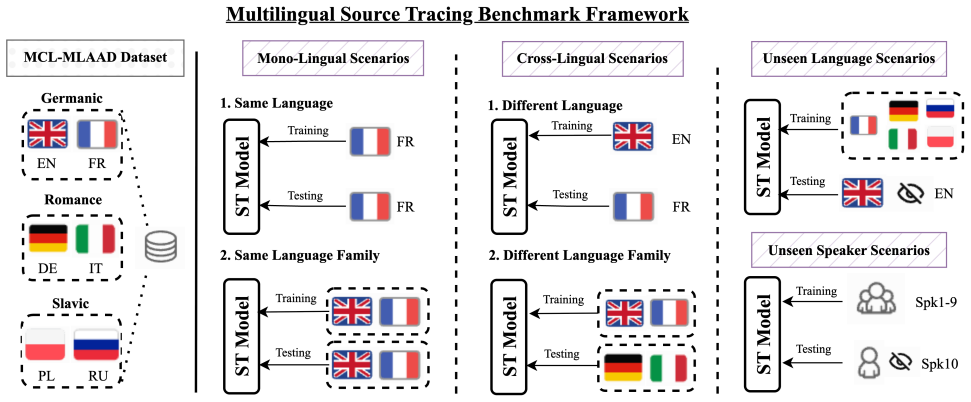
The benchmark's engine is the MCL-MLAAD dataset: a balanced subset of the MLAAD corpus with six languages across three language families (Germanic, Romance, Slavic) and four TTS architectures (Griffin-Lim, Bark, XTTS v1.1, XTTS v2), each utterance available clean and with four noise perturbations from MUSAN. The central comparison is between DSP front-ends (LFCCs fed to ResNet18, AASIST, or ECAPA-TDNN) and SSL front-ends (XLS-R, wav2vec2.0, and language-fine-tuned variants fed to AASIST), evaluated under four protocols: mono/cross-lingual, language-family, leave-one-language-out, and seen/unseen pseudo-speakers.
What would settle it
Check the MCL-MLAAD dataset metadata to confirm that all four TTS architectures (Griffin-Lim, Bark, XTTS v1.1, XTTS v2) appear in each of the six languages. If any language lacks a class, recompute the cross-lingual macro-F1 scores using only the present classes; a large drop in LFCC-ECAPA-TDNN's 88.40% average would indicate the result partly reflects language detection rather than source tracing.
Extended reading notes
Core claim
On its own terms, the paper's central discovery is that cross-lingual deepfake source tracing is achievable with current architectures, but the optimal model differs by scenario. In monolingual settings, fine-tuning an SSL front-end (XLS-R) on the target language gives the highest accuracy (97.91% macro-F1). In cross-lingual settings—training on one language and testing on another—the hand-crafted LFCC front-end paired with an ECAPA-TDNN backend outperforms all SSL variants, including multilingual pre-trained ones, by a large margin (88.40% vs. 59.75% for XLSR-AASIST). This suggests that DSP features capture language-agnostic generation artifacts, whereas SSL representations are biased by th
Load-bearing premise
The claim that cross-lingual performance reflects source tracing rather than language detection assumes that every one of the four TTS architectures is available in all six languages; if a language lacks one architecture, the 4-way classification task is not well-defined and results could be confounded.
Editorial extensions
If this is right
- Forensic attribution of deepfake speech can work across languages, not just within a single training language.
- A model trained on one language family transfers better within that family, so deployment should consider linguistic typology when data are scarce.
- DSP-based systems are a stronger baseline for cross-lingual source tracing than SSL-based systems in the tested conditions, contrary to the usual deep-learning advantage.
- Unseen-language generalization is achievable with LFCC+ResNet18 or LFCC+ECAPA-TDNN (around 96–97% macro-F1), enabling tracing for languages absent from training data.
- The lack of a consistent seen/unseen speaker gap suggests the models are not obviously shortcutting on speaker identity, though the pseudo-speaker labels are approximate.
Reading between the lines
- Editorial inference: the strong leave-one-language-out results imply that a small set of languages may suffice to train a universal source tracer for these four architectures; testing on typologically more distant languages (e.g., Mandarin or Arabic) would stress this claim.
- Editorial inference: the cross-lingual advantage of LFCC over XLS-R suggests that generation artifacts are partly channel-like and language-independent; future SSL fine-tuning could target artifact-discrimination directly rather than language-matched features.
- Editorial inference: if the four TTS architectures are not all present in every language, the cross-lingual results could conflate language detection with source tracing; checking the MCL-MLAAD metadata is a simple way to settle this.
- Editorial inference: the pseudo-speaker clustering relies on embeddings from an off-the-shelf speaker model, so the unseen-speaker robustness finding is an upper bound on true speaker invariance; a dataset with ground-truth speaker identities would be needed to confirm it.
Editorial analysis
A structured set of objections, weighed in public.
Referee Report
Summary. Motivated by the lack of multilingual source tracing for speech deepfakes, the authors construct MCL-MLAAD from MLAAD, covering six languages across three families (Germanic, Romance, Slavic) and four TTS architectures (Griffin-Lim, Bark, XTTS v1.1, XTTS v2). They define four evaluation protocols: monolingual, cross-lingual, cross-family, leave-one-language-out (unseen language), and pseudo-speaker seen/unseen. They compare three LFCC-based DSP models (AASIST, ResNet18, ECAPA-TDNN backends) with SSL front-end models (XLS-R, wav2vec2 Large, and six language-fine-tuned XLS-R variants, all with AASIST). Reported results: W2V2(xx)-AASIST achieves the best average monolingual macro-F1 (97.91%), LFCC-ECAPA-TDNN the best cross-lingual average (88.40%), same-family transfers outperform cross-family, LFCC models generalize better than XLSR to unseen languages and pseudo-speakers, and no consistent seen/unseen speaker gap is found. Code, dataset, and protocol are released.
Significance. The paper provides a useful and reproducible benchmark resource: public code/data/protocols, a clean four-class design, and a broad comparison across feature types, language families, and pretraining strategies. If the confounds are resolved, it would be a solid first step for multilingual source tracing. However, the headline DSP-versus-SSL conclusion is not identified by the current experimental matrix because front-end, backend, and Mixup are compounded; the per-language TTS composition needs explicit verification; and single-run macro-F1 numbers lack statistical support.
major comments (4)
- [Section 4.4 / Table 4 (RQ4)] The central claim that 'DSP architectures inherently prioritize language-agnostic patterns' is not supported. All SSL models use the AASIST backend and Mixup, while the LFCC family uses three different backends and no Mixup. In the backend-matched comparison, LFCC-AASIST is the worst cross-lingual model (54.46%), below XLSR-AASIST (59.75%), W2V2(xx)-AASIST (73.45%) and W2V2EN-AASIST (78.18%). The best DSP score (88.40%) comes from LFCC-ECAPA-TDNN, and no SSL-ECAPA-TDNN run is reported. The observed advantage may therefore be due to the ECAPA-TDNN backend or the absence/presence of Mixup rather than to LFCC as a DSP front-end. Please add an SSL-ECAPA-TDNN baseline, or rephrase the conclusion to describe the specific LFCC-ECAPA-TDNN configuration and remove the 'inherently' generalization.
- [Section 2.1 / Table 1] The benchmark defines a 4-class source-tracing task, and all cross-lingual and unseen-language comparisons rely on the class structure being the same in every language. The text states that six languages and four TTS architectures were selected, but it never explicitly says that each language contains all four architectures, and Table 1 only gives per-language utterance totals. If, for example, one architecture is absent from Russian (which has fewer samples, 1,200 vs 2,100), cross-lingual scores could reflect language/class prior differences rather than source-tracing ability. Please state the coverage explicitly and provide a language × TTS contingency table.
- [Sections 3.2.3 and 4, Tables 4-6] Every macro-F1 number is a single run. Tables 4-6 report 36 cells and averages with no confidence intervals, standard deviations, or significance tests. Some headline differences are small (e.g., 97.91% vs 97.78% monolingual average), while macro-F1 on roughly 1,000 test samples per language can vary by several points across seeds. Because several conclusions are rankings (best model, within-family advantage, SSL-versus-DSP), the absence of seed variability makes the comparisons unverifiable. Please report at least three seeds with mean±std, or apply significance tests.
- [Sections 2.2.4 and 4.7, Table 6] The seen/unseen speaker protocol is based on pseudo-speaker labels from unsupervised ECAPA2 clustering with an elbow-selected k=18 and per-language thresholds θ. The authors themselves note the lack of ground-truth speaker labels and the low speaker count. Given this, the conclusion that models show 'potential robustness to speaker variation' is fragile and should not be presented as a key finding. Please mark Table 6 as exploratory only and either validate the clustering with a small labeled subset or soften the conclusion accordingly. Also clarify the exact rule for classifying a pseudo-speaker as 'seen' vs 'unseen' (e.g., what happens when the prior is between 0 and θ).
minor comments (6)
- [Section 3.2.3] The macro-F1 formula, F1 = 2PR/(P+R) with macro-averaged P and R, is nonstandard; macro-F1 is typically the average of per-class F1 values. Please define and use the standard version or explain why this variant was chosen.
- [Section 4.4] 'When backend architectures are comparable (top four subtables)' is confusing; Table 4 has three SSL subtables and three DSP subtables, not four. Please correct the cross-reference.
- [Section 2.1] There are typos: 'Multil-lingual' and 'Lingual-Balanced' (likely 'linguistically balanced').
- [Section 4.7] 'unlike was hypothesized' should be 'contrary to the hypothesis'.
- [References] Some cited references (e.g., [7], [8], [25], [30], [31], [34]-[37], [67]) are not clearly connected to source tracing or the benchmark; trimming would improve readability.
- [Table 1] The meaning of '(×5)' should be explained in the caption; as written it is ambiguous whether the counts are utterances or audio files after perturbation.
Circularity Check
No significant circularity: the benchmark is an empirical measurement with independent external resources and no result reduces to its inputs.
full rationale
This paper is an empirical benchmark study, not a derivation. The central outputs are measured macro-F1 scores of various front-end/back-end combinations on a new protocol (MCL-MLAAD) constructed by selecting six languages and four TTS architectures from the external MLAAD corpus. There is no fitted parameter that is later relabeled as a prediction: the benchmark protocol, train/dev/test splits, and evaluation metrics are all defined independently of the reported findings. The pseudo-speaker labels in §2.2.4 are derived from an external ECAPA2 speaker encoder and spherical k-means clustering, and the paper explicitly acknowledges the limitation that 'the speaker labels were derived through clustering process' (§4.7) and that synthetic speech 'does not even have crisply-defined speaker identity' (§2.2.4). These are honest measurement choices, not circular reasoning. The SSL front-ends are externally pretrained models (wav2vec2, XLS-R) and the fine-tuned variants use external CommonVoice data, so the language-generalization results are not built from the conclusions they support. All self-citations are background literature and none carries a load-bearing argument; no uniqueness theorem or prior result by the authors is invoked to force the design. The apparent DSP-vs-SSL comparison is partially confounded by backend choice (all SSL models use AASIST, while the best DSP system uses ECAPA-TDNN), but the paper explicitly conditions its claim on the backend: 'DSP-based methods with robust backend ECAPA-TDNN exhibit superior cross-lingual stability' (§4.4), and the conclusion says 'LFCC features combined with ResNet or ECAPA-TDNN backends demonstrate superior cross-lingual generalization' (§5). That is an experimental design limitation, not a reduction of the result to its own assumptions. No derivation chain in the paper equates an output to an input by construction, so there is no circularity to report.
Assumptions & free parameters
free parameters (5)
- speaker seen/unseen threshold theta =
0.074 to 0.085 (Table 2)
- number of speaker clusters k =
18
- TTS model selection =
Griffin-Lim, Bark, XTTS v1.1, XTTS v2
- language selection =
en, de, fr, it, pl, ru
- Mixup alpha =
0.5
assumptions (4)
- domain assumption All four TTS architectures are available for all six languages
- domain assumption ECAPA2 embeddings cluster into meaningful pseudo-speaker identities
- domain assumption MLAAD synthetic samples preserve source-model identity across languages
- standard math Macro-F1 based on macro-averaged precision and recall is a valid comparison metric
Cite this review
Pith. "Pith review of Multilingual Source Tracing of Speech Deepfakes: A First Benchmark." pith.science (2026). https://pith.science/paper/YM2TOJ4I
@misc{pith2026250804143,
  author       = {Pith},
  title        = {Pith review of: Multilingual Source Tracing of Speech Deepfakes: A First Benchmark},
  year         = {2026},
  howpublished = {\url{https://pith.science/paper/YM2TOJ4I}},
  note         = {Machine review of arXiv:2508.04143}
}
read the original abstract
Recent progress in generative AI has made it increasingly easy to create natural-sounding deepfake speech from just a few seconds of audio. While these tools support helpful applications, they also raise serious concerns by making it possible to generate convincing fake speech in many languages. Current research has largely focused on detecting fake speech, but little attention has been given to tracing the source models used to generate it. This paper introduces the first benchmark for multilingual speech deepfake source tracing, covering both mono- and cross-lingual scenarios. We comparatively investigate DSP- and SSL-based modeling; examine how SSL representations fine-tuned on different languages impact cross-lingual generalization performance; and evaluate generalization to unseen languages and speakers. Our findings offer the first comprehensive insights into the challenges of identifying speech generation models when training and inference languages differ. The dataset, protocol and code are available at https://github.com/xuanxixi/Multilingual-Source-Tracing.
Figures


Figures from the paper (1 more)

Forward citations
Cited by 1 Pith paper
-
Fake-Mamba: Real-Time Speech Deepfake Detection Using Bidirectional Mamba as Self-Attention's Alternative
Fake-Mamba reports EERs of 0.97%, 1.74%, and 5.85% on three speech deepfake benchmarks, but the provided full text is an unrelated paper, so the claims cannot be verified.
Reference graph
Works this paper leans on
-
[1]
Introduction Recent advances in Generative AI (GenAI) have resulted in an unprecedented surge in synthetic data generation. The National Security Agency (NSA), Federal Bureau of Investigation (FBI), and Department of Homeland Security (DHS) recently released a joint report 1. It warns that synthetic media, especially deep- fake content, is now spreading q...
arXiv 2025
-
[2]
Multilingual Source Tracing Benchmark As shown in Figure 2, to comprehensively and fair eval- uate Multilingual ST model performance in both Mono- and Cross-Lingual scenarios, we propose the linguistically- balanced dataset MCL-MLAAD and establish novel protocols for thorough assessment of generalization capabilities. 2.1. Dataset Accurate evaluation of M...
-
[3]
ST Models This section introduces the models used for ST tasks
Multilingual Source Tracing Methods 3.1. ST Models This section introduces the models used for ST tasks. We first study how different input features influence performance 4https://huggingface.co/Jenthe/ECAPA2 in both mono-lingual and cross-lingual settings. Based on the type of front-end feature, we group the models into two cate- gories: DSP-based and SS...
-
[4]
Results and Discussion 4.1. Mono-Lingual Performance (RQ1) As shown in the diagonal entries of Table 4, monolingual per- formance demonstrates that W2V2(xx)-AASIST achieves high- est macro-F1 score of 97.91%, indicating that language-specific fine-tuning enhance phonetic differentiation. Notably, LFCC- ECAPA-TDNN attains 97.78% (18.98% higher than LFCC- A...
-
[5]
Furthermore, we first explore the effects of unseen languages and speakers in ST tasks
Conclusion In this work, we establish the first multilingual benchmark for speech deepfake source tracing, covering both monolingual and cross-lingual scenarios across six languages and two model cat- egories (DSP- and SSL-based models). Furthermore, we first explore the effects of unseen languages and speakers in ST tasks. Our findings reveal three key i...
-
[6]
V oxpopulitts: a large-scale multilingual tts corpus for zero-shot speech generation,
W. Liu, J. Bai, X. Cheng, J. Zuo, Z. Jiang, S. Ji, M. Fang, X. Yang, Q. Yang, and Z. Zhao, “V oxpopulitts: a large-scale multilingual tts corpus for zero-shot speech generation,” in Proceedings of the 31st International Conference on Computational Linguistics , 2025, pp. 10 293–10 297
work page 2025
-
[7]
Promptvc: Flexible stylistic voice conversion in latent space driven by natural language prompts,
J. Yao, Y . Yang, Y . Leiet al., “Promptvc: Flexible stylistic voice conversion in latent space driven by natural language prompts,” in Proceedings of IEEE International Conference on Acoustics, Speech and Signal Processing (ICASSP) . IEEE, 2024, pp. 10 571–10 575
work page 2024
-
[8]
A survey on speech deep- fake detection,
M. Li, Y . Ahmadiadli, and X. P. Zhang, “A survey on speech deep- fake detection,”ACM Computing Surveys, vol. 58, no. 3, pp. 1–42, 2025, just Accepted
work page 2025
Show all 73 references
-
[9]
Scams and frauds in the digital age: Ml-based detection and prevention strategies,
S. V . J. Kolupuri, A. Paul, R. S. Bhowmick, and et al., “Scams and frauds in the digital age: Ml-based detection and prevention strategies,” in Proceedings of the 26th International Conference on Distributed Computing and Networking, 2025, pp. 340–345
2025
-
[10]
Ge-gnn: Gated edge-augmented graph neural network for fraud detection,
W. Zhang and C. Luo, “Ge-gnn: Gated edge-augmented graph neural network for fraud detection,” IEEE Transactions on Big Data, vol. 11, no. 4, pp. 1664–1676, 2025
2025
-
[11]
Crowd density estimation based on multi-level attention maps,
B. Ding, R. Han, Z. Ma, and X. Xuan, “Crowd density estimation based on multi-level attention maps,” in 2021 IEEE 5th Informa- tion Technology,Networking,Electronic and Automation Control Conference (ITNEC), vol. 5, 2021, pp. 1759–1765
2021
-
[12]
Frect: Frequency-augmented convolu- tional transformer for robust time series anomaly detection,
W. Zhang, D. Xu, G. Yao, X. Lin, R. Guan, C. Du, R. Han, X. Xuan, and C. Luo, “Frect: Frequency-augmented convolu- tional transformer for robust time series anomaly detection,” in Advanced Intelligent Computing Technology and Applications , D.-S. Huang, W. Chen, Y . Pan, and H...
2025
-
[13]
Decomposition-based multi-scale transformer framework for time series anomaly detection,
W. Zhang and C. Luo, “Decomposition-based multi-scale transformer framework for time series anomaly detection,”Neural Networks, vol. 187, p. 107399, 2025. [Online]. Available: https:// www.sciencedirect.com/science/article/pii/S0893608025002783
2025
-
[14]
Asvspoof 2021: To- wards spoofed and deepfake speech detection in the wild,
X. Liu, X. Wang, M. Sahidullah et al. , “Asvspoof 2021: To- wards spoofed and deepfake speech detection in the wild,” IEEE/ACM Transactions on Audio, Speech, and Language Pro- cessing, vol. 31, pp. 2507–2522, 2023
2021
-
[15]
Asvspoof 5: Crowdsourced speech data, deepfakes, and adversarial attacks at scale,
X. Wang, H. Delgado, H. Tak et al., “Asvspoof 5: Crowdsourced speech data, deepfakes, and adversarial attacks at scale,” in Pro- ceedings of The Automatic Speaker Verification Spoofing Coun- termeasures Workshop (ASVspoof 2024). ISCA, 2024, pp. 1–8
2024
-
[16]
Add 2022: The first audio deep synthesis detection challenge,
J. Yi, R. Fu, J. Tao et al. , “Add 2022: The first audio deep synthesis detection challenge,” in Proceedings of IEEE Interna- tional Conference on Acoustics, Speech and Signal Processing (ICASSP). IEEE, 2022, pp. 9216–9220
2022
-
[17]
Add 2023: The second audio deep- fake detection challenge,
J. Yi, J. Tao, R. Fu et al., “Add 2023: The second audio deep- fake detection challenge,” in Proceedings of CEUR Workshop , vol. 3597, 2023, pp. 125–130, iSSN: 1613-0073
2023
-
[18]
Trident of poseidon: A generalized approach for detecting deepfake voices,
T. P. Doan, H. Dinh-Xuan, T. Ryu et al., “Trident of poseidon: A generalized approach for detecting deepfake voices,” in Pro- ceedings of the 2024 on ACM SIGSAC Conference on Computer and Communications Security , ser. CCS ’24. ACM, 2024, pp. 2222–2235
2024
-
[19]
Xlsr-mamba: A dual-column bidirec- tional state space model for spoofing attack detection,
Y . Xiao and R. K. Das, “Xlsr-mamba: A dual-column bidirec- tional state space model for spoofing attack detection,” IEEE Sig- nal Processing Letters, vol. 32, pp. 1276–1280, 2025
2025
-
[20]
Nes2net: A lightweight nested architecture for foundation model driven speech anti-spoofing,
T. Liu, D.-T. Truong, R. K. Das, K. A. Lee, and H. Li, “Nes2net: A lightweight nested architecture for foundation model driven speech anti-spoofing,” 2025. [Online]. Available: https://arxiv.org/abs/2504.05657
2025
-
[21]
Interpretable temporal class activation representation for audio spoofing detection,
M. Li and X. P. Zhang, “Interpretable temporal class activation representation for audio spoofing detection,” inProceedings of In- terspeech, 2024, pp. 1120–1124
2024
-
[22]
Speech watermarking: An approach for the forensic analysis of digital telephonic recordings,
M. Faundez-Zanuy, J. J. Lucena-Molina, and M. Hagm ¨uller, “Speech watermarking: An approach for the forensic analysis of digital telephonic recordings,” Journal of Forensic Sciences , vol. 55, no. 4, pp. 1080–1087, 2018, impact Factor: 1.5 (2023)
2018
-
[23]
Digital image foren- sics via intrinsic fingerprints,
A. Swaminathan, M. Wu, and K. J. R. Liu, “Digital image foren- sics via intrinsic fingerprints,” IEEE Transactions on Information Forensics and Security, vol. 3, no. 1, pp. 101–117, March 2008
2008
-
[24]
Forensic analysis and anonymization of printed documents,
T. Richter, S. Escher, D. Sch ¨onfeld et al., “Forensic analysis and anonymization of printed documents,” in Proceedings of the 6th ACM Workshop on Information Hiding and Multimedia Security. ACM, 2018, pp. 127–138
2018
-
[25]
Transformer for authenticating the source microphone in digital audio forensics,
M. Qamhan, Y . A. Alotaibi, and S. A. Selouani, “Transformer for authenticating the source microphone in digital audio forensics,” Forensic Science International: Digital Investigation , vol. 45, p. 301539, 2023
2023
-
[26]
Primek-net: Multi- scale spectral learning via group prime-kernel convolutional neu- ral networks for single channel speech enhancement,
Z. Lin, J. Wang, R. Li, F. Shen, and X. Xuan, “Primek-net: Multi- scale spectral learning via group prime-kernel convolutional neu- ral networks for single channel speech enhancement,” in ICASSP 2025 - 2025 IEEE International Conference on Acoustics, Speech and Signal Processi...
2025
-
[27]
Guidelines on cell phone forensics,
W. Jansen and R. Ayers, “Guidelines on cell phone forensics,” National Institute of Standards and Technology (NIST), NIST Special Publication 800-101, 2007, nIST SP 800-101 Rev. 1. [Online]. Available: https://csrc.nist.gov/publications/detail/sp/ 800-101/rev-1/final
2007
-
[28]
Source cell-phone recognition from recorded speech using non-speech segments,
C. Hanilc ¸i and T. Kinnunen, “Source cell-phone recognition from recorded speech using non-speech segments,” Digital Signal Processing, vol. 35, pp. 75–85, 2014. [Online]. Available: https:// www.sciencedirect.com/science/article/pii/S1051200414002565
2014
-
[29]
Forensic analysis of phone call networks,
S. Catanese, E. Ferrara, and G. Fiumara, “Forensic analysis of phone call networks,”Social Network Analysis and Mining, vol. 3, no. 1, pp. 15–33, March 2013
2013
-
[30]
Addressing noise and stochasticity in fraud detection for service networks,
W. Zhang, D. Xu, X. Xuan, L. Jiang, G. Yao, R. Han, X. Lang, and C. Luo, “Addressing noise and stochasticity in fraud detection for service networks,” 2025. [Online]. Available: https://arxiv.org/abs/2505.00946
2025 arXiv
-
[31]
Source tracing of audio deepfake systems,
N. Klein, T. Chen, H. Tak et al., “Source tracing of audio deepfake systems,” in Proceedings of Interspeech. ISCA, 2024, pp. 1100– 1104
2024
-
[32]
Generalized source tracing: Detect- ing novel audio deepfake algorithm with real emphasis and fake dispersion strategy,
Y . Xie, R. Fu, Z. Wen et al., “Generalized source tracing: Detect- ing novel audio deepfake algorithm with real emphasis and fake dispersion strategy,” inProceedings of Interspeech. ISCA, 2024, pp. 4833–4837
2024
-
[33]
Neural codec source tracing: Toward comprehensive attribution in open-set condition,
Y . Xie, X. Wang, Z. Wang et al., “Neural codec source tracing: Toward comprehensive attribution in open-set condition,” arXiv preprint arXiv:2501.06514, 2025, preprint
2025 arXiv
-
[34]
Multilingual speech translation from efficient finetuning of pretrained models,
X. Li, C. Wang, Y . Tang et al., “Multilingual speech translation from efficient finetuning of pretrained models,” in Proceedings of the 59th Annual Meeting of the Association for Computational Linguistics and the 11th International Joint Conference on Natu- ral Language Proce...
2021
-
[35]
Solving the unsolvable: Translating case law in hong kong,
K. kui Sin, X. Xuan, C. Kit, C. H. yan Chan, and H. H. kin Ip, “Solving the unsolvable: Translating case law in hong kong,”
-
[36]
Multi-scene ro- bust speaker verification system built on improved ecapa-tdnn,
X. Xuan, R. Jin, T. Xuan, G. Du, and K. Xuan, “Multi-scene ro- bust speaker verification system built on improved ecapa-tdnn,” in 2022 IEEE 6th Advanced Information Technology, Electronic and Automation Control Conference (IAEAC ), 2022, pp. 1689–1693
2022
-
[37]
Translaw: Benchmarking large language models in multi-agent simulation of the collaborative translation,
X. Xuan, K. kui Sin, Y . Zhou, and C. Kit, “Translaw: Benchmarking large language models in multi-agent simulation of the collaborative translation,” 2025. [Online]. Available: https://arxiv.org/abs/2507.00875
2025 arXiv
-
[38]
Probing the feasibility of mul- tilingual speaker anonymization,
S. Meyer, F. Lux, and N. T. Vu, “Probing the feasibility of mul- tilingual speaker anonymization,” in Proceedings of Interspeech, 2024, pp. 4448–4452
2024
-
[39]
Introducing multilingual pho- netic information to speaker embedding for speaker verification,
Z. Song, L. He, P. Wang et al. , “Introducing multilingual pho- netic information to speaker embedding for speaker verification,” in Proceedings of IEEE International Conference on Acoustics, Speech and Signal Processing (ICASSP) . IEEE, 2024, pp. 10 091–10 095
2024
-
[40]
Research on front-end of asv system based on mel spectrum in noise scenario,
X. Xuan, J. Dong, and T. Xuan, “Research on front-end of asv system based on mel spectrum in noise scenario,” in 2022 IEEE 10th Joint International Information Technology and Artificial In- telligence Conference (ITAIC), vol. 10, 2022, pp. 2638–2642
2022
-
[41]
Research on acoustic feature extractor for automatic speaker verification systerm,
X. Xuan and R. Han, “Research on acoustic feature extractor for automatic speaker verification systerm,” in 2022 IEEE 10th Joint International Information Technology and Artificial Intelligence Conference (ITAIC), vol. 10, 2022, pp. 2628–2633
2022
-
[42]
Madd: A multi-lingual multi-speaker audio deepfake detection dataset,
X. Qi, H. Gu, J. Yi et al., “Madd: A multi-lingual multi-speaker audio deepfake detection dataset,” in 2024 IEEE 14th Interna- tional Symposium on Chinese Spoken Language Processing (ISC- SLP). IEEE, 2024, pp. 466–470
2024
-
[43]
Research on speaker identifica- tion models based on cnn and additive angular margin loss,
X. Xuan, R. Han, and B. Ding, “Research on speaker identifica- tion models based on cnn and additive angular margin loss,” in 2021 2nd International Conference on Electronics, Communica- tions and Information Technology (CECIT), 2021, pp. 1046–1050
2021
-
[44]
Conformer-based speaker recogni- tion model for real-time multi-scenarios,
X. Xuan, R. Han, and J. Gao, “Conformer-based speaker recogni- tion model for real-time multi-scenarios,” Computer Engineering and Applications, vol. 60, no. 7, pp. 147–156, 2024
2024
-
[45]
Scaling speech technology to 1,000+ languages,
V . Pratap, A. Tjandra, B. Shi et al., “Scaling speech technology to 1,000+ languages,” Journal of Machine Learning Research , vol. 25, no. 97, pp. 1–52, 2024
2024
-
[46]
Neural codec language models are zero-shot text to speech synthesizers,
S. Chen, C. Wang, Y . Wu, Z. Zhang, L. Zhou, S. Liu, Z. Chen, Y . Liu, H. Wang, J. Liet al., “Neural codec language models are zero-shot text to speech synthesizers,” IEEE Transactions on Au- dio, Speech and Language Processing, 2025
2025
-
[47]
Polyglotfake: A novel multilingual and multimodal deepfake dataset,
Y . Hou, H. Fu, C. Chenet al., “Polyglotfake: A novel multilingual and multimodal deepfake dataset,” inInternational Conference on Pattern Recognition. Cham: Springer Nature Switzerland, 2024, pp. 180–193
2024
-
[48]
Musan: A music, speech, and noise corpus,
D. Snyder, G. Chen, and D. Povey, “Musan: A music, speech, and noise corpus,” arXiv preprint arXiv:1510.08484, 2015
2015 arXiv
-
[49]
Mlaad: The multi- language audio anti-spoofing dataset,
N. M. M ¨uller, P. Kawa, W. H. Choonget al., “Mlaad: The multi- language audio anti-spoofing dataset,” in2024 International Joint Conference on Neural Networks (IJCNN). IEEE, 2024, pp. 1–7
2024
-
[50]
Heterogeneity over homogeneity: Investigating multilingual speech pre-trained models for detecting audio deepfake,
O. C. Phukan, G. Kashyap, A. B. Buduru et al., “Heterogeneity over homogeneity: Investigating multilingual speech pre-trained models for detecting audio deepfake,” in Findings of the Asso- ciation for Computational Linguistics: NAACL 2024 , 2024, pp. 2496–2506
2024
-
[51]
Transferring audio deepfake detection capability across lan- guages,
Z. Ba, Q. Wen, P. Cheng, Y . Wang, F. Lin, L. Lu, and Z. Liu, “Transferring audio deepfake detection capability across lan- guages,” in Proceedings of the ACM Web Conference 2023, 2023, pp. 2033–2044
2023
-
[52]
Towards quantifying and reducing language mismatch ef- fects in cross-lingual speech anti-spoofing,
T. Liu, I. Kukanov, Z. Pan, Q. Wang, H. B. Sailor, and K. A. Lee, “Towards quantifying and reducing language mismatch ef- fects in cross-lingual speech anti-spoofing,” in2024 IEEE Spoken Language Technology Workshop (SLT). IEEE, 2024, pp. 1185– 1192
2024
-
[53]
Are audio deepfake detection models polyglots?
B. Marek, P. Kawa, and P. Syga, “Are audio deepfake detection models polyglots?” arXiv preprint arXiv:2412.17924, 2024
2024 arXiv
-
[54]
Aasist: Audio anti-spoofing us- ing integrated spectro-temporal graph attention networks,
J. Jung, H. S. Heo, H. Tak et al., “Aasist: Audio anti-spoofing us- ing integrated spectro-temporal graph attention networks,” inPro- ceedings of IEEE International Conference on Acoustics, Speech and Signal Processing (ICASSP). IEEE, 2022, pp. 6367–6371
2022
-
[55]
Shortcut learning in deep neural networks,
R. Geirhos et al. , “Shortcut learning in deep neural networks,” Nature Machine Intelligence, vol. 2, no. 11, pp. 665–673, 2020
2020
-
[56]
Ecapa2: A hybrid neural net- work architecture and training strategy for robust speaker embed- dings,
J. Thienpondt and K. Demuynck, “Ecapa2: A hybrid neural net- work architecture and training strategy for robust speaker embed- dings,” in 2023 IEEE Automatic Speech Recognition and Under- standing Workshop (ASRU). IEEE, 2023, pp. 1–8
2023
-
[57]
Concept decompositions for large sparse text data using clustering,
I. S. Dhillon and D. S. Modha, “Concept decompositions for large sparse text data using clustering,” Machine Learning , vol. 42, no. 1, pp. 143–175, 2001. [Online]. Available: https://doi.org/10.1023/A:1007612920971
2001 doi
-
[58]
Review on determining number of cluster in k-means clustering,
T. M. Kodinariya and P. R. Makwana, “Review on determining number of cluster in k-means clustering,” International Journal, vol. 1, no. 6, pp. 90–95, 2013
2013
-
[59]
A comparison of features for synthetic speech detection,
M. Sahidullah, T. Kinnunen, and C. Hanilc ¸i, “A comparison of features for synthetic speech detection,” in Proceedings of Inter- speech, 2015, pp. 2087–2091
2015
-
[60]
Common V oice: A massively-multilingual speech corpus,
R. Ardila, M. Branson, K. Davis et al. , “Common V oice: A massively-multilingual speech corpus,” in Proceedings of the Twelfth Language Resources and Evaluation Conference , 2020, pp. 4218–4222
2020
-
[61]
Deep residual learning for image recognition,
K. He, X. Zhang, S. Ren, and J. Sun, “Deep residual learning for image recognition,” in Proceedings of the IEEE conference on computer vision and pattern recognition, 2016, pp. 770–778
2016
-
[62]
ECAPA- TDNN: Emphasized channel attention, propagation and aggrega- tion in TDNN based speaker verification,
B. Desplanques, J. Thienpondt, and K. Demuynck, “ECAPA- TDNN: Emphasized channel attention, propagation and aggrega- tion in TDNN based speaker verification,” in Proceedings of In- terspeech, 2020, pp. 3830–3834, iSSN 2308-457X
2020
-
[63]
Unsu- pervised cross-lingual representation learning for speech recogni- tion,
A. Conneau, A. Baevski, R. Collobert, and A. Mohamed, “Unsu- pervised cross-lingual representation learning for speech recogni- tion,” in Proceedings of Interspeech, 2021, pp. 2426–2430
2021
-
[64]
V oxpopuli: A large-scale multilingual speech corpus for representation learning, semi- supervised learning and interpretation,
C. Wang, M. Riviere, A. Lee et al., “V oxpopuli: A large-scale multilingual speech corpus for representation learning, semi- supervised learning and interpretation,” inProceedings of the 59th Annual Meeting of the Association for Computational Linguistics and the 11th Internat...
2021
-
[65]
MLS: A large-scale multilin- gual dataset for speech research,
V . Pratap, Q. Xu, A. Sriram et al., “MLS: A large-scale multilin- gual dataset for speech research,” in Proceedings of Interspeech, 2020, pp. 2757–2761
2020
-
[66]
mixup: Beyond empirical risk minimization,
H. Zhang, M. Cisse, Y . N. Dauphin, and D. Lopez-Paz, “mixup: Beyond empirical risk minimization,” in International Conference on Learning Representations (ICLR), 2018. [Online]. Available: https://arxiv.org/abs/1710.09412
2018 arXiv
-
[67]
V oxlingua107: A dataset for spoken lan- guage recognition,
J. Valk and T. Alum ¨ae, “V oxlingua107: A dataset for spoken lan- guage recognition,” inProceedings of the 2021 IEEE Spoken Lan- guage Technology Workshop (SLT). IEEE, 2021, pp. 652–658
2021
-
[68]
Speech recog- nition and keyword spotting for low-resource languages: Babel project research at cued,
M. J. F. Gales, K. M. Knill, A. Ragni et al. , “Speech recog- nition and keyword spotting for low-resource languages: Babel project research at cued,” in Proceedings of the Fourth Interna- tional Workshop on Spoken Language Technologies for Under- Resourced Languages (SLTU-201...
2014
-
[69]
wav2vec 2.0: A framework for self-supervised learning of speech represen- tations,
A. Baevski, Y . Zhou, A. Mohamed, and et al., “wav2vec 2.0: A framework for self-supervised learning of speech represen- tations,” Advances in Neural Information Processing Systems , vol. 33, pp. 12 449–12 460, 2020
2020
-
[70]
Lib- rispeech: An asr corpus based on public domain audio books,
V . Panayotov, G. Chen, D. Povey, and S. Khudanpur, “Lib- rispeech: An asr corpus based on public domain audio books,” in Proceedings of IEEE International Conference on Acoustics, Speech and Signal Processing (ICASSP). IEEE, 2015, pp. 5206– 5210
2015
-
[71]
Towards generalisable and calibrated audio deepfake detection with self-supervised represen- tations,
O. Pascu, A. Stan, D. Oneata et al., “Towards generalisable and calibrated audio deepfake detection with self-supervised represen- tations,” in Proceedings of Interspeech, 2024, pp. 4828–4832
2024
-
[73]
Unlocking the full potential of separa- ble convolutions on tensor cores,
A. Cui, C. Zhao, X. Deng, G. Jiang, Y . Yang, G. Yao, R. Han, W. Zhang, and X. Xuan, “Unlocking the full potential of separa- ble convolutions on tensor cores,” in International Conference on Intelligent Computing. Springer, 2025, pp. 39–50
2025
-
[2025]
Available: https://arxiv.org/abs/2501.09444
[Online]. Available: https://arxiv.org/abs/2501.09444
Reviewed August 6, 2026 · model on record in the stance chip above.
Discussion (0). Sign in to comment.