REVIEW 4 major objections 4 minor 1 cited by
On the origin of the Hercules group: I. chemical signatures indicating the outer bar origin
T0 review · 4 major / 4 minor · reviewed 2026-08-12 · deepseek-v4-flash
Pith's one-line read Super metal-rich Hercules stars trace to the Milky Way's outer bar
desk verdict A credible multi-element chemical fingerprint for the low-Lz Hercules subgroups, but the APOGEE half of the evidence depends on a post-hoc [Mg/Fe] cut and needs robustness testing before the outer-bar claim can carry weight. read the letter →
The pith
A machine-rendered reading of the paper's core claim, the machinery that carries it, and where it could break.
The reading
What carries the argument
The load-bearing device is a chemical selection: the paper partitions the solar-neighbourhood sample in the $L_Z$–$V_R$ plane, then discards all stars with $[\mathrm{Mg}/\mathrm{Fe}] \ge 0.1$ to remove the high-$\alpha$ thick-disk population. This cut, chosen from the flat kinematic distribution of thick-disk stars, resolves the inconsistencies among iron-peak elements and between the GALAH and APOGEE surveys, and exposes a sharp 'low-$L_Z$ patch' at Hercules III and IV that is chemically uniform in its iron-peak, odd-Z, and $\alpha$ abundances. The comparison of these abundances with the Galaxy's radial metallicity gradient and with Na/Al age tracers is what carries the argument from a kinematic group to an inner-Galactic birthplace.
What would settle it
A direct test would be an infrared spectroscopic survey of stars in the outer bar region (around $R \sim 4$–$6$ kpc): if those stars are not unusually rich in Ni, Na, and Al and poor in O, Ca, and Ti relative to the solar neighbourhood, the claimed outer-bar origin for the Hercules III and IV stars fails. Alternatively, if the low-$L_Z$ patch disappears when the $\alpha$ cut is varied or when the dwarf/giant calibration offsets noted for Al and Si are corrected, the signature would be a selection artefact rather than a real population.
Extended reading notes
Core claim
On its own terms, the paper discovers a chemically distinct stellar population inside the Hercules kinematic group. In the angular momentum–radial velocity ($L_Z$–$V_R$) plane, the Hercules subgroups III and IV at low angular momentum contain a low-alpha (thin-disk) population that is significantly enhanced in iron-peak elements and odd-Z elements and slightly deficient in alpha elements compared with kinematically local stars. The Na and Al enhancements identify these stars as the youngest members of the old sequence that originates in the inner disc. Interpreting the super metal-rich, alpha-poor, odd-Z-rich composition as the fingerprint of the peak of the Galaxy's radial metallicity profile, the paper concludes that Hercules III and IV formed in the outer thin bar region of the inner Galaxy and were subsequently delivered to the solar neighbourhood, implying that the Hercules formation mechanism must transport stars outward from the inner Galaxy.
Load-bearing premise
The entire chemical conclusion depends on the assumption that cutting at $[\mathrm{Mg}/\mathrm{Fe}] < 0.1$ cleanly isolates the thin-disk population, so that the residual abundance differences between kinematic groups reflect stellar birthplaces rather than survey calibration systematics, remaining thick-disk contamination, or the arbitrary placement of kinematic group boundaries.
Editorial extensions
If this is right
- If the claim holds, the solar neighbourhood contains stars born in the inner Galaxy, so local stellar samples can be used to probe the chemistry of the outer bar region.
- The requirement that the formation mechanism transports stars from the inner Galaxy to the solar neighbourhood excludes purely local or circular-orbit scenarios and supports a resonant mechanism such as Trojan orbits at bar corotation.
- The identification of Hercules III and IV as the youngest stars of the old sequence connects the Hercules group to the inner thick disc and implies that the old sequence extends into the outer bar.
- The low-$L_Z$ patch becomes a testable population: infrared surveys of the inner Galaxy can check whether outer-bar stars share the same Ni, Na, and Al enhancements.
- Consistent detection of the patch in both GALAH and APOGEE after the alpha cut suggests that survey differences in wavelength and stellar selection can be reconciled once thick-disk contamination is removed.
Reading between the lines
- Beyond the paper: the same $[\mathrm{Mg}/\mathrm{Fe}] < 0.1$ selection could be applied to other kinematic groups to look for additional inner-Galaxy migrants, effectively turning the Hercules method into a general search tool.
- If the outer bar is indeed Na/Al-rich, then Na and Al abundances in local stars could serve as a chemical tag for outer-bar membership, independent of kinematics.
- The paper's argument implies that local chemical evolution models should account for a population of stars whose abundances reflect the inner disc rather than local enrichment, which would bias interpretations of the solar-neighbourhood abundance distribution if ignored.
- A testable extension: if Trojan orbits are responsible, Hercules III and IV stars should show orbital librations around the bar's Lagrange points in Gaia astrometry, a prediction the authors' companion paper develops.
Signed reviews
Editorial analysis
A structured set of objections, weighed in public.
Referee Report
Summary. The paper investigates the chemical composition of the Hercules kinematic group in the solar neighbourhood using Gaia DR3 astrometry and GALAH DR4 and APOGEE DR17 spectroscopy. It defines kinematic groups in the LZ-VR plane, analyses [Mg/Fe]-[Fe/H] diagrams, and after applying a [Mg/Fe] < 0.1 cut to remove thick-disc stars, finds that the low angular momentum subgroups Hercules III and IV display enhanced iron-peak (Fe, Ni, Mn) and Odd-Z (Na, Al) abundances and slightly deficient alpha (O, Ca, Ti) abundances relative to kinematically local stars. The authors interpret this pattern as evidence that these stars originated in the outer thin bar in the inner Galaxy and were transported outward by a bar-related mechanism, to be discussed in a companion paper.
Significance. If the chemical signature is real, the paper would provide a valuable new constraint on the origin of the Hercules group, linking a specific kinematic substructure to the inner Galaxy and bar dynamics. The study makes good use of two independent spectroscopic surveys and presents a fairly complete elemental inventory, and the authors are transparent about inconsistencies between surveys and within element groups. However, the central claim depends on a post-hoc [Mg/Fe] cut that is the very step that makes the signal appear, and the reported abundance differences are not accompanied by significance tests or robustness checks. The strengths are the survey cross-checks and the explicit acknowledgment of degeneracies; the weakness is that the main conclusion currently rests on this single, not-fully-justified selection.
major comments (4)
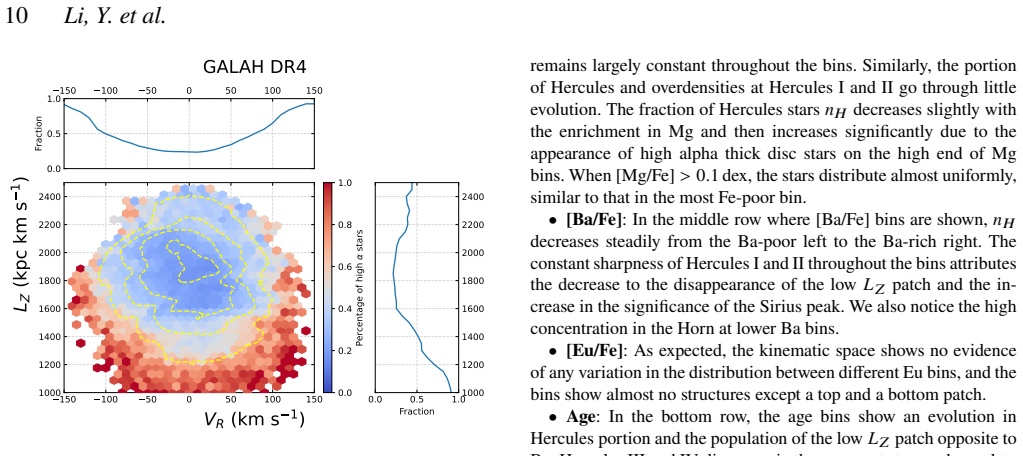
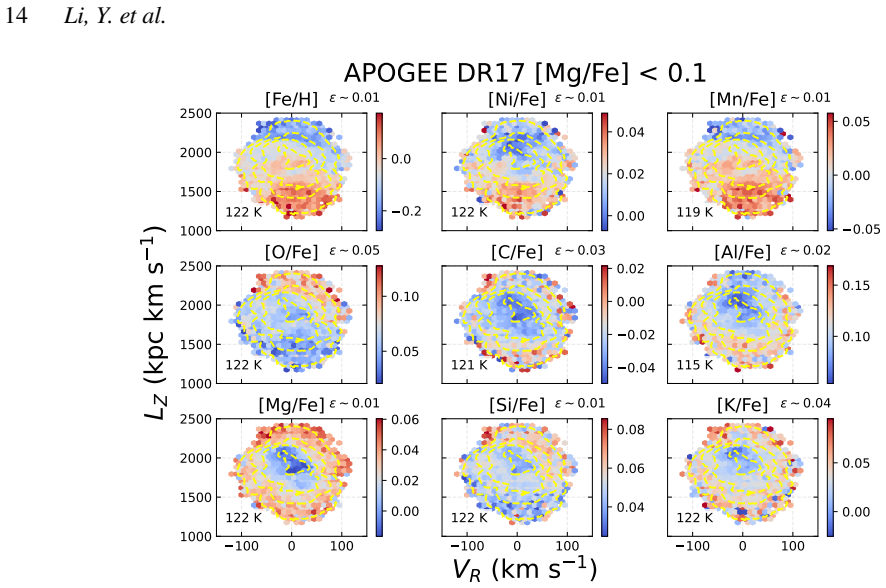
- [§3.4–3.5, Figs. 9–12] The main chemical signal of Hercules III/IV is only present after applying the [Mg/Fe] < 0.1 cut, and the cut is not robustly tested. The paper's own APOGEE Mg-binning (Fig. 10) shows that the low-Lz patch is nearly absent at [Mg/Fe] < -0.02 (nH = 13%) and appears progressively as the threshold approaches 0.1 (19%, 21%, 30%). This means the APOGEE enhancement in Fig. 12 is driven by stars with -0.02 < [Mg/Fe] < 0.1, i.e., stars immediately below the cut rather than by the most alpha-poor thin-disc population. The threshold 0.1 is chosen 'based on the analysis in Sec. 3.4' but no alternative thresholds (e.g., 0.0, 0.05, 0.15) are explored. Without such robustness checks, the claim that the low-alpha population carries the iron-peak and Odd-Z enhancement is not established; the signal could be an artifact of residual thick-disc contamination or of the arbitrary kinematic boundaries.
- [Tables 4 and 5] The paper states abundances are 'significantly enhanced' but provides only medians with quartile ranges, without any statistical significance test. For instance, in Table 4, [Fe/H] for Hercules III is +0.12 (+0.23/−0.01) versus LSR −0.01 (+0.09/−0.12); the quartile ranges show large overlap. Similarly, [Na/Fe] for Hercules III is 0.09 (+0.15/+0.02) versus LSR 0.02 (+0.08/−0.04). Given the broad distributions and the modest sample sizes after the cut, a bootstrap or rank-sum test is needed to support the qualitative description. The lack of such tests is load-bearing because the central claim is a differential abundance pattern.
- [§3.4, Figs. 9–10] The GALAH and APOGEE data disagree on the behaviour of the Hercules fraction with [Mg/Fe]: nH is roughly constant across Mg bins in GALAH (27%, 26%, 25%, 30%) but rises monotonically in APOGEE (13%, 19%, 21%, 30%). The paper resolves this by 'favouring' APOGEE because of better bimodality separation, but no quantitative test or explanation is offered. This discrepancy is directly relevant to the post-cut interpretation: it suggests that the APOGEE low-alpha patch is an emergent feature of the binning near 0.1 dex, while the GALAH data do not show the same emergence, so the cross-survey agreement claimed for Fig. 12 is not actually a confirmation of a single low-alpha population.
- [§4] The interpretation of the chemical pattern as evidence for an outer thin bar origin is an inference from literature radial metallicity gradients, not a quantitative comparison with inner-Galaxy abundance data. The paper itself notes that 'the direct way to verify the origin... is to compare the abundances in the inner disc' and that such data are scarce. As a result, the claim 'these chemical signatures support their origin from the outer thin bar' goes beyond what the data alone can establish; alternative origins (e.g., radial migration from a range of radii, or different bar models) are not considered quantitatively. This is not an error, but it is a limitation that should be stated more carefully in the abstract and conclusions.
minor comments (4)
- [§1, §2] There are several typos, e.g., 'refered to' in §1, 'associtated' in §1, and 'the the' in the first sentence of §2. A careful proofreading pass is recommended.
- [Figs. 6 and 7] The colour scales and binning are not identical between panels in Figs. 6 and 7, making visual comparisons across elements difficult; a common scale or a clearer description of the colour mapping would aid the reader.
- [Abstract, §4–5] The paper uses 'outer thin bar' in the abstract but 'inner disc' and 'inner Galaxy' in §4–5; the precise spatial region intended (e.g., R ~ 4–6 kpc from Wylie et al.) should be stated consistently throughout.
- [Table 1] The table caption notes that the APOGEE Hercules IV peak is the thick-disc peak; this is helpful, but the corresponding low-alpha peak should also be listed (or explicitly omitted) so that the comparison with the low-alpha analysis in Tables 4 and 5 is transparent.
Circularity Check
No significant circularity: the Hercules III/IV chemical signature is measured within a common [Mg/Fe]<0.1 sample, and the outer-bar interpretation rests on external gradient results, not on this paper's fitted parameters.
full rationale
The derivation chain is self-contained in the relevant sense. The paper identifies kinematic groups from Gaia overdensity contours, then measures abundances in those groups. The Fe-peak and Odd-Z enhancements of Hercules III and IV are already visible before the alpha cut in Figs. 4 and 5 and Table 1, so they are not manufactured by the subsequent selection. The [Mg/Fe]<0.1 threshold in Sec. 3.5 is a uniform selection applied to all kinematic groups, not a parameter fitted to the particular abundance contrast being claimed; the abstract's 'deficiency in alpha elements' is based on O, Ca, and Ti, which are not the selection variable, and is evaluated relative to kinematically local stars inside the same low-alpha sample. The outer-bar interpretation is an inference from external, independently published radial metallicity gradient results (Wegg et al. 2015; Wylie et al. 2021; Lian et al. 2023; Guiglion et al. 2024), not from a result derived in this paper. Self-references to the companion paper II (Li et al. 2024) are forward references to future dynamical work, not evidence used to force the chemical conclusion. Co-authorship overlap with Owusu et al. (2024) and Wylie et al. (2021) does not make those citations circular, because their content is externally falsifiable and the present paper's central claim does not reduce to those citations. The threshold sensitivity noted by the skeptic is a legitimate selection-robustness concern, but it is not a circularity: no equation equates the claimed prediction to an input, and no fitted parameter is renamed as a prediction. Verdict: no significant circularity.
Assumptions & free parameters
free parameters (1)
- [Mg/Fe] thick-disc threshold =
0.1 dex
assumptions (4)
- domain assumption Solar position and motion parameters (R_GC = 8.2 kpc, LSR tangential velocity 235 km/s, solar peculiar motion (11.1, 12.24, 7.25) km/s).
- domain assumption Inner Galaxy has a positive radial metallicity gradient peaking around R ~ 4-6 kpc, associated with the outer bar.
- ad hoc to paper Stars with [Mg/Fe] >= 0.1 are thick disk stars that contribute little to kinematic structures.
- domain assumption Na and Al enhancements identify the old sequence in the inner disc.
Cite this review
Pith. "Pith review of On the origin of the Hercules group: I. chemical signatures indicating the outer bar origin." pith.science (2026). https://pith.science/paper/YM42UYS6
@misc{pith2026241119085,
  author       = {Pith},
  title        = {Pith review of: On the origin of the Hercules group: I. chemical signatures indicating the outer bar origin},
  year         = {2026},
  howpublished = {\url{https://pith.science/paper/YM42UYS6}},
  note         = {Machine review of arXiv:2411.19085}
}
read the original abstract
The Hercules kinematic group is a kinematic anomaly of stars observed in the solar neighbourhood (SNd). In this series of papers, we present a comprehensive study of this structure. This paper focuses on its chemical signatures over several groups of elements. The next paper discusses its kinematical properties. While studies suggested a non-native origin of Hercules stars due to the distinct chemical and kinematic features, previous studies focussed mainly on the Fe abundances. We adopt chemical data with abundances of elements from GALAH and APOGEE to seek further chemical implications on the origin. Our analysis reveals that the low alpha population of the low angular momentum Hercules group is significantly enhanced in iron-peak (Fe, Ni, Mn) and Odd-Z (Na, Al) elements, and slightly deficient in alpha elements (O, Ca, Ti) compared to kinematically local stars. The super enhancement in iron-peak elements and deficiency in alpha elements support their origin from the outer thin bar in the inner Galaxy. Moreover, the enhancement in Na and Al indicates these stars as the youngest stars in the old sequence from the inner thick disc. Hence, the origin of these stars can be related to the outer bar region. These chemical signatures require the underlying dynamical mechanism that forms the Hercules group to be capable of transporting stars in the inner Galaxy out to the SNd. The next paper will consider the Trojan orbits as the favoured mechanism.
Figures


Figures from the paper (10 more)





Forward citations
Cited by 1 Pith paper
-
On the origin of the Hercules group: II. the Trojan quasi-periodic identity on the orbital level
Quasi-periodic orbits trapped around L4/L5 Trojan orbits of a slowly rotating long Galactic bar reproduce the Hercules kinematic group's position and shape in the solar neighbourhood velocity plane and can transport i...
Reference graph
Works this paper leans on
-
[1]
Abdurro'uf et al., 2022, @doi [ ] 10.3847/1538-4365/ac4414 , https://ui.adsabs.harvard.edu/abs/2022ApJS..259...35A 259, 35
-
[2]
Antoja T., et al., 2014, @doi [ ] 10.1051/0004-6361/201322623 , https://ui.adsabs.harvard.edu/abs/2014A&A...563A..60A 563, A60
-
[3]
Antoja T., et al., 2017, @doi [ ] 10.1051/0004-6361/201629387 , https://ui.adsabs.harvard.edu/abs/2017A&A...601A..59A 601, A59
-
[4]
Astropy Collaboration et al., 2013, @doi [ ] 10.1051/0004-6361/201322068 , https://ui.adsabs.harvard.edu/abs/2013A&A...558A..33A 558, A33
-
[5]
Astropy Collaboration et al., 2018, @doi [ ] 10.3847/1538-3881/aabc4f , https://ui.adsabs.harvard.edu/abs/2018AJ....156..123A 156, 123
-
[6]
Astropy Collaboration et al., 2022, @doi [ ] 10.3847/1538-4357/ac7c74 , https://ui.adsabs.harvard.edu/abs/2022ApJ...935..167A 935, 167
-
[7]
A., P \'e rez-Villegas A., L \'e pine J
Barros D. A., P \'e rez-Villegas A., L \'e pine J. R. D., Michtchenko T. A., Vieira R. S. S., 2020, @doi [ ] 10.3847/1538-4357/ab59d1 , https://ui.adsabs.harvard.edu/abs/2020ApJ...888...75B 888, 75
-
[8]
Basri G., Marcy G. W., Graham J. R., 1996, @doi [ ] 10.1086/176842 , https://ui.adsabs.harvard.edu/abs/1996ApJ...458..600B 458, 600
Show all 91 references
-
[9]
Baumann P., Ram \' rez I., Mel \'e ndez J., Asplund M., Lind K., 2010, @doi [ ] 10.1051/0004-6361/201015137 , https://ui.adsabs.harvard.edu/abs/2010A&A...519A..87B 519, A87
2010 doi
-
[10]
S., 2014, @doi [ ] 10.1051/0004-6361/201322631 , https://ui.adsabs.harvard.edu/abs/2014A&A...562A..71B 562, A71
Bensby T., Feltzing S., Oey M. S., 2014, @doi [ ] 10.1051/0004-6361/201322631 , https://ui.adsabs.harvard.edu/abs/2014A&A...562A..71B 562, A71
2014 doi
-
[11]
Bernet M., Ramos P., Antoja T., Famaey B., Monari G., Al Kazwini H., Romero-G \'o mez M., 2022, @doi [ ] 10.1051/0004-6361/202244070 , https://ui.adsabs.harvard.edu/abs/2022A&A...667A.116B 667, A116
2022 doi
-
[12]
Binney J., 2020, @doi [ ] 10.1093/mnras/staa1103 , https://ui.adsabs.harvard.edu/abs/2020MNRAS.495..895B 495, 895
2020 doi
-
[13]
C., Kazantzidis S., Weinberg D
Bird J. C., Kazantzidis S., Weinberg D. H., Guedes J., Callegari S., Mayer L., Madau P., 2013, @doi [ ] 10.1088/0004-637X/773/1/43 , https://ui.adsabs.harvard.edu/abs/2013ApJ...773...43B 773, 43
2013 doi
-
[14]
V., Bajkova A
Bobylev V. V., Bajkova A. T., Myll \"a ri A. A., 2010, @doi [Astronomy Letters] 10.1134/S1063773710010044 , https://ui.adsabs.harvard.edu/abs/2010AstL...36...27B 36, 27
2010 doi
-
[15]
W., 2010, @doi [ ] 10.1088/0004-637X/717/2/617 , https://ui.adsabs.harvard.edu/abs/2010ApJ...717..617B 717, 617
Bovy J., Hogg D. W., 2010, @doi [ ] 10.1088/0004-637X/717/2/617 , https://ui.adsabs.harvard.edu/abs/2010ApJ...717..617B 717, 617
2010 doi
-
[16]
Buder S., et al., 2021, @doi [ ] 10.1093/mnras/stab1242 , https://ui.adsabs.harvard.edu/abs/2021MNRAS.506..150B 506, 150
2021 doi
- [17]
-
[18]
Chiappini C., Matteucci F., Romano D., 2001, @doi [ ] 10.1086/321427 , https://ui.adsabs.harvard.edu/abs/2001ApJ...554.1044C 554, 1044
2001 doi
-
[19]
Chiba R., Friske J. K. S., Sch \"o nrich R., 2021, @doi [ ] 10.1093/mnras/staa3585 , https://ui.adsabs.harvard.edu/abs/2021MNRAS.500.4710C 500, 4710
2021 doi
-
[20]
R., Grand R
Ciuc a I., Kawata D., Miglio A., Davies G. R., Grand R. J. J., 2021, @doi [ ] 10.1093/mnras/stab639 , https://ui.adsabs.harvard.edu/abs/2021MNRAS.503.2814C 503, 2814
2021 doi
-
[21]
Cui X.-Q., et al., 2012, @doi [Research in Astronomy and Astrophysics] 10.1088/1674-4527/12/9/003 , https://ui.adsabs.harvard.edu/abs/2012RAA....12.1197C 12, 1197
2012 doi
-
[22]
Aguerri J
D'Onghia E., L. Aguerri J. A., 2020, @doi [ ] 10.3847/1538-4357/ab6bd6 , https://ui.adsabs.harvard.edu/abs/2020ApJ...890..117D 890, 117
2020 doi
-
[23]
D'Orazi V., Magrini L., Randich S., Galli D., Busso M., Sestito P., 2009, @doi [ ] 10.1088/0004-637X/693/1/L31 , https://ui.adsabs.harvard.edu/abs/2009ApJ...693L..31D 693, L31
2009 doi
-
[24]
J., Wyse R
Daniel K. J., Wyse R. F. G., 2015, @doi [ ] 10.1093/mnras/stu2683 , https://ui.adsabs.harvard.edu/abs/2015MNRAS.447.3576D 447, 3576
2015 doi
-
[25]
J., Wyse R
Daniel K. J., Wyse R. F. G., 2018, @doi [ ] 10.1093/mnras/sty199 , https://ui.adsabs.harvard.edu/abs/2018MNRAS.476.1561D 476, 1561
2018 doi
-
[26]
B., Fox A
De Cia A., Jenkins E. B., Fox A. J., Ledoux C., Ramburuth-Hurt T., Konstantopoulou C., Petitjean P., Krogager J.-K., 2021, @doi [ ] 10.1038/s41586-021-03780-0 , https://ui.adsabs.harvard.edu/abs/2021Natur.597..206D 597, 206
2021 doi
-
[27]
M., Freeman K
De Silva G. M., Freeman K. C., Bland-Hawthorn J., Asplund M., Bessell M. S., 2007, @doi [ ] 10.1086/510131 , https://ui.adsabs.harvard.edu/abs/2007AJ....133..694D 133, 694
2007 doi
-
[28]
Dehnen W., 1998, @doi [ ] 10.1086/300364 , https://ui.adsabs.harvard.edu/abs/1998AJ....115.2384D 115, 2384
1998 doi
-
[29]
Dehnen W., 2000, @doi [ ] 10.1086/301226 , https://ui.adsabs.harvard.edu/abs/2000AJ....119..800D 119, 800
2000 doi
-
[30]
J., 1950, @doi [ ] 10.1086/145240 , https://ui.adsabs.harvard.edu/abs/1950ApJ...111...65E 111, 65
Eggen O. J., 1950, @doi [ ] 10.1086/145240 , https://ui.adsabs.harvard.edu/abs/1950ApJ...111...65E 111, 65
1950 doi
-
[31]
J., 1958, @doi [ ] 10.1093/mnras/118.2.154 , https://ui.adsabs.harvard.edu/abs/1958MNRAS.118..154E 118, 154
Eggen O. J., 1958, @doi [ ] 10.1093/mnras/118.2.154 , https://ui.adsabs.harvard.edu/abs/1958MNRAS.118..154E 118, 154
1958 doi
-
[32]
J., 1983, @doi [ ] 10.1086/113352 , https://ui.adsabs.harvard.edu/abs/1983AJ.....88..642E 88, 642
Eggen O. J., 1983, @doi [ ] 10.1086/113352 , https://ui.adsabs.harvard.edu/abs/1983AJ.....88..642E 88, 642
1983 doi
-
[33]
J., 1996, @doi [ ] 10.1086/118126 , https://ui.adsabs.harvard.edu/abs/1996AJ....112.1595E 112, 1595
Eggen O. J., 1996, @doi [ ] 10.1086/118126 , https://ui.adsabs.harvard.edu/abs/1996AJ....112.1595E 112, 1595
1996 doi
-
[34]
Famaey B., Jorissen A., Luri X., Mayor M., Udry S., Dejonghe H., Turon C., 2005, @doi [ ] 10.1051/0004-6361:20041272 , https://ui.adsabs.harvard.edu/abs/2005A&A...430..165F 430, 165
2005 doi
-
[35]
Feltzing S., Holmberg J., 2000, , https://ui.adsabs.harvard.edu/abs/2000A&A...357..153F 357, 153
2000
-
[36]
Fragkoudi F., et al., 2019, @doi [ ] 10.1093/mnras/stz1875 , https://ui.adsabs.harvard.edu/abs/2019MNRAS.488.3324F 488, 3324
2019 doi
-
[37]
GRAVITY Collaboration et al., 2019, @doi [ ] 10.1051/0004-6361/201935656 , https://ui.adsabs.harvard.edu/abs/2019A&A...625L..10G 625, L10
2019 doi
-
[38]
GRAVITY Collaboration et al., 2021, @doi [ ] 10.1051/0004-6361/202040208 , https://ui.adsabs.harvard.edu/abs/2021A&A...647A..59G 647, A59
2021 doi
-
[39]
Gaia Collaboration et al., 2023, @doi [ ] 10.1051/0004-6361/202243940 , https://ui.adsabs.harvard.edu/abs/2023A&A...674A...1G 674, A1
2023 doi
-
[40]
Gilmore G., Reid N., 1983, @doi [ ] 10.1093/mnras/202.4.1025 , https://ui.adsabs.harvard.edu/abs/1983MNRAS.202.1025G 202, 1025
1983 doi
-
[41]
Grisoni V., Matteucci F., Romano D., Fu X., 2019, @doi [ ] 10.1093/mnras/stz2428 , https://ui.adsabs.harvard.edu/abs/2019MNRAS.489.3539G 489, 3539
2019 doi
-
[42]
Guiglion G., et al., 2019, @doi [ ] 10.1051/0004-6361/201834203 , https://ui.adsabs.harvard.edu/abs/2019A&A...623A..99G 623, A99
2019 doi
-
[43]
Guiglion G., et al., 2024, @doi [ ] 10.1051/0004-6361/202347122 , https://ui.adsabs.harvard.edu/abs/2024A&A...682A...9G 682, A9
2024 doi
-
[44]
R., et al., 2020, @doi [Nature] 10.1038/s41586-020-2649-2 , 585, 357
Harris C. R., et al., 2020, @doi [Nature] 10.1038/s41586-020-2649-2 , 585, 357
2020 doi
-
[45]
Hattori K., Gouda N., Tagawa H., Sakai N., Yano T., Baba J., Kumamoto J., 2019, @doi [ ] 10.1093/mnras/stz266 , https://ui.adsabs.harvard.edu/abs/2019MNRAS.484.4540H 484, 4540
2019 doi
-
[46]
R., et al., 2015, @doi [ ] 10.1088/0004-637X/808/2/132 , https://ui.adsabs.harvard.edu/abs/2015ApJ...808..132H 808, 132
Hayden M. R., et al., 2015, @doi [ ] 10.1088/0004-637X/808/2/132 , https://ui.adsabs.harvard.edu/abs/2015ApJ...808..132H 808, 132
2015 doi
-
[47]
Hunt J. A. S., Bovy J., 2018, @doi [ ] 10.1093/mnras/sty921 , https://ui.adsabs.harvard.edu/abs/2018MNRAS.477.3945H 477, 3945
2018 doi
-
[48]
Hunt J. A. S., Hong J., Bovy J., Kawata D., Grand R. J. J., 2018, @doi [ ] 10.1093/mnras/sty2532 , https://ui.adsabs.harvard.edu/abs/2018MNRAS.481.3794H 481, 3794
2018 doi
-
[49]
D., 2007, @doi [Computing in Science & Engineering] 10.1109/MCSE.2007.55 , 9, 90
Hunter J. D., 2007, @doi [Computing in Science & Engineering] 10.1109/MCSE.2007.55 , 9, 90
2007 doi
-
[50]
J., 1991, in Sundelius B., ed., Dynamics of Disc Galaxies
Kalnajs A. J., 1991, in Sundelius B., ed., Dynamics of Disc Galaxies. p. 323
1991
-
[51]
Khoperskov S., Gerhard O., 2022, @doi [ ] 10.1051/0004-6361/202141836 , https://ui.adsabs.harvard.edu/abs/2022A&A...663A..38K 663, A38
2022 doi
-
[52]
I., Lugaro M., 2020, @doi [ ] 10.3847/1538-4357/abae65 , https://ui.adsabs.harvard.edu/abs/2020ApJ...900..179K 900, 179
Kobayashi C., Karakas A. I., Lugaro M., 2020, @doi [ ] 10.3847/1538-4357/abae65 , https://ui.adsabs.harvard.edu/abs/2020ApJ...900..179K 900, 179
2020 doi
-
[53]
Kushniruk I., Bensby T., 2019, @doi [ ] 10.1051/0004-6361/201935234 , https://ui.adsabs.harvard.edu/abs/2019A&A...631A..47K 631, A47
2019 doi
-
[54]
L., Feuillet D., Casagrande L., 2020, @doi [ ] 10.1051/0004-6361/202037923 , https://ui.adsabs.harvard.edu/abs/2020A&A...638A.154K 638, A154
Kushniruk I., Bensby T., Feltzing S., Sahlholdt C. L., Feuillet D., Casagrande L., 2020, @doi [ ] 10.1051/0004-6361/202037923 , https://ui.adsabs.harvard.edu/abs/2020A&A...638A.154K 638, A154
2020 doi
-
[55]
W., Bovy J., Mackereth J
Leung H. W., Bovy J., Mackereth J. T., Hunt J. A. S., Lane R. R., Wilson J. C., 2023, @doi [ ] 10.1093/mnras/stac3529 , https://ui.adsabs.harvard.edu/abs/2023MNRAS.519..948L 519, 948
2023 doi
- [56]
-
[57]
R., 2023, @doi [Nature Astronomy] 10.1038/s41550-023-01977-z , https://ui.adsabs.harvard.edu/abs/2023NatAs...7..951L 7, 951
Lian J., Bergemann M., Pillepich A., Zasowski G., Lane R. R., 2023, @doi [Nature Astronomy] 10.1038/s41550-023-01977-z , https://ui.adsabs.harvard.edu/abs/2023NatAs...7..951L 7, 951
2023 doi
-
[58]
Liang X., Yoon S.-J., Zhao J., Li Z., Zhang J., Wu Y., 2023, @doi [ ] 10.3847/1538-4357/acf295 , https://ui.adsabs.harvard.edu/abs/2023ApJ...956..146L 956, 146
2023 doi
-
[59]
Lindegren L., et al., 2021, @doi [ ] 10.1051/0004-6361/202039709 , https://ui.adsabs.harvard.edu/abs/2021A&A...649A...2L 649, A2
2021 doi
- [60]
-
[61]
E., Andrievsky S
Luck R. E., Andrievsky S. M., Kovtyukh V. V., Gieren W., Graczyk D., 2011, @doi [ ] 10.1088/0004-6256/142/2/51 , https://ui.adsabs.harvard.edu/abs/2011AJ....142...51L 142, 51
2011 doi
-
[62]
A., L \'e pine J
Michtchenko T. A., L \'e pine J. R. D., P \'e rez-Villegas A., Vieira R. S. S., Barros D. A., 2018, @doi [ ] 10.3847/2041-8213/aad804 , https://ui.adsabs.harvard.edu/abs/2018ApJ...863L..37M 863, L37
2018 doi
- [63]
-
[64]
Monari G., Kawata D., Hunt J. A. S., Famaey B., 2017, @doi [ ] 10.1093/mnrasl/slw238 , https://ui.adsabs.harvard.edu/abs/2017MNRAS.466L.113M 466, L113
2017 doi
-
[65]
Monari G., Famaey B., Siebert A., Wegg C., Gerhard O., 2019, @doi [ ] 10.1051/0004-6361/201834820 , https://ui.adsabs.harvard.edu/abs/2019A&A...626A..41M 626, A41
2019 doi
-
[66]
F., Helmi A., Freeman K
Navarro J. F., Helmi A., Freeman K. C., 2004, @doi [ ] 10.1086/381751 , https://ui.adsabs.harvard.edu/abs/2004ApJ...601L..43N 601, L43
2004 doi
-
[67]
F., Przybilla N., 2012, @doi [ ] 10.1051/0004-6361/201118158 , https://ui.adsabs.harvard.edu/abs/2012A&A...539A.143N 539, A143
Nieva M. F., Przybilla N., 2012, @doi [ ] 10.1051/0004-6361/201118158 , https://ui.adsabs.harvard.edu/abs/2012A&A...539A.143N 539, A143
2012 doi
-
[68]
E., 2015, @doi [ ] 10.1051/0004-6361/201526269 , https://ui.adsabs.harvard.edu/abs/2015A&A...579A..52N 579, A52
Nissen P. E., 2015, @doi [ ] 10.1051/0004-6361/201526269 , https://ui.adsabs.harvard.edu/abs/2015A&A...579A..52N 579, A52
2015 doi
-
[69]
E., Christensen-Dalsgaard J., Mosumgaard J
Nissen P. E., Christensen-Dalsgaard J., Mosumgaard J. R., Silva Aguirre V., Spitoni E., Verma K., 2020, @doi [ ] 10.1051/0004-6361/202038300 , https://ui.adsabs.harvard.edu/abs/2020A&A...640A..81N 640, A81
2020 doi
- [70]
-
[71]
Pagel B. E. J., Edmunds M. G., 1981, @doi [ ] 10.1146/annurev.aa.19.090181.000453 , https://ui.adsabs.harvard.edu/abs/1981ARA&A..19...77P 19, 77
1981
-
[72]
E., 2007, @doi [Computing in Science and Engineering] 10.1109/MCSE.2007.53 , 9, 21
P\'erez F., Granger B. E., 2007, @doi [Computing in Science and Engineering] 10.1109/MCSE.2007.53 , 9, 21
2007 doi
-
[73]
P \'e rez-Villegas A., Portail M., Wegg C., Gerhard O., 2017, @doi [ ] 10.3847/2041-8213/aa6c26 , https://ui.adsabs.harvard.edu/abs/2017ApJ...840L...2P 840, L2
2017 doi
-
[74]
Portail M., Gerhard O., Wegg C., Ness M., 2017, @doi [ ] 10.1093/mnras/stw2819 , https://ui.adsabs.harvard.edu/abs/2017MNRAS.465.1621P 465, 1621
2017 doi
-
[75]
C., et al., 2018, @doi [ ] 10.1093/mnras/sty865 , https://ui.adsabs.harvard.edu/abs/2018MNRAS.478..228Q 478, 228
Quillen A. C., et al., 2018, @doi [ ] 10.1093/mnras/sty865 , https://ui.adsabs.harvard.edu/abs/2018MNRAS.478..228Q 478, 228
2018 doi
- [76]
-
[77]
J., Brunthaler A., 2004, @doi [ ] 10.1086/424960 , https://ui.adsabs.harvard.edu/abs/2004ApJ...616..872R 616, 872
Reid M. J., Brunthaler A., 2004, @doi [ ] 10.1086/424960 , https://ui.adsabs.harvard.edu/abs/2004ApJ...616..872R 616, 872
2004 doi
-
[78]
S \'a nchez-Bl \'a zquez P., et al., 2014, @doi [ ] 10.1051/0004-6361/201423635 , https://ui.adsabs.harvard.edu/abs/2014A&A...570A...6S 570, A6
2014 doi
-
[79]
Sch \"o nrich R., Binney J., Dehnen W., 2010, @doi [ ] 10.1111/j.1365-2966.2010.16253.x , https://ui.adsabs.harvard.edu/abs/2010MNRAS.403.1829S 403, 1829
2010
-
[80]
A., Binney J
Sellwood J. A., Binney J. J., 2002, @doi [ ] 10.1046/j.1365-8711.2002.05806.x , https://ui.adsabs.harvard.edu/abs/2002MNRAS.336..785S 336, 785
2002
-
[81]
M., 1979, @doi [ ] 10.1086/157039 , https://ui.adsabs.harvard.edu/abs/1979ApJ...229.1046T 229, 1046
Tinsley B. M., 1979, @doi [ ] 10.1086/157039 , https://ui.adsabs.harvard.edu/abs/1979ApJ...229.1046T 229, 1046
1979 doi
- [82]
-
[83]
Virtanen P., et al., 2020, @doi [Nature Methods] 10.1038/s41592-019-0686-2 , https://rdcu.be/b08Wh 17, 261
2020 doi
-
[84]
Wallerstein G., 1962, @doi [ ] 10.1086/190067 , https://ui.adsabs.harvard.edu/abs/1962ApJS....6..407W 6, 407
1962 doi
-
[85]
X., et al., 2024, @doi [ ] 10.1093/mnras/stae385 , https://ui.adsabs.harvard.edu/abs/2024MNRAS.528.5394W 528, 5394
Wang E. X., et al., 2024, @doi [ ] 10.1093/mnras/stae385 , https://ui.adsabs.harvard.edu/abs/2024MNRAS.528.5394W 528, 5394
2024 doi
-
[86]
Wegg C., Gerhard O., Portail M., 2015, @doi [ ] 10.1093/mnras/stv745 , https://ui.adsabs.harvard.edu/abs/2015MNRAS.450.4050W 450, 4050
2015 doi
-
[87]
Wegg C., Rojas-Arriagada A., Schultheis M., Gerhard O., 2019, @doi [ ] 10.1051/0004-6361/201936779 , https://ui.adsabs.harvard.edu/abs/2019A&A...632A.121W 632, A121
2019 doi
-
[88]
M., Gerhard O
Wylie S. M., Gerhard O. E., Ness M. K., Clarke J. P., Freeman K. C., Bland-Hawthorn J., 2021, @doi [ ] 10.1051/0004-6361/202140990 , https://ui.adsabs.harvard.edu/abs/2021A&A...653A.143W 653, A143
2021 doi
-
[89]
Yoshii Y., 1982, , https://ui.adsabs.harvard.edu/abs/1982PASJ...34..365Y 34, 365
1982
-
[90]
da Costa-Luis C., et al., 2024, tqdm: A fast, Extensible Progress Bar for Python and CLI , @doi 10.5281/zenodo.595120
2024 doi
-
[91]
write newline
" write newline "" before.all 'output.state := FUNCTION fin.entry write newline FUNCTION new.block output.state before.all = 'skip after.block 'output.state := if FUNCTION new.sentence output.state after.block = 'skip output.state before.all = 'skip after.sentence 'output.stat...
Reviewed August 12, 2026 · model on record in the stance chip above.
Discussion (0). Continue with ORCID to comment.