REVIEW 4 major objections 5 minor 81 references
Inner rocky super-Earth formation: distinguishing the formation pathways in viscously heated and passive discs
T0 review · 4 major / 5 minor · reviewed 2026-08-14 · deepseek-v4-flash
Pith's one-line read The final masses of inner rocky super-Earths are set by the thermal structure of the protoplanetary disc, with early formation in viscously heated discs matching Kepler masses and late or passive-disc formation requiring mergers.
desk verdict A clearly-argued synthesis that maps disc thermal structure onto two super-Earth formation channels and offers an observational discriminator, but the whole viscous-heating branch rests on a premise that the paper itself admits is contested. read the letter →
The pith
A machine-rendered reading of the paper's core claim, the machinery that carries it, and where it could break.
The reading
What carries the argument
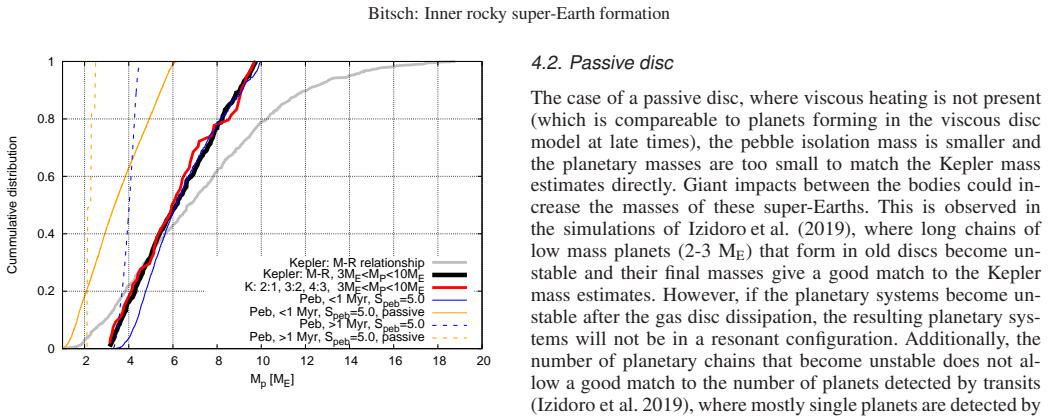
The central object is the pebble isolation mass, $M_{\rm iso}$: the planetary mass at which the growing embryo opens a partial gap in the gas disc, inverting the radial pressure gradient exterior to the planet so that drifting pebbles accumulate outside and the accretion of solids halts. Its key property is $M_{\rm iso}\propto(H/r)^3$, with weak corrections from viscosity and the pressure gradient, which converts the disc's thermal structure directly into a final planetary mass. The paper computes $M_{\rm iso}$ for two disc structures: a viscously heated disc model whose aspect ratio and isolation mass decline as the disc cools over a few million years, and a purely passively irradiated disc with a much smaller inner $H/r$. Comparing these curves with Kepler masses derived from a mass-radius relation carries the argument: the early viscous curve overlaps the observed masses, while the late and passive curves fall below them.
What would settle it
Measure the midplane temperature or aspect ratio of inner protoplanetary discs at ages below about 1 Myr: if $H/r$ is as low as passive models even at early times, the early viscous pathway cannot deliver 5-10 Earth-mass planets without mergers. Alternatively, a transit and radial-velocity survey of resonant super-Earth systems could falsify the early pathway: if most resonant systems with masses of 5-10 Earth masses show high mutual inclinations or evidence of recent giant impacts, resonant chains are being reshaped by mergers rather than broken without collisions.
Extended reading notes
Core claim
The central claim is that the observed Kepler super-Earth masses, roughly 3-10 Earth masses, are the pebble isolation masses of the early viscously heated inner protoplanetary disc. The isolation mass, $M_{\rm iso}=25 f_{\rm fit}\, M_{\rm E} + (\Pi_{\rm crit}/\lambda) M_{\rm E}$, depends mainly on the aspect ratio $H/r$ through $f_{\rm fit}\propto(H/r)^3$, and in the viscously heated model $H/r$ is high enough during the first million years that $M_{\rm iso}$ reaches the inferred Kepler masses. In a purely passive disc, or in the same viscous model after about 1 Myr as the disc cools, $M_{\rm iso}$ drops to 2-3 $M_{\rm E}$, below most observed masses. The paper's simulations of single embryos growing by pebble accretion and migrating inward reproduce the cumulative Kepler mass distribution only when planets reach isolation before 1 Myr and the pebble flux is large enough; the final mass is independent of the pebble flux. The two formation pathways are distinguished by what breaks the resonant chains that migration naturally builds: early viscous formation requires a mechanism that breaks resonance without mergers and leaves low mutual inclinations, whereas late or passive formation requires collisions to raise the masses, with high mutual inclinations as a by-product.
Load-bearing premise
The load-bearing premise is that the inner protoplanetary disc is strongly heated by viscous accretion during its first million years, so its aspect ratio, and hence the pebble isolation mass, is high enough to produce 5-10 Earth-mass planets; if midplane viscous heating is weak, as recent shearing-box simulations suggest, the early viscous channel fails and mergers must explain the observations.
Editorial extensions
If this is right
- If the early viscous pathway dominates, super-Earth masses in a system are effectively set by the disc aspect ratio at formation, so planets in the same system should be similar in mass and the mass distribution should not depend strongly on the initial reservoir of solids.
- Most observed close-in super-Earths would have to assemble within about one million years, before the disc cools and the pebble isolation mass drops below the Kepler masses.
- The resonant chains produced by migration must be broken by a mechanism that avoids collisions, such as magnetic rebound, a short disc lifetime, or weak resonance trapping in low-viscosity discs, leaving systems flat with low mutual inclinations.
- If formation is late or occurs in passive discs, the observed masses require giant impacts; resonant systems then survive only if mergers happen while gas is still present, and the resulting systems should show high mutual inclinations.
- Transit plus radial-velocity observations can distinguish the channels by counting hidden planets and measuring mutual inclinations, turning exoplanet system architectures into a probe of inner-disc viscous heating.
Reading between the lines
- One extension of the paper's logic is that the near-independence of final mass from pebble flux predicts a weak correlation between a star's observed disc dust mass and the masses of its close-in super-Earths; systems forming in dust-poor discs should still reach the same isolation masses if the early viscous channel operates.
- The two channels also predict different mass-radius scatter within individual systems: the early viscous channel yields similar masses set by one shared disc structure, while a merger-dominated channel should leave more diversity in mass and composition among planets in the same system.
- Because $M_{\rm iso}$ grows as $(H/r)^3$, the peak of the Kepler mass distribution could in principle be inverted to estimate the inner-disc aspect ratio at the time of formation, effectively using super-Earth masses as a fossil thermometer for early protoplanetary discs.
Signed reviews
Editorial analysis
A structured set of objections, weighed in public.
Referee Report
Summary. The paper compares the pebble isolation mass predicted by a viscously heated protoplanetary disc model (Bitsch et al. 2015a) and a purely passively heated disc model against the inferred masses of Kepler super-Earths, using the Wolfgang et al. (2016) mass-radius relation. In the viscously heated model, the inner disc (0.1–1 AU) initially has a high aspect ratio, giving pebble isolation masses of several Earth masses; the paper argues that planets formed within 1 Myr by pebble accretion can therefore match the observed Kepler mass distribution without mergers. In contrast, the passive disc has low pebble isolation masses (2–3 ME), so the paper argues that mergers are required to match observations. From this comparison, the author proposes two formation pathways: early formation in viscously heated discs, where resonant chains must be broken without mergers, and late or passive-disc formation, where mergers during the gas phase are required. The paper makes testable predictions: the two pathways should differ in mutual inclination distributions and in the number of hidden planets detectable by RV follow-up of TESS targets.
Significance. If the underlying viscous-heating premise is correct, the paper provides a simple and elegant explanation for the typical masses of close-in super-Earths, tying the observed mass distribution to disc thermal structure rather than to initial solid reservoirs. The work is transparent in its assumptions, uses an external observational sample, and gives falsifiable predictions for future RV and transit observations. The comparison is a forward model against data, not a fit calibrated to the Kepler mass distribution, which is a strength. However, the significance is strongly conditional on the contested assumption that the inner regions of planet-forming discs are viscously heated during the first Myr; the paper itself acknowledges a competing simulation result that would invalidate the main pathway. The two-pathway distinction also relies on an as-yet unidentified mechanism for breaking resonant chains without mergers. These caveats make the paper an interesting and useful framework, but its central claim is more provisional than the abstract suggests.
major comments (4)
- [§5.1, Figs. 1 and 2] The central mass match depends entirely on the inner disc having the high aspect ratio of a viscously heated disc in the first Myr. The paper acknowledges in Section 5.1 that Mori et al. (2019) find midplane viscous heating to be suppressed by weak turbulence, which would eliminate the high early pebble isolation masses and collapse the 'viscously heated pathway' into the merger-dominated pathway. The rebuttal offered — that a cold disc would make the Earth's building material water-rich — is an argument about the solar nebula, not about the population of Kepler stars, so it does not protect the exoplanet claim. As written, the abstract's statement that planets growing within 1 Myr in the viscously heated inner disc reach pebble isolation masses matching Kepler observations is conditional on a premise the manuscript itself identifies as contested. The manuscript should either provide direct evidence or a quantitative argument that inner discs around solar-type stars are viscously heated during the first Myr, or explicitly reframe the conclusions as conditional on that premise, with the passive/merger scenario as the null hypothesis.
- [§5.2, §4.1, abstract] The viscously heated pathway requires resonant chains to be broken without planetary mergers, yet the paper states in Section 5.2 that 'it is yet unclear which mechanism could drive this breaking of the resonant chains without causing major instabilities.' Since the observed period-ratio distribution of Kepler systems is used to justify the need to break resonances, this unexplained step is load-bearing for the claim that the viscously heated pathway can reproduce the full Kepler population. The magnetic rebound effect is mentioned as a possibility but is admitted to be untested for multi-planet resonant chains. The manuscript needs to specify a plausible, tested mechanism or clearly mark this pathway as incomplete and speculative, rather than presenting it as a viable channel on equal footing with the merger pathway.
- [§3, Fig. B.1, Appendix B] The paper states that final planetary masses in the pebble accretion scenario are independent of the pebble flux, but this is only true above a threshold. Fig. B.1 shows that for S_peb = 0.75 and 1.0, planets do not reach the pebble isolation mass within 1 Myr, and the match in Fig. 2 is obtained using S_peb = 5.0, a freely chosen scaling factor. The central comparison therefore depends on a tuned parameter, and this dependence should be stated explicitly in the main text (not only in the appendix). The paper should quantify the range of S_peb for which the simulated masses match the Kepler distribution, and discuss whether S_peb = 5 is physically motivated or merely chosen to produce agreement.
- [Fig. 2] The claim that the simulated mass distributions 'match the Kepler observations very well' is supported only by visual inspection of cumulative distributions. No statistical test (e.g., Kolmogorov-Smirnov) or uncertainty propagation from the Wolfgang et al. (2016) mass-radius relation is provided. Given that this match is the core quantitative result of the paper, the manuscript should include a quantitative comparison and state the sensitivity of the match to the assumed mass-radius relation and to the selection cuts (3–10 ME).
minor comments (5)
- [§1, Eq. (2) vicinity] The text near Eq. (2) contains a duplicated word: 'the Stokes number in the used model model varies' should read 'the Stokes number in the used model varies.'
- [Fig. 1 caption] The caption has a typo: 'with cut-offat planetary radii' should be 'with cut-off at planetary radii.'
- [§5.1] The phrase 'current sheats' appears to be a typo for 'current sheets.'
- [References] Several references are cited as 'arXiv e-prints' without numbers (e.g., Izidoro et al. 2019, Lambrechts et al. 2019, Baillié et al. 2015). These should be updated to their published or arXiv identifiers for reproducibility.
- [Fig. 2 and Fig. B.1] The axis label 'Cummulative distribution' should be 'Cumulative distribution.'
Circularity Check
No significant circularity: the Kepler-mass comparison is a forward prediction from disc-structure and gap-opening models, not a fit to the data.
full rationale
The paper's central claim is that planets growing within ~1 Myr in a viscously heated disc reach the pebble isolation mass, whose value is then compared with Kepler-derived masses. The pebble isolation mass formula (Eqs. 1-2) and the disc structure are taken from Bitsch et al. (2018b) and Bitsch et al. (2015a), respectively; neither set of prior results was calibrated to the Kepler mass distribution, and the comparison in Figs. 1-2 is therefore a forward model against external data rather than a fitted reproduction. The pebble-flux scaling Speb is a free parameter, but it only determines whether growth to the isolation mass is completed before or after 1 Myr; the final mass ceiling is set by the independently computed Miso, so the headline mass match is not statistically forced by Speb. Heavy author self-citation is present, but it is normal model reuse, not load-bearing circularity: the cited disc and gap-opening results have independent content and were not defined in terms of the Kepler masses they are used to explain. The author explicitly flags in Section 5.1 that MHD shearing-box simulations (Mori et al. 2019) could suppress viscous heating and invalidate the high-Miso pathway; this is a genuine physical correctness risk, but it does not make the derivation circular.
Assumptions & free parameters
free parameters (3)
- S_peb (pebble flux scaling factor) =
5.0 (adopted; 0.75, 1.0, 2.5 tested)
- alpha_disc (viscosity parameter for Miso) =
0.001 (main; 1e-4 to 0.0054 in Appendix A)
- Stokes number tau_f =
0.1 (plotting; simulations 0.05-0.2)
assumptions (6)
- domain assumption The pebble isolation mass formula of Bitsch et al. (2018b) (Eq. 1-2) determines the maximum mass from pebble accretion.
- domain assumption The disc thermal structure of Bitsch et al. (2015a) represents viscously heated protoplanetary discs with H/r ~ 0.05 in the inner regions within 1 Myr.
- domain assumption The mass-radius relationship of Wolfgang et al. (2016) converts Kepler radii to masses.
- domain assumption Type-I migration follows Paardekooper et al. (2011) and drives planets to the inner edge where they form resonant chains.
- domain assumption Inner super-Earths are predominantly rocky and form interior to the water ice line.
- domain assumption Gas accretion onto cores below about 10 Earth masses is inefficient, so post-isolation growth via gas is small.
Cite this review
Pith. "Pith review of Inner rocky super-Earth formation: distinguishing the formation pathways in viscously heated and passive discs." pith.science (2026). https://pith.science/paper/YM4TJYLO
@misc{pith2026190808710,
  author       = {Pith},
  title        = {Pith review of: Inner rocky super-Earth formation: distinguishing the formation pathways in viscously heated and passive discs},
  year         = {2026},
  howpublished = {\url{https://pith.science/paper/YM4TJYLO}},
  note         = {Machine review of arXiv:1908.08710}
}
read the original abstract
The formation of super-Earths is strongly linked to the structure of the protoplanetary disc, which determines growth and migration. In the pebble accretion scenario, planets grow to the pebble isolation mass, at which the planet carves a small gap in the gas disc halting the pebble flux and thus its growth. The pebble isolation mass scales with the disc's aspect ratio, which directly depends on the disc structure. I compare the growth of super-Earths in viscously heated discs and discs purely heated by the central star with super-Earth observations. This allows two formation pathways of super-Earths to be distinguished in the inner systems. Planets growing within 1 Myr in the viscously heated inner disc reach pebble isolation masses that correspond directly to the inferred masses of the Kepler observations for systems that feature planets in resonance or not in resonance. However, to explain the period ratio distribution of Kepler planets -- where most Kepler planet pairs are not in mean motion resonance configurations -- a fraction of these resonant chains has to be broken. In case the planets are born early in a viscously heated disc, these resonant chains thus have to be broken without planetary mergers. If super-Earths form either late or in purely passive discs, the pebble isolation mass is too small to explain the Kepler observations, implying that planetary mergers are important for the final system architecture. Resonant planetary systems thus have to experience mergers already during the gas disc phase, so the planets can get trapped in resonance after reaching 5-10 Earth masses. In case instabilities are dominating the system architecture, the systems should not be flat with mutually inclined orbits. This implies that future observations of planetary systems with RV and transits could distinguish between these two formation channels of super-Earth. (abridged)
Figures

Reference graph
Works this paper leans on
-
[1]
2018, Nature Astronomy, 2, 873
Alibert, Y ., V enturini, J., Helled, R., et al. 2018, Nature Astronomy, 2, 873
2018
-
[2]
Ansdell, M., Williams, J. P ., Manara, C. F., et al. 2017, AJ, 1 53, id. 240
work page 2017
-
[3]
Ansdell, M., Williams, J. P ., van der Marel, N., et al. 2016, A pJ, 828, 46
work page 2016
-
[4]
Ataiee, S., Baruteau, C., Alibert, Y ., & Benz, W. 2018, A&A, 6 15, A110
work page 2018
-
[5]
Bai, X. N. 2013, ApJ, 772, id.96
work page 2013
-
[6]
Bai, X. N. & Stone, J. M. 2013, ApJ, 769, id. 76 Baillié, K., Charnoz, S., & Pantin, É. 2015, astro-ph.EP Baraffe, I., Chabrier, G., Allard, F., & Hauschildt, P . H. 1998, A&A , 337, p.403 Baraffe, I., Homeier, D., Allard, F., & Chabrier, G. 2015, A&A, 577, A42
work page 2013
- [7]
-
[8]
Birnstiel, T., Klahr, H., & Ercolano, B. 2012, A&A, 539, id.A 148
work page 2012
Show all 81 references
-
[9]
& Kley, W
Bitsch, B. & Kley, W. 2010, A&A, 523, A30
2010
-
[10]
2014, A&A, 5 64, id.A135
Bitsch, B., Morbidelli, A., Lega, E., & Crida, A. 2014, A&A, 5 64, id.A135
2014
-
[11]
2017, AJ, 153, id
Brasser, R., Bitsch, B., & Matsumura, S. 2017, AJ, 153, id. 22 2
2017
-
[12]
2008, A&A, 480, pp.8 59
Brauer, F., Dullemond, C., & Henning, T. 2008, A&A, 480, pp.8 59
2008
-
[13]
B., Izidoro, A., et al
Carrera, D., Ford, E. B., Izidoro, A., et al. 2018, ApJ, 866, 1 04
2018
-
[14]
& Laughlin, G
Chiang, E. & Laughlin, G. 2013, MNRAS, 431, 3444
2013
-
[15]
& Y oudin, A
Chiang, E. & Y oudin, A. 2010, Annual Review of Earth and Plane tary Sciences, 38, p.493
2010
-
[16]
Chiang, E. I. & Goldreich, P . 1997, ApJ, 490, 368
1997
-
[17]
P ., Kuiper, R., & Ormel, C
Cimerman, N. P ., Kuiper, R., & Ormel, C. W. 2017, MNRAS, 471, 4 662
2017
-
[18]
N., & Pierens, A
Cossou, C., Raymond, S. N., & Pierens, A. 2013, A&A, 553, id.L 2
2013
-
[19]
P ., Birnstiel, T., Huang, J., et al
Dullemond, C. P ., Birnstiel, T., Huang, J., et al. 2018, ApJ, 869, L46
2018
-
[20]
Dullemond, C. P . & Dominik, C. 2004, A&A, 417, 159
2004
-
[21]
M., Hughes, A
Flaherty, K. M., Hughes, A. M., Teague, R., et al. 2018, ApJ, 8 56, 117
2018
-
[22]
& Schlichting, H
Gupta, A. & Schlichting, H. E. 2019, MNRAS, 487, 24
2019
-
[23]
& Bae, J
Hartmann, L. & Bae, J. 2018, MNRAS, 474, 88
2018
-
[24]
2016, A&A, 591, A72
Ida, S., Guillot, T., & Morbidelli, A. 2016, A&A, 591, A72
2016
-
[25]
& Ohtsuki, K
Iwasaki, K. & Ohtsuki, K. 2006, AJ, 131, 3093
2006
-
[26]
N., et al
Izidoro, A., Bitsch, B., Raymond, S. N., et al. 2019, arXiv e- prints
2019
-
[27]
N., et al
Izidoro, A., Ogihara, M., Raymond, S. N., et al. 2017, MNRAS, 470, pp. 1750
2017
-
[28]
& Mordasini, C
Jin, S. & Mordasini, C. 2018, ApJ, 853, 163
2018
-
[29]
& Lacerda, P
Johansen, A. & Lacerda, P . 2010, MNRAS, 404, pp. 475
2010
-
[30]
S., Kleine, T., Burkhardt, C., & Budde, G
Kruijer, T. S., Kleine, T., Burkhardt, C., & Budde, G. 2017, L PI, 48th Confer- ence, id.1386
2017
-
[31]
& Johansen, A
Lambrechts, M. & Johansen, A. 2012, A&A, 544, id.A32
2012
-
[32]
& Johansen, A
Lambrechts, M. & Johansen, A. 2014, A&A, 572, id.A107
2014
-
[33]
2014, A&A, 57 2, id
Lambrechts, M., Johansen, A., & Morbidelli, A. 2014, A&A, 57 2, id. A35
2014
-
[34]
& Lega, E
Lambrechts, M. & Lega, E. 2017, A&A, 606, A146
2017
-
[35]
A., et al
Lambrechts, M., Morbidelli, A., Jacobson, S. A., et al. 2019 , arXiv e-prints
2019
-
[36]
& Ormel, C
Liu, B. & Ormel, C. W. 2017, A&A, 606, A66
2017
-
[37]
W., & Lin, D
Liu, B., Ormel, C. W., & Lin, D. N. C. 2017, A&A, 601, A15
2017
-
[38]
& Pringle, J
Lynden-Bell, D. & Pringle, J. E. 1974, MNRAS, 168, 603
1974
-
[39]
Mamajek, E. E. 2009, AIP Conference Proceedings, 1158, pp.3
2009
-
[40]
F., Morbidelli, A., & Guillot, T
Manara, C. F., Morbidelli, A., & Guillot, T. 2018, A&A, 618, L 3
2018
-
[41]
Masset, F. S. 2002, A&A, 387, 605
2002
-
[42]
2012, Icarus, 221, 624
Matsumoto, Y ., Nagasawa, M., & Ida, S. 2012, Icarus, 221, 624
2012
-
[43]
2011, ArXiv e-print s
Mayor, M., Marmier, M., Lovis, C., et al. 2011, ArXiv e-print s
2011
-
[44]
P ., Hubbard, A., Y ang, C.-C., & Mac Low, M
McNally, C. P ., Hubbard, A., Y ang, C.-C., & Mac Low, M. M. 2014 , ApJ, 791, id. 62
2014
-
[45]
P ., Nelson, R
McNally, C. P ., Nelson, R. P ., & Paardekooper, S.-J. 2019, MNRAS, L120
2019
-
[46]
& Nesvorny, D
Morbidelli, A. & Nesvorny, D. 2012, A&A, 546, id.A18
2012
-
[47]
2014, A&A, 572, id.A118
Mordasini, C. 2014, A&A, 572, id.A118
2014
-
[48]
2019, ApJ, 872, 98
Mori, S., Bai, X.-N., & Okuzumi, S. 2019, ApJ, 872, 98
2019
-
[49]
D., Pascucci, I., Apai, D., & Ciesla, F
Mulders, G. D., Pascucci, I., Apai, D., & Ciesla, F. J. 2018, A J, 156, 24
2018
-
[50]
2019, MNRAS, 1807
Ndugu, N., Bitsch, B., & Jurua, E. 2019, MNRAS, 1807
2019
-
[51]
K., & Morbidelli, A
Ogihara, M., Kokubo, E., Suzuki, T. K., & Morbidelli, A. 2018 , A&A, 615, A63
2018
-
[52]
2015, A&A, 578, A3 6
Ogihara, M., Morbidelli, A., & Guillot, T. 2015, A&A, 578, A3 6
2015
-
[53]
2011, ApJ, 738, id.141
Oka, A., Nakamoto, T., & Ida, S. 2011, ApJ, 738, id.141
2011
-
[54]
Ormel, C. W. & Klahr, H. H. 2010, A&A, 520, id.A43
2010
-
[55]
W., Kuiper, R., & Shi, J.-M
Ormel, C. W., Kuiper, R., & Shi, J.-M. 2015, MNRAS, 446, 1026
2015
-
[56]
W., Shi, J.-M., & Kuiper, R
Ormel, C. W., Shi, J.-M., & Kuiper, R. 2015, MNRAS, 447, p.351 2
2015
-
[57]
Owen, J. E. & Jackson, A. P . 2012, MNRAS, 425, pp.2931
2012
-
[58]
Owen, J. E. & Wu, Y . 2013, ApJ, 775, 105
2013
-
[59]
Owen, J. E. & Wu, Y . 2017, ApJ, 847, 29
2017
-
[60]
J., Baruteau, C., & Kley, W
Paardekooper, S. J., Baruteau, C., & Kley, W. 2011, MNRAS, 41 0, 293
2011
-
[61]
& Mellema, G
Paardekooper, S.-J. & Mellema, G. 2006, A&A, 453, pp.1129
2006
-
[62]
& Mellema, G
Paardekooper, S.-J. & Mellema, G. 2006, A&A, 459, L17
2006
-
[63]
Pichierri, G., Batygin, K., & Morbidelli, A. r. 2019, A&A, 62 5, A7
2019
-
[64]
Pinte, C., Dent, W. R. F., Ménard, F., et al. 2016, ApJ, 816, 25
2016
-
[65]
Piso, A. M. A. & Y oudin, A. 2014, ApJ, 786, id. 21
2014
-
[66]
B., Hubickyj, O., Bodenheimer, P ., et al
Pollack, J. B., Hubickyj, O., Bodenheimer, P ., et al. 1996, I carus, 124, 62
1996
-
[67]
Raymond, S. N. & Cossou, C. 2014, MNRAS, 440, L11
2014
-
[68]
W., & Dorn, C
Schoonenberg, D., Liu, B., Ormel, C. W., & Dorn, C. 2019, arXi v e-prints, arXiv:1906.00669
2019 arXiv
-
[69]
& Batygin, K
Spalding, C. & Batygin, K. 2016, ApJ, 830, 5
2016
-
[70]
K., Ogihara, M., Morbidelli, A., Crida, A., & Guil lot, T
Suzuki, T. K., Ogihara, M., Morbidelli, A., Crida, A., & Guil lot, T. 2016, A&A, 596, id.A74
2016
-
[71]
Tanaka, H., Takeuchi, T., & Ward, W. R. 2002, ApJ, 565, 1257
2002
-
[72]
Ward, W. R. 1986, Icarus, 67, 164
1986
-
[73]
Weidenschilling, S. J. 1977, MNRAS, 180, p.57
1977
-
[74]
M., Marcy, G
Weiss, L. M., Marcy, G. W., Petigura, E. A., et al. 2018, AJ, 15 5, 48
2018
-
[75]
P ., Cieza, L., Hales, A., et al
Williams, J. P ., Cieza, L., Hales, A., et al. 2019, ApJ, 875, L 9
2019
-
[76]
A., & Ford, E
Wolfgang, A., Rogers, L. A., & Ford, E. B. 2016, ApJ, 825, 19
2016
-
[77]
2019, ApJ, 874, 91 Y oudin, A
Wu, Y . 2019, ApJ, 874, 91 Y oudin, A. & Lithwick, Y . 2007, Icarus, 192, p. 588
2019
-
[78]
B., Sasselov, D
Zeng, L., Jacobsen, S. B., Sasselov, D. D., et al. 2019, arXiv e-prints, arXiv:1906.04253
2019 arXiv
-
[79]
2018, ApJ, 869, L47
Zhang, S., Zhu, Z., Huang, J., et al. 2018, ApJ, 869, L47
2018
-
[80]
Zhu, W. & Wu, Y . 2018, AJ, 156, id.92
2018
-
[81]
2019, arXiv e-prints, arXiv:1904.02127 Article number, page 10 of 10
Zhu, Z., Zhang, S., Jiang, Y .-F., et al. 2019, arXiv e-prints, arXiv:1904.02127 Article number, page 10 of 10
2019 arXiv
Reviewed August 14, 2026 · model on record in the stance chip above.
Discussion (0). Continue with ORCID to comment.