REVIEW 3 major objections 5 minor 48 references
BanClickThumb: A Multimodal Dataset and Transformer Fusion Benchmarks for Clickbait Detection in Bengali YouTube Videos
T0 review · 3 major / 5 minor · reviewed 2026-08-01 · deepseek-v4-flash
Pith's one-line read Combining Bengali YouTube titles and thumbnails lifts clickbait detection to 84 percent accuracy, two points above text-only.
desk verdict The dataset is the real contribution; the fusion-over-text claim is statistically unverified. read the letter →
The pith
A machine-rendered reading of the paper's core claim, the machinery that carries it, and where it could break.
The reading
What carries the argument
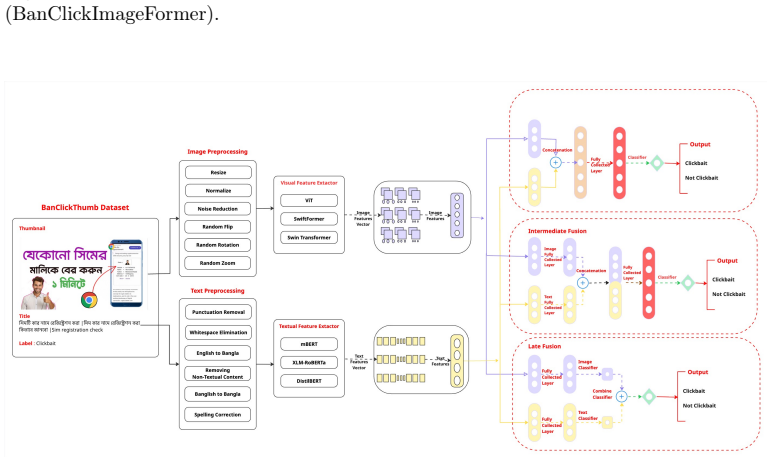
The central object is BanClickFusionFormer, a multimodal transformer that combines a Vision Transformer (ViT) thumbnail encoder with an XLM-RoBERTa title encoder by merging their hidden-layer representations before classification — 'intermediate fusion.' The supporting machinery is the BanClickThumb dataset pipeline: ten annotators, majority-vote labels with Cohen's Kappa 0.83–0.93, five content domains, and a 70/10/20 stratified split. The comparison across early, late, and intermediate fusion is what lets the paper attribute the accuracy gain to fusion depth rather than to model choice.
What would settle it
Re-run BanClickTextFormer (XLM-RoBERTa) and BanClickFusionFormer (ViT + XLM-RoBERTa, intermediate fusion) on the same train/validation/test split with at least ten random seeds, and compute 95% confidence intervals for test accuracy; if the intervals for 0.84 and 0.82 overlap, the paper's central comparative claim is not supported. A second check would be to repeat the comparison without the translation/transliteration preprocessing step to see whether the fusion gain depends on it.
Extended reading notes
Core claim
The paper's central claim is that Bengali YouTube clickbait is a joint visual-linguistic phenomenon, and that a multimodal transformer fusing the two at an intermediate layer — ViT for thumbnails, XLM-RoBERTa for titles — detects it better than either modality alone: 0.84 accuracy on the test split, versus 0.82 for the best text-only model and 0.68 for the best image-only model. It further claims that this result is supported by a new, publicly released dataset of 7,147 manually annotated thumbnail-title pairs with high annotator agreement, and that a systematic comparison of early, late, and intermediate fusion shows intermediate fusion to be the most effective while also the most sensitive
Load-bearing premise
The load-bearing premise is that the single-run accuracies are stable enough to compare — the paper explicitly states that results come from single training runs without confidence intervals or significance testing, so if run-to-run variance is one or two accuracy points, the claimed fusion-over-text advantage is not established.
Editorial extensions
If this is right
- If the central claim holds, a practical Bengali clickbait screener can operate at 84% accuracy using off-the-shelf transformers, with a cheaper SwiftFormer-plus-XLM-RoBERTa variant at 83% for large-scale screening.
- Titles are the stronger single signal (82% vs 68%), so any future detector should not rely on thumbnails alone; thumbnails add a small but real margin when fused.
- Fusion depth matters: intermediate fusion gives the best accuracy but is brittle to encoder pairing, since Swin Transformer + XLM-RoBERTa collapses to 71% at the same fusion depth.
- The error analysis points to three concrete next steps: OCR for thumbnail text, figurative-language-aware Bengali encoders, and native-script modeling instead of translation or transliteration.
Reading between the lines
- Because the reported 2-point gain is based on single runs, a fair reading should treat the fusion-over-text advantage as provisional until multi-seed intervals are reported; this is our inference, not the paper's claim.
- The dataset covers only five months and five content domains, so the 0.84 accuracy is likely to decay as clickbait tactics drift or when applied to other platforms; a temporal refresh is a natural test.
- The image-only confusion matrix (267 false negatives on 605 clickbait test items) suggests that many thumbnail errors stem from unread text overlays; adding OCR could yield a larger gain than increasing model capacity.
- A direct test of whether large pretrained vision-language models can close the remaining gap is now possible with this dataset, since the paper leaves zero-shot and few-shot comparisons as future work.
Editorial analysis
A structured set of objections, weighed in public.
Referee Report
Summary. The paper introduces BanClickThumb, a manually annotated Bengali YouTube thumbnail-title dataset of 7,147 pairs, and benchmarks several text-only, image-only, and multimodal transformer models. The best reported model, BanClickFusionFormer (ViT + XLM-RoBERTa with intermediate fusion), achieves 0.84 test accuracy, compared with 0.82 for the best text-only model and 0.68 for the best image-only model. The authors claim this demonstrates the effectiveness of multimodal fusion for Bengali clickbait detection, and they provide error analysis pointing to dense thumbnail text, figurative language, and cultural slang as remaining challenges. The dataset and code are publicly released.
Significance. If the results hold, the paper makes a useful contribution: it provides the first publicly available multimodal dataset for Bengali YouTube clickbait detection, with a transparent annotation protocol, high reported inter-annotator agreement, and a systematic comparison of early, late, and intermediate fusion across 27 configurations. The public release of data and code is a concrete strength, as is the qualitative error analysis. However, the central quantitative claim—that multimodal fusion beats text-only by 2 accuracy points—is not statistically supported by the evidence presented, so the significance of the fusion-over-text conclusion is provisional.
major comments (3)
- [§6.6, §8 (also Abstract and Table 11)] The headline claim that BanClickFusionFormer (0.84) improves over text-only XLM-RoBERTa (0.82) is not statistically established. The paper concedes in Section 8 that 'Results are based on single training runs without confidence intervals or significance testing.' On n=1,430 test pairs, a 2-point gap is about 28 predictions, with a standard error for the difference of roughly 1.4 points; the observed gap is therefore about 1.4 SE and would not reach conventional significance without paired evidence. This concern is compounded by model selection: 27 fusion configurations were searched and the single best on validation was selected, so the reported test number is an optimistic maximum. The collapse of intermediate Swin + XLM-RoBERTa to 0.71 accuracy in Table 11 illustrates the run/configuration sensitivity. I request multiple seeded runs, confidence intervals, and a paired significance test
- [§6.5–6.6, Tables 10–11] The claim that BanClickFusionFormer achieves 'the best overall performance' is not supported uniformly across metrics. BanClickFusionFormer has accuracy 0.84 but weighted F1 0.81, whereas late-fusion Swin Transformer + XLM-RoBERTa has accuracy 0.83 but weighted F1 0.87. Since Section 2.4 states that F1 is particularly informative under class skew, the paper should state which metric was used for model selection, justify 'best overall,' and discuss the substantial F1 advantage of the late-fusion configuration. As written, the accuracy-only framing conceals a metric inconsistency that is material to the practical recommendation.
- [§5.3.3 and §6.2, Table 7] The hyperparameter narrative is internally inconsistent. Section 5.3.3 says hyperparameters, including the late-fusion weight α, are tuned by grid search to maximize validation accuracy, but Section 6.2 and Table 7 state that all 27 fusion configurations use a uniform schedule (batch size 32, 15 epochs, LR 2e-5). No grid ranges, selected hyperparameter values, or validation accuracies are reported. Since α is fitted on the validation set and its value is never disclosed, the reader cannot verify how sensitive the late-fusion results are to this choice. This weakens the reproducibility of the benchmark comparisons and the claim that performance differences are attributable to architecture rather than tuning artifacts.
minor comments (5)
- [Abstract and §4.3, Table 4] The dataset is described as 'balanced,' but the actual split has 4,123 non-clickbait vs. 3,024 clickbait (about 58/42). 'Approximately balanced' would be more accurate; the abstract and Section 4.3 should be aligned.
- [§4.2] Kappa values are reported as ranging from 0.83 to 0.93, but the aggregation is unclear: are these pairwise Cohen's Kappa means, per-domain values, or Fleiss' Kappa over all ten annotators? Please specify.
- [Figure 7] The confusion-matrix label 'SWIFT' is inconsistent with the model name 'SwiftFormer' used elsewhere; please use the full name for clarity.
- [§5.1.1 and §6.7] The preprocessing pipeline translates embedded English tokens to Bangla and transliterates Banglish. This may erase exactly the code-mixed cues that the error analysis identifies as important. An ablation isolating the translation/transliteration step would strengthen the error-analysis claims.
- [§8] The limitation 'class weighting was applied systematically only in the text branch' appears to conflict with Section 5.3.3's statement that all fusion models minimize class-weighted cross-entropy. Please clarify whether fusion models also used class weighting.
Circularity Check
No circular derivation: all headline results are empirical benchmark measurements; the statistical-rigor limitation is a correctness risk, not a circularity step.
full rationale
BanClickThumb is an empirical benchmark paper; there is no formal derivation chain whose conclusion is equivalent to its inputs. The headline result (BanClickFusionFormer 0.84 vs. text-only 0.82) is a test-set measurement, not a prediction derived from fitted parameters. Hyperparameters and the late-fusion weight α are tuned on the validation set (§5.3.2: 'the weight α∈[0,1] balances the modalities and is tuned on the validation set'), but the reported accuracy is on the held-out 1,430-pair test split, so the fitted-input-called-prediction pattern does not apply. No load-bearing self-citation, uniqueness theorem, or smuggled ansatz appears; the cited works (e.g., Imran et al. 2024; Faria et al. 2025a,b; Hossain et al. 2022) are external comparisons or methodological background. The paper itself flags the real weakness: §8 says 'Results are based on single training runs without confidence intervals or significance testing.' That makes the 2-point fusion-over-text gap statistically unsupported and the best-model claim fragile, but statistical fragility is not definitional circularity. The 27-configuration selection on validation is standard model selection with a separate test set, so any optimism is an experimental-design concern, not a re-labeling of the fit as a prediction. Score 0.
Assumptions & free parameters
free parameters (3)
- Late fusion weight α =
not reported (tuned on validation, Section 5.3.2)
- Class weights for cross-entropy =
not reported
- Fusion projection/alignment dimensions =
not reported
assumptions (4)
- domain assumption Annotator majority labels are ground truth for clickbait.
- domain assumption The five-domain, class-balanced convenience sample represents Bengali YouTube clickbait.
- domain assumption Pretrained XLM-RoBERTa/ViT/SwiftFormer have sufficient Bengali/thumbnail transfer.
- standard math Cohen's/Fleiss' Kappa 0.83-0.93 indicates label reliability.
Cite this review
Pith. "Pith review of BanClickThumb: A Multimodal Dataset and Transformer Fusion Benchmarks for Clickbait Detection in Bengali YouTube Videos." pith.science (2026). https://pith.science/paper/YN2EZI3K
@misc{pith2026260717182,
  author       = {Pith},
  title        = {Pith review of: BanClickThumb: A Multimodal Dataset and Transformer Fusion Benchmarks for Clickbait Detection in Bengali YouTube Videos},
  year         = {2026},
  howpublished = {\url{https://pith.science/paper/YN2EZI3K}},
  note         = {Machine review of arXiv:2607.17182}
}
read the original abstract
Clickbait, where video titles and thumbnails exaggerate or misrepresent content, reduces user trust, wastes attention, and promotes misinformation on video-sharing platforms. Detecting Bengali clickbait remains challenging because publicly available multimodal datasets are limited. To address this gap, we introduce BanClickThumb, a curated dataset of 7,147 Bengali YouTube thumbnail-title pairs from five content domains, annotated by ten annotators with high agreement (Cohen's Kappa: 0.83-0.93). Using this dataset, we benchmark text-only, image-only, and multimodal approaches. Among unimodal models, BanClickTextFormer (XLM-RoBERTa) achieves 0.82 accuracy, while BanClickImageFormer (SwiftFormer) reaches 0.68. Our proposed multimodal model, BanClickFusionFormer, combines ViT and XLM-RoBERTa through intermediate fusion and achieves the best accuracy of 0.84. Error analysis shows that dense thumbnail text, figurative language, and culturally specific slang remain challenging. Our findings demonstrate the effectiveness of multimodal fusion for Bengali clickbait detection and provide a publicly available benchmark to support future research on low-resource multimodal content analysis.
Figures


Figures from the paper (5 more)




Reference graph
Works this paper leans on
-
[1]
Advances in Neural Information Processing Systems , volume =
Attention is All You Need , author =. Advances in Neural Information Processing Systems , volume =
-
[2]
Journal of Pragmatics , volume =
Click bait: Forward-reference as lure in online news headlines , author =. Journal of Pragmatics , volume =. 2015 , publisher =
2015
-
[3]
Psychological Bulletin , volume =
The psychology of curiosity: A review and reinterpretation , author =. Psychological Bulletin , volume =. 1994 , publisher =
1994
-
[4]
Trends in Cognitive Sciences , volume =
The psychology of fake news , author =. Trends in Cognitive Sciences , volume =. 2021 , publisher =
2021
-
[5]
Proceedings of the 38th International Conference on Machine Learning (ICML) , pages =
Learning Transferable Visual Models From Natural Language Supervision , author =. Proceedings of the 38th International Conference on Machine Learning (ICML) , pages =. 2021 , organization =
2021
-
[6]
2022 , organization =
Li, Junnan and Li, Dongxu and Xiong, Caiming and Hoi, Steven , booktitle =. 2022 , organization =
2022
-
[7]
Data in Brief , volume =
BaitBuster-Bangla: A Comprehensive Dataset for Clickbait Detection in Bangla with Multi-Feature and Multi-Modal Analysis , author =. Data in Brief , volume =. 2024 , publisher =
2024
-
[8]
Artificial Intelligence for Cybersecurity , pages =
Clickbait Detection for YouTube Videos , author =. Artificial Intelligence for Cybersecurity , pages =. 2022 , publisher =
2022
Show all 48 references
-
[9]
2024 6th International Conference on Electrical Engineering and Information & Communication Technology (ICEEICT) , pages =
Arfat, Yasin and Tista, Sharmistha Chanda , title =. 2024 6th International Conference on Electrical Engineering and Information & Communication Technology (ICEEICT) , pages =. 2024 , organization =
2024
-
[10]
Intelligent Automation & Soft Computing , volume =
Experimental Evaluation of Clickbait Detection Using Machine Learning Models , author =. Intelligent Automation & Soft Computing , volume =. 2020 , publisher =
2020
-
[11]
Applied Sciences , volume =
Automatic Detection of Clickbait Headlines Using Semantic Analysis and Machine Learning Techniques , author =. Applied Sciences , volume =. 2023 , publisher =
2023
-
[12]
2016 IEEE/ACM International Conference on Advances in Social Networks Analysis and Mining (ASONAM) , pages =
Stop Clickbait: Detecting and preventing clickbaits in online news media , author =. 2016 IEEE/ACM International Conference on Advances in Social Networks Analysis and Mining (ASONAM) , pages =. 2016 , organization =
2016
-
[13]
2020 19th IEEE International Conference on Machine Learning and Applications (ICMLA) , year =
Mishra, Rahul and Yadav, Piyush and Calizzano, Remi and Leippold, Markus , title =. 2020 19th IEEE International Conference on Machine Learning and Applications (ICMLA) , year =
2020
-
[14]
2016 , note =
Potthast, Martin and Köpsel, Sebastian and Stein, Benno and Hagen, Matthias , title =. 2016 , note =
2016
-
[15]
ICASSP 2021 - 2021 IEEE International Conference on Acoustics, Speech and Signal Processing (ICASSP) , year =
Gamage, Bhanuka and Labib, Adnan and Joomun, Aisha and Lim, Chern Hong and Wong, KokSheik , title =. ICASSP 2021 - 2021 IEEE International Conference on Acoustics, Speech and Signal Processing (ICASSP) , year =
2021
-
[16]
Proceedings of the 2024 Conference on Empirical Methods in Natural Language Processing (EMNLP) , pages =
Multimodal Clickbait Detection by De-confounding Biases Using Causal Representation Inference , author =. Proceedings of the 2024 Conference on Empirical Methods in Natural Language Processing (EMNLP) , pages =. 2024 , publisher =
2024
-
[17]
Applied Intelligence , year =
Varshney, Deepika and Vishwakarma, Dinesh Kumar , title =. Applied Intelligence , year =
-
[18]
Arafat Alam and Islam, Niful and Hasib, Khan Md and Mridha, M.F
Faria, Fatema Tuj Johora and Moin, Mukaffi Bin and Hasan, Zayeed and Khandaker, Md. Arafat Alam and Islam, Niful and Hasib, Khan Md and Mridha, M.F. , title =. International Journal of Information Management Data Insights , volume =. 2025 , publisher =
2025
-
[19]
Proceedings of the Thirteenth Language Resources and Evaluation Conference (LREC) , year =
Hossain, Eftekhar and Sharif, Omar and Hoque, Mohammed Moshiul , title =. Proceedings of the Thirteenth Language Resources and Evaluation Conference (LREC) , year =
-
[20]
and Baniata, Mohammad H
Faria, Fatema Tuj Johora and Baniata, Laith H. and Baniata, Mohammad H. and Khair, Mohannad A. and Bani Ata, Ahmed Ibrahim and Bunterngchit, Chayut and Kang, Sangwoo , title =. Electronics , year =
-
[21]
Proceedings of the Workshop on Combating Online Hostile Posts in Regional Languages during Emergency Situations , pages =
Choi, Hyewon and Yoon, Yejun and Yoon, Seunghyun and Park, Kunwoo , title =. Proceedings of the Workshop on Combating Online Hostile Posts in Regional Languages during Emergency Situations , pages =. 2022 , address =
2022
-
[22]
Devlin, Jacob and Chang, Ming-Wei and Lee, Kenton and Toutanova, Kristina , journal =
-
[23]
arXiv preprint arXiv:1911.02116 , year =
Unsupervised cross-lingual representation learning at scale , author =. arXiv preprint arXiv:1911.02116 , year =
1911 arXiv
-
[24]
Sanh, Victor and Debut, Lysandre and Chaumond, Julien and Wolf, Thomas , journal =
-
[25]
arXiv preprint arXiv:2010.11929 , year =
An image is worth 16x16 words: Transformers for image recognition at scale , author =. arXiv preprint arXiv:2010.11929 , year =
2010 arXiv
-
[26]
Proceedings of the IEEE/CVF International Conference on Computer Vision , pages =
Swin transformer: Hierarchical vision transformer using shifted windows , author =. Proceedings of the IEEE/CVF International Conference on Computer Vision , pages =
-
[27]
Proceedings of the IEEE/CVF International Conference on Computer Vision , pages =
SwiftFormer: Efficient additive attention for transformer-based real-time mobile vision applications , author =. Proceedings of the IEEE/CVF International Conference on Computer Vision , pages =
-
[28]
Multimodal Machine Learning: A Survey and Taxonomy , journal =
Baltru. Multimodal Machine Learning: A Survey and Taxonomy , journal =. 2019 , volume =
2019
-
[29]
Advances in Information Retrieval , series =
A probabilistic interpretation of precision, recall and F-score, with implication for evaluation , author =. Advances in Information Retrieval , series =. 2005 , publisher =
2005
-
[30]
AI 2006: Advances in Artificial Intelligence , series =
Beyond Accuracy, F-Score and ROC: A Family of Discriminant Measures for Performance Evaluation , author =. AI 2006: Advances in Artificial Intelligence , series =. 2006 , publisher =
2006
-
[31]
arXiv preprint arXiv:2011.09903 , year =
Impact of accuracy on model interpretations , author =. arXiv preprint arXiv:2011.09903 , year =
2011 arXiv
-
[32]
Educational and Psychological Measurement , volume =
Cohen, Jacob , title =. Educational and Psychological Measurement , volume =. 1960 , publisher =
1960
-
[33]
, title =
Fleiss, Joseph L. , title =. Psychological Bulletin , volume =. 1971 , publisher =
1971
-
[34]
Computational Linguistics , volume =
Artstein, Ron and Poesio, Massimo , title =. Computational Linguistics , volume =. doi:10.1162/coli.07-034-R2 , pages =
-
[35]
Computational Linguistics , volume =
Beigman Klebanov, Beata and Beigman, Eyal , title =. Computational Linguistics , volume =. 2009 , doi =
2009
-
[36]
Proceedings of the 14th International Joint Conference on Artificial Intelligence (IJCAI) , volume =
Kohavi, Ron , title =. Proceedings of the 14th International Joint Conference on Artificial Intelligence (IJCAI) , volume =
-
[37]
Proceedings of the 5th International Conference on Learning Representations (ICLR) , year =
Zhang, Chiyuan and Bengio, Samy and Hardt, Moritz and Recht, Benjamin and Vinyals, Oriol , title =. Proceedings of the 5th International Conference on Learning Representations (ICLR) , year =
-
[38]
, title =
Buda, Mateusz and Maki, Atsuto and Mazurowski, Maciej A. , title =. Neural Networks , volume =. 2018 , publisher =
2018
-
[39]
Intelligent Data Analysis , volume =
Japkowicz, Nathalie and Stephen, Shaju , title =. Intelligent Data Analysis , volume =
-
[40]
Journal of Machine Learning Research , volume =
Srivastava, Nitish and Hinton, Geoffrey and Krizhevsky, Alex and Sutskever, Ilya and Salakhutdinov, Ruslan , title =. Journal of Machine Learning Research , volume =
-
[41]
Goodfellow, Ian and Bengio, Yoshua and Courville, Aaron , title =
-
[42]
2018 , address =
Mitchell, Ryan , title =. 2018 , address =
2018
-
[43]
Automated Data Collection with R: A Practical Guide to Web Scraping and Text Mining , publisher =
Munzert, Simon and Rubba, Christian and Mei. Automated Data Collection with R: A Practical Guide to Web Scraping and Text Mining , publisher =
-
[44]
Bird, Steven and Klein, Ewan and Loper, Edward , title =
-
[45]
and Rubin, Victoria L
Chen, Yimin and Conroy, Niall J. and Rubin, Victoria L. , title =. Proceedings of the 2015 ACM Workshop on Multimodal Deception Detection (WMD '15) , year =
2015
-
[46]
Findings of the Association for Computational Linguistics: ACL-IJCNLP 2021 , pages =
Wu, Yang and Zhan, Pengwei and Zhang, Yunjian and Wang, Liming and Xu, Zhen , title =. Findings of the Association for Computational Linguistics: ACL-IJCNLP 2021 , pages =
2021
-
[47]
, title =
Hovy, Dirk and Spruit, Shannon L. , title =. Proceedings of the 54th Annual Meeting of the Association for Computational Linguistics (ACL) , pages =
-
[48]
Advances in Digital Marketing and eCommerce , editor =
Weismueller, Jason and Harrigan, Paul , title =. Advances in Digital Marketing and eCommerce , editor =. 2021 , publisher =. doi:10.1007/978-3-030-76520-0_17 , isbn =
2021 doi
Reviewed August 1, 2026 · model on record in the stance chip above.
Discussion (0). Sign in to comment.