REVIEW 2 major objections 4 minor 13 references
Experimental Demonstration of an Extreme Sub-Wavelength Nanomagnetic Acoustic Antenna Actuated by Spin-Orbit Torque from a Heavy Metal Nanostrip
T0 review · 2 major / 4 minor · reviewed 2026-08-14 · deepseek-v4-flash
Pith's one-line read An on-chip acoustic antenna made of magnetostrictive nanomagnets actuated by spin-orbit torque from a platinum strip radiates at about 1% efficiency despite being 67 times smaller than the acoustic wavelength, roughly 50 times the…
desk verdict The qualitative demonstration of an SOT-actuated acoustic antenna is plausible and new, but the load-bearing efficiency claim is undermined by an internal calibration inconsistency. read the letter →
The pith
A machine-rendered reading of the paper's core claim, the machinery that carries it, and where it could break.
The reading
What carries the argument
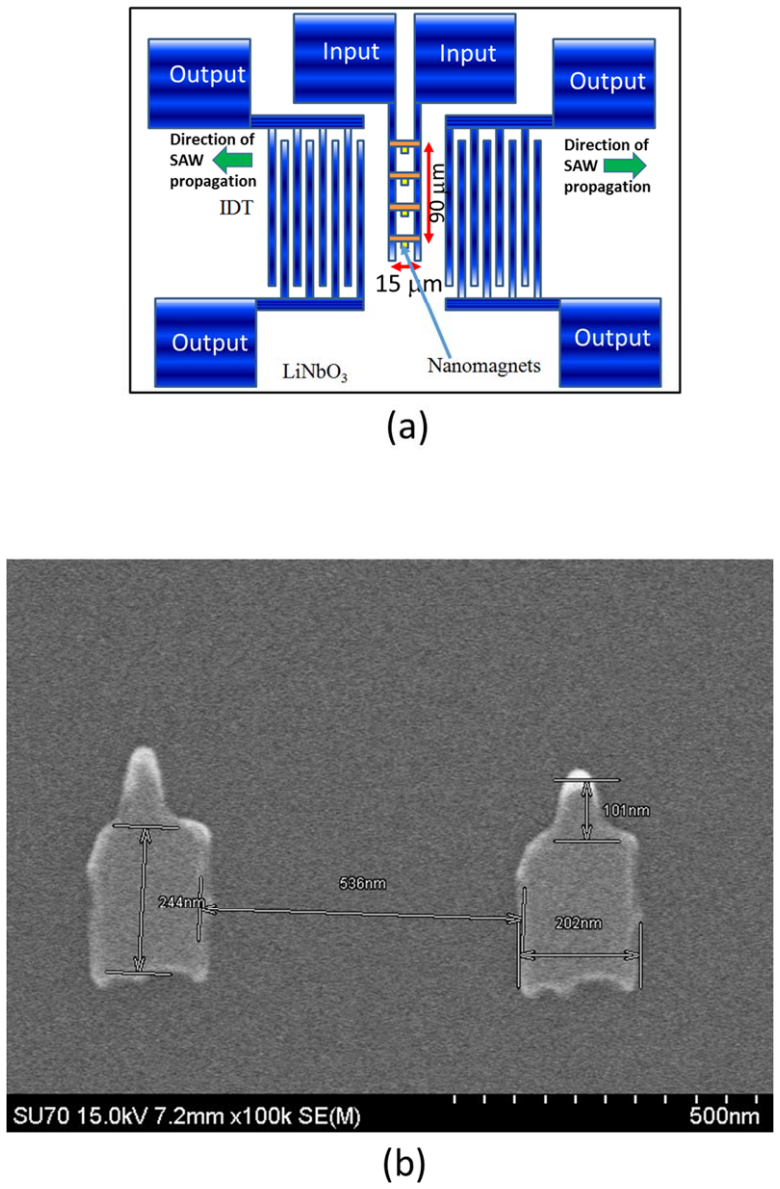
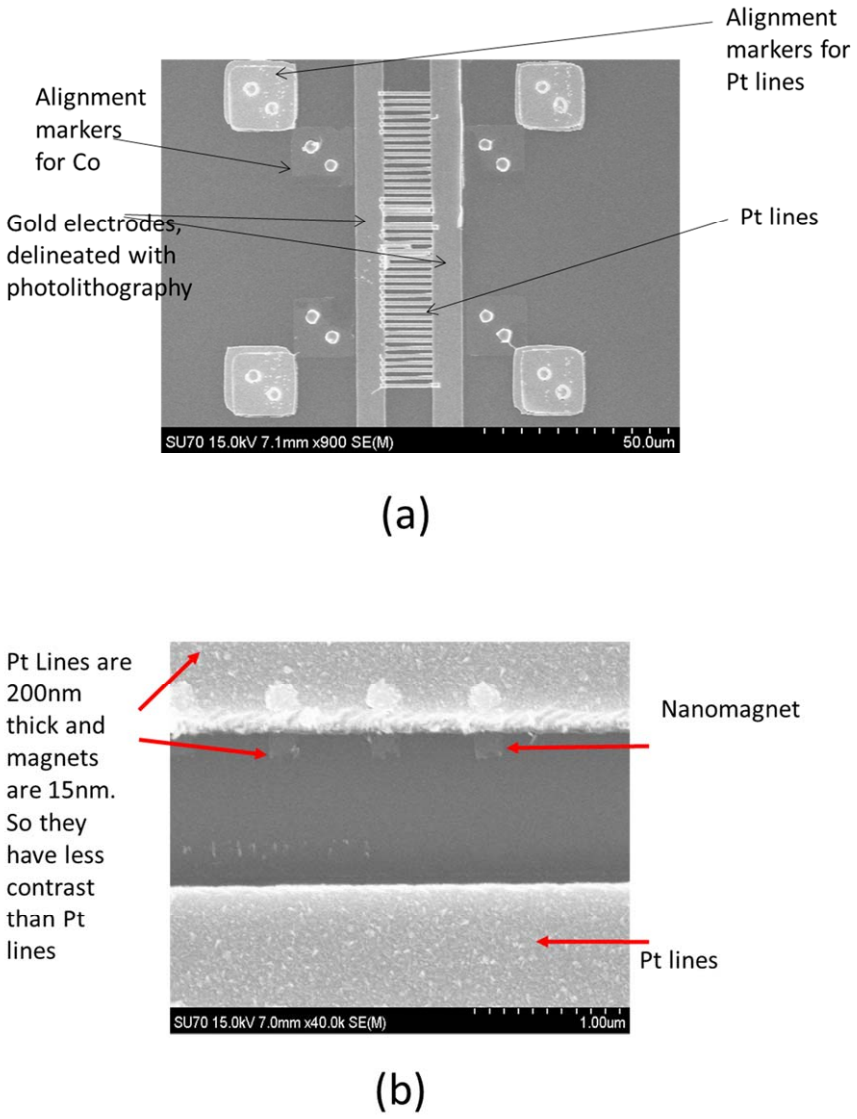
The central mechanism is spin-orbit torque from the giant spin Hall effect in a platinum nanostrip, where a charge current creates opposite spin accumulation at the strip's top and bottom surfaces. When the current is reversed, the torque on the cobalt nanomagnets reverses and their magnetizations rotate in the opposite direction. Because cobalt is magnetostrictive, the rotation makes each nanomagnet expand and contract, straining the lithium niobate substrate and launching a surface acoustic wave whose wavelength is set by the excitation frequency and the acoustic velocity, not by the antenna size. The ledge geometry keeps most of each nanomagnet unclamped by the platinum strip, allowing the breathing-mode strain to reach the substrate.
What would settle it
Measure the radiated acoustic power independently, for example with a calibrated laser Doppler vibrometer or a calibrated test transducer on the same substrate; if the inferred power at the two reported drive conditions is not close to 3.4 mW and 10.7 mW, the efficiency values and the claimed 50-fold advantage would need revision.
Extended reading notes
Core claim
The central claim is that a nanomagnetic assembly actuated by alternating spin-orbit torque from a heavy-metal strip radiates acoustic power at roughly 1% efficiency while being an extreme sub-wavelength emitter, with wavelength-to-antenna ratio about 67:1. The paper argues this is about 50 times the efficiency that would be allowed for an acoustic antenna driven at acoustic resonance, where the conventional scaling limit would be about $(1/67)^2$, i.e. 0.02%. The surface acoustic wave is detected by interdigitated transducers, and the measured phase delay between the input signal and the detected signal agrees with the acoustic transit time across the roughly 6 mm separation, which the authors use to rule out direct electromagnetic pickup. They further identify the device as the converse of earlier magnetostrictive electromagnetic antennas driven by acoustic waves: here photons are converted to magnons through the spin Hall effect and then to phonons through magneto-elastic coupling.
Load-bearing premise
The voltage picked up by the receiver electrodes is assumed to correspond to a specific acoustic wave amplitude; if that correspondence is off, the claimed efficiency and the 50-fold advantage change.
Editorial extensions
If this is right
- Acoustic emitters can be made with physical dimensions tens of times smaller than the acoustic wavelength when actuated by spin-orbit torque, because the radiated wavelength is controlled by the electrical drive frequency and the substrate sound velocity.
- The same assembly acts as a dual electromagnetic and acoustic antenna; only the acoustic functionality is characterized here, leaving the electromagnetic emission as a direct next measurement.
- The maximum drive frequency is limited by how fast the nanomagnet magnetizations rotate, estimated here as up to roughly 100 MHz, which is adequate for many on-chip acoustic applications.
- Inverting the input and output ports should in principle produce an oscillating voltage across the platinum strip through spin pumping and the inverse spin Hall effect, although the ledge design deliberately suppresses that reciprocal response.
Reading between the lines
- An independent calibration of the receiving electrodes against a known acoustic source would settle the absolute efficiency, since the reported 1% and the 50-fold margin depend on a single conversion factor relating voltage to acoustic amplitude.
- The phase-delay check used here could serve as a general diagnostic for distinguishing genuine acoustic emission from electromagnetic crosstalk in other sub-wavelength emitter demonstrations.
- Because the radiated wavelength is decoupled from antenna size, arrays of spin-orbit-torque-driven emitters with relative phase control might steer acoustic beams at fixed frequency, a capability a resonantly driven sub-wavelength antenna would not naturally offer.
Signed reviews
Editorial analysis
A structured set of objections, weighed in public.
Referee Report
Summary. The paper reports an experimental demonstration of an acoustic antenna based on magnetostrictive nanomagnets actuated by spin-orbit torque from a Pt strip on a LiNbO3 substrate. The authors claim a radiation efficiency of ~1% at 3.63 MHz and 6.87 MHz, with an antenna dimension 67 times smaller than the acoustic wavelength, exceeding the conventional (1/67)^2 efficiency limit by ~50 times. The manuscript describes the device concept, fabrication, oscilloscope measurements, and efficiency calculations based on measured voltages at an interdigitated transducer.
Significance. If the quantitative claim were substantiated, the work would be significant because it introduces a new actuation mechanism for sub-wavelength acoustic antennas, avoiding the usual size-efficiency tradeoff. The qualitative observation of SOT-driven SAW generation is interesting and the phase-shift analysis gives some confidence against electromagnetic pickup. However, the headline efficiency claim is not supported as written because of an inconsistency in the IDT calibration parameter μ and an apparent discrepancy in the SAW power formula, so the significance of the work is currently limited to the qualitative demonstration.
major comments (2)
- [II, Eq. (2) and the paragraph following it] The conversion factor μ between the detected IDT voltage Vout and the SAW amplitude φ is internally inconsistent. The text defines Vout ≈ μ φ and states μ ≈ 2, but then computes φ = 2 Vout, which corresponds to μ = 0.5. Since the SAW power in Eq. (1) scales as φ^2, this inconsistency changes the estimated efficiency by a factor of 16. Using the stated μ ≈ 2 would reduce the reported efficiencies to roughly 0.034% and 0.081%, giving only about 1.7× and 4× improvement over the (1/67)^2 limit, not the claimed ~50×. No in-situ calibration of μ is provided, so the ambiguity remains unresolved and directly undermines the central quantitative claim.
- [II, Eq. (1)] Substituting the stated values (y0 = 2.1×10^-4 S, W = 40λ, λ = v/f = 0.91 mm, and φ = 0.9 V) into Eq. (1) yields a SAW power of about 2.8 nW, not the reported 3.4 mW. This several-orders-of-magnitude discrepancy indicates a missing or erroneous factor in the power expression or in the value of y0. Because the radiation efficiency is the ratio of this power to the input power, the reported efficiency values are not reproducible from the equations as written and require clarification or correction.
minor comments (4)
- [II, input power calculation] The text states that the input power is calculated as V_in^2/R_Pt with V_in being peak-to-zero, but for V_in = 11.25 V and R_Pt ≈ 100 Ω this formula gives 1.27 W, not the reported 633 mW. The reported value corresponds to using V_in as an RMS value (V_in^2/(2R_Pt)). The authors should clarify the definition of V_in and the correct power formula.
- [II, Eq. (1) and Fig. 4] The value and units of y0 are presented unclearly in the typeset text ('42.1 10−× S'), and the manuscript should state the number unambiguously, since the SAW power calculation depends directly on it.
- [II, phase-shift analysis] The observed phase shifts (2.2 rad at 3.63 MHz and 3.3 rad at 6.87 MHz) are said to be close to the acoustic predictions (1.62 and 4.6 rad), but the differences are not explained. A discussion of the uncertainty in path length or velocity would strengthen the argument against electromagnetic pickup.
- [II, efficiency estimate] The paper assumes 100% IDT detection efficiency and states this is conservative, but it does not quantify the detection efficiency. Providing an estimate of the detection efficiency or a control measurement would make the efficiency claim more robust.
Circularity Check
No circular derivation: the efficiency claim is an experimental comparison with an external benchmark, and the self-cited IDT response factor is a calibration input rather than the derived result.
full rationale
The paper's central claim is a measured efficiency (~1% and 0.54%) compared with the (1/67)^2 resonant-antenna benchmark. No equation in the paper defines the antenna efficiency in terms of that benchmark, and the benchmark is not derived from the measurement; thus the headline comparison is not circular. The only quantity imported from the authors' prior work is the IDT response factor mu in Eq. (2), cited to ref. [12] as approximately 2; it is a calibration coefficient used to convert the measured IDT voltage to SAW amplitude, not a fitted parameter and not the target result, so its use is a normal citation rather than a circular reduction. The paper does contain an internal calibration inconsistency: Eq. (2) gives Vout ≈ mu*phi with mu ≈ 2, but the text immediately computes phi = 2*Vout (implying mu = 0.5); this changes the SAW power estimate by a factor of 16 and is a missing-support/correctness risk for the quantitative 50x claim, but it is not a circularity. The stated assumption of 100% IDT detection efficiency is likewise an acknowledged limitation, not a circular step.
Assumptions & free parameters
free parameters (2)
- IDT response function μ =
2 (from ref [12])
- IDT detection efficiency =
100% (assumed)
assumptions (3)
- domain assumption The efficiency of an acoustic antenna driven at acoustic resonance is limited to (l/λ)^2.
- domain assumption The detected IDT voltage arises from the SAW generated by the SOT-driven magnetostriction of the nanomagnets.
- domain assumption The nanomagnets rotate in response to the alternating spin-orbit torque at frequencies up to 100 MHz.
Cite this review
Pith. "Pith review of Experimental Demonstration of an Extreme Sub-Wavelength Nanomagnetic Acoustic Antenna Actuated by Spin-Orbit Torque from a Heavy Metal Nanostrip." pith.science (2026). https://pith.science/paper/YNDJTA3E
@misc{pith2026190803516,
  author       = {Pith},
  title        = {Pith review of: Experimental Demonstration of an Extreme Sub-Wavelength Nanomagnetic Acoustic Antenna Actuated by Spin-Orbit Torque from a Heavy Metal Nanostrip},
  year         = {2026},
  howpublished = {\url{https://pith.science/paper/YNDJTA3E}},
  note         = {Machine review of arXiv:1908.03516}
}
read the original abstract
A novel on-chip extreme sub-wavelength "acoustic antenna" whose radiation efficiency is ~50 times larger than the theoretical limit for a resonantly driven antenna is demonstrated. The antenna is composed of magnetostrictive nanomagnets deposited on a piezoelectric substrate. The nanomagnets are partially in contact with a heavy metal (Pt) nanostrip. Passage of alternating current through the nanostrip exerts alternating spin-orbit torque on the nanomagnets and periodically rotates their magnetizations. During the rotation, the magnetostrictive nanomagnets expand and contract, thereby setting up alternating tensile and compressive strain in the piezoelectric substrate underneath. This leads to the generation of a surface acoustic wave in the substrate and makes the nanomagnet assembly act as an acoustic antenna. The measured radiation efficiency of this acoustic antenna at the detected frequency is ~1%, while the wavelength to antenna dimension ratio is ~ 67:1. For a standard antenna driven at acoustic resonance, the efficiency would have been limited to ~ (1/67)^2 = 0.02%. It was possible to beat that limit (by ~50 times) via actuating the antenna not by acoustic resonance, but by using a completely different mechanism involving spin-orbit torque originating from the giant spin Hall effect in Pt.
Figures

Figures from the paper (1 more)

Reference graph
Works this paper leans on
-
[1]
Z. Yao, Y. E. Wang, S. Keller and G. P. Carman, IEEE Trans. Antennas Propag., 2015, 63, 3335–44
work page 2015
-
[2]
J. P. Domann and G. P. Carman, J. Appl. Phys., 2017, 121, 044905
work page 2017
-
[3]
T. Nan, H. Lin, Y. Gao, A. Matyushov, G. Yu, H. Chen, N. Sun, S. Wei, Z. Wang, M. Li, X. Wang, A. Belkessam, R. Guo, B. Chen, J. Zhou, G. Qian, Y. Hui, M. Rinaldi, M. E. McConney, B. M. Howe, Z. Hu, J. G. Jones, G. J. Brown and N. X. Sun, Nat. Commun. 8, 296 (2017)
work page 2017
-
[4]
H. Lin, M. Zaeimbashi, N. Sun, X. Liang, H. Chen, C. Dong, A. Matyushov, X. Wang, Y. Guo, and N. X. Sun, IMBioc 2018–2018 IEEE/MTT-S Int. Microwave Biomedical Conf., 2018, 13–15
work page 2018
-
[5]
H. Lin, M. R. Page, M. McConney, J. Jones, B. Howe and N. X. Sun, Integrated magneto-electric devices: filters, pico-Tesla magnetometers, and ultra-compact acoustic antennas. MRS Bull., 2018, 43, 841–847
work page 2018
- [6]
- [7]
- [8]
Show all 13 references
-
[9]
Z. Zeng, P. K. Amiri, I. N. Krivorotov, H. Zhao, G. Finocchio, J. P. Wang, J. A. Katine, Y. Huai, J. Langer, K. Galatsis, K. L. Wang and H. W. Jiang, High-power coherent microwave emission from magnetic tunnel junction nano-oscillator with per pendicular anisotropy . ACS Nano,...
2012
-
[10]
S. M. Mohseni, S. R. Sani, J. Persson, T. N. Anh Nguyen, S. Chung, Ye Pogoryelov and J. Akerman, High frequency operation of a spin-torque oscillator a t low field . Phys. Satus Solidi RRL, 2011, 12, 432
2011
-
[11]
Datta, Surface Acoustic Wave Devices, Prentice Hall, Englewood Cliffs, New Jersey, 1986
S. Datta, Surface Acoustic Wave Devices, Prentice Hall, Englewood Cliffs, New Jersey, 1986
1986
-
[12]
Sampath, N
V. Sampath, N. D’Souza, D. Bhattacharya, G. M. Atkinson, S. Bandyopadhyay and J. Atulasimha, Acoustic wave induced magnetization switching of magnetostrictive nanomagnets from single domain to non-volatile vortex states. Nano Lett., 2016, 16, 5681
2016
-
[13]
Bhuktare, A
S. Bhuktare, A. S. Shukla, H. Singh, A. Bose and A. A. Tulapurkar, Direct observation of reciprocity between spin current and phonon interconversion. Appl. Phys. Lett., 2019, 114, 052402. 1 Supporting Information: Experimental Demonstration of a Nanomagnetic Acoustic Antenna A...
2019
Reviewed August 14, 2026 · model on record in the stance chip above.
Discussion (0). Continue with ORCID to comment.