REVIEW 4 major objections 6 minor 43 references
Efficient Reduced Order Modeling Based on HODMD to Predict Intraventricular Flow Dynamics
T0 review · 4 major / 6 minor · reviewed 2026-08-06 · deepseek-v4-flash
Pith's one-line read A HODMD-based reduced-order model reconstructs and predicts left-ventricle flow from as few as three transient cycles, keeping errors below 5-10% and speed-ups around 10^5.
desk verdict A legitimate new application of HODMD to idealized left-ventricle flow with genuine out-of-sample prediction, but the headline error numbers are normalized in a way that flatters the method and no trivial baseline is tested. read the letter →
The pith
A machine-rendered reading of the paper's core claim, the machinery that carries it, and where it could break.
The reading
What carries the argument
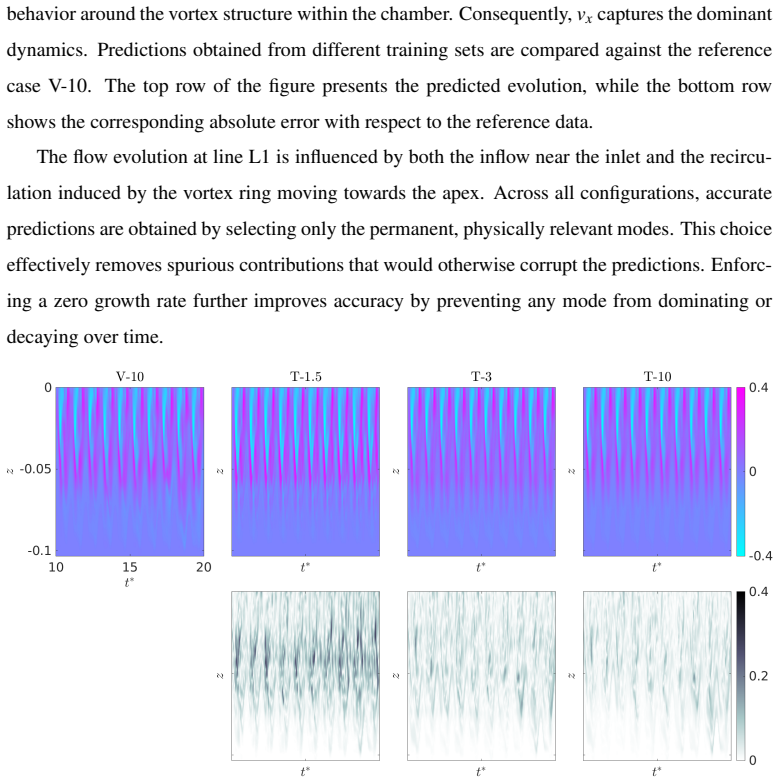
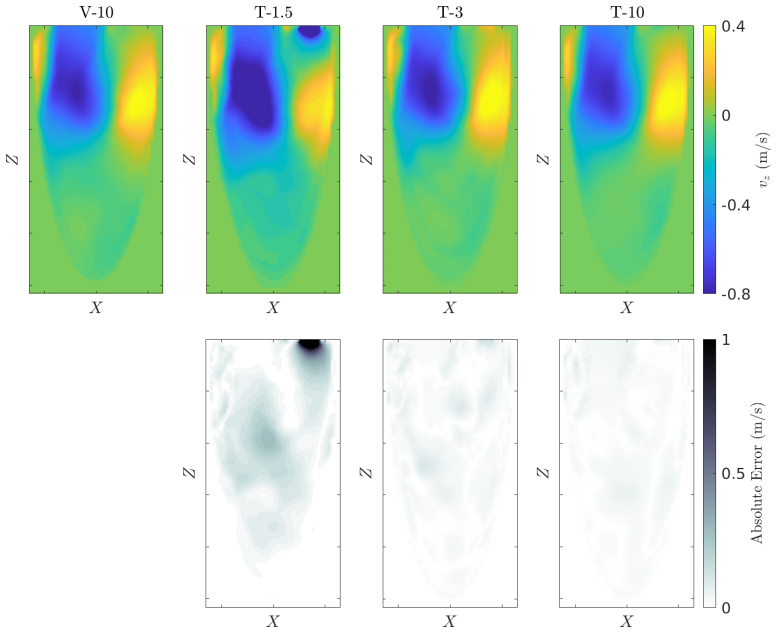
The central object is the md-HODMD decomposition of the five-dimensional velocity tensor $\boldsymbol{\mathcal{V}} \in \mathbb{R}^{3 \times J_2 \times J_3 \times J_4 \times K}$: HOSVD compresses the tensor, DMD applied to the temporal coefficients extracts modes with amplitude, growth rate $\delta_m$, and frequency $\omega_m$, and predictions are obtained by evaluating the modal expansion at times beyond the training window. Two controls carry the argument: spectral filtering retains only modes whose growth rates fall below a tunable threshold $\delta_{\mathrm{tune}}$, and the zero-growth enforcement sets $\delta_m = 0$ for the retained modes, turning the model into a purely periodic expansion. The paper identifies the intraventricular vortex ring as the dominant structure these modes must capture, and the two idealized geometries are chosen to present different vortex-ring behavior.
What would settle it
Compute the per-cycle error maps for the T-3 model on each of the validation cycles 10–20; if any single cycle shows more than 10% error over a substantial region, the claimed below-10% long-term prediction would not hold for that cycle. A complementary test would be to train on the first three cycles of one CFD run and predict cycles 10–20 of a second run with a small perturbation to the peak inlet velocity, checking whether the error stays below the paper's thresholds.
Extended reading notes
Core claim
The central claim, stated on the paper's own terms, is that the dominant intraventricular flow physics is sufficiently periodic that a spectrally filtered HODMD model with enforced zero growth rates ($\delta_m = 0$) can serve as a reliable long-term reduced-order model. The paper shows that the dominant frequency and its harmonics are captured accurately even from 1.5 cycles, and that enforcing zero growth removes artificial damping and improves predictions. Using the first three cycles for training, the model reconstructs and predicts the flow in validation cycles 10–20 with errors below 5% for the semi-ellipsoidal Ideal 1 geometry and below 10% for the rounded Ideal 2 geometry, with speed-up factors of $1.5 \times 10^5$ and $1.7 \times 10^5$, respectively, relative to the full-order CFD runs.
Load-bearing premise
The load-bearing premise is that the flow during validation cycles 10–20 is governed by exactly the same periodic modes extracted from the first training cycles, so forcing all retained growth rates to zero is a valid model; the paper itself reports cycle-to-cycle variability in total kinetic energy up to 4%, so this periodicity is only approximate.
Editorial extensions
If this is right
- Training on only three transient cardiac cycles is enough to build a ROM that predicts cycles 10–20, so the long CFD simulations used for validation can be replaced by seconds-long ROM predictions in surrogate-database generation.
- With speed-ups of at least $10^5$, parametric studies and real-time hemodynamic evaluation become feasible on ordinary computing hardware rather than HPC clusters.
- The method works on two geometries with different vortex-ring life cycles, early breakdown versus a stable ring traveling to the apex, suggesting the approach is not tied to one flow regime.
- The modal representation gives an interpretable physical picture: dominant modes sit at the cardiac frequency and its harmonics, so the ROM's output can be understood in terms of coherent flow structures rather than as a black box.
- The comparison between 1.5, 3, and 10 training cycles establishes a practical rule of thumb: at least three cycles are needed, while one and a half is not reliable for long-term prediction.
Reading between the lines
- The zero-growth assumption implies the ROM will degrade as beat-to-beat variability increases; a natural next test is patient-specific geometries with physiological cycle-to-cycle variation, where the retained mode set may need to grow or allow small nonzero growth rates.
- Because the reported errors are global relative errors, clinically relevant local quantities such as wall shear stress or vortex-breakdown timing could be less accurate; a careful validation on those quantities would be needed before use in diagnosis.
- A stronger falsification would be to train on the first three cycles of one simulation and predict the later cycles of a second simulation with a slightly perturbed inflow waveform, testing whether the extracted modes are stable features of the flow rather than artifacts of one CFD run.
- The same spectral-filtering plus zero-growth recipe could be transferred to other periodic physiological flows, such as aortic or pulmonary flows, where a dominant fundamental frequency and harmonics are expected.
Signed reviews
Editorial analysis
A structured set of objections, weighed in public.
Referee Report
Summary. The paper presents a reduced-order modeling framework based on higher-order dynamic mode decomposition (HODMD) for reconstructing and extrapolating intraventricular flow in two idealized left-ventricle geometries. The method uses HOSVD-based tensor compression, DMD mode extraction with spectral filtering, and enforces zero growth rates for prediction. The authors train on 1.5, 3, or 10 cardiac cycles from transient CFD simulations and validate on cycles 10–20, reporting normalized errors below 5% (Ideal 1) and below 10% (Ideal 2) and speed-ups of order 10^5.
Significance. The application of HODMD to cardiac hemodynamics is novel and the out-of-sample validation design is a strength: the validation window is not used in training. The method provides interpretable modes tied to vortex-ring dynamics. If the quantitative claims are substantiated with appropriate error metrics and baselines, this could be a useful tool for fast surrogate modeling. The authors also provide open code and tutorials, which supports reproducibility.
major comments (4)
- [Section 2.3, Eq. (5)] The error metric in Eq. (5) normalizes the absolute error by the maximum absolute error in the prediction window. Consequently, the statement that 'in at least 99% of spatial locations the error is below 5%' (Section 4.1) refers to 5% of the worst error, not 5% of a characteristic flow velocity. This metric cannot support the abstract's claim that reconstruction and prediction errors remain below 5%/10%. Please recompute errors using a flow-physics-based normalization (e.g., normalized RMSE by mean inlet velocity or TKE) and report the implied absolute errors; this is essential for assessing the method's accuracy.
- [Section 2.3 and Section 3.2] The zero-growth enforcement is not validated against a trivial baseline. Since the validation cycles exhibit cycle-to-cycle variability (Section 3.2 reports TKE RRMSE up to 4% and a baseline uncertainty of 5–10%), a model that simply repeats the last training cycle may achieve similar or better performance. Please add a comparison with a periodic-repeat baseline and, if possible, with a version of the ROM that retains estimated growth rates, over the same validation window. Without this, the reported accuracy cannot be attributed to the HODMD predictive mechanism.
- [Table 2 and Section 2.3] The tunable growth-rate threshold delta_tune is chosen separately for each case (1.0, 0.5, 0.01, with the text mentioning 0.05 in Section 3.3), and no sensitivity study is reported. Because this parameter directly controls which modes are retained, the claimed robustness of the spectral filtering is not established. Please provide a systematic variation of delta_tune (or a data-driven selection criterion) and report the resulting error distributions for at least the T-3 case.
- [Eq. (7) and Section 4.1] The speed-up factor compares the CFD cost on 40 CPUs with the ROM time, but the text does not state whether t_ROM includes the offline HODMD/HOSVD training cost or only the evaluation of Eq. (2). Since the abstract highlights the 10^5 speed-up, please clarify the cost accounting and, if the offline cost is excluded, report the total (offline + online) speed-up.
minor comments (6)
- [Section 3.3] The threshold in Fig. 4 is delta_tune = 5e-2, but Table 2 lists delta_tune = 1.0, 0.5, 0.01. Clarify the relationship between these values and the selection criterion.
- [Section 2.2] The notation \hat{bR}_1... in Eq. (4) is undefined; define the dimensions of these matrices or state that they are the blocks of the modified Koopman matrix.
- [Section 2.1] The sentence 'A tunable tolerance epsilon determines...' should specify that epsilon_1 = epsilon_2 = epsilon, as stated later, and define how epsilon maps to P_i and N.
- [Section 3.1] The expression 'p \in R' should be 'p \in {1.5,3,10}' or a defined set; using real numbers is imprecise.
- [Figure 8 and 11] The histograms are based on the normalized error of Eq. (5); please state this in the captions to avoid over-interpretation.
- [Section 4.1] The statement 'the ROM prediction over the same time span was completed in just 36 seconds' should specify the hardware and whether this includes data loading and mode selection.
Circularity Check
No significant circularity: the ROM predictions are genuine extrapolations to unseen cardiac cycles, and the core HODMD methodology is independently published and applied in-domain.
full rationale
The paper's central claim is that a HODMD-based ROM trained on early cycles can reconstruct and predict intraventricular flow in later cycles. The training windows (T-1.5, T-3, T-10) and the validation window (V-10) are disjoint, so the reported prediction errors are not fitted to the validation data. The zero-growth enforcement is a modeling assumption, not a circular definition: the growth rates are estimated from training data and then deliberately set to zero, and the validation data are not used to select this choice. The HODMD algorithm is cited to a peer-reviewed SIAM paper by one of the authors, but this is an independent methodological reference rather than an unverified self-citation; the paper also presents its own calibration and frequency analyses. The error metric in Eq. (5) normalizes by the maximum absolute error, which weakens the interpretability of the 'below 5%' claims, but this is a statistical-presentation concern, not circularity. The paper openly acknowledges cycle-to-cycle variability and frames predictions within a 5-10% baseline uncertainty, which further indicates that the claimed accuracy is not definitionally guaranteed. No step in the derivation chain reduces to its own inputs by construction.
Assumptions & free parameters
free parameters (4)
- HOSVD/HODMD tolerance epsilon (epsilon1 = epsilon2 = epsilon)
- HODMD delay parameter d
- Growth-rate threshold delta_tune =
1.0 (T-1.5), 0.5 (T-3), 0.01 (T-10, V-10)
- Enforced zero growth rate delta_m = 0 =
0
assumptions (5)
- domain assumption The intraventricular flow can be approximated as a linear combination of a small number of DMD modes with exponential time evolution.
- ad hoc to paper The flow becomes periodic after an initial transient, so setting all growth rates to zero is valid for long-term prediction.
- domain assumption The laminar assumption is valid at Re approximately 4900-5500.
- domain assumption The cycle-to-cycle variability in the CFD data is small enough that a single deterministic ROM prediction can be compared directly to the V-10 reference.
- ad hoc to paper Error normalized by the maximum absolute error over the prediction window is an appropriate accuracy measure.
Cite this review
Pith. "Pith review of Efficient Reduced Order Modeling Based on HODMD to Predict Intraventricular Flow Dynamics." pith.science (2026). https://pith.science/paper/YNRU5OXM
@misc{pith2026250721716,
  author       = {Pith},
  title        = {Pith review of: Efficient Reduced Order Modeling Based on HODMD to Predict Intraventricular Flow Dynamics},
  year         = {2026},
  howpublished = {\url{https://pith.science/paper/YNRU5OXM}},
  note         = {Machine review of arXiv:2507.21716}
}
abstract
Accurate and efficient modeling of cardiac blood flow is crucial for advancing data-driven tools in cardiovascular research and clinical applications. Recently, the accuracy and availability of computational fluid dynamics (CFD) methodologies for simulating intraventricular flow have increased. However, these methods remain complex and computationally costly. This study presents a reduced order model (ROM) based on higher order dynamic mode decomposition (HODMD). The proposed approach enables accurate reconstruction and long term prediction of left ventricle flow fields. The method is tested on two idealized ventricular geometries exhibiting distinct flow regimes to assess its robustness under different hemodynamic conditions. By leveraging a small number of training snapshots and focusing on the dominant periodic components representing the physics of the system, the HODMD-based model accurately reconstructs the flow field over entire cardiac cycles and provides reliable long-term predictions beyond the training window. The reconstruction and prediction errors remain below 5\% for the first geometry and below 10\% for the second, even when using as few as the first 3 cycles of simulated data, representing the transitory regime. Additionally, the approach reduces computational costs with a speed-up factor of at least $10^{5}$ compared to full-order simulations, enabling fast surrogate modeling of complex cardiac flows. These results highlight the potential of spectrally-constrained HODMD as a robust and interpretable ROM for simulating intraventricular hemodynamics. This approach shows promise for integration in real-time analysis and patient specific models.
Figures


Figures from the paper (8 more)




Reference graph
Works this paper leans on
-
[1]
World Health Organization, Cardiovascular diseases (cvds) - fact sheet, https://www.who.int/news-room/ fact-sheets/detail/cardiovascular-diseases-(cvds) (2024). 24
work page 2024
-
[2]
J. D. Thomas, Z. B. Popovic, Assessment of left ventricular function by cardiac ultrasound, Journal of the American College of Cardiology 48 (10) (2006) 2012–2025. URL https://doi.org/10.1016/j.jacc.2006.06.071
-
[3]
P. J. Kilner, G.-Z. Yang, A. J. Wilkes, R. H. Mohiaddin, D. N. Firmin, M. H. Yacoub, Asymmetric redirection of flow through the heart, Nature 404 (6779) (2000) 759–761. URL https://doi.org/10.1038/35008075
-
[4]
G. Pedrizzetti, F. Domenichini, Left ventricular fluid mechanics: the long way from theoretical models to clinical applications, Annals of biomedical engineering 43 (2015) 26–40. URL https://doi.org/10.1007/s10439-014-1101-x
-
[5]
P. P. Sengupta, J. Korinek, M. Belohlavek, J. Narula, M. A. Vannan, A. Jahangir, B. K. Khandheria, Left ventricular structure and function: basic science for cardiac imaging, Journal of the American College of Cardiology 48 (10) (2006) 1988–2001. URL https://doi.org/10.1016/j.jacc.2006.08.030
-
[6]
V . Spandan, V . Meschini, R. Ostilla-Mónico, D. Lohse, G. Querzoli, M. D. De Tullio, R. Verzicco, A par- allel interaction potential approach coupled with the immersed boundary method for fully resolved simula- tions of deformable interfaces and membranes, Journal of Computational Physics 348 (2017) 567–590. doi: 10.1016/j.jcp.2017.07.036
-
[7]
V . Meschini, M. D. De Tullio, G. Querzoli, R. Verzicco, Flow structure in healthy and pathological left ventricles with natural and prosthetic mitral valves, Journal of Fluid Mechanics 834 (2018) 271–307. doi:10.1017/jfm. 2017.725
doi:10.1017/jfm 2018
-
[8]
V . Meschini, R. Mittal, R. Verzicco, Systolic anterior motion in hypertrophic cardiomyopathy: a fluid–structure interaction computational model, Theoretical and Computational Fluid Dynamics 35 (3) (2021) 381–396. doi: 10.1007/s00162-021-00564-0
Show all 43 references
-
[9]
Domenichini, G
F. Domenichini, G. Pedrizzetti, B. Baccani, Three-dimensional filling flow into a model left ventricle, Journal of Fluid Mechanics 539 (2005) 179–198. doi:10.1017/S0022112005005550
2005 doi
-
[10]
Domenichini, G
F. Domenichini, G. Querzoli, A. Cenedese, G. Pedrizzetti, Combined experimental and numerical analysis of the flow structure into the left ventricle, Journal of Biomechanics 40 (9) (2007) 1988–1994. doi:10.1016/j. jbiomech.2006.09.024
2007 doi
-
[11]
Domenichini, G
F. Domenichini, G. Pedrizzetti, Hemodynamic forces in a model left ventricle, Physical Review Fluids 1 (8) (2016) 083201. doi:10.1103/PhysRevFluids.1.083201
2016 doi
-
[12]
Quarteroni, T
A. Quarteroni, T. Lassila, S. Rossi, R. Ruiz-Baier, Integrated heart—coupling multiscale and multiphysics models for the simulation of the cardiac function, Computer Methods in Applied Mechanics and Engineering 314 (2017) 345–407. URL https://doi.org/10.1016/j.cma.2016.05.031
2017 doi
-
[13]
P. C. Africa, I. Fumagalli, M. Bucelli, A. Zingaro, M. Fedele, A. Quarteroni, et al., lifex-cfd: An open-source com- putational fluid dynamics solver for cardiovascular applications, Computer Physics Communications 296 (2024) 109039. URL https://doi.org/10.1016/j.cpc.2023.109039
2024
-
[14]
M. S. Nagargoje, E. Lazpita, J. Garicano-Mena, S. Le Clainche, A review on vortex dynamics in the healthy and 25 dilated left ventricles and its application to heart health, Flow 5 (2025) E10. URL https://doi.org/10.1017/flo.2025.6
2025 doi
-
[15]
Lazpita, M
E. Lazpita, M. Neidlin, J. Garicano-Mena, S. Le Clainche, Characterizing intraventricular flow patterns via modal decomposition techniques in idealized left ventricle models, arXiv preprint (2025)
2025
-
[16]
Kheradvar, G
A. Kheradvar, G. Pedrizzetti, A. Kheradvar, G. Pedrizzetti, V ortex formation in the heart, Springer, 2012. URL https://doi.org/10.1007/978-1-4471-2288-3_3
2012 doi
-
[17]
Chnafa, S
C. Chnafa, S. Mendez, F. Nicoud, Image-based large-eddy simulation in a realistic left heart, Computers & Fluids 94 (2014) 173–187. URL https://doi.org/10.1016/j.compfluid.2014.01.030
2014 doi
-
[18]
Ballarin, E
F. Ballarin, E. Faggiano, S. Ippolito, A. Manzoni, A. Quarteroni, G. Rozza, R. Scrofani, Fast simulations of patient- specific haemodynamics of coronary artery bypass grafts based on a pod–galerkin method and a vascular shape parametrization, Journal of Computational Physics 3...
2016 doi
-
[19]
Lassila, A
T. Lassila, A. Manzoni, A. Quarteroni, G. Rozza, Model order reduction in fluid dynamics: challenges and per- spectives, Reduced Order Methods for modeling and computational reduction (2014) 235–273. URL https://doi.org/10.1007/978-3-319-02090-7_9
2014 doi
-
[20]
Le Clainche, J
S. Le Clainche, J. M. Vega, Higher order dynamic mode decomposition, SIAM Journal on Applied Dynamical Systems 16 (2) (2017) 882–925. doi:10.1137/15M1054924. URL https://doi.org/10.1137/15M1054924
2017 doi
-
[21]
Le Clainche, J
S. Le Clainche, J. M. Vega, Higher order dynamic mode decomposition to identify and extrapolate flow patterns, Physics of Fluids 29 (8) (2017). URL https://doi.org/10.1063/1.4997206
2017 doi
-
[22]
Hetherington, A
A. Hetherington, A. Corrochano, R. Abadía-Heredia, E. Lazpita, E. Muñoz, P. Díaz, E. Maiora, M. López-Martín, S. Le Clainche, Modelflows-app: data-driven post-processing and reduced order modelling tools, Computer Physics Communications 301 (2024) 109217. URL https://doi.org/1...
2024
-
[23]
Sirovich, Turbulence and the dynamics of coherent structures
L. Sirovich, Turbulence and the dynamics of coherent structures. i. coherent structures, Quarterly of Applied Math- ematics 45 (3) (1987) 561–571. doi:10.1090/qam/910462. URL https://www.ams.org/journals/qam/1987-45-03/S0033-569X-1987-0910462-6/
1987 doi
-
[24]
Groun, M
N. Groun, M. Villalba-Orero, L. Casado-Martín, E. Lara-Pezzi, E. Valero, S. Le Clainche, J. Garicano-Mena, Eigenhearts: Cardiac diseases classification using eigenfaces approach, Computers in Biology and Medicine 192 (2025) 110167. URL https://doi.org/10.1016/j.compbiomed.2025.110167
2025
-
[25]
P. J. Schmid, Dynamic mode decomposition of numerical and experimental data, Journal of Fluid Mechanics 656 (2010) 5–28. doi:10.1017/S0022112010001217. URL https://doi.org/10.1017/S0022112010001217
2010 doi
-
[26]
Mezi ´c, Analysis of fluid flows via spectral properties of the koopman operator, Annual review of fluid mechanics 45 (1) (2013) 357–378
I. Mezi ´c, Analysis of fluid flows via spectral properties of the koopman operator, Annual review of fluid mechanics 45 (1) (2013) 357–378. URL https://doi.org/10.1146/annurev-fluid-011212-140652 26
2013 doi
-
[27]
S. E. Otto, C. W. Rowley, Koopman operators for estimation and control of dynamical systems, Annual Review of Control, Robotics, and Autonomous Systems 4 (1) (2021) 59–87. URL https://doi.org/10.1146/annurev-control-071020-010108
2021 doi
-
[28]
Zheng, J
X. Zheng, J. H. Seo, V . Vedula, T. Abraham, R. Mittal, Computational modeling and analysis of intracardiac flows in simple models of the left ventricle, European Journal of Mechanics - B/Fluids 35 (2012) 31–39. doi: 10.1016/j.euromechflu.2012.03.002
2012 doi
-
[29]
Vedula, S
V . Vedula, S. Fortini, J. H. Seo, G. Querzoli, R. Mittal, Computational modeling and validation of intraventricular flow in a simple model of the left ventricle, Theoretical and Computational Fluid Dynamics 28 (2014) 589–604. doi:10.1007/s00162-014-0335-4
2014 doi
-
[30]
H. A. Kjeldsberg, J. Sundnes, K. Valen-Sendstad, A verified and validated moving domain computational fluid dy- namics solver with applications to cardiovascular flows, International Journal for Numerical Methods in Biomedical Engineering 39 (6) (2023) e3703. URL https://doi.o...
2023 doi
-
[31]
Ansys, inc., Ansys Fluent Academic Research, Release 2023 R1, Help System, Ansys Fluent Theory Guide (2023)
2023
-
[32]
G. He, L. Han, J. Zhang, A. Shah, D. J. Kaczorowski, B. P. Griffith, Z. Wu, Numerical study of the effect of lvad inflow cannula positioning on thrombosis risk, Computer methods in biomechanics and biomedical engineering 25 (8) (2022) 852–860. URL https://doi.org/10.1080/10255...
2022
-
[33]
Tagliabue, L
A. Tagliabue, L. Dedè, A. Quarteroni, Complex blood flow patterns in an idealized left ventricle: a numerical study, Chaos: An Interdisciplinary Journal of Nonlinear Science 27 (9) (2017). URL https://doi.org/10.1063/1.5002120
2017 doi
-
[34]
Lazpita, M
E. Lazpita, M. Nagargoje, S. Clainche, J. Garicano-Mena, On the numerical simulation of left ventricle models, in: ECCOMAS 2024, 2024. URL https://www.scipedia.com/public/Lazpita_et_al_2024a
2024
-
[35]
Lazpita, A
E. Lazpita, A. Mares, P. Quintero, J. Garicano-Mena, S. Le Clainche, Modeling heart flow dynamics using nu- merical simulations to identify the vortex ring: a practical guide, Results in Engineering 24 (2024) 103644. doi:10.1016/j.rineng.2024.103644
2024
-
[36]
F. Canè, L. Delcour, A. C. Luigi Redaelli, P. Segers, J. Degroote, A cfd study on the interplay of torsion and vortex guidance by the mitral valve on the left ventricular wash-out making use of overset meshes (chimera technique), Frontiers in Medical Technology 4 (2022) 101805...
2022
-
[37]
Grünwald, J
A. Grünwald, J. Korte, N. Wilmanns, C. Winkler, K. Linden, U. Herberg, S. Groß-Hardt, U. Steinseifer, M. Neidlin, Intraventricular flow simulations in singular right ventricles reveal deteriorated washout and low vortex formation, Cardiovascular Engineering and Technology (202...
2022 doi
-
[38]
Korte, T
J. Korte, T. Rauwolf, J.-N. Thiel, A. Mitrasch, P. Groschopp, M. Neidlin, A. Schmeißer, R. Braun-Dullaeus, P. Berg, Hemodynamic assessment of the pathological left ventricle function under rest and exercise conditions, Fluids 8 (2) (2023) 71. URL https://doi.org/10.3390/fluids...
2023 doi
-
[39]
Le Clainche, D
S. Le Clainche, D. Izbassarov, M. Rosti, L. Brandt, O. Tammisola, Coherent structures in the turbulent channel flow of an elastoviscoplastic fluid, Journal of Fluid Mechanics 888 (2020) A5. URL https://doi.org/10.1017/jfm.2020.31
2020 doi
-
[40]
Lazpita, Á
E. Lazpita, Á. Martínez-Sánchez, A. Corrochano, S. Hoyas, S. Le Clainche, R. Vinuesa, On the generation and destruction mechanisms of arch vortices in urban fluid flows, Physics of Fluids 34 (5) (2022). URL https://doi.org/10.1063/5.0088305
2022 doi
-
[41]
Corrochano, G
A. Corrochano, G. D’Alessio, A. Parente, S. Le Clainche, Hierarchical higher-order dynamic mode decomposition for clustering and feature selection, Computers & Mathematics with Applications 158 (2024) 36–45. URL https://doi.org/10.1016/j.camwa.2024.01.003
2024 doi
-
[42]
Lazpita, J
E. Lazpita, J. Garicano-Mena, G. Paniagua, S. Le Clainche, E. Valero, A data–driven sensibility tool for flow control based on resolvent analysis, Results in Engineering 22 (2024) 102070. URL https://doi.org/10.1016/j.rineng.2024.102070
2024
-
[43]
ModelFLOWs-cardiac, https://modelflows.github.io/modelflowsapp/ cardiacpathologydetection/, accessed: 2025-04-23
DigitHEART: New tools and models for predicting heart disease progression and treat- ment response. ModelFLOWs-cardiac, https://modelflows.github.io/modelflowsapp/ cardiacpathologydetection/, accessed: 2025-04-23. 28
2025
Reviewed August 6, 2026 · model on record in the stance chip above.
Discussion (0). Continue with ORCID to comment.