REVIEW 3 major objections 4 minor 1 cited by
Invariant parameterization of geostrophic eddies in the ocean
T0 review · 3 major / 4 minor · reviewed 2026-08-14 · deepseek-v4-flash
Pith's one-line read This paper constructs the first higher-order invariant closure for ocean eddy parameterization and shows numerically that it outperforms the standard non-invariant closure in decaying-turbulence tests.
desk verdict Solid symmetry analysis undercuts its own 'first higher-order invariant closure' claim via a permissive generalized definition, and the numerics are confounded; worth refereeing but needs reframing. read the letter →
The pith
A machine-rendered reading of the paper's core claim, the machinery that carries it, and where it could break.
The reading
What carries the argument
The carrying object is the one-and-a-half order closure model (23), built from the Reynolds-averaged barotropic vorticity equation plus a prognostic equation for turbulent kinetic energy $k$. Its invariant nature rests on three pieces: the prolongation of the symmetry group of the vorticity equation to $k$ (which transforms as $\tilde k = e^{-4\varepsilon_3}k$), the differential invariants $I_1 = \psi_{xx}/\sqrt{|\psi_x|}$ and $I_2 = k/\psi_x^2$ with the invariant differentiation operators (15), and the generalized interpretation of scale transformations as equivalence transformations that act on the eddy mixing length $L_{\mathrm{eddy}}$ via $\tilde L_{\mathrm{eddy}} = e^{-\varepsilon_3}L_{\mathrm{eddy}}$. The nonlinear invariant hyperdiffusion term $\tilde A k^{5/4}\nabla^4\eta$ replaces standard linear hyperdiffusion, which broke scale invariance.
What would settle it
Compute the action of a generalized Galilean boost $(t,x,y,\psi,k) \to (t, x+f(t), y, \psi-f_t(t)y, k)$ on system (23): the $k$-equation's conversion term $-\kappa\nabla\psi\cdot\nabla\eta$ will not be form-preserving, showing the closure is not invariant under the full symmetry group. Alternatively, repeat the 72-run decaying-turbulence experiment on a doubly periodic domain where Galilean invariance is physical; if the invariant model then loses its advantage or becomes unstable, the essential-subgroup assumption is the culprit.
Extended reading notes
Core claim
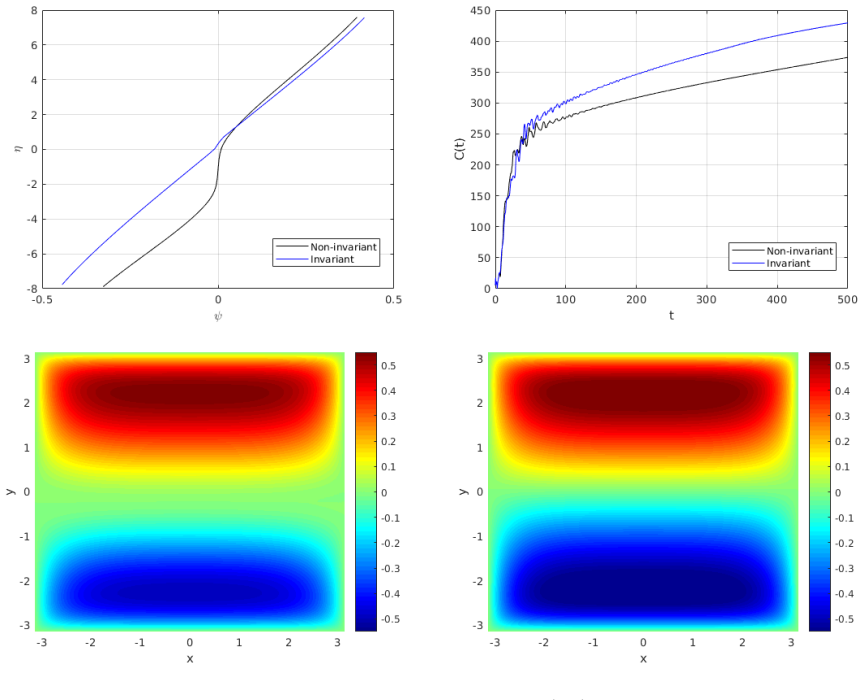
The paper's central claim is that a one-and-a-half order closure for geostrophic eddies can be made invariant: the closed system (23), with $\kappa$ and $\nu$ as in (18) and (22), admits the prolonged action of the essential subgroup $\bar G_{\mathrm{ess}}$ (scale transformations, translations, and streamfunction gauging) of the maximal Lie symmetry group of the barotropic vorticity equation, with the eddy mixing length $L_{\mathrm{eddy}}$ scaling as $e^{-\varepsilon_3}$ so that the scale transformation acts as an equivalence transformation on the class of closed systems. This gives the first example of an invariantly closed system using a closure of order higher than one. The paper also introduces generalized invariant parameterization, in which symmetries of the original model are preserved as equivalence transformations of the class of closed models rather than as strict symmetries of a single model. Numerically, the invariant model produces Fofonoff vortex solutions more robustly than the non-invariant model: higher mean anti-correlation, less scatter, and no unstable integrations.
Load-bearing premise
The construction assumes that fixed Dirichlet boundaries make generalized Galilean boosts 'not natural,' so only the essential subgroup needs preserving; if Galilean invariance were required of the closed model, system (23) would not qualify as invariant.
Editorial extensions
If this is right
- Symmetry preservation in parameterization is not limited to first-order closures; one-and-a-half order closure models that carry turbulent kinetic energy can be made invariant in the generalized sense.
- The equivalence-transformation interpretation gives a practical rule: closure constants with a physical dimension, like the eddy mixing length, may be rescaled by symmetries, while dimensionless constants must not be; this distinguishes $L_{\mathrm{eddy}}$ from $\tilde A$.
- Invariant hyperdiffusion of the form $\tilde A k^{5/4}\nabla^4\eta$ is self-refining: as resolved eddy kinetic energy decreases with finer resolution, the hyperdiffusion strength decreases automatically, unlike grid-spacing-tuned $A$.
- Numerically, the invariant model reproduces the linear $\eta$\textendash$\psi$ relation of Fofonoff states over a wider parameter range and delays diffusive homogenization of the gyres.
Reading between the lines
- Beyond the paper: the same equivalence-transformation trick could be applied to other closure constants with physical dimensions, such as eddy turnover time in $\kappa = 2\gamma T_{\mathrm{eddy}}k$, turning each into a scale-covariant parameter and enlarging the set of invariant closure families.
- Beyond the paper: the requirement to preserve only the essential subgroup is a modeling choice tied to fixed Dirichlet boundaries; on periodic beta-plane domains, Galilean invariance becomes natural, and a testable prediction is that an invariant closure must then include generalized Galilean boosts, which would change the allowed form of the energy-conversion term.
- Beyond the paper: the nonlinear hyperdiffusion term suggests a concrete diagnostic, namely comparing spectral energy fluxes of the invariant and non-invariant models to see whether the $k^{5/4}$ multiplier alters the inertial-range cascade in a way that explains the delayed homogenization.
Signed reviews
Editorial analysis
A structured set of objections, weighed in public.
Referee Report
Summary. The paper extends the invariant-parameterization framework to higher-order (one-and-a-half order) closures and introduces a generalized notion in which symmetries of the original model are preserved as equivalence transformations of a class of closed systems, with closure parameters treated as arbitrary elements. The specific application is to geostrophic eddies in a barotropic ocean: the authors compute the maximal Lie symmetry algebra of the barotropic vorticity equation on the beta-plane, compute for the first time the Lie symmetries of the underlying two-dimensional Euler equations, prolong the symmetries to the turbulent kinetic energy, and construct a closed system (Eq. (23)) that they claim is invariant under the essential subgroup of the symmetry group in this generalized sense. They then compare this invariant model with the standard non-invariant model (17) in numerical experiments of freely decaying two-dimensional turbulence, measuring the anti-correlation function as an indicator of Fofonoff-vortex emergence, and report that the invariant model gives, on average, better and more robust results.
Significance. If substantiated, the paper would make a useful contribution: it would provide the first higher-order symmetry-preserving closure, a new potential symmetry interpretation for the Euler equations on the beta-plane, and a generalized framework for treating closure parameters as equivalence-transformation variables. The symmetry computations and the invariance verification for Eq. (23) appear internally consistent, and the explicit prolongation of the symmetry action to the turbulent kinetic energy is a clean and reusable result. However, the significance is limited by two issues: the claimed novelty of the first higher-order invariant closure is undermined by the permissiveness of the generalized definition, and the numerical evidence does not isolate the effect of symmetry preservation from other changes between the two compared models.
major comments (3)
- [Section 2 and Section 5 (after Eq. (22))] The generalized definition of invariant parameterization in Section 2 explicitly allows equivalence transformations to act on the arbitrary elements of the class, i.e., on the closure parameters. Under this definition, the 'standard non-invariant' model (17) with r=0 is already generalized scale-invariant: with κ given by (18) and with the scale transformation acting on the parameters as L_eddy' = e^{-ε}L_eddy, A' = e^{-5ε}A, and ν' = e^{-3ε}ν (or the inverse convention), the class of systems (17) is mapped to itself. The paper itself notes in Section 5 that scale invariance of (17) can be restored by letting A transform. Therefore, the statement that 'the above class gives the first example for an invariantly closed system employing a closure of order higher than one' (Section 5, after Eq. (23)) is a convention about which parameters are allowed to transform, not a structural property of the closure. The formal definition does not distinguish (23) from (17); the distinction relies on the informal physical-justification requirement about dimensionless constants. The authors should either refine the definition to include a formal criterion (e.g., which closure parameters are required to be absolute invariants) or substantially revise the novelty claim.
- [Section 6, numerical experiments] The numerical comparison does not support the general claim that 'the invariant parameterization schemes give, on average, better results than the standard non-invariant closure models' (Abstract and Section 6.2). The invariant model (23) differs from the standard model (17) in at least three respects simultaneously: the hyperdiffusion term is changed from A∇⁴η to ~Ak^{5/4}∇⁴η, the eddy energy diffusivity is changed from a constant ν to ν = 2~αL_eddy(2k)^{1/2}, and the symmetry properties are altered. The 4 unstable non-invariant runs are mentioned, but it is not stated whether they are excluded from the reported means and standard deviations; the difference in means of the anti-correlation function (469 vs 445) is not assessed with any statistical test or confidence interval. To attribute the observed improvement to symmetry preservation, the authors should include controlled experiments, for example comparing (23) with (17) in which A and ν are allowed to scale as equivalence transformations, or comparing (23) with (20), and report significance measures.
- [Section 5, choice of the essential subgroup] The selection of G_ess as the symmetry group to preserve is a load-bearing modeling assumption. The paper excludes generalized Galilean boosts because fixed Dirichlet boundaries are not natural for moving frames, but the same boundary argument also breaks scale invariance, which is nevertheless retained through the equivalence-transformation interpretation. The asymmetry between treating scale transformations as equivalence transformations and treating Galilean boosts as non-natural is not derived from a formal principle. Since the central claim of invariance of model (23) depends on this choice, the authors should state a more principled criterion for selecting the essential subgroup, or at least discuss how the results would change if Galilean boosts were also treated as equivalence transformations on the boundary conditions.
minor comments (4)
- [Section 6.1] There is a typo in the boundary conditions description: 'no normal follow' should be 'no normal flow'.
- [Section 6.1] The setting ~A = A/k₀^{5/4} matches the initial hyperdiffusion strength at t = 0 only; since k evolves in time, the assertion that the diffusion strength is 'similar over the entire integration' should be quantified or stated more cautiously.
- [Eq. (24)] The anti-correlation function C is reported with values around 469 in non-dimensional units, but the definition (24) is dimensionally dependent on the choice of scaling; a brief statement of the normalization or units would improve interpretability.
- [Section 4] The claim that the Lie symmetries of the system (8) 'have not been done in the literature before' would be easier to verify if the authors indicated the search terms or briefly explained why the existing symmetry analyses of the beta-plane equations do not cover this system.
Circularity Check
No significant circularity: the invariant closure (23) is obtained by imposing explicit scaling constraints on prescribed eddy-transfer forms, and its numerical skill is tested against an external Fofonoff benchmark rather than used to set parameters.
full rationale
The paper's central closure coefficients, κ = α L_eddy (2k)^{1/2} and ν = 2α̃ L_eddy (2k)^{1/2}, are taken from the prior physical closure literature (Marshall & Adcroft and Eden & Greatbatch), not fitted to the Fofonoff outcome measured in Section 6. The invariant hyperdiffusion multiplier k^{5/4} in (21) is derived by requiring each term in the averaged vorticity equation to scale as e^{-2ε3} under the scale subgroup, and the statement that (21) is invariant under all of Ḡ is checked by direct computation; it is not obtained by assuming the target result. The differential invariants I1 and the invariant differentiation operators (15) are cited from the authors' earlier work [4], but this is a parameter-free invariant-theory computation with stated assumptions (ψx ≠ 0) and does not include the closure model (23) as an input; the same generating invariants can be verified independently from the moving frame (16). Thus the self-citation is load-bearing only in the sense of supplying technical infrastructure, not as a substitute for the paper's own derivation. The generalized-invariance notion is a definition, and the choice to let L_eddy transform while holding α, α̃, and à fixed is an explicitly defended modeling convention in Section 5 and in the paragraph following Remark 4. A critic could argue this convention is permissive; for example, allowing A and ν to transform could make the 'standard' model (17) scale-invariant in the same generalized sense. But that is a scope or correctness objection, not a reduction of the paper's claims to its inputs. Finally, the numerical comparison is not a fitted prediction: setting à = A / k0^{5/4} merely equalizes initial hyperdiffusion strength between the invariant and non-invariant models, and the 72-run ensemble varies prescribed parameter ranges rather than tuning constants to maximize the anti-correlation function C. No fitted parameter is renamed as a prediction, no uniqueness theorem is imported from the authors' prior work to force the chosen ansatz, and no output quantity is equal by construction to an input quantity. Hence no significant circularity is present.
Assumptions & free parameters
free parameters (5)
- alpha =
0.01 (fixed in experiments)
- L_eddy =
range [2π/100, 2π/20] in experiments
- nu =
range [10^-4, 10^-3]
- A_tilde =
A in [10^-7, 10^-5], with à = A/k0^(5/4)
- k0 =
range [0.10, 0.25]
assumptions (7)
- domain assumption Reynolds averaging rules, including the Reynolds property ¯ab = ¯a¯b and ab = ¯a¯b + a′b′
- domain assumption The turbulent kinetic energy equation (11) is a valid evolution equation for k after averaging and neglecting certain terms (e.g., r=0 for freely decaying turbulence)
- ad hoc to paper The closure ansatz κ = α L_eddy (2k)^(1/2) and ν = 2 ˜α L_eddy (2k)^(1/2) (Eqs. 18, 22) is physically appropriate
- ad hoc to paper The choice of ¯G_ess as the symmetry group to preserve, dropping generalized Galilean boosts
- standard math Standard results from Lie group analysis, including moving frame invariantization and differential invariant theory
- ad hoc to paper The scaling of L_eddy as e^(-ε3) under the equivalence transformation
- domain assumption The standard numerical framework (Arakawa Jacobian, RK2, boundary conditions) is a correct discretization
Cite this review
Pith. "Pith review of Invariant parameterization of geostrophic eddies in the ocean." pith.science (2026). https://pith.science/paper/YNVOJCZP
@misc{pith2026190806345,
  author       = {Pith},
  title        = {Pith review of: Invariant parameterization of geostrophic eddies in the ocean},
  year         = {2026},
  howpublished = {\url{https://pith.science/paper/YNVOJCZP}},
  note         = {Machine review of arXiv:1908.06345}
}
read the original abstract
The framework of invariant parameterization is extended to higher-order closure schemes. We also define, for the first time, generalized invariant parameterization schemes, where symmetries of the corresponding original model are preserved as equivalence transformations of related classes of closed system of differential equations. As a particular problem, we consider invariant parameterization schemes for geostrophic eddies in a barotropic ocean. Here the initial model is the barotropic vorticity equation, which is equivalent to the system of incompressible inviscid two-dimensional Euler equations on a midlatitude beta-plane. The maximal Lie invariance algebra of this model is infinite-dimensional, and we intend to preserve it in the course of invariant parameterization, at least partially. The parameterizations proposed for the eddy vorticity flux and the energy flux are of order one and a half since we explicitly consider the equation for the turbulent kinetic energy in the closure models. These parameterizations are therefore the first examples of invariant higher-order closure schemes. Numerical experiments are carried out to assess the performance of these invariant schemes in studies of freely decaying two-dimensional turbulence, and it is verified that the invariant parameterization schemes give, on average, better results than the standard non-invariant closure models do.
Figures


Figures from the paper (1 more)

Forward citations
Cited by 1 Pith paper
-
Differential invariants for a class of diffusion equations
The differential invariant algebra for the equivalence pseudogroup of ut = uxx + f(u, ux) is generated by one invariant I11 and two invariant differentiation operators.
Reference graph
Works this paper leans on
-
[32]
and Bihlo A., Symmetry preserving parameterization schemes, J
Popovych R.O. and Bihlo A., Symmetry preserving parameterization schemes, J. Math. Phys. 53 (2012), 073102 (36 pages), arXiv:1010.3010
arXiv 2012
- [1]
-
[2]
Conservative parameterization schemes
Bihlo A. and Bluman G., Conservative parameterization schemes, J. Math. Phys. 54 (2013), 083101 (24 pages), arXiv:1209.4279
work page Pith review arXiv 2013
-
[3]
Complete group classification of a class of nonlinear wave equations
Bihlo A., Dos Santos Cardoso-Bihlo E.M. and Popovych R.O., Complete group classification of a class of nonlinear wave equations, J. Math. Phys. 53 (2012), 123515 (32 pages), arXiv:1106.4801
work page Pith review arXiv 2012
-
[4]
and Popovych R.O., Invariant parameterization and turbulence modeling on the beta-plane, Phys
Bihlo A., Dos Santos Cardoso-Bihlo E.M. and Popovych R.O., Invariant parameterization and turbulence modeling on the beta-plane, Phys. D 269 (2014), 48–62, arXiv:1112.1917
arXiv 2014
-
[5]
Lie symmetries and exact solutions of the barotropic vorticity equation
Bihlo A. and Popovych R.O., Lie symmetries and exact solutions of the barotropic vorticity equation,J. Math. Phys. 50 (2009), 123102 (12 pages), arXiv:0902.4099
work page Pith review arXiv 2009
-
[6]
Lie symmetry analysis and exact solutions of the quasi-geostrophic two-layer problem
Bihlo A. and Popovych R.O., Lie symmetry analysis and exact solutions of the quasi-geostrophic two-layer problem, J. Math. Phys. 52 (2011), 033103 (24 pages), arXiv:1010.1542
work page Pith review arXiv 2011
-
[7]
and Popovych R.O., Invariant discretization schemes for the shallow-water equations, SIAM J
Bihlo A. and Popovych R.O., Invariant discretization schemes for the shallow-water equations, SIAM J. Sci. Comput. 34 (2012), B810–B839, arXiv:1201.0498
arXiv 2012
Show all 39 references
-
[8]
and Popovych R.O., Group classification of linear evolution equations, J
Bihlo A. and Popovych R.O., Group classification of linear evolution equations, J. Math. Anal. Appl. 448 (2017), 982–1005
2017
-
[9]
and Valiquette F., Symmetry-preserving numerical schemes, in Symmetries and integrability of difference equations, Springer, pp
Bihlo A. and Valiquette F., Symmetry-preserving numerical schemes, in Symmetries and integrability of difference equations, Springer, pp. 261–324, 2017
2017
-
[10]
and Kumei S., Symmetries and differential equations , Springer, New York, 1989
Bluman G. and Kumei S., Symmetries and differential equations , Springer, New York, 1989
1989
-
[11]
and Venaille A., Statistical mechanics of two-dimensional and geophysical flows, Phys
Bouchet F. and Venaille A., Statistical mechanics of two-dimensional and geophysical flows, Phys. Rep. 515 (2012), 227–295
2012
-
[12]
and Haidvogel D.B., Two-dimensional turbulence above topography, J
Bretherton F.P. and Haidvogel D.B., Two-dimensional turbulence above topography, J. Fluid Mech. 78 (1976), 129–154. 20
1976
-
[13]
and Pohjanpelto J., Algorithms for differential invariants of symmetry groups of differ- ential equation, Found
Cheh J., Olver P.J. and Pohjanpelto J., Algorithms for differential invariants of symmetry groups of differ- ential equation, Found. Comput. Math. 8 (2008), 501–532
2008
-
[14]
Cummins P.F., Inertial gyres in decaying and forced geostrophic turbulence, J. Mar. Res. 50 (1992), 545–566
1992
-
[15]
and Zanna L., The statistical nature of turbulent barotropic ocean jets, Ocean Model
David T.W., Marshall D.P. and Zanna L., The statistical nature of turbulent barotropic ocean jets, Ocean Model. 113 (2017), 34–49
2017
-
[16]
and Greatbatch R.J., Evolution of mean-flow Fofonoff gyres in barotropic quasigeostrophic turbulence, J
Dukowicz J.K. and Greatbatch R.J., Evolution of mean-flow Fofonoff gyres in barotropic quasigeostrophic turbulence, J. Phys. Oceanogr. 29 (1999), 1832–1852
1999
-
[17]
and Greatbatch R.J., Towards a mesoscale eddy closure, Ocean Model
Eden C. and Greatbatch R.J., Towards a mesoscale eddy closure, Ocean Model. 20 (2008), 223–239
2008
-
[18]
and Olver P.J., Moving coframes: I
Fels M. and Olver P.J., Moving coframes: I. A practical algorithm, Acta Appl. Math. 51 (1998), 161–213
1998
-
[19]
and Olver P.J., Moving coframes
Fels M. and Olver P.J., Moving coframes. II. Regularization and theoretical foundations, Acta Appl. Math. 55 (1999), 127–208
1999
-
[20]
Fofonoff N.P., Steady flow in a frictionless homogeneous ocean, J. Mar. Res. 13 (1954), 254–264
1954
-
[21]
and Menemenlis D., Can large eddy simulation techniques improve mesoscale rich ocean models?, in Ocean modeling in an eddying regime , Wiley Online Library, pp
Fox-Kemper B. and Menemenlis D., Can large eddy simulation techniques improve mesoscale rich ocean models?, in Ocean modeling in an eddying regime , Wiley Online Library, pp. 319–337, 2008
2008
-
[22]
and Nadiga B.T., Four-gyre circulation in a barotropic model with double-gyre wind forcing, J
Greatbatch R.J. and Nadiga B.T., Four-gyre circulation in a barotropic model with double-gyre wind forcing, J. Phys. Oceanogr. 30 (2000), 1461–1471
2000
-
[23]
Katkov V.L., A class of exact solutions of the equation for the forecast of the geopotential, Izv. Akad. Nauk. SSSR Ser. Fiz. Atmosfer. i Oceana 1 (1965), 630–631
1965
-
[24]
Katkov V.L., Exact solutions of the geopotential forecast equation, Izv. Akad. Nauk. SSSR Ser. Fiz. Atmosfer. i Oceana 2 (1966), 1193
1966
-
[25]
D 98 (1996), 481–491
Leith C.E., Stochastic models of chaotic systems, Phys. D 98 (1996), 481–491
1996
-
[26]
and Adcroft A.J., Parameterization of ocean eddies: Potential vorticity mixing, energetics and Arnold’s first stability theorem, Ocean Modell
Marshall D.P. and Adcroft A.J., Parameterization of ocean eddies: Potential vorticity mixing, energetics and Arnold’s first stability theorem, Ocean Modell. 32 (2010), 188–204
2010
-
[27]
Oberlack M., Invariant modeling in large-eddy simulation of turbulence , in: Annual research briefs, Stanford University, 1997
1997
-
[28]
and Pohjanpelto J., Moving frames for Lie pseudo-groups, Canadian J
Olver P.J. and Pohjanpelto J., Moving frames for Lie pseudo-groups, Canadian J. Math. 60 (2008), 1336– 1386
2008
-
[29]
and Popovych R.O., Group analysis of general Burgers–Korteweg–de Vries equa- tions, J
Opanasenko S., Bihlo A. and Popovych R.O., Group analysis of general Burgers–Korteweg–de Vries equa- tions, J. Math. Phys. 58 (2017), 081511
2017
-
[30]
Press, New York, 1982
Ovsiannikov L.V., Group analysis of differential equations , Acad. Press, New York, 1982
1982
-
[31]
Popovych R.O., Classification of admissible transformations of differential equations, Collection of Works of Institute of Mathematics, Kyiv 3 (2006), 239–254
2006
-
[33]
and Bihlo A., Inverse problem on conservation laws, arXiv:1705.03547, 2017
Popovych R.O. and Bihlo A., Inverse problem on conservation laws, arXiv:1705.03547, 2017
2017 arXiv
-
[34]
and Eshraghi H., Admissible transformations and normalized classes of non- linear Schr¨ odinger equations,Acta Appl
Popovych R.O., Kunzinger M. and Eshraghi H., Admissible transformations and normalized classes of non- linear Schr¨ odinger equations,Acta Appl. Math. 109 (2010), 315–359, arXiv:math-ph/0611061
2010 arXiv
-
[35]
and Talley L.D., Generalizations of Arakawa’s Jacobian, J
Salmon R. and Talley L.D., Generalizations of Arakawa’s Jacobian, J. Comput. Phys. 83 (1989), 247–259
1989
-
[36]
The basic experiment, Mon
Smagorinsky J., General circulation experiments with the primitive equations: I. The basic experiment, Mon. Wea. Rev. 91 (1963), 99–164
1963
-
[37]
Fluid Mech
Speziale C.G., Galilean invariance of subgrid-scale stress models in the large-eddy simulation of turbulence, J. Fluid Mech. 156 (1985), 55–62
1985
-
[38]
13 of Atmospheric Sciences Library, Kluwer Academic Publishers, Dortrecht, 1988
Stull R.B., An introduction to boundary layer meteorology , vol. 13 of Atmospheric Sciences Library, Kluwer Academic Publishers, Dortrecht, 1988
1988
-
[39]
and Vallis G.K., Emergence of Fofonoff states in inviscid and viscous ocean circulation models, J
Wang J. and Vallis G.K., Emergence of Fofonoff states in inviscid and viscous ocean circulation models, J. Mar. Res. 52 (1994), 83–127. 21
1994
Reviewed August 14, 2026 · model on record in the stance chip above.
Discussion (0). Continue with ORCID to comment.