REVIEW 4 major objections 4 minor 33 references
Latent Sensor Fusion: Multimedia Learning of Physiological Signals for Resource-Constrained Devices
T0 review · 4 major / 4 minor · reviewed 2026-08-06 · deepseek-v4-flash
Pith's one-line read A single frozen image-trained VQ-VAE encoder can fuse up to six physiological signal types for stress detection, matching per-modality baselines while cutting model complexity by 64% and improving inference speed.
desk verdict A genuinely testable idea about using a frozen image VQ-VAE for biosignal fusion, but the paper omits the accuracy numbers that would make it believable. read the letter →
The pith
A machine-rendered reading of the paper's core claim, the machinery that carries it, and where it could break.
The reading
What carries the argument
The central object is the frozen VQ-VAE encoder with a shared discrete codebook, originally pretrained on CIFAR-10 images. The key enabling mechanism is the spectral abstraction step: every physiological modality is rasterized into an STFT spectrogram image, so all inputs live in the same visual format the encoder already understands. This lets a single generic image encoder produce unified latent codes for ECG, EMG, EDA, temperature, respiration, and accelerometer signals, eliminating the per-modality encoders that drive storage and compute costs in conventional fusion architectures.
What would settle it
Train the identical downstream classifier on latent codes produced by a randomly initialized, frozen VQ-VAE of the same architecture (no CIFAR-10 pretraining) applied to the same spectrograms; if stress-classification performance does not drop substantially relative to the CIFAR-10-pretrained encoder, then the transfer of generic visual features is not what carries the result.
Extended reading notes
Core claim
The paper claims that a vector-quantized variational autoencoder (VQ-VAE) trained only to reconstruct CIFAR-10 images, then frozen, serves as a modality-agnostic front-end for physiological signal fusion. Raw time-series signals are first converted to 128x128 RGB spectrograms via the Short-Time Fourier Transform, and the frozen encoder maps these into compact 16x16 discrete latent codes. A lightweight MobileNetV3-with-Conv-LSTM classifier is then fine-tuned on the fused latent codes for binary stress classification. Across fusion permutations of up to six modalities from the WESAD dataset, the unified encoder matches or exceeds the accuracy, F1, and AUC of a BEV-fusion-inspired baseline built from per-modality ResNet encoders, while requiring only one encoder to be loaded regardless of sensor count.
Load-bearing premise
The load-bearing premise is that a VQ-VAE encoder trained only on generic CIFAR-10 photographs, then frozen, still produces latent codes from biosignal spectrograms that preserve enough stress-relevant information for accurate classification.
Editorial extensions
If this is right
- A single frozen encoder can serve as a common front-end for at least six physiological modalities, matching or exceeding a per-modality ResNet fusion baseline on stress classification accuracy, F1, and AUC.
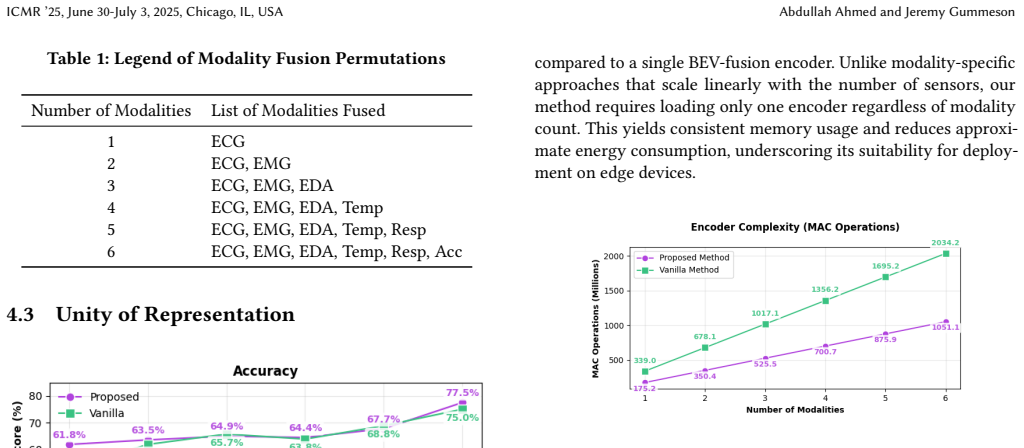
- Model complexity drops by 64% and inference runs about 1.4 times faster compared with modality-specific sensor fusion frameworks, with memory use staying constant as more sensors are added.
- The encoder never needs to be trained or fine-tuned on physiological data; only the downstream classifier is adapted, so adding a new sensor modality does not require additional encoder training.
- Because only one encoder is loaded regardless of modality count, the approach keeps memory and energy overhead flat as wearables incorporate more biosignals.
Reading between the lines
- A natural testable extension is to compare the frozen CIFAR-10 encoder against a VQ-VAE trained directly on biosignal spectrograms; if accuracies are similar, it would suggest that generic visual textural features already capture the structure needed for physiological inference.
- The approach probably transfers beyond the six tested signals to any time-series that can be meaningfully rasterized, such as audio, inertial, or environmental streams, since the encoder itself never sees sensor data.
- The reported 64% and 1.4x gains apply to the encoder stage; end-to-end savings on a real device may be smaller in tasks where the downstream classifier dominates runtime, a point the paper itself acknowledges.
- If the transfer works as claimed, it implies that stress-relevant information in biosignal spectrograms is largely carried by generic visual texture and local frequency structure rather than by modality-specific semantics, which would be a statement about the nature of physiological signal representations.
Editorial analysis
A structured set of objections, weighed in public.
Referee Report
Summary. The paper proposes a modality-agnostic encoding pipeline for physiological signals on resource-constrained devices. Raw time series from six sensor channels are resampled and converted into 128x128 STFT spectrograms, then encoded by a single VQ-VAE encoder that was pretrained on CIFAR-10 images and is used without fine-tuning. The resulting 16x16 latent codes are fed to a Conv-LSTM/MobileNetV3 classifier for binary stress detection on the WESAD dataset. The manuscript claims that this unified encoder reduces model complexity by 64%, provides 1.4x faster inference, and matches or exceeds a self-constructed BEVFusion-inspired baseline in accuracy, F1-score, and AUC. However, the paper reports no numerical results, error bars, or evaluation protocol details, and the efficiency claims in the introduction are inconsistent with the complexity ratio reported in Section 4.4.
Significance. If the central claim holds, the contribution is potentially significant: a single frozen image-pretrained VQ-VAE encoder could serve as a low-cost, modality-agnostic front-end for multimodal biosignal fusion, eliminating per-modality encoders on wearable devices. The evaluation design has the right ingredients to avoid circularity, since it uses an external pretrained model (CIFAR-10 VQ-VAE) and a public dataset (WESAD). However, as presented, the significance is prospective rather than demonstrated: no accuracy, F1, AUC, latency, or complexity measurements are actually reported, and the figures containing the evidence are not available in the manuscript. The paper would need to provide the missing numerical evaluation and reconcile its efficiency claims before its contribution can be assessed.
major comments (4)
- [Section 4.3 / Figure 4] Section 4.3 claims that the method "consistently matches or exceeds BEV-fusion in accuracy, F1-score, and AUC," but the manuscript provides no numerical values, error bars, number of independent runs, or train/validation/test split details, and Figure 4 itself is not included in the manuscript. This is the load-bearing empirical claim of the paper, so without these numbers the central result is unverifiable. Please provide tables of exact metrics with confidence intervals, specify the subject-level split for WESAD, and report the number of runs and random seeds.
- [Section 1 vs Section 4.4] The introduction claims a 64% model-complexity reduction and 1.4x faster inference, while Section 4.4 states that the latent encoder is 1.9x less computationally complex than BEV-fusion. These numbers are mutually inconsistent under standard definitions: a 64% reduction would make the proposed encoder roughly 2.8x lighter, not 1.9x. The authors should define the exact complexity metric (e.g., MACs, parameters, or memory traffic), report measured values for both systems, and reconcile the introduction with Section 4.4.
- [Section 4 / baseline protocol] The comparison baseline is a self-constructed "BEV-fusion-inspired" pipeline in which each modality-specific ResNet encoder is trained on 1,000 labeled samples, yet the proposed method's training set size, label count, and data-splitting procedure are not reported. Because the authors designed the baseline themselves, the fairness of the head-to-head comparison cannot be assessed. Please specify the exact training and evaluation protocol for both methods, including the number of subjects, samples, labels, and any preprocessing differences.
- [Sections 3.1-3.2 and 5] The paper's core assumption is that a VQ-VAE encoder pretrained on CIFAR-10 preserves physiologically relevant information when applied to STFT spectrograms of ECG, EMG, EDA, temperature, respiration, and accelerometer signals, but no evidence is provided to support this transfer: there are no classification results against raw-signal baselines, no latent-space probing or reconstruction analysis, and no PSNR or information-retention measurements. Section 5 itself concedes that further experimentation is needed to assess generalizability, which undermines the stated claim that the unified encoder works "without compromising representational accuracy." Please add a direct test of information retention in the frozen latent codes, such as a comparison with a modality-specific autoencoder or a reconstruction-quality analysis.
minor comments (4)
- [Figures] All figures are referenced through captions, but the actual plots (especially Figures 3, 4, and 5) are not available in the manuscript, making it impossible to inspect the reported trends; please include the figures with labeled axes and error bars.
- [Sections 4 and 4.1] Section 4 describes the downstream classifier as a Conv-LSTM, while Section 4.1 says a MobileNetV3 model with Conv-LSTM layers is fine-tuned; please clarify the exact architecture used.
- [Section 3.2, Eq. (2)] The objective in Eq. (2) is the beta-VAE ELBO with a KL term, which is not the standard VQ-VAE training objective; the standard VQ-VAE loss includes codebook and commitment terms, so the exact training setup is ambiguous.
- [References] The reference list contains malformed entries, for example reference [14] begins with "Lerchner, Irina Higgins" instead of a proper author list, and reference [17] appears with an inconsistent citation format.
Circularity Check
No significant circularity: the core transfer claim rests on an external frozen VQ-VAE, and the inconsistencies are reporting gaps rather than definitional reductions.
full rationale
The central claim—that a frozen VQ-VAE encoder pretrained on CIFAR-10 can serve as a modality-agnostic front-end for physiological signal STFT spectrograms—is an empirical transfer claim, not a tautology. Section 4.1 states that the encoder is pretrained on CIFAR-10 and frozen, with only a downstream classifier fine-tuned on WESAD data; no parameter of the encoder is fitted to the target modalities and then renamed as a prediction. The comparison uses an author-constructed BEV-fusion-inspired baseline, which could be a fairness concern, but unfairness is not circularity. The paper contains no self-citations by the authors and invokes no uniqueness theorem or prior-work ansatz to force its architecture. Quantitative inconsistencies, such as the Introduction's 64% complexity reduction and 1.4x speedup versus Section 4.4's 1.9x complexity figure, undermine verifiability but do not make the derivation self-referential. Section 5 explicitly acknowledges that 'further experimentation is necessary to fully assess its generalizability' and that evaluation was limited in modalities, datasets, and tasks; this is an honest limitation that affects evidentiary strength, not circularity. Because no equation, fitted parameter, or cited result is shown to be equivalent by construction to the paper's inputs, the appropriate circularity score is 0.
Assumptions & free parameters
free parameters (5)
- STFT window size =
128 records, 32-step overlap
- Spectral image dimensions =
128x128 RGB
- Latent code grid size =
16x16 per modality
- Baseline ResNet training samples =
1,000 labeled samples per modality
- VQ-VAE ELBO beta =
not reported
assumptions (4)
- domain assumption STFT spectral images retain sufficient task-relevant information from all six physiological modalities.
- domain assumption Features learned on CIFAR-10 natural images transfer to biosignal spectrograms.
- domain assumption WESAD self-reported STAI scores provide valid binary stress labels.
- domain assumption Latent code concatenation is a sufficient fusion strategy for the six signals.
Cite this review
Pith. "Pith review of Latent Sensor Fusion: Multimedia Learning of Physiological Signals for Resource-Constrained Devices." pith.science (2026). https://pith.science/paper/YNZO47D2
@misc{pith2026250714185,
  author       = {Pith},
  title        = {Pith review of: Latent Sensor Fusion: Multimedia Learning of Physiological Signals for Resource-Constrained Devices},
  year         = {2026},
  howpublished = {\url{https://pith.science/paper/YNZO47D2}},
  note         = {Machine review of arXiv:2507.14185}
}
read the original abstract
Latent spaces offer an efficient and effective means of summarizing data while implicitly preserving meta-information through relational encoding. We leverage these meta-embeddings to develop a modality-agnostic, unified encoder. Our method employs sensor-latent fusion to analyze and correlate multimodal physiological signals. Using a compressed sensing approach with autoencoder-based latent space fusion, we address the computational challenges of biosignal analysis on resource-constrained devices. Experimental results show that our unified encoder is significantly faster, lighter, and more scalable than modality-specific alternatives, without compromising representational accuracy.
Figures


Figures from the paper (2 more)

Reference graph
Works this paper leans on
-
[1]
Tadas Baltrušaitis, Chaitanya Ahuja, and Louis-Philippe Morency. 2019. Multi- modal Machine Learning: A Survey and Taxonomy. IEEE Transactions on Pattern Analysis and Machine Intelligence 41, 2 (2019), 423–443
work page 2019
-
[2]
Yoshua Bengio, Aaron Courville, and Pascal Vincent. 2013. Representation Learning: A Review and New Perspectives. IEEE Transactions on Pattern Analysis and Machine Intelligence 35, 8 (2013), 1798–1828
work page 2013
-
[3]
Varun Chandola, Arindam Banerjee, and Vipin Kumar. 2009. Anomaly Detection: A Survey. Comput. Surveys 41, 3 (2009), 1–58
work page 2009
-
[4]
Tat-Seng Chua, Chong-Wah Ngo, Roy Ka-Wei Lee, Ravi Kumar, Hady W Lauw, Denizhan Kara, Tomoyoshi Kimura, Shengzhong Liu, Jinyang Li, Dongxin Liu, Tianshi Wang, Ruijie Wang, Yizhuo Chen, Yigong Hu, and Tarek Abdelzaher
-
[5]
Jacob Devlin, Ming-Wei Chang, Kenton Lee, and Kristina Toutanova. 2019. BERT: Pre-training of Deep Bidirectional Transformers for Language Understanding. In Proceedings of the 2019 Conference of the North American Chapter of the Association for Computational Linguistics (NAACL). 4171–4186
work page 2019
-
[6]
Sidney K D’Mello, Panayiotis (Panos) Georgiou, Stefan Scherer, Emily Mower Provost, Mohammad Soleymani, Marcelo Worsley, Philip Schmidt, Attila Reiss, Robert Duerichen, Claus Marberger, and Kristof Van Laerhoven. 2018. Intro- ducing WESAD, a Multimodal Dataset for Wearable Stress and Affect Detection. Proceedings of the 20th ACM International Conference o...
arXiv 2018
-
[7]
Patrick Esser, Robin Rombach, and Björn Ommer. 2020. Taming Transformers for High-Resolution Image Synthesis. arXiv (2020). doi:10.48550/arxiv.2012.09841 arXiv:2012.09841
-
[8]
Kaiming He, Xiangyu Zhang, Shaoqing Ren, and Jian Sun. 2015. Deep Residual Learning for Image Recognition. arXiv (2015). doi:10.48550/arxiv.1512.03385 arXiv:1512.03385
Show all 33 references
-
[9]
Kaiming He, Xiangyu Zhang, Shaoqing Ren, and Jian Sun. 2016. Deep Residual Learning for Image Recognition. InProceedings of the IEEE Conference on Computer Vision and Pattern Recognition (CVPR) . 770–778
2016
- [10]
- [11]
-
[12]
Yehuda Koren, Robert Bell, and Chris Volinsky. 2009. Matrix Factorization Tech- niques for Recommender Systems. Computer 42, 8 (2009), 30–37
2009
-
[13]
Yann LeCun, Yoshua Bengio, and Geoffrey Hinton. 2015. Deep Learning. Nature 521, 7553 (2015), 436–444
2015
-
[14]
Burgess and Xavier Glorot and Matthew M
Lerchner, Irina Higgins and Loïc Matthey and Arka Pal and Christopher P. Burgess and Xavier Glorot and Matthew M. Botvinick and Shakir Mohamed and Alexander. [n. d.]. beta-VAE: Learning Basic Visual Concepts with a Constrained Variational Framework. In 5th International Confer...
2017
-
[15]
Patrick Lewis, Ethan Perez, Aleksandra Piktus, Fabio Petroni, Vladimir Karpukhin, Naman Goyal, Heinrich Küttler, Mike Lewis, Wen-tau Yih, Tim Rocktäschel, et al
-
[16]
Van Der Laak, Bram Van Ginneken, and Clara I
Geert Litjens, Thijs Kooi, Babak Ehteshami Bejnordi, Arnaud Arindra Adiyoso Setio, Francesco Ciompi, Mohsen Ghafoorian, Jeroen A.W.M. Van Der Laak, Bram Van Ginneken, and Clara I. Sánchez. 2017. A Survey on Deep Learning in Medical Image Analysis. Medical Image Analysis 42 (20...
2017
- [17]
- [18]
-
[19]
Tomas Mikolov, Kai Chen, Greg Corrado, and Jeffrey Dean. 2013. Efficient Estimation of Word Representations in Vector Space. arXiv preprint (2013). arXiv:1301.3781
2013 arXiv
- [20]
-
[21]
Antonio Ortega, Pascal Frossard, Jelena Kovačević, José M. F. Moura, and Pierre Vandergheynst. 2018. Graph Signal Processing: Overview, Challenges, and Ap- plications. Proc. IEEE 106, 5 (2018), 808–828. doi:10.1109/jproc.2018.2820126
2018
-
[22]
Jeffrey Pennington, Richard Socher, and Christopher D. Manning. 2014. GloVe: Global Vectors for Word Representation. In Proceedings of the 2014 Conference on Empirical Methods in Natural Language Processing (EMNLP) . 1532–1543
2014
-
[23]
Alec Radford, Jong Wook Kim, Chris Hallacy, Aditya Ramesh, Gabriel Goh, Sand- hini Agarwal, Girish Sastry, Amanda Askell, Pamela Mishkin, Jack Clark, et al
-
[24]
Olga Russakovsky, Jia Deng, Hao Su, Jonathan Krause, Sanjeev Satheesh, Sean Ma, Zhiheng Huang, Andrej Karpathy, Aditya Khosla, Michael Bernstein, et al
-
[25]
Sola and J
J. Sola and J. Sevilla. 1997. Importance of input data normalization for the application of neural networks to complex industrial problems.IEEE Transactions on Nuclear Science 44, 3 (1997), 1464–1468. doi:10.1109/23.589532
1997 doi
-
[26]
Aaron van den Oord, Oriol Vinyals, and Koray Kavukcuoglu. 2017. Neural Discrete Representation Learning. Advances in Neural Information Processing Systems 30 (2017)
2017
-
[27]
Gomez, Łukasz Kaiser, and Illia Polosukhin
Ashish Vaswani, Noam Shazeer, Niki Parmar, Jakob Uszkoreit, Llion Jones, Aidan N. Gomez, Łukasz Kaiser, and Illia Polosukhin. 2017. Attention Is All You Need. Advances in Neural Information Processing Systems 30 (2017)
2017
- [28]
-
[29]
Yichen Xie, Chenfeng Xu, Marie-Julie Rakotosaona, Patrick Rim, Federico Tombari, Kurt Keutzer, Masayoshi Tomizuka, and Wei Zhan. 2023. SparseFusion: Fusing Multi-Modal Sparse Representations for Multi-Sensor 3D Object Detec- tion. 2023 IEEE/CVF International Conference on Comp...
2023
-
[2015]
International Journal of Computer Vision 115, 3 (2015), 211–252
ImageNet Large Scale Visual Recognition Challenge. International Journal of Computer Vision 115, 3 (2015), 211–252
2015
-
[2020]
Advances in Neural Information Processing Systems 33 (2020), 9459–9474
Retrieval-Augmented Generation for Knowledge-Intensive NLP Tasks. Advances in Neural Information Processing Systems 33 (2020), 9459–9474
2020
-
[2021]
In Proceedings of the 38th International Conference on Machine Learning (ICML)
Learning Transferable Visual Models From Natural Language Supervision. In Proceedings of the 38th International Conference on Machine Learning (ICML) . 8748–8763
-
[2024]
Proceedings of the ACM on Web Conference 2024 (2024), 2795–2806
FreqMAE: Frequency-Aware Masked Autoencoder for Multi-Modal IoT Sensing. Proceedings of the ACM on Web Conference 2024 (2024), 2795–2806. doi:10.1145/3589334.3645346
2024
Reviewed August 6, 2026 · model on record in the stance chip above.
Discussion (0). Sign in to comment.