REVIEW 3 major objections 5 minor 1 cited by
ToxicTone: A Mandarin Audio Dataset Annotated for Toxicity and Toxic Utterance Tonality
T0 review · 3 major / 5 minor · reviewed 2026-08-07 · deepseek-v4-flash
Pith's one-line read A new 52,062-clip Mandarin speech dataset labels both the form and the source of toxicity, and a model that hears tone as well as words detects it best.
desk verdict ToxicTone is a genuinely useful Mandarin spoken-toxicity resource, but the paper's central claim that it captures hidden prosodic toxicity is undercut by its own text-based prefilter. read the letter →
The pith
A machine-rendered reading of the paper's core claim, the machinery that carries it, and where it could break.
The reading
What carries the argument
The load-bearing object is the annotation scheme: a two-axis label space (form of toxicity and source of toxicity) applied to real-world web-crawled audio, split into 2-to-10-second clips. The pipeline first runs speaker diarization, ASR transcription via K2D, and a text-based BERT toxicity filter (score above 0.75) that reduces 770k candidate clips to 52k, augmented with 600 rule-matched pornographic-language samples. Human annotation by 11 native Mandarin speakers resolves ties with a fifth annotator. The detection model is an ensemble of three pre-trained encoders—XLS-R 1B (acoustic), SONAR text (linguistic), and Emotion2Vec+ Large (emotional)—feeding a three-layer linear classifier; the same features are also used for one-vs-all source classification.
What would settle it
Take a random sample of the clips that scored below 0.75 on the text filter and have native Mandarin speakers annotate them with the same two-layer scheme; if a substantial fraction are toxic, particularly via angry, dismissive, or sarcastic tone, the dataset's claim to capture tone-hidden toxicity fails.
Extended reading notes
Core claim
ToxicTone is, to the authors' knowledge, the largest public spoken toxicity dataset for Mandarin, and it is built to separate what is said from how it is said. Each of the 52,062 two-to-ten-second clips carries two annotation layers: the form of toxicity and its source, where the source layer captures tone-based toxicity such as dismissiveness, sarcasm, anger, and threat that can co-occur with innocuous words. The paper's central empirical finding is that the multimodal ensemble $X+S_T+E$—concatenating XLS-R speech features, SONAR text embeddings of ASR transcripts, and Emotion2Vec+ emotion embeddings—outperforms all text-only and single-encoder baselines on binary toxicity detection (F1 64.16% vs. 50.54% for the best text baseline), with the gains concentrated on the tone-driven source categories. The authors read this as evidence that speech-specific prosodic cues are not optional extras but necessary signal for spoken toxicity detection.
Load-bearing premise
The pipeline assumes that a text-based classifier scoring above 0.75 is a sufficient gate for what counts as toxic speech, so utterances whose toxicity lives mainly in tone rather than words may be discarded before any human sees them.
Editorial extensions
If this is right
- ToxicTone provides a public 52,062-clip benchmark with both binary toxicity labels and fine-grained form and source labels for Mandarin speech.
- Combining acoustic (XLS-R), linguistic (SONAR text), and emotional (Emotion2Vec+) features outperforms text-only and single-modality models on binary toxicity detection.
- The best configuration reaches 64.16% F1, while the strongest text baseline reaches 50.54%, showing that speech cues carry signal text misses.
- Source classification is strongest for word-based toxicity and weakest for threat, reflecting label imbalance and the subtlety of tone-based categories.
Reading between the lines
- The text-based filter likely sets an upper bound on how much purely prosodic toxicity the dataset can contain; auditing rejected clips would quantify that ceiling.
- Because source labels are fine-grained, they could be used as auxiliary supervision or as targets for a hierarchical model, potentially improving the weakest categories (sarcasm, threat).
- The form and source annotation scheme is language-neutral and could transfer to other dialects or languages where indirect toxicity is common.
- Re-running the same pipeline with an audio-based or multimodal prefilter on the original 770k candidate clips could grow the dataset substantially and test whether tone-driven toxicity was being screened out.
Editorial analysis
A structured set of objections, weighed in public.
Referee Report
Summary. This manuscript introduces ToxicTone, a Mandarin audio dataset of 52,062 two-to-ten-second clips (about 93 hours), collected from web-crawled audio, diarized and transcribed with public models, then prefiltered by a text-based Chinese toxicity classifier at a 0.75 threshold plus 600 rule-based pornographic samples, and annotated by 11 native speakers for both the form and the source of toxicity. The paper reports binary toxicity detection and multi-label source classification using SONAR, XLS-R, and Emotion2Vec features, and claims that the best ensemble (X+ST+E, F1 64.16%) outperforms text-only baselines, underscoring the essential role of speech-specific cues and the ability to reveal hidden toxic expressions.
Significance. If its central claims were supported, ToxicTone would be a valuable resource: it is the largest public Mandarin audio toxicity dataset by utterance count and duration, with a two-axis annotation scheme (form and source) and a public GitHub release. The annotation effort (11 annotators, approximately 900 hours) and the use of real-world topical categories are concrete strengths. The paper also ships a reproducible pipeline built on public models, which is a practical asset. However, the evidence currently supports the dataset's scale and internal statistics, not the stronger claims about non-lexical prosodic toxicity, because the collection pipeline conditions on text-visible toxicity and the modeling comparisons lack a matched in-domain text baseline.
major comments (3)
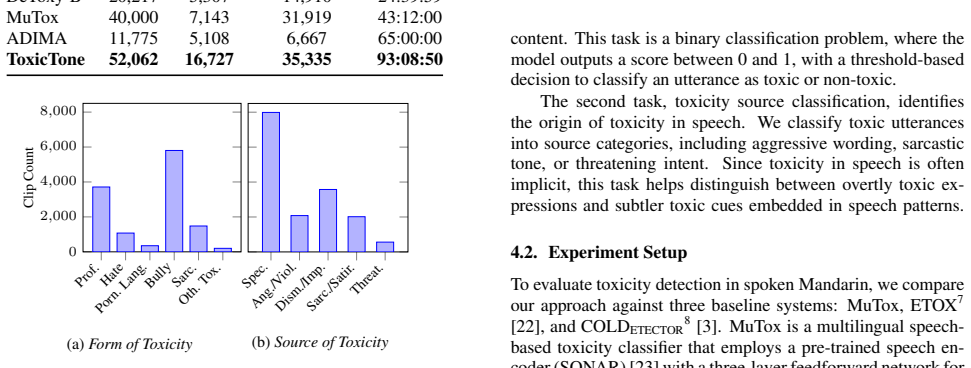
- [3.2 (Preprocessing)] The text-toxicity prefilter is the load-bearing step for the paper's central novelty, and the manuscript provides no evidence that the retained corpus contains hidden, non-lexical toxicity. All 52,062 clips (plus 600 porn-rule clips) were selected because the Alibaba-pai classifier scored their ASR transcripts above 0.75; clips with benign text but toxic prosody—sarcastic praise, dismissive politeness, calmly delivered threats—are discarded by construction. The source-label distribution in Section 3.3 (Specific Words nearly 8,000, Threatening about 560, Sarcastic/Satirical relatively rare) is consistent with lexical bias. The claims in the Abstract and Section 6 that ToxicTone 'uncovers toxic content that may be hidden behind seemingly polite words' therefore require a held-out low-score sample: the authors should annotate a random sample of clips with scores at or below 0.75 and report the prefilter's recall against human labels, along with threshold sensitivity. Without this, the dataset can be described as a large audio corpus of lexically prompted toxic speech, but not as evidence about prosodic-only toxicity.
- [4.2 and Table 3] Table 3 does not include a matched text-only model trained on ToxicTone transcripts, so the claimed superiority of X+ST+E does not establish that speech cues are essential. ST is a frozen SONAR text encoder, COLDETECTOR is fine-tuned on the unrelated COLD dataset, and ETOX is a lexicon-based system. The correct control is a text encoder (e.g., bert-base-chinese or RoBERTa) fine-tuned on the ASR transcripts of the same train/dev/test splits with the same labels and decision threshold, reported with the same metrics. If a fine-tuned text model matches or exceeds the reported F1 of 64.16%, the multimodal advantage disappears; if it does not, the result gains support. This experiment is required to back the abstract's 'essential role of speech-specific cues.'
- [3.3 (Human Annotation)] No inter-annotator agreement is reported for the human labels. Given that four annotators per sample can still produce two-to-two ties requiring a fifth review, and that only 32% of the prefiltered clips (16,727/52,062, Table 1) are labeled toxic despite the text prefilter, label reliability is a load-bearing property of the dataset. The authors should report agreement statistics (e.g., Fleiss' kappa or Krippendorff's alpha) overall and per form/source label, and they should follow through on the Section 5 promise to release annotator-level annotations.
minor comments (5)
- [3.2 (Preprocessing)] The paragraph justifying the 0.75 threshold is a single sentence; the authors should report precision/recall of the prefilter on a validation sample and the effect of the threshold on the final dataset composition.
- [3.2 (Preprocessing)] The paper does not report ASR word error rate or diarization error for the models cited as [16] and [17]; these errors propagate into the text prefilter and into the ST text encoder, so at least a qualitative estimate would help readers interpret the pipeline's noise.
- [4.3 and Table 3] The ETOX and COLDETECTOR baselines are not described in enough detail to reproduce their audio-vs-text input configuration; for example, it is unclear how audio is fed to COLDETECTOR and which language resources ETOX uses for Mandarin.
- [4.4 and Figure 3] For the one-vs-all source classifiers, the manuscript should state whether the same test clip can receive multiple source labels and how the decision threshold is applied, since Figure 3 reports both F1 and accuracy for each source category.
- [Throughout] There are several formatting and naming inconsistencies: 'COLDETECTOR' appears as 'COLD ETECTOR' in one line, and 'Etox'/'ETOX' are used interchangeably; please normalize the baseline names.
Circularity Check
No circularity: ToxicTone is an empirical dataset and benchmark paper with no derivational step that reduces to its own inputs.
full rationale
ToxicTone is an empirical resource paper: its contributions are a collected and annotated corpus, descriptive statistics, and benchmark results from a multimodal classifier. There is no derivation chain in which an output quantity is defined in terms of the quantity it claims to predict. The Section 3.2 text-toxicity prefilter (Alibaba-pai score > 0.75) is a corpus-selection heuristic; it conditions the sample on lexically visible toxicity and therefore weakens the 'hidden prosodic toxicity' generalization, but it is not circular because the prefilter score is not presented as an independent prediction nor as evidence for the prosodic-cue claim. The use of the authors' prior ASR and diarization models (references [16] and [17]) is standard tooling; these are externally pretrained models not fitted to ToxicTone labels, so they do not smuggle in the paper's conclusions. The X+ST+E result is an empirical comparison among encoders and baselines, not a quantity constructed to equal its input. No fitted parameter is renamed as a prediction, and no load-bearing claim rests solely on a self-citation. The main risks are external-validity and baseline-comparison concerns, not circularity.
Assumptions & free parameters
free parameters (3)
- text_toxicity_filter_threshold =
0.75
- binary_decision_threshold =
not reported
- porn_word_list_extraction_rule =
rule-based list, 600 samples
assumptions (4)
- domain assumption A text-based toxicity classifier score is a valid proxy for spoken toxicity for data selection.
- domain assumption ASR transcriptions from K2D are accurate enough to preserve toxicity-relevant content.
- domain assumption Prosodic cues carry toxicity information beyond lexical content.
- domain assumption Majority annotations by 11 native speakers constitute ground truth.
Cite this review
Pith. "Pith review of ToxicTone: A Mandarin Audio Dataset Annotated for Toxicity and Toxic Utterance Tonality." pith.science (2026). https://pith.science/paper/YOOBS5AF
@misc{pith2026250515773,
  author       = {Pith},
  title        = {Pith review of: ToxicTone: A Mandarin Audio Dataset Annotated for Toxicity and Toxic Utterance Tonality},
  year         = {2026},
  howpublished = {\url{https://pith.science/paper/YOOBS5AF}},
  note         = {Machine review of arXiv:2505.15773}
}
read the original abstract
Despite extensive research on toxic speech detection in text, a critical gap remains in handling spoken Mandarin audio. The lack of annotated datasets that capture the unique prosodic cues and culturally specific expressions in Mandarin leaves spoken toxicity underexplored. To address this, we introduce ToxicTone -- the largest public dataset of its kind -- featuring detailed annotations that distinguish both forms of toxicity (e.g., profanity, bullying) and sources of toxicity (e.g., anger, sarcasm, dismissiveness). Our data, sourced from diverse real-world audio and organized into 13 topical categories, mirrors authentic communication scenarios. We also propose a multimodal detection framework that integrates acoustic, linguistic, and emotional features using state-of-the-art speech and emotion encoders. Extensive experiments show our approach outperforms text-only and baseline models, underscoring the essential role of speech-specific cues in revealing hidden toxic expressions.
Figures


Figures from the paper (1 more)

Forward citations
Cited by 1 Pith paper
-
Towards High-Level Semantic Intelligence
A survey proposing that AI's next stage should be understood as High-Level Semantic Intelligence: mastering humor, sarcasm, metaphor, empathy, persuasion, and narrative across modalities.
Reference graph
Works this paper leans on
-
[1]
Introduction Toxic speech in online media is a serious global problem that creates hostile environments, discourages participation, and si- lences vulnerable voices. For individuals, exposure to toxic speech can cause psychological problems like stress, anxiety, and depression [1]. This concern is more serious on social platforms, where users—especially t...
-
[2]
ToxicTone: A Mandarin Audio Dataset Annotated for Toxicity and Toxic Utterance Tonality
Related work Previous works on Chinese toxic speech detection focus mainly on text. COLA [7] represents the first Chinese offensive language classification dataset, comprising 18.7k comments sourced from YouTube and Weibo. The dataset categorizes texts into four classes: neutral, insulting, antisocial, and ille- gal. TOCP [8], which focuses on Chinese pro...
work page Pith review arXiv 2025
-
[3]
Dataset collection 3.1. Definition of toxicity We define toxicity via two aspects: theformof toxicity and the sourceof toxicity. Forms of toxicity:These describe the specific manifesta- tions of harmful or offensive language. They include: • Profanities (Prof.): Offensive words that demonstrate disre- spect or negativity. For example,fuck,bastard,sissy,id...
-
[4]
Experiments 4.1. Experiment Type We evaluate two classification tasks. The first, toxicity detec- tion, determines whether a given speech segment contains toxic 5https://podcasters.apple.com/support/1691-apple-podcasts-categories 6https://open.spotify.com/genre/0JQ5DArNBzkmxXHCqFLx2U SocNews Entr GamingPsychLifeHealthFit EducFood CultArts Bus TechSciParen...
-
[5]
Limitation and future work While our dataset and models establish a strong foundation for Chinese spoken toxic speech detection, several areas offer opportunities for further refinement. The dataset reflects real- world toxicity distributions, including natural class imbalances, such as the higher prevalence of toxic speech in gaming con- tent. While this...
-
[6]
Conclusion This work introduces the first large-scale Mandarin Chinese toxic speech dataset, addressing a critical gap in spoken toxic speech detection. Unlike prior text-based datasets, our dataset incorporates prosodic cues and detailed toxicity labels, enabling a more nuanced understanding of harmful speech. Our exper- iments demonstrate that multimoda...
-
[7]
X. Tang and X. Shen, “Categorizing offensive language in social networks: A Chinese corpus, systems and an explainable tool,” in Proceedings of the 19th Chinese National Conference on Compu- tational Linguistics, 2020, pp. 1045–1056
work page 2020
-
[8]
R. M. Kowalski, G. W. Giumetti, A. N. Schroeder, and M. R. Lattanner, “Bullying in the digital age: a critical review and meta- analysis of cyberbullying research among youth.”Psychological bulletin, 2014
work page 2014
Show all 37 references
-
[9]
On- line networks of racial hate: A systematic review of 10 years of research on cyber-racism,
A.-M. Bliuc, N. Faulkner, A. Jakubowicz, and C. McGarty, “On- line networks of racial hate: A systematic review of 10 years of research on cyber-racism,”Computers in Human Behavior, 2018
2018
-
[10]
COLD: A benchmark for Chinese offensive language detection,
J. Deng, J. Zhou, H. Sun, C. Zheng, F. Mi, H. Meng, and M. Huang, “COLD: A benchmark for Chinese offensive language detection,” inProceedings of the 2022 Conference on Empiri- cal Methods in Natural Language Processing, 2022, pp. 11 580– 11 599
2022
-
[11]
Code-switching and identity constructions in taiwan tv commercials,
M.-c. Chiu, “Code-switching and identity constructions in taiwan tv commercials,”Monumenta Taiwanica, 2012
2012
-
[12]
RTP-LX: Can LLMs evaluate toxi- city in multilingual scenarios?
A. de Wynter, I. Watts, T. Wongsangaroonsri, M. Zhang, N. Farra, N. E. Altıntoprak, L. Baur, S. Claudet, P. Gajdusek, C. G ¨oren, Q. Gu, A. Kaminska, T. Kaminski, R. Kuo, A. Kyuba, J. Lee, K. Mathur, P. Merok, I. Milovanovi´c, N. Paananen, V .-M. Paana- nen, A. Pavlenko, B. P....
2025
-
[13]
Facilitat- ing fine-grained detection of Chinese toxic language: Hierarchical taxonomy, resources, and benchmarks,
J. Lu, B. Xu, X. Zhang, C. Min, L. Yang, and H. Lin, “Facilitat- ing fine-grained detection of Chinese toxic language: Hierarchical taxonomy, resources, and benchmarks,” inProceedings of the 61st Annual Meeting of the Association for Computational Linguistics (Volume 1: Long P...
2023
-
[14]
SWITCH- BOARD: Telephone speech corpus for research and develop- ment,
J. J. Godfrey, E. C. Holliman, and J. McDaniel, “SWITCH- BOARD: Telephone speech corpus for research and develop- ment,” inAcoustics, speech, and signal processing, ieee interna- tional conference on, 1992
1992
-
[15]
TOCP: A dataset for Chinese profanity processing,
H. Yang and C.-J. Lin, “TOCP: A dataset for Chinese profanity processing,” inProceedings of the Second Workshop on Trolling, Aggression and Cyberbullying, 2020, pp. 6–12
2020
-
[16]
DeToxy: A Large-Scale Multimodal Dataset for Toxicity Clas- sification in Spoken Utterances,
S. Ghosh, S. Lepcha, S. Sakshi, R. R. Shah, and S. Umesh, “DeToxy: A Large-Scale Multimodal Dataset for Toxicity Clas- sification in Spoken Utterances,” inInterspeech 2022, 2022, pp. 5185–5189
2022
-
[17]
toxic” and “non-toxic
and splitting the results into 2–10 second clips. Given the enormous number of generated segments, a pre- liminary filtering step was required. To this end, we applied a text-based toxicity classifier from Alibaba-pai3—based on Chi- nese BERT-base [18] —to the transcriptions. ...
-
[18]
MuTox: Universal MUltilingual audio-based TOXicity dataset and zero- shot detector,
M. Costa-juss `a, M. Meglioli, P. Andrews, D. Dale, P. Hansanti, E. Kalbassi, A. Mourachko, C. Ropers, and C. Wood, “MuTox: Universal MUltilingual audio-based TOXicity dataset and zero- shot detector,” inFindings of the Association for Computational Linguistics: ACL 2024, 2024...
2024
-
[19]
ADIMA: Abuse Detection In Multilingual Audio,
V . Gupta, R. Sharon, R. Sawhney, and D. Mukherjee, “ADIMA: Abuse Detection In Multilingual Audio,” inICASSP 2022 - 2022 IEEE International Conference on Acoustics, Speech and Signal Processing (ICASSP), 2022
2022
-
[20]
MOSI: Mul- timodal Corpus of Sentiment Intensity and Subjectivity Analy- sis in Online Opinion Videos ,
A. Zadeh, R. Zellers, E. Pincus, and L.-P. Morency, “MOSI: Mul- timodal Corpus of Sentiment Intensity and Subjectivity Analy- sis in Online Opinion Videos ,”arXiv preprint arXiv:1606.06259, 2016
2016 arXiv
-
[21]
Common V oice: A Massively-Multilingual Speech Corpus,
R. Ardila, M. Branson, K. Davis, M. Kohler, J. Meyer, M. Hen- retty, R. Morais, L. Saunders, F. Tyers, and G. Weber, “Common V oice: A Massively-Multilingual Speech Corpus,” inProceedings of the Twelfth Language Resources and Evaluation Conference, 2020
2020
-
[22]
Seamless: Multilingual expressive and streaming speech translation,
L. Barrault, Y .-A. Chung, M. C. Meglioli, D. Dale, N. Dong, M. Duppenthaler, P.-A. Duquenne, B. Ellis, H. Elsahar, J. Haa- heimet al., “Seamless: Multilingual expressive and streaming speech translation,”arXiv preprint arXiv:2312.05187, 2023
2023 arXiv
-
[23]
Building a Taiwanese Mandarin Spoken Language Model: A First Attempt,
C.-K. Yang, Y .-K. Fu, C.-A. Li, Y .-C. Lin, Y .-X. Lin, W.-C. Chen, H. L. Chung, C.-Y . Kuan, W.-P. Huang, K.-H. Lu, T.-Q. Lin, H.- H. Wang, E.-P. Hu, C.-J. Hsu, L.-H. Tseng, I.-H. Chiu, U. Sanga, X. Chen, P. chun Hsu, S. wen Yang, and H. yi Lee, “Building a Taiwanese Mandari...
2024
-
[24]
Leave no knowledge behind during knowledge distillation: Towards practical and effective knowledge distillation for code-switching asr using realistic data,
L.-H. Tseng, Z.-C. Chen, W.-S. Chang, C.-K. Lee, T.-R. Huang, and H.-y. Lee, “Leave no knowledge behind during knowledge distillation: Towards practical and effective knowledge distillation for code-switching asr using realistic data,” in2024 IEEE Spoken Language Technology Wo...
2024
-
[25]
BERT: Pre- training of deep bidirectional transformers for language under- standing,
J. Devlin, M.-W. Chang, K. Lee, and K. Toutanova, “BERT: Pre- training of deep bidirectional transformers for language under- standing,” inProceedings of the 2019 Conference of the North American Chapter of the Association for Computational Linguis- tics: Human Language Techno...
2019
-
[26]
Antiso- cial behavior in online discussion communities,
J. Cheng, C. Danescu-Niculescu-Mizil, and J. Leskovec, “Antiso- cial behavior in online discussion communities,” inProceedings of the international aaai conference on web and social media, 2015
2015
-
[27]
Online Harassment, Digital Abues, and Cyberstalking in America,
A. Lenhart, M. Ybarra, K. Zickuhr, and M. Price-Feeney, “Online Harassment, Digital Abues, and Cyberstalking in America,” 2016
2016
-
[28]
GPT-4o System Card,
OpenAIet al., “GPT-4o System Card,” 2024. [Online]. Available: https://arxiv.org/abs/2410.21276
2024 arXiv
-
[29]
Toxicity in multilingual machine trans- lation at scale,
M. Costa-juss `a, E. Smith, C. Ropers, D. Licht, J. Maillard, J. Fer- rando, and C. Escolano, “Toxicity in multilingual machine trans- lation at scale,” inFindings of the Association for Computational Linguistics: EMNLP 2023, 2023
2023
-
[30]
SONAR: sentence- level multimodal and language-agnostic representations,
P.-A. Duquenne, H. Schwenk, and B. Sagot, “SONAR: sentence- level multimodal and language-agnostic representations,”arXiv e-prints, pp. arXiv–2308, 2023
2023
-
[31]
XLS-R: Self-supervised Cross-lingual Speech Rep- resentation Learning at Scale,
A. Babu, C. Wang, A. Tjandra, K. Lakhotia, Q. Xu, N. Goyal, K. Singh, P. von Platen, Y . Saraf, J. Pino, A. Baevski, A. Conneau, and M. Auli, “XLS-R: Self-supervised Cross-lingual Speech Rep- resentation Learning at Scale,” inInterspeech 2022, 2022
2022
-
[32]
SUPERB: Speech Processing Universal PER- formance Benchmark,
S. wen Yanget al., “SUPERB: Speech Processing Universal PER- formance Benchmark,” inInterspeech 2021, 2021
2021
-
[33]
emotion2vec: Self-Supervised Pre-Training for Speech Emotion Representation,
Z. Ma, Z. Zheng, J. Ye, J. Li, Z. Gao, S. Zhang, and X. Chen, “emotion2vec: Self-Supervised Pre-Training for Speech Emotion Representation,”Proc. ACL 2024 Findings, 2024
2024
-
[34]
Emo- bias: A Large Scale Evaluation of Social Bias on Speech Emotion Recognition,
Y .-C. Lin, H. Wu, H.-C. Chou, C.-C. Lee, and H. yi Lee, “Emo- bias: A Large Scale Evaluation of Social Bias on Speech Emotion Recognition,” inInterspeech 2024, 2024
2024
-
[35]
On the social bias of speech self-supervised models,
Y .-C. Lin, T.-Q. Lin, H.-C. Lin, A. T. Liu, and H. yi Lee, “On the social bias of speech self-supervised models,” inInterspeech 2024, 2024
2024
-
[36]
Handling bias in toxic speech detection: A survey,
T. Garg, S. Masud, T. Suresh, and T. Chakraborty, “Handling bias in toxic speech detection: A survey,”ACM Computing Surveys, 2023
2023
-
[37]
Spoken Stereoset: on Evaluating Social Bias Toward Speaker in Speech Large Lan- guage Models,
Y .-C. Lin, W.-C. Chen, and H.-Y . Lee, “Spoken Stereoset: on Evaluating Social Bias Toward Speaker in Speech Large Lan- guage Models,” in2024 IEEE Spoken Language Technology Workshop (SLT), 2024
2024
Reviewed August 7, 2026 · model on record in the stance chip above.
Discussion (0). Continue with ORCID to comment.