Competing Effect of Biquadratic and Heisenberg Coupling on Magnetic Tunnel Junction Molecular Spintronics Devices
Pith reviewed 2026-05-14 18:56 UTC · model grok-4.3
The pith
Biquadratic coupling plays a secondary role to Heisenberg coupling in stabilizing magnetization of molecular spintronics devices.
A machine-rendered reading of the paper's core claim, the machinery that carries it, and where it could break.
Core claim
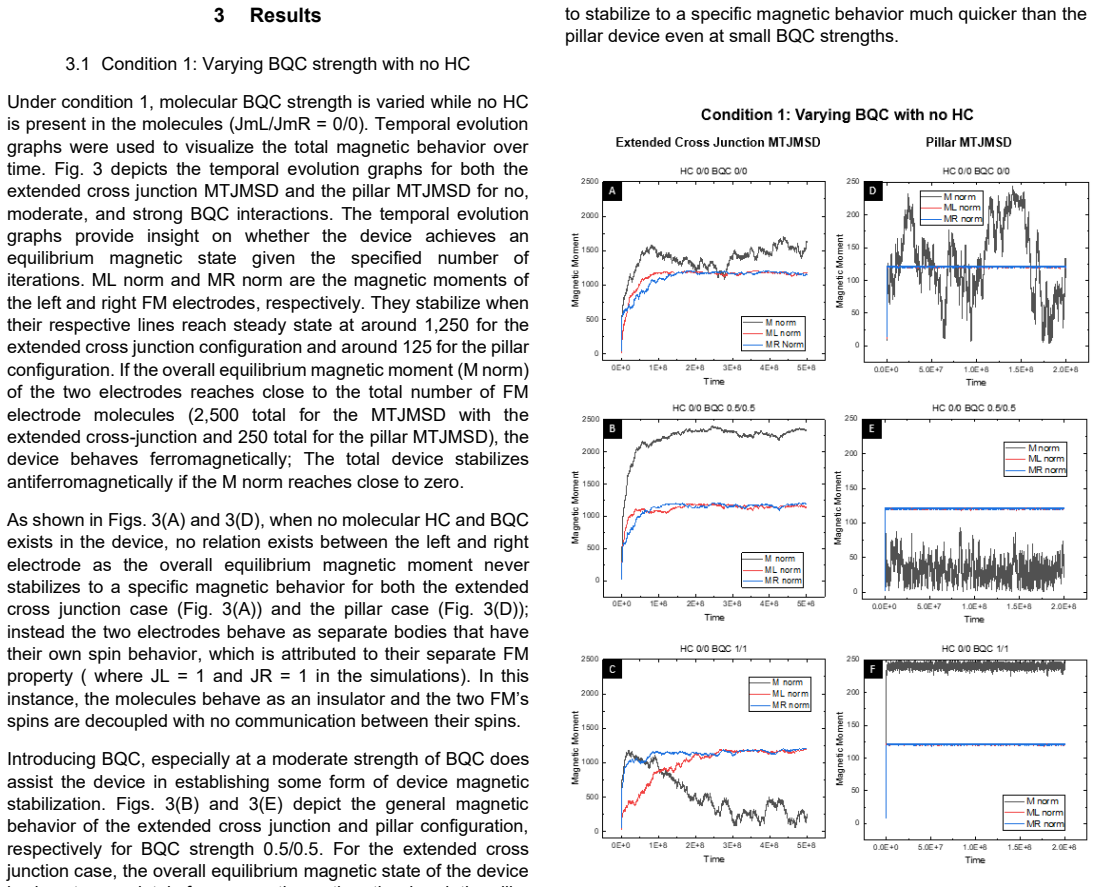
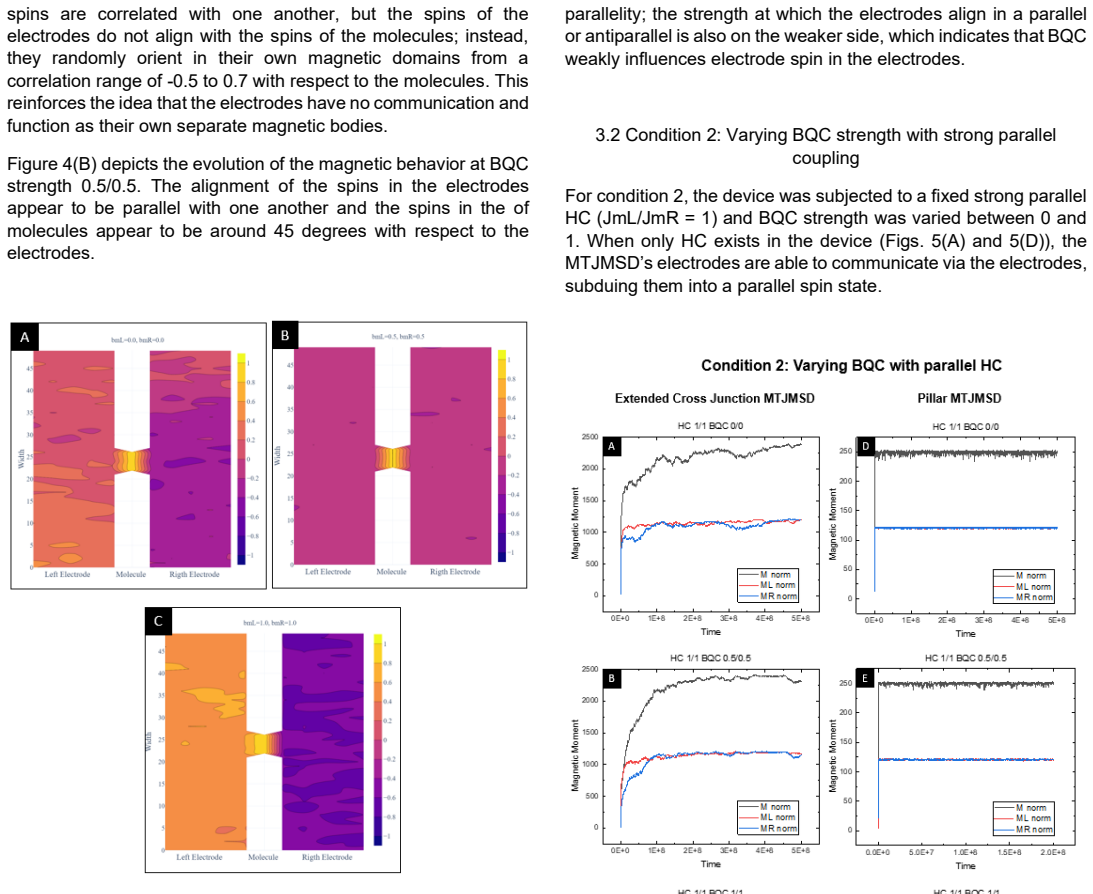
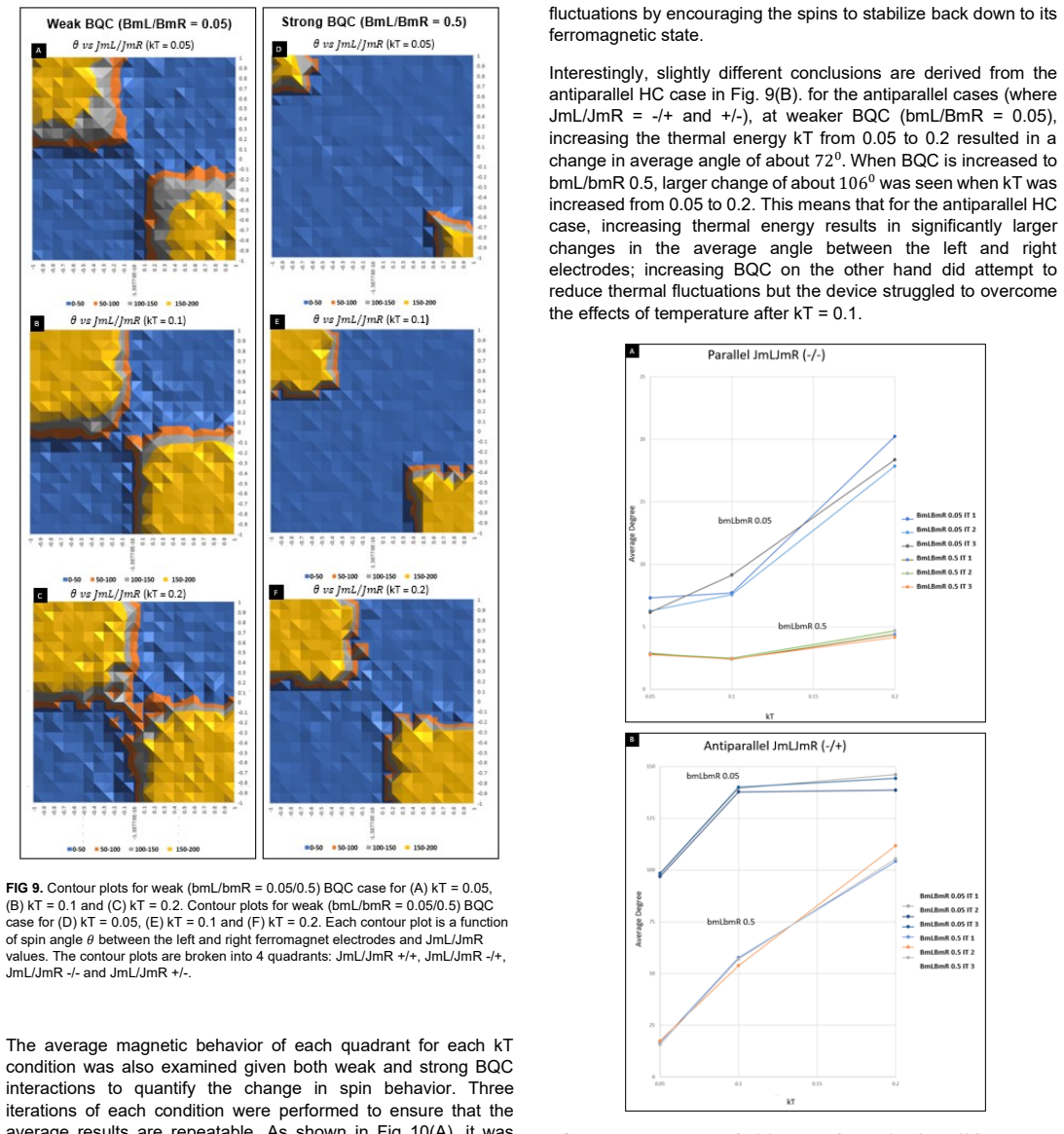
In simulations of MTJMSDs, increasing biquadratic coupling strength produced minimal changes in overall magnetization when strong Heisenberg coupling was present, showing that Heisenberg coupling dominates device magnetization. Temporal studies revealed that devices with only biquadratic coupling failed to reach magnetic stability, while those with both couplings achieved stable states thanks to the stabilizing effect of Heisenberg coupling. This establishes biquadratic coupling as secondary in magnetization dynamics and unable to overcome Heisenberg coupling's stronger stabilizing effect.
What carries the argument
Three-dimensional Heisenberg model Monte Carlo simulations that vary biquadratic coupling strength under conditions of no molecular Heisenberg coupling, strong parallel Heisenberg coupling, and strong antiparallel Heisenberg coupling.
If this is right
- Devices with both couplings reach stable magnetic states due to Heisenberg coupling.
- Increasing biquadratic coupling has little impact on magnetization when Heisenberg coupling is strong.
- Biquadratic coupling explains observed magnetic phases beyond parallel and antiparallel in experiments.
- Heisenberg coupling is the primary driver of magnetization dynamics in these devices.
Where Pith is reading between the lines
- Device design could focus on enhancing Heisenberg coupling for stability while using biquadratic coupling to access additional phase orientations.
- This competition between couplings may influence behavior in other nanoscale magnetic structures with similar edge effects.
- Experimental validation could involve measuring stability thresholds as coupling strengths are tuned independently.
Load-bearing premise
The three-dimensional Heisenberg model with the chosen coupling parameters and boundary conditions accurately represents the real physical behavior of molecular spin channels along the MTJ edge.
What would settle it
Demonstrating through experiment or simulation that biquadratic coupling alone can produce stable magnetization states in MTJMSDs without Heisenberg coupling would falsify the dominance claim.
Figures
read the original abstract
Heisenberg exchange coupling (HC) and biquadratic exchange coupling (BQC) are known to occur in magnetic tunnel junctions (MTJ) and nanoscale spintronics structures. MTJ-based molecular spintronics devices (MTJMSD) provide a platform to study these interactions and the correlated magnetic behavior they generate. Molecular spin channels formed along the exposed MTJ edge have been shown to produce strong exchange interactions that include HC and BQC, which can drive perpendicular alignment of spin vectors in adjacent ferromagnetic electrodes. Despite their importance, the competing roles of HC and BQC in MTJMSDs remain unclear. Monte Carlo simulations using a three-dimensional Heisenberg model were performed to systematically vary BQC strength under three conditions: no molecular HC, strong parallel HC, and strong antiparallel HC. The resulting magnetic and physical properties of the MTJMSDs were analyzed. Increasing BQC strength produced minimal changes in overall magnetization when strong HC was present, indicating that HC dominates device magnetization. Temporal evolution studies showed that devices with only BQC failed to reach magnetic stability, while devices with both HC and BQC achieved stable magnetic states due to the stabilizing influence of HC. These results show that BQC plays a secondary role in magnetization dynamics and cannot overcome the stronger stabilizing effect of HC. The presence of BQC offers a plausible explanation for experimentally observed magnetic phase orientations beyond simple parallel and antiparallel states in MTJMSDs.
Editorial analysis
A structured set of objections, weighed in public.
Referee Report
Summary. The manuscript reports Monte Carlo simulations of a three-dimensional Heisenberg model for magnetic tunnel junction molecular spintronics devices (MTJMSDs). It systematically varies biquadratic exchange coupling (BQC) strength under three regimes (no molecular Heisenberg coupling (HC), strong parallel HC, strong antiparallel HC) and concludes that HC dominates magnetization stabilization while BQC plays a secondary role, with BQC alone failing to produce stable states and offering an explanation for experimentally observed non-collinear magnetic phases.
Significance. If the simulation results hold under the stated model, the work provides a concrete mechanism for how competing exchange interactions shape device-level magnetism in MTJMSDs, directly addressing the origin of magnetic phases beyond simple parallel/antiparallel alignments that have been seen in experiments. The self-consistent simulation protocol (direct parameter variation without circular fitting) is a strength, though the absence of reported error bars or convergence diagnostics limits quantitative impact.
major comments (2)
- [Methods / Simulation details] The description of the Monte Carlo protocol (abstract and methods) does not specify the numerical values chosen for the strong parallel and antiparallel HC strengths, the range of BQC strengths scanned, the lattice dimensions, or the number of Monte Carlo steps per spin; without these, the claim that 'increasing BQC strength produced minimal changes' cannot be quantitatively assessed or reproduced.
- [Results / Temporal evolution studies] No error bars, standard deviations, or convergence checks are reported for the magnetization curves or temporal evolution plots; this weakens the assertion that devices with only BQC 'failed to reach magnetic stability' while HC+BQC cases succeeded, as statistical reliability of the observed differences is not demonstrated.
minor comments (2)
- [Abstract] The abstract states that 'molecular spin channels formed along the exposed MTJ edge have been shown to produce strong exchange interactions' but does not cite the specific prior experimental or theoretical works supporting this statement.
- [Methods] Notation for the three simulation conditions (no HC, strong parallel HC, strong antiparallel HC) should be defined explicitly with symbols in the methods section to improve clarity when comparing the resulting magnetization data.
Simulated Author's Rebuttal
We thank the referee for the constructive comments on our manuscript. We address each major point below and have revised the manuscript to incorporate the requested details and improvements.
read point-by-point responses
-
Referee: [Methods / Simulation details] The description of the Monte Carlo protocol (abstract and methods) does not specify the numerical values chosen for the strong parallel and antiparallel HC strengths, the range of BQC strengths scanned, the lattice dimensions, or the number of Monte Carlo steps per spin; without these, the claim that 'increasing BQC strength produced minimal changes' cannot be quantitatively assessed or reproduced.
Authors: We agree that the specific numerical values for the strong parallel and antiparallel HC strengths, the scanned range of BQC strengths, the lattice dimensions, and the number of Monte Carlo steps per spin were omitted from the original methods description. This was an oversight that limits reproducibility. In the revised manuscript, we have added these parameters explicitly in a new subsection of the Methods section. revision: yes
-
Referee: [Results / Temporal evolution studies] No error bars, standard deviations, or convergence checks are reported for the magnetization curves or temporal evolution plots; this weakens the assertion that devices with only BQC 'failed to reach magnetic stability' while HC+BQC cases succeeded, as statistical reliability of the observed differences is not demonstrated.
Authors: We acknowledge that the absence of error bars, standard deviations, and explicit convergence checks weakens the statistical presentation of the results. In the revised manuscript, we have added error bars (computed as standard deviations over multiple independent runs) to the magnetization and temporal evolution figures, along with a brief discussion of the convergence diagnostics employed. revision: yes
Circularity Check
No significant circularity: direct Monte Carlo parameter sweeps on standard model
full rationale
The paper reports Monte Carlo simulations of a three-dimensional Heisenberg model in which BQC strength is varied under fixed conditions of no HC, strong parallel HC, and strong antiparallel HC. Magnetization, stability, and phase outcomes are computed directly from the model Hamiltonian and boundary conditions; no quantity is fitted to a data subset and then re-labeled as a prediction, no self-citation supplies a uniqueness theorem or ansatz that the present work relies upon, and no derivation reduces an output to an input by algebraic identity. The reported dominance of HC over BQC follows immediately from the enumerated simulation cases without circular redefinition or renaming of known results.
Axiom & Free-Parameter Ledger
free parameters (2)
- BQC strength
- HC strength
axioms (1)
- domain assumption The three-dimensional Heisenberg model with nearest-neighbor interactions accurately captures the magnetic behavior of molecular spin channels at the MTJ edge.
Reference graph
Works this paper leans on
-
[1]
Kartsev, A., et al., Biquadratic exchange interactions in two-dimensional magnets. npj Computational Materials,
-
[2]
Tyagi, P., C. Baker, and C. D'Angelo, Paramagnetic molecule induced strong antiferromagnetic exchange coupling on a magnetic tunnel junction based molecular spintronics device. Nanotechnology, 2015. 26(30): p. 305602
work page 2015
-
[3]
Tyagi, P., et al., Molecular coupling competing with defects within insulator of the magnetic tunnel junction - based molecular spintronics devices. Sci Rep, 2021. 11(1): p. 17128
work page 2021
-
[4]
Tyagi, P., Molecular Spin Devices: Current Understanding and New Territories. Nano, 2011. 04(06): p. 325-338
work page 2011
-
[5]
Maciel, N., et al., Magnetic Tunnel Junction Applications. Sensors (Basel), 2019. 20(1)
work page 2019
-
[6]
Demokritov, S., Biquadratic interlayer coupling in layered magnetic systems. 1997
work page 1997
-
[7]
Evidence for a Biquadratic Coupling Effect
Rührig, M., et al., Domain Observations on Fe Cr Fe Layered Structnres. Evidence for a Biquadratic Coupling Effect. Physica Status Solidi (a), 1991. 125(2): p. 635 - 656
work page 1991
-
[8]
Phys Rev B Condens Matter, 1993
Heinrich, B., et al., Bilinear and biquadratic exchange coupling in bcc Fe/Cu/Fe trilayers: Ferromagnetic - resonance and surface magneto -optical Kerr -effect Page | 10 studies. Phys Rev B Condens Matter, 1993. 47(9): p. 5077-5089
work page 1993
-
[9]
Slonezewski, J., Fluctuation Mechanism for Biquadratic Exchange Coupling in Magnetic Multilayers. Physical Review Letters, 1991
work page 1991
-
[10]
Layadi, A., Effect of biquadratic coupling and in -plane anisotropy on the resonance modes of a trilayer system. Physical Review B, 2002. 65(10)
work page 2002
-
[11]
American Institute of Physics, 2003
Gareev, R., Antiferromagnetic interlayer exchange coupling across epitaxial, Ge -containing spacers. American Institute of Physics, 2003. 83
work page 2003
-
[12]
Layadi, A., Study of the resonance modes of a magnetic tunnel junction -like system. Physical Review B, 2005. 72(2)
work page 2005
-
[13]
Journal of Applied Physics 2006
Layadi, A., Analytical expressions for the magnetization curves of a magnetic-tunnel-junction-like system. Journal of Applied Physics 2006. 100(8)
work page 2006
-
[14]
Brown, H., et al., Impact of direct exchange coupling via the insulator on the magnetic tunnel junction based molecular spintronics devices with competing molecule induced inter -electrode coupling. AIP Advances, 2021. 11(1)
work page 2021
-
[15]
Tyagi, P., Magnetic Tunnel Junction Based Molecular Spintronics Devices Exhibiting Current Suppression. Organic Electronics, 2019. 64(1566-1199): p. 188-194
work page 2019
-
[16]
Grizzle, A., C. D’Angelo, and P. Tyagi, Monte Carlo simulation to study the effect of molecular spin state on the spatio -temporal evolution of equilibrium magnetic properties of magnetic tunnel junction based molecular spintronics devices. AIP Advances, 2021. 11(1)
work page 2021
-
[17]
Newman, M., Monte Carlo Simulations in Statistical Physics. 1999
work page 1999
-
[18]
Katzgraber, H., Introduction to Monte Carlo Methods. 2011
work page 2011
-
[19]
Engineering Science and Technology, an International Journal, 2016
Joshi, V.K., Spintronics: A contemporary review of emerging electronics devices. Engineering Science and Technology, an International Journal, 2016. 19(3): p. 1503-1513
work page 2016
discussion (0)
Sign in with ORCID, Apple, or X to comment. Anyone can read and Pith papers without signing in.