REVIEW 2 major objections 4 minor 48 references
Adaptive Manipulation for Coalitions in Knockout Tournaments
T0 review · 2 major / 4 minor · reviewed 2026-08-11 · deepseek-v4-flash
Pith's one-line read This paper introduces adaptive coalition manipulation in knockout tournaments and proves it hard for every class of the polynomial hierarchy, even when the required win probability is one.
desk verdict Solid hardness results for adaptive coalition manipulation, but the DP recurrence is wrong and the algorithmic claims fall with it. read the letter →
The pith
A machine-rendered reading of the paper's core claim, the machinery that carries it, and where it could break.
The reading
What carries the argument
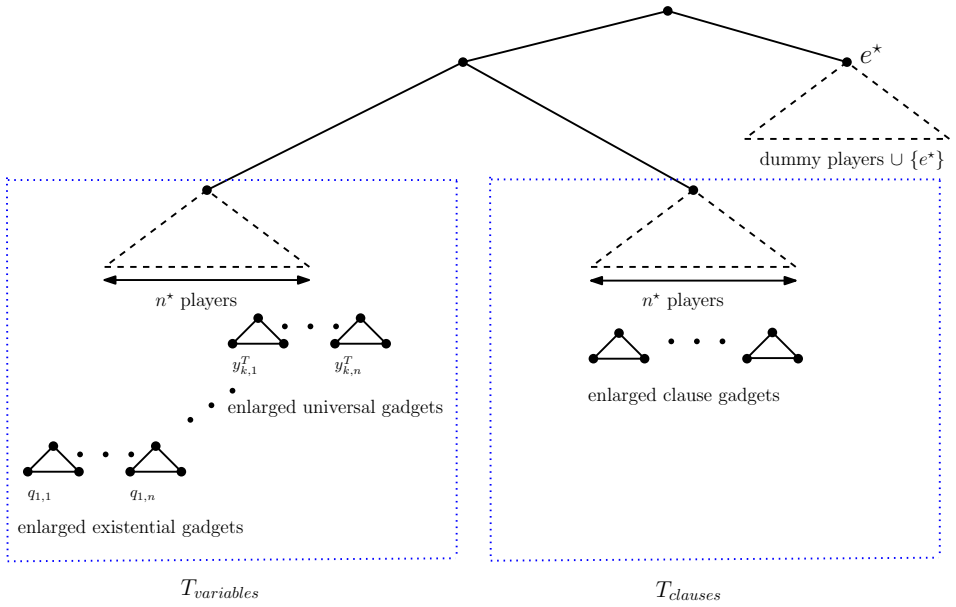
The load-bearing object is the adaptive strategy function, which maps a coalition player, a round number, and the observed seeding for that round to a throw-or-play decision. The hardness reductions build constant-sized selection gadgets, subtournaments where one coalition player can decide which of several non-coalition players wins, to encode existential choices, universal random advances, and clause satisfaction, arranged so that the number of quantifier alternations becomes the depth of the tournament. On the algorithmic side, the central mechanism is a dynamic program over the coalition skeleton, the subtree of the tournament tree containing the paths from the root to coalition players, which tracks valid configurations and sibling configurations and maximizes the favorite's winning probability round by round.
What would settle it
Run the Section 3.1 reduction on a small quantified Boolean formula with two quantifier alternations, enumerate all adaptive strategies for the resulting tournament, and check that the favorite's maximum winning probability is exactly one when the formula is true; any mismatch would refute the reduction, as would a polynomial-time algorithm for ACCM-KT at threshold one, which would collapse the polynomial hierarchy.
Extended reading notes
Core claim
The central claim is that adaptive constructive coalition manipulation in knockout tournaments is hard for every class in the polynomial hierarchy even when the threshold probability is one, and that the generalized version with imbalanced tournament trees is PSPACE-complete. The hardness arises from reductions from quantified Boolean formulas: constant-sized subtournaments act as gadgets in which a coalition player chooses which of several other players wins, while universal-variable gadgets advance randomly so that later existential gadgets can react to the assignment observed. The same constructions also resolve the NP-hardness of the non-adaptive variant, which had been open, and show that computing a best response for the first round is NP-hard.
Load-bearing premise
The load-bearing premise is that coalition players observe the exact current seeding before each round and can coordinate freely on whether to throw; without this observation, the reductions' alternating-quantifier encoding would collapse.
Editorial extensions
If this is right
- If ACCM-KT is hard for every class in the polynomial hierarchy, then adaptive coalition manipulation in balanced knockout tournaments has no polynomial-time algorithm and no polynomial-size witness under standard complexity assumptions.
- The PSPACE-completeness of ACCM-GKT means that allowing imbalanced tournament trees makes the problem at least as hard as quantified Boolean formulas with polynomially many quantifier alternations.
- The NP-hardness of the non-adaptive variant closes the open question left by the earlier model, showing that the non-adaptive problem is NP-complete given its previously known containment in NP.
- The dynamic programming algorithms show that when the coalition is small, or when the coalition size is combined with the size of a minimum random game cover, the optimal strategy can be computed in polynomial or fixed-parameter tractable time.
- The best-response variant can be solved in the same running-time bounds, so a coalition can re-optimize round by round as the seeding is revealed without writing down an exponentially large strategy.
Reading between the lines
- If the observed-seeding assumption is what creates the alternating-quantifier structure, then a model in which the coalition must commit to a round's throws before seeing that round's seeding should collapse the hardness to NP; this is testable by rerunning the reduction without adaptive reaction.
- The hardness transfers to budget-constrained manipulation, since coalition manipulation is the special case where throwing a game involving a coalition player costs one unit and all other manipulations are infinitely expensive.
- The best-response formulation suggests an online protocol: compute the optimal first-round profile, play the round, observe the new seeding, and recompute, which gives the optimal continuation even though the full strategy has exponential description.
- The jump from PH-hardness to PSPACE-completeness when moving from balanced to imbalanced trees indicates that the balanced-tree restriction is not a technical convenience but the boundary between two distinct hardness levels.
Signed reviews
Editorial analysis
A structured set of objections, weighed in public.
Referee Report
Summary. The paper introduces an adaptive model of constructive coalition manipulation for probabilistic knockout tournaments, in which coalition players may decide, after each round, which matches to throw based on the current seeding. The authors claim (i) hardness for every class in the polynomial hierarchy for the balanced setting (ACCM-KT), (ii) PSPACE-completeness for an imbalanced generalization (ACCM-GKT), (iii) NP-hardness for best-response and non-adaptive variants, and (iv) algorithmic tractability: an n^{O(|C|)}-time algorithm for ACCM-GKT, an FPT algorithm for ACCM-KT parameterized by coalition size plus minimum random game cover, and polynomial-space containment for ACCM-GKT. The algorithmic results are obtained through a dynamic programming recurrence in Section 4.1.
Significance. If the results were correct, the paper would make a substantial contribution: it appears to be the first to introduce adaptiveness to coalition manipulation in knockout tournaments, and it resolves an open question on the NP-hardness of the non-adaptive CCM-KT problem. The hardness reductions are detailed and are not affected by the technical flaw found in the algorithmic section. However, the dynamic programming recurrence in Section 4.1 is unsound in a load-bearing way: it fails to account for the effect of a coalition player intentionally losing on the advancement probability of the opponent. Because the correctness of Theorems 15-17 and Corollary 18, as well as the PSPACE-containment half of Theorem 8, rests on this recurrence, a central pillar of the paper's positive results collapses.
major comments (2)
- [Section 4.1, definition of p(S,S',S*,c) and Lemma 14] The transition probability p(S,S',S*,c) is defined as a product over players in S* only, with factors c(e)*p(e, s_{S,S'}(e)) for coalition winners and p(e, s_{S,S'}(e)) for non-coalition winners. This omits the effect of a coalition player who intentionally loses (c(e)=0): when such a player throws a match, the opponent advances with probability 1, but the formula records the opponent's original winning probability p(opponent, e), which may be less than 1. Consequently, the sum of p(S,S',S*,c) over all next configurations S* is strictly less than 1 whenever some coalition player throws, so the expression is not a probability distribution and the induction in Lemma 14 is invalid. Concrete counterexample: take four players with C={c1,c2}, favorite e*, seed (c1,c2,e,d), p(c1,c2)=1/5, p(e,c1)=1, p(c2,e)=1, p(e,d)=1. The strategy 'c2 throws the first match' lets c1 reach the final and e* beats c1, giving e* win probability 1, but the DP in Section 4.1 returns at most 1/5. Thus Lemma 14 is false.
- [Theorems 15, 16, 17 and Corollary 18; Theorem 8 containment] Since Lemma 14 is false, the running-time analyses and correctness statements in Section 4.2 do not follow. In particular, Theorem 15 (XP for ACCM-GKT), Theorem 16 (FPT for ACCM-KT), and Corollary 18 (best-response computation) are unsupported. Moreover, Theorem 8 claims PSPACE-completeness for ACCM-GKT, but its containment in PSPACE is deferred to Theorem 17; with Theorem 17 unproven, only PSPACE-hardness is established. The hardness reductions in Section 3 are not affected by this flaw, but the positive results and the completeness claim in Theorem 8 are.
minor comments (4)
- [Section 2.6, Definition 1] The definition of a random game cover has a typo: 'i ∈ X or j ∈ Y' should read 'i ∈ X or j ∈ X'.
- [Section 2.1, strategy definition] The strategy function ξ outputs zero or one, but the meaning of a zero when two coalition players face each other is not fully formalized; the constraint that not both can intentionally lose is stated only informally in the text.
- [Proof of Theorem 12, New Clause Gadget] The 'ensurance player e' is named inconsistently with the favorite player e*; this can confuse the reader, though the intended meaning is clear from context.
- [Section 2.1, best response argument] The discussion that lowering winning probabilities arbitrarily is equivalent to choosing either the original probability or zero is reasonable, but it would benefit from a formal statement about the optimality of pure strategies in the adaptive setting, since the current argument is informal and only considers a single current game.
Circularity Check
No significant circularity: the hardness results are self-contained reductions from QBF, Multicolored Clique, and 3SAT, and the dynamic program is an independent construction; self-citations are background only.
full rationale
No circular step is present. The hardness theorems are self-contained reductions from standard external problems: Theorem 3 and Remark 1 reduce from Quantified Boolean Formula with a constant number of alternations (Arora-Barak; Stockmeyer), Theorem 8 reduces from QBF with polynomially many alternations (PSPACE-hard by Arora-Barak), Theorem 9 reduces from Multicolored Clique (Fellows et al.), and Theorem 12 reduces from 3SAT (Karp). Each reduction explicitly constructs variable, universal, clause, selection, and randomize gadgets with 0, 1/2, and 1 probabilities, and proves both directions by mapping satisfying assignments to strategies and strategies back to assignments; no step presupposes the claim being proved. The algorithmic results follow from a constructively defined dynamic program over the coalition skeleton with an explicit base case (M[0,{e*}] = 1) and a recursion over levels; the DP fits no parameter to the threshold t, and no hardness result is used to justify it. The authors' self-citations appear only as background literature citations (for example, their own papers on tournament popularity, Challenge-the-Champ bribery, and tournament fixing), not as a load-bearing lemma, uniqueness theorem, or ansatz. Two soundness concerns belong to a correctness pass rather than to circularity: the transition formula in Section 4.1 may not sum to 1 when a coalition player deliberately loses, and a direction in the (<=) proof of Theorem 3 contains an apparent typo. Neither concern makes a claimed result equivalent to its own input by definition.
Assumptions & free parameters
assumptions (5)
- standard math Standard complexity-theoretic hardness of QBF with quantifier alternations, PSPACE-hardness of QBF, and W[1]-hardness of Multicolored Clique.
- domain assumption The probability matrix PN is known exactly to all players and the coalition has perfect information about the current seeding each round.
- domain assumption Non-coalition players never act strategically and always play to win.
- domain assumption Coalition players can only keep their original win probability or lower it to zero, and arbitrary lowering is equivalent to these two options.
- standard math A minimum random game cover can be computed in FPT time via the standard vertex cover algorithm.
Cite this review
Pith. "Pith review of Adaptive Manipulation for Coalitions in Knockout Tournaments." pith.science (2026). https://pith.science/paper/YOQ44RQU
@misc{pith2026241211799,
  author       = {Pith},
  title        = {Pith review of: Adaptive Manipulation for Coalitions in Knockout Tournaments},
  year         = {2026},
  howpublished = {\url{https://pith.science/paper/YOQ44RQU}},
  note         = {Machine review of arXiv:2412.11799}
}
read the original abstract
Knockout tournaments, also known as single-elimination or cup tournaments, are a popular form of sports competitions. In the standard probabilistic setting, for each pairing of players, one of the players wins the game with a certain (a priori known) probability. Due to their competitive nature, tournaments are prone to manipulation. We investigate the computational problem of determining whether, for a given tournament, a coalition has a manipulation strategy that increases the winning probability of a designated player above a given threshold. More precisely, in every round of the tournament, coalition players can strategically decide which games to throw based on the advancement of other players to the current round. We call this setting adaptive constructive coalition manipulation. To the best of our knowledge, while coalition manipulation has been studied in the literature, this is the first work to introduce adaptiveness to this context. We show that the above problem is hard for every complexity class in the polynomial hierarchy. On the algorithmic side, we show that the problem is solvable in polynomial time when the coalition size is a constant. Furthermore, we show that the problem is fixed-parameter tractable when parameterized by the coalition size and the size of a minimum player set that must include at least one player from each non-deterministic game. Lastly, we investigate a generalized setting where the tournament tree can be imbalanced.
Figures


Figures from the paper (5 more)


Reference graph
Works this paper leans on
- [1]
-
[2]
S. Arora and B. Barak. Computational Complexity: A Modern Approach . Cambridge Univer- sity Press, 2009. 4, 10, 11, 12, 18, 19
work page 2009
-
[3]
H. Aziz, S. Gaspers, S. Mackenzie, N. Mattei, P. Stursberg, and T. Walsh. Fixing balanced knockout and double elimination tournaments. Artificial Intelligence, 262:1–14, 2018. 2, 6
work page 2018
-
[4]
Brandt and F
F. Brandt and F. Fischer. Pagerank as a weak tournament solution. In Proceedings of the 3rd International Workshop on Web and Internet Economics (WINE) , pages 300–305. Springer,
-
[5]
Chaudhary, H
J. Chaudhary, H. Molter, and M. Zehavi. How to make knockout tournaments more popular? In Proceedings of the 2024 AAAI Conference on Artificial Intelligence (AAAI) , volume 38, pages 9582–9589, 2024. 1
2024
-
[6]
J. Chaudhary, H. Molter, and M. Zehavi. Parameterized analysis of bribery in challenge the champ tournaments. In Proceedings of the 33rd International Joint Conference on Artificial Intelligence (IJCAI) , pages 2704–2712, 2024. 7
work page 2024
-
[7]
Tournament qualification, seeding and selection efficiency
Connolly and Rendleman. Tournament qualification, seeding and selection efficiency. Technical Report 2011-96, Tuck School of Business , 2011. 1
2011
- [8]
Show all 48 references
-
[9]
R. G. Downey, M. R. Fellows, et al. Fundamentals of parameterized complexity , volume 4. Springer, 2013. 10
2013
-
[10]
F. Durand. Towards less manipulable voting systems . PhD thesis, Universit´ e Pierre et Marie Curie-Paris VI, 2015. 6
2015
-
[11]
F. Durand. Coalitional manipulation of voting rules: simulations on empirical data. Consti- tutional Political Economy , 34:390–409, 2023. 6
2023
-
[12]
ESPN Analytics
ESPN. ESPN Analytics. http://www.espn.com/analytics, 2023. 2
2023
-
[13]
M. R. Fellows, D. Hermelin, F. Rosamond, and S. Vialette. On the parameterized complexity of multiple-interval graph problems. Theoretical Computer Science, 410(1):53–61, 2009. 5, 19 30
2009
-
[14]
T. Feltes. Match fixing in western europe. In Match-fixing in international sports: Existing processes, law enforcement, and prevention strategies , pages 15–30. Springer, 2013. 2
2013
-
[15]
Optimal seedings in elimination tournaments
Groh, Moldovanu, Sela, and Sunde. Optimal seedings in elimination tournaments. Economic Theory, 49(1):59–80, 2012. 1
2012
-
[16]
Gupta, S
S. Gupta, S. Roy, S. Saurabh, and M. Zehavi. When rigging a tournament, let greediness blind you. In Proceedings of the 27th International Joint Conference on Artificial Intelligence (IJCAI), pages 275–281, 2018. 2
2018
-
[17]
Gupta, S
S. Gupta, S. Roy, S. Saurabh, and M. Zehavi. Winning a tournament by any means necessary. In Proceedings of the 27th International Joint Conference on Artificial Intelligence (IJCAI) , pages 282–288, 2018. 2
2018
-
[18]
Gupta, S
S. Gupta, S. Saurabh, R. Sridharan, and M. Zehavi. On succinct encodings for the tourna- ment fixing problem. In Proceedings of the 28th International Joint Conference on Artificial Intelligence (IJCAI) , pages 322–328, 2019. 2
2019
-
[19]
D. Hill. A critical mass of corruption: Why some football leagues have more match-fixing than others. International Journal of Sports Marketing and Sponsorship , 11(3):38–52, 2010. 2
2010
-
[20]
R. M. Karp. Reducibility among combinatorial problems. In Complexity of Computer Com- putations, pages 85–103. Springer, 1972. 24
1972
-
[21]
M. P. Kim and V. V. Williams. Fixing tournaments for kings, chokers, and more. InProceedings of the 24th International Joint Conference on Artificial Intelligence (IJCAI) , pages 561–567,
-
[22]
M. P. Kim, W. Suksompong, and V. V. Williams. Who can win a single-elimination tourna- ment? SIAM Journal on Discrete Mathematics , 31(3):1751–1764, 2017. 2
2017
-
[23]
Konicki and V
C. Konicki and V. V. Williams. Bribery in balanced knockout tournaments. In Proceedings of the 18th International Conference on Autonomous Agents and Multiagent Systems (AAMAS) , pages 2066–2068, 2019. 2, 7
2019
-
[24]
J. F. Laslier. Tournament solutions and majority voting , volume 7. Springer, 1997. 1
1997
-
[25]
A. E. Manoli and G. A. Antonopoulos. ‘the only game in town?’: football match-fixing in greece. Trends in organized crime, 18:196–211, 2015. 2
2015
-
[26]
Mattei and T
N. Mattei and T. Walsh. Empirical evaluation of real world tournaments. arXiv preprint arXiv:1608.01039, 2016. 2
2016 arXiv
-
[27]
Mattei, J
N. Mattei, J. Goldsmith, A. Klapper, and M. Mundhenk. On the complexity of bribery and manipulation in tournaments with uncertain information. Journal of Applied Logic , 13(4): 557–581, 2015. 2, 4, 7, 8, 9
2015
-
[28]
Time out for match-fixers manipulating livestreams
MediaNews. Time out for match-fixers manipulating livestreams. https://www.europol.europa.eu/media-press/newsroom/news/ time-out-for-match-fixers-manipulating-livestreams , 2020. 2 31
2020
-
[29]
Top controversies of world cup 2023
MediaNews. Top controversies of world cup 2023. https:// timesofindia.indiatimes.com/sports/cricket/icc-world-cup/news/ angelo-mathews-timed-out-to-pitch-switch-top-controversies/ /-of-world-cup-2023/articleshow/105326878.cms , 2023. 2
2023
-
[30]
Most Talked-About Corruption Scandals in Sports History
MediaNews. Most Talked-About Corruption Scandals in Sports History. https://247wallst.com/special-report/2023/09/07/ 17-most-talked-about-corruption-scandals-in-sports-history/ , 2023. 2
2023
-
[31]
Predictmachine
Predict. Predictmachine. https://www.predictionmachine.com, 2023. 2
2023
-
[32]
M. S. Ramanujan and S. Szeider. Rigging nearly acyclic tournaments is fixed-parameter tractable. In Proceedings of the 2017 AAAI Conference on Artificial Intelligence (AAAI) , pages 3929–3935, 2017. 29
2017
-
[33]
S. Rosen. Prizes and incentives in elimination tournaments, 1985. 1
1985
-
[34]
Russell and P
T. Russell and P. Van Beek. Detecting manipulation in cup and round robin sports competi- tions. In Proceedings of the 24th International Conference on Tools with Artificial Intelligence (ICTAI), volume 1, pages 285–290. IEEE, 2012. 6
2012
-
[35]
Russell and T
T. Russell and T. Walsh. Manipulating tournaments in cup and round robin competitions. In Proceedings of the 1st International Conference on Algorithmic Decision Theory (ADT), pages 26–37. Springer, 2009. 2, 11
2009
-
[36]
Saarinen, J
S. Saarinen, J. Goldsmith, and C. A. Tovey. Probabilistic copeland tournaments. In Pro- ceedings of the 14th International Conference on Autonomous Agents and Multiagent Systems (AAMAS), pages 1851–1852, 2015. 7
2015
-
[37]
Schneider, A
J. Schneider, A. Schvartzman, and S. M. Weinberg. Condorcet-consistent and approximately strategyproof tournament rules. arXiv preprint arXiv:1605.09733 , 2016. 6
2016 arXiv
-
[38]
Stanton and V
I. Stanton and V. V. Williams. The structure, efficacy, and manipulation of double-elimination tournaments. Journal of Quantitative Analysis in Sports , 9(4):319–335, 2013. 2, 6
2013
-
[39]
L. J. Stockmeyer. The polynomial-time hierarchy. Theoretical Computer Science, 3(1):1–22,
-
[40]
Suksompong
W. Suksompong. Tournaments in computational social choice: Recent developments. In Proceedings of the 28th International Joint Conference on Artificial Intelligence (IJCAI), pages 4611–4618, 2021. 1
2021
-
[41]
Team Rankings
Team. Team Rankings. https://www.teamrankings.com/, 2023. 2
2023
-
[42]
Toward a theory of the rent-seeking society
Tullock. Toward a theory of the rent-seeking society. Texas A&M University Press , 1980. 1
1980
-
[43]
T. Vu, A. Altman, and Y. Shoham. On the complexity of schedule control problems for knockout tournaments. In Proceedings of the 8th International Conference on Autonomous Agents and Multiagent Systems (AAMAS) , pages 225–232, 2009. 1, 2, 6 32
2009
-
[44]
T. Walsh. Where are the hard manipulation problems? Journal of Artificial Intelligence Research, 42:1–29, 2011. 6
2011
-
[45]
V. V. Williams. Fixing a tournament. In Proceedings of the 2010 AAAI Conference on Artificial Intelligence (AAAI) , volume 24, pages 895–900, 2010. 2
2010
-
[46]
V. V. Williams. Knockout Tournaments, page 453–474. Cambridge University Press, 2016. 1
2016
-
[47]
Y. Yang. On the complexity of the two-stage majority rule. In Proceedings of the 2023 International Conference on Autonomous Agents and Multiagent Systems , pages 2022–2030,
2023
-
[48]
M. Zehavi. Tournament fixing parameterized by feedback vertex set number is fpt. In Pro- ceedings of the 2023 AAAI Conference on Artificial Intelligence (AAAI) , volume 37, pages 5876–5883, 2023. 2 33
2023
Reviewed August 11, 2026 · model on record in the stance chip above.
Discussion (0). Continue with ORCID to comment.