REVIEW 4 major objections 5 minor 1 cited by
StereoINR: Cross-View Geometry Consistent Stereo Super Resolution with Implicit Neural Representation
T0 review · 4 major / 5 minor · reviewed 2026-08-15 · deepseek-v4-flash
Pith's one-line read A single implicit neural network can super-resolve stereo pairs at any scale while keeping views geometrically consistent.
desk verdict Solid engineering with a genuinely new combination, but the geometry-consistency claim leans on an unvalidated disparity prior and the conclusion overreaches. read the letter →
The pith
A machine-rendered reading of the paper's core claim, the machinery that carries it, and where it could break.
The reading
What carries the argument
The load-bearing mechanism is the disparity-guided arbitrary-scale upsampler (DGASU). Given latent codes from both views, it estimates bidirectional disparity with SPyNet, warps each view's latent code into the other view using bilinear warping, and forms cross-attention in which the current view's code is the query and the warped other-view code supplies keys and values; a squeeze-and-excitation refinement and alternation of self- and cross-attention layers then feed an MLP $F_\theta: \mathbb{R}^{2+C} \to \mathbb{R}^3$ that predicts RGB from continuous coordinates and nearest latent codes, with sinusoidal positional encoding $\gamma(x)$ and a bicubic LR skip connection. This machinery is what lets a single model upsample at arbitrary real-valued scales while still letting each reconstructed pixel borrow evidence from its matching pixel in the other view.
What would settle it
Run StereoINR on rectified stereo pairs at a fixed scale and deliberately corrupt the disparity maps (for example, shift the horizontal flow by several pixels or replace SPyNet with a constant disparity) before the warping stage, then compare SCORE and PSNR in occluded versus non-occluded regions; if the consistency scores remain high under corrupted disparity, the disparity guidance is not the load-bearing ingredient, whereas a sharp drop would confirm that accurate disparity is required.
Extended reading notes
Core claim
The paper argues that earlier stereo super-resolution methods produce inconsistent views because they upsample left and right features independently with convolution-based modules such as pixel shuffle, so the upsampling operation never uses information from the other view. StereoINR replaces that operation with a disparity-guided arbitrary-scale upsampler: a frozen single-image super-resolution transformer is adapted by lightweight stereo, scale, and spatial adapters to extract left and right latent codes; SPyNet supplies bidirectional disparity; each view's latent code is warped into the other view's coordinate frame; alternating self-attention and cross-attention aggregate aligned features; and an MLP maps continuous query coordinates, conditioned on the nearest latent codes, to output RGB values with a bicubic skip connection. The authors report that this design improves pixel-level geometric consistency measured by SCORE, outperforms other arbitrary-scale methods out of the training scale distribution, and matches fixed-scale methods within it.
Load-bearing premise
The entire cross-view fusion rests on the assumption that horizontal optical flow computed by the pre-trained SPyNet equals true disparity under rectified settings; wherever disparity is wrong, such as occlusions, textureless areas, or non-rectified inputs, the warped features misalign and the cross-attention can propagate incorrect information between views.
Editorial extensions
If this is right
- A single StereoINR model can change its upsampling factor at inference time over a continuous range (the paper trains with scales sampled from $U(1,4)$ and tests up to $\times 30$), removing the need to retrain or swap architectures per scale.
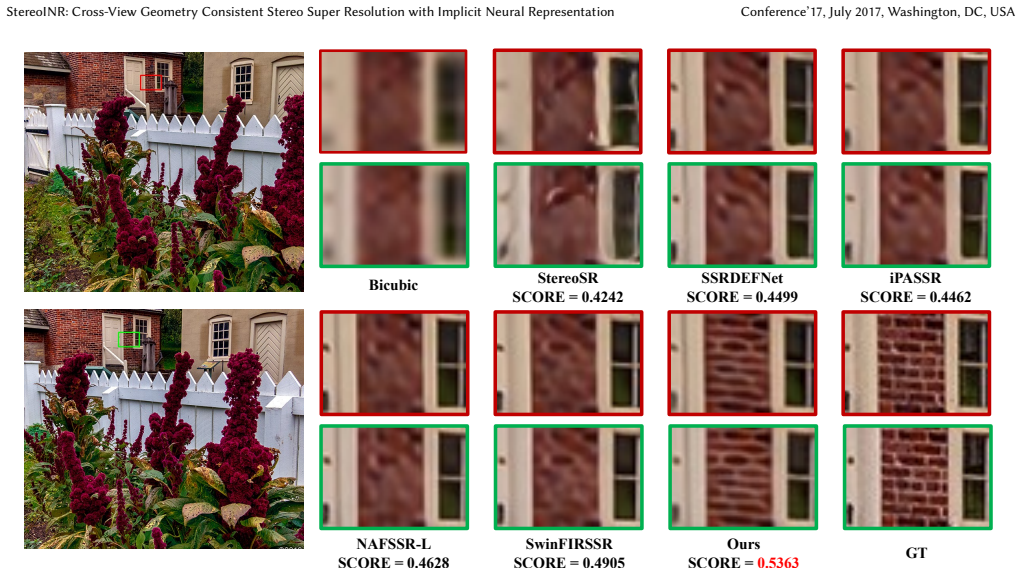
- Because cross-view fusion happens during upsampling, the super-resolved left and right views stay consistent enough that a pre-trained stereo matcher (RAFT-Stereo) produces disparity maps closer to those of the ground-truth high-resolution pair, reflected in higher SCORE.
- The frozen-encoder-plus-adapters design means only a small number of parameters are tuned (2.03M reported), so the approach is a parameter-efficient route from single-image super-resolution pretraining to stereo super-resolution.
- Out-of-distribution scales from $\times 6$ to $\times 30$ show consistent PSNR and LPIPS gains over other arbitrary-scale methods such as LIIF, LTE, LINF, OPESR, and EQSR, according to the reported tables.
- The model trained on Middlebury and Flickr1024 also performs on KITTI 2012 and KITTI 2015, indicating the learned cross-view upsampling transfers to new stereo domains.
Reading between the lines
- If disparity-guided upsampling is the true source of the consistency gain, the same warp-then-attend idea should extend to light-field and multi-camera super-resolution, where more than two views must satisfy epipolar constraints.
- A testable extension would jointly fine-tune the disparity estimator with the super-resolution objective; the paper uses a frozen SPyNet, so its accuracy sets an upper bound on how well cross-view features can align in occluded or textureless regions.
- The largest consistency gains appear on Flickr1024 at $\times 4$, a dataset with strong parallax and varied texture; this suggests the method's advantage will be most visible in scenes with genuine depth variation and may shrink for near-planar scenes.
- Because the MLP maps continuous coordinates to colors given latent codes, the same representation could in principle output disparity or depth at arbitrary resolution alongside color, though the paper does not explore this.
Signed reviews
Editorial analysis
A structured set of objections, weighed in public.
Referee Report
Summary. The paper proposes StereoINR, a method for arbitrary-scale stereo image super-resolution. It combines a frozen HAT-based encoder extended with stereo, scale, and spatial adapters, with a disparity-guided arbitrary-scale upsampler (DGASU). DGASU estimates disparity from the low-resolution left-right pair using SPyNet horizontal optical flow, warps deep features across views, and then applies alternating self- and cross-attention in an implicit neural representation framework to produce continuous coordinate-to-color mappings. The method is evaluated on Middlebury, Flickr1024, and KITTI datasets under both out-of-distribution scales (Table 1, scales ×2 to ×30) and in-distribution scales (Table 2, ×2 and ×4), with PSNR, SSIM, LPIPS, and a stereo consistency metric SCORE. Ablations study the adapters, the upsampler design, and the attention mechanism.
Significance. If the geometric-consistency improvements are trustworthy, StereoINR would be a useful contribution: it offers a single model for continuous magnification of stereo pairs while explicitly fusing cross-view information through disparity-guided warping. The paper contains multi-dataset and multi-scale comparisons, component-wise ablations, and an honest limitations section. The idea of warping features with estimated disparity before cross-attention is reasonable, and the out-of-scale comparisons in Table 1 show consistent gains over INR-based single-image super-resolution baselines. However, the paper provides no code, no error bars, and only 112 validation pairs, and the central geometric-consistency claim rests on an unvalidated disparity prior and a metric computed with a different estimator.
major comments (4)
- [Section 4.1, Eqs. (5)-(12)] The disparity guidance is a load-bearing component, but its accuracy is never measured. The model uses SPyNet horizontal optical flow as stereo disparity on low-resolution inputs to warp features for cross-attention (Eqs. 7-12), yet the paper reports no disparity error on any test set, no occlusion analysis, and no sensitivity study. Because training uses only per-view L1 loss with no disparity-consistency term, the claimed geometric consistency is an emergent property whose reliability is unknown. I recommend adding an evaluation of SPyNet disparity error on a dataset with ground-truth disparity, or an ablation comparing SPyNet warping with RAFT-Stereo warping and with ground-truth disparity, and an analysis of behaviors at occlusions and textureless regions.
- [Eq. (18) and Table 2] There is an estimator mismatch between the consistency metric and the model's internal alignment. SCORE (Eq. 18) estimates disparity from SR/HR outputs with RAFT-Stereo, while the model aligns features with SPyNet on LR inputs. The large SCORE improvements in Table 2 (e.g., Flickr1024 ×4 SCORE 0.5544 vs. SwinFIRSSR 0.3211) could partly reflect an alignment bias inherited from SPyNet rather than verifiable subpixel geometry. To support the claim of 'significant improvements in pixel-level geometric consistency,' the authors should also report SCORE using a disparity estimator unrelated to the architecture, and should decompose SCORE into its perceptual and disparity terms so that the reader can see how much of the gain comes from the disparity term.
- [Introduction, third contribution, and Table 2] The claim of outperforming existing approaches is contradicted by the paper's own numbers. The introduction states that the method 'outperform[s] existing approaches in both qualitative and quantitative evaluations,' but Table 2 shows StereoINR does not beat SwinFIRSSR on PSNR or SSIM in most in-scale cells: for example, KITTI2012 ×2 PSNR 31.58 vs. 31.79 and SSIM 0.9289 vs. 0.9321, KITTI2012 ×4 PSNR 27.14 vs. 27.16, and Flickr1024 ×2 SSIM 0.9254 vs. 0.9286. The performance claim should be restricted to SCORE and, for PSNR/LPIPS, to the out-of-distribution scales in Table 1; the abstract's language about 'matching' state-of-the-art methods is more accurate and should be used consistently.
- [Section 4.1 and Tables 1-2] The quantitative conclusions are not supported with measures of variability. The validation set is only 112 pairs, and no error bars, confidence intervals, or significance tests are reported. Several PSNR differences are on the order of 0.01-0.03 dB (e.g., Middlebury ×4 30.47 vs. SwinFIRSSR 30.44), which is within typical run-to-run variation for a model trained with batch size 1 and no reported number of seeds. I ask for standard deviations across at least three training runs, or paired statistical tests on the validation set, for the main comparisons in Tables 1 and 2.
minor comments (5)
- [Eq. (17)] There is an extra closing parenthesis in the equation: 'Fθ(ez*L, ez*R, γ(x−x∗)))' should be 'Fθ(ez*L, ez*R, γ(x−x∗))'.
- [Section 3.2] The phrase 'the stereo adapter leverage cross-attention' should be 'leverages' for subject-verb agreement.
- [References [32]] The text cites reference [32] for RAFT-Stereo, but the reference is the RAFT optical flow paper; the RAFT-Stereo paper should be cited separately.
- [Table 3] The check marks and crosses in the table rows are not defined in the caption; adding a legend such as '✓ indicates that the adapter is enabled' would make the ablation results easier to interpret.
- [Section 4.1] The metric is introduced as 'Score' and used as 'SCORE' elsewhere; the capitalization should be made consistent.
Circularity Check
No significant circularity: the central claims are empirical and the disparity guidance/metric are external, unoptimized estimators.
full rationale
The paper's derivation chain is self-contained against external benchmarks. The arbitrary-scale INR upsampler is trained with an L1 loss on random scales sampled from U(1,4); no equation reduces to a fitted constant or to the reported SCORE values. The cross-view geometry-consistency claim is evaluated with SCORE (Eq. 18), which uses LPIPS and a RAFT-Stereo disparity MAE term; internally, the model warps features using SPyNet optical flow as a disparity proxy (Eqs. 5-8, Section 4.1). These are two distinct, independently pretrained external estimators, and neither is fine-tuned to optimize the other, so the reported consistency improvement is not an identity or a fit renamed as a prediction. The acknowledged limitation in Section 5 — 'our method currently relies on accurate disparity estimation' — is a real dependence and a correctness risk, but it is not circularity, because erroneous disparity degrades the attention-based warping rather than being encoded into the evaluation metric. The assumption that horizontal optical flow equals disparity under rectified settings is likewise an explicit modeling assumption, not a circular definition. Ablations (DGASU vs. pixel shuffle, cross-attention vs. self-attention) compare architectural variants under identical training and evaluation, so they do not smuggle the conclusion into the inputs. No self-citation chain is load-bearing; the cited SISR priors (HAT, LIIF, SPyNet, RAFT-Stereo) are external and independently established. The paper's core contributions are empirical performance gains on held-out KITTI, Middlebury, and Flickr1024 datasets, and nothing in the derivation makes those gains true by construction.
Assumptions & free parameters
free parameters (5)
- Scale range U(1,4) =
1 to 4
- MLP depth and width in DGASU
- Positional encoding frequency n
- Spatial adapter bottleneck dimension m
- Training patch size =
64x96
assumptions (6)
- domain assumption Rectified stereo assumption: horizontal optical flow equals disparity
- domain assumption SPyNet pre-trained on video generalizes to stereo disparity
- domain assumption Training data (Middlebury + Flickr1024) is representative
- domain assumption L1 loss optimization yields geometrically consistent results
- domain assumption Pretrained HAT features can be adapted to stereo via adapters
- domain assumption Evaluation metrics (PSNR, SSIM, LPIPS, SCORE) capture quality and consistency
Cite this review
Pith. "Pith review of StereoINR: Cross-View Geometry Consistent Stereo Super Resolution with Implicit Neural Representation." pith.science (2026). https://pith.science/paper/YOXSOTN3
@misc{pith2026250505509,
  author       = {Pith},
  title        = {Pith review of: StereoINR: Cross-View Geometry Consistent Stereo Super Resolution with Implicit Neural Representation},
  year         = {2026},
  howpublished = {\url{https://pith.science/paper/YOXSOTN3}},
  note         = {Machine review of arXiv:2505.05509}
}
read the original abstract
Stereo image super-resolution (SSR) aims to enhance high-resolution details by leveraging information from stereo image pairs. However, existing stereo super-resolution (SSR) upsampling methods (e.g., pixel shuffle) often overlook cross-view geometric consistency and are limited to fixed-scale upsampling. The key issue is that previous upsampling methods use convolution to independently process deep features of different views, lacking cross-view and non-local information perception, making it difficult to select beneficial information from multi-view scenes adaptively. In this work, we propose Stereo Implicit Neural Representation (StereoINR), which innovatively models stereo image pairs as continuous implicit representations. This continuous representation breaks through the scale limitations, providing a unified solution for arbitrary-scale stereo super-resolution reconstruction of left-right views. Furthermore, by incorporating spatial warping and cross-attention mechanisms, StereoINR enables effective cross-view information fusion and achieves significant improvements in pixel-level geometric consistency. Extensive experiments across multiple datasets show that StereoINR outperforms out-of-training-distribution scale upsampling and matches state-of-the-art SSR methods within training-distribution scales.
Figures


Figures from the paper (7 more)




Forward citations
Cited by 1 Pith paper
-
Symmetry-Constrained Multi-Scale Physics-Informed Neural Networks for Graphene Electronic Band Structure Prediction
The abstract claims a symmetry-constrained neural network reproduces graphene band structures with near-zero Dirac gap, but the manuscript body is a different paper.
Reference graph
Works this paper leans on
-
[1]
Jiezhang Cao, Qin Wang, Yongqin Xian, Yawei Li, Bingbing Ni, Zhiming Pi, Kai Zhang, Yulun Zhang, Radu Timofte, and Luc Van Gool. 2023. Ciaosr: Contin- uous implicit attention-in-attention network for arbitrary-scale image super- resolution. In Proceedings of the IEEE/CVF Conference on Computer Vision and Pattern Recognition. 1796–1807
work page 2023
-
[2]
Hanting Chen, Yunhe Wang, Tianyu Guo, Chang Xu, Yiping Deng, Zhenhua Liu, Siwei Ma, Chunjing Xu, Chao Xu, and Wen Gao. 2021. Pre-trained image processing transformer. In Proceedings of the IEEE/CVF conference on computer vision and pattern recognition . 12299–12310
work page 2021
-
[3]
Hao-Wei Chen, Yu-Syuan Xu, Min-Fong Hong, Yi-Min Tsai, Hsien-Kai Kuo, and Chun-Yi Lee. 2023. Cascaded local implicit transformer for arbitrary-scale super- resolution. In Proceedings of the IEEE/CVF Conference on Computer Vision and Pattern Recognition. 18257–18267
work page 2023
-
[4]
Xiang Chen, Jinshan Pan, and Jiangxin Dong. 2024. Bidirectional multi-scale implicit neural representations for image deraining. InProceedings of the IEEE/CVF Conference on Computer Vision and Pattern Recognition . 25627–25636. StereoINR: Cross-View Geometry Consistent Stereo Super Resolution with Implicit Neural Representation Conference’17, July 2017, W...
work page 2024
-
[5]
Xiangyu Chen, Xintao Wang, Jiantao Zhou, Yu Qiao, and Chao Dong. 2023. Activating More Pixels in Image Super-Resolution Transformer. In Proceedings of the IEEE/CVF Conference on Computer Vision and Pattern Recognition (CVPR) . 22367–22377
work page 2023
-
[6]
Yinbo Chen, Sifei Liu, and Xiaolong Wang. 2021. Learning continuous image representation with local implicit image function. In Proceedings of the IEEE/CVF conference on computer vision and pattern recognition . 8628–8638
work page 2021
-
[7]
Zeyuan Chen, Yinbo Chen, Jingwen Liu, Xingqian Xu, Vidit Goel, Zhangyang Wang, Humphrey Shi, and Xiaolong Wang. 2022. Videoinr: Learning video implicit neural representation for continuous space-time super-resolution. In Proceedings of the IEEE/CVF Conference on Computer Vision and Pattern Recognition. 2047–2057
2022
-
[8]
Xiaojie Chu, Liangyu Chen, and Wenqing Yu. 2022. Nafssr: Stereo image super- resolution using nafnet. In Proceedings of the IEEE/CVF conference on computer vision and pattern recognition . 1239–1248
work page 2022
Show all 53 references
-
[9]
Qinyan Dai, Juncheng Li, Qiaosi Yi, Faming Fang, and Guixu Zhang. 2021. Feed- back Network for Mutually Boosted Stereo Image Super-Resolution and Disparity Estimation. In Proceedings of the 29th ACM International Conference on Multimedia. 1985–1993
2021
-
[10]
Jia Deng, Wei Dong, Richard Socher, Li-Jia Li, Kai Li, and Li Fei-Fei. 2009. Imagenet: A large-scale hierarchical image database. In 2009 IEEE conference on computer vision and pattern recognition . Ieee, 248–255
2009
-
[11]
Andreas Geiger, Philip Lenz, and Raquel Urtasun. 2012. Are we ready for au- tonomous driving? the kitti vision benchmark suite. In 2012 IEEE conference on computer vision and pattern recognition . IEEE, 3354–3361
2012
-
[12]
Rui Gong, Qin Wang, Martin Danelljan, Dengxin Dai, and Luc Van Gool. 2023. Continuous pseudo-label rectified domain adaptive semantic segmentation with implicit neural representations. In Proceedings of the IEEE/CVF Conference on Computer Vision and Pattern Recognition . 7225–7235
2023
-
[13]
Jinjin Gu and Chao Dong. 2021. Interpreting Super-Resolution Networks with Local Attribution Maps. In 2021 IEEE/CVF Conference on Computer Vision and Pattern Recognition (CVPR). 9195–9204
2021
-
[14]
Daniel S Jeon, Seung-Hwan Baek, Inchang Choi, and Min H Kim. 2018. Enhancing the spatial resolution of stereo images using a parallax prior. In Proceedings of the IEEE conference on computer vision and pattern recognition . 1721–1730
2018
-
[15]
Hyunyoung Jung, Zhuo Hui, Lei Luo, Haitao Yang, Feng Liu, Sungjoo Yoo, Rakesh Ranjan, and Denis Demandolx. 2023. Anyflow: Arbitrary scale optical flow with implicit neural representation. In Proceedings of the IEEE/CVF Conference on Computer Vision and Pattern Recognition . 5455–5465
2023
-
[16]
Jaewon Lee and Kyong Hwan Jin. 2022. Local texture estimator for implicit representation function. In Proceedings of the IEEE/CVF conference on computer vision and pattern recognition . 1929–1938
2022
-
[17]
Wenbo Li, Xin Lu, Shengju Qian, Jiangbo Lu, Xiangyu Zhang, and Jiaya Jia. 2021. On efficient transformer-based image pre-training for low-level vision. arXiv preprint arXiv:2112.10175 (2021)
2021 arXiv
-
[18]
Zhaohuai Liang and Changhe Li. 2024. Any-Stereo: Arbitrary Scale Disparity Estimation for Iterative Stereo Matching. In Proceedings of the AAAI Conference on Artificial Intelligence, Vol. 38. 3333–3341
2024
-
[19]
Bee Lim, Sanghyun Son, Heewon Kim, Seungjun Nah, and Kyoung Mu Lee
-
[20]
Andreas Lugmayr, Martin Danelljan, Luc Van Gool, and Radu Timofte. 2020. Srflow: Learning the super-resolution space with normalizing flow. InProceedings of the European conference on computer vision (ECCV) . Springer, 715–732
2020
-
[21]
Chenxi Ma, Bo Yan, Weimin Tan, and Xuhao Jiang. 2021. Perception-oriented stereo image super-resolution. In Proceedings of the 29th ACM International Con- ference on Multimedia. 2420–2428
2021
-
[22]
Moritz Menze and Andreas Geiger. 2015. Object scene flow for autonomous vehicles. In Proceedings of the IEEE conference on computer vision and pattern recognition. 3061–3070
2015
-
[23]
Ben Mildenhall, Pratul P Srinivasan, Matthew Tancik, Jonathan T Barron, Ravi Ramamoorthi, and Ren Ng. 2021. Nerf: Representing scenes as neural radiance fields for view synthesis. Commun. ACM 65, 1 (2021), 99–106
2021
-
[24]
Zidian Qiu, Zongyao He, Zhihao Zhan, Zilin Pan, Xingyuan Xian, and Zhi Jin
-
[25]
Nasim Rahaman, Aristide Baratin, Devansh Arpit, Felix Draxler, Min Lin, Fred Hamprecht, Yoshua Bengio, and Aaron Courville. 2019. On the spectral bias of neural networks. In International conference on machine learning . PMLR, 5301– 5310
2019
-
[26]
Anurag Ranjan and Michael J. Black. 2017. Optical Flow Estimation Using a Spatial Pyramid Network. In2017 IEEE Conference on Computer Vision and Pattern Recognition (CVPR). 2720–2729
2017
-
[27]
Mausoom Sarkar, Mayur Hemani, Rishabh Jain, Balaji Krishnamurthy, et al. 2023. Parameter efficient local implicit image function network for face segmenta- tion. In Proceedings of the IEEE/CVF Conference on Computer Vision and Pattern Recognition. 20970–20980
2023
-
[28]
Daniel Scharstein, Heiko Hirschmüller, York Kitajima, Greg Krathwohl, Nera Nešić, Xi Wang, and Porter Westling. 2014. High-resolution stereo datasets with subpixel-accurate ground truth. In German conference on pattern recognition . Springer, 31–42
2014
-
[29]
Wei Shang, Dongwei Ren, Wanying Zhang, Yuming Fang, Wangmeng Zuo, and Kede Ma. 2024. Arbitrary-Scale Video Super-Resolution with Structural and Textural Priors. In European Conference on Computer Vision . Springer, 73–90
2024
-
[30]
Gaochao Song, Qian Sun, Luo Zhang, Ran Su, Jianfeng Shi, and Ying He. 2023. OPE-SR: Orthogonal position encoding for designing a parameter-free upsam- pling module in arbitrary-scale image super-resolution. In Proceedings of the IEEE/CVF Conference on Computer Vision and Patte...
2023
-
[31]
Wonil Song, Sungil Choi, Somi Jeong, and Kwanghoon Sohn. 2020. Stereoscopic image super-resolution with stereo consistent feature. In Proceedings of the AAAI Conference on Artificial Intelligence, Vol. 34. 12031–12038
2020
-
[32]
Zachary Teed and Jia Deng. 2020. Raft: Recurrent all-pairs field transforms for optical flow. In Proceedings of the European conference on computer vision (ECCV) . Springer, 402–419
2020
-
[33]
Longguang Wang, Yulan Guo, Yingqian Wang, Juncheng Li, Shuhang Gu, Radu Timofte, Ming Cheng, Haoyu Ma, Qiufang Ma, Xiaopeng Sun, et al. 2023. NTIRE 2023 challenge on stereo image super-resolution: Methods and results. In Pro- ceedings of the IEEE/CVF conference on computer vis...
2023
-
[34]
Longguang Wang, Yulan Guo, Yingqian Wang, Zhengfa Liang, Zaiping Lin, Jun- gang Yang, and Wei An. 2020. Parallax attention for unsupervised stereo corre- spondence learning. IEEE transactions on pattern analysis and machine intelligence 44, 4 (2020), 2108–2125
2020
-
[35]
Longguang Wang, Yingqian Wang, Zhengfa Liang, Zaiping Lin, Jungang Yang, Wei An, and Yulan Guo. 2019. Learning parallax attention for stereo image super-resolution. In Proceedings of the IEEE/CVF Conference on Computer Vision and Pattern Recognition. 12250–12259
2019
-
[36]
Xiaohang Wang, Xuanhong Chen, Bingbing Ni, Hang Wang, Zhengyan Tong, and Yutian Liu. 2023. Deep Arbitrary-Scale Image Super-Resolution via Scale- Equivariance Pursuit. In2023 IEEE/CVF Conference on Computer Vision and Pattern Recognition (CVPR)
2023
-
[37]
Yingqian Wang, Longguang Wang, Jungang Yang, Wei An, and Yulan Guo. 2019. Flickr1024: A large-scale dataset for stereo image super-resolution. InProceedings of the IEEE/CVF International Conference on Computer Vision Workshops . 0–0
2019
-
[38]
Yingqian Wang, Xinyi Ying, Longguang Wang, Jungang Yang, Wei An, and Yulan Guo. 2021. Symmetric parallax attention for stereo image super-resolution. In Proceedings of the IEEE/CVF Conference on Computer Vision and Pattern Recognition. 766–775
2021
-
[39]
Min Wei and Xuesong Zhang. 2023. Super-Resolution Neural Operator. In Pro- ceedings of the IEEE/CVF Conference on Computer Vision and Pattern Recognition (CVPR). 18247–18256
2023
-
[40]
Xingqian Xu, Zhangyang Wang, and Humphrey Shi. 2021. Ultrasr: Spatial en- coding is a missing key for implicit image function-based arbitrary-scale super- resolution. arXiv preprint arXiv:2103.12716 (2021)
2021 arXiv
-
[41]
Jingyu Yang, Sheng Shen, Huanjing Yue, and Kun Li. 2021. Implicit transformer network for screen content image continuous super-resolution. Advances in Neural Information Processing Systems 34 (2021), 13304–13315
2021
-
[42]
Jing Yao, Danfeng Hong, Jocelyn Chanussot, Deyu Meng, Xiaoxiang Zhu, and Zongben Xu. 2020. Cross-attention in coupled unmixing nets for unsupervised hyperspectral super-resolution. In Proceedings of the European conference on computer vision (ECCV). Springer, 208–224
2020
-
[43]
Jie-En Yao, Li-Yuan Tsao, Yi-Chen Lo, Roy Tseng, Chia-Che Chang, and Chun-Yi Lee. 2023. Local Implicit Normalizing Flow for Arbitrary-Scale Image Super- Resolution. In Proceedings of the IEEE/CVF Conference on Computer Vision and Pattern Recognition
2023
-
[44]
Xinyi Ying, Yingqian Wang, Longguang Wang, Weidong Sheng, Wei An, and Yulan Guo. 2020. A stereo attention module for stereo image super-resolution. IEEE Signal Processing Letters 27 (2020), 496–500
2020
-
[45]
Dafeng Zhang, Feiyu Huang, Shizhuo Liu, Xiaobing Wang, and Zhezhu Jin. 2022. Swinfir: Revisiting the swinir with fast fourier convolution and improved training for image super-resolution. arXiv preprint arXiv:2208.11247 (2022)
2022 arXiv
-
[46]
Richard Zhang, Phillip Isola, Alexei A Efros, Eli Shechtman, and Oliver Wang
-
[47]
Shengping Zhang, Wei Yu, Feng Jiang, Liqiang Nie, Hongxun Yao, Qingming Huang, and Dacheng Tao. 2024. Stereo image restoration via attention-guided correspondence learning. IEEE Transactions on Pattern Analysis and Machine Intelligence (2024)
2024
-
[48]
Yulun Zhang, Yapeng Tian, Yu Kong, Bineng Zhong, and Yun Fu. 2018. Residual dense network for image super-resolution. In Proceedings of the IEEE conference on computer vision and pattern recognition . 2472–2481
2018
-
[49]
Yuanbo Zhou, Yuyang Xue, Wei Deng, Xinlin Zhang, Qinquan Gao, and Tong Tong. 2024. ASteISR: Adapting Single Image Super-resolution Pre-trained Model Conference’17, July 2017, Washington, DC, USA Yi Liu1, Xinyi Liu 1, Yi Wan1, Panwang Xia 1, Qiong Wu1, Yongjun Zhang1 1School of...
2024 arXiv
-
[50]
Wenbin Zou, Hongxia Gao, Liang Chen, Yunchen Zhang, Mingchao Jiang, Zhongxin Yu, and Ming Tan. 2023. Cross-view hierarchy network for stereo image super-resolution. In Proceedings of the IEEE/CVF Conference on Computer Vision and Pattern Recognition . 1396–1405
2023
-
[2017]
In Proceedings of the IEEE conference on computer vision and pattern recognition workshops
Enhanced deep residual networks for single image super-resolution. In Proceedings of the IEEE conference on computer vision and pattern recognition workshops. 136–144
-
[2018]
In Proceedings of the IEEE conference on computer vision and pattern recognition
The unreasonable effectiveness of deep features as a perceptual metric. In Proceedings of the IEEE conference on computer vision and pattern recognition . 586–595
-
[2023]
InProceedings of the IEEE/CVF Conference on Computer Vision and Pattern Recognition
Sc-nafssr: Perceptual-oriented stereo image super-resolution using stereo consistency guided nafssr. InProceedings of the IEEE/CVF Conference on Computer Vision and Pattern Recognition . 1426–1435
Reviewed August 15, 2026 · model on record in the stance chip above.
Discussion (0). Continue with ORCID to comment.