REVIEW 3 major objections 4 minor 31 references
Flexible Cloud/User-Centric Entanglement and Photon Pair Distribution with Synthesizable Optical Router
T0 review · 3 major / 4 minor · reviewed 2026-08-14 · deepseek-v4-flash
Pith's one-line read This paper reports an experimental quantum network whose remote branching node, built from an 8×8 space switch in loopback, can reallocate photon pairs and polarization entanglement among five users on demand, with six demonstrated…
desk verdict A credible experimental demonstration of reconfigurable quantum resource distribution, with the entanglement visibility reporting too thin and one abstract overclaim that needs tightening. read the letter →
The pith
A machine-rendered reading of the paper's core claim, the machinery that carries it, and where it could break.
The reading
What carries the argument
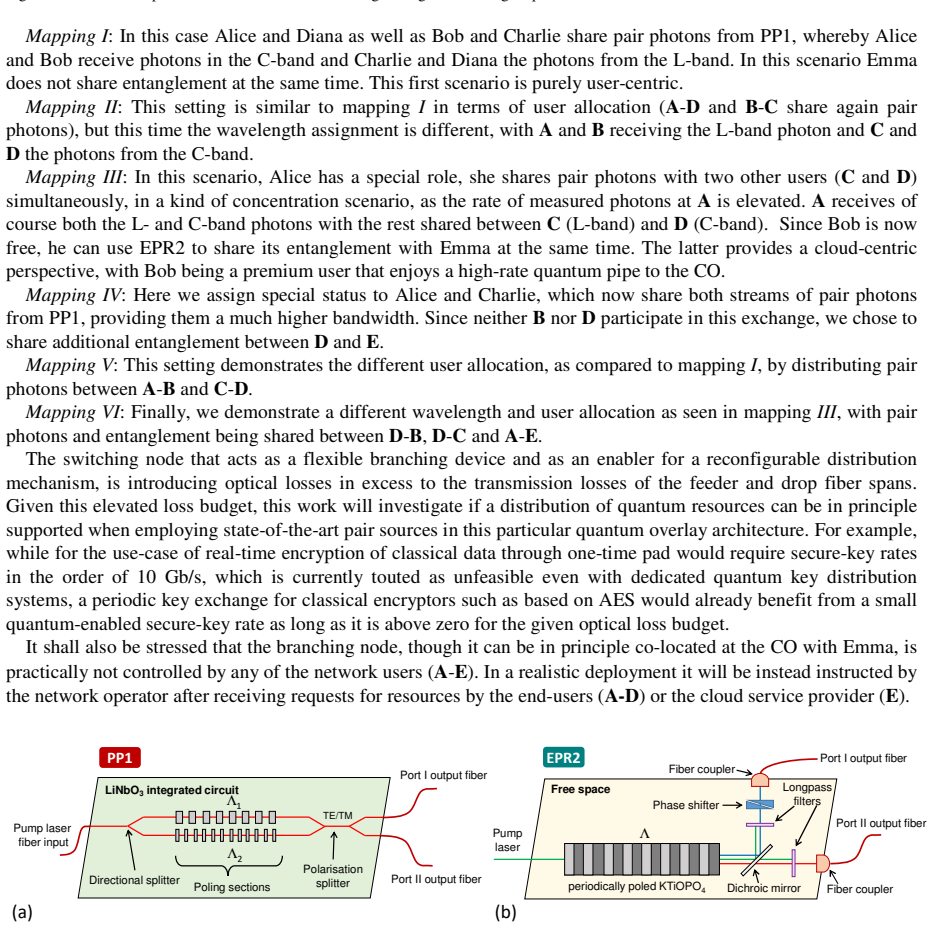
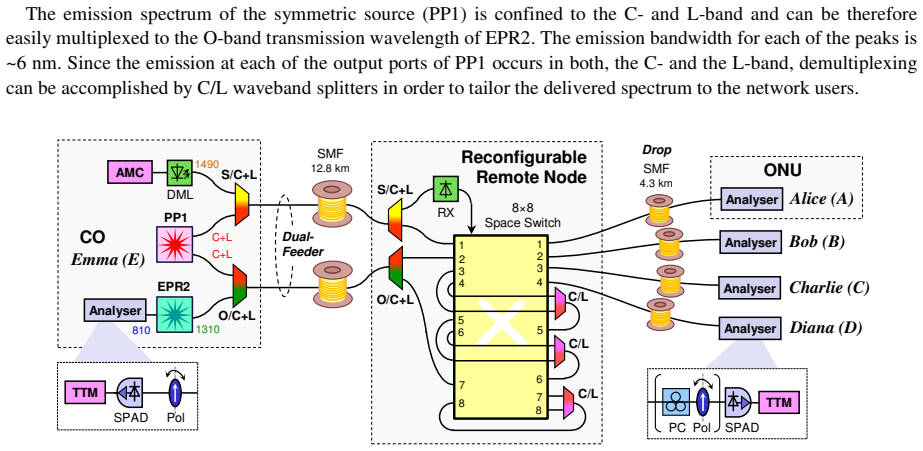
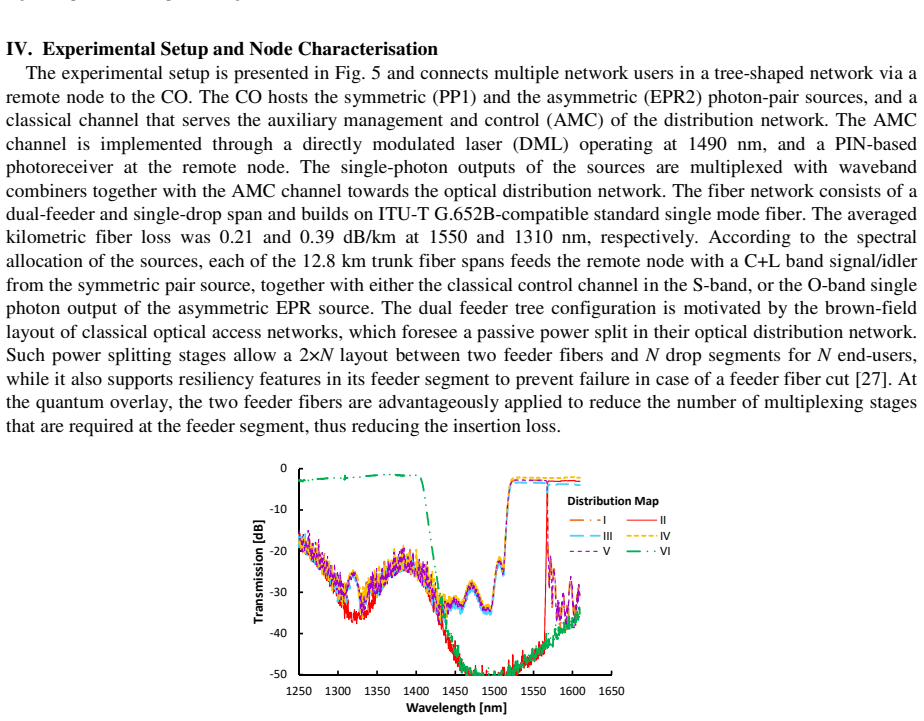
The central object is the synthesizable branching node: an 8×8 optical space switch operated in loopback configuration, surrounded by waveband splitters and combiners that separate the O-, C-, and L-band quantum channels. The loopback ports let the node internally re-circulate and recombine wavelength bands, so the node's effective architecture—which user gets which band, and whether the central office is included—is composed on demand rather than fixed in hardware. This is the mechanism that turns a static passive tree into a reconfigurable distribution map, and it is what allows dynamic bandwidth allocation (up to 3.2× for one user) and simultaneous service to multiple users with insertion losses of 2.2 dB in the O-band and 2.8–3.8 dB in the C/L-bands.
What would settle it
Re-analyze the same eight-setting correlation data with accidental coincidences subtracted and compute the CHSH parameter: if any of the three E-X pairs yields $S \leq 2$, or its corrected visibility falls below $1/\sqrt{2}$, the entanglement-distribution claim for that pair is refuted.
Extended reading notes
Core claim
The central claim is that a quantum access network need not be frozen by passive wavelength multiplexing: a branching node built from an 8×8 space switch in loopback configuration, together with C/L waveband splitters, can synthesize different connectivity maps and thereby allocate quantum bandwidth flexibly. The authors demonstrate simultaneous photon-pair distribution to multiple users in six mappings, plus asymmetric EPR entanglement from the central office to remote users in three of those mappings. Measured coincidence rates range from about 1 to 16 counts/s depending on the mapping, and the EPR source shows back-to-back visibility $0.955 \pm 0.033$; after 17 km transmission, the three entanglement-sharing pairs still show visibilities of $0.841$–$0.886$, above the classical threshold $1/\sqrt{2} \approx 0.707$. Reconfiguration is quasi-hitless, a user's pair rate can be adjusted by a factor of 3.2 (5.1 dB), and an in-band classical control channel at 1490 nm can co-exist without penalty. The authors present this as a step from static, passive entanglement distribution toward agile, service-oriented quantum networks.
Load-bearing premise
The entanglement-distribution result stands on the assumption that the quoted visibility values ($0.841$–$0.886$), measured with eight polarizer settings and not corrected for accidental coincidences, genuinely certify entanglement, so if the true visibilities are lower than reported the three-user entanglement claim weakens.
Editorial extensions
If this is right
- If the scheme works as demonstrated, quantum network operators can offer entanglement as an on-demand service: the same physical tree can switch between pair sharing among end users, concentration of bandwidth on one user, and cloud-centric links to a central hub.
- Dynamic bandwidth allocation becomes available at the quantum layer: a single user's delivered photon rate can be changed by 3.2× (5.1 dB) by switching the node, which could be used for service-level differentiation or load balancing.
- A classical control channel can travel alongside quantum channels on the same feeder fiber without observable penalty, because it is temporally gated during reconfiguration and spectrally rejected at users; this removes a practical obstacle to managing remote quantum nodes.
- Because the node is built from standard telecom switch and multiplexer components and can in principle be powered by optical energy harvesting, it can remain a passive element of the optical distribution network while still being reconfigurable.
Reading between the lines
- The same loopback-switch design could be reprogrammed to implement other logical topologies beyond the six shown—for example, a quantum key distribution star or a relay chain—since the routing is defined by configuration rather than the fiber plant.
- The architecture's flexibility suggests heterogeneous services could share the same infrastructure: entanglement for some users and single-photon quantum key distribution for others, delivered simultaneously through different spectral allocations.
- The entanglement witness could be strengthened to a CHSH-Bell test; if the same three links violate a Bell inequality, the distribution claim would not rely on the $1/\sqrt{2}$ visibility threshold alone.
Signed reviews
Editorial analysis
A structured set of objections, weighed in public.
Referee Report
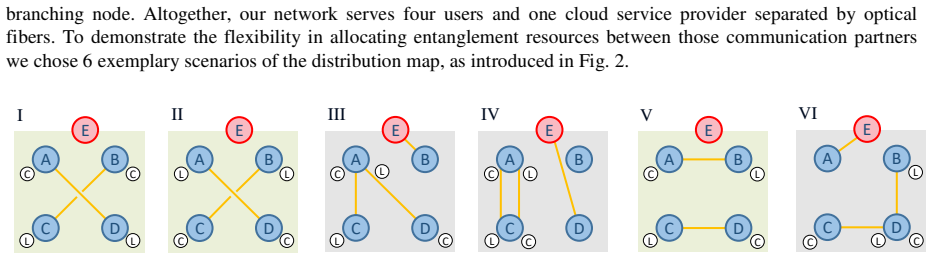
Summary. The manuscript reports an experimental optical network node built from an 8x8 space switch in a loopback configuration together with C/L waveband splitters. A central office hosts two SPDC sources: a symmetric LiNbO3 source (PP1) emitting C- and L-band photon pairs and an asymmetric ppKTP source (EPR2) emitting polarization-entangled 904/1294 nm pairs. The node connects four remote users (Alice, Bob, Charlie, Diana) and a local hub (Emma) through a 17-km tree-shaped fiber network. Six static distribution mappings (I-VI) are demonstrated for single-photon pair distribution, with coincidence rates in Table I; entanglement distribution from EPR2 is characterized in three of these mappings via polarization visibility measurements reported in Table II. The paper also demonstrates dynamic cycling through all six configurations, reports a 3.2x rate adjustment for one user after dark-count subtraction, and claims penalty-free co-existence of a 1490-nm auxiliary management and control (AMC) channel.
Significance. The architecture is a useful step toward reconfigurable quantum distribution networks: it combines active spatial switching with spectral slicing over the O, C, and L bands, supports both user-centric and cloud-centric allocations, and demonstrates simultaneous multi-user distribution with dynamic bandwidth changes. Strengths of the paper include its forward loss-budget reasoning (the expected remote rate is a calculation, not a fit), the reporting of 60-s integration means with 1-sigma standard deviations, independent back-to-back characterization of the EPR source (V = 0.955 +/- 0.033), and explicit discussion of detector and source limitations. If the per-basis visibility data confirm the entanglement witness and the penalty-free claim is backed by a quantitative comparison, this will be a solid systems demonstration; without those additions, the paper's central claims currently exceed the evidence presented.
major comments (3)
- [V.B, Table II] The visibility estimator is never defined, and the per-basis results behind Table II are not reported. The text says that a visibility measurement was performed for the eight polarizer settings HH, HV, VH, VV, AD, AA, DA, and DD, but it does not state whether the quoted V is the H/V visibility, the D/A visibility, their average, or another combination. This matters because the 1/sqrt(2) threshold is not a valid entanglement witness in a single basis: a separable state can have unit visibility in one basis and zero in the other. Please provide the raw coincidence counts (or at least V_HV and V_DA with uncertainties) for mappings III, IV, and VI, and state the exact formula used. This is load-bearing for the central entanglement-distribution claim; the weakest entry, V = 0.842 +/- 0.109, has a 1-sigma lower bound only 0.026 above the threshold, so per-basis confirmation is essential.
- [Abstract, Section VI] The abstract's claim that 'penalty-free operation is confirmed' for the co-existing 1490-nm classical control channel is not supported by the quantitative data presented. Section VI states that 'no impact is observed at the switching transients' and shows detector-event traces for an electrical versus an optical AMC channel, but there is no statistical comparison of delivered rates, coincidence rates, or entanglement visibility with the AMC channel on and off. Please either report such a comparison (for example, mean and standard deviation of the relevant rate or visibility in the same mapping with and without the optical AMC channel) or weaken the claim to say that no penalty was observed within the time resolution and statistics of the dynamic-switching measurement.
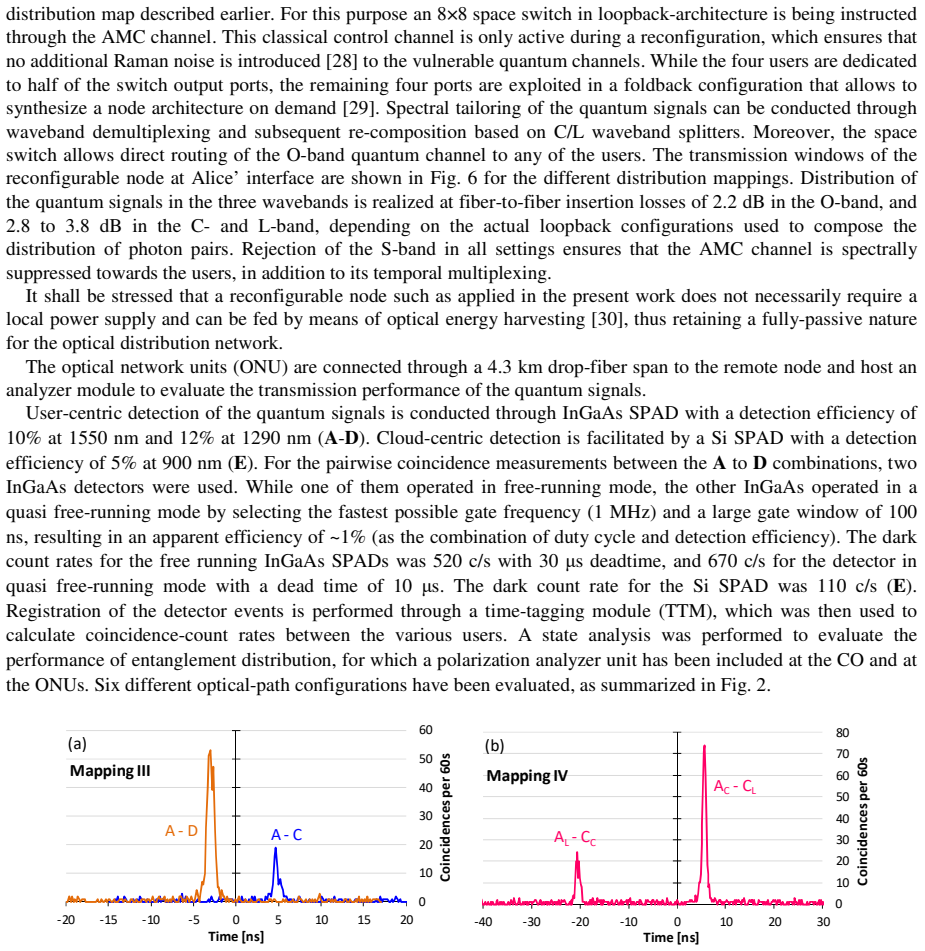
- [V.A, Table I] The coincidence window and accidental-coincidence treatment are not specified for Table I. The quoted pair rates are 1.2 to 8.8 cc/s, while the InGaAs dark-count rates are 520 to 670 c/s, and the temporal-correlation plots in Fig. 7 show nonzero backgrounds. Without stating the coincidence window and whether accidental coincidences were subtracted, the reported rates and the 'factor of 3.2' dynamic rate adjustment in Section VI are not fully reproducible. Please specify the window and either subtract accidentals or quantify their contribution.
minor comments (4)
- [V.B] The phrase 'entanglement shared between three users' (also used in the abstract) is ambiguous: Table II shows Emma paired with Bob, Diana, and Alice in three separate mappings, not simultaneous three-party entanglement. Please rephrase to say 'between Emma and three different remote users in different mappings.'
- [Fig. 8] The label 'Dianna' in Fig. 8 should be 'Diana' to match the text.
- [IV] Please state the coincidence window used by the time-tagging module, since it is needed to interpret the rates in Tables I and II.
- [V.B] Please provide a reference or derivation for the statement that visibility exceeding 1/sqrt(2) witnesses entanglement for the two-basis measurement; as written, the threshold appears basis-specific rather than universally applicable.
Circularity Check
No significant circularity: the central claims are direct experimental measurements, and self-citations are not load-bearing.
full rationale
The paper's core claims—six static distribution mappings, a dynamic rate-adjustment factor of 3.2, and entanglement visibility above 1/√2 for three user–Emma pairs—are presented as direct measurements (Tables I and II, Fig. 8), not as outputs of a fitted model or of a self-referential derivation. The EPR2 source is based on the authors' prior work [25,26], but its entanglement is re-characterized independently in this paper by a back-to-back visibility measurement (V = 0.955 ± 0.033), so the network-level entanglement claim does not rest on an unverified self-citation. The branching-node concept is attributed to the authors' earlier work [23], but that citation is contextual; the node's insertion losses and transmission spectra are measured here. The only numerical consistency statement, that the E-X rate 'agrees well with the expected rate due to transmission loss at feeder fiber, branching node and drop fiber,' is a loss-budget sanity check rather than a fitted parameter renamed as a prediction. No equation in the paper defines a target quantity in terms of the same target quantity, and none of the reported visibilities are used as inputs to construct the mappings. The under-specification of the visibility formula and the thin margin above 1/√2 are reporting and correctness concerns, not circularity. No circular step can be exhibited, so the circularity score is 0.
Assumptions & free parameters
assumptions (4)
- domain assumption SPDC sources produce photon pairs with Poisson statistics; coincidence peaks correspond to paired photons.
- domain assumption Polarization visibility above 1/√2 with the eight measured settings witnesses polarization entanglement.
- domain assumption The 1490 nm AMC channel, active only during reconfiguration, is temporally gated and spectrally filtered so it does not add noise to quantum channels.
- domain assumption The birefringence-induced polarization rotation in the fibers can be compensated such that the remaining visibility reduction is only an experimental imperfection.
Cite this review
Pith. "Pith review of Flexible Cloud/User-Centric Entanglement and Photon Pair Distribution with Synthesizable Optical Router." pith.science (2026). https://pith.science/paper/YPG6DQMQ
@misc{pith2026190801673,
  author       = {Pith},
  title        = {Pith review of: Flexible Cloud/User-Centric Entanglement and Photon Pair Distribution with Synthesizable Optical Router},
  year         = {2026},
  howpublished = {\url{https://pith.science/paper/YPG6DQMQ}},
  note         = {Machine review of arXiv:1908.01673}
}
read the original abstract
The practical roll-out of quantum communication technologies in optical networks and the adoption of novel quantum applications demand the distribution of single or entangled photons. Flexibility and dynamicity are paramount for the provision of quantum resources, in order to scale with the number of users and to meet the demand of complex network architectures. We present a quantum network architecture that features this degree of reconfigurability, without being restricted to a rigid physical-layer network based on purely passive multiplexing componentry. We leverage spectral assets of photon-pair sources, from the short-wavelength band to the L-band, and agile spatial switching at a remote optical network node, in order to realize a flexible distribution map that features different flavors, reaching from cloud-centric to user-centric quantum connectivity. Photon pair distribution is experimentally demonstrated between five users in a 17-km reach, tree-shaped optical network, with high visibility entanglement shared between three users of the network. Simultaneous distribution of photons to more than one user is enabled and the delivered photon rate can be dynamically adjusted. Penalty-free operation is confirmed for integrating a co-existing classical control channel within the quantum.
Figures

Figures from the paper (5 more)


Reference graph
Works this paper leans on
-
[1]
is based on the distribution and measurements o f entangled photons. Furthermore, quantum communica tion protocols such as blind quantum computing [2], dist ributed quantum computing, clock synchronization [3 ] and realization of device independent security [4] reli es on the distribution of entanglement. Other types of quantum communication protocols not...
-
[2]
H.J. Kimble, “The quantum internet,” Nature , vol. 453, pp. 1023-1030, Jun. 2008
work page 2008
-
[3]
Universal blind quantum computation,
A. Broadbent, J. Fitzsimons, and E. Kashefi, “Universal blind quantum computation,” in Proc. IEEE Symposium on Foundations of Computer Science (FOCS) , Atlanta, United States, pp. 517-526, Oct. 2009
work page 2009
-
[4]
Quantum Clock Synchronization Based on Shared Prior Entanglement,
R. Jozsa, D.S. Abrams, J.P. Dowling, and C.P. Williams, “Quantum Clock Synchronization Based on Shared Prior Entanglement,” APS Phys. Rev. Lett. , vol. 85, no. 9, p. 2010, Aug. 2000
work page 2010
-
[5]
Device-independent security of quantum cryptography against collective attacks,
A. Acin, N. Brunner, N. Gisin, S. Massar, S. Pironio, and V. Scarani, “Device-independent security of quantum cryptography against collective attacks,” APS Phys. Rev. Lett. , vol. 98, no. 23, p. 230501, Jun. 2007
work page 2007
-
[6]
A fully automated entanglement-based quantum cryptography system for telecom fiber networks,
A. Treiber et al. , “A fully automated entanglement-based quantum cryptography system for telecom fiber networks,” IOP New J. Phys., vol. 11, p. 045013, Apr. 2009. 0 10000 20000 30000 40000 50000 60000 0 1000 2000 3000 4000 5000 6000 7000 0 10 20 30 40 50 60 810 -nm Detector events [cts] O/C/L -band Detector events [cts] Time [s] electrical AMC channel I ...
work page 2009
-
[7]
An Experimental Implementation of Oblivious Transfer in the Noisy Storage Model,
C. Erven, N. Ng, N. Gigov, R. Laflamme, S. Wehner, and G. Weihs, “An Experimental Implementation of Oblivious Transfer in the Noisy Storage Model,” Nature Comm. , vol. 5, p. 3418, 2014
work page 2014
-
[8]
Quantum advantage for probabilistic one-time programs,
M.C. Roehsner, J.A. Kettlewell, T.B. Batalhão, J.F. Fitzsimons, and P. Walther, “Quantum advantage for probabilistic one-time programs,” Nature Comm. , vol. 9, p. 5225, Dec. 2018
work page 2018
Show all 31 references
-
[9]
Micrometer-scale integrated silicon source of time-energy entangled photons,
D. Grassani et al. , “Micrometer-scale integrated silicon source of time-energy entangled photons,” OSA Optica , vol. 2, no. 2, pp. 88-94, Feb. 2015
2015
-
[10]
Chip-to-chip quantum entanglement distribution,
J. Wang et al. , “Chip-to-chip quantum entanglement distribution,” in Proc. Conf. Lasers and Electro-Optics (CLEO) , San Jose (CA), United States, May 2015, FTu2A.1
2015
-
[11]
Integrated sources of entangled photons at the telecom wavelength in femtosecond-laser-written circuits,
S. Atzeni et al. , “Integrated sources of entangled photons at the telecom wavelength in femtosecond-laser-written circuits,” OSA Optica , vol. 5, no. 3, pp. 311-314, Mar. 2018
2018
-
[12]
A ps-pulse laser for ultrafast entanglement generation at 42.66 GHz repetition rate,
S. Zeiger, F. Laudenbach, B. Schrenk, M. Hentschel, and H. Hübel, “A ps-pulse laser for ultrafast entanglement generation at 42.66 GHz repetition rate,” in Proc. Europ. Conf. on Lasers and Electro-Optics (CLEO) , Munich, Germany, Jun. 2019, p. EB-P.36
2019
-
[13]
Polarization design for ground-to-satellite quan tum entanglement distribution
X. Han et al. , “Polarization design for ground-to-satellite quan tum entanglement distribution” OSA Opt. Expr., vol. 28, no. 1, pp. 369-378, Jan. 2020
2020
-
[14]
Passively stable distribution of polarisation entanglement over 192 km of deployed optical fibre,
S. Wengerowsky et al. , “Passively stable distribution of polarisation entanglement over 192 km of deployed optical fibre,” Quantum Information, vol. 6, p. 5, Jan. 2020
2020
-
[15]
Dense Wavelength Division Multiplexed Quantum Key Distribution Using Entangled Photons,
J. Mower, F.N.C Wong, J.H. Shapiro, and D. Englund, “Dense Wavelength Division Multiplexed Quantum Key Distribution Using Entangled Photons,” arXiv:1110.4867, Oct. 2011
2011 arXiv
-
[16]
Multi-party Agile QKD network with a fiber-based entangled source,
E.Y. Zhu, C. Corbari, A.V. Gladyshev, P.G. Kazansky, H.K. Lo, and L. Qian, “Multi-party Agile QKD network with a fiber-based entangled source,” in Proc. Conf. Lasers and Electro-Optics (CLEO) , San Jose (CA), United States, May 2015, JW2A.10
2015
-
[17]
Entanglement distribution over 150 km in wavelength division multiplexed channels for quantum cryptography,
D. Aktas et al. , “Entanglement distribution over 150 km in wavelength division multiplexed channels for quantum cryptography,” Wiley Laser Photonics Rev. , vol. 10, no. 3, pp. 451-457, May 2016
2016
-
[18]
Experimental realization of an entanglement access network and secure multi-party computation,
X.Y. Chang, D.L. Deng, X.X. Yuan, P.Y. Hou, Y.Y. Huang, and L.M. Duan, “Experimental realization of an entanglement access network and secure multi-party computation,” Sci. Rep. , vol. 6, p. 29453, Jul. 2016
2016
-
[19]
Broadband source of telecom-band polarization entangled photon-pairs for wavelength-multiplexed entanglement distribution,
H.C. Lim, A. Yoshizawa, H. Tsuchida, and K. Kikuchi, “Broadband source of telecom-band polarization entangled photon-pairs for wavelength-multiplexed entanglement distribution,” OSA Opt. Expr. , vol. 16, no. 20, pp. 16052-16057, 2008
2008
-
[20]
Demonstration of active routing of entanglement in a multi-user network,
I. Herbauts, B. Blauensteiner, A. Poppe, T. Jennewein, and H. Hübel, “Demonstration of active routing of entanglement in a multi-user network,” OSA Opt. Expr. , vol. 21, no. 13, pp. 29013-29024, 2013
2013
-
[21]
Entanglement Distribution in Optical Networks,
A. Ciurana, V. Martin, J. Martinez, B. Schrenk, M. Peev, and A. Poppe, “Entanglement Distribution in Optical Networks,” IEEE J. Sel. Topics in Quantum Electron. , vol. 21, no. 3, p. 6400212, May 2015
2015
-
[22]
Quantum Entanglement Distribution for Secret Key Establishment in Metropolitan Optical Networks,
M. Alshowkan, and K. Elleithy, “Quantum Entanglement Distribution for Secret Key Establishment in Metropolitan Optical Networks,” in Proc. IEEE Int. Conf. Netw., Architecture and Storage (NAS) , Long Beach (CA), United States, Aug. 2016, pp. 1-8
2016
-
[23]
An entanglement-based wavelength-multiplexed quantum communication network,
S. Wengerowsky, S.K. Joshi, F. Steinlechner, H. Hübel, and R. Ursin, “An entanglement-based wavelength-multiplexed quantum communication network,” Nature , vol. 564, pp. 225-228, Dec. 2018
2018
-
[24]
Flexible entanglement distribution based on WDM and active switching technology
F. Laudenbach, B. Schrenk, M. Hentschel, and H. Hübel, “Flexible entanglement distribution based on WDM and active switching technology”, in Proc. Int. Conf. Transp. Opt. Netw. (ICTON) , Angers, France, Jul. 2019, We.B5.5
2019
-
[25]
Post-selection free, integrated optical source of non- degenerate, polarization entangled photon pairs,
H. Herrmann, X. Yang, A. Thomas, A. Poppe, W. Sohler, and C. Silberhorn, “Post-selection free, integrated optical source of non- degenerate, polarization entangled photon pairs,” OSA Opt. Expr. , vol. 21, no. 23, pp. 27981-27991, Nov. 2013
2013
-
[26]
A novel single-crystal & single-pass source for polarisation- and colour-entangled photon pairs,
F. Laudenbach, S. Kalista, M. Hentschel, P. Walther, and H. Hübel, “A novel single-crystal & single-pass source for polarisation- and colour-entangled photon pairs,” Sci. Rep. , vol. 7, p. 7235, 2017
2017
-
[27]
Numerical Investigation of Photon-Pair Generation in Periodically Poled MTiOXO4 (M=K, Rb, Cs; X=P, As),
F. Laudenbach, R.B. Jin, C. Greganti, M. Hentschel, P. Walther, and H. Hübel, “Numerical Investigation of Photon-Pair Generation in Periodically Poled MTiOXO4 (M=K, Rb, Cs; X=P, As),” APS Phys. Rev. Appl. , vol. 8, no. 2, p. 024035, Aug. 2017
2017
-
[28]
Demonstration of a Remotely Dual-Pumped Long-Reach PON for Flexible Deployment
B. Schrenk et al. , “Demonstration of a Remotely Dual-Pumped Long-Reach PON for Flexible Deployment”, IEEE/OSA J. Lightwave Technol. , vol. 30, pp. 953-961, Apr. 2012
2012
-
[29]
Perspectives and Limitations of QKD Integration in Metropolitan Area Networks,
S. Aleksic, F. Hipp, D. Winkler, A. Poppe, B. Schrenk, and G. Franzl, “Perspectives and Limitations of QKD Integration in Metropolitan Area Networks,” OSA Opt. Expr. , vol. 12, no. 8, pp. 10359-10373, 2015
2015
-
[30]
Architecture on demand design for high-capacity optical SDM/TDM/FDM switching,
M. Garrich et al. , “Architecture on demand design for high-capacity optical SDM/TDM/FDM switching,” IEEE/OSA J. Opt. Comm. Netw. , vol. 7, no. 1, pp. 21-25, Jan. 2015
2015
-
[31]
Passive ROADM Flexibility in Optical Access with Spectral and Spatial Reconfigurability,
B. Schrenk et al. , “Passive ROADM Flexibility in Optical Access with Spectral and Spatial Reconfigurability,” IEEE J. Sel. Areas of Comm. , vol. 33, no. 12, pp. 2837-2846, Sept. 2015
2015
Reviewed August 14, 2026 · model on record in the stance chip above.
Discussion (0). Continue with ORCID to comment.