REVIEW 4 major objections 6 minor 1 cited by
A modular, instrumented indoor water tank can serve as a reproducible, cost-effective middle ground between simulation and field deployment for both maritime and space robotics, the paper argues, with four demonstration studies backing the
Reviewed by Pith at T0; open to challenge. T0 means a machine referee read the full paper against a public rubric. the ladder, T0–T4 →
T0 review · deepseek-v4-flash
2026-08-02 20:28 UTC pith:YQ3CQWXU
load-bearing objection A real facility with a genuinely useful open-source SYSID study and honest limitations; the 'intermediate testbed' claim is plausible but transfer to field/space remains asserted rather than shown. the 4 major comments →
Marinarium: A Modular Experimental Facility for Reproducible Maritime and Space-Analog Field Robotics
The pith
A machine-rendered reading of the paper's core claim, the machinery that carries it, and where it could break.
Core claim
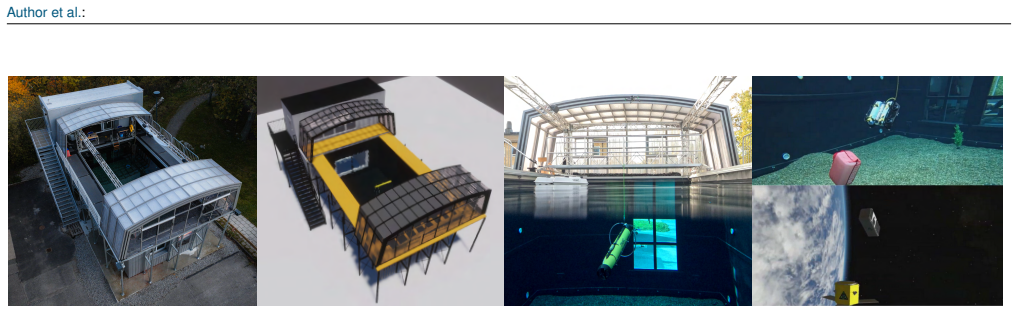
The paper argues that a single modular facility—an instrumented 9×5×3 m indoor tank with motion capture above and below the surface, a retractable roof, and a simulator twin—can be a reproducible, low-cost middle ground between simulation and field deployment for maritime and space robotics. Four demonstrations support this: a Koopman-operator method that predicts a small ROV's state in open-loop rollouts better than physics and neural baselines; a rendezvous among underwater, surface, and aerial vehicles; a learned residual-dynamics correction that shrinks simulator endpoint error; and a paired test where a neutrally buoyant ROV and a planar free-flyer execute the same temporal-logic inspec
What carries the argument
The load-bearing object is the facility itself: a prefabricated, free-standing basin with a gravel floor that scatters acoustic reflections, dual motion-capture systems covering the underwater and aerial volumes, a retractable roof for real-weather operation, and a simulator twin that ingests live vehicle states. The cross-domain space experiment works because the same autonomy stack runs on both the ROV and the planar free-flyer, so software differences are removed and only the physical environment differs. Methodologically, the dynamics result rests on a Koopman operator approximated by extended dynamic mode decomposition with a radial-basis-function dictionary: the nonlinear vehicle dynam
Load-bearing premise
The whole value proposition rests on the assumption that hydrodynamic behavior in a 9×5×3 m indoor tank is close enough to open-water conditions, and neutral buoyancy close enough to microgravity, for results obtained there to transfer to field and space deployments; the paper itself flags hydrodynamic effects as the main deviation from true microgravity and lists formal equivalence guarantees as future work.
What would settle it
Equip the same autonomy stack used in the paired experiment, run the identical temporal-logic inspection task on the air-bearing floor, in the tank, and in an open-water or parabolic-flight setting, and compare tracking-error distributions and success times. If the tank does not rank-order the settings the way real deployments do, the intermediate-testbed claim collapses. A cheaper check specific to the sim-to-real study: retrain the residual model on tank data and evaluate on trajectories dominated by high-yaw-rate turns; the paper already notes such instability, and showing it is systematic
If this is right
- Model learning for underwater robots can use dense real-world data instead of simulation or trial-and-error field tests: the tank yielded more than 45,000 synchronized 12-dimensional state-plus-thruster samples per dataset at 50 Hz.
- Underwater simulators can be made more faithful by injecting residual dynamics learned from motion-capture data; the paper reports the corrected simulator roughly halved long-horizon position error on held-out trajectories.
- Spacecraft autonomy software can be rehearsed on an underwater vehicle before air-bearing or orbital testing, since the same temporal-logic plan and nonlinear MPC tracked comparably on both platforms.
- Multi-domain missions can be rehearsed indoors with full ground truth, including acoustic underwater communication, which the gravel floor made possible at a 70% transmission rate.
- Because the structure is assembled from prefabricated modules with construction cost estimated under four million Swedish kronor, other groups could build equivalent facilities.
Where Pith is reading between the lines
- The paper stops short of showing that tank-learned models transfer to open water; a natural next test is to deploy the identified dynamics or residual-corrected simulator against offshore data and measure how much accuracy degrades.
- The paired underwater and air-bearing setup suggests a staged validation ladder—simulator, planar free-flyer, neutrally buoyant ROV, orbital demo—where the ROV leg adds realistic disturbance forces that a nearly drag-free air-bearing floor cannot provide.
- The reported instability during sharp turns in the residual-dynamics study points to a concrete fix: decouple linear and angular residual predictors or train with oversampled high-yaw-rate maneuvers, so the corrected simulator can be used to train control policies.
- A gravel-scattering floor that lifts acoustic-modem rates from 0% to 70% in a small tank implies that other indoor basins could become underwater-networking testbeds with minimal retrofit.
Editorial analysis
A structured set of objections, weighed in public.
Referee Report
Summary. The paper presents the Marinarium, a small (9×5×3 m) modular indoor water tank facility at KTH with underwater and above-water motion capture, a retractable roof, a digital twin in SMaRCSim, and integration with the ATMOS planar space-robotics testbed. The authors argue that this combination provides a cost-effective, reproducible intermediate step between simulation and offshore/space deployment. Four studies are used as validation: data-driven system identification of a BlueROV2 using Koopman EDMDc-RBF; a multi-domain rendezvous mission with an AUV, USV, and UAV; a learned residual-dynamics model for sim-to-real transfer; and a paired inspection task on a BlueROV2 and the ATMOS free-flyer under the same STL-based NMPC stack. The central claim is that these experiments demonstrate the facility's value for reproducible, instrumented experimentation in maritime and space-analog field robotics.
Significance. If the facility descriptions and experimental results are taken at face value, the paper is a useful infrastructure contribution. It is one of very few small-scale facilities with dual underwater/above-water MoCap, and the open-sourced SYSID datasets, code, and hyperparameters are a strength that increases reproducibility. The Koopman-based identification result is a plausible and interesting first application to underwater vehicles. The sim-to-real residual pipeline, despite its limitations, is a concrete demonstration of how an instrumented tank plus a digital twin can be used for underwater real-to-sim learning. The paired ATMOS/BlueROV2 experiment is also a valuable demonstration of infrastructure interoperability. However, the paper's strongest claims—that the facility is a validated intermediate testbed for offshore and space deployment—are not established by the experiments. The four studies are capability demonstrations, not transfer validations. The conclusion that the facility 'bridges laboratory robotics, offshore operations, and space applications' is substantially ahead of what the data support, and the paper's own caveats in Sec. VII.A and VII.C undercut this conclusi
major comments (4)
- [§VII.C and Fig. 13] The claim that the BlueROV2 'can reproduce the behavior of a free-flying spacecraft' is not supported by the closed-loop tracking comparison. Both platforms use the same NMPC controller, and the controller includes an EKF that actively estimates and compensates for disturbance forces and torques (Sec. VII.B). Similar closed-loop tracking errors can therefore be obtained even if the plant dynamics differ substantially. The paper itself acknowledges in Sec. VII.A that hydrodynamic effects are the main deviations from microgravity and in Sec. VII.C that formal equivalence is future work. The experiment demonstrates that the same software stack runs on both platforms, but not that the underwater vehicle is a valid surrogate. Either remove the validation language and reframe the result as a feasibility/prototyping demonstration, or add an open-loop dynamic comparison, a disturbance-estimate c
- [§VI.F, Table 4] The abstract and conclusion state that the residual model 'significantly improves simulation' of the AUV, but Table 4 shows no significant reduction in angular velocity error (e.g., at H=100: 0.23 vs 0.25; at H=500: 0.25 vs 0.27), and the text reports that the corrected model becomes unstable on sharp turns with high angular velocity and fast forward acceleration. The improvements are limited to longer horizons for pose and linear velocity. This is a load-bearing point for the sim2real bridging claim. The paper should present angular-velocity results as a negative or inconclusive result, quantify the instability (e.g., fraction of trajectories diverging, time-to-instability), and temper the abstract/conclusion accordingly. As written, the claim overstates what the experiment shows.
- [§IV.D, Table 2, §IV.E] The RMSE comparisons in Table 2 lack error bars, confidence intervals, or multiple train/test splits. The test set is a single chronological split, and the Koopman hyperparameters (K, gamma, lambda) are tuned on a subset of the training data, but no variance is reported. The differences between Koopman and the double-integrator baseline at 1-step and 10-step horizons (0.0629 vs 0.0784 and 0.0831 vs 0.1088) may be within experimental noise, and the paper's own Fig. 6 shows only one rollout. In addition, the PINc baseline 'did not seem to reduce significantly during training' despite using the same hyperparameters as [48], yet it is still reported as a baseline with RMSE ~8.8. This unexplained failure undermines the fairness of the comparison. Please provide multiple seeds/splits with error bars, report the PINc training issue as a failure mode rather than a silent baseline, and either fix
- [§VIII, Abstract] The central claim that the Marinarium 'enables new experimental methodologies that bridge laboratory robotics, offshore operations, and space applications' is not supported by any comparison to offshore or open-water data. None of the four studies validates the tank as a representation of offshore conditions; the multi-domain mission is a demonstration of integration, not of transferability. The paper should explicitly state that the transferability of results from the tank to offshore and space environments remains an open hypothesis, and use language such as 'controlled prototyping environment' rather than 'bridge' and 'validated testbed' throughout the abstract and conclusion.
minor comments (6)
- [§IV.D, Eq. (13)] The notation is confusing: N=9165 is called 'the total number of data points' in Eq. (13), but the dataset was earlier described as having more than 45823 samples. Please clarify whether N is the test-set size or the number of rollout starting points, and keep the definitions consistent.
- [Table 4] The column headers (e.g., 'hat p_sim', 'p_sim', 'hat omega_sim') are hard to read with the hat notation in the table. Use separate columns with explicit 'corrected' and 'uncorrected' labels, and state the units of each quantity. Also, '7198 trajectories' appears where the surrounding text says '7998'; please check.
- [Fig. 6] The caption says the figure shows 'ground truth vs. Koopman, physics and DI rollouts', but the PINc model is not plotted. State this in the caption and explain why (the PINc model is left out because of poor performance).
- [§II.C] The order of the four research areas in the introduction (SYSID, sim2real, multi-domain, space) does not match the section order (IV, VI, V, VII). Reorder the list or the section numbering to avoid confusion.
- [§III.B] The sentence 'has enabled a transmission rate of 70% with Delphis Succorfish modems ... from a 0% without stones' is a nice quantitative result, but it belongs in Sec. V as a motivating capability for the multi-domain experiment. Also clarify the number of trials over which the 0% and 70% rates are measured.
- [References] Reference [43] is cited as a digital twin of CIRTESU, but the reference title suggests a human-robot interaction paper. Double-check that this reference indeed describes a digital twin of the facility.
Circularity Check
No significant circularity: the paper's four demonstrations are empirical and benchmarked against MoCap ground truth; self-cited simulator and space lab function as tools, not as definitions of the claimed results.
full rationale
The paper's contributions are facility design and four empirical demonstrations, not first-principles derivations. The system-identification study (Sec. IV) fits EDMDc-RBF and baselines on chronological train/test splits of MoCap data (Eq. 13), so evaluations use held-out ground truth. The sim-to-real residual study (Sec. VI) computes residuals from MoCap ground truth and the simulator, trains an MLP, and reports held-out endpoint RMSE; the paper itself flags that angular-velocity error does not improve and that sharp turns can be unstable (Sec. VI.F), which is an honest limitation rather than a forced result. The spacecraft-autonomy comparison (Sec. VII) runs two platforms under an identical controller, so observed tracking similarity is partly due to feedback; however, the paper explicitly disclaims dynamic equivalence ('hydrodynamic effects introduce the main deviations from true microgravity', Sec. VII.A) and defers 'formal guarantees for equivalence between underwater and space-domain validation' to future work (Sec. VII.C). This weakens the generalization claim but does not define the claimed result in terms of its inputs. Self-citations to SMaRCSim [5] and ATMOS [22] are used as tools and comparison platforms, not as unverified authorities or uniqueness theorems; the central validations are judged against external MoCap ground truth and held-out data. No equation or fitted parameter is renamed as a prediction, so no circular step is exhibited.
Axiom & Free-Parameter Ledger
free parameters (4)
- Koopman EDMDc-RBF hyperparameters (K, gamma, lambda) =
K=500, gamma=3.0, lambda=0.1
- Double-integrator gain matrices K_lin, K_ang =
not reported numerically; learned via ridge regression
- Residual MLP hyperparameters and normalization statistics =
4x256 SiLU, lr=3e-3, wd=1e-5, gamma=0.997, epochs=2000, batch=768, Huber beta=0.9; mu_delta, sigma_delta from data
- NMPC stage/terminal weights Q, R, P =
unspecified
axioms (5)
- domain assumption Fossen model (M, C, D, g, w) adequately describes underwater vehicle dynamics for modeling and control
- domain assumption Neutral buoyancy in the tank is a valid surrogate for microgravity for spacecraft autonomy validation
- standard math RBFs are dense in C(X), so the lifted linear system can approximate the nonlinear dynamics
- domain assumption The MoCap systems provide sufficiently accurate ground truth for all experiments
- domain assumption The sea-gravel layer sufficiently reduces acoustic multipath to enable acoustic modem communication
read the original abstract
Field robotics research in maritime and space domains is constrained by a persistent gap between low-cost, low-fidelity simulation and costly offshore experimentation. Instrumented water tanks partially bridge this gap but often provide limited sensing, restricted experimental capabilities, and weak integration with simulation tools. To address these limitations, we present Marinarium, a modular, standalone experimental facility that provides a cost-effective intermediate testbed between simulation and field deployment. Marinarium combines a fully instrumented underwater and aerial operational volume with motion capture (MoCap), a retractable roof enabling both sheltered and open-air operation, a digital twin implemented in SMaRCSim, and direct integration with a planar space robotics laboratory, enabling both maritime and underwater space-analog experimentation. We present the design rationale of the facility and validate its capabilities through four representative studies in field robotics: (i) data-driven system identification of underwater vehicle dynamics; (ii) heterogeneous multi-domain robotic rendezvous; (iii) sim-to-real transfer for underwater robotics using learned dynamics residuals; and (iv) cross-domain validation of spacecraft autonomy using underwater surrogates. Together, these studies demonstrate that Marinarium enables reproducible, instrumented experimentation across multiple field robotics challenges that would otherwise require costly offshore deployments or be impractical to investigate using simulation alone.
Figures


Forward citations
Cited by 1 Pith paper
-
Risk-Aware Belief Control Barrier Functions over Random Finite Sets
A particle-based nonsmooth belief control barrier function enforces risk-aware safety when the number of moving obstacles is unknown and time-varying.
Reference graph
Works this paper leans on
-
[1]
Challenges and future trends in marine robotics.Annual Reviews in Control, 46:350–368, 2018
Enrica Zereik, Marco Bibuli, Nikola Mi ˇskovi´c, Pere Ridao, and Ant ´onio Pascoal. Challenges and future trends in marine robotics.Annual Reviews in Control, 46:350–368, 2018
2018
-
[2]
Sonar-based deep learning in underwater robotics: Overview, robustness, and challenges.IEEE Journal of Oceanic Engineering, 2025
Martin Aubard, Ana Madureira, Lu ´ıs Teixeira, and Jos´e Pinto. Sonar-based deep learning in underwater robotics: Overview, robustness, and challenges.IEEE Journal of Oceanic Engineering, 2025
2025
-
[3]
Basilisk: A flexible, scalable and modu- lar astrodynamics simulation framework.Journal of aerospace information systems, 17(9):496–507, 2020
Patrick W Kenneally, Scott Piggott, and Hanspeter Schaub. Basilisk: A flexible, scalable and modu- lar astrodynamics simulation framework.Journal of aerospace information systems, 17(9):496–507, 2020
2020
-
[4]
Sara Aldhaheri, Yang Hu, Yongchang Xie, Peng Wu, Dimitrios Kanoulas, and Yuanchang Liu. Underwater robotic simulators review for autonomous system de- velopment.arXiv preprint arXiv:2504.06245, 2025
Pith/arXiv arXiv 2025
-
[5]
SMaRC- Sim: Maritime Robotics Simulation Modules
Mart Karta ˇsev, David D¨orner, ¨Ozer ¨Ozkahraman, Petter ¨Ogren, Ivan Stenius, and John Folkesson. SMaRC- Sim: Maritime Robotics Simulation Modules. In 2025 Symposium on Maritime Informatics and Robotics (MARIS), pages 1–4, June 2025
2025
-
[6]
Uuv simulator: A gazebo-based pack- age for underwater intervention and multi-robot simu- lation
Musa Morena Marcusso Manh ˜aes, Sebastian A Scherer, Martin V oss, Luiz Ricardo Douat, and Thomas Rauschenbach. Uuv simulator: A gazebo-based pack- age for underwater intervention and multi-robot simu- lation. InOceans 2016 Mts/Ieee Monterey, pages 1–8. Ieee, 2016
2016
-
[7]
Sim2real in robotics and automa- tion: Applications and challenges.IEEE transactions on automation science and engineering, 18(2):398– 400, 2021
Sebastian H ¨ofer, Kostas Bekris, Ankur Handa, Juan Camilo Gamboa, Melissa Mozifian, Florian Golemo, Chris Atkeson, Dieter Fox, Ken Goldberg, John Leonard, et al. Sim2real in robotics and automa- tion: Applications and challenges.IEEE transactions on automation science and engineering, 18(2):398– 400, 2021
2021
-
[8]
Kevin Chang, Rakesh Vivekanandan, Noah Pragin, Sean Bullock, and Geoffrey Hollinger. Learning to dock: A simulation-based study on closing the sim2real gap in autonomous underwater docking.arXiv preprint arXiv:2506.17823, 2025
Pith/arXiv arXiv 2025
-
[9]
Lidtke, Douwe Rijpkema, and B ¨ulent D ¨uz
Artur K. Lidtke, Douwe Rijpkema, and B ¨ulent D ¨uz. General reinforcement learning control for AUV ma- noeuvring in turbulent flows.Ocean Engineering, 309:118538, October 2024
2024
-
[10]
Joel Lindsay, Jordan Ross, Mae L Seto, Edward Greg- son, Alexander Moore, Jay Patel, and Robert Bauer. Collaboration of heterogeneous marine robots toward multidomain sensing and situational awareness on par- tially submerged targets.IEEE Journal of Oceanic Engineering, 47(4):880–894, 2022
2022
-
[11]
Remote-access marine robotics infrastructure and experiments at labust.Journal of marine science and engineering, 12(2):317, 2024
Fausto Ferreira, Juraj Obradovi ´c, Dula Nad, Ivan Lonˇcar, Luka Mandi ´c, Igor Kvasi ´c, Natko Kra ˇsevac, and Nikola Mi ˇskovi´c. Remote-access marine robotics infrastructure and experiments at labust.Journal of marine science and engineering, 12(2):317, 2024
2024
-
[12]
A new hydrodynamics test facility for uuv dynamics and control research
James C Kinsey, David A Smallwood, and Louis L Whitcomb. A new hydrodynamics test facility for uuv dynamics and control research. InOceans 2003. Celebrating the Past... Teaming Toward the Future (IEEE Cat. No. 03CH37492), volume 1, pages 356–
2003
-
[13]
Navigation in the presence of obstacles for an agile autonomous underwater vehicle
Marios Xanthidis, Nare Karapetyan, Hunter Damron, Sharmin Rahman, James Johnson, Allison O’Connell, Jason M O’Kane, and Ioannis Rekleitis. Navigation in the presence of obstacles for an agile autonomous underwater vehicle. In2020 IEEE International Con- ference on Robotics and Automation (ICRA), pages 892–899. IEEE, 2020
2020
-
[14]
An integrated visual odometry system with stereo camera for unmanned underwater vehicles.IEEE Access, 10:71329–71343, 2022
Zhizun Xu, Maryam Haroutunian, Alan J Murphy, Jeff Neasham, and Rose Norman. An integrated visual odometry system with stereo camera for unmanned underwater vehicles.IEEE Access, 10:71329–71343, 2022
2022
-
[15]
Learning to swim: Reinforcement learning for 6-dof control of thruster-driven autonomous underwater vehicles
Levi Cai, Kevin Chang, and Yogesh Girdhar. Learning to swim: Reinforcement learning for 6-dof control of thruster-driven autonomous underwater vehicles. In 2025 IEEE International Conference on Robotics and Automation (ICRA), pages 11286–11293. IEEE, 2025
2025
-
[16]
Deep reinforcement learning framework for underwater locomotion of soft robot
Guanda Li, Jun Shintake, and Mitsuhiro Hayashibe. Deep reinforcement learning framework for underwater locomotion of soft robot. In2021 IEEE international conference on robotics and automation (ICRA), pages 12033–12039. IEEE, 2021
2021
-
[17]
Intelligent docking control of autonomous underwater vehicles using deep reinforce- ment learning and a digital twin system.Expert Systems with Applications, 296:129085, 2026
Yu-Hsien Lin, Chen-Hao Chiang, Chao-Ming Yu, and Joyce Yi-Tzu Huang. Intelligent docking control of autonomous underwater vehicles using deep reinforce- ment learning and a digital twin system.Expert Systems with Applications, 296:129085, 2026
2026
-
[18]
Carignan and D.L
C.R. Carignan and D.L. Akin. The reaction stabilization of on-orbit robots.IEEE Control Systems Magazine, 20(6):19–33, 2000
2000
-
[19]
Underwater 16 VOLUME , <Society logo(s) and publication title will appear here.> demonstrator for autonomous in-orbit assembly of large structures
Christian Ernst Siegfried Koch, Marko Jankovic, Sankaranarayanan Natarajan, Shubham Vyas, Wiebke Brinkmann, Vincent Bissonnette, Thierry Germa, Alessio Turetta, and Frank Kirchner. Underwater 16 VOLUME , <Society logo(s) and publication title will appear here.> demonstrator for autonomous in-orbit assembly of large structures. In15th International Symposi...
2020
-
[20]
Crew training safety: An integrated process
Jean-Bruno Marciacq and Loredana Bessone. Crew training safety: An integrated process. InSafety design for space systems, pages 745–815. Elsevier, 2009
2009
-
[21]
Practicing for space underwater: inventing neutral buoyancy training, 1963–1968.Endeavour, 39(3-4):147–159, 2015
Michael J Neufeld and John B Charles. Practicing for space underwater: inventing neutral buoyancy training, 1963–1968.Endeavour, 39(3-4):147–159, 2015
1963
-
[22]
Towards open-source and modular space systems with atmos.arXiv preprint arXiv:2501.16973, 2025
Pedro Roque, Sujet Phodapol, Elias Krantz, Jaeyoung Lim, Joris Verhagen, Frank J Jiang, David D ¨orner, Huina Mao, Gunnar Tibert, Roland Siegwart, et al. Towards open-source and modular space systems with atmos.arXiv preprint arXiv:2501.16973, 2025
Pith/arXiv arXiv 2025
-
[23]
Ocean Laboratory
SINTEF Ocean. Ocean Laboratory. https://www.sintef. no/en/all-laboratories/ocean-laboratory/, 2025. Ac- cessed: 2025-11-18
2025
-
[24]
Research & development on ocean systems and solu- tions
Technology Centre for Offshore & Marine (TCOMS). Research & development on ocean systems and solu- tions. https://tcoms.sg/website/research-development/,
-
[25]
Deep wave basin in brest
Ifremer, Recherches et D ´eveloppements Technologiques. Deep wave basin in brest. https://rd-technologiques. ifremer.fr/Moyens/Bassins-Canal-d-Essais/ Bassin-d-essais-du-centre-de-Bretagne#Domaines. Accessed: 2025-11-26
2025
-
[26]
Aquatron laboratory - pool tank
Dalhousie University. Aquatron laboratory - pool tank. https://www.dal.ca/dept/aquatron/facilities/pool tank.html. Accessed: 2025-11-25
2025
-
[27]
Fish-inspired tracking of underwater turbulent plumes.Bioinspiration & Biomimetics, 19(5):056024, 2024
Peter Gunnarson and John O Dabiri. Fish-inspired tracking of underwater turbulent plumes.Bioinspiration & Biomimetics, 19(5):056024, 2024
2024
-
[28]
New robotics research water tank to enable advanced marine autonomy
University of Michigan. New robotics research water tank to enable advanced marine autonomy. https://robotics.umich.edu/news/2025/ new-robotics-research-water-tank/
2025
-
[29]
Auv test- ing facility and resources
BYU, Electrical and Computer Engineering. Auv test- ing facility and resources. https://frostlab.byu.edu/tank. Accessed: 2025-11-26
2025
-
[30]
Lane, and Steven Weis- man
David Akin, Robert Roberts, J. Lane, and Steven Weis- man. Robotic capabilities for complex space opera- tions. InAIAA Space 2001 Conference and Exposition. American Institute of Aeronautics and Astronautics (AIAA), 2001
2001
-
[31]
Neutral buoyancy research facility (nbrf)
University of Maryland, Division of Research. Neutral buoyancy research facility (nbrf)
-
[32]
Eva development and veri- fication testing at nasa’s neutral buoyancy laboratory
Juniper C Jairala, Robert Durkin, Ralph J Marak, Stephanie A Sipila, Zane A Ney, Scott E Parazynski, and Arthur H Thomason. Eva development and veri- fication testing at nasa’s neutral buoyancy laboratory. In42nd International Conference on Environmental Systems (ICES), number JSC-CN-26179, 2012
2012
-
[33]
Maritime infrastructure, research facilities & labs
DFKI Robotics Innovation Center. Maritime infrastructure, research facilities & labs. https://robotik.dfki-bremen.de/en/research/ research-facilities-labs/maritime-infrastructure. Accessed: 2025-11-12
2025
-
[34]
Research platform for underwater robotics
Fraunhofer IOSB-AST. Research platform for underwater robotics. https://www.iosb-ast. fraunhofer.de/en/departments/Underwater-Robotics/ research-platform-underwater-robotic.html, 2025. Accessed: 2025-11-18
2025
-
[35]
Research center in undewa- ter robotics (cirs)
Universitat de Girona. Research center in undewa- ter robotics (cirs). http://eia.udg.es/ ∼pere/Pere Ridao Home Page/CIRS.html. Accessed: 2025-11-25
2025
-
[36]
Surro- gate modeling for rov trajectory planning in realistic marine currents: A methodology for data assisted un- derwater navigation
G Monr ´os-Andreu, S Lopez-Barajas, J Luis-G ´omez, R Mar´ın Prades, A Gonz´alez-Barber´a, A Macias, A So- lis, R Mart ´ınez-Cuenca, PJ Sanz, and S Chiva. Surro- gate modeling for rov trajectory planning in realistic marine currents: A methodology for data assisted un- derwater navigation. InOCEANS 2025 Brest, pages 1–8. IEEE, 2025
2025
-
[37]
Robotics and autonomous systems laboratory
INESC TEC. Robotics and autonomous systems laboratory. https://www.inesctec.pt/en/laboratories/ robotics-and-autonomous-systems-laboratory. Ac- cessed: 2025-11-26
2025
-
[38]
Underwater technology
AAU Energy Aalborg University. Underwater technology. https://www.energy.aau.dk/research/ research-groups/underwater-technology. Accessed: 2025-11-26
2025
-
[39]
DTU ASTA Autonomous Systems Test Arena
DTU Center for Collaborative Autonomous Systems. DTU ASTA Autonomous Systems Test Arena. https: //asta.dtu.dk/, 2025. Accessed: 2025-11-20
2025
-
[40]
Mars: A cabled observatory testbed in monterey bay
M Mcnutt, G Massion, K Raybould, J Bellingham, and C Paull. Mars: A cabled observatory testbed in monterey bay. InEGS-AGU-EUG Joint Assembly, page 11585, 2003
2003
-
[41]
The digital ocean lab (dol): Centralising ocean research in the baltic sea
Alexandru Umlauft, Felix Schmidt, Gerrit L ¨unsdorf, Torben Globisch, Nele Daske, Patrick Suhrbier, Kris- tine Bauer, Sascha Krohmann, and Uwe Freiherr von Lukas. The digital ocean lab (dol): Centralising ocean research in the baltic sea. InOCEANS 2024-Halifax, pages 1–6. IEEE, 2024
2024
-
[42]
Fjord- lab: A full-scale marine field laboratory for innovation, research, and education in ocean science and technol- ogy
Martin Ludvigsen, Finn Olav Bjϕrnson, Ingrid Ellingsen, Kay Fjϕrtoft, Karl Henning Hasle, Hans Pet- ter Hildre, Beate Kvamstad-Lervold, Andreas Madsen, Kjell Olav Skjϕlsvik, Asgeir J Sϕrensen, et al. Fjord- lab: A full-scale marine field laboratory for innovation, research, and education in ocean science and technol- ogy. InOCEANS 2025 Brest, pages 1–9. I...
2025
-
[43]
Unity-based mixed reality hri for underwater exploration and object recovery using a i- auv and hololens
Salvador L ´opez-Barajas, Sebastian Realpe, Josep Mar´ın, Alejandro Solis, Andrea Pino, Ra ´ul Mar ´ın, and Pedro Sanz. Unity-based mixed reality hri for underwater exploration and object recovery using a i- auv and hololens. InOCEANS 2025 Brest, pages 1–4. IEEE, 2025. VOLUME , 17 Author et al.:
2025
-
[44]
Turtlmap: Real- time localization and dense mapping of low-texture underwater environments with a low-cost unmanned underwater vehicle
Jingyu Song, Onur Bagoren, Razan Andigani, Advaith Sethuraman, and Katherine A Skinner. Turtlmap: Real- time localization and dense mapping of low-texture underwater environments with a low-cost unmanned underwater vehicle. In2024 IEEE/RSJ International Conference on Intelligent Robots and Systems (IROS), pages 1191–1198. IEEE, 2024
2024
-
[45]
Controlling ocean one: Human–robot collaboration for deep-sea manipulation.Journal of Field Robotics, 38(1):28–51, 2021
Gerald Brantner and Oussama Khatib. Controlling ocean one: Human–robot collaboration for deep-sea manipulation.Journal of Field Robotics, 38(1):28–51, 2021
2021
-
[46]
Gliding in ex- treme waters: Dynamic modeling and nonlinear control of an agile underwater glider.IFAC-PapersOnLine, 58(20):121–126, 2024
Hanzhi Yang and Nina Mahmoudian. Gliding in ex- treme waters: Dynamic modeling and nonlinear control of an agile underwater glider.IFAC-PapersOnLine, 58(20):121–126, 2024
2024
-
[47]
Resistance predic- tion using cfd at model-and full-scale and comparison with measurements.Ocean Engineering, 321:120367, 2025
Rui Lopes, Arash Eslamdoost, Rikard Johansson, Seemontini RoyChoudhury, Rickard E Bensow, Per Hogstr¨om, and Dmitriy Ponkratov. Resistance predic- tion using cfd at model-and full-scale and comparison with measurements.Ocean Engineering, 321:120367, 2025
2025
-
[48]
Modelling of underwater vehicles using physics-informed neural networks with control, 2025
Abdelhakim Amer, David Felsager, Yury Brodskiy, and Andriy Sarabakha. Modelling of underwater vehicles using physics-informed neural networks with control, 2025
2025
-
[49]
6-DoF Modelling and Control of a Remotely Operated Vehicle
Chu-Jou Wu. 6-DoF Modelling and Control of a Remotely Operated Vehicle. Master’s thesis, Flinders University, College of Science and Engineering, 2018. Electronic thesis, Flinders University Theses Collec- tion
2018
-
[50]
An open-source benchmark simulator: Control of a bluerov2 underwater robot.Journal of Marine Science and Engineering, 10(12), 2022
Malte von Benzon, Fredrik Fogh Sørensen, Esben Uth, Jerome Jouffroy, Jesper Liniger, and Simon Pedersen. An open-source benchmark simulator: Control of a bluerov2 underwater robot.Journal of Marine Science and Engineering, 10(12), 2022
2022
-
[51]
Recent advances in ai for navigation and con- trol of underwater robots.Current Robotics Reports, 3(4):165–175, 2022
Leif Christensen, Jos ´e de Gea Fern ´andez, Marc Hilde- brandt, Christian Ernst Siegfried Koch, and Bilal We- hbe. Recent advances in ai for navigation and con- trol of underwater robots.Current Robotics Reports, 3(4):165–175, 2022
2022
-
[52]
Learning coupled dynamic models of underwater vehicles using support vector regression
Bilal Wehbe and Mario Michael Krell. Learning coupled dynamic models of underwater vehicles using support vector regression. InOCEANS 2017-Aberdeen, pages 1–7. IEEE, 2017
2017
-
[53]
Empowering autonomous under- water vehicles using learning-based model predictive control with dynamic forgetting gaussian processes
Abdelhakim Amer, Mohit Mehndiratta, Yury Brodskiy, and Erdal Kayacan. Empowering autonomous under- water vehicles using learning-based model predictive control with dynamic forgetting gaussian processes. IEEE Transactions on Control Systems Technology, 33(5):1913–1920, 2025
1913
-
[54]
Harry Asada and Jose A
H. Harry Asada and Jose A. Solano-Castellanos. Control-coherent koopman modeling: A physical mod- eling approach. In2024 IEEE 63rd Conference on Decision and Control (CDC), pages 7314–7319, 2024
2024
-
[55]
Above and below: Heterogeneous multi- robot slam across surface and underwater domains
John McConnell, Armon Shariati, Paul Szenher, and Yaxuan Li. Above and below: Heterogeneous multi- robot slam across surface and underwater domains. IEEE Robotics and Automation Letters, 11(1):129–136, 2025
2025
-
[56]
Cross- view and cross-domain underwater localization based on optical aerial and acoustic underwater images
Matheus M Dos Santos, Giovanni G De Giacomo, Paulo LJ Drews-Jr, and Silvia SC Botelho. Cross- view and cross-domain underwater localization based on optical aerial and acoustic underwater images. IEEE Robotics and Automation Letters, 7(2):4969– 4974, 2022
2022
-
[57]
Shipping data: Unctad releases new seaborne trade statistics
UN Trade & Development. Shipping data: Unctad releases new seaborne trade statistics
-
[58]
Multi-domain monitoring of ma- rine environments using a heterogeneous robot team
Florian Shkurti, Anqi Xu, Malika Meghjani, Juan Camilo Gamboa Higuera, Yogesh Girdhar, Philippe Giguere, Bir Bikram Dey, Jimmy Li, Arnold Kalmbach, Chris Prahacs, et al. Multi-domain monitoring of ma- rine environments using a heterogeneous robot team. In 2012 IEEE/RSJ International Conference on Intelligent Robots and Systems, pages 1747–1753. IEEE, 2012
2012
-
[59]
A survey on uav-aided maritime communications: Deployment considerations, applications, and future challenges.IEEE Open Journal of the Communications Society, 4:56–78, 2022
Nikolaos Nomikos, Panagiotis K Gkonis, Petros S Bithas, and Panagiotis Trakadas. A survey on uav-aided maritime communications: Deployment considerations, applications, and future challenges.IEEE Open Journal of the Communications Society, 4:56–78, 2022
2022
-
[60]
A survey of maritime unmanned search system: Theory, applications and future directions
Jiqiang Li, Guoqing Zhang, Changyan Jiang, and Wei- dong Zhang. A survey of maritime unmanned search system: Theory, applications and future directions. Ocean Engineering, 285:115359, 2023
2023
-
[61]
Openuav cloud testbed: A collaborative design studio for field robotics
Harish Anand, Stephen A Rees, Zhiang Chen, Ash- win Jose Poruthukaran, Sarah Bearman, Lakshmi Gana Prasad Antervedi, and Jnaneshwar Das. Openuav cloud testbed: A collaborative design studio for field robotics. In2021 IEEE 17th International Conference on Automation Science and Engineering (CASE), pages 724–731. IEEE, 2021
2021
-
[62]
The reality gap in robotics: Challenges, solutions, and best practices.Annual Review of Control, Robotics, and Autonomous Systems, 9, 2025
Elie Aljalbout, Jiaxu Xing, Angel Romero, Iretiayo Akinola, Caelan Reed Garrett, Eric Heiden, Abhishek Gupta, Tucker Hermans, Yashraj Narang, Dieter Fox, et al. The reality gap in robotics: Challenges, solutions, and best practices.Annual Review of Control, Robotics, and Autonomous Systems, 9, 2025
2025
-
[63]
Swim4Real: Deep Reinforcement Learning-Based Energy-Efficient and Agile 6-DOF Control for Underwater Vehicles.IEEE Robotics and Automation Letters, 10(7):7326–7333, July 2025
Vicente Suf ´an and Giancarlo Troni. Swim4Real: Deep Reinforcement Learning-Based Energy-Efficient and Agile 6-DOF Control for Underwater Vehicles.IEEE Robotics and Automation Letters, 10(7):7326–7333, July 2025
2025
-
[64]
Champion-level drone racing using deep reinforcement learning.Nature, 620(7976):982–987, 2023
Elia Kaufmann, Leonard Bauersfeld, Antonio Loquer- cio, Matthias M ¨uller, Vladlen Koltun, and Davide Scaramuzza. Champion-level drone racing using deep reinforcement learning.Nature, 620(7976):982–987, 2023
2023
-
[65]
Sim-to-real of soft robots with learned residual physics.IEEE Robotics and 18 VOLUME , <Society logo(s) and publication title will appear here.> Automation Letters, 2024
Junpeng Gao, Mike Y Michelis, Andrew Spielberg, and Robert K Katzschmann. Sim-to-real of soft robots with learned residual physics.IEEE Robotics and 18 VOLUME , <Society logo(s) and publication title will appear here.> Automation Letters, 2024
2024
-
[66]
Miller, Anne Wright, Y Sargent, Rob Cohen, and Teresa Hunt
David P. Miller, Anne Wright, Y Sargent, Rob Cohen, and Teresa Hunt. Attitude and Position Control Using Real-Time Color Tracking.ResearchGate, March 2000
2000
-
[67]
Vertical Habitability Layout Studies and Neu- tral Buoyancy/Parabolic Flight Habitat Studies
NASA. Vertical Habitability Layout Studies and Neu- tral Buoyancy/Parabolic Flight Habitat Studies. Techni- cal Report Document ID: 20230008022, NASA Tech- nical Reports Server., 2014
2014
-
[68]
Nasa analogs and mockups
NASA. Nasa analogs and mockups
-
[69]
PX4: A node-based multithreaded open source robotics framework for deeply embedded platforms
Lorenz Meier, Dominik Honegger, and Marc Pollefeys. PX4: A node-based multithreaded open source robotics framework for deeply embedded platforms. In2015 IEEE International Conference on Robotics and Au- tomation (ICRA), pages 6235–6240, May 2015
2015
-
[70]
Fossen.Handbook of Marine Craft Hydrody- namics and Motion Control
Thor I. Fossen.Handbook of Marine Craft Hydrody- namics and Motion Control. John Wiley & Sons, Ltd., Chichester, UK, 2nd edition, 2021
2021
-
[71]
Hoerl and Robert W
Arthur E. Hoerl and Robert W. Kennard. Ridge regres- sion: Biased estimation for nonorthogonal problems. Technometrics, 12(1):55–67, 1970
1970
-
[72]
Brunton, Marko Budi ˇsi´c, Eurika Kaiser, and J
Steven L. Brunton, Marko Budi ˇsi´c, Eurika Kaiser, and J. Nathan Kutz. Modern koopman theory for dynamical systems.SIAM Review, 64(2):229–340, 2022
2022
-
[73]
Computational aspects of radial basis function approximation
Holger Wendland. Computational aspects of radial basis function approximation. In Kurt Jetter, Martin D. Buhmann, Werner Haussmann, Robert Schaback, and Joachim St ¨ockler, editors,Topics in Multivariate Ap- proximation and Interpolation, volume 12 ofStudies in Computational Mathematics, pages 231–256. Elsevier, 2006
2006
-
[74]
A cyber-physical system for hydro- batic auvs: System integration and field demonstration
Sriharsha Bhat, Ignacio Torroba, ¨Ozer ¨Ozkahraman, Nils Bore, Christopher Iliffe Sprague, Yiping Xie, Ivan Stenius, Josefine Severholt, Carl Ljung, John Folkesson, et al. A cyber-physical system for hydro- batic auvs: System integration and field demonstration. In2020 IEEE/OES Autonomous Underwater Vehicles Symposium (AUV), pages 1–8. IEEE, 2020
2020
-
[75]
Nonlinear model predictive control for hydrobatics: Experiments with an under- actuated auv.Journal of Field Robotics, 40(7):1840– 1859, 2023
Sriharsha Bhat, Chariklia Panteli, Ivan Stenius, and Dimos V Dimarogonas. Nonlinear model predictive control for hydrobatics: Experiments with an under- actuated auv.Journal of Field Robotics, 40(7):1840– 1859, 2023
2023
-
[76]
To smooth or to filter: a comparative study of state estimation approaches for vision-based autonomous underwater docking
David D ¨orner, Aldo Ter ´an Espinoza, Ignacio Torroba, Jakob Kuttenkeuler, and Ivan Stenius. To smooth or to filter: a comparative study of state estimation approaches for vision-based autonomous underwater docking. InOCEANS 2024-Singapore, pages 1–9. IEEE, 2024
2024
-
[77]
Ad hoc acoustic network aided localization for micro-auvs
Davide Fenucci, Jeremy Sitbon, Jeffrey Neasham, Alexander B Phillips, and Andrea Munaf `o. Ad hoc acoustic network aided localization for micro-auvs. Field Robotics, 2:1888–1919, 2022
1919
-
[78]
Robust estimation of a location param- eter
Peter J Huber. Robust estimation of a location param- eter. InBreakthroughs in statistics: Methodology and distribution, pages 492–518. Springer, 1992
1992
-
[79]
Decoupled weight decay regularization.arXiv preprint arXiv:1711.05101, 2017
Ilya Loshchilov and Frank Hutter. Decoupled weight decay regularization.arXiv preprint arXiv:1711.05101, 2017
Pith/arXiv arXiv 2017
-
[80]
Residual reinforcement learning for robot control
Tobias Johannink, Shikhar Bahl, Ashvin Nair, Jianlan Luo, Avinash Kumar, Matthias Loskyll, Juan Aparicio Ojea, Eugen Solowjow, and Sergey Levine. Residual reinforcement learning for robot control. In2019 International Conference on Robotics and Automation (ICRA), pages 6023–6029, 2019
2019
discussion (0)
Sign in with ORCID, Apple, or X to comment. Anyone can read and Pith papers without signing in.