REVIEW 3 major objections 6 minor 80 references
Quality Assessment and Distortion-aware Saliency Prediction for AI-Generated Omnidirectional Images
T0 review · 3 major / 6 minor · reviewed 2026-08-06 · deepseek-v4-flash
Pith's one-line read The paper claims that AI-generated 360° images can be automatically evaluated from three human-experience perspectives and repaired by using predicted distortion-aware saliency to guide inpainting.
desk verdict Useful new database for AIGODI quality, but the distortion-aware saliency ground truth is under-specified and unvalidated, which is the main thing to fix before trusting the saliency and optimization claims. read the letter →
The pith
A machine-rendered reading of the paper's core claim, the machinery that carries it, and where it could break.
The reading
What carries the argument
The load-bearing object is the shared-wise encoder built on BLIP-2: a frozen Q-Former interacting with partially frozen image and text encoders produces text-image fused features, while five layers of image features are kept for spatial detail. On top of it, BLIP2OIQA uses a viewport-split step (six 110° viewports), then self-attention for intra-viewport quality and three cross-attention aggregators to form perspective-aware representations for quality, comfortability, and correspondence, regressed by MLPs. BLIP2OISal uses a feature-fusion module that combines the last two image-feature layers with the text-image fused feature through a spatial transformer, followed by three hierarchical feature-refine modules that progressively merge earlier image features at multiple scales. The quality model is trained with L1 loss against MOS; the saliency model is trained with a weighted combination of a correlation loss and a KL-divergence loss.
What would settle it
Collect the raw click annotations, measure inter-subject agreement (for example, overlap of click centers), and retrain BLIP2OISal on maps built with a different aggregation rule such as majority voting instead of smoothed centers; if performance on held-out human maps collapses or changes substantially across aggregation rules, the saliency ground truth and the model trained on it are not stable.
Extended reading notes
Core claim
The central discovery is that a single pretrained vision-language encoder (BLIP-2) can support both tasks needed to make AI-generated 360° images usable: predicting how humans will experience them, and locating the distorted regions that spoil that experience. BLIP2OIQA splits an omnidirectional image into six viewports, fuses each with the text prompt, and applies self-attention within viewports and cross-attention across viewports to produce separate scores for quality, comfortability, and correspondence; the paper reports SRCC values of 0.9074, 0.8763, and 0.8354 on these dimensions. BLIP2OISal fuses text-image features with multi-layer spatial image features in a saliency decoder and reports AUC 0.8312 and CC 0.4324 on distortion-aware saliency. The same predicted saliency, thresholded into viewport masks, guides an inpainting-based optimization that improves human ratings (for example, quality rises from 46.31 to 50.66 on low-quality images) and moves the whole loop toward automatic quality control for AI-generated omnidirectional content.
Load-bearing premise
The load-bearing premise is that the distortion-aware saliency maps derived from subjects' handle-click directions reliably mark the regions that are both salient and distorted; no inter-subject agreement or external validation of this click-to-map protocol is reported.
Editorial extensions
If this is right
- The OHF2024 database gives the community 600 images, 1,800 MOS ratings across three dimensions, and 600 distortion-aware saliency maps, all to be released.
- BLIP2OIQA can rank AI-generated 360° images on quality, comfortability, and prompt correspondence better than the 21 compared no-reference IQA models, including on a train/test split that separates generation models.
- BLIP2OISal can mark distortion-aware salient regions better than the 20 compared saliency models on the new task.
- Saliency-guided inpainting of predicted distorted viewports improves both predicted and human-rated scores on all three dimensions for low- and high-quality images.
- The two models share a single encoder, so one forward pass can produce both an experience profile and an edit mask for an image.
Reading between the lines
- If the click-based annotation protocol were cross-checked with eye-tracking, the distortion-aware saliency task could be benchmarked against established fixation datasets and the click-to-map aggregation could be tested for subject bias.
- Because distortion-aware saliency is tied to the text prompt, the same shared-encoder architecture could be adapted for prompt-conditional quality control during generation, not just post-hoc inpainting.
- The three rating dimensions are only weakly correlated, especially correspondence versus the other two, so general-purpose IQA models that collapse quality to one score may miss what makes AI-generated omnidirectional images fail for immersive use.
- A testable extension is to apply the optimization loop to other 360° generators and measure whether inpainting gains persist when the repair model differs from the generation model.
Editorial analysis
A structured set of objections, weighed in public.
Referee Report
Summary. The paper introduces OHF2024, a new database of 600 AI-generated omnidirectional images (AIGODIs) with subjective ratings from three dimensions (quality, comfortability, and correspondence) and distortion-aware saliency maps derived from human clicks. It proposes two models sharing a BLIP-2 based encoder: BLIP2OIQA for multi-perspective quality assessment and BLIP2OISal for distortion-aware saliency prediction, and an automatic optimization pipeline that uses predicted scores and saliency maps to guide viewport-based inpainting. Experiments report state-of-the-art performance on both tasks (e.g., BLIP2OIQA SRCC 0.9074 for quality in Table I; BLIP2OISal AUC 0.8312 in Table III) and improved human ratings after optimization (Table VII). The database and code are promised for release.
Significance. If the claims hold, the paper fills a clear gap: no existing database or models jointly address quality assessment, distortion-aware saliency, and optimization for AIGODIs. The three-dimensional evaluation (quality, comfortability, correspondence) is a thoughtful adaptation of general AIGC-IQA to the immersive, text-prompt-driven ODI setting. The proposed shared-encoder architecture with task-specific decoders is reasonable and the optimization demonstration is a useful practical application. The planned release of the database and code is a concrete community contribution that will enable further work. However, the significance is conditional on the reliability of the novel distortion-aware saliency ground truth and on the statistical robustness of the reported performance gains.
major comments (3)
- [Section III-C2] The construction of the distortion-aware saliency ground truth is under-specified and unvalidated. The text says subjects provide 'handle-click direction' for regions with severe distortions, and then 'we first label the center of the distorted salient regions in an image, then the fixation maps are smoothed with a 0.4° Gaussian kernel.' It does not report how clicks from 20 subjects were aggregated into one map, whether multiple clicks per image were allowed, how a 'distorted salient region' was distinguished from any distorted region, or any inter-subject agreement statistic. No external validation (e.g., eye-tracking, second annotation pass, or expert localization) is provided. Since Table III and the optimization results in Section VI rely directly on these maps, the saliency and optimization claims inherit this risk. Please provide the full annotation protocol, aggregation method, agreement measures, and a validation experiment.
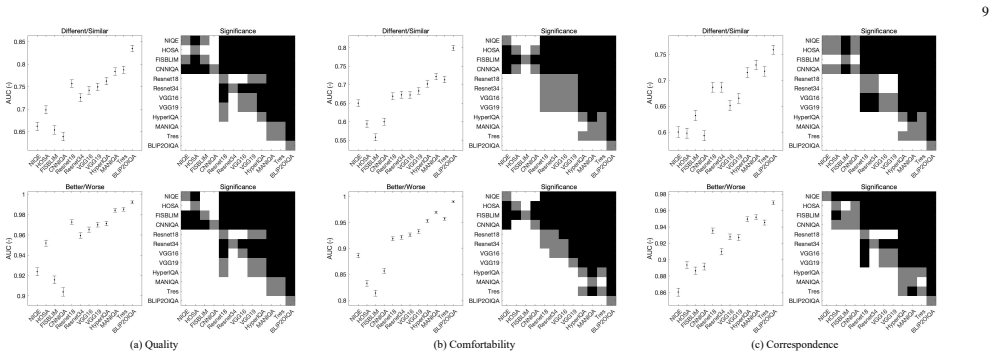
- [Section V-A and Tables I-III] All reported performance numbers for BLIP2OIQA, BLIP2OISal, and the baselines are single point estimates from one random 7:3 scene-based split. No standard deviations, confidence intervals, or significance tests are given for the SRCC/PLCC/KRCC comparisons. The ROC analysis in Fig. 11 is not fully described: the construction of the image pairs, the number of trials, and the statistical test behind the significance matrices are missing. Without multiple splits or bootstrapping, the claimed SOTA improvements (e.g., Table I, quality SRCC 0.9074 vs. 0.8793) could be within noise. Please add multiple splits or significance testing for both the IQA and saliency results.
- [Section VI-B and Table VII] The optimization process introduces a free threshold x0 in Eq. (14) to convert saliency maps into inpainting masks, but no sensitivity analysis is provided; the reported improvements in Table VII may depend strongly on its value. The subjective study for Table VII is not described in terms of number of subjects, whether they were different from the database collection subjects, or per-image variance. In addition, because the low-quality/high-quality grouping and the post-optimization evaluation both use BLIP2OIQA, there is a mild circularity; the human ratings help address this, but without error bars it is unclear whether the differences between 'Before' and 'After' (e.g., Quality 46.31 to 50.66) are statistically significant. Please add threshold sensitivity, subject details, and statistical testing.
minor comments (6)
- [Section III-C2] The word 'Gaussion' should be 'Gaussian'.
- [Section V-D1] The word 'directely' should be 'directly'.
- [Fig. 11 caption] 'The frist row' should be 'The first row'.
- [Section IV] The sentence 'The detailed architecture of the two proposed models are are given in section IV-A and IV-B' contains a duplicated 'are'.
- [Equation (13)] The KLD formula has notation issues: 'P P = 1and P ˆP = 1' should read '∑ P = 1 and ∑ U P = 1' with an explicit summation index.
- [Section V-A] The ROC analysis is described too briefly; please specify how 'Different vs. Similar' and 'Better vs. Worse' pairs were formed, the number of pairs, and the statistical test used to produce the significance matrices.
Circularity Check
No derivation-level circularity: supervised models are evaluated on held-out scene splits, and the optimization claim is independently confirmed by human ratings; minor self-citations are not load-bearing.
full rationale
The central claims (BLIP2OIQA/BLIP2OISal SOTA on OHF2024) are standard supervised learning results. MOS labels (Sec. III-C1) and distortion-aware saliency maps (Sec. III-C2) are human annotations, and Tables I/III use held-out scene-based splits (Sec. V-A), so the test numbers are not fitted inputs renamed as predictions. The optimization loop in Sec. VI does use BLIP2OIQA to select low-quality images and to re-score the refined images, which is a mild self-referential element; however, Table VII also reports independent human annotation scores and shows aligned improvements (e.g., quality 46.31 to 50.66 for LQ images), so the quality-improvement claim does not reduce to the model's own score by construction. Citations [13] and [25] are from the same group and are used for motivation, perspective design, and encoder-initialization choices, but they are not invoked as a uniqueness theorem or as the sole justification for the core claims; the paper provides its own data analyses (Fig. 7, Fig. 11) and comparisons against 21 IQA and 20 saliency baselines. The unvalidated click-to-map protocol for distortion-aware saliency (no aggregation or inter-subject agreement reported) is a data-reliability risk that could affect the saliency and optimization results, but it is not a circularity between the paper's stated inputs and outputs.
Assumptions & free parameters
free parameters (4)
- alpha (saliency loss weight) =
Not reported
- beta (saliency loss weight) =
Not reported
- threshold x0 in Eq. 14 =
Not reported
- viewport FOV =
110 degrees
assumptions (3)
- domain assumption MOS computed from 20 subjects per image is a reliable ground truth for the three quality dimensions
- ad hoc to paper Distortion-aware saliency maps created by smoothing click annotations with a 0.4 degree Gaussian kernel faithfully represent the regions humans find distorted
- domain assumption A single 7:3 random scene-based split is sufficient to estimate model performance
Cite this review
Pith. "Pith review of Quality Assessment and Distortion-aware Saliency Prediction for AI-Generated Omnidirectional Images." pith.science (2026). https://pith.science/paper/YQ4N6ENO
@misc{pith2026250621925,
  author       = {Pith},
  title        = {Pith review of: Quality Assessment and Distortion-aware Saliency Prediction for AI-Generated Omnidirectional Images},
  year         = {2026},
  howpublished = {\url{https://pith.science/paper/YQ4N6ENO}},
  note         = {Machine review of arXiv:2506.21925}
}
read the original abstract
With the rapid advancement of Artificial Intelligence Generated Content (AIGC) techniques, AI generated images (AIGIs) have attracted widespread attention, among which AI generated omnidirectional images (AIGODIs) hold significant potential for Virtual Reality (VR) and Augmented Reality (AR) applications. AI generated omnidirectional images exhibit unique quality issues, however, research on the quality assessment and optimization of AI-generated omnidirectional images is still lacking. To this end, this work first studies the quality assessment and distortion-aware saliency prediction problems for AIGODIs, and further presents a corresponding optimization process. Specifically, we first establish a comprehensive database to reflect human feedback for AI-generated omnidirectionals, termed OHF2024, which includes both subjective quality ratings evaluated from three perspectives and distortion-aware salient regions. Based on the constructed OHF2024 database, we propose two models with shared encoders based on the BLIP-2 model to evaluate the human visual experience and predict distortion-aware saliency for AI-generated omnidirectional images, which are named as BLIP2OIQA and BLIP2OISal, respectively. Finally, based on the proposed models, we present an automatic optimization process that utilizes the predicted visual experience scores and distortion regions to further enhance the visual quality of an AI-generated omnidirectional image. Extensive experiments show that our BLIP2OIQA model and BLIP2OISal model achieve state-of-the-art (SOTA) results in the human visual experience evaluation task and the distortion-aware saliency prediction task for AI generated omnidirectional images, and can be effectively used in the optimization process. The database and codes will be released on https://github.com/IntMeGroup/AIGCOIQA to facilitate future research.
Figures


Figures from the paper (8 more)




Reference graph
Works this paper leans on
-
[1]
I. Goodfellow, J. Pouget-Abadie, M. Mirza, B. Xu, D. Warde-Farley, S. Ozair, A. Courville, and Y . Bengio, “Generative adversarial nets,” in Proceedings of the Advances in Neural Information Processing Systems (NeurIPS), vol. 27, 2014
work page 2014
-
[2]
Auto-Encoding Variational Bayes,
D. P. Kingma and M. Welling, “Auto-Encoding Variational Bayes,” arXiv e-prints, p. arXiv:1312.6114, Dec. 2013
arXiv 2013
-
[3]
High- resolution image synthesis with latent diffusion models,
R. Rombach, A. Blattmann, D. Lorenz, P. Esser, and B. Ommer, “High- resolution image synthesis with latent diffusion models,” in Proceedings of the IEEE Conference on Computer Vision and Pattern Recognition (CVPR), pp. 10 684–10 695
-
[4]
Learning transferable visual models from natural language supervi- sion,
A. Radford, J. W. Kim, C. Hallacy, A. Ramesh, G. Goh, S. Agarwal, G. Sastry, A. Askell, P. Mishkin, J. Clark, G. Krueger, and I. Sutskever, “Learning transferable visual models from natural language supervi- sion,” in Proceedings of the International Conference on Machine Learning (ICML)
-
[5]
J. Li, D. Li, S. Savarese, and S. Hoi, “Blip-2: Bootstrapping language- image pre-training with frozen image encoders and large language models,” arXiv e-prints, p. arXiv:2301.12597, Jan. 2023
arXiv 2023
-
[6]
MVDiffusion: Enabling holistic multi-view image generation with correspondence- aware diffusion,
S. Tang, F. Zhang, J. Chen, P. Wang, and Y . Furukawa, “MVDiffusion: Enabling holistic multi-view image generation with correspondence- aware diffusion,” in Proceedings of the Neural Information Processing Systems (NeurIPS), 2023
work page 2023
-
[7]
Text2light: Zero-shot text-driven hdr panorama generation,
Z. Chen, G. Wang, and Z. Liu, “Text2light: Zero-shot text-driven hdr panorama generation,” ACM Trans. Graph. , vol. 41, no. 6, nov 2022. [Online]. Available: https://doi.org/10.1145/3550454.3555447
arXiv 2022
-
[8]
Dreamscene360: Unconstrained text-to- 3d scene generation with panoramic gaussian splatting,
S. Zhou, Z. Fan, D. Xu, H. Chang, P. Chari, T. Bharadwaj, S. You, Z. Wang, and A. Kadambi, “Dreamscene360: Unconstrained text-to- 3d scene generation with panoramic gaussian splatting,” arXiv preprint arXiv:2404.06903, 2024
arXiv 2024
Show all 80 references
-
[9]
4k4dgen: Panoramic 4d generation at 4k resolution,
R. Li, P. Pan, B. Yang, D. Xu, S. Zhou, X. Zhang, Z. Li, A. Kadambi, Z. Wang, and Z. Fan, “4k4dgen: Panoramic 4d generation at 4k resolution,” arXiv preprint arXiv:2406.13527 , 2024
2024 arXiv
-
[10]
GANs Trained by a Two Time-Scale Update Rule Converge to a Local Nash Equilibrium,
M. Heusel, H. Ramsauer, T. Unterthiner, B. Nessler, and S. Hochreiter, “GANs Trained by a Two Time-Scale Update Rule Converge to a Local Nash Equilibrium,” in Proceedings of the Advances in Neural Information Processing Systems (NeurIPS) , vol. 30, 2017
2017
-
[11]
Improved techniques for training gans,
T. Salimans, I. Goodfellow, W. Zaremba, V . Cheung, A. Radford, and X. Chen, “Improved techniques for training gans,” in Proceedings of the Advances in Neural Information Processing Systems (NeurIPS) , vol. 29, 2016
2016
-
[12]
Clipscore: A reference-free evaluation metric for image captioning,
J. Hessel, A. Holtzman, M. Forbes, R. Le Bras, and Y . Choi, “Clipscore: A reference-free evaluation metric for image captioning,” arXiv e-prints, p. arXiv:2104.08718, Apr. 2021
2021 arXiv
-
[13]
Aigciqa2023: A large-scale image quality assessment database for ai generated images: from the perspectives of quality, authenticity and correspondence,
J. Wang, H. Duan, J. Liu, S. Chen, X. Min, and G. Zhai, “Aigciqa2023: A large-scale image quality assessment database for ai generated images: from the perspectives of quality, authenticity and correspondence,” in Proceedings of the CAAI International Conference on Artificial ...
2023
-
[14]
Agiqa-3k: An open database for ai-generated image quality assessment,
C. Li, Z. Zhang, H. Wu, W. Sun, X. Min, X. Liu, G. Zhai, and W. Lin, “Agiqa-3k: An open database for ai-generated image quality assessment,” IEEE Transactions on Circuits and Systems for Video Technology (TCSVT), 2023
2023
-
[15]
Sgdnet: An end-to-end saliency-guided deep neural network for no-reference image quality assessment,
S. Yang, Q. Jiang, W. Lin, and Y . Wang, “Sgdnet: An end-to-end saliency-guided deep neural network for no-reference image quality assessment,” in Proceedings of the ACM International Conference on Multimedia (ACM MM) , 2019, pp. 1383–1391
2019
-
[16]
Realistic saliency guided image enhancement,
S. M. H. Miangoleh, Z. Bylinskii, E. Kee, E. Shechtman, and Y . Aksoy, “Realistic saliency guided image enhancement,” in Proceedings of the IEEE/CVF Conference on Computer Vision and Pattern Recognition (CVPR), 2023, pp. 186–194
2023
-
[17]
Rich human feedback for text-to-image generation,
Y . Liang, J. He, G. Li, P. Li, A. Klimovskiy, N. Carolan, J. Sun, J. Pont- Tuset, S. Young, F. Yanget al., “Rich human feedback for text-to-image generation,” in Proceedings of the IEEE/CVF Conference on Computer Vision and Pattern Recognition (CVPR) , 2024, pp. 19 401–19 411
2024
-
[18]
Mc360iqa: A multi-channel cnn for blind 360-degree image quality assessment,
W. Sun, X. Min, G. Zhai, K. Gu, H. Duan, and S. Ma, “Mc360iqa: A multi-channel cnn for blind 360-degree image quality assessment,” IEEE Journal of Selected Topics in Signal Processing (JSTSP) , vol. 14, no. 1, pp. 64–77, 2019
2019
-
[19]
Perceptual quality assessment of omnidirectional images,
H. Duan, G. Zhai, X. Min, Y . Zhu, Y . Fang, and X. Yang, “Perceptual quality assessment of omnidirectional images,” in Proceedings of the IEEE International Symposium on Circuits and Systems (ISCAS) , 2018, pp. 1–5
2018
-
[20]
Koniq-10k: An ecologically valid database for deep learning of blind image quality assessment,
V . Hosu, H. Lin, T. Sziranyi, and D. Saupe, “Koniq-10k: An ecologically valid database for deep learning of blind image quality assessment,” IEEE Transactions on Image Processing (TIP) , vol. 29, pp. 4041–4056, 2020
2020
-
[21]
Perceptual quality as- sessment of smartphone photography,
Y . Fang, H. Zhu, Y . Zeng, K. Ma, and Z. Wang, “Perceptual quality as- sessment of smartphone photography,” in Proceedings of the IEEE/CVF conference on computer vision and pattern recognition (CVPR) , 2020, pp. 3677–3686
2020
-
[22]
Perceptual Quality Assessment of Omnidirectional Audio- Visual Signals,
X. Zhu, H. Duan, Y . Cao, Y . Zhu, Y . Zhu, J. Liu, L. Chen, X. Min, and G. Zhai, “Perceptual Quality Assessment of Omnidirectional Audio- Visual Signals,” in Proceedings of the CAAI International Conference on Artificial Intelligence (CICAI) , Singapore, 2024, pp. 512–525
2024
-
[23]
Confusing image quality assessment: Toward better augmented reality experience,
H. Duan, X. Min, Y . Zhu, G. Zhai, X. Yang, and P. Le Callet, “Confusing image quality assessment: Toward better augmented reality experience,” IEEE Transactions on Image Processing (TIP) , vol. 31, pp. 7206–7221, 2022
2022
-
[24]
Esiqa: Perceptual quality assessment of vision-pro-based egocentric spatial images,
X. Zhu, L. Yang, H. Duan, X. Min, G. Zhai, and P. L. Callet, “Esiqa: Perceptual quality assessment of vision-pro-based egocentric spatial images,” arXiv preprint arXiv:2407.21363 , 2024
2024 arXiv
-
[25]
Understanding and evaluating human preferences for ai generated images with instruction tuning,
J. Wang, H. Duan, G. Zhai, and X. Min, “Understanding and evaluating human preferences for ai generated images with instruction tuning,” arXiv preprint arXiv:2405.07346 , 2024
2024 arXiv
-
[26]
Salicon: Saliency in context,
M. Jiang, S. Huang, J. Duan, and Q. Zhao, “Salicon: Saliency in context,” in Proceedings of the IEEE Conference on Computer Vision and Pattern Recognition (CVPR) , 2015, pp. 1072–1080
2015
-
[28]
Cat2000: A large scale fixation dataset for boosting saliency research,
A. Borji and L. Itti, “Cat2000: A large scale fixation dataset for boosting saliency research,” arXiv preprint arXiv:1505.03581 , 2015. 13
2015 arXiv
-
[29]
Saliency based on information maximization,
N. Bruce and J. Tsotsos, “Saliency based on information maximization,” in Proceedings of the Advances in Neural Information Processing Systems (NeurIPS), vol. 18, 2005
2005
-
[30]
Predicting human gaze using low-level saliency combined with face detection,
M. Cerf, J. Harel, W. Einh ¨auser, and C. Koch, “Predicting human gaze using low-level saliency combined with face detection,” in Proceedings of the Advances in Neural Information Processing Systems (NeurIPS) , vol. 20, 2007
2007
-
[31]
Visual saliency estimation by nonlinearly integrating features using region covariances,
E. Erdem and A. Erdem, “Visual saliency estimation by nonlinearly integrating features using region covariances,” Journal of Vision, vol. 13, no. 4, pp. 11–11, 2013
2013
-
[32]
Saliency in augmented reality,
H. Duan, W. Shen, X. Min, D. Tu, J. Li, and G. Zhai, “Saliency in augmented reality,” in Proceedings of the ACM International Conference on Multimedia (ACM MM) , 2022
2022
-
[33]
Salicon: Reducing the semantic gap in saliency prediction by adapting deep neural networks,
X. Huang, C. Shen, X. Boix, and Q. Zhao, “Salicon: Reducing the semantic gap in saliency prediction by adapting deep neural networks,” in Proceedings of the IEEE International Conference on Computer Vision (ICCV), 2015, pp. 262–270
2015
-
[34]
Predicting human eye fixations via an lstm-based saliency attentive model,
M. Cornia, L. Baraldi, G. Serra, and R. Cucchiara, “Predicting human eye fixations via an lstm-based saliency attentive model,” IEEE Trans- actions on Image Processing (TIP) , vol. 27, no. 10, pp. 5142–5154, 2018
2018
-
[35]
Visual attention analysis and prediction on human faces for children with autism spectrum disorder,
H. Duan, X. Min, Y . Fang, L. Fan, X. Yang, and G. Zhai, “Visual attention analysis and prediction on human faces for children with autism spectrum disorder,” ACM Transactions on Multimedia Computing, Com- munications, and Applications (TOMM), vol. 15, no. 3s, pp. 1–23, 2019
2019
-
[36]
A dataset of eye movements for the children with autism spectrum disorder,
H. Duan, G. Zhai, X. Min, Z. Che, Y . Fang, X. Yang, J. Guti ´errez, and P. L. Callet, “A dataset of eye movements for the children with autism spectrum disorder,” in Proceedings of the ACM Multimedia Systems Conference, 2019, pp. 255–260
2019
-
[37]
Perceptual video quality assessment: A survey,
X. Min, H. Duan, W. Sun, Y . Zhu, and G. Zhai, “Perceptual video quality assessment: A survey,” arXiv preprint arXiv:2402.03413 , 2024
2024 arXiv
-
[38]
Blind image quality assessment: A fuzzy neural network for opinion score distribution prediction,
Y . Gao, X. Min, Y . Zhu, X.-P. Zhang, and G. Zhai, “Blind image quality assessment: A fuzzy neural network for opinion score distribution prediction,” IEEE Transactions on Circuits and Systems for Video Technology (TCSVT), 2023
2023
-
[39]
Identifying children with autism spectrum disorder based on gaze-following,
Y . Fang, H. Duan, F. Shi, X. Min, and G. Zhai, “Identifying children with autism spectrum disorder based on gaze-following,” in Proceedings of the IEEE International Conference on Image Processing (ICIP) . IEEE, 2020, pp. 423–427
2020
-
[40]
Matterport3d: Learning from rgb- d data in indoor environments,
A. Chang, A. Dai, T. Funkhouser, M. Halber, M. Niessner, M. Savva, S. Song, A. Zeng, and Y . Zhang, “Matterport3d: Learning from rgb- d data in indoor environments,” in Proceedngs of the International Conference on 3D Vision (3DV) , 2017
2017
-
[41]
Recognizing scene viewpoint using panoramic place representation,
J. Xiao, K. A. Ehinger, A. Oliva, and A. Torralba, “Recognizing scene viewpoint using panoramic place representation,” in Proceedings of the IEEE/CVF Conference on Computer Vision and Pattern Recognition (CVPR), 2012, pp. 2695–2702
2012
-
[42]
Hierarchical text-conditional image generation with clip latents,
A. Ramesh, P. Dhariwal, A. Nichol, C. Chu, and M. Chen, “Hierarchical text-conditional image generation with clip latents,” arXiv e-prints , p. arXiv:2204.06125, Apr. 2022
2022 arXiv
-
[43]
Scenescape: Text- driven consistent scene generation,
R. Fridman, A. Abecasis, Y . Kasten, and T. Dekel, “Scenescape: Text- driven consistent scene generation,” arXiv e-prints, p. arXiv:2302.01133, Feb. 2023
2023 arXiv
-
[44]
High- resolution image synthesis with latent diffusion models,
R. Rombach, A. Blattmann, D. Lorenz, P. Esser, and B. Ommer, “High- resolution image synthesis with latent diffusion models,” in Proceedings of the IEEE/CVF Conference on Computer Vision and Pattern Recogni- tion (CVPR), June 2022, pp. 10 684–10 695
2022
-
[45]
Audio-visual saliency for omnidirectional videos,
Y . Zhu, X. Zhu, H. Duan, J. Li, K. Zhang, Y . Zhu, L. Chen, X. Min, and G. Zhai, “Audio-visual saliency for omnidirectional videos,” arXiv e-prints, p. arXiv:2311.05190, Nov. 2023
2023 arXiv
-
[46]
Attentive deep image quality assessment for omnidirectional stitching,
H. Duan, X. Min, W. Sun, Y . Zhu, X.-P. Zhang, and G. Zhai, “Attentive deep image quality assessment for omnidirectional stitching,” IEEE Journal of Selected Topics in Signal Processing (JSTSP) , vol. 17, no. 6, pp. 1150–1164, 2023
2023
-
[47]
Augmented reality image quality assessment based on visual confusion theory,
H. Duan, L. Guo, W. Sun, X. Min, L. Chen, and G. Zhai, “Augmented reality image quality assessment based on visual confusion theory,” in Proceedings of the IEEE International Symposium on Broadband Multimedia Systems and Broadcasting (BMSB) , 2022, pp. 1–6
2022
-
[48]
Viewing behavior supported visual saliency predictor for 360 degree videos,
Y . Zhu, G. Zhai, Y . Yang, H. Duan, X. Min, and X. Yang, “Viewing behavior supported visual saliency predictor for 360 degree videos,” IEEE Transactions on Circuits and Systems for Video Technology (TCSVT), vol. 32, no. 7, pp. 4188–4201, 2022
2022
-
[49]
Ivqad 2017: An immersive video quality assessment database,
H. Duan, G. Zhai, X. Yang, D. Li, and W. Zhu, “Ivqad 2017: An immersive video quality assessment database,” in Proceedings of the International Conference on Systems, Signals and Image Processing (IWSSIP), 2017, pp. 1–5
2017
-
[50]
Methodology for the subjective assessment of the quality of television pictures,
B. Series, “Methodology for the subjective assessment of the quality of television pictures,” ITU-R, Tech. Rep. ITU-R BT, 2012
2012
-
[51]
How is gaze influenced by image transformations? dataset and model,
Z. Che, A. Borji, G. Zhai, X. Min, G. Guo, and P. Le Callet, “How is gaze influenced by image transformations? dataset and model,” IEEE Transactions on Image Processing (TIP), vol. 29, pp. 2287–2300, 2019
2019
-
[52]
Perceptual quality assessment of omnidirectional images as moving camera videos,
X. Sui, K. Ma, Y . Yao, and Y . Fang, “Perceptual quality assessment of omnidirectional images as moving camera videos,” IEEE Transactions on Visualization and Computer Graphics (TVCG) , vol. 28, no. 8, pp. 3022–3034, 2021
2021
-
[53]
Learning without human scores for blind image quality assessment,
W. Xue, L. Zhang, and X. Mou, “Learning without human scores for blind image quality assessment,” in Proceedings of the IEEE Conference on Computer Vision and Pattern Recognition (CVPR). IEEE Computer Society
-
[54]
Blind image quality esti- mation via distortion aggravation,
X. Min, G. Zhai, K. Gu, Y . Liu, and X. Yang, “Blind image quality esti- mation via distortion aggravation,” IEEE Transactions on Broadcasting (TBC), vol. 64, no. 2, pp. 508–517, 2018
2018
-
[55]
Making a “completely blind
A. Mittal, R. Soundararajan, and A. C. Bovik, “Making a “completely blind” image quality analyzer,” IEEE Signal Processing Letters, vol. 20, no. 3, pp. 209–212, 2013
2013
-
[56]
A feature-enriched completely blind image quality evaluator,
L. Zhang, L. Zhang, and A. C. Bovik, “A feature-enriched completely blind image quality evaluator,” IEEE Transactions on Image Processing (TIP), vol. 24, no. 8, pp. 2579–2591, 2015
2015
-
[57]
Blind image quality assessment based on high order statistics aggregation,
J. Xu, P. Ye, Q. Li, H. Du, Y . Liu, and D. S. Doermann, “Blind image quality assessment based on high order statistics aggregation,” IEEE Transactions on Image Processing (TIP), vol. 25, pp. 4444–4457, 2016. [Online]. Available: https://api.semanticscholar.org/CorpusID:1899069
2016
-
[58]
Blind quality assessment based on pseudo-reference image,
X. Min, K. Gu, G. Zhai, J. Liu, X. Yang, and C. W. Chen, “Blind quality assessment based on pseudo-reference image,” IEEE Transactions on Multimedia (TMM), vol. 20, no. 8, pp. 2049–2062, 2018
2018
-
[59]
Fisblim: A five-step blind metric for quality assessment of multiply distorted images,
K. Gu, G. Zhai, M. Liu, X. Yang, W. Zhang, X. Sun, W. Chen, and Y . Zuo, “Fisblim: A five-step blind metric for quality assessment of multiply distorted images,” in Proceedings of the SiPS , 2013, pp. 241– 246
2013
-
[60]
No-reference image quality assessment in the spatial domain,
A. Mittal, A. K. Moorthy, and A. C. Bovik, “No-reference image quality assessment in the spatial domain,” IEEE Transactions on Image Processing (TIP), vol. 21, no. 12, pp. 4695–4708, 2012
2012
-
[61]
Convolutional neural networks for no-reference image quality assessment,
L. Kang, P. Ye, Y . Li, and D. Doermann, “Convolutional neural networks for no-reference image quality assessment,” in Proceedings of the IEEE Conference on Computer Vision and Pattern Recognition (CVPR) , June 2014
2014
-
[62]
Deep residual learning for image recognition,
K. He, X. Zhang, S. Ren, and J. Sun, “Deep residual learning for image recognition,” in Proceedings of the IEEE Conference on Computer Vision and Pattern Recognition (CVPR) , 2016, pp. 770–778
2016
-
[63]
Very deep convolutional networks for large-scale image recognition,
K. Simonyan and A. Zisserman, “Very deep convolutional networks for large-scale image recognition,” arXiv e-prints, p. arXiv:1409.1556, Sep. 2014
2014 arXiv
-
[64]
Blindly assess image quality in the wild guided by a self-adaptive hyper network,
S. Su, Q. Yan, Y . Zhu, C. Zhang, X. Ge, J. Sun, and Y . Zhang, “Blindly assess image quality in the wild guided by a self-adaptive hyper network,” in Proceedings of the IEEE/CVF Conference on Computer Vision and Pattern Recognition (CVPR) , 2020, pp. 3664–3673
2020
-
[65]
MANIQA: Multi-dimension Attention Network for No-Reference Im- age Quality Assessment,
S. Yang, T. Wu, S. Shi, S. Lao, Y . Gong, M. Cao, J. Wang, and Y . Yang, “MANIQA: Multi-dimension Attention Network for No-Reference Im- age Quality Assessment,” arXiv e-prints , p. arXiv:2204.08958, Apr. 2022
2022 arXiv
-
[66]
No-reference im- age quality assessment via transformers, relative ranking, and self- consistency,
S. A. Golestaneh, S. Dadsetan, and K. M. Kitani, “No-reference im- age quality assessment via transformers, relative ranking, and self- consistency,” in Proceedings of the IEEE/CVF Winter Conference on Applications of Computer Vision (WACV), January 2022, pp. 1220–1230
2022
-
[67]
Eva: Exploring the limits of masked visual representation learning at scale,
Y . Fang, W. Wang, B. Xie, Q. Sun, L. Wu, X. Wang, T. Huang, X. Wang, and Y . Cao, “Eva: Exploring the limits of masked visual representation learning at scale,” in Proceedings of the IEEE/CVF Conference on Computer Vision and Pattern Recognition (CVPR) , 2023, pp. 19 358– 19 369
2023
-
[68]
Blip: Bootstrapping language-image pre-training for unified vision-language understanding and generation,
J. Li, D. Li, C. Xiong, and S. Hoi, “Blip: Bootstrapping language-image pre-training for unified vision-language understanding and generation,” in Proceedings of the International Conference on Machine Learning (ICML), 2022, pp. 12 888–12 900
2022
-
[69]
On the accuracy of objective image and video quality models: New methodology for performance evaluation,
L. Krasula, K. Fliegel, P. Le Callet, and M. Kl ´ıma, “On the accuracy of objective image and video quality models: New methodology for performance evaluation,” in Proceedings of the International Conference on Quality of Multimedia Experience (QoMEX) . IEEE, 2016, pp. 1–6
2016
-
[70]
Quality assessment of sharpened images: Challenges, methodology, and objective metrics,
L. Krasula, P. Le Callet, K. Fliegel, and M. Kl ´ıma, “Quality assessment of sharpened images: Challenges, methodology, and objective metrics,” IEEE Transactions on Image Processing (TIP), vol. 26, no. 3, pp. 1496– 1508, 2017
2017
-
[71]
Transalnet: Towards perceptually relevant visual saliency prediction,
J. Lou, H. Lin, D. Marshall, D. Saupe, and H. Liu, “Transalnet: Towards perceptually relevant visual saliency prediction,” Neurocomputing, vol. 494, pp. 455–467, 2022. 14
2022
-
[72]
Context-aware saliency detection,
S. Goferman, L. Zelnik-Manor, and A. Tal, “Context-aware saliency detection,” IEEE Transactions on Pattern Analysis and Machine Intelli- gence (TPAMI), vol. 34, no. 10, pp. 1915–1926, 2011
1915
-
[73]
Graph-based visual saliency,
J. Harel, C. Koch, and P. Perona, “Graph-based visual saliency,” in Proceedings of the Advances in Neural Information Processing Systems (NeurIPS), vol. 19, 2006
2006
-
[74]
Visual saliency based on scale-space analysis in the frequency domain,
J. Li, M. D. Levine, X. An, X. Xu, and H. He, “Visual saliency based on scale-space analysis in the frequency domain,” IEEE Transactions on Pattern Analysis and Machine Intelligence (TPAMI) , vol. 35, no. 4, pp. 996–1010, 2012
2012
-
[75]
A model of saliency-based visual atten- tion for rapid scene analysis,
L. Itti, C. Koch, and E. Niebur, “A model of saliency-based visual atten- tion for rapid scene analysis,” IEEE Transactions on Pattern Analysis and Machine Intelligence (TPAMI) , vol. 20, no. 11, pp. 1254–1259, 1998
1998
-
[76]
Learning to predict where humans look,
T. Judd, K. Ehinger, F. Durand, and A. Torralba, “Learning to predict where humans look,” in Proceedings of the IEEE International Confer- ence on Computer Vision (ICCV) . IEEE, 2009, pp. 2106–2113
2009
-
[77]
Saliency esti- mation using a non-parametric low-level vision model,
N. Murray, M. Vanrell, X. Otazu, and C. A. Parraga, “Saliency esti- mation using a non-parametric low-level vision model,” in Proceedings of the IEEE Conference on Computer Vision and Pattern Recognition (CVPR). IEEE, 2011, pp. 433–440
2011
-
[78]
Spatio-temporal saliency detection using phase spectrum of quaternion fourier transform,
C. Guo, Q. Ma, and L. Zhang, “Spatio-temporal saliency detection using phase spectrum of quaternion fourier transform,” in Proceedings of the IEEE Conference on Computer Vision and Pattern Recognition (CVPR) . IEEE, 2008, pp. 1–8
2008
-
[79]
Saliency detection: A spectral residual approach,
X. Hou and L. Zhang, “Saliency detection: A spectral residual approach,” in Proceedings of the IEEE Conference on Computer Vision and Pattern Recognition (CVPR). Ieee, 2007, pp. 1–8
2007
-
[80]
Sun: A bayesian framework for saliency using natural statistics,
L. Zhang, M. H. Tong, T. K. Marks, H. Shan, and G. W. Cottrell, “Sun: A bayesian framework for saliency using natural statistics,” Journal of Vision, vol. 8, no. 7, pp. 32–32, 2008
2008
-
[81]
Visual saliency detection by spatially weighted dissimilarity,
L. Duan, C. Wu, J. Miao, L. Qing, and Y . Fu, “Visual saliency detection by spatially weighted dissimilarity,” in Proceedings of the IEEE Conference on Computer Vision and Pattern Recognition (CVPR) . IEEE, 2011, pp. 473–480. Liu Yang received the B.E. degree from Shanghai Jia...
2011
Reviewed August 6, 2026 · model on record in the stance chip above.
Discussion (0). Sign in to comment.