REVIEW 3 major objections 5 minor 188 references
Classification of Average Crystalline Topological Superconductors through a Generalized Real-Space Construction
T0 review · 3 major / 5 minor · reviewed 2026-08-15 · deepseek-v4-flash
Pith's one-line read A complete classification of average crystalline topological superconductors: all 17 two-dimensional wallpaper groups and all 32 three-dimensional point groups are classified, under both decoherence and disorder, and many phases have no…
desk verdict First systematic classification of average crystalline topological superconductors across 2D wallpaper and 3D point groups, built from a physically motivated real-space construction; the spectral-sequence cross-check rests on an unproved equivalence conjecture, leaving three stacking relations conditional. read the letter →
The pith
A machine-rendered reading of the paper's core claim, the machinery that carries it, and where it could break.
The reading
What carries the argument
The generalized real-space block-state construction partitions the crystal into cells fixed by crystalline little groups, decorates a p-dimensional cell with a p-dimensional ASPT protected by the cell's average onsite symmetry plus exact fermion parity, and then imposes two checks: the folded intersection of decorated edge modes must be a trivial ASPT, and decorations that differ by nucleating and shrinking closed SPT bubbles are identified. In the average setting the key modification is that bosonic anomalies are ignored, so previously forbidden decorations become obstruction-free. The construction carries the classification because every candidate phase is built from these decorated cells, and the bubble equivalence is what reduces naive decoration counts to final groups. A generalized spectral sequence, with h0(Z2^f)=0 for decoherence and h0=h1=0 for disorder, serves as an independent check on the same data.
What would settle it
For the decohered spinless pmm model, the paper predicts that a single Z2 fSPT decoration on a 1D block is obstruction-free, with a gappable edge in the doubled space. An exact-diagonalization or tensor-network calculation that finds a protected degeneracy or nonlocal correlation on that edge, even after all symmetric gapping terms are included, would falsify the relaxed obstruction-free condition and with it the classification.
Extended reading notes
Core claim
The paper's central claim is that fermionic phases protected by exact fermion parity and average crystalline symmetry are classified by generalized block-state data: each cell decorated by an onsite ASPT built from the cell's little-group symmetry, subject to a relaxed obstruction-free condition and identified by bubble equivalence. The obstruction-free condition is relaxed because bosonic Berry-phase obstructions vanish under decoherence and charge-localization obstructions vanish under disorder, and this relaxation is the mechanism that creates intrinsic ACSPTs. The full classification, summarized in Tables I-VI, shows that many crystalline topological superconductors survive realistic imperfections and that a substantial number of the resulting phases are intrinsic, existing only because the symmetry is average.
Load-bearing premise
The load-bearing premise is the conjectured crystalline equivalence principle: that a crystal with only average crystalline symmetry can be faithfully replaced, for classification purposes, by an onsite system with the same group structure, orientation-reversing operations treated as antiunitary and the fermion-parity extension adjusted; if that conjecture fails, the spectral-sequence computation is not an independent validation and the stacking relations for D3d, D2d, and Td rest on an unverified assumption.
Editorial extensions
If this is right
- If the classification is correct, a wide class of crystalline topological superconductors remains well defined in the presence of disorder or decoherence, not just in idealized clean crystals.
- The intrinsic ACSPT phases should evolve into intrinsic gapless phases as disorder or decoherence is removed, giving a new route to quantum critical states.
- The boundary of each average SPT should impose an average-symmetry Lieb-Schultz-Mattis constraint, so the classification implies a family of disorder-robust LSM constraints.
- Because the block-state construction does not depend on a free-fermion limit, the classification should hold for strongly interacting systems as well as noninteracting ones.
Reading between the lines
- The paper leaves U(1) charge conservation and time-reversal symmetry out; if the same coarse-graining logic carries over, an analogous classification for systems with those symmetries is a natural next step.
- The three point groups D3d, D2d, and Td have stacking relations taken from the spectral sequence alone; a direct block-state derivation for those groups would either confirm the conjectured equivalence or expose a discrepancy.
- The predicted intrinsic phases could in principle be probed in small disordered or decohered lattice models with exact diagonalization or tensor-network methods, checking whether the doubled-space edge is indeed gappable.
- The boundary LSM constraints for intrinsic ACSPTs may be qualitatively different from those for extrinsic ones; the paper leaves this open, so a classification of these boundary anomalies is a testable extension.
Signed reviews
Editorial analysis
A structured set of objections, weighed in public.
Referee Report
Summary. The manuscript develops a generalized real-space block-state construction for average crystalline symmetry-protected topological phases (ACSPTs) in fermionic systems with exact fermion parity and crystalline symmetries that are preserved only on average under disorder or decoherence. The authors classify ACSPTs for all 17 2D wallpaper groups and all 32 3D point groups, for both spinless and spin-1/2 fermions, reporting results in Tables I–VI. The classification is obtained by decorating coarse-grained cells with onsite ASPTs, imposing generalized obstruction-free conditions and bubble equivalence relations, and is cross-checked against a generalized spectral-sequence computation. The paper highlights numerous intrinsic ACSPTs that have no clean-system analogue. It concludes with a discussion of stacking relations, noting that for D3d, D2d, and Td those relations are currently taken from the spectral-sequence computation alone.
Significance. If the classification is correct, this is a substantial advance: it provides the first systematic enumeration of average crystalline topological superconductors across all wallpaper groups and 3D point groups, and it significantly enlarges the known landscape of intrinsic ASPTs. The worked examples in Sec. II (pmm, p2, and C2v) are carefully presented, with explicit Majorana-mode counting, K-matrix edge analyses, and anomaly-indicator computations, and the appendix delivers a per-group construction that is a valuable reference resource. The paper also makes a useful conceptual point that the obstruction-free conditions are relaxed under decoherence/disorder, enabling phases that are strictly forbidden in clean systems. The absence of fitted parameters and the transparent physical reasoning are additional strengths. However, the completeness claim and the independent-check claim both rest on a conjecture that is not proved, which limits the certainty of the full classification.
major comments (3)
- [Sec. III E] The crystalline equivalence principle is explicitly conjectural: the text states, "We conjecture that there is a crystalline equivalent principle similar to the case of clean SPTs [70]," and then uses the onsite ASPT classification with antiunitary symmetries and modified omega2 as the basis for the spectral-sequence computation around Eq. (52). This conjecture is load-bearing because the spectral-sequence results are presented as an independent consistency check of the block-state classification. Without a proof or at least a nontrivial independent test, agreement between the two methods is evidence only that both computations embody the same assumption. The manuscript should either prove the equivalence in the average-symmetry setting, supply a concrete derivation or explicit counterexample-free argument, or clearly label the spectral-sequence-based results as conditional on this conjecture.
- [Sec. V] The Conclusion states that stacking relations for D3d, D2d, and Td are unresolved within the block-state construction and that "we currently rely on the generalized spectral-sequence results alone for their stacking relations." Since these three point groups include intrinsic ACSPTs highlighted among the main results, their entries in Tables V and VI (for example, D3d spinless decohered G = Z2 × Z4 and Td spinless decohered G = Z2 × Z4) depend entirely on the conjectural spectral-sequence bridge. This is a genuine gap in the completeness claim: either derive these stacking relations by block-state arguments, or explicitly mark the affected rows as conditional and temper the completeness statement.
- [Sec. III C 1 and Sec. III C 2] For the decohered spin-1/2 case, the paper argues that certain obstruction functions are trivialized by decoherence because they live in the bosonic layer, and it derives several intrinsic decorations (e.g., the Zf4 ASPT on 1D blocks). The logic is plausible, but the argument relies on a layer-by-layer truncation of the general fermionic obstruction data from Ref. [81]. The manuscript does not provide a fully explicit account of why the remaining higher-layer obstructions and differentials do not generate additional constraints in the crystalline block-state setting. Since the spin-1/2 classification is a central and highly nontrivial part of the tables, a more detailed derivation of the obstruction-free conditions in this case would materially strengthen the paper.
minor comments (5)
- [Appendix A 13] In the p3 section, the text labels the block list as "BBlocks and onsite symmetries," which appears to be a typo for "Blocks and onsite symmetries."
- [Tables I, II, IV, and VI] The disordered classifications appear twice: in Tables I–II in the Introduction and in Tables IV and VI in the Results. The duplication is confusing, especially because the captions describe the data differently; the authors should either remove one set or explicitly state that the tables are identical and explain why both are needed.
- [Sec. III E] The description of replacing orientation-reversing crystalline symmetries by antiunitary onsite symmetries and modifying omega2 is very brief. A concrete example showing how this replacement works for one wallpaper group or point group would make the spectral-sequence computation much easier for readers to verify.
- [Sec. IV] The notation E1D0, E0D0, G0, and their spin-1/2 counterparts is used in Tables III and V without being defined in the main text; a definition should be given near its first appearance.
- [Sec. II A] The subsection heading "Fermionic APSTs and intrinsic ASPTs" contains a typo (APSTs should be ASPTs).
Circularity Check
No circularity: the block-state and spectral-sequence classifications are genuinely separate computations, and the crystalline equivalence principle is an explicitly conjectural assumption rather than a self-referential input.
full rationale
The paper's central derivation is a generalized block-state construction: cells are decorated with onsite ASPT states, obstruction-free conditions are checked from edge-anomaly/folding arguments, and the classification is reduced by bubble equivalence and stacking relations. None of these steps is defined by the spectral-sequence answer, and no parameter is fitted to a subset of data and then renamed a prediction. The spectral-sequence method is an independent Atiyah-Hirzebruch calculation built on the higher derivatives of Ref. [81], with the decoherence/disorder modifications implemented by setting h0 or h1 layers to zero; this is a stated physical truncation, not a fit to the block-state results. The paper explicitly labels the crystalline equivalence principle for average crystalline SPTs as a conjecture in Sec. III E: 'We conjecture that there is a crystalline equivalent principle similar to the case of clean SPTs [70].' An unproved conjecture weakens the status of the spectral-sequence cross-check and leaves the D3d/D2d/Td stacking relations dependent on that conjecture, but it is not circularity by construction. Self-citations to Refs. [51], [77], and [94] are to prior onsite ASPT classification, clean crystalline SPT classification, and a computational package respectively; these are parameter-free inputs or code with stated assumptions that do not include the present target result, so they constitute independent support rather than a self-referential chain. No equation or derivation reduces to its own input, and no known result is merely renamed in new coordinates. The appropriate finding is no significant circularity.
Assumptions & free parameters
assumptions (5)
- standard math Group cohomology and Atiyah-Hirzebruch spectral sequence machinery for SPT classification are correct and applicable.
- standard math Obstruction functions for fermionic SPTs up to 3+1 dimensions from Ref. [81] are correct.
- domain assumption Scale separation: disorder or decoherence correlation length is much smaller than the coarse-grained cell size, and the underlying lattice structure remains intact.
- domain assumption Crystalline equivalence principle for ACSPTs: ACSPT classification equals onsite ASPT classification with antiunitary treatment of orientation-reversing symmetries and a modified omega2.
- domain assumption Decoherence trivializes bosonic SPT layers and Berry-phase obstructions; disorder additionally trivializes 0D charge decorations.
Cite this review
Pith. "Pith review of Classification of Average Crystalline Topological Superconductors through a Generalized Real-Space Construction." pith.science (2026). https://pith.science/paper/YQA6M5PP
@misc{pith2026250802661,
  author       = {Pith},
  title        = {Pith review of: Classification of Average Crystalline Topological Superconductors through a Generalized Real-Space Construction},
  year         = {2026},
  howpublished = {\url{https://pith.science/paper/YQA6M5PP}},
  note         = {Machine review of arXiv:2508.02661}
}
read the original abstract
We investigate a novel class of topological superconducting phases protected by exact fermion-parity symmetry and average crystalline symmetries. These phases belong to the broader class of average crystalline symmetry-protected topological (ACSPT) states and include numerous examples of intrinsic ACSPTs -- topological phases that arise only in the presence of disorder or decoherence. Unlike conventional symmetry-protected topological (SPT) phases, which require exact symmetry protection, average SPT (ASPT) phases remain robust as long as the symmetry is restored on average across disorder realizations or mixed-state ensembles. To classify these phases, we extend the real-space block state construction framework to account for average crystalline symmetries. In this generalized setting, lower-dimensional cells are decorated with ASPT phases, and the obstruction-free conditions are reformulated to incorporate the constraints imposed by average symmetry at block intersections. This provides a physically transparent and systematic method for classifying ASPTs with spatial symmetries that are only preserved statistically. We further validate our classification using a generalized spectral sequence analysis, which serves as an independent consistency check. Our results demonstrate that many crystalline topological superconductors remain well defined under realistic imperfections, and they uncover a rich landscape of intrinsically average-symmetry-protected phases that have no analog in clean systems.
Figures


Figures from the paper (55 more)




Reference graph
Works this paper leans on
-
[51]
C4v Cell Decomposition FIG. 40. C4v lattice Blocks and onsite symmetries : • 2D: Gσ1, Gσ2 = Z2 • 1D: Gτ = Z4 ⋊ Z2 Decohered Spinless Block state decorations: 1D – τ: Majorana chain, ZM1 2 fSPT, ZM2 2 fSPT 2D – σ1, σ2:p +ip SC, fLG Obstructions 2D – p +ip SC on σ1 or σ2 is obstructed by chiral anomaly at τ – Decoration of p±ip-SC with opposite chirali- tie...
-
[77]
S6 Cell Decomposition FIG. 44. S6 lattice Blocks and onsite symmetries : • σ1,σ 2 =I • τ1 = Z3,τ 2 =I • µ =S6 center An important distinction of this point group is that it is inversion-symmetric. If we denote the generating element of S6 roto-reflection as gS6, it is easy to see that g3 S6 inverts any point in the unit cell. This is impor- tant, as inver...
-
[70]
D4h Cell Decomposition FIG. 42. D4h lattice Blocks and onsite symmetries : • 2D: Gσ1, Gσ2, Gσ3 = Z2 • 1D: Gτ1 = Z4 ⋊ Z2, Gτ2, Gτ3 = Z2× Z2 • 0D: Gµ = Z2× (Z4 ⋊ Z2) Decohered Spinless Block state decorations: 0D – µ: Odd fermion 1D – τ1: Majorana chain, ZM1 2 fSPT, ZM2 2 fSPT – τ2: Majorana chain, ZM1 2 fSPT, ZM3 2 fSPT – τ3: Majorana chain, ZM2 2 fSPT, ZM...
-
[1]
2D: No obstruction-free states ( Z1)
Zf 4 ASPT on τ1 or τ2 (I) These states are also trivialization-free. 2D: No obstruction-free states ( Z1). Final classification: E0D 1/2,dec = Z2(I) E1D 1/2,dec = Z2 2(I) E2D 1/2,dec = Z1 G1/2,dec =E1D 1/2,dec×E2D 1/2,dec = Z3 2(I) Disordered Spinless Block state decorations: 1D – τ1,τ 2: Majorana chain 2D – σ1:p +ip SC – σ2:p +ip SC, fLG Obstructions 2D ...
-
[3]
fLG on σ2 (E) These states are all trivialization-free. Final classification: E1D 0,dis = Z2 2(I) E2D 0,dis = Z2(E) G0,dis =E1D 0,dis×E2D 0,dis = Z2(E)× Z2 2(I) Disordered Spin-1/2 Block state decorations: 1D – τ1,τ 2: 1D Zf 4 disorder-intrinsic state 2D – σ1:p +ip SC – σ2: 2D Zf 4 ASPT Obstructions 2D – p+ip SC onσ1 is obstructed by chiral anomaly at τ1 ...
-
[6]
D2 =V Cell Decomposition FIG. 33. D2 lattice Blocks and onsite symmetries : • 2D: Gσ1, Gσ2 =I • 1D: Gτ1, Gτ2, Gτ3 = Z2 (rotation) • 0D: Gµ =D2 Decohered Spinless Block state decorations: 0D – µ: Odd fermion 1D – τ1, τ2, τ3: Majorana chain, Z2 fSPT 2D – σ1, σ2:p +ip SC Obstructions 1D – Majorana chain onτ1,τ2, orτ3 are obstructed at µ. 2D – p+ip SC onσ1 is...
-
[7]
Therefore, the 1D classification reduces to Z2 2
Z2 fSPT on τ1, τ2, or τ3 (I) 2D: No obstruction-free states ( Z1) Trivializations: • Majorana bubble on σ1 ⇒ Simultaneous decora- tion of Z2 fSPT on τ1 and τ2. Therefore, the 1D classification reduces to Z2 2. • Majorana bubble on σ2 ⇒ Simultaneous decora- tion of Z2 fSPT on τ2 and τ3. Therefore, the 1D classification further reduces to Z2. • Chern insula...
-
[8]
2D: No obstruction-free states ( Z1)
Zf 4 ASPT on τ1,τ2, or τ3 (I) These states are also trivialization-free. 2D: No obstruction-free states ( Z1). Final classification: E0D 1/2,dec = Z2(I) E1D 1/2,dec = Z3 2(I) E2D 1/2,dec = Z1 G1/2,dec =E0D 1/2,dec×E1D 1/2,dec×E2D 1/2,dec = Z4 2(I) Disordered Spinless Block state decorations: 1D – τ1, τ2, τ3: Majorana chain 2D – σ1, σ2:p +ip SC Obstruction...
Show all 188 references
-
[10]
2D: No obstruction-free states ( Z1) Final classification: E1D 1/2,dis = Z3 2(I) E2D 1/2,dis = Z1 G1/2,dis =E1D 1/2,dis×E2D 1/2,dis = Z3 2(I)
1D Zf 4 disorder-intrinsic stateon τ1, τ2 or τ3 (I) These states are also trivialization-free. 2D: No obstruction-free states ( Z1) Final classification: E1D 1/2,dis = Z3 2(I) E2D 1/2,dis = Z1 G1/2,dis =E1D 1/2,dis×E2D 1/2,dis = Z3 2(I)
-
[11]
C2v Cell Decomposition FIG. 34. C2v lattice Blocks and onsite symmetries : • Gσ1, Gσ2 = Z2 • Gτ = Z2× Z2 54 Decohered Spinless Block state decorations: 1D – τ: Majorana chain ZM1 2 fSPT, ZM2 2 fSPT 2D – σ1, σ2:p +ip SC, fLG Obstructions 2D – p+ip SC onσ1 is obstructed by chira...
-
[13]
Z2× Z2 fSPT on τ (E) 2D: (Z2 2)
-
[14]
There- fore, the 1D classification reduces to Z2 2
n = 2 fLG on σ1 or σ2 (I) Trivializations: • Majorana bubble on σ1⇒ ZM1 2 fSPT on τ. There- fore, the 1D classification reduces to Z2 2. • Majorana bubble on σ2⇒ ZM2 2 fSPT on τ. There- fore, the 1D classification further reduces to Z2. Final classification: E1D 0,dec = Z2(E) ...
-
[16]
Final classification: E1D 1/2,dis = Z2(I) E2D 1/2,dis = Z2 2(I) G1/2,dis =E1D 1/2,dis×E2D 1/2,dis = Z3 2(I)
fLG on σ1 or σ2 (I) These states are all trivialization-free Final classification: E1D 0,dis = Z2(E) E2D 0,dis = Z2 2(I) G0,dis =E1D 0,dis×E2D 0,dis = Z2(E)× Z2 2(I) 55 Disordered Spin-1/2 Block state decorations: 1D – τ: 1D Zf 4 disorder-intrinsic state(I) 2D – σ1, σ2: 2D Zf ...
-
[17]
D2h/Vh Cell Decomposition FIG. 35. D2h/Vh lattice Blocks and onsite symmetries : • 2D: Gσ1, Gσ2, Gσ3 = Z2 • 1D: Gτ1, Gτ2, Gτ3 = Z2× Z2 • 0D: Gµ = Z2× Z2× Z2 Decohered Spinless Block state decorations: 0D – µ: Odd fermion 1D – τ1: Majorana chain, ZM1 2 fSPT, ZM2 2 fSPT – τ2: Ma...
-
[18]
Individual decorations are intrinsic whereas decoration on any pair of τ blocks is extrin- sic
Any Z2 fSPT on τ1, τ2 or τ3. Individual decorations are intrinsic whereas decoration on any pair of τ blocks is extrin- sic. 2D: (Z3 2)
-
[19]
Therefore, the 1D classification reduces to Z5 2
n = 2 fLG on σ1, σ2, or σ3 (I) Trivializations: • Majorana bubble on σ1 ⇒ Simultaneous decora- tion of ZM1 2 fSPT on τ1 and τ2. Therefore, the 1D classification reduces to Z5 2 . • Majorana bubble on σ2 ⇒ Simultaneous decora- tion of ZM2 2 fSPT on τ1 and τ3. Therefore, the 1D ...
-
[20]
Majorana chain on τ1,τ2, or τ3 (I) 2D (Z3 2)
-
[21]
Final classification: E1D 1/2,dis = Z3 2(I) E2D 1/2,dis = Z3 2(I) G1/2,dis =E1D 1/2,dis×E2D 1/2,dis = Z6 2(I)
fLG on σ1, σ2 or σ3 (I) These states are all trivialization-free Final classification: E1D 0,dis = Z3 2(I) E2D 0,dis = Z3 2(I) G0,dis =E1D 0,dis×E2D 0,dis = Z6 2(I) Disordered Spin-1/2 Block state decorations: 1D – τ1, τ2, τ3: 1D Zf 4 disorder-intrinsic state(I) 2D – σ1, σ2, σ...
-
[22]
C4 Cell Decomposition FIG. 36. C4 lattice Blocks and onsite symmetries : • Gσ =I • Gτ = Z4 Decohered Spinless Block state decorations: 1D – τ: Majorana chain, Z4 fSPT 2D – σ1:p +ip SC Obstructions 2D 57 – p+ip SC onσ is obstructed by chiral anomaly at τ Obstruction-free states...
-
[24]
There- fore, the 1D classification reduces to Z2 2 • Open surface decorations trivializes Majorana chain onτ
Z4 fSPT on τ (E) 2D: No obstruction-free states ( Z1) Trivializations: • Majorana bubble on σ⇒ Z4 ASPT on τ. There- fore, the 1D classification reduces to Z2 2 • Open surface decorations trivializes Majorana chain onτ. Therefore, the 1D classification further reduces to Z1 (tr...
-
[25]
Z4×ωf 2 Zf 2 ASPT on τ (I) This state is also trivialization-free. 2D: No obstruction-free states ( Z1) Final classification: E1D 1/2,dec = Z2(I) E2D 1/2,dec = Z1 G1/2,dec =E1D 1/2,dec×E2D 1/2,dec = Z2(I) Disordered Spinless Block state decorations: 1D – τ: Majorana chain 2D –...
-
[26]
Therefore, the 1D classification reduces to Z1 (trivial)
Majorana chain on τ (E) 2D: No obstruction-free states ( Z1) Trivializations: • Open surface decorations trivializes Majorana chain onτ. Therefore, the 1D classification reduces to Z1 (trivial). Final classification: E1D 0,dis = Z1 E2D 0,dis = Z1 G0,dis =E1D 0,dis×E2D 0,dis = ...
-
[27]
2D: No obstruction-free states ( Z1) Final classification: E1D 1/2,dis = Z2(I) E2D 1/2,dis = Z1 G1/2,dis =E1D 1/2,dis×E2D 1/2,dis = Z2(I)
1D Zf 4 disorder-intrinsic stateon τ (I) 58 This state is also trivialization-free. 2D: No obstruction-free states ( Z1) Final classification: E1D 1/2,dis = Z2(I) E2D 1/2,dis = Z1 G1/2,dis =E1D 1/2,dis×E2D 1/2,dis = Z2(I)
-
[28]
S4 Cell Decomposition FIG. 37. S4 lattice Blocks and onsite symmetries : • 2D: Gσ1, Gσ2 =I • 1D: Gτ1 = Z2, Gτ2 =I • Gµ =S4 Decohered Spinless Block state decorations: 0D – µ: Odd fermion 1D – τ1: Majorana chain, Z2 fSPT – τ2: Majorana chain 2D – σ1, σ2:p +ip SC Obstructions 1D...
-
[29]
Majorana chains on τ1 and τ2 (E)
-
[30]
Therefore, the 1D classification reduces to Z2
Z2 fSPT on τ1 and Majorana chain on τ2 (E) 2D: No obstruction-free states ( Z1) Trivializations: • Majorana bubble on σ1⇒ Z2 fSPT on τ1 and Ma- jorana chain onτ2. Therefore, the 1D classification reduces to Z2. • Majorana bubble on σ2 ⇒ Odd fermion on µ. Therefore, the 0D clas...
-
[31]
Majorana chain on τ2 (E) 2D: (Z2)
-
[32]
Therefore, the 1D classification reduces to Z2
p +ip SC on σ2 (E) Trivializations: • Majorana bubble on σ1⇒ Majorana chain on τ2. Therefore, the 1D classification reduces to Z2. • Fermion bubble onτ1⇒ Odd fermion onµ. There- fore, the 0D classification reduces to Z1 (trivial). Final classification: E0D 1/2,dec = Z1 E1D 1/2...
-
[34]
Therefore, the 1D classification reduces to Z2
Majorana chain on τ2 (I) 2D: No obstruction-free states ( Z1) Trivializations: • Majorana bubble on σ1⇒ Majorana chain on τ2. Therefore, the 1D classification reduces to Z2. Final classification: E1D 0,dis = Z2(I) E2D 0,dis = Z1 G0,dis =E1D 0,dis×E2D 0,dis = Z2(I) Disordered S...
-
[36]
Majorana chain on τ2 (I) 2D: 2D: ( Z2)
-
[37]
Therefore, the 1D classification reduces to Z2
p +ip SC on σ2 (E) Trivializations: • Majorana bubble on σ1⇒ Majorana chain on τ2. Therefore, the 1D classification reduces to Z2. Final classification: E1D 1/2,dis = Z2(I) E2D 1/2,dis = Z2(E) G1/2,dis =E1D 1/2,dis×E2D 1/2,dis = Z2(E)× Z2(I) 60 FIG. 38. C4h lattice
-
[38]
2D – p+ip SC onσ1 is obstructed by chiral anomaly at τ1 – p +ip SC on σ2 is incompatible with spinless rotational symmetry on equator
C4h Cell Decomposition Blocks and onsite symmetries : • Gσ1 =I, Gσ2 = Z2 • Gτ1 = Z4, Gτ2 = Z2 • Gµ =C4× Z2 Decohered Spinless Block state decorations: 0D – µ: Odd fermion 1D – τ1: Majorana chain, Z4 fSPT – τ2: Majorana chain, Z2 fSPT 2D – σ1:p +ip SC – σ2:p +ip SC, fLG Obstruc...
-
[39]
Z2 fSPT on τ2 (I) 2D: (Z4)
-
[40]
There- fore, the 1D classification reduces to Z2
fLG on σ2 (E) Trivializations: • Majorana bubble on σ1⇒ Z4 fSPT on τ1. There- fore, the 1D classification reduces to Z2. • Majorana bubble on σ2 ⇒ Odd fermion on µ. Therefore, the 0D classification reduces to Z1 (triv- ial). Final classification: E0D 0,dec = Z1 E1D 0,dec = Z2(...
-
[41]
2D: No obstruction-free states ( Z1)
Zf 4 ASPT on τ2 (I) 61 These states are also trivialization-free. 2D: No obstruction-free states ( Z1). Final classification: E0D 1/2,dec = Z2(I) E1D 1/2,dec = Z2 2(I) E2D 1/2,dec = Z1 G1/2,dec =E0D 1/2,dec×E1D 1/2,dec×E2D 1/2,dec = Z3 2(I) Disordered Spinless Block state deco...
-
[43]
fLG on σ2 (E) These states are all trivialization-free. Final classification: E1D 0,dis = Z2 2(I) E2D 0,dis = Z2(E) G0,dis =E1D 0,dis×E2D 0,dis = Z2(E)× Z2 2(I) Disordered Spin-1/2 Block state decorations: 1D – τ1,τ 2: 1D Zf 4 disorder-intrinsic state 2D – σ1:p +ip SC – σ2: 2D...
-
[46]
D4 Cell Decomposition FIG. 39. D4 lattice Blocks and onsite symmetries : • 2D: Gσ1, Gσ2 =I • 1D: Gτ1 = Z4, Gτ2, Gτ3 = Z2 • 0D: Gµ =D4 62 Decohered Spinless Block state decorations: 0D – µ: Odd fermion 1D – τ1: Majorana chain, Z4 fSPT – τ2, τ3: Majorana chain, Z2 fSPT 2D – σ1, ...
-
[47]
Therefore, the 1D classification reduces to Z2 2
Z2 fSPT on τ3 (E) 2D: No obstruction-free states ( Z1) Trivializations: • Majorana bubble onσ1⇒ Simultaneous decoration of Z4 fSPT on τ1 and Z2 fSPT on τ2. Therefore, the 1D classification reduces to Z2 2. • Majorana bubble on σ2 ⇒ Simultaneous decora- tion of Z2 fSPT on τ2 an...
-
[48]
2D: No obstruction-free states ( Z1)
Zf 4 ASPT on τ2 or τ3 (I) These states are also trivialization-free. 2D: No obstruction-free states ( Z1). Final classification: E0D 1/2,dec = Z2(I) E1D 1/2,dec = Z3 2(I) E2D 1/2,dec = Z1 G1/2,dec =E0D 1/2,dec×E1D 1/2,dec×E2D 1/2,dec = Z4 2(I) Disordered Spinless Block state d...
-
[49]
This reduces the 1D classification to Z2 2
Majorana chain on τ1, τ2 or τ3 (I) 2D: No obstruction-free states ( Z1) Trivializations: • Open surface decoration ⇒ Simultaneous decora- tion of Majorana chains on τ1, τ2, and τ3. This reduces the 1D classification to Z2 2. Final classification: E1D 0,dis = Z2 2(I) E2D 0,dis ...
-
[50]
2D: No obstruction-free states ( Z1) Final classification: E1D 1/2,dis = Z3 2(I) E2D 1/2,dis = Z1 G1/2,dis =E1D 1/2,dis×E2D 1/2,dis = Z3 2(I)
1D Zf 4 disorder-intrinsic stateon τ1,τ2, or τ3 (I) These states are also trivialization-free. 2D: No obstruction-free states ( Z1) Final classification: E1D 1/2,dis = Z3 2(I) E2D 1/2,dis = Z1 G1/2,dis =E1D 1/2,dis×E2D 1/2,dis = Z3 2(I)
-
[54]
There- fore, the 1D classification reduces to Z2 2
n = 2 fLG on σ1 or σ2 (I) Trivializations: 64 • Majorana bubble on σ1⇒ ZM1 2 fSPT on τ. There- fore, the 1D classification reduces to Z2 2. • Majorana bubble on σ2⇒ ZM2 2 fSPT on τ. There- fore, the 1D classification further reduces to Z2. Final classification: E1D 0,dec = Z2(...
-
[57]
D2d =Vd FIG. 41. D2d =Vd lattice. On the southern hemisphere, the positions of σ1 andσ2 are exchanged by the S4 rotoreflection symmetry. The τ2 blocks have Z2 onsite symmetry as they are axes of C2 rotation, while the τ3 blocks have Z2 onsite symmetry since they lie on mirror ...
-
[58]
Simultaneous decoration of Majorana chains on τ1 and τ3 (I)
-
[59]
Simultaneous decoration of ZM1 2 fSPT on τ1 and Majorana chain on τ3 (I)
-
[60]
Simultaneous decoration of ZM2 2 fSPT on τ1 and Majorana chain on τ3 (I)
-
[61]
Z2 fSPT on τ3 (E) 2D: (Z2)
-
[62]
Therefore, the 1D classification reduces to Z4 2
n = 2 fLG on σ1 and σ2 (I) Trivializations: • Majorana bubble on σ1 ⇒ Simultaneous decora- tion of ZM1 2 fSPT on τ1 and Majorana chain on τ3. Therefore, the 1D classification reduces to Z4 2. • Majorana bubble on σ2 ⇒ Simultaneous decora- tion of ZM2 2 fSPT on τ1 and Majorana ...
-
[63]
Zf,M1 4 ASPT on τ1 (I)
-
[64]
Zf,M2 4 ASPT on τ1 (I)
-
[65]
Trivializations: • Zf 4 ASPT on σ1⇒ Zf 4 ASPT on τ3
Zf 4 ASPT on τ3 (I) 2D: No obstruction-free states ( Z1). Trivializations: • Zf 4 ASPT on σ1⇒ Zf 4 ASPT on τ3. Therefore, the 1D classification reduces to Z3 2. • Fermion bubble onτ1⇒ Odd fermion onµ. There- fore, the 0D classification reduces to Z1 (trivial). Final classifica...
-
[67]
Therefore, the 1D classification reduces to Z2 2
fLG on σ1 and σ2 (I) Trivializations: • Majorana bubble on σ1⇒ Majorana chain on τ2. Therefore, the 1D classification reduces to Z2 2. Final classification: E1D 0,dis = Z2 2(I) E2D 0,dis = Z2(I) G0,dis =E1D 0,dis×E2D 0,dis = Z3 2(I) Disordered Spin-1/2 Block state decorations:...
-
[69]
Therefore, the 1D classification re- duces to Z2 2
2D Zf 4 ASPT on σ1 and σ2 (I) Trivializations: • 1D Zf 4 disorder-intrinsic bubbleon σ1⇒ Majorana chain on τ2. Therefore, the 1D classification re- duces to Z2 2. Final classification: E1D 1/2,dis = Z2 2(I) E2D 1/2,dis = Z2(I) G1/2,dis =E1D 1/2,dis×E2D 1/2,dis = Z3 2(I) 67
-
[71]
2D: (Z3 2)
Any combination of Z2 fSPTs onτ1,τ2,τ3 (I). 2D: (Z3 2)
-
[72]
Therefore, the 1D classification reduces to Z5 2
n = 2 fLG on σ1, σ2 or σ3 (I) Trivializations: • Majorana bubble on σ1 ⇒ Simultaneous decora- tion of ZM1 2 fSPT on τ1 and τ2. Therefore, the 1D classification reduces to Z5 2. • Majorana bubble on σ2 ⇒ Simultaneous decora- tion of ZM2 2 fSPT on τ1 and τ3. Therefore, the 1D cl...
-
[74]
Final classification: E1D 1/2,dis = Z3 2(I) E2D 1/2,dis = Z3 2(I) G1/2,dis =E1D 1/2,dis×E2D 1/2,dis = Z6 2(I) FIG
fLG on σ1, σ2, or σ3 (I) These states are all trivialization-free Final classification: E1D 0,dis = Z3 2(I) E2D 0,dis = Z3 2(I) G0,dis =E1D 0,dis×E2D 0,dis = Z6 2(I) Disordered Spin-1/2 Block state decorations: 1D – τ1, τ2, τ3: 1D Zf 4 disorder-intrinsic state(I) 2D – σ1, σ2, ...
-
[75]
Decohered/Disordered Block state decorations: 1D – τ: Majorana chain 2D – σ:p +ip SC Obstructions 2D – p+ip SC onσ is obstructed by chiral anomaly at τ
C3 Cell Decomposition Blocks and onsite symmetries : • Gσ =I • Gτ = Z3 For all four cases, the decorations, obstructions, and trivializations are the same for the C3 point group. Decohered/Disordered Block state decorations: 1D – τ: Majorana chain 2D – σ:p +ip SC Obstructions ...
-
[76]
Trivializations: • Majorana bubble on σ⇒ Majorana on τ
Majorana chain on τ 2D: No obstruction-free states ( Z1). Trivializations: • Majorana bubble on σ⇒ Majorana on τ. There- fore, the 1D classification reduces to Z1 (trivial) Final classification: E1D = Z1 E2D = Z1 G =E1D×E2D = Z1 69
-
[78]
Therefore, the 1D classification reduces to Z1 (trivial)
Majorana chains on τ1 and τ2 (E) 2D: No obstruction-free states ( Z1) Trivializations: • Majorana bubble on σ1⇒ Majorana chains on τ1 and τ2. Therefore, the 1D classification reduces to Z1 (trivial). Final classification: E0D 0,dec = Z1 E1D 0,dec = Z1 E2D 0,dec = Z1 G0,dec =E1...
-
[79]
Therefore, the 1D classification reduces to Z2 Final classification: E1D 0,dis = Z2(I) E2D 0,dis = Z1 G0,dis =E1D 0,dis×E2D 0,dis = Z2(I)
Majorana chain on τ1 or τ2 (I) 2D: No obstruction-free states ( Z1) Trivializations: • Majorana bubble on σ1⇒ Majorana chains on τ1 and τ2. Therefore, the 1D classification reduces to Z2 Final classification: E1D 0,dis = Z2(I) E2D 0,dis = Z1 G0,dis =E1D 0,dis×E2D 0,dis = Z2(I)
-
[80]
D3 Cell Decomposition FIG. 45. D3 lattice Blocks and onsite symmetries : • 2D: Gσ1, Gσ2 =I • 1D: Gτ1 =I, Gτ2, Gτ3 = Z2 • 0D: Gµ =D3 Decohered Spinless Block state decorations: 0D – µ: Odd fermion 1D – τ1: Majorana chain – τ2, τ3: Majorana chain, Z2 fSPT 2D – σ1, σ2:p +ip SC Ob...
-
[82]
Therefore, the 1D classification reduces to Z2
Z2 fSPTs on τ2 and τ3 (E) 2D: No obstruction-free states ( Z1) Trivializations: • Majorana bubble onσ1 and open surface decoration ⇒ Majorana chains on τ2 and τ3. Therefore, the 1D classification reduces to Z2. • Majorana bubble on σ2 ⇒ Simultaneous decora- tion of Z2 fSPT on ...
-
[84]
Trivializations: • Majorana bubble on σ1⇒ Majorana chain on τ1
Zf 4 ASPT on τ2 and τ3(I) 2D: No obstruction-free states ( Z1). Trivializations: • Majorana bubble on σ1⇒ Majorana chain on τ1. Therefore, the 1D classification reduces to Z2. • Fermion bubble onτ2⇒ Odd fermion onµ. There- fore, the 0D classification reduces to Z1 (trivial). F...
-
[85]
Majorana chain on τ1(I)
-
[86]
This reduces the 1D classification to Z2
Majorana chain on τ2 and τ3(I) 2D: No obstruction-free states ( Z1) Trivializations: • Open surface decoration ⇒ Simultaneous decora- tion of Majorana chains on τ1, τ2, and τ3. This reduces the 1D classification to Z2. • Majorana bubble on σ1⇒ Majorana chain on τ1. This furthe...
-
[88]
This reduces the 1D classification to Z2 Final classification: E1D 1/2,dis = Z2(I) E2D 1/2,dis = Z1 G1/2,dis =E1D 1/2,dis×E2D 1/2,dis = Z2(I)
1D Zf 4 disorder-intrinsic stateon τ2 and τ3 (I) 2D: No obstruction-free states ( Z1) 72 Trivializations: • Majorana bubble on σ1⇒ Majorana chain on τ1. This reduces the 1D classification to Z2 Final classification: E1D 1/2,dis = Z2(I) E2D 1/2,dis = Z1 G1/2,dis =E1D 1/2,dis×E2...
-
[89]
C3v Cell Decomposition FIG. 46. C3v lattice Blocks and onsite symmetries : • 2D: Gσ1, Gσ2 = Z2 • 1D: Gτ = Z3 ⋊ Z2 Decohered Spinless Block state decorations: 1D – τ: Majorana chain, Z2 fSPT 2D – σ1, σ2:p +ip SC, fLG Obstructions 2D – p +ip SC on σ1 or σ2 is obstructed by chira...
-
[90]
Z2 fSPT on τ 2D: (Z× Z4)
-
[91]
Simultaneous decoration of p±ip SC on σ1 and σ2 with opposite chiralities. (E)
-
[92]
Therefore, the 1D classification reduces to Z2
Simultaneous decoration of (up to n = 4) fLG on σ1 and σ2 (E) Trivializations: • Majorana chain on one of σ1 or σ2 ⇒ Majorana chain onτ. Therefore, the 1D classification reduces to Z2. • Majorana chain on σ1 and σ2 ⇒ Z2 fSPT on τ. Therefore the 1D classification further reduce...
-
[93]
Majorana chain on τ 2D: (Z× Z2)
-
[94]
Simultaneous decoration of p±ip SC on σ1 and σ2 with opposite chiralities (E)
-
[95]
Therefore, the 1D classification reduces to Z1 (trivial)
Simultaneous decoration of fLG on σ1 and σ2 (E) Trivializations: • Majorana chain on one of σ1 or σ2 ⇒ Majorana chain onτ. Therefore, the 1D classification reduces to Z1 (trivial). • p + ip SC bubble on λ⇒ Two layers of p± ip SC with opposite chiralities on σ1 and σ2 is equiv-...
-
[96]
1D Zf 4 disorder-intrinsic stateon τ (I) 2D: (Z2)
-
[97]
Therefore, the 1D classification reduces to Z1 (trivial)
Simultaneous decoration of 2D Zf 4 ASPT on σ1 and σ2 (I) Trivializations: • 1D Zf 4 disorder-intrinsic bubbleon one of σ1 or σ2 ⇒ 1D Zf 4 disorder-intrinsic stateon τ. Therefore, the 1D classification reduces to Z1 (trivial). Final classification: E1D 1/2,dis = Z1 E2D 1/2,dis ...
-
[98]
D3d Cell Decomposition FIG. 47. D3d lattice. On the southern hemisphere, the po- sitions of σ1 and σ2 are exchanged by the S6 rotoreflection symmetry. The τ2 blocks have Z2 onsite symmetry as they are axes of C2 rotation, while the τ3 blocks have Z2 onsite symmetry since they ...
-
[99]
Simultaneous decoration of Majorana chains on τ1 and τ3 (E)
-
[100]
Z2 fSPT on τ1, τ2, τ3 (I) 2D: (Z2)
-
[101]
Therefore, the 1D classification reduces to Z3 2
n = 2 fLG on σ1 and σ2 (I) Trivializations: • Majorana bubble onσ1⇒ Simultaneous decoration of Majorana chain on τ1 andτ3. Therefore, the 1D classification reduces to Z3 2. • Majorana bubbles on σ1 and σ2⇒ Simultaneous decoration of Z2 fSPT onτ1 andτ2. Therefore, the 1D classi...
-
[102]
Trivializations: • Zf 4 ASPT on σ1⇒ Simultaneous decoration of Zf 4 ASPT onτ1 andτ2
Zf 4 ASPT on τ1, τ2, or τ3 (I) 2D: No obstruction-free states ( Z1). Trivializations: • Zf 4 ASPT on σ1⇒ Simultaneous decoration of Zf 4 ASPT onτ1 andτ2. Therefore, the 1D classification reduces to Z2 2. • Fermion bubble onτ1⇒ Odd fermion onµ. There- fore, the 0D classificatio...
-
[103]
Majorana chain on τ1, τ2, or τ3 (I) 2D (Z2)
-
[104]
Therefore, the 1D classification reduces to Z2 2
fLG on σ1 and σ2 (I) Trivializations: • Majorana bubble on σ1⇒ Majorana chains on τ1 and τ2. Therefore, the 1D classification reduces to Z2 2. Final classification: E1D 0,dis = Z2 2(I) E2D 0,dis = Z2(I) G0,dis =E1D 0,dis×E2D 0,dis = Z3 2(I) Disordered Spin-1/2 Block state deco...
-
[105]
1D Zf 4 disorder-intrinsic stateon τ1, τ2, or τ3 (I) 2D (Z2)
-
[106]
Therefore, the 1D classification reduces to Z2 2
2D Zf 4 ASPT on σ1 and σ2 (I) Trivializations: • 1D Zf 4 disorder-intrinsic bubbleon σ1 ⇒ 1D Zf 4 disorder-intrinsic stateon τ1 and τ2. Therefore, the 1D classification reduces to Z2 2. Final classification: E1D 1/2,dis = Z2 2(I) E2D 1/2,dis = Z2(I) G1/2,dis =E1D 1/2,dis×E2D 1...
-
[107]
C6 Cell Decomposition Blocks and onsite symmetries : • Gσ =I • Gτ = Z6 76 FIG. 48. C6 lattice Decohered Spinless Block state decorations: 1D – τ: Majorana chain, Z6 fSPT 2D – σ:p +ip SC Obstructions 2D – p+ip SC onσ is obstructed by chiral anomaly at τ Obstruction-free states:...
-
[108]
There- fore, the 1D classification reduces to Z2 • Open surface decorations trivializes Majorana chain onτ
Z6 fSPT on τ 2D: No obstruction-free states ( Z1) Trivializations: • Majorana bubble on σ⇒ Z6 ASPT on τ. There- fore, the 1D classification reduces to Z2 • Open surface decorations trivializes Majorana chain onτ. Therefore, the 1D classification further reduces to Z1 (trivial)...
-
[109]
Z6×ωf 2 Zf 2 ASPT on τ (I) This state is also trivialization-free. 2D: No obstruction-free states ( Z1) Final classification: E1D 1/2,dec = Z2(I) E2D 1/2,dec = Z1 G1/2,dec =E1D 1/2,dec×E2D 1/2,dec = Z2(I) Disordered Spinless Block state decorations: 1D – τ: Majorana chain 2D –...
-
[110]
Therefore, the 1D classification reduces to Z1 (trivial)
Majorana chain on τ 2D: No obstruction-free states ( Z1) Trivializations: 77 • Open surface decorations trivializes Majorana chain onτ. Therefore, the 1D classification reduces to Z1 (trivial). Final classification: E1D 0,dis = Z1 E2D 0,dis = Z1 G0,dis =E1D 0,dis×E2D 0,dis = Z...
-
[111]
2D: No obstruction-free states ( Z1) Final classification: E1D 1/2,dis = Z2(I) E2D 1/2,dis = Z1 G1/2,dis =E1D 1/2,dis×E2D 1/2,dis = Z2(I)
1D Zf 4 disorder-intrinsic stateon τ(I) This state is also trivialization-free. 2D: No obstruction-free states ( Z1) Final classification: E1D 1/2,dis = Z2(I) E2D 1/2,dis = Z1 G1/2,dis =E1D 1/2,dis×E2D 1/2,dis = Z2(I)
-
[112]
C3h Cell Decomposition Blocks and onsite symmetries : • 2D: Gσ1 =I, Gσ2 = Z2 • 1D: Gτ1 = Z3, Gτ2 = Z2 • 0D: Gµ = Z3× Z2 FIG. 49. C3h lattice Decohered Spinless Block state decorations: 0D – µ: Odd fermion 1D – τ1: Majorana chain – τ2: Majorana chain, Z2 fSPT 2D – σ1:p +ip SC –...
-
[113]
Z2 fSPT on τ2 (E) 2D: (Z4) 78
-
[114]
There- fore, the 1D classification reduces to Z1 (trivial)
fLG on σ2 (E) Trivializations: • Majorana bubble on σ1⇒ Z2 fSPT on τ2. There- fore, the 1D classification reduces to Z1 (trivial). • Majorana bubble on σ2 ⇒ Odd fermion on µ. Therefore, the 0D classification reduces to Z1 (triv- ial). Final classification: E0D 0,dec = Z1 E1D 0...
-
[115]
Majorana chain on τ1(I) 2D (Z2)
-
[116]
fLG on σ2 Trivializations: • Final classification: E1D 0,dis = Z2 2 E2D 0,dis = Z2 Non-trivial stacking⇒G 0,dis =E1D 0,dis×E2D 0,dis = Z3 2 79 Disordered Spin-1/2 Block state decorations: 1D – τ1: Majorana chain – τ2: 1D Zf 4 disorder-intrinsic state 2D – σ1:p +ip SC – σ2: 2D ...
-
[117]
Majorana chain on τ1 (I) 2D (Z2)
-
[118]
Therefore, the 1D classification reduces to Z1 (triv- ial)
2D Zf 4 ASPT on σ2 (I) Trivializations: • Majorana bubble on σ1⇒ Majorana chain on τ1. Therefore, the 1D classification reduces to Z1 (triv- ial). Final classification: E1D 1/2,dis = Z1 E2D 1/2,dis = Z2(I) G1/2,dis =E1D 1/2,dis×E2D 1/2,dis = Z2(I)
-
[119]
C6h Cell Decomposition Blocks and onsite symmetries : • Gσ1 =I, Gσ2 = Z2 • Gτ1 = Z6, Gτ2 = Z2 • Gµ = Z6× Z2 FIG. 50. C6h lattice Decohered Spinless Block state decorations: 0D – µ: Odd fermion 1D – τ1: Majorana chain, Z6 fSPT – τ2: Majorana chain, Z2 fSPT 2D – σ1:p +ip SC – σ2...
-
[120]
Z2 fSPT on τ2 (I) 2D: (Z4) 80
-
[121]
Therefore, the 1D classification reduces to Z2
fLG on σ2 Trivializations: • Majorana bubble onσ1⇒ Simultaneous decoration of Z6 fSPT on τ1 and Z2 fSPT on τ2. Therefore, the 1D classification reduces to Z2. • Majorana bubble on σ2⇒ Z2 fSPT onτ2 and com- plex fermion on µ. Final classification: E0D 0,dec = Z2(E) E1D 0,dec = ...
-
[122]
Z6 ⋊ Zf 2 ASPT on τ1 (I)
-
[123]
Trivializations: • Fermion bubble onτ1⇒ Odd fermion onµ
Zf 4 ASPT on τ2 (I) 2D: No obstruction-free states ( Z1). Trivializations: • Fermion bubble onτ1⇒ Odd fermion onµ. There- fore, the 0D classification reduces to Z1 (trivial). Final classification: E0D 1/2,dec = Z1 E1D 1/2,dec = Z2 2(I) E2D 1/2,dec = Z1 G1/2,dec =E0D 1/2,dec×E1...
-
[124]
Majorana chain on τ1 or τ2 (I) 2D (Z2)
-
[125]
fLG on σ2 (E) These states are all trivialization-free. Final classification: E1D 0,dis = Z2 2(I) E2D 0,dis = Z2(E) G0,dis =E1D 0,dis×E2D 0,dis = Z2(E)× Z2 2(I) Disordered Spin-1/2 Block state decorations: 1D – τ1,τ 2: 1D Zf 4 disorder-intrinsic state 2D – σ1:p +ip SC – σ2: 2D...
-
[126]
1D Zf 4 disorder-intrinsic stateon τ1 or τ2 (I) 2D (Z2)
-
[127]
Final classification: E1D 1/2,dis = Z2 2(I) E2D 1/2,dis = Z2(I) G1/2,dis =E1D 1/2,dis×E2D 1/2,dis = Z3 2(I)
2D Zf 4 ASPT on σ2 (I) These states are all trivialization-free. Final classification: E1D 1/2,dis = Z2 2(I) E2D 1/2,dis = Z2(I) G1/2,dis =E1D 1/2,dis×E2D 1/2,dis = Z3 2(I)
-
[128]
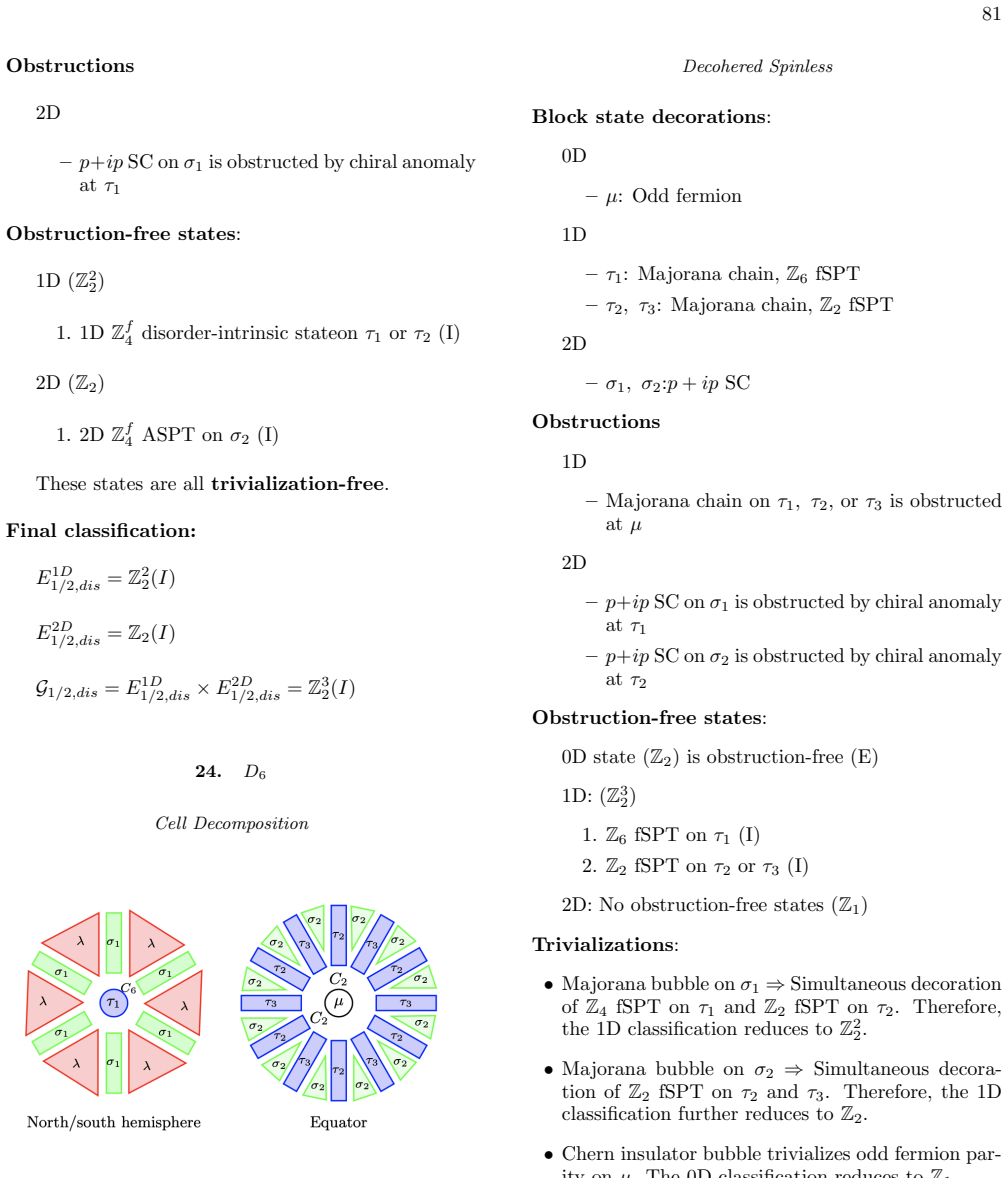
D6 Cell Decomposition FIG. 51. D6 lattice Blocks and onsite symmetries : • 2D: Gσ1, Gσ2 =I • 1D: Gτ1 = Z6, Gτ2, Gτ3 = Z2 • 0D: Gµ = Z6 ⋊ Z2 Decohered Spinless Block state decorations: 0D – µ: Odd fermion 1D – τ1: Majorana chain, Z6 fSPT – τ2, τ3: Majorana chain, Z2 fSPT 2D – σ...
-
[129]
Therefore, the 1D classification reduces to Z2 2
Z2 fSPT on τ2 or τ3 (I) 2D: No obstruction-free states ( Z1) Trivializations: • Majorana bubble onσ1⇒ Simultaneous decoration of Z4 fSPT on τ1 and Z2 fSPT on τ2. Therefore, the 1D classification reduces to Z2 2. • Majorana bubble on σ2 ⇒ Simultaneous decora- tion of Z2 fSPT on...
-
[130]
Z6⇒ Zf 2 ASPT on τ1 (I)
-
[131]
2D: No obstruction-free states ( Z1)
Zf 4 ASPT on τ2 or τ3 (I) These states are also trivialization-free. 2D: No obstruction-free states ( Z1). Final classification: E0D 1/2,dec = Z2(I) E1D 1/2,dec = Z3 2(I) E2D 1/2,dec = Z1 G1/2,dec =E0D 1/2,dec×E1D 1/2,dec×E2D 1/2,dec = Z4 2(I) Disordered Spinless Block state d...
-
[132]
This reduces the 1D classification to Z2 2
Majorana chain on τ1, τ2 or τ3 (I) 2D: No obstruction-free states ( Z1) Trivializations: • Open surface decoration ⇒ Simultaneous decora- tion of Majorana chains on τ1, τ2, and τ3. This reduces the 1D classification to Z2 2. Final classification: E1D 0,dis = Z2 2(I) E2D 0,dis ...
-
[133]
2D: No obstruction-free states ( Z1) Final classification: E1D 1/2,dis = Z3 2(I) E2D 1/2,dis = Z1 G1/2,dis =E1D 1/2,dis×E2D 1/2,dis = Z3 2(I) 83 FIG
1D Zf 4 disorder-intrinsic stateon τ1, τ2, or τ3 (I) These states are also trivialization-free. 2D: No obstruction-free states ( Z1) Final classification: E1D 1/2,dis = Z3 2(I) E2D 1/2,dis = Z1 G1/2,dis =E1D 1/2,dis×E2D 1/2,dis = Z3 2(I) 83 FIG. 52. C6v lattice
-
[134]
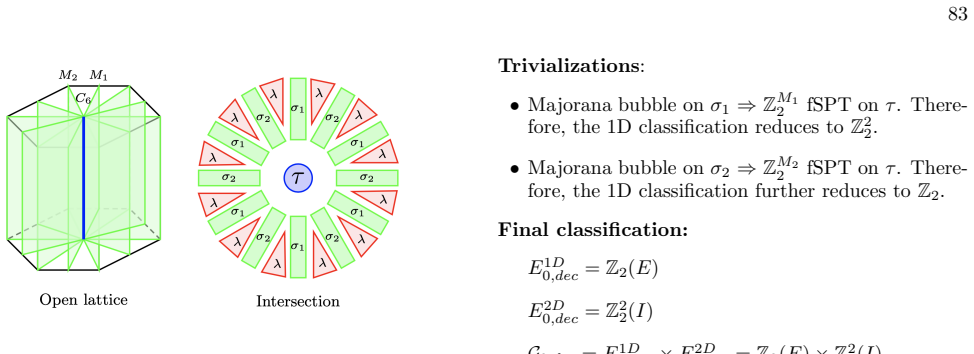
C6v Cell Decomposition Blocks and onsite symmetries : • Gσ1, Gσ2 = Z2 • Gτ = Z6 ⋊ Z2 Decohered Spinless Block state decorations: 1D – τ: Majorana chain, ZM1 2 fSPT, ZM2 2 fSPT 2D – σ1, σ2:p +ip SC, fLG Obstructions 2D – p +ip SC on σ1 or σ2 is obstructed by chiral anomaly at τ...
-
[135]
Majorana chain on τ (E)
-
[136]
Z4 ⋊ Z2 fSPT on τ (E) 2D: (Z2 2)
-
[137]
There- fore, the 1D classification reduces to Z2 2
n = 2 fLG on σ1 or σ2 (I) Trivializations: • Majorana bubble on σ1⇒ ZM1 2 fSPT on τ. There- fore, the 1D classification reduces to Z2 2. • Majorana bubble on σ2⇒ ZM2 2 fSPT on τ. There- fore, the 1D classification further reduces to Z2. Final classification: E1D 0,dec = Z2(E) ...
-
[138]
Majorana chain on τ (E) 2D (Z2 2)
-
[139]
Final classification: E1D 1/2,dis = Z2(I) E2D 1/2,dis = Z2 2(I) G1/2,dis =E1D 1/2,dis×E2D 1/2,dis = Z3 2(I)
fLG on σ1 or σ2 (I) These states are all trivialization-free Final classification: E1D 0,dis = Z2(E) E2D 0,dis = Z2 2(I) G0,dis =E1D 0,dis×E2D 0,dis = Z2(E)× Z2 2(I) Disordered Spin-1/2 Block state decorations: 1D – τ: 1D Zf 4 disorder-intrinsic state(I) 2D – σ1, σ2: 2D Zf 4 A...
-
[140]
D3h Cell Decomposition FIG. 53. D3h lattice Blocks and onsite symmetries : • 2D: Gσ1, Gσ2, Gσ3 = Z2 • 1D: Gτ1 = Z3 ⋊ Z2, Gτ2, Gτ3 = Z2× Z2 • 0D: Gµ = Z2× (Z3 ⋊ Z2) Decohered Spinless Block state decorations: 0D – µ: Odd fermion 1D – τ1: Majorana chain, Z3 ⋊ Z2 fSPT – τ2: Major...
-
[141]
Majorana chains on τ2 and τ3 (E)
-
[142]
Z3 ⋊ Z2 fSPT on τ1 (I)
-
[143]
ZM1 2 fSPT on τ2 and ZM2 2 fSPT on τ3 (I)
-
[144]
ZM3 2 fSPTs on τ2 and τ3 (I) 2D: (Z2 2) 85
-
[145]
n = 2 fLGs on σ1 and σ2 (I)
-
[146]
Therefore, the 1D classification reduces to Z3 2
n = 2 fLG on σ3 (I) Trivializations: • Majorana bubble on σ3 ⇒ ZM1 2 fSPT on τ2 and ZM2 2 fSPT on τ3. Therefore, the 1D classification reduces to Z3 2. • Majorana bubbles on σ1 and σ2⇒ Simultaneous decoration of Z3 ⋊Z2 fSPT onτ1 and ZM3 2 fSPTs on τ2 and τ3. Therefore, the 1D ...
-
[147]
Z3 ⋊ Z2 ⋊ Zf 2 ASPT on τ1 (I)
-
[148]
Zf,M1 4 ASPT on τ2 and Zf,M2 4 ASPT on τ3 (I)
-
[149]
Therefore, the 1D classification reduces to Z2 2
Zf,M3 4 ASPTs on τ2 and τ3 (I) Trivializations: • Z4 ASPT bubble on σ1⇒ Z3 ⋊ Z2 ⋊ Zf 2 ASPT on τ1. Therefore, the 1D classification reduces to Z2 2. • Fermion bubble onτ2⇒ Odd fermion onµ. There- fore, the 0D classification reduces to Z1 (trivial). Final classification: E0D 1/...
-
[151]
Majorana chains on τ2 and τ3 (E) 2D (Z2 2) 86
-
[152]
fLG on σ1 and σ2 (I)
-
[153]
fLG on σ3 (I) Trivializations: • Majorana bubble on σ⇒ Majorana chain on τ1. Therefore, the 1D classification reduces to Z2 Final classification: E1D 0,dis = Z2(E) E2D 0,dis = Z2 2(I) G0,dis =E1D 0,dis×E2D 0,dis = Z2(E)× Z2 2(I) Disordered Spin-1/2 Block state decorations: 1D ...
-
[154]
1D Zf 4 disorder-intrinsic stateon τ1 (I)
-
[155]
1D Zf 4 disorder-intrinsic statesonτ2 andτ3 (I) 2D (Z2 2)
-
[156]
2D Zf 4 ASPT on σ1 and σ2 (I)
-
[157]
Therefore, the 1D classification reduces to Z2 Final classification: E1D 1/2,dis = Z2(I) E2D 1/2,dis = Z2 2(I) G1/2,dis =E1D 1/2,dis×E2D 1/2,dis = Z3 2(I)
2D Zf 4 ASPT on σ3 (I) Trivializations: • 1D Zf 4 disorder-intrinsic bubbleon σ ⇒ 1D Zf 4 disorder-intrinsic stateon τ1. Therefore, the 1D classification reduces to Z2 Final classification: E1D 1/2,dis = Z2(I) E2D 1/2,dis = Z2 2(I) G1/2,dis =E1D 1/2,dis×E2D 1/2,dis = Z3 2(I)
-
[158]
D6h Cell Decomposition FIG. 54. D6h lattice Blocks and onsite symmetries : • Gσ1, Gσ2, Gσ3 = Z2 • Gτ1 = Z6 ⋊ Z2, Gτ2, Gτ3 = Z2× Z2 • Gµ = Z2× (Z6 ⋊ Z2) Decohered Spinless Block state decorations: 0D – µ: Odd fermion 1D – τ1: Majorana chain, ZM1 2 fSPT, ZM2 2 fSPT – τ2: Majoran...
-
[159]
Any combination of fSPTs on τ1, τ2, τ3 (I) 2D: (Z3 2)
-
[160]
Therefore, the 1D classification reduces to Z5 2
n = 2 fLG on σ1, σ2, or σ3 (I) Trivializations: • Majorana bubble on σ1 ⇒ Simultaneous decora- tion of ZM1 2 fSPT on τ1 and τ2. Therefore, the 1D classification reduces to Z5 2. • Majorana bubble on σ2 ⇒ Simultaneous decora- tion of ZM2 2 fSPT on τ1 and τ3. Therefore, the 1D c...
-
[161]
Majorana chain on τ1, τ2, or τ3 (I) 2D (Z3 2)
-
[162]
Final classification: E1D 1/2,dis = Z3 2(I) E2D 1/2,dis = Z3 2(I) G1/2,dis =E1D 1/2,dis×E2D 1/2,dis = Z6 2(I) 88 FIG
fLG on σ1, σ2, or σ3 (I) These states are all trivialization-free Final classification: E1D 0,dis = Z3 2(I) E2D 0,dis = Z3 2(I) G0,dis =E1D 0,dis×E2D 0,dis = Z6 2(I) Disordered Spin-1/2 Block state decorations: 1D – τ1, τ2, τ3: 1D Zf 4 disorder-intrinsic state(I) 2D – σ1, σ2, ...
-
[163]
1D: (Z4 2)
T Cell Decomposition Blocks and onsite symmetries : • 2D: Gσ1, Gσ2 =I • 1D: Gτ1, Gτ2 = Z3, Gτ3 = Z2 • 0D: Gµ =A4 Decohered Spinless Block state decorations: 0D – µ: Odd fermion 1D – τ1, τ2: Majorana chain – τ3: Majorana chain, Z2 fSPT 2D – σ1, σ2:p +ip SC Obstructions 2D – p +...
-
[164]
Majorana chain on τ1, τ2, or τ3 (I)
-
[165]
This reduces 1D classification to Z3 2
Z2 fSPT on τ3 (I) 2D: No obstruction-free states ( Z1) Trivializations: • Majorana bubble onσ1⇒ Simultaneous decoration of Majorana chain on τ2 and Z2 fSPT on τ3. This reduces 1D classification to Z3 2. • Majorana bubble on σ2 ⇒ Simultaneous decora- tion of Majorana chains on ...
-
[167]
This reduces 1D classification to Z2 2
Zf 4 ASPT on τ3 (I) 2D: No obstruction-free states ( Z1) Trivializations: • Majorana bubble on σ1⇒ Majorana chain on τ2. This reduces 1D classification to Z2 2. • Majorana bubbles on σ1 andσ2⇒ Majorana chain onτ1. This further reduces 1D classification to Z2. Final classificat...
-
[168]
This reduces 1D classification to Z2 2
Majorana chain on τ1, τ2, or τ3 2D: No obstruction-free states ( Z1) Trivializations: • Majorana bubble on σ1⇒ Majorana chain on τ2. This reduces 1D classification to Z2 2. • Majorana bubbles on σ1 andσ2⇒ Majorana chain onτ1. This further reduces 1D classification to Z2. • Ope...
-
[170]
This reduces 1D classification to Z2 2
1D Zf 4 disorder-intrinsic stateon τ3 (I) 2D: No obstruction-free states ( Z1) Trivializations: • Majorana bubble on σ1⇒ Majorana chain on τ2. This reduces 1D classification to Z2 2. • Majorana bubbles on σ1 andσ2⇒ Majorana chain onτ1. This further reduces 1D classification to...
-
[171]
Th Cell Decomposition Blocks and onsite symmetries : • 2D: Gσ1 =I, Gσ2, Gσ3 = Z2 • 1D: Gτ1 = Z3, Gτ2 = Z2× Z2, Gτ3 = Z2 • 0D: Gµ =A4× Z2 90 FIG. 56. Th lattice Decohered Spinless Block state decorations: 0D – µ: Odd fermion 1D – τ1: Majorana chain – τ2: Majorana chain, Z2× Z2 ...
-
[173]
Z2× Z2 fSPT on τ2 (I)
-
[175]
Z2 fSPT on τ3 (E) 2D (Z2)
-
[176]
This reduces 1D classification to Z4 2
Simultaenous decoration of n = 2 fLG on σ2 and σ3 (I) Trivializations: • Majorana bubble onσ1⇒ Simultaneous decoration of Majorana chain on τ1 and Z2 fSPT on τ3. This reduces 1D classification to Z4 2. • Majorana bubble onσ2⇒ Simultaneous decoration of (1, 0) fSPT onτ2 and Maj...
-
[178]
Z2 2×ωf 2 Zf 2 ASPT on τ2 (I)
-
[179]
This reduces 1D classification to Z3 2
Zf 4 ASPT on τ3 (I) 2D: No obstruction-free states ( Z1) Trivializations: • Majorana bubble on σ1⇒ Majorana chain on τ1. This reduces 1D classification to Z3 2. • Zf 4 ASPT bubble on σ2⇒ Zf 4 ASPT on τ3. This further reduces 1D classification to Z2 2. Final classification: E0D...
-
[181]
Majorana chain on τ2 or τ3 (I) 2D: (Z2)
-
[182]
This reduces 1D classification to Z2 2
Simultaneous decoration of fLG on σ2 and σ3 (I) Trivializations: • Majorana bubble on σ1⇒ Majorana chain on τ1. This reduces 1D classification to Z2 2. • Majorana bubble on σ2⇒ Majorana chain on τ3. This further reduces 1D classification to Z2. Final classification: E1D 0,dis ...
-
[183]
Majorana chain on τ1 (E)
-
[184]
1D Zf 4 disorder-intrinsic stateon τ2 or τ3 (I) 2D: (Z2)
-
[185]
This reduces 1D classification to Z2 2
Simultaneous decoration of 2D Zf 4 ASPT on σ2 and σ3 (I) Trivializations: • Majorana bubble on σ1⇒ Majorana chain on τ1. This reduces 1D classification to Z2 2. 92 • 1D Zf 4 disorder-intrinsic bubbleon σ2 ⇒ 1D Zf 4 disorder-intrinsic stateon τ3. This fur- ther reduces 1D class...
-
[186]
Td Cell Decomposition FIG. 57. Td lattice Blocks and onsite symmetries : • 2D: Gσ1, Gσ2, Gσ3 = Z2 • 1D: Gτ1, Gτ2 = Z3 ⋊ Z2, Gτ3 = Z2× Z2 • 0D: Gµ =S4 Decohered Spinless Block state decorations: 0D – µ: Odd fermion 1D – τ1, τ2: Majorana chain, Z3 ⋊ Z2 fSPT (Z2) – τ3: Majorana c...
-
[187]
Majorana chain on τ1 and τ2 (E)
-
[189]
Z3 ⋊ Z2 fSPT on τ2 (E)
-
[190]
Majorana chain on τ3 (I)
-
[191]
(1,1) fSPT on τ3 (I) 2D (Z2)
-
[192]
• Majorana bubble on σ3⇒ Majorana chains on τ1 and τ2
Simultaenous decoration of n = 2 fLG on σ1, σ2, and σ3 (I) Trivializations: • Majorana bubbles on σ1 and σ2⇒ (1,1) fSPT on τ3. • Majorana bubble on σ3⇒ Majorana chains on τ1 and τ2. • Z2 fSPT bubble on σ1⇒ Z3 ⋊ Z2 fSPT on τ1. • Z2 fSPT bubble on σ2⇒ Z3 ⋊ Z2 fSPT on τ2. Ul- tim...
-
[193]
Obstructions 1D – (1,0)-fSPT or (0,1)-fSPT on τ3 is obstructed at µ Obstruction-free states: 0D state ( Z2) is obstruction-free (I)
labeled by (n1,n 2) 2D – σ1, σ2, σ3: No nontrivial block states. Obstructions 1D – (1,0)-fSPT or (0,1)-fSPT on τ3 is obstructed at µ Obstruction-free states: 0D state ( Z2) is obstruction-free (I). 1D: (Z3 2)
-
[194]
Z3 ⋊ Z2 ⋊ Zf 2 ASPT on τ1 or τ2 (I)
-
[195]
• Zf 4 ASPT bubble on σ2⇒ Z3 ⋊ Z2 ⋊ Zf 2 ASPT on τ2
(1,1) ASPT on τ3 (I) Trivializations: • Zf 4 ASPT bubble on σ1⇒ Z3 ⋊ Z2 ⋊ Zf 2 ASPT on τ1. • Zf 4 ASPT bubble on σ2⇒ Z3 ⋊ Z2 ⋊ Zf 2 ASPT on τ2. Therefore, the 1D classification further reduces to Z2. Final classification: E0D 1/2,dec = Z2(I) E1D 1/2,dec = Z2(I) E2D 1/2,dec = Z...
-
[196]
Majorana chain on τ1 or τ2 (E)
-
[197]
Majorana chain on τ3 (I) 2D: (Z2)
-
[198]
Trivializations: • Majorana bubble on σ1⇒ Majorana chain on τ1
Simultaneous decoration of fLG onσ1, σ2, and σ3 (I). Trivializations: • Majorana bubble on σ1⇒ Majorana chain on τ1. This reduces 1D classification to Z2 2. • Majorana bubble on σ2⇒ Majorana chain on τ2. This further reduces 1D classification to Z2. Final classification: E1D 0...
-
[199]
1D Zf 4 disorder-intrinsic stateon τ1, τ2, or τ3 (I) 94 2D: (Z2)
-
[200]
(I) Trivializations: • 1D Zf 4 disorder-intrinsic bubbleon σ1 ⇒ 1D Zf 4 disorder-intrinsic stateon τ1
Simultaneous decoration of 2D Zf 4 ASPT on σ1, σ2, and σ3. (I) Trivializations: • 1D Zf 4 disorder-intrinsic bubbleon σ1 ⇒ 1D Zf 4 disorder-intrinsic stateon τ1. This re- duces 1D classification to Z2 2. • 1D Zf 4 disorder-intrinsic bubbleon σ2 ⇒ 1D Zf 4 disorder-intrinsic sta...
-
[201]
O Cell Decomposition FIG. 58. O lattice Blocks and onsite symmetries : • Gσ1, Gσ2 =I • Gτ1 = Z3, Gτ2 = Z4, Gτ3 = Z2 • Gµ =S4 Decohered Spinless Block state decorations: 0D – µ: Odd fermion 1D – τ1: Majorana chain – τ2: Majorana chain, Z4 fSPT – τ3: Majorana chain, Z2 fSPT 2D –...
-
[203]
Therefore, the 1D classification reduces to Z2 2
Z2 fSPT on τ3 (I) 2D: No obstruction-free states ( Z1) Trivializations: • Majorana bubble on σ1 ⇒ Simultaneous decora- tion of Majorana chain on τ1 and Z2 fSPT on τ3. Therefore, the 1D classification reduces to Z2 2. • Majorana bubble on σ2 ⇒ Simultaneous decora- tion of Major...
-
[205]
Z4 ⋊ Zf 2 ASPT on τ2 (I)
-
[206]
Therefore, the 1D classification reduces to Z2 2
Zf 4 ASPT on τ3 (I) 2D: No obstruction-free states ( Z1) Trivializations: • Majorana bubble on σ1⇒ Majorana chain on τ1. Therefore, the 1D classification reduces to Z2 2. Final classification: E0D 1/2,dec = Z2(I) E1D 1/2,dec = Z2 2(I) E2D 1/2,dec = Z1 G1/2,dec =E0D 1/2,dec×E1D...
-
[207]
Therefore, the 1D classification reduces to Z2 2
Majorana chain on τ1, τ2, or τ3 (I) 2D: No obstruction-free states ( Z1) Trivializations: • Majorana bubble on σ1⇒ Majorana chain on τ1. Therefore, the 1D classification reduces to Z2 2. • Open surface decoration trivializes Majorana chain on τ2. Therefore, the 1D classificati...
-
[209]
Therefore, the 1D classification reduces to Z2 2
1D Zf 4 disorder-intrinsic stateon τ2 or τ3 (I) 2D: No obstruction-free states ( Z1) Trivializations: • Majorana bubble on σ1⇒ Majorana chain on τ1. Therefore, the 1D classification reduces to Z2 2. 96 Final classification: E1D 1/2,dis = Z2 2(I) E2D 1/2,dis = Z1 G1/2,dis =E1D ...
-
[210]
Oh Cell Decomposition FIG. 59. Oh lattice Blocks and onsite symmetries : • Gσ1, Gσ2, Gσ3 = Z2 • Gτ1 = Z3 ⋊ Z2, Gτ2 = Z4× Z2, Gτ3 = Z2× Z2 • Gµ =S4× Z2 Decohered Spinless Block state decorations: 0D – µ: Odd fermion 1D – τ1: Majorana chain, Z3 ⋊ Z2 fSPT (Z2) – τ2: Majorana chai...
-
[211]
– All decorations with one copy of fLG state are obstructed
∼= (ZM1 2 fSPT, ZM2 2 fSPT) 2D – σ1, σ2, σ3: p±ip SC, fLG Obstructions 1D – Majorana chain on τ2 is obstructed at µ (M1 reflection symmetry) – Majorana chain on τ3 is obstructed at µ (4- fold rotation symmetry about τ2) 2D – p±ip SC decorations are obstructed by chiral anomaly...
-
[212]
Majorana chain on τ1 (I)
-
[213]
Z3 ⋊ Z2 fSPT on τ1 (E)
-
[214]
ZM1 2 fSPT on τ2 or τ3 (I)
-
[215]
ZM2 2 fSPT on τ3 (I) 2D: (Z2 2)
-
[216]
• Majorana bubble onσ1⇒ Simultaneous decoration of Zn1 4 fSPT on τ2 and ZM2 2 fSPT on τ3
n = 2 fLG on σ2 and σ3 (I) Trivializations: • Double Majorana ( Z2 fSPT) bubble on σ2⇒ Z3 ⋊ Z2 fSPT on τ1. • Majorana bubble onσ1⇒ Simultaneous decoration of Zn1 4 fSPT on τ2 and ZM2 2 fSPT on τ3. • Majorana bubble onσ2⇒ Simultaneous decoration of Majorana chain on τ1 and Zn2 ...
-
[217]
Majorana chain on τ1, τ2, or τ3 (I) 2D: (Z2 2)
-
[218]
Therefore, the 1D classification reduces to Z2 2
fLG on σ2 and σ3 (I) Trivializations: • Majorana bubble on σ1⇒ Majorana chain on τ1. Therefore, the 1D classification reduces to Z2 2. Final classification: E1D 0,dis = Z2 2(I) E2D 0,dis = Z2 2(I) G0,dis =E1D 0,dis×E2D 0,dis = Z4 2(I) Disordered Spin-1/2 Block state decoration...
-
[219]
1D Zf 4 disorder-intrinsic stateon τ1, τ2, or τ3 (I) 2D: (Z2 2)
-
[220]
2D Zf 4 ASPT on σ1 (I)
-
[221]
Therefore, the 1D classification reduces to Z2 2
2D Zf 4 ASPT on σ2 and σ3 (I) Trivializations: • 1D Zf 4 disorder-intrinsic bubbleon σ1 ⇒ 1D Zf 4 disorder-intrinsic stateon τ1. Therefore, the 1D classification reduces to Z2 2. Final classification: E1D 1/2,dis = Z2 2(I) E2D 1/2,dis = Z2 2(I) G1/2,dis =E1D 1/2,dis×E2D 1/2,di...
Reviewed August 15, 2026 · model on record in the stance chip above.
Discussion (0). Continue with ORCID to comment.