REVIEW 2 major objections 1 minor 47 references
Conveyance: A Versatile Framework for Learning in Structured Class Spaces
T0 review · 2 major / 1 minor · reviewed 2026-06-29 · grok-4.3
Pith's one-line read Conveyance is a loss function for structured classes that encodes graph relations by maximizing two separate margins over class partitions.
desk verdict Conveyance presents a two-margin loss for graph-structured classes that unifies three tasks but leaves the formal properties unverified for arbitrary graphs. read the letter →
The pith
A machine-rendered reading of the paper's core claim, the machinery that carries it, and where it could break.
The reading
What carries the argument
Maximizing two separate margins over distinct class partitions to encode graph-like class relations.
What would settle it
A simple three-class graph example where the Conveyance loss does not respect the encoded relation or violates monotonicity under the defined partitions.
Extended reading notes
Core claim
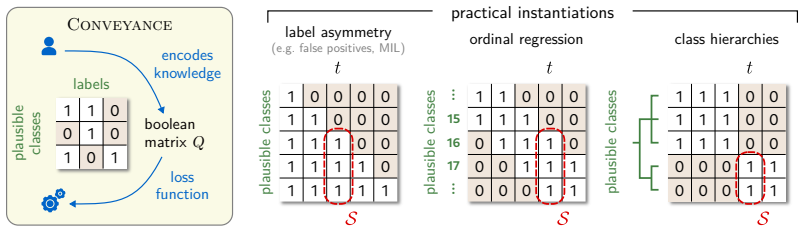
Conveyance is a new classification approach and associated loss function tailored to structured class spaces. It allows users to encode graph-like relations between classes without having to define complex joint distributions or manually tune utility matrices. The loss function operates by maximizing two separate margins over distinct class partitions, while preserving formal properties such as monotonicity and partial convexity. It demonstrates versatility by applying to hierarchical classification, ordinal regression, and multiple instance learning where it matches or exceeds specialized baselines.
Load-bearing premise
Maximizing two separate margins over distinct class partitions will reliably exploit arbitrary graph relations while preserving the formal properties.
Editorial extensions
If this is right
- Conveyance applies directly to hierarchical classification by respecting class hierarchies.
- It supports ordinal regression through order-preserving relations between classes.
- The same loss works for multiple instance learning without task-specific adjustments.
- It offers a single framework instead of needing separate methods for each structured task.
- The preserved monotonicity ensures the loss behaves consistently with the encoded relations.
Reading between the lines
- It could reduce the engineering effort needed to adapt models to new structured classification problems.
- Applications might extend to settings with partial class orderings or noisy labels where relations are known.
- Integration into neural network training could allow learning with structural constraints end-to-end.
Editorial analysis
A structured set of objections, weighed in public.
Referee Report
Summary. The paper proposes Conveyance, a classification loss for structured class spaces that encodes user-supplied graph-like relations between classes by maximizing two separate margins over distinct class partitions. The loss is claimed to preserve monotonicity and partial convexity without requiring joint distributions or tuned utility matrices. It is evaluated on hierarchical classification, ordinal regression, and multiple instance learning, where it matches or exceeds task-specific baselines.
Significance. If the central derivation establishing that the two-margin construction preserves the stated properties for arbitrary graphs (rather than only the three tested structures) is sound and the empirical results are reproducible, the work would offer a genuinely unified alternative to specialized losses in structured settings. The absence of parameter-free derivations or machine-checked proofs in the provided text limits the assessed strength, but the versatility claim, if substantiated, would be a meaningful contribution to loss-function design.
major comments (2)
- [Abstract / §3] Abstract and §3 (loss definition): the claim that maximizing two separate margins over distinct partitions preserves monotonicity and partial convexity for arbitrary graph relations is load-bearing for the versatility argument, yet the abstract supplies neither the explicit margin definitions nor a proof sketch; the skeptic note correctly identifies that this must be shown generally rather than assumed from the three demonstrated partitions.
- [§5] §5 (experiments): the evaluation is confined to hierarchies, ordinal scales, and MIL bags; without additional theoretical analysis or counter-example checks for graphs outside these families, the generalization claim that the partition choice reliably exploits arbitrary relations remains unverified and directly affects the central contribution.
minor comments (1)
- [Abstract] The abstract would be strengthened by a single sentence giving the concrete form of the two margins or the partition construction.
Simulated Author's Rebuttal
We thank the referee for the constructive comments. We address each major point below, clarifying the generality of the derivation in §3 and outlining planned revisions to strengthen the presentation.
read point-by-point responses
-
Referee: [Abstract / §3] Abstract and §3 (loss definition): the claim that maximizing two separate margins over distinct partitions preserves monotonicity and partial convexity for arbitrary graph relations is load-bearing for the versatility argument, yet the abstract supplies neither the explicit margin definitions nor a proof sketch; the skeptic note correctly identifies that this must be shown generally rather than assumed from the three demonstrated partitions.
Authors: Section 3 defines the two margins explicitly in terms of the user-supplied graph: one margin is taken over the partition induced by direct neighbors, and the second over the complement partition. The proofs of monotonicity and partial convexity are stated and derived for this general construction without restricting the graph family; the three experimental structures are merely instantiations. The abstract is intentionally concise, but we will revise it to include a one-sentence statement of the margin definitions and will move a compact proof outline from the appendix into the main text of §3. revision: partial
-
Referee: [§5] §5 (experiments): the evaluation is confined to hierarchies, ordinal scales, and MIL bags; without additional theoretical analysis or counter-example checks for graphs outside these families, the generalization claim that the partition choice reliably exploits arbitrary relations remains unverified and directly affects the central contribution.
Authors: The theoretical claims rest on the general derivation in §3, which holds for any graph that induces well-defined partitions; no additional assumptions on the graph topology are used. The experiments illustrate the framework on three representative relation types. To further substantiate the generalization claim we will add a short paragraph in §5 explaining how arbitrary graphs map to the two partitions and include one synthetic experiment on a non-hierarchical, non-ordinal graph (e.g., a small cyclic graph) in the revised version. revision: yes
Circularity Check
No circularity: loss defined on external user graphs, properties asserted without self-referential reduction.
full rationale
The abstract and context describe the Conveyance loss as operating directly on user-supplied graph relations between classes by maximizing two margins over partitions, with monotonicity and partial convexity stated as preserved properties. No equations, derivations, or self-citations are provided that would make any claimed result equivalent to its own inputs by construction. The method is positioned as a general framework demonstrated on three tasks rather than a fitted quantity renamed as a prediction or justified solely by author-overlapping citations. This is the normal case of a self-contained proposal whose central mechanism does not reduce to tautology.
Assumptions & free parameters
Cite this review
Pith. "Pith review of Conveyance: A Versatile Framework for Learning in Structured Class Spaces." pith.science (2026). https://pith.science/paper/YQCM2AJS
@misc{pith2026260528420,
  author       = {Pith},
  title        = {Pith review of: Conveyance: A Versatile Framework for Learning in Structured Class Spaces},
  year         = {2026},
  howpublished = {\url{https://pith.science/paper/YQCM2AJS}},
  note         = {Machine review of arXiv:2605.28420}
}
read the original abstract
While machine learning (ML) architectures have evolved rapidly to account for complex data, loss functions like cross-entropy remain mostly structure-agnostic in many real-world applications. However, the "class-symmetric" nature of these standard losses fundamentally limits the ability of ML models to exploit structural relationships between classes, particularly when facing structured noise. We propose Conveyance, a new classification approach and associated loss function tailored to structured class spaces. It allows users to encode graph-like relations between classes without having to define complex joint distributions or manually tune utility matrices. Technically, our loss function operates by maximizing two separate margins over distinct class partitions, while preserving formal properties such as monotonicity and partial convexity. We demonstrate the versatility and effectiveness of our method by applying it to hierarchical classification, ordinal regression, and multiple instance learning. Across these tasks, Conveyance either matches or exceeds the performance of specialized baselines, thereby offering a unified solution for structured class spaces.
Figures


Figures from the paper (5 more)



Reference graph
Works this paper leans on
-
[1]
Agustsson, R
E. Agustsson, R. Timofte, S. Escalera, X. Baro, I. Guyon, and R. Rothe. Apparent and real age estimation in still images with deep residual regressors on Appa-Real database. InProc. IEEE Int. Conf. on Automatic Face and Gesture Recognition (FG), pages 87–94, 2017
2017
-
[2]
Andrews, I
S. Andrews, I. Tsochantaridis, and T. Hofmann. Support vector machines for multiple-instance learning. InProceedings of the 16th International Conference on Neural Information Processing Systems, NIPS’02, page 577–584, Cambridge, MA, USA, 2002. MIT Press
2002
-
[3]
Beckham and C
C. Beckham and C. Pal. Unimodal probability distributions for deep ordinal classification. In D. Precup and Y . W. Teh, editors,Proceedings of the 34th International Conference on Machine Learning, volume 70 ofProceedings of Machine Learning Research, pages 411–419. PMLR, 06–11 Aug 2017
2017
-
[4]
Boykov, O
Y . Boykov, O. Veksler, and R. Zabih. Fast approximate energy minimization via graph cuts.IEEE Transactions on Pattern Analysis and Machine Intelligence, 23(11):1222–1239, 2001
2001
-
[5]
D. Chapman and A. Jain. Musk (Version 2). UCI Machine Learning Repository, 1994. DOI: https://doi.org/10.24432/C51608
-
[6]
Chen, C.-S
B.-C. Chen, C.-S. Chen, and W. H. Hsu. Cross-age reference coding for age-invariant face recognition and retrieval. InProceedings of the European Conference on Computer Vision (ECCV), 2014
2014
-
[7]
T. G. Dietterich, R. H. Lathrop, and T. Lozano-Pérez. Solving the multiple instance problem with axis-parallel rectangles.Artificial Intelligence, 89(1):31–71, 1997
1997
-
[8]
Dosovitskiy, L
A. Dosovitskiy, L. Beyer, A. Kolesnikov, D. Weissenborn, X. Zhai, T. Unterthiner, M. Dehghani, M. Min- derer, G. Heigold, S. Gelly, J. Uszkoreit, and N. Houlsby. An image is worth 16x16 words: Transformers for image recognition at scale, 2021
2021
Show all 47 references
-
[9]
Z. Du, S. Mao, X. Lu, M. Qi, Y . Zhang, J. Gu, and L. Jiao. Rethinking multiple-instance learning from feature space to probability space. In Y . Yue, A. Garg, N. Peng, F. Sha, and R. Yu, editors,International Conference on Learning Representations, volume 2025, pages 28530–28...
2025
-
[10]
Z. Du, S. Mao, Y . Zhang, S. Gou, L. Jiao, and L. Xiong. Rgmil: Guide your multiple-instance learning model with regressor. In A. Oh, T. Naumann, A. Globerson, K. Saenko, M. Hardt, and S. Levine, editors, Advances in Neural Information Processing Systems, volume 36, pages 3560...
2023
-
[11]
Díaz and A
R. Díaz and A. Marathe. Soft labels for ordinal regression. In2019 IEEE/CVF Conference on Computer Vision and Pattern Recognition (CVPR), pages 4733–4742, 2019
2019
-
[12]
Ehteshami Bejnordi, M
B. Ehteshami Bejnordi, M. Veta, P. Johannes van Diest, B. van Ginneken, N. Karssemeijer, et al. Diagnostic assessment of deep learning algorithms for detection of lymph node metastases in women with breast cancer.JAMA, 318(22):2199, Dec. 2017
2017
-
[13]
Fourkioti, M
O. Fourkioti, M. De Vries, and C. Bakal. CAMIL: Context-aware multiple instance learning for cancer detection and subtyping in whole slide images. InThe Twelfth International Conference on Learning Representations, 2024
2024
-
[14]
B.-B. Gao, C. Xing, C.-W. Xie, J. Wu, and X. Geng. Deep label distribution learning with label ambiguity. IEEE Transactions on Image Processing, 26(6):2825–2838, 2017
2017
-
[15]
Gao, H.-Y
B.-B. Gao, H.-Y . Zhou, J. Wu, and X. Geng. Age estimation using expectation of label distribution learning. InProceedings of the Twenty-Seventh International Joint Conference on Artificial Intelligence, IJCAI-18, pages 712–718. International Joint Conferences on Artificial In...
2018
-
[16]
Goldberger and E
J. Goldberger and E. Ben-Reuven. Training deep neural-networks using a noise adaptation layer. In International Conference on Learning Representations, 2016
2016
-
[17]
B. Han, J. Yao, G. Niu, M. Zhou, I. Tsang, Y . Zhang, and M. Sugiyama. Masking: A new perspective of noisy supervision. In S. Bengio, H. Wallach, H. Larochelle, K. Grauman, N. Cesa-Bianchi, and R. Garnett, editors,Advances in Neural Information Processing Systems, volume 31. C...
2018
-
[18]
K. He, X. Zhang, S. Ren, and J. Sun. Deep residual learning for image recognition. In2016 IEEE Conference on Computer Vision and Pattern Recognition (CVPR), pages 770–778. IEEE Computer Society, 2016
2016
-
[19]
L. Hou, C. Yu, and D. Samaras. Squared earth mover’s distance-based loss for training deep neural networks.CoRR, abs/1611.05916, 2016
2016 arXiv
-
[20]
Huang, Z
S. Huang, Z. Liu, W. Jin, and Y . Mu. Bag dissimilarity regularized multi-instance learning.Pattern Recogn., 126(C), June 2022
2022
-
[21]
M. Ilse, J. Tomczak, and M. Welling. Attention-based deep multiple instance learning. In J. Dy and A. Krause, editors,Proceedings of the 35th International Conference on Machine Learning, volume 80 of Proceedings of Machine Learning Research, pages 2127–2136. PMLR, 10–15 Jul 2018
2018
-
[22]
Kazeminia, A
S. Kazeminia, A. Sadafi, A. Makhro, A. Y . Bogdanova, C. Marr, and B. Rieck. Topologically-regularized multiple instance learning for red blood cell disease classification.ArXiv, abs/2307.14025, 2023
2023
-
[23]
Khosla, P
P. Khosla, P. Teterwak, C. Wang, A. Sarna, Y . Tian, P. Isola, A. Maschinot, C. Liu, and D. Krishnan. Supervised contrastive learning. InProceedings of the 34th International Conference on Neural Information Processing Systems, NIPS ’20, Red Hook, NY , USA, 2020. Curran Associates Inc
2020
-
[24]
Krizhevsky
A. Krizhevsky. Learning multiple layers of features from tiny images. Technical report, University of Toronto, 2009
2009
-
[25]
LeCun, S
Y . LeCun, S. Chopra, R. Hadsell, M. Ranzato, and F.-J. Huang. A tutorial on energy-based learning. Predicting Structured Data, 2006
2006
-
[26]
B. Li, Y . Li, and K. W. Eliceiri. Dual-stream multiple instance learning network for whole slide image classification with self-supervised contrastive learning.2021 IEEE/CVF Conference on Computer Vision and Pattern Recognition (CVPR), pages 14313–14323, 2020
2021
-
[27]
X. Ma, H. Huang, Y . Wang, S. Romano, S. M. Erfani, and J. Bailey. Normalized loss functions for deep learning with noisy labels. InICML, volume 119 ofProceedings of Machine Learning Research, pages 6543–6553. PMLR, 2020
2020
-
[28]
Z. Niu, M. Zhou, L. Wang, X. Gao, and G. Hua. Ordinal regression with multiple output cnn for age estimation. In2016 IEEE Conference on Computer Vision and Pattern Recognition (CVPR), pages 4920–4928, 2016
2016
-
[29]
H. Pan, H. Han, S. Shan, and X. Chen. Mean-variance loss for deep age estimation from a face. In2018 IEEE/CVF Conference on Computer Vision and Pattern Recognition, pages 5285–5294, 2018
2018
-
[30]
Paplham and V
J. Paplham and V . Franc. A Call to Reflect on Evaluation Practices for Age Estimation: Comparative Analysis of the State-of-the-Art and a Unified Benchmark . In2024 IEEE/CVF Conference on Computer Vision and Pattern Recognition (CVPR), pages 1196–1205, Los Alamitos, CA, USA, ...
2024
-
[31]
Patrini, A
G. Patrini, A. Rozza, A. K. Menon, R. Nock, and L. Qu. Making deep neural networks robust to label noise: A loss correction approach. InCVPR, pages 2233–2241. IEEE Computer Society, 2017
2017
-
[32]
Z. Shao, H. Bian, Y . Chen, Y . Wang, J. Zhang, X. Ji, and Y . Zhang. Transmil: Transformer based correlated multiple instance learning for whole slide image classication. InNeural Information Processing Systems, 2021
2021
-
[33]
Szegedy, V
C. Szegedy, V . Vanhoucke, S. Ioffe, J. Shlens, and Z. Wojna. Rethinking the inception architecture for computer vision. In2016 IEEE Conference on Computer Vision and Pattern Recognition (CVPR), pages 2818–2826, 2016
2016
-
[34]
Y . Taha, G. Montavon, and N. Körber. Drainage: A unifying framework for addressing class uncertainty. CoRR, abs/2512.03182, 2025. 11
2025
-
[35]
Tsochantaridis, T
I. Tsochantaridis, T. Joachims, T. Hofmann, and Y . Altun. Large margin methods for structured and interdependent output variables.J. Mach. Learn. Res., 6:1453–1484, Dec. 2005
2005
-
[36]
D. P. Vassileios Balntas, Edgar Riba and K. Mikolajczyk. Learning local feature descriptors with triplets and shallow convolutional neural networks. In E. R. H. Richard C. Wilson and W. A. P. Smith, editors, Proceedings of the British Machine Vision Conference (BMVC), pages 11...
2016
-
[37]
A. Viterbi. Error bounds for convolutional codes and an asymptotically optimum decoding algorithm. IEEE Transactions on Information Theory, 13(2):260–269, 1967
1967
-
[38]
Welinder, S
P. Welinder, S. Branson, T. Mita, C. Wah, F. Schroff, S. Belongie, and P. Perona. Caltech-UCSD Birds 200. Technical Report CNS-TR-2010-001, California Institute of Technology, 2010
2010
-
[39]
Y . Yan, X. Wang, X. Guo, J. Fang, W. Liu, and J. Huang. Deep multi-instance learning with dynamic pooling. In J. Zhu and I. Takeuchi, editors,Proceedings of The 10th Asian Conference on Machine Learning, volume 95 ofProceedings of Machine Learning Research, pages 662–677. PML...
2018
-
[40]
J. Yao, B. Han, Z. Zhou, Y . Zhang, and I. W. Tsang. Latent class-conditional noise model.IEEE Transactions on Pattern Analysis and Machine Intelligence, 45(8):9964–9980, 2023
2023
-
[41]
X. Ye, X. Li, S. Dai, T. Liu, Y . Sun, and W. Tong. Active negative loss functions for learning with noisy labels. InProceedings of the 37th International Conference on Neural Information Processing Systems, NIPS ’23, Red Hook, NY , USA, 2023. Curran Associates Inc
2023
-
[42]
Zhang, Y
H. Zhang, Y . Meng, Y . Zhao, Y . Qiao, X. Yang, S. E. Coupland, and Y . Zheng. Dtfd-mil: Double-tier feature distillation multiple instance learning for histopathology whole slide image classification. In2022 IEEE/CVF Conference on Computer Vision and Pattern Recognition (CVP...
2022
-
[43]
Zhang, G
Y . Zhang, G. Niu, and M. Sugiyama. Learning noise transition matrix from only noisy labels via total variation regularization. InICML, Proceedings of Machine Learning Research, pages 12501–12512. PMLR, 2021
2021
-
[44]
Zhang, Y
Z. Zhang, Y . Song, and H. Qi. Age progression/regression by conditional adversarial autoencoder.2017 IEEE Conference on Computer Vision and Pattern Recognition (CVPR), pages 4352–4360, 2017
2017
-
[45]
X. Zhou, X. Liu, J. Jiang, X. Gao, and X. Ji. Asymmetric loss functions for learning with noisy labels. In ICML, volume 139 ofProceedings of Machine Learning Research, pages 12846–12856. PMLR, 2021. 12 A Log-Sum-Exp Reformulations of the Conveyance Loss In this appendix, we pr...
2021
-
[46]
Every source class c /∈ {3,5}retains 40% of its labels and distributes the remaining 60% equally between cat and dog (30% each)
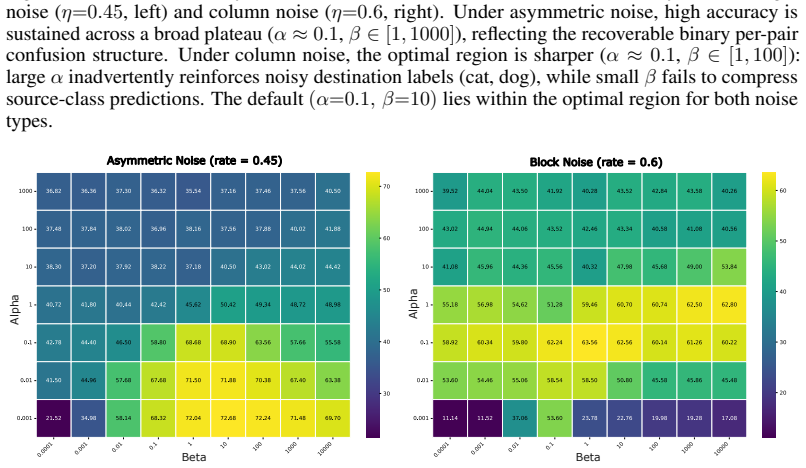
Column noise concentrates all corruption into two fixed destination classes: cat (class 3) and 16 dog (class 5). Every source class c /∈ {3,5}retains 40% of its labels and distributes the remaining 60% equally between cat and dog (30% each). The destination classes themselves ...
-
[47]
Block noise applies uniform within-superclass corruption. For every class c within a superclass of 5 members, 60% of labels are corrupted and distributeduniformlyamong the four co-superclass members (15%each), while40%of labels are retained: Tc,c = 0.4, T c,c′ = 0.15∀c ′ ̸=cin...
2011
Reviewed June 29, 2026 · model on record in the stance chip above.
Discussion (0). Continue with ORCID to comment.