REVIEW 5 major objections 5 minor 1 cited by
This paper proposes SITP, a transport protocol that checks only packet headers and delivers corrupted payloads to the semantic decoder, achieving TCP-level reliability and UDP-level latency for image transmission.
Reviewed by Pith at T0; open to challenge. T0 means a machine referee read the full paper against a public rubric. the ladder, T0–T4 →
T0 review · deepseek-v4-flash
2026-08-04 06:38 UTC pith:YQNWQQJP
load-bearing objection SITP is a clean engineering study that rediscovers UDP-Lite-style partial checksums for semantic communication, then shows a smart cross-image interleaving trick; the paper overclaims reliability and omits its closest prior art, but the analytical model and experiments are solid enough to warrant a proper review. the 5 major comments →
SITP: A High-Reliability Semantic Information Transport Protocol Without Retransmission for Semantic Communication
The pith
A machine-rendered reading of the paper's core claim, the machinery that carries it, and where it could break.
Core claim
The central discovery is that reliability and latency need not be traded off if the transport layer stops trying to guarantee bit integrity and instead protects only the information needed to route and reassemble segments. SITP verifies an 8-byte header (plus a pseudo-header for context) using a simple checksum, while the data-link CRC covers only the data-link header; any payload bit errors are passed through to the application layer. The receiver's semantic decoder, trained end-to-end to be noise-robust, reconstructs images from these imperfect features. On an animal-face image benchmark, SITP achieves higher PSNR and MS-SSIM and lower LPIPS than TCP at low SNR and better reconstruction th
What carries the argument
The key mechanism is the header-only integrity check: SITP's checksum covers only the SITP header and a pseudo-header, and the data-link CRC covers only the data-link header, so corrupted payload bits never trigger packet drops. The supporting analytical object is the cross-layer packet-loss probability, a product of per-layer acceptance probabilities that maps bit-error rate (and, via the QAM formula, SNR) to an end-to-end loss rate. For burst resilience, a cross-image feature interleaving matrix randomly permutes the quantized semantic bits of N images before packetization, turning a burst of consecutive lost packets into scattered single-feature errors across many images.
Load-bearing premise
The load-bearing premise is that the semantic decoder is genuinely robust to arbitrary bit errors in the quantized features, and that header and payload errors are statistically independent with the same bit-error rate; if a fade corrupts headers and payloads together, or the decoder meets an error pattern it cannot tolerate, SITP's reliability edge over UDP disappears.
What would settle it
Transmit SITP packets over a block-fading channel, measure the header error rate and payload error rate separately, and compare the measured end-to-end packet loss with the prediction of the cross-layer model (which uses a single shared bit-error rate and independent per-layer losses). If the measured loss systematically exceeds the prediction when header and payload errors are correlated, the independence assumption is false and the claimed reliability advantage is not guaranteed.
If this is right
- Eliminating the handshake and retransmission makes latency one-way, so real-time applications get reliability without round-trip feedback delays.
- Because end-to-end loss depends on header lengths only, payload size can be changed freely without affecting reliability, simplifying packetization.
- The closed-form SNR-to-loss mapping lets operators predict application-level quality from a single channel measurement.
- Interleaving depth can be matched to expected fade duration, turning a destructive burst into a gentle quality dip across many frames.
Where Pith is reading between the lines
- Editorial inference: The decoder-robustness assumption sets the ceiling on SITP's gain; training the decoder with stronger bit-flip augmentation than the one used here should widen the gap over UDP.
- Editorial inference: Under slow block fading, headers and payloads corrupt together, so the cross-layer model's independence assumption will overstate reliability; longer interleaving or stronger header protection would be needed to preserve the advantage.
- Editorial inference: The header-only verification concept could transfer to text or video semantic communication, provided the decoder is trained with the same corruption distribution it will encounter at the receiver.
Editorial analysis
A structured set of objections, weighed in public.
Referee Report
Summary. The paper proposes SITP, a transport protocol for semantic communication that verifies only packet headers and retains potentially corrupted payloads for semantic decoding, thereby claiming TCP-level reliability with UDP-level latency and no retransmission. A cross-layer analytical model (physical, data-link, network, transport, application) is derived, expressing packet-loss probability as a function of BER/SNR. A cross-image feature interleaving mechanism is added to mitigate burst-fade losses. Experiments on AFHQ image transmission compare SITP with TCP and UDP in terms of latency, packet-loss probability, PSNR, MS-SSIM, and LPIPS, and evaluate the interleaving mechanism under a time-varying burst-fade channel.
Significance. The core idea — moving transport-layer validation from payload integrity to header-only integrity and exploiting the semantic decoder's tolerance to payload corruption — is a timely and potentially valuable direction for 6G semantic communication. The derived layer-wise probability expressions (Eqs. (14), (18)–(20)) are internally consistent for the stated independent-bit-error model, and the cross-image interleaving mechanism is a reasonable extension. If the reliability claims are substantiated, the protocol design and analytical framework could be a useful reference for protocol-layer semantic communication. However, the paper's headline claims currently outpace the evidence, especially the unquantified dependence on decoder robustness and the loose use of 'TCP-level reliability.'
major comments (5)
- [§I, §VI-D, Table III] The claim of 'TCP-level reliability' is not established. TCP's reliability guarantee is bit-perfect delivery via retransmission; SITP has no retransmission and discards packets when the header fails. The experiments cap TCP at five retransmissions (Table III/IV), but no end-to-end reliability metric (e.g., probability of successful image delivery, outage probability, or throughput under a loss constraint) is reported. The packet-loss comparison in Fig. 8 is not a transport-level reliability guarantee. Please either reword the claim to 'comparable reconstruction quality to TCP at low SNR under the tested retransmission limit' or provide a formal reliability metric that justifies the wording.
- [§V-A, Eqs. (33)–(36); §VI-D] The central advantage over UDP rests on the assertion that the SwinJSCC decoder can reconstruct from quantized features corrupted by arbitrary payload bit errors. The manuscript states the training loss (Eq. (36)) but gives no training-time corruption model, no bit-error tolerance curve, and no analysis of which bit positions or corruption patterns the decoder can tolerate. Without this, the reported PSNR/LPIPS gains at low SNR cannot be extrapolated beyond the specific SNR and interleaving settings tested. Please add a BER-vs-reconstruction-quality study for retained corrupted payloads and show the decoder's collapse threshold relative to the payload BER delivered by SITP.
- [§IV, Eqs. (22)–(23); §V-B] The cross-layer model assumes statistically independent bit errors across the header fields and packetization layers. While this is acceptable for AWGN with independent bits, the burst-fade channel introduced in Section V-B produces correlated errors both within a packet and across consecutive packets. Equation (39) applies the independent-error formula P_Cross-fail piecewise and then time-averages; it does not model within-fade correlation or the burst-length dependence that the interleaving mechanism is designed to address. Please state the independence assumption explicitly and validate the model against a channel with memory, or revise the model to include burst correlation.
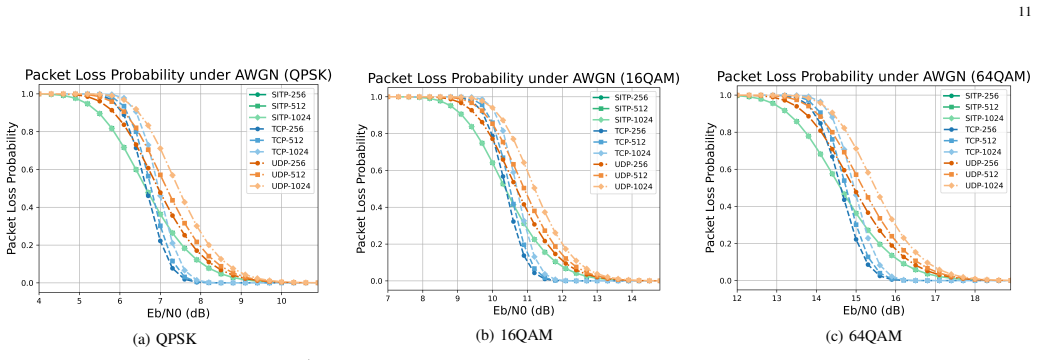
- [§VI-C, Fig. 8, Table IV] The TCP packet-loss comparison is under-specified. The paper does not provide the TCP packet-loss formula or state how the maximum of five retransmissions enters the plotted curves. As written, the statement that 'SITP consistently achieves lower packet loss probabilities than UDP... and outperforms TCP in low-SNR regimes' cannot be verified from the presented equations. Please report the exact TCP model, including the per-attempt packet failure probability and the retransmission policy, so that the comparison is reproducible.
- [§VI-A, §VI-D] The experimental reporting is insufficient for the strength of the claims. No training hyperparameters, dataset split, number of independent runs, or confidence intervals are given for the PSNR/MS-SSIM/LPIPS curves in Figs. 9 and 10. The code is only promised to be released. Without error bars, it is unclear whether the reported margins over UDP are significant. Please provide error bars over multiple random seeds and a complete training protocol.
minor comments (5)
- [§I, paragraph 2] Typo: 'semantic features subfigure are partially corrupted' — 'subfigure' appears to be a stray word.
- [§III-A, Eq. (7)] The notation is inconsistent: Eq. (7) uses h_depkt(·) while the text refers to g_depack(·). Please unify the notation.
- [§IV, Eq. (15)] The subscripts in P_Dalink-suc and P_Dalink-fail are inconsistent (also spelled 'Dalink' vs 'Data-link'). Please standardize.
- [§VI-A] Typo: 'mertics' should be 'metrics'.
- [§II-B] The related-work discussion is thin on the relationship between the proposed header-only checksum and existing partial-checksum or forward-error-correction approaches at the transport layer. A brief comparison would help position the contribution.
Circularity Check
No significant circularity; the analytical model is derived from BER and protocol constants rather than fitted to the claimed outcomes, and self-citations are peripheral.
full rationale
The paper's central derivation chain is self-contained. The cross-layer packet-loss model in Eqs. (11)-(23) is constructed by composing layer-specific failure probabilities: synchronization errors, header corruption, CRC/checksum undetected-error probabilities, and application-header errors. Each quantity is expressed in terms of the bit error rate P_b, protocol-determined header lengths, and standard error-detection parameters; no parameter is fitted to the reconstruction-quality results it is later compared against. The SNR-to-BER mapping in Eqs. (24)-(25) is a standard M-QAM formula, and the packet-loss experiments use the same channel model, which is normal simulation practice rather than a definitional re-use of the claimed conclusion. The end-to-end reconstruction experiments (Figs. 9-10) involve an actual neural codec and are not forced by the analytical model; the decoder's tolerance to corrupted payloads is an empirical property that could fail, but that is a correctness/robustness risk, not circularity. The self-citations (e.g., [9], [14], [15]) are background references for semantic communication concepts and do not carry the load-bearing uniqueness or derivation steps. The interleaving analysis (Eqs. (39)-(41)) is somewhat loose because the formula for average packet loss does not itself include interleaving depth, but the performance gain is demonstrated experimentally rather than derived from the same equation. Overall, no prediction is equivalent by construction to its input, and the central claims retain independent empirical content.
Axiom & Free-Parameter Ledger
free parameters (7)
- t_sync (sync bit-error tolerance threshold) =
3
- N_sync (sync sequence length) =
11 bytes
- Protocol header lengths (N_PH, N_DH, N_NH, N_SITP_HDR, N_AH) =
64, 112, 320, 64, 24 bits
- CRC and checksum lengths (r_d, r_s) =
32, 16 bits
- Burst-fade channel parameters (gamma_good, gamma_bad range, t2-t1) =
15 dB, 7.0-14.8 dB, 528 packets
- Maximum TCP retransmissions =
5
- Interleaving depth (batch size) =
4, 8, 16
axioms (6)
- domain assumption Per-layer packet-loss events are statistically independent
- domain assumption Identical modulation and BER for headers and payload; ideal equalization reduces the channel to AWGN
- domain assumption CRC and checksum undetected-error probability is 2^{-r} under random independent bit errors
- domain assumption Correlation-based synchronization with independent bit errors and threshold t_sync
- domain assumption The learned semantic decoder can reconstruct from arbitrarily corrupted retained payloads
- standard math M-QAM BER formula (24) is valid for the SNR ranges used
invented entities (1)
-
SITP header-only checksum policy
no independent evidence
read the original abstract
With the evolution of 6G networks, modern communication systems are facing unprecedented demands for high reliability and low latency. However, conventional transport protocols are designed for bit-level reliability, failing to meet the semantic robustness requirements. To address this limitation, this paper proposes a novel Semantic Information Transport Protocol (SITP), which achieves TCP-level reliability and UDP level latency by verifying only packet headers while retaining potentially corrupted payloads for semantic decoding. Building upon SITP, a cross-layer analytical model is established to quantify packet-loss probability across the physical, data-link, network, transport, and application layers. The model provides a unified probabilistic formulation linking signal noise rate (SNR) and packet-loss rate, offering theoretical foundation into end-to-end semantic transmission. Furthermore, a cross-image feature interleaving mechanism is developed to mitigate consecutive burst losses by redistributing semantic features across multiple correlated images, thereby enhancing robustness in burst-fade channels. Extensive experiments show that SITP offers lower latency than TCP with comparable reliability at low SNRs, while matching UDP-level latency and delivering superior reconstruction quality. In addition, the proposed cross-image semantic interleaving mechanism further demonstrates its effectiveness in mitigating degradation caused by bursty packet losses.
Figures




Forward citations
Cited by 1 Pith paper
-
SPAT: A Semantic Port-Aware Adaptive-Rate Transmission Protocol for Semantic Communication
SPAT embeds source and destination port data into semantic features, uses differentiated uplink/downlink processing and adaptive channel selection, and shows better reconstruction quality than TCP, UDP, and SITP on AF...
Reference graph
Works this paper leans on
-
[1]
Framework and overall objectives of the future development of imt for 2030 and beyond,
D. N. R. ITU-R, “Framework and overall objectives of the future development of imt for 2030 and beyond,”Int. Telecommu. Union (ITU) Rec. (ITU-R), Nov. 2023. 13
2030
-
[2]
Extended reality (xr) toward building immersive solutions: the key to unlocking industry 4.0,
A. Alhakamy, “Extended reality (xr) toward building immersive solutions: the key to unlocking industry 4.0,”ACM Comput. Surv., vol. 56, no. 9, pp. 1–38, Sept. 2024
2024
-
[3]
Time- sensitive networking (tsn) for industrial automation: Current advances and future directions,
T. Zhang, G. Wang, C. Xue, J. Wang, M. Nixon, and S. Han, “Time- sensitive networking (tsn) for industrial automation: Current advances and future directions,”ACM Comput. Surv., vol. 57, no. 2, pp. 1–38, Feb. 2024
2024
-
[4]
V2x-vitv2: Improved vision transformers for vehicle-to-everything cooperative perception,
R. Xu, C.-J. Chen, Z. Tu, and M.-H. Yang, “V2x-vitv2: Improved vision transformers for vehicle-to-everything cooperative perception,” IEEE Trans. Pattern Anal. Mach. Intell., vol.47, no. 1, pp. 650–662, Jan. 2025
2025
-
[5]
Intelligent wearable photonic sensing system for remote healthcare mon- itoring using stretchable elastomer optical fiber,
B. Zha, Z. Wang, L. Ma, J. Chen, H. Wang, X. Li, S. Kumar, and R. Min, “Intelligent wearable photonic sensing system for remote healthcare mon- itoring using stretchable elastomer optical fiber,”IEEE Internet Things J., vol. 11, no. 10, pp. 17317–17329, May 2024
2024
-
[6]
6g: The intelligent network of everything,
H. Pennanen, T. H ¨anninen, O. Tervo, A. T ¨olli, and M. Latva-Aho, “6g: The intelligent network of everything,”IEEE Access,vol. 11, pp. 1319– 1421, 2025
2025
-
[7]
6g hyper reliable and low-latency communication–requirement analysis and proof of concept,
T. Tao, Y . Wang, D. Li, Y . Wan, P. Baracca, and A. Wang, “6g hyper reliable and low-latency communication–requirement analysis and proof of concept,” inProc. IEEE V eh. Technol. Conf. (VTC-Fall), Dec. 2023, pp. 1–5
2023
-
[8]
Reliability-latency-rate tradeoff in low-latency communications with finite-blocklength coding,
L. Li, W. Chen, P. Popovski, and K. B. Letaief, “Reliability-latency-rate tradeoff in low-latency communications with finite-blocklength coding,” IEEE Trans. Inf. Theory, vol. 71, no. 1, pp. 360-389, Jan. 2025
2025
-
[9]
A new communication paradigm: From bit accuracy to semantic fidelity,
G. Shi, D. Gao, X. Song, J. Chai, M. Yang, X. Xie, L. Li, and X. Li, “A new communication paradigm: From bit accuracy to semantic fidelity,” arXiv preprint arXiv:2101.12649, Jan. 2021
Pith/arXiv arXiv 2021
-
[10]
A mathematical theory of communication,
C. E. Shannon, “A mathematical theory of communication,”The Bell Syst. Tech. J., vol. 27, no. 3, pp. 379–423, Jul. 1948
1948
-
[11]
Recent contributions to the mathematical theory of com- munication,
W. Weaver, “Recent contributions to the mathematical theory of com- munication,”ETC: Rev. Gen. Semantics, vol. 10, no. 4, pp. 261–281, 1953
1953
-
[12]
A gan-based semantic communication for text without csi,
J. Mao, K. Xiong, M. Liu, Z. Qin, W. Chen, P. Fan, and K. B. Letaief, “A gan-based semantic communication for text without csi,”IEEE Trans. Wireless Commun., vol. 23, no. 10, pp. 14498-14514, Oct. 2024
2024
-
[13]
Deep learning enabled semantic communications with speech recognition and synthesis,
Z. Weng, Z. Qin, X. Tao, C. Pan, G. Liu, and G. Y . Li, “Deep learning enabled semantic communications with speech recognition and synthesis,” IEEE Trans. Wireless Commun., vol. 22, no. 9, pp. 6227-6240, Sept. 2023
2023
-
[14]
Swin kansformer-based seman- tic communication systems for wireless image transmission,
Y . Wang, S. Ma, D. Gao, and G. Shi, “Swin kansformer-based seman- tic communication systems for wireless image transmission,” inProc. IEEE/CIC Int. Conf. Commun. China (ICCC Workshops), Oct. 2024, pp. 265–270
2024
-
[15]
Semantic feature division multiple access for digital semantic multiple access channels,
B. Shen, S. Ma, R. Chen, Y . Wu, H. Li, G. Shi, S. Li, and N. Al-Dhahir, “Semantic feature division multiple access for digital semantic multiple access channels,”IEEE Trans. Cognit. Commun. Networking, June, 2025
2025
-
[16]
Conquering high packet-loss erasure: Moe swin transformer- based video semantic communication,
L. Teng, S. Fan, C. Dong, H. Liang, Z. Bao, X. Xu, R. Meng, and P. Zhang, “Conquering high packet-loss erasure: Moe swin transformer- based video semantic communication,”arXiv preprint arXiv:2508.01205, Aug. 2025
Pith/arXiv arXiv 2025
-
[17]
Cross-modal graph semantic communication assisted by generative ai in the metaverse for 6g,
M. Chen, M. Liu, C. Wang, X. Song, Z. Zhang, Y . Xie, and L. Wang, “Cross-modal graph semantic communication assisted by generative ai in the metaverse for 6g,”Res., vol. 7, pp. 0342, Apr. 2024
2024
-
[18]
Synchronous multi-modal semantic communication system with packet-level coding,
Y . Tian, J. Ying, Z. Qin, Y . Jin, and X. Tao, “Synchronous multi-modal semantic communication system with packet-level coding,”IEEE Trans. Wireless Commun., vol. 24, no. 5, pp. 3684-3697, May 2025
2025
-
[19]
Exploiting cross-layer vulnerabilities: Off-path attacks on the tcp/ip protocol suite,
X. Feng, Q. Li, K. Sun, K. Xu, and J. Wu, “Exploiting cross-layer vulnerabilities: Off-path attacks on the tcp/ip protocol suite,”Commun. ACM, vol. 68, no. 3, pp. 48–59, Mar. 2025
2025
-
[20]
Position-aided semantic communication for efficient image transmission: Design, implementation, and experimental results,
P. Jiang, C.-K. Wen, S. Jin, and J. Zhang, “Position-aided semantic communication for efficient image transmission: Design, implementation, and experimental results,”IEEE Trans. Wireless Commun., 2025
2025
-
[21]
Comparative analysis of tcp and udp protocol performance in sending text messages using chatting applications,
W. Haryono, “Comparative analysis of tcp and udp protocol performance in sending text messages using chatting applications,”J. Inotera, vol. 10, no. 1, pp. 41-48, Jan. 2025
2025
-
[22]
A taxonomy and survey of sctp research,
L. Budzisz, J. Garcia, A. Brunstrom, and R. Ferr ´us, “A taxonomy and survey of sctp research,”ACM Comput. Surv., vol. 44, no. 4, pp. 1-36, Aug. 2012
2012
-
[23]
A framework for multiaccess support for unreliable internet traffic using multipath dccp,
M. Amend, E. Bogenfeld, M. Cvjetkovic, V . Rakocevic, M. Pieska, A. Kassler, and A. Brunstrom, “A framework for multiaccess support for unreliable internet traffic using multipath dccp,” inProc. IEEE Conf. Local Comput. Netw. (LCN), Feb. 2019, pp. 316–323
2019
-
[24]
Flec: Enhancing quic with application-tailored relia- bility mechanisms,
F. Michel, A. Cohen, D. Malak, Q. De Coninck, M. M ´edard, and O. Bonaventure, “Flec: Enhancing quic with application-tailored relia- bility mechanisms,”IEEE/ACM Trans. Netw., vol. 31, no. 2, pp. 606-619, Apr. 2023
2023
-
[25]
Kutsevol, O
P. Kutsevol, O. Ayan and W. Kellerer, ”Towards Semantic-Aware Trans- port Layer Protocols: A Control Performance Perspective,” inProc. IEEE Int. Conf. Commun. (ICC), 2023, pp. 997-1002
2023
-
[26]
Low-loss tcp/ip header compression for wireless networks,
M. Degermark, M. Engan, B. Nordgren, and S. Pink, “Low-loss tcp/ip header compression for wireless networks,” inProc. ACM Int. Conf. Mobile Comput. Netw. (MobiCom), Nov. 1996, pp. 1–14
1996
-
[27]
Computing the internet checksum,
R. Braden, D. Borman, and C. Partridge, “Computing the internet checksum,”ACM SIGCOMM Comput. Commun. Rev., vol. 19, no. 2, pp. 86–94, Sept. 1988
1988
-
[28]
Fast calculation algorithm of the undetected errors probability of crc codes,
R.-D. Lin and W.-S. Chen, “Fast calculation algorithm of the undetected errors probability of crc codes,” inProc. Int. Conf. Adv. Inf. Netw. Appl. (AINA), Apr. 2005, pp. 480–483
2005
-
[29]
Performance of checksums and crcs over real data,
C. Partridge, J. Hughes, and J. Stone, “Performance of checksums and crcs over real data,”ACM SIGCOMM Comput. Commun. Rev., vol. 25, no. 4, pp. 68–76, Oct. 1995
1995
-
[30]
Evaluation of ber for awgn, rayleigh fading channels under m-qam modulation scheme,
M. Raju and K. A. Reddy, “Evaluation of ber for awgn, rayleigh fading channels under m-qam modulation scheme,” inProc. Int. Conf. Electr ., Electron., Optim. Tech. (ICEEOT), Nov. 2016, pp. 3081–3086
2016
-
[31]
Swinjscc: Taming swin transformer for deep joint source-channel coding,
K. Yang, S. Wang, J. Dai, X. Qin, K. Niu, and P. Zhang, “Swinjscc: Taming swin transformer for deep joint source-channel coding,”IEEE Trans. Cogn. Commun. Netw., vol. 11, no. 1, pp. 90-104, Feb. 2025
2025
-
[32]
Digital semantic communications: An alternating multi-phase training strategy with mask attack,
M. Gong, S. Wang, S. Bi, Y . Wu, and L. Qian, “Digital semantic communications: An alternating multi-phase training strategy with mask attack,”IEEE Trans. Wireless Commun., 2025
2025
-
[33]
Learning multiple layers of features from tiny images,
A. Krizhevsky, G. Hintonet al., “Learning multiple layers of features from tiny images,”Master’s thesis, Univ. Toronto, 2009
2009
-
[34]
Stargan v2: Diverse image synthesis for multiple domains,
Y . Choi, Y . Uh, J. Yoo, and J.-W. Ha, “Stargan v2: Diverse image synthesis for multiple domains,” inProc. IEEE/CVF Conf. Comput. Vis. Pattern Recognit. (CVPR), 2020, pp. 8188–8197
2020
-
[35]
The unreasonable effectiveness of deep features as a perceptual metric,
R. Zhang, P. Isola, A. A. Efros, E. Shechtman, and O. Wang, “The unreasonable effectiveness of deep features as a perceptual metric,” in Proc. IEEE/CVF Conf. Comput. Vis. Pattern Recognit. (CVPR), 2018, pp. 586–595
2018
discussion (0)
Sign in with ORCID, Apple, or X to comment. Anyone can read and Pith papers without signing in.