Quantum nonlocal correlations of anomalous weak values
Pith reviewed 2026-07-03 19:53 UTC · model grok-4.3
The pith
Post-selection enhances nonlocal correlations via anomalous weak values of the CHSH operator, but entanglement is required to exceed the bounds achievable with separable boundary states.
A machine-rendered reading of the paper's core claim, the machinery that carries it, and where it could break.
Core claim
Fixing the overlap between pre- and post-selected states, the maximal weak value of any CHSH operator is largest when boundary states may be entangled, smaller when one boundary state is forced separable, and smallest when both are forced separable. The gap between the unrestricted maximum and the separable PPS bound grows with the concurrence of the states that achieve the bound. Nonlocal weak values of the CHSH operator therefore serve as post-selected entanglement witnesses, and a state-adapted choice of post-selection and CHSH measurement detects every pure two-qubit state with nonzero concurrence, including cases where the ordinary CHSH test is inconclusive.
What carries the argument
maximal anomalous weak value of the CHSH operator, compared across three boundary-state separability scenarios with fixed pre-post overlap
If this is right
- Post-selection alone can enhance correlations beyond standard Bell limits.
- Entanglement is necessary to exceed the corresponding separable PPS bounds.
- The combination of post-selection and entanglement produces the strongest attainable correlations.
- Nonlocal weak values act as post-selected entanglement witnesses.
- A constructive, state-adapted protocol detects every pure two-qubit source state with nonzero concurrence.
Where Pith is reading between the lines
- The separation of post-selection and entanglement effects could support hybrid protocols that use post-selection for amplification while reserving entanglement for the strongest nonlocality.
- The witness construction may extend usefully to noisy or lossy channels where standard Bell tests become inconclusive.
- Applications to quantum sensing and weak-value amplification could benefit from treating the two resources as independently tunable.
Load-bearing premise
The overlap between pre- and post-selected states can be fixed independently of the separability of the boundary states.
What would settle it
An experimental measurement, in a post-selected ensemble with verified separable boundary states and fixed pre-post overlap, of a CHSH weak value larger than the paper's derived separable PPS bound would falsify the claim that entanglement is necessary to exceed that bound.
Figures


read the original abstract
Violations of Bell inequalities are a hallmark of entanglement, with only entangled states capable of exceeding classical bounds in standard Bell tests. Here we analyze anomalous weak values of the CHSH operator in pre- and post-selected (PPS) quantum ensembles, treating them as generalized bounds on Bell-type nonlocal correlations in the presence of post-selection. Fixing the overlap between the pre- and post-selected states, we compare three scenarios: unrestricted boundary states, one separable boundary state, and both boundary states separable. For each case, we derive both the maximal weak value for a fixed Bell operator and the maximal bound obtained by further optimizing over all CHSH operators. Our results show that post-selection and entanglement are distinct operational resources: post-selection alone can enhance correlations, but entanglement is necessary to exceed the corresponding separable PPS bounds, and their combination yields the strongest attainable correlations. We further show that the enhancement beyond the separable bound closely tracks the concurrence of the states that optimize the bounds, identifying entanglement as the source of the additional correlation strength. Finally, we show that nonlocal weak values provide post-selected entanglement witnesses, and we give a constructive protocol that detects every pure two-qubit source state with nonzero concurrence in the ideal state-adapted setting, even in regimes where the corresponding standard CHSH entanglement test is inconclusive. In this state-adapted setting, we explicitly construct the post-selection and CHSH measurements that achieve the largest possible separation from the separable PPS bound. More broadly, our results motivate hybrid protocols that combine post-selection and entanglement, with possible applications to improved quantum sensing, weak-value amplification, and quantum information processing.
Editorial analysis
A structured set of objections, weighed in public.
Referee Report
Summary. The paper claims that, with the overlap between pre- and post-selected states held fixed, anomalous weak values of the CHSH operator yield distinct bounds on nonlocal correlations in three scenarios (unrestricted boundary states, one separable boundary state, both separable). Post-selection alone enhances correlations above the standard Bell bound, but entanglement is required to exceed the separable PPS bounds; the enhancement tracks concurrence, and nonlocal weak values furnish post-selected entanglement witnesses. A constructive protocol is given that detects every pure two-qubit state with nonzero concurrence in the state-adapted setting.
Significance. If the derivations hold, the work cleanly separates post-selection and entanglement as operational resources for nonlocal correlations and supplies a new class of entanglement witnesses that remain informative even when standard CHSH tests are inconclusive. The explicit construction of optimal post-selection and CHSH measurements for the state-adapted case is a concrete strength that could support hybrid sensing or amplification protocols.
major comments (1)
- [comparison of the three scenarios (abstract and main derivation)] The central claim that entanglement is necessary to exceed the separable PPS bounds rests on the ability to fix the pre-post overlap independently of the separability constraints on the boundary states. The manuscript does not supply an explicit argument or construction showing that the allowable joint states (or the effective post-selection operator) remain unrestricted by the separability requirement when the overlap is held constant; without this, the reported separation between the three bounds may not isolate entanglement as the sole additional resource.
minor comments (1)
- [introduction / results section] The abstract refers to 'maximal weak value for a fixed Bell operator' and 'maximal bound obtained by further optimizing over all CHSH operators'; the distinction between these two quantities should be stated with explicit notation at the first appearance in the main text.
Simulated Author's Rebuttal
We thank the referee for the careful reading and for identifying a point that merits explicit clarification. We address the major comment below and will revise the manuscript to incorporate the requested argument.
read point-by-point responses
-
Referee: [comparison of the three scenarios (abstract and main derivation)] The central claim that entanglement is necessary to exceed the separable PPS bounds rests on the ability to fix the pre-post overlap independently of the separability constraints on the boundary states. The manuscript does not supply an explicit argument or construction showing that the allowable joint states (or the effective post-selection operator) remain unrestricted by the separability requirement when the overlap is held constant; without this, the reported separation between the three bounds may not isolate entanglement as the sole additional resource.
Authors: We agree that an explicit statement would strengthen the presentation. In the derivation the overlap α = |⟨ϕ|ψ⟩| is held fixed while the three scenarios are distinguished solely by whether the boundary states |ψ⟩ and |φ⟩ are required to be separable. For any α ∈ [0,1] one can always choose product states realizing that overlap (e.g., |ψ⟩ = |0 angle|0 angle and |φ⟩ = |0 angle|0 angle for α=1; |φ⟩ = |0 angle|1 angle for α=0; or |φ⟩ = (|0 angle+|1 angle)/√2 ⊗ |0 angle for α=1/√2). Entangled boundary states can equally attain the same α. Consequently the separability constraint does not restrict the admissible overlaps, and the comparison isolates the effect of entanglement. We will insert a short paragraph (with the above construction) immediately after the definition of the three scenarios in Section II. revision: yes
Circularity Check
No significant circularity; derivations self-contained in standard QM
full rationale
The paper compares maximal weak values of the CHSH operator across three boundary-state scenarios (unrestricted, one separable, both separable) at fixed pre-post overlap, deriving bounds by direct optimization over quantum states and operators. No quoted equations reduce a claimed prediction or bound to a fitted parameter, self-citation chain, or definitional renaming. The overlap-fixing step is an explicit modeling choice enabling the comparison rather than a result derived from the paper's own outputs. All steps remain grounded in standard quantum mechanics without load-bearing self-citations or ansatzes smuggled from prior author work.
Axiom & Free-Parameter Ledger
Reference graph
Works this paper leans on
-
[1]
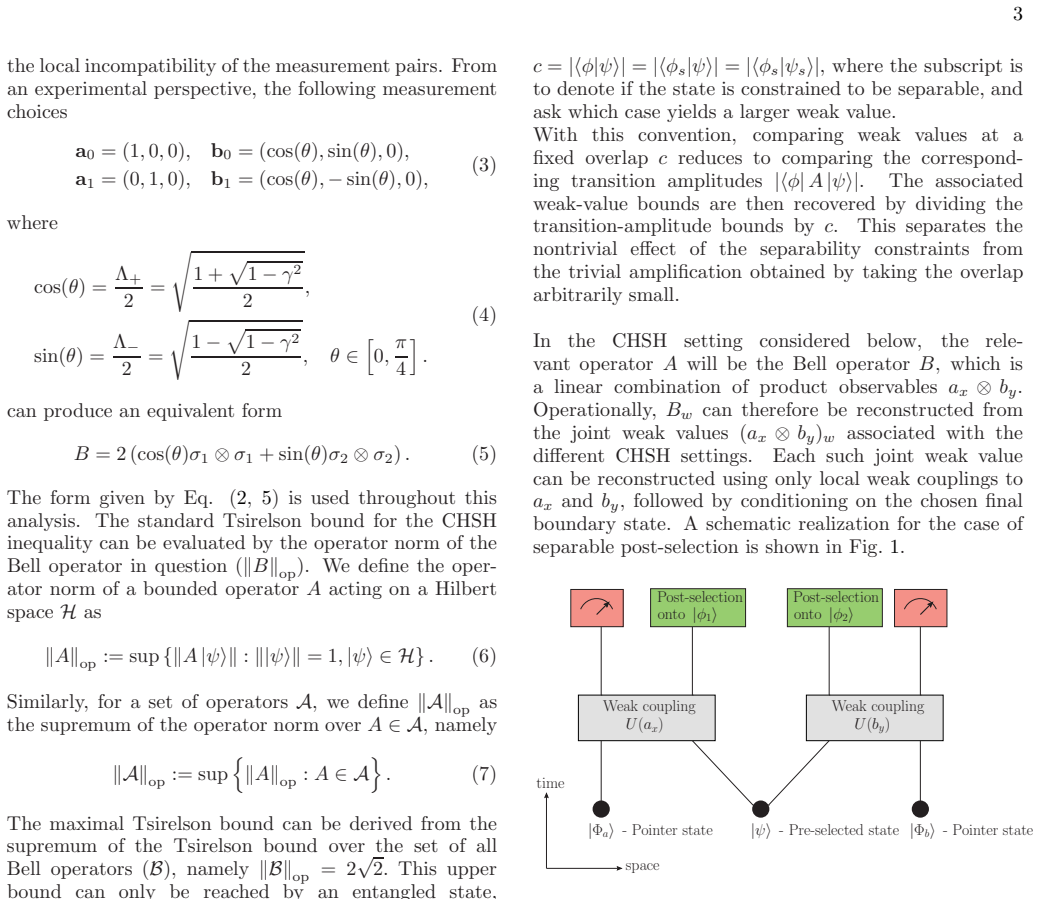
This upper bound can only be reached by an entangled state, where if we were to restrict the supremum to be done strictly on separable states we would have found the classical bound of 2. Similarly, by post-selecting the fi- nal state, weak values of a Bell operator can be measured. The weak value of an operator A with respect to pre-selected state |ψ ⟩ an...
-
[2]
and an arbitrary value of γ. In addition, we consider the entangled states which set these bounds and show a cor- respondence between their entanglement measure (con- currence) and their difference with respect to the separa- ble bound ∥B∥TS, c,s . This correspondence highlights the role of entanglement in the enhancement of post-selected correlations
-
[3]
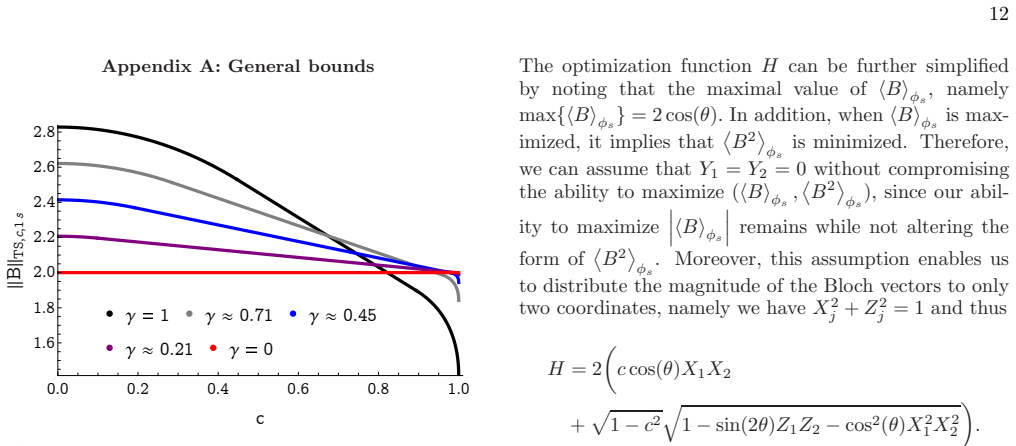
Tsirelson bound Here we derive the two-states Tsirelson bound ∥B∥TS, c for an arbitrary Bell operator. We start by rewriting the Bell operator in the following way B = (Λ + + Λ − )σ1 ⊗ σ1 +σ2 ⊗ σ2 2 + (Λ + − Λ − )σ1 ⊗ σ1 − σ2 ⊗ σ2 2 . (13) We can identify the following σ1 ⊗ σ1 +σ2 ⊗ σ2 2 = |Φ 1+⟩ ⟨Φ 1+| − |Φ 1− ⟩ ⟨Φ 1− |, σ1 ⊗ σ1 − σ2 ⊗ σ2 2 = |Φ 2+⟩ ⟨Φ 2...
-
[4]
Half-separable case Here we derive the two-state operator norm ∥B∥TS, c, 1s with the constraint that one of the states is separable. We assume that the post-selected state |φs⟩ = |φ 1⟩ ⊗ |φ 2⟩ is a product state, i.e. can be obtained via a local projective measurement of each particle. We begin by constructing the pre-selected state as |ψ ⟩ =c |φs⟩ + √ 1 ...
-
[5]
Separable case Here we derive the two-state operator norm ∥B∥TS, c,s with the constraint that both pre- and post-selected states are separable, namely |φ⟩ = |φ 1⟩ ⊗ |φ 2⟩, |ψ ⟩ = |ψ 1⟩ ⊗ |ψ 2⟩. (30) The overlap between the states is given by c = |⟨φ|ψ ⟩|= |⟨φ 1|ψ 1⟩ ⟨φ 2|ψ 2⟩|=r1r2, (31) where we denote |⟨φj|ψj⟩|=rj and demand that r1r2 = c. To proceed, w...
-
[6]
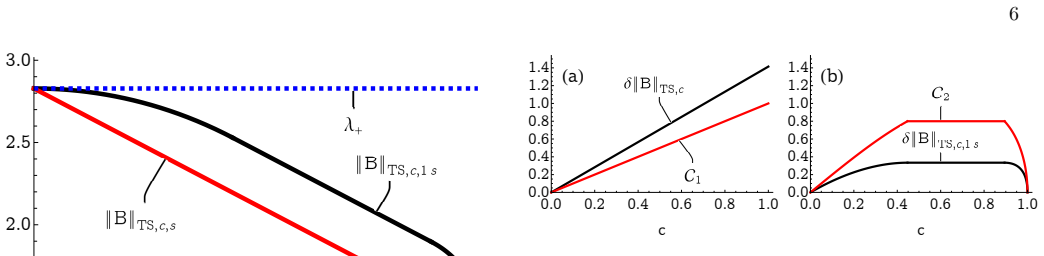
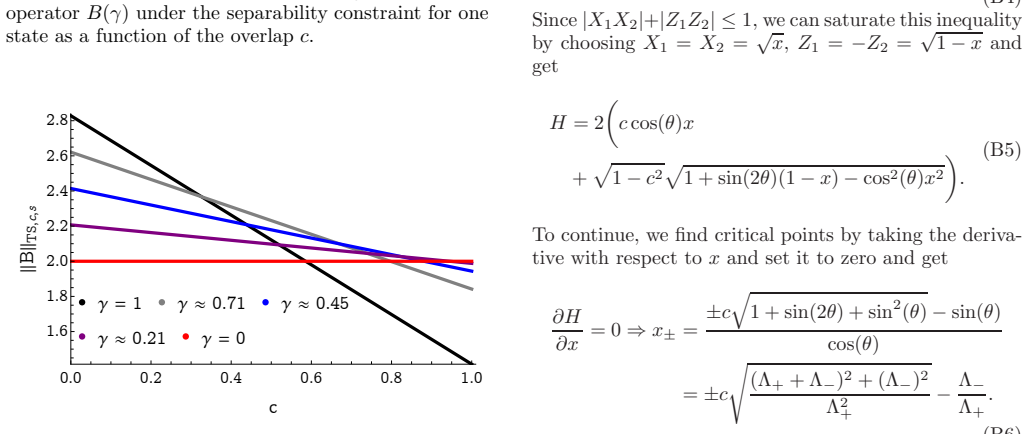
and get ⟨φ|B |ψ ⟩ = 2 [cos(θ)X1X2 + sin(θ)Y1Y2], (32) where Xj = ⟨φj|X |ψj⟩, Y j = ⟨φj|Y |ψj⟩, Z j = ⟨φj|Z |ψj⟩. (33) Following an optimization procedure (see Appendix C), we obtain the separable bound ∥B∥TS, c,s = 2 [cos(θ) + sin(θ)(1 − c)] =λ + − Λ −c. (34) The two-state norm ∥B∥TS, c,s under the constraint of separability is linearly decreasing from λ ...
-
[7]
Summary We compare the three cases for a representative Bell operator with γ = 1 in Fig. 2. We see a clear hierar- chy between the three cases. When there is no entan- glement (red curve), the correlation strength increases linearly as the overlap decreases, illustrating a trade-off between correlation strength and the probability to post- select. On the o...
-
[8]
Tsirelson bound To find the maximal two-state Tsirelson bound, we re- call that ∥B∥TS, c =λ + = 2√ 1 +γ = ∥B∥op, this means that we can pick γ = 1 and get ∥B∥TS, c = ∥B∥op = 2 √
-
[9]
( 29) and optimize over all possible Bell operators, which is equivalent to optimizing over θ
Half-separable case To derive ∥B∥TS, c, 1s we use our result from Eq. ( 29) and optimize over all possible Bell operators, which is equivalent to optimizing over θ. The general solution contains three branches, and so we need to optimize over all of them. For this purpose, we need to investigate the behavior of each branch with respect to the bound- aries...
-
[10]
Separable case To derive ∥B∥TS, c,s we use our result from Eq. ( 34) and optimize over all possible Bell operators, which is equivalent to optimize over θ. For this purpose, we set u = cos(θ) and find solution for ∂∥B∥TS, c,s ∂u = 0, ⇒ u = 1√ 1 + (1 − c)2. (42) Plugging back the solution we find ∥B∥TS, c,s = 2 √ 1 + (1 − c)2. (43) The two-state maximal boun...
-
[11]
simply by having a sufficiently small overlap. Here entanglement detection is enabled by ex- ceeding the post-selected separable bound —the maximal weak value attainable when both boundary states are separable. 8 We now make this intuition precise. Fix a Bell op- erator B and an overlap c = |⟨φ|ψ ⟩| between pre- and post-selected states. From Sec. II we kno...
-
[12]
If one boundary state is known to be separable, then a violation of Eq
can be made state-specific when one of the boundary states is independently characterized. If one boundary state is known to be separable, then a violation of Eq. (
-
[13]
Conversely, if one boundary state is known to be entangled, Eq
certifies that the other boundary state is entangled. Conversely, if one boundary state is known to be entangled, Eq. (
-
[14]
In that case one should compare the observed weak value with the half-separable threshold
alone does not identify whether the other boundary state is entangled as well. In that case one should compare the observed weak value with the half-separable threshold. Since ∥B∥TS, c, 1s is the maximal transition amplitude attainable when one boundary state is separable and the other is unrestricted, any weak value satisfying |Bw|> ∥B∥TS, c, 1s c (48) r...
-
[15]
This condition is more demanding than Eq
certifies that the pre-selected state is entangled as well. This condition is more demanding than Eq. ( 47), since ∥B∥TS, c,s ≤ ∥ B∥TS, c, 1s, but it certifies the stronger statement that one entangled boundary state is not sufficient to explain the observed weak value. In an experimental implementation, the witness can be used either in a targeted or in an a...
-
[16]
certifies entanglement of the post- selected boundary state. More generally, if the known pre-selected state is entangled, then certifying entangle- ment of the post-selected state requires comparison with the half-separable threshold in Eq. ( 48). Constructive γ = 1 witness for pure states Having established the general witness criteria, we now show that ...
-
[17]
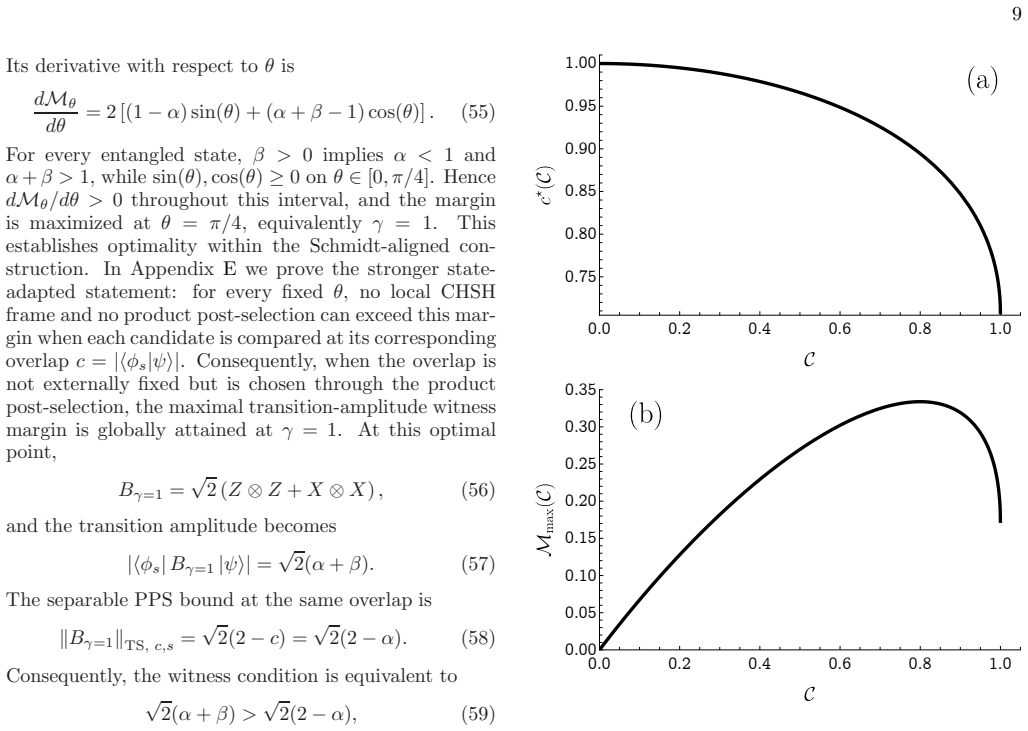
The corresponding maximal state-adapted transition-amplitude margin can be written as Mmax(C) = √ 2 2 √ 1 + √ 1 − C 2 2 + √ 1 − √ 1 − C 2 2 − 2 . (63) Fig. 5 displays both the optimal working overlap and this maximal margin as design parameters for the state- adapted witness. 0.0 0.2 0.4 0.6 0.8 1.0 0.75 0.80 0.85 0.90 0.95 1.00 0.0 0.2 0.4 0.6 0....
-
[18]
(b) Corresponding maximal transition-amplitude witness margin Mmax(C). The margin is strictly positive for every C > 0, showing that every pure entangled two-qubit source state is detectable in principle. The maximal margin occurs at C = 4/ 5, with Mmax = √ 2( √ 5 − 2). Adaptive implementation The preceding construction also suggests how the gen- eral mar...
-
[19]
reduces to M(Bγ =1,φ s) = c|Bw| − √ 2(2 − c). (65) Here the choice of B means the choice of local CHSH measurement directions, or equivalently the local CHSH frame; this is independent of the choice of the product final boundary state |φs⟩ = |φA⟩ ⊗ |φB⟩. We denote by σn := n ·σ the Pauli observable along the Bloch-sphere direction n. For γ = 1, a local CHS...
-
[20]
This distinction is illustrated in Fig
im- plies that |ψ ⟩ is entangled; nevertheless, only a subset of these states achieves such a violation for the fixed settings. This distinction is illustrated in Fig. 6 for γ = 1, where we plot the standard CHSH values S1(c) and S2(c) associated with the Tsirelson-saturating fam- ily and the half-separable–saturating family, respectively (see Appendix D)....
-
[21]
The dashed orange line is the standard separable limit for this fixed operator, βsep = Λ + = √
-
[22]
The solid purple curve shows S1(c) (see Eq. (D2)), obtained from either of the Tsirelson-saturating boundary states (18), and the solid black curve shows S2(c) (see Eq. (D11)) for a representative entangled state that saturates the half-separable bound. The highlighted markers indicate the corresponding detection thresholds for a standard CHSH test: S1 al...
-
[23]
Tsirelson To investigate standard entanglement detection with respect to the states used for the two-state Tsirelson bound, we may use either of the states given by Eq. ( 18) and get S1 := |⟨ψ |B |ψ ⟩|= |⟨φ|B |φ⟩|= 2c (cos(θ) + sin(θ)), (D2) which is a linear function with respect to the overlap. Above a threshold value of c those states are detectable in...
-
[24]
(D5) The orthogonal state is given by ⏐ ⏐ ⏐φ (B) s, ⊥ ⟩ = B − ⟨B⟩φ s ∆ (B)φ s |φs⟩
Half-separable To investigate standard entanglement detection with respect to a representative |ψ ⟩ — the entangled state that optimizes the half-separable bound ∥B∥TS, c, 1s, we recall that |ψ ⟩ =c |φs⟩ + √ 1 − c2 ⏐ ⏐ ⏐φ (B) s, ⊥ ⟩ . (D5) The orthogonal state is given by ⏐ ⏐ ⏐φ (B) s, ⊥ ⟩ = B − ⟨B⟩φ s ∆ (B)φ s |φs⟩. (D6) 14 Therefore, we get ⟨ψ |B |ψ ⟩ =...
-
[25]
J. S. Bell, On the einstein podolsky rosen paradox, Physics Physique Fizika 1, 195 (1964)
work page 1964
-
[26]
N. Brunner, D. Cavalcanti, S. Pironio, V. Scarani, and S. Wehner, Bell nonlocality, Rev. Mod. Phys. 86, 419 (2014)
work page 2014
-
[27]
R. F. Werner, Quantum states with einstein-podolsky- rosen correlations admitting a hidden-variable model, Phys. Rev. A 40, 4277 (1989)
work page 1989
-
[28]
R. Horodecki, P. Horodecki, and M. Horodecki, Violating bell inequality by mixed spin-1/2 states: necessary and sufficient condition, Physics Letters A 200, 340 (1995)
work page 1995
-
[29]
B. S. Cirel’son, Quantum generalizations of bell’s in- equality, Letters in Mathematical Physics 4, 93 (1980)
work page 1980
-
[30]
S. Popescu and D. Rohrlich, Quantum nonlocality as an axiom, Foundations of Physics 24, 379 (1994)
work page 1994
-
[31]
B. Hensen, H. Bernien, A. E. Dr´ eau, A. Reiserer, N. Kalb, M. S. Blok, J. Ruitenberg, R. F. L. Vermeulen, R. N. Schouten, C. Abell´ an, W. Amaya, V. Pruneri, M. W. Mitchell, M. Markham, D. J. Twitchen, D. Elkouss, S. Wehner, T. H. Taminiau, and R. Hanson, Loophole- free bell inequality violation using electron spins sepa- rated by 1.3 kilometres, Nature ...
work page 2015
-
[32]
M. Giustina, M. A. M. Versteegh, S. Wengerowsky, J. Handsteiner, A. Hochrainer, K. Phelan, F. Steinlech- ner, J. Kofler, J.-A. Larsson, C. Abell´ an, W. Amaya, V. Pruneri, M. W. Mitchell, J. Beyer, T. Gerrits, A. E. Lita, L. K. Shalm, S. W. Nam, T. Scheidl, R. Ursin, B. Wittmann, and A. Zeilinger, Significant- loophole-free test of bell’s theorem with entan...
work page 2015
-
[33]
L. K. Shalm, E. Meyer-Scott, B. G. Christensen, P. Bier- horst, M. A. Wayne, M. J. Stevens, T. Gerrits, S. Glancy, D. R. Hamel, M. S. Allman, K. J. Coakley, S. D. Dyer, C. Hodge, A. E. Lita, V. B. Verma, C. Lam- brocco, E. Tortorici, A. L. Migdall, Y. Zhang, D. R. Kumor, W. H. Farr, F. Marsili, M. D. Shaw, J. A. Stern, C. Abell´ an, W. Amaya, V. Pruneri, ...
work page 2015
-
[34]
M. Navascu´ es, S. Pironio, and A. Ac ´ ın, Bounding the set of quantum correlations, Phys. Rev. Lett. 98, 010401 (2007)
work page 2007
-
[35]
M. Navascu´ es, S. Pironio, and A. Ac ´ ın, A con- vergent hierarchy of semidefinite programs char- acterizing the set of quantum correlations, New Journal of Physics 10, 073013 (2008)
work page 2008
- [36]
-
[37]
D. Mayers and A. Yao, Self testing quantum apparatus, Quantum Information and Computation 4, 273 (2004)
work page 2004
-
[38]
S. Pironio, A. Ac ´ ın, S. Massar, A. B. de la Giroday, D. N. Matsukevich, P. Maunz, S. Olmschenk, D. Hayes, L. Luo, T. A. Manning, and C. Monroe, Random numbers certi- fied by bell’s theorem, Nature 464, 1021 (2010)
work page 2010
-
[39]
A. Ac ´ ın, N. Brunner, N. Gisin, S. Massar, S. Piro- nio, and V. Scarani, Device-independent security of quantum cryptography against collective attacks, Phys. Rev. Lett. 98, 230501 (2007)
work page 2007
-
[40]
K. Wharton and H. Price, Bell inequality violations without entanglement? it’s just postselection, (2025), arXiv:2508.13431 [quant-ph]
-
[41]
K. Wang, Z. Hou, K. Qian, L. Chen, M. Krenn, M. Aspelmeyer, A. Zeilinger, S. Zhu, and X.-S. Ma, Violation of bell inequality with unentan- gled photons, Science Advances 11, eadr1794 (2025) , https://www.science.org/doi/pdf/10.1126/sciadv.adr1794. 17
-
[42]
Y. Aharonov and L. Vaidman, The two-state vector formalism: An updated review, in Time in Quantum Mechanics , edited by J. Muga, R. S. Mayato, and ´I. Egusquiza (Springer Berlin Heidelberg, Berlin, Heidelberg, 2008) pp. 399–447
work page 2008
-
[43]
J. Dressel, M. Malik, F. M. Miatto, A. N. Jor- dan, and R. W. Boyd, Colloquium: Understand- ing quantum weak values: Basics and applications, Rev. Mod. Phys. 86, 307 (2014)
work page 2014
-
[44]
Weak Values and Quantum Nonlocality
Y. Aharonov and E. Cohen, Weak values and quantum nonlocality (2015), arXiv:1504.03797 [quant-ph]
work page internal anchor Pith review Pith/arXiv arXiv 2015
-
[45]
Y. Aharonov, E. Cohen, and J. Tollaksen, Completely top–down hierarchical structure in quantum mechanics, Proceedings of the National Academy of Sciences 115, 11730 (2018) , https://www.pnas.org/doi/pdf/10.1073/pnas.1807554115
-
[46]
Vaidman, Instantaneous measurement of nonlocal variables, Phys
L. Vaidman, Instantaneous measurement of nonlocal variables, Phys. Rev. Lett. 90, 010402 (2003)
work page 2003
-
[47]
K. J. Resch and A. M. Steinberg, Extracting joint weak values with local, single-particle measurements, Phys. Rev. Lett. 92, 130402 (2004)
work page 2004
-
[48]
J. S. Lundeen and A. M. Steinberg, Experimental joint weak measurement on a photon pair as a probe of hardy’s paradox, Phys. Rev. Lett. 102, 020404 (2009)
work page 2009
-
[49]
O. Calder´ on-Losada, T. T. Moctezuma Quistian, H. Cruz-Ramirez, S. Murgueitio Ramirez, A. B. U’Ren, A. Botero, and A. Valencia, A weak values ap- proach for testing simultaneous einstein–podolsky–rosen elements of reality for non-commuting observables, Communications Physics 3, 117 (2020)
work page 2020
-
[50]
S. Pang, J. Dressel, and T. A. Brun, Entanglement-assisted weak value amplification, Phys. Rev. Lett. 113, 030401 (2014)
work page 2014
-
[51]
M. F. Pusey, Anomalous weak values are proofs of con- textuality, Phys. Rev. Lett. 113, 200401 (2014)
work page 2014
-
[52]
A. Chefles and S. M. Barnett, Diagonalisation of the bell- chsh operator, Physics Letters A 232, 4 (1997)
work page 1997
-
[53]
Y. Aharonov and L. Vaidman, Properties of a quantum system during the time interval between two measure- ments, Phys. Rev. A 41, 11 (1990)
work page 1990
-
[54]
M. S. Leifer, Uncertainty from the aharonov–vaidman identity, Quantum Studies: Mathematics and Foundations 10, 373 (2023)
work page 2023
discussion (0)
Sign in with ORCID, Apple, or X to comment. Anyone can read and Pith papers without signing in.