Notes on Wasserstein distance and wormholes
Pith reviewed 2026-06-28 16:45 UTC · model grok-4.3
The pith
The Boltzmann-Wasserstein distance between two quantum theories reduces to a squared horizon-area difference for small entropy shifts and equals a thermal two-point function when Hamiltonians differ by an operator V.
A machine-rendered reading of the paper's core claim, the machinery that carries it, and where it could break.
Core claim
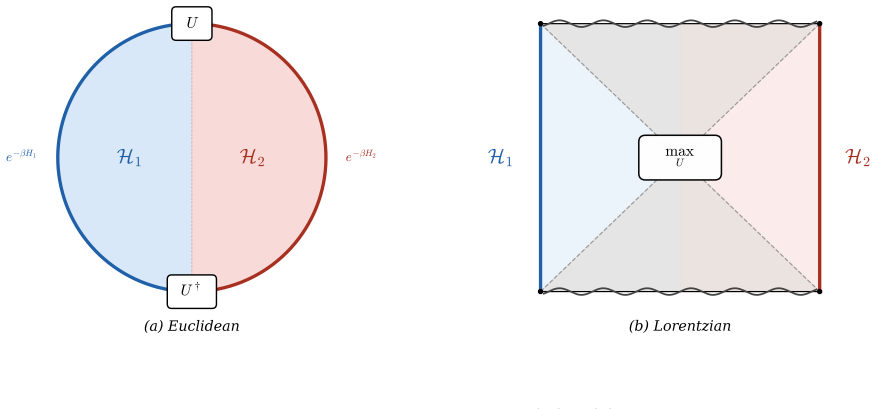
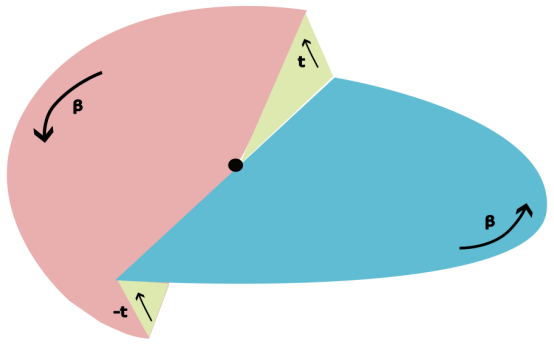
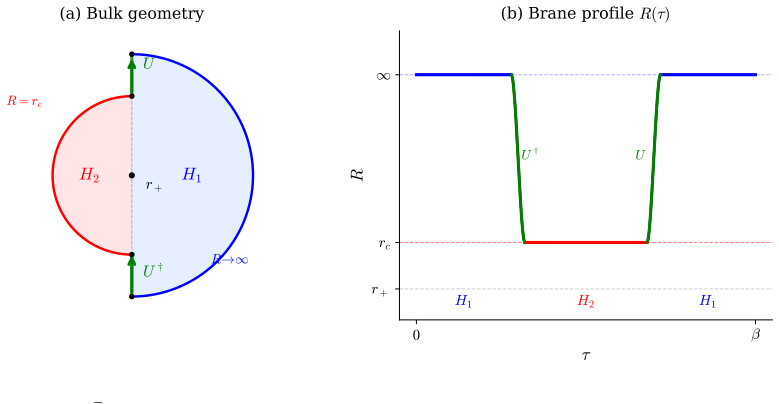
The paper establishes that the dominant wormhole is the one realizing the comonotone partition function C_max, which pairs energy eigenstates by rank order, and that this quantity is exactly reproduced by a classical Schwinger-Keldysh saddle consisting of two Euclidean caps sharing a horizon joined by Lorentzian segments that adiabatically connect the two theories. The on-shell action of this saddle matches both the saddle conditions and the value of C_max, while a purely Euclidean interpolation is exponentially suppressed. The saddle captures only the rearrangement of the spectrum; perturbative expansions in the difference operator V additionally retain the variance of its matrix elements.
What carries the argument
The comonotone partition function C_max, which pairs states by rank in the energy basis and is realized as the dominant wormhole in the doubled Hilbert space.
If this is right
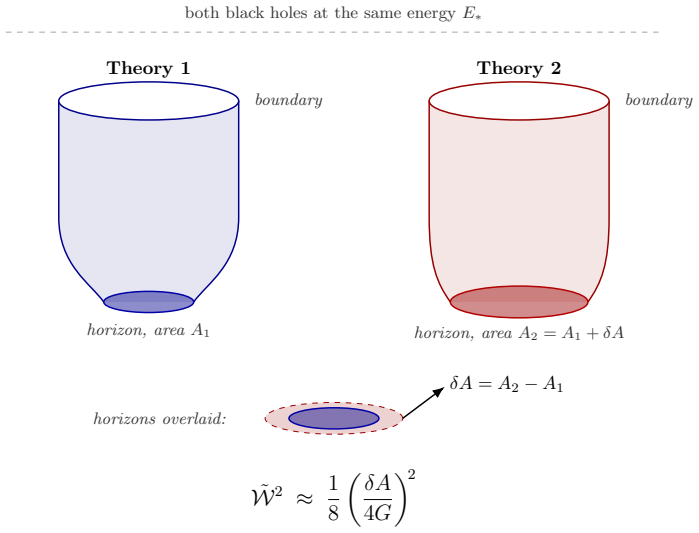
- For semiclassical theories differing by a small entropy shift the normalized BW distance squared approximates (delta A / 4G)^2 / 8 with areas evaluated at equal energy.
- When Hamiltonians differ by an operator V the BW distance equals the long-time average of the real-time thermal two-point function of V.
- If the thermal one-point function of V vanishes, a four-point function representation appears at the next order in the expansion.
- The gravity saddle computes only the spectral rearrangement while perturbative representations retain the variance of the matrix elements of V.
Where Pith is reading between the lines
- The construction supplies a geometric diagnostic for how close two gravitational theories are when their spectra are only mildly rearranged.
- The same wormhole saddle may be used to compare theories whose spectra are known only approximately, such as those obtained from T bar T deformations.
- Because the Lorentzian segments are required for the leading contribution, any purely Euclidean path-integral approach to the distance would miss the dominant term.
Load-bearing premise
That the comonotone pairing by energy rank gives the dominant wormhole contribution and that the constructed Schwinger-Keldysh saddle exactly reproduces both its saddle conditions and its on-shell value.
What would settle it
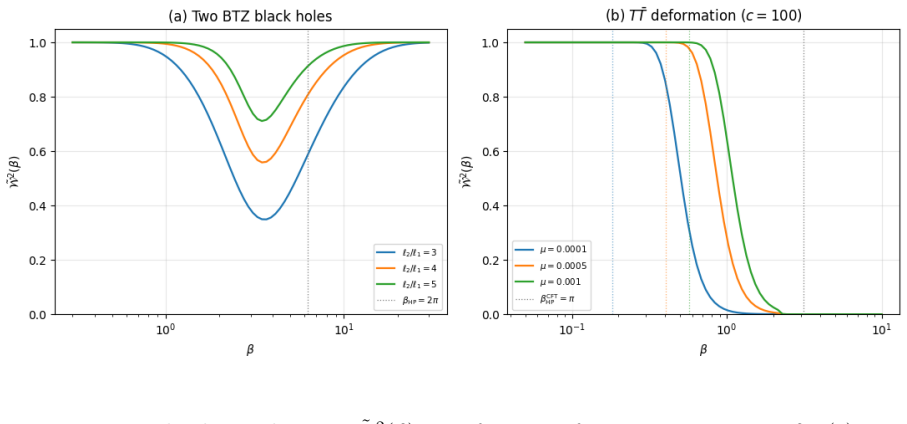
Numerical computation of the optimal W2 transport distance between the Boltzmann-weighted spectra of two explicit models, such as BTZ black holes with different cosmological constants, and direct comparison against the predicted horizon-area formula at equal energy.
Figures
read the original abstract
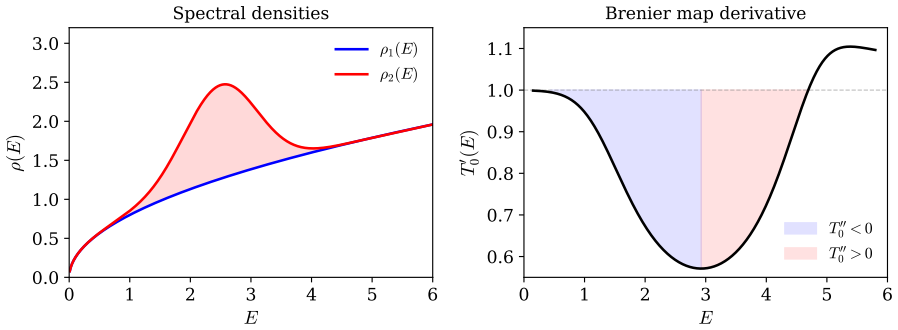
We develop the Boltzmann-Wasserstein (BW) distance, a temperature-dependent metric on the space of quantum theories, defined as the optimal $W_2$ distance between Boltzmann-weighted energy spectra. Computing it is an optimisation over wormholes: each unitary identification of the two energy bases defines a coupling of the two boundaries in the doubled Hilbert space, and the optimum - the comonotone partition function $C_{\max}$, which pairs states by rank - is the dominant wormhole connecting the two theories. For semiclassical theories differing by a small entropy shift, the normalised BW distance collapses to a squared horizon-area comparator, $\tilde{\mathcal{W}}^2 \approx (\delta A/4G)^2/8$, with the two areas evaluated at equal energy. When the Hamiltonians differ by an operator $V$, the BW distance equals a long-time average of the real-time thermal two-point function of $V$; when the thermal one-point function of $V$ vanishes - for instance for $V$ odd under an unbroken discrete global symmetry - a four-point representation appears at the next order. On the gravity side we construct the classical saddle that computes $C_{\max}$: a Schwinger-Keldysh wormhole built from two Euclidean caps sharing a single horizon, joined by Lorentzian segments that adiabatically interpolate between the two theories. Its on-shell action reproduces the spectral saddle of $C_{\max}$ - both the saddle-point conditions and the on-shell value - and the Lorentzian segments are essential: a purely Euclidean interpolation is exponentially suppressed. The saddle captures only the rearrangement of the spectrum; the perturbative representations retain in addition the variance of the matrix elements of $V$, invisible to the classical geometry. We work out two examples - two BTZ black holes with different cosmological constants and a $T\bar{T}$ deformation of BTZ.
Editorial analysis
A structured set of objections, weighed in public.
Referee Report
Summary. The paper defines the Boltzmann-Wasserstein (BW) distance as the optimal W_2 transport distance between Boltzmann-weighted energy spectra of two quantum theories. It identifies the optimum with the comonotone partition function C_max realized geometrically as a wormhole in the doubled Hilbert space, constructs an explicit Schwinger-Keldysh saddle (two Euclidean caps sharing a horizon joined by Lorentzian adiabatic segments) whose on-shell action is claimed to reproduce both the saddle-point equations and the value of C_max, derives that for small entropy shifts the normalized distance reduces to a squared horizon-area difference evaluated at equal energy, and shows that when the Hamiltonians differ by an operator V the distance equals a long-time average of the thermal two-point function of V (or a four-point function when the one-point vanishes). Two BTZ examples are worked out.
Significance. If the central identification between the SK wormhole saddle and the comonotone optimum holds without circularity, the work supplies a concrete gravitational realization of an optimal-transport distance on the space of theories, together with falsifiable reductions to area comparisons and thermal correlators. The explicit construction of the saddle and the demonstration that purely Euclidean interpolation is exponentially suppressed are positive features.
major comments (2)
- [Schwinger-Keldysh wormhole saddle construction (around the description of the two Euclidean caps and Lorentzian segments] The central claim that the constructed SK wormhole saddle exactly reproduces both the saddle-point conditions and the on-shell value of C_max (the comonotone optimum) is load-bearing for all subsequent results, including the area-comparator formula and the two-point-function representation. The manuscript must show explicitly that the variational equations obtained from varying the gravity action coincide with the optimality condition for rank-ordered pairing without presupposing the result; any mismatch or additional contribution from the Lorentzian segments would invalidate the equality between the geometric on-shell value and the spectral optimum.
- [Semiclassical limit and area comparator] The reduction ilde{\mathcal{W}}^2 ≈ (\delta A/4G)^2/8 for semiclassical theories differing by a small entropy shift is stated to hold when the areas are evaluated at equal energy. The derivation of this leading-order expression, the precise definition of the normalization, and the regime of validity (including the size of higher-order corrections in the entropy shift) must be supplied with the intermediate steps shown.
minor comments (2)
- [Introduction/definition of BW distance] Notation for the normalized distance \tilde{\mathcal{W}} and the precise relation between the partition function C_max and the W_2 cost should be introduced with an explicit equation early in the text.
- [Comparison of Euclidean vs. SK saddles] The statement that the Lorentzian segments are essential because a purely Euclidean interpolation is exponentially suppressed should be accompanied by a quantitative estimate of the suppression factor.
Simulated Author's Rebuttal
We thank the referee for their careful reading of the manuscript and for the constructive comments. We respond to the major comments point by point below.
read point-by-point responses
-
Referee: [Schwinger-Keldysh wormhole saddle construction (around the description of the two Euclidean caps and Lorentzian segments] The central claim that the constructed SK wormhole saddle exactly reproduces both the saddle-point conditions and the on-shell value of C_max (the comonotone optimum) is load-bearing for all subsequent results, including the area-comparator formula and the two-point-function representation. The manuscript must show explicitly that the variational equations obtained from varying the gravity action coincide with the optimality condition for rank-ordered pairing without presupposing the result; any mismatch or additional contribution from the Lorentzian segments would invalidate the equality between the geometric on-shell value and the spectral optimum.
Authors: We agree that an explicit demonstration without circularity is required. In the revised manuscript we will insert a dedicated calculation that varies the on-shell gravity action of the SK wormhole (two Euclidean caps joined by Lorentzian segments) and shows that the resulting saddle-point equations are identical to the optimality conditions for comonotone rank-ordered pairing. We will also verify that the Lorentzian segments contribute only through the adiabatic matching and do not alter the on-shell value or introduce extraneous terms. revision: yes
-
Referee: [Semiclassical limit and area comparator] The reduction ilde{\mathcal{W}}^2 ≈ (\delta A/4G)^2/8 for semiclassical theories differing by a small entropy shift is stated to hold when the areas are evaluated at equal energy. The derivation of this leading-order expression, the precise definition of the normalization, and the regime of validity (including the size of higher-order corrections in the entropy shift) must be supplied with the intermediate steps shown.
Authors: We acknowledge that the semiclassical reduction was stated without full intermediate steps. In the revision we will expand the relevant section to derive the normalized distance ilde{\mathcal{W}} from the definition of C_max, perform the small-\delta S expansion at fixed energy, obtain the leading (\delta A/4G)^2 term, define the normalization factor explicitly, and bound the higher-order corrections O((\delta S/S)^2). The regime \delta S o 0 with rac{ ext{area difference}}{ ext{total area}} o 0 will be stated clearly. revision: yes
Circularity Check
No significant circularity in the derivation chain
full rationale
The paper defines the BW distance as the optimal W_2 distance between Boltzmann-weighted energy spectra and identifies the comonotone partition function C_max (pairing by rank) as the mathematical optimum, which is then interpreted as the dominant wormhole. It constructs an explicit Schwinger-Keldysh saddle (two Euclidean caps sharing a horizon joined by Lorentzian adiabatic segments) and states that its on-shell action reproduces both the saddle-point conditions and value of this C_max. The semiclassical area comparator and two-point function representations are derived from this equivalence rather than presupposed. No self-citation load-bearing steps, fitted inputs renamed as predictions, or definitional reductions (e.g., geometry defined to match C_max by fiat) appear; the central claim is an independent gravitational computation of a spectral optimum.
Axiom & Free-Parameter Ledger
axioms (2)
- domain assumption Optimal transport theory applies directly to Boltzmann-weighted energy spectra of quantum theories
- ad hoc to paper The comonotone coupling (pairing by rank) achieves the optimum C_max
invented entities (2)
-
Boltzmann-Wasserstein distance
no independent evidence
-
Schwinger-Keldysh wormhole saddle
no independent evidence
Reference graph
Works this paper leans on
-
[1]
Relative Entropy and Proximity of Quantum Field Theories,
V. Balasubramanian, J. J. Heckman and A. Maloney, “Relative Entropy and Proximity of Quantum Field Theories,” JHEP05(2015) 104, [arXiv:1410.6809]
Pith/arXiv arXiv 2015
-
[2]
E. Perlmutter, L. Rastelli, C. Vafa and I. Valenzuela, “A CFT Distance Conjecture,” JHEP 10(2021) 070, [arXiv:2011.10040]
arXiv 2021
-
[3]
K. Hashimoto and N. Tanahashi, “Holography and Optimal Transport: Emergent Wasser- stein Spacetime in Harmonic Oscillator, SYK and Krylov Complexity,” [arXiv:2604.17649]
-
[4]
Wasserstein Space of Quantum Chaos,
K. Hashimoto, N. Tanahashi and K. Yoshida, “Wasserstein Space of Quantum Chaos,” [arXiv:2605.20995]
-
[5]
Quantum optimal transport with quantum channels,
G. De Palma and D. Trevisan, “Quantum optimal transport with quantum channels,” Ann. Henri Poincar´ e22(2021) 3199, [arXiv:1911.00803]
arXiv 2021
-
[6]
Villani,Optimal Transport: Old and New, Springer (2009)
C. Villani,Optimal Transport: Old and New, Springer (2009)
2009
-
[7]
Polar factorization and monotone rearrangement of vector-valued functions,
Y. Brenier, “Polar factorization and monotone rearrangement of vector-valued functions,” Comm. Pure Appl. Math.44(1991) 375
1991
-
[8]
The variation of the spectrum of a normal matrix,
A. J. Hoffman and H. W. Wielandt, “The variation of the spectrum of a normal matrix,” Duke Math. J.20(1953) 37
1953
-
[9]
Optimal transport and unitary orbits in C ∗- algebras,
B. Jacelon, K. R. Strung and A. Vignati, “Optimal transport and unitary orbits in C ∗- algebras,” J. Funct. Anal.281(2021) 109068, [arXiv:1808.03181]
arXiv 2021
-
[10]
A C ∗-algebraic Hoffman–Wielandt theorem,
B. Jacelon, “A C ∗-algebraic Hoffman–Wielandt theorem,” [arXiv:2605.22585]
-
[11]
Eternal black holes in anti-de Sitter,
J. Maldacena, “Eternal black holes in anti-de Sitter,” JHEP04(2003) 021, [arXiv:hep- th/0106112]
arXiv 2003
-
[12]
JT gravity as a matrix integral,
P. Saad, S. H. Shenker and D. Stanford, “JT gravity as a matrix integral,” [arXiv:1903.11115]
Pith/arXiv arXiv 1903
-
[13]
Time evolution of entanglement entropy from black hole interiors,
T. Hartman and J. Maldacena, “Time evolution of entanglement entropy from black hole interiors,” JHEP05(2013) 014, [arXiv:1303.1080]
Pith/arXiv arXiv 2013
-
[14]
Sur les fonctions absolument monotones,
S. Bernstein, “Sur les fonctions absolument monotones,” Acta Math.52(1929) 1. 37
1929
-
[15]
D. V. Widder,The Laplace Transform, Princeton University Press (1941)
1941
-
[16]
R. L. Schilling, R. Song and Z. Vondraˇ cek,Bernstein Functions: Theory and Applications, de Gruyter Studies in Mathematics37, de Gruyter, Berlin, 2nd ed. (2012)
2012
-
[17]
The black hole in three-dimensional space- times,
M. Ba˜ nados, C. Teitelboim and J. Zanelli, “The black hole in three-dimensional space- times,” Phys. Rev. Lett.69(1992) 1849, [arXiv:hep-th/9204099]
Pith/arXiv arXiv 1992
-
[18]
Renormalization group flows from holography — supersymmetry and a c-theorem,
D. Z. Freedman, S. S. Gubser, K. Pilch and N. P. Warner, “Renormalization group flows from holography — supersymmetry and a c-theorem,” Adv. Theor. Math. Phys.3(1999) 363, [arXiv:hep-th/9904017]
Pith/arXiv arXiv 1999
-
[19]
Real-time gauge/gravity duality,
K. Skenderis and B. C. van Rees, “Real-time gauge/gravity duality,” Phys. Rev. Lett.101 (2008) 081601, [arXiv:0805.0150]
Pith/arXiv arXiv 2008
-
[20]
Expectation value of composite fieldT ¯Tin two-dimensional quan- tum field theory,
A. B. Zamolodchikov, “Expectation value of composite fieldT ¯Tin two-dimensional quan- tum field theory,” [arXiv:hep-th/0401146]
-
[21]
On space of integrable quantum field theories,
F. A. Smirnov and A. B. Zamolodchikov, “On space of integrable quantum field theories,” Nucl. Phys. B915(2017) 363, [arXiv:1608.05499]
Pith/arXiv arXiv 2017
-
[22]
T¯T-deformed 2D quantum field theories,
A. Cavagli` a, S. Negro, I. M. Sz´ ecs´ enyi and R. Tateo, “T¯T-deformed 2D quantum field theories,” JHEP10(2016) 112, [arXiv:1608.05534]
Pith/arXiv arXiv 2016
-
[23]
Moving the CFT into the bulk withT T,
L. McGough, M. Mezei and H. Verlinde, “Moving the CFT into the bulk withT T,” JHEP 04(2018) 010, [arXiv:1611.03470]
Pith/arXiv arXiv 2018
-
[24]
Black hole entropy from near-horizon microstates,
A. Strominger, “Black hole entropy from near-horizon microstates,” JHEP02(1998) 009, [arXiv:hep-th/9712251]
Pith/arXiv arXiv 1998
-
[25]
Sinkhorn Distances: Lightspeed Computation of Optimal Transport,
M. Cuturi, “Sinkhorn Distances: Lightspeed Computation of Optimal Transport,” Adv. Neural Inf. Process. Syst.26(2013), [arXiv:1306.0895]. 38
Pith/arXiv arXiv 2013
discussion (0)
Sign in with ORCID, Apple, or X to comment. Anyone can read and Pith papers without signing in.