REVIEW 3 major objections 6 minor 1 cited by
Compact protoplanetary discs can be produced by dead zones
T0 review · 3 major / 6 minor · reviewed 2026-08-08 · deepseek-v4-flash
Pith's one-line read Dead zones can explain the prevalence of compact protoplanetary discs: when fragile dust fragments in the moderately turbulent region beyond the dead zone, the observed mm-sized dust disc is cut off at the dead zone edge, so disc size…
desk verdict Plausible new compact-disc mechanism via dead-zone fragmentation, but the central claim depends on a narrow parameter regime and the pre-relaxed gas initial condition needs testing. read the letter →
The pith
A machine-rendered reading of the paper's core claim, the machinery that carries it, and where it could break.
The reading
What carries the argument
The load-bearing mechanism is the fragmentation-limited dust growth regime, defined by the balance between turbulent relative velocities and the fragmentation velocity through the Stokes number (St_frag = (1/3 δ_turb) (v_frag/c_s)^2). Beyond the dead zone, α_SS jumps from about $10^{-4}$ to $10^{-3}$ or higher, so the maximum grain size collapses to sub-mm sizes, preventing the growth of detectable mm dust. The dead zone edge acts as a radial gate: a sharp (but continuous) transition in α_SS produces a local steepening of the pressure gradient that accelerates radial drift of ≲ mm dust ('hitchhiking'), which further inhibits growth and creates a slight dust pile-up at the outer edge, visible as a low-contrast ring in synthetic images. The models also track the full dust size distribution with DustPy and post-process it with RADMC-3D and CASA to generate realistic synthetic observations, which are then compared to actual ALMA data. This machinery connects an analytically known growth limit (from Birnstiel et al. 2009, 2012) to a specific disc-structure feature (the dead zone) and uses it to predict an observable property (disc size).
What would settle it
A direct test would be to measure the 1.3-mm and 3-mm disc sizes of a sample of compact discs at high resolution: the model predicts that sharp-transition discs have nearly identical sizes at both wavelengths, whereas drift-dominated discs should appear smaller at longer wavelengths. A second, equally direct check is to measure the fragmentation velocity of realistic icy aggregates in the laboratory; if v_frag ≥ 5 m/s, the models themselves show that mm dust forms across the MRI-active region and the dead-zone-size correspondence breaks down.
Extended reading notes
Core claim
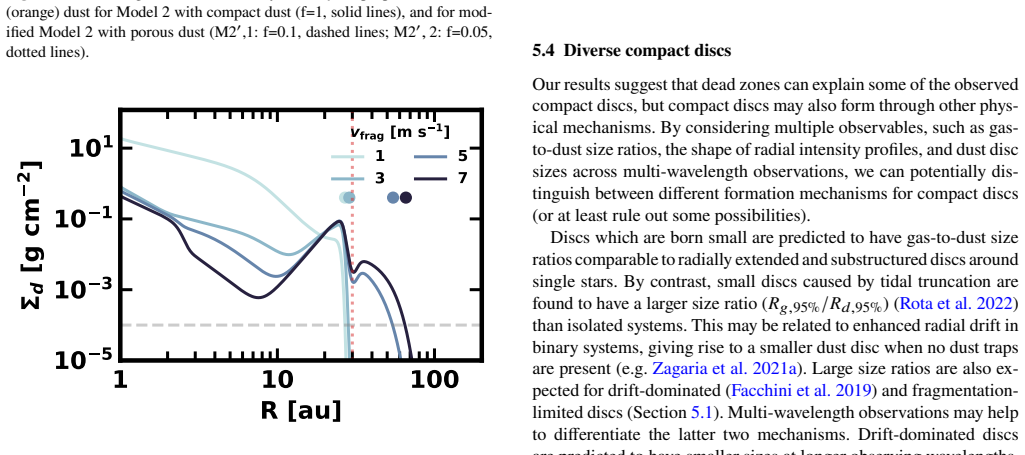
The central discovery is that the fragmentation of fragile dust (fragmentation velocity ≈ 1 m/s) in moderate turbulence (alpha_SS ≈ $10^{-3}$), as expected in MRI-active regions beyond the dead zone, naturally produces radially compact millimetre-dust discs whose observed size is set by the radial extent of the dead zone. In the models, mm-sized dust cannot grow in the MRI-active region because turbulent relative velocities exceed the fragmentation threshold, so the mm-dust disc is bounded by the transition radius R_t; model discs with R_t = 20, 30, and 50 au have observed radii R_d,90% ≈ 19, 27, and 34 au at 1 Myr. The sharp drop in gas surface density at the dead zone edge accelerates inward drift of sub-mm grains ('hitchhiking'), creating a subtle outer-edge bump that appears as a low-contrast ring or shoulder at high resolution. The paper also shows that pressure bumps inside the dead zone are inefficient dust traps at radii ≲ 10 au because fragile dust fragments near the bump and the small fragments replenish the optically thick inner disc, hiding the trap; only more resilient dust (v_frag ≈ 3 m/s or above) produces a visible ring under those conditions. These synthetic morphologies resemble recent high-resolution observations of compact discs such as Sz 66 and MP Mus.
Load-bearing premise
The mechanism requires both fragile dust (fragmentation velocity around 1 m/s) and a sharp jump in turbulence at the dead zone edge; if real dead zone edges are smooth or if grains can survive collisions at speeds above a few m/s, the dead zone size would no longer set the observed disc size.
Editorial extensions
If this is right
- If correct, the observed mm-dust size of compact discs becomes a direct tracer of the dead zone radius, turning ALMA size measurements into a probe of dead zone location and hence of disc ionization and magnetic-field structure.
- The model predicts nearly identical disc sizes at 1.3 mm and 3 mm for sharp dead zone edges, which can be tested against multi-wavelength ALMA observations; a strong size difference would favour drift-dominated or alternative mechanisms.
- High-resolution (≈0.02 arcsec) imaging of seemingly smooth compact discs should reveal a low-contrast ring or a change in slope at the outer edge, as seen in Sz 66 and MP Mus, providing a concrete observational signature of the hitchhiking effect.
- Compact discs formed by this mechanism follow the observed size–luminosity relation (R_eff ∝ L_mm^0.5) and naturally yield a shallower slope at later stages, matching the trend seen in older star-forming regions such as Upper Sco.
- The model predicts that inner pressure bumps (≲ 10 au) are hidden by the optically thick inner disc, so a faint ring in scattered light or CO may still be present even when the mm continuum looks smooth, informing the interpretation of substructure surveys.
Reading between the lines
- A natural extension the paper leaves implicit is that if dead-zone radius sets disc size, then in a population of compact discs the measured sizes should correlate with stellar properties that control ionization (e.g., X-ray luminosity, cosmic-ray rate, magnetic field geometry) - a test that could be done with existing surveys.
- The hitchhiking effect is not unique to dead zones: it should operate at any sharp outward drop in gas surface density, such as at the outer edge of a deep planetary gap or a photoevaporation front; this could be tested in substructured discs showing a weak outer ring at similar contrast.
- The degeneracy between turbulence α_SS and fragmentation velocity v_frag highlighted in Section 5.2 implies that dust-size measurements alone cannot separately constrain these parameters; breaking the degeneracy requires independent turbulence estimates from molecular-line widths or dust scale-heights, combined with laboratory and microphysical constraints on v_frag.
- The models indicate that dust grains in the outer disc are systematically limited to sub-mm sizes in the MRI-active region even at α_SS = 5 × 10^-4; if real discs have such low turbulence, then planetesimal formation by coagulation in the outer disc appears difficult, which may push the field toward alternative growth mechanisms such as streaming instability or gravitational collapse.
Editorial analysis
A structured set of objections, weighed in public.
Referee Report
Summary. The paper proposes that fragmentation of fragile dust (vfrag ~ 1 m/s) in moderately turbulent MRI-active regions outside a dead zone can explain radially compact protoplanetary discs. Using 1D DustPy models with a radially varying alpha_SS profile, the authors first evolve the gas alone for 6 Myr to remove the dead-zone-edge pressure bump, then introduce dust and follow its coagulation, fragmentation, drift, and emission. They find that the mm-dust disc is truncated near the dead-zone transition radius, yielding Rd,90 values of roughly 19--38 au, wavelength-independent sizes for sharp transitions, and a size--luminosity relation broadly consistent with observed compact discs. The paper also explores planet-carved pressure bumps, porous dust, higher fragmentation velocities, and smooth versus sharp alpha transitions, and compares synthetic ALMA images with objects such as Sz 66 and MP Mus.
Significance. If the mechanism survives the model assumptions, it is significant: it gives a physical interpretation of compact discs as tracing the dead-zone radius, and it produces testable predictions (similar 1.3/3 mm sizes for sharp transitions, a weak outer-edge 'shoulder' or ring, and a degeneracy between alpha_SS and vfrag). The study is transparent and well-documented: the parameter space is clearly tabulated, no parameters are fitted to the target observations, and the synthetic observations use standard, reproducible tools (RADMC-3D and CASA). The main reservation is that the central result depends on three conditions --- a sharp alpha transition, vfrag ~ 1 m/s, and dust being absent during the gas relaxation phase --- and the paper does not fully stress-test the third condition, which is the most directly load-bearing for the title claim.
major comments (3)
- [Section 4.1 (initial condition)] The central claim that the mm-dust disc size is set by the dead-zone radius depends on the absence of a dust trap at the dead-zone outer edge, but that absence is imposed by construction: the gas is evolved alone for 6 Myr before dust is introduced, so the pressure bump at Rt has relaxed before any dust can encounter it. In a real disc, dust is present throughout the viscous relaxation, and Pinilla et al. (2016) --- cited in this section --- show that the bump can trap dust for several Myr; the text itself says the trap 'remains as a boost to the pressure gradient ... for another a few million years'. The model therefore selects the regime in which the trap has already dissipated, and the reported Rd,90 values at 1 Myr would likely be larger in a co-evolution run that includes dust from t = 0. I recommend adding such a run, or providing a physical justification for why late dust introduction is appropriate. The 6-Myr gas-only preconditioning also means that the quoted 1 Myr and 3 Myr times are time since dust insertion, not the physical age of the disc, which complicates the comparison to young observed discs.
- [Section 4.2.1 and Table 2 (Model 4)] The smooth-transition model is presented as only mildly different, but Table 2 shows a substantial quantitative change: at 1 Myr, Model 4 has Rd,90 = 37.68 au and F1.3mm = 97.71 mJy, versus 26.67 au and 19.71 mJy for the sharp-transition Model 2; even at 3 Myr the sizes are 29.93 au versus 23.77 au. Because the slow-transition profile is the case motivated by non-ideal MHD simulations (Bai et al. 2016, cited in Section 4.2.1), the size-limiting mechanism is not established for realistic dead-zone edges. The text should either quantify this sensitivity in the conclusions or explicitly restrict the claim to sharp transitions and explain why that regime is physical.
- [Section 5.3.2 and Fig. 14] The robustness test for the fragmentation velocity shows that mm-size dust begins to form beyond the dead zone for vfrag >= 5 m/s (Fig. 14), and the quoted M2',5 case gives Rd,90 = 29.46 au at 0.5 Myr, compared with 26.67 au for Model 2 at 1 Myr. The comparison uses different epochs, so the conclusion that 'less fragile dust does not significantly increase disc sizes' is not cleanly demonstrated. Since vfrag is a free parameter with considerable experimental uncertainty, the abstract and conclusions should state more carefully that the mechanism is contingent on vfrag ~ 1 m/s, and the analysis should specify how much dust outside Rt can be present before the observed size criterion changes.
minor comments (6)
- [Section 2.1] There is a typo in the text: 'Sefan-Boltzmann constant' should read 'Stefan-Boltzmann constant'.
- [Data Availability] The software list contains 'DustyPyLib'; the correct name used elsewhere in the paper is 'DustPyLib'.
- [Section 5.1] The citation '(Anania et al, submitted)' appears in the text but has no entry in the reference list; please add the reference or remove the citation.
- [Table 4] Models M2',3 through M2',5 are listed in Table 4 without any resulting quantities; since the note explains why, it would be helpful to point the reader explicitly to Fig. 14 as the quantitative output for these runs.
- [Section 5.3.2] The M2' runs with high vfrag are quoted at 0.5 Myr, while all other size measurements in Table 2 are at 1 and 3 Myr; please state the reason for this different evaluation time in the text.
- [Appendix B] The caption for Figure B1 says 'orange and green lines', but the text and legend identify the two profiles as 'noise-free' and 'thermal noise'; please make the colour and label terminology consistent.
Circularity Check
No significant circularity: the compact-disc size is a simulated output from independently specified physical inputs, not a refit of the target observations.
full rationale
The paper's central claim is that mm-dust fragmentation in the MRI-active region sets the observed disc size to the dead-zone transition radius. The inputs (dead-zone profile Eq. 17 with specified alpha_DZ, alpha_MRI, Rt, and w; fragmentation velocity vfrag=1 m/s from laboratory experiments; alpha values from ALMA constraints) are all fixed before the DustPy runs, and the disc radii Rd,68 and Rd,90 are measured from synthetic observations generated after the evolution. No parameter is fitted to the observed compact-disc sizes or to the size-luminosity relation; the comparison to Long et al. (2019) and Shi et al. (2024) is a post-hoc overlay without tuning. The relation between Rt and Rd,90 is an emergent consequence of the prescribed alpha transition combined with the fragmentation-limited growth expressions in Eqs. (11)-(12), so the output is not identical to the input by definition. The 6-Myr gas-only relaxation before dust is introduced is a modeling choice that could affect robustness, but it is not a circular reduction: the relaxed gas profile is itself recomputed from the same viscous equation and is not defined in terms of the predicted dust size. The only self-citation (Tong et al. 2024) supports a secondary discussion point about long-term gas spreading and is not load-bearing for the main result. Thus the derivation chain is self-contained against external benchmarks and no circular step is exhibited.
Assumptions & free parameters
free parameters (5)
- Fragmentation velocity v_frag =
1 m/s (canonical; 3, 5, 7 m/s explored)
- Dead-zone transition radius R_t =
30 au canonical; 20 and 50 au explored
- Transition sharpness parameter w =
30 for sharp, slow profile in Model 4
- MRI-active turbulence alpha_SS,MRI =
1e-3 canonical; 1e-2 and 5e-4 explored
- Dead-zone turbulence alpha_SS,DZ =
1e-4
assumptions (7)
- standard math Smoluchowski coagulation-fragmentation and advection-diffusion equations for dust (Section 2.2)
- domain assumption Alpha-viscosity prescription for gas evolution (Shakura-Sunyaev, Eq. 1)
- domain assumption Two-zone dead zone profile with transition function (Eq. 17)
- domain assumption Constant fragmentation velocity across the entire disc (Section 3)
- domain assumption No dust back-reaction on the gas (Section 5.5)
- domain assumption No MHD winds (Section 5.5)
- domain assumption Vertically averaged 1-D model with Gaussian vertical dust distribution (Eq. 10)
Cite this review
Pith. "Pith review of Compact protoplanetary discs can be produced by dead zones." pith.science (2026). https://pith.science/paper/YREPDM3M
@misc{pith2026250204452,
  author       = {Pith},
  title        = {Pith review of: Compact protoplanetary discs can be produced by dead zones},
  year         = {2026},
  howpublished = {\url{https://pith.science/paper/YREPDM3M}},
  note         = {Machine review of arXiv:2502.04452}
}
read the original abstract
Radially compact protoplanetary discs (<=50 au) are ubiquitous in nearby star-forming regions. Multiple mechanisms have been invoked to interpret various compact discs. In this paper, we propose that fragmentation of fragile dust grains in moderate turbulence, as expected beyond the dead zone, provides an effective alternative mechanism to form compact discs which are consistent with current observations. We run 1-D dust transport and collision models with DustPy and generate synthetic observations, and find that discs formed by this mechanism have sizes determined by the extent of their dead zones. Accounting for dust porosity, and considering less fragile dust, do not change disc sizes significantly. The smooth dust morphology can be altered only when pressure bumps are present in the dead zone. However, when present at small radii (<=10 au), pressure bumps cannot effectively trap dust. Dust in these bumps fragments and replenishes the inner discs, effectively hiding dust traps in the optically thick inner disc from observations. We note a striking resemblance in the radial intensity profile between our synthetic observations and some recent high-resolution observations of compact discs. We discuss how such observations can inform our understanding of the underlying disc physics.
Figures


Figures from the paper (11 more)


Forward citations
Cited by 1 Pith paper
-
A JWST, ALMA and VLA survey of the Ophiuchus-A star-forming region: Unveiling hidden dust mass and connecting infrared outflows to their radio origins
A multi-wavelength survey of 20 Ophiuchus protostars finds dust masses tens to hundreds of times larger than millimetre-only estimates, if the adopted dust-opacity model is correct.
Reference graph
Works this paper leans on
-
[1]
write newline
" write newline "" before.all 'output.state := FUNCTION fin.entry write newline FUNCTION new.block output.state before.all = 'skip after.block 'output.state := if FUNCTION new.sentence output.state after.block = 'skip output.state before.all = 'skip after.sentence 'output.state := if if FUNCTION not #0 #1 if FUNCTION and 'skip pop #0 if FUNCTION or pop #1...
-
[2]
Alessi M., Pudritz R. E., Cridland A. J., 2020, @doi [ ] 10.1093/mnras/staa308 , https://ui.adsabs.harvard.edu/abs/2020MNRAS.493.1013A 493, 1013
-
[3]
Anderson A. R., Williams J. P., van der Marel N., Law C. J., Ricci L., Tobin J. J., Tong S., 2022, @doi [ ] 10.3847/1538-4357/ac8ff0 , https://ui.adsabs.harvard.edu/abs/2022ApJ...938...55A 938, 55
-
[4]
M., Terrell M., Tripathi A., Ansdell M., Williams J
Andrews S. M., Terrell M., Tripathi A., Ansdell M., Williams J. P., Wilner D. J., 2018, @doi [ ] 10.3847/1538-4357/aadd9f , https://ui.adsabs.harvard.edu/abs/2018ApJ...865..157A 865, 157
-
[5]
Ansdell M., et al., 2016, @doi [ ] 10.3847/0004-637X/828/1/46 , https://ui.adsabs.harvard.edu/abs/2016ApJ...828...46A 828, 46
-
[6]
Ansdell M., Williams J. P., Manara C. F., Miotello A., Facchini S., van der Marel N., Testi L., van Dishoeck E. F., 2017, @doi [ ] 10.3847/1538-3881/aa69c0 , https://ui.adsabs.harvard.edu/abs/2017AJ....153..240A 153, 240
-
[7]
Arlt R., Urpin V., 2004, @doi [ ] 10.1051/0004-6361:20035896 , https://ui.adsabs.harvard.edu/abs/2004A&A...426..755A 426, 755
-
[8]
Bacciotti F., et al., 2025, arXiv e-prints, https://ui.adsabs.harvard.edu/abs/2025arXiv250103920B p. arXiv:2501.03920
arXiv 2025
Show all 156 references
-
[9]
Bai X.-N., 2015, @doi [ ] 10.1088/0004-637X/798/2/84 , https://ui.adsabs.harvard.edu/abs/2015ApJ...798...84B 798, 84
2015 doi
-
[10]
M., 2013, @doi [ ] 10.1088/0004-637X/769/1/76 , https://ui.adsabs.harvard.edu/abs/2013ApJ...769...76B 769, 76
Bai X.-N., Stone J. M., 2013, @doi [ ] 10.1088/0004-637X/769/1/76 , https://ui.adsabs.harvard.edu/abs/2013ApJ...769...76B 769, 76
2013 doi
-
[11]
Bai X.-N., Ye J., Goodman J., Yuan F., 2016, @doi [ ] 10.3847/0004-637X/818/2/152 , https://ui.adsabs.harvard.edu/abs/2016ApJ...818..152B 818, 152
2016 doi
- [12]
-
[13]
Banzatti A., et al., 2023, @doi [ ] 10.3847/2041-8213/acf5ec , https://ui.adsabs.harvard.edu/abs/2023ApJ...957L..22B 957, L22
2023 doi
-
[14]
A., Carpenter J
Barenfeld S. A., Carpenter J. M., Ricci L., Isella A., 2016, @doi [ ] 10.3847/0004-637X/827/2/142 , https://ui.adsabs.harvard.edu/abs/2016ApJ...827..142B 827, 142
2016 doi
-
[15]
B \'e thune W., Lesur G., Ferreira J., 2017, @doi [ ] 10.1051/0004-6361/201630056 , https://ui.adsabs.harvard.edu/abs/2017A&A...600A..75B 600, A75
2017 doi
-
[16]
P., Brauer F., 2009, @doi [ ] 10.1051/0004-6361/200912452 , https://ui.adsabs.harvard.edu/abs/2009A&A...503L...5B 503, L5
Birnstiel T., Dullemond C. P., Brauer F., 2009, @doi [ ] 10.1051/0004-6361/200912452 , https://ui.adsabs.harvard.edu/abs/2009A&A...503L...5B 503, L5
2009 doi
-
[17]
Birnstiel T., Dullemond C., Brauer F., 2010, @doi [ ] 10.1051/0004-6361/200913731 , 513, A79
2010 doi
-
[18]
Birnstiel T., Klahr H., Ercolano B., 2012, @doi [ ] 10.1051/0004-6361/201118136 , https://ui.adsabs.harvard.edu/abs/2012A&A...539A.148B 539, A148
2012 doi
-
[19]
Birnstiel T., et al., 2018, @doi [ ] 10.3847/2041-8213/aaf743 , https://ui.adsabs.harvard.edu/abs/2018ApJ...869L..45B 869, L45
2018 doi
-
[20]
D., Payne D
Blandford R. D., Payne D. G., 1982, @doi [ ] 10.1093/mnras/199.4.883 , https://ui.adsabs.harvard.edu/abs/1982MNRAS.199..883B 199, 883
1982 doi
-
[21]
Blum J., Wurm G., 2008, @doi [ ] 10.1146/annurev.astro.46.060407.145152 , https://ui.adsabs.harvard.edu/abs/2008ARA&A..46...21B 46, 21
2008
-
[22]
CASA Team et al., 2022, @doi [ ] 10.1088/1538-3873/ac9642 , https://ui.adsabs.harvard.edu/abs/2022PASP..134k4501C 134, 114501
2022 doi
-
[23]
Cazzoletti P., et al., 2019, @doi [ ] 10.1051/0004-6361/201935273 , https://ui.adsabs.harvard.edu/abs/2019A&A...626A..11C 626, A11
2019 doi
-
[24]
J., Cuzzi J
Ciesla F. J., Cuzzi J. N., 2006, @doi [ ] 10.1016/j.icarus.2005.11.009 , https://ui.adsabs.harvard.edu/abs/2006Icar..181..178C 181, 178
2006 doi
-
[25]
A., et al., 2019, @doi [ ] 10.1093/mnras/sty2653 , 482, 698
Cieza L. A., et al., 2019, @doi [ ] 10.1093/mnras/sty2653 , 482, 698
2019 doi
-
[26]
G., et al., 2017, @doi [ ] 10.3847/1538-4357/aa97e2 , https://ui.adsabs.harvard.edu/abs/2017ApJ...851...83C 851, 83
Cox E. G., et al., 2017, @doi [ ] 10.3847/1538-4357/aa97e2 , https://ui.adsabs.harvard.edu/abs/2017ApJ...851...83C 851, 83
2017 doi
-
[27]
N., Okuzumi S., Flock M., Pinilla P., Dzyurkevich N., 2022, @doi [ ] 10.1051/0004-6361/202141689 , https://ui.adsabs.harvard.edu/abs/2022A&A...658A..97D 658, A97
Delage T. N., Okuzumi S., Flock M., Pinilla P., Dzyurkevich N., 2022, @doi [ ] 10.1051/0004-6361/202141689 , https://ui.adsabs.harvard.edu/abs/2022A&A...658A..97D 658, A97
2022 doi
-
[28]
N., G \'a rate M., Okuzumi S., Yang C.-C., Pinilla P., Flock M., Stammler S
Delage T. N., G \'a rate M., Okuzumi S., Yang C.-C., Pinilla P., Flock M., Stammler S. M., Birnstiel T., 2023, @doi [ ] 10.1051/0004-6361/202244731 , https://ui.adsabs.harvard.edu/abs/2023A&A...674A.190D 674, A190
2023 doi
-
[29]
M., 2024, @doi [ ] 10.1051/0004-6361/202450328 , https://ui.adsabs.harvard.edu/abs/2024A&A...688A..81D 688, A81
Delussu L., Birnstiel T., Miotello A., Pinilla P., Rosotti G., Andrews S. M., 2024, @doi [ ] 10.1051/0004-6361/202450328 , https://ui.adsabs.harvard.edu/abs/2024A&A...688A..81D 688, A81
2024 doi
-
[30]
Dipierro G., Laibe G., Alexander R., Hutchison M., 2018, @doi [ ] 10.1093/mnras/sty1701 , 479, 4187
2018 doi
-
[31]
Doi K., Kataoka A., 2021, @doi [ ] 10.3847/1538-4357/abe5a6 , https://ui.adsabs.harvard.edu/abs/2021ApJ...912..164D 912, 164
2021 doi
-
[32]
Dong R., et al., 2018, @doi [ ] 10.3847/1538-4357/aac6cb , https://ui.adsabs.harvard.edu/abs/2018ApJ...860..124D 860, 124
2018 doi
-
[33]
T., 2003, @doi [ ] 10.1146/annurev.astro.41.011802.094840 , https://ui.adsabs.harvard.edu/abs/2003ARA&A..41..241D 41, 241
Draine B. T., 2003, @doi [ ] 10.1146/annurev.astro.41.011802.094840 , https://ui.adsabs.harvard.edu/abs/2003ARA&A..41..241D 41, 241
2003 arXiv
-
[34]
P., 2014, @doi [ ] 10.1051/0004-6361/201423708 , https://ui.adsabs.harvard.edu/abs/2014A&A...567A..38D 567, A38
Dr a \.z kowska J., Windmark F., Dullemond C. P., 2014, @doi [ ] 10.1051/0004-6361/201423708 , https://ui.adsabs.harvard.edu/abs/2014A&A...567A..38D 567, A38
2014 doi
-
[36]
Dullemond C. P., Juhasz A., Pohl A., Sereshti F., Shetty R., Peters T., Commercon B., Flock M., 2012, RADMC-3D: A multi-purpose radiative transfer tool , Astrophysics Source Code Library, record ascl:1202.015
2012
-
[37]
P., et al., 2018, @doi [ ] 10.3847/2041-8213/aaf742 , https://ui.adsabs.harvard.edu/abs/2018ApJ...869L..46D 869, L46
Dullemond C. P., et al., 2018, @doi [ ] 10.3847/2041-8213/aaf742 , https://ui.adsabs.harvard.edu/abs/2018ApJ...869L..46D 869, L46
2018 doi
-
[38]
J., Henning T., Kley W., 2013, @doi [ ] 10.1088/0004-637X/765/2/114 , https://ui.adsabs.harvard.edu/abs/2013ApJ...765..114D 765, 114
Dzyurkevich N., Turner N. J., Henning T., Kley W., 2013, @doi [ ] 10.1088/0004-637X/765/2/114 , https://ui.adsabs.harvard.edu/abs/2013ApJ...765..114D 765, 114
2013 doi
-
[39]
Eisner J., et al., 2018, @doi [ ] 10.3847/1538-4357/aac3e2 , 860, 77
2018 doi
-
[40]
F., 2017, @doi [ ] 10.1051/0004-6361/201630329 , https://ui.adsabs.harvard.edu/abs/2017A&A...605A..16F 605, A16
Facchini S., Birnstiel T., Bruderer S., van Dishoeck E. F., 2017, @doi [ ] 10.1051/0004-6361/201630329 , https://ui.adsabs.harvard.edu/abs/2017A&A...605A..16F 605, A16
2017 doi
-
[41]
Facchini S., et al., 2019, @doi [ ] 10.1051/0004-6361/201935496 , 626, L2
2019 doi
-
[42]
Flaherty K., et al., 2020, @doi [ ] 10.3847/1538-4357/ab8cc5 , 895, 109
2020 doi
-
[43]
Flaherty K., et al., 2024, @doi [ ] 10.1093/mnras/stae1480 , https://ui.adsabs.harvard.edu/abs/2024MNRAS.532..363F 532, 363
2024 doi
-
[44]
Flock M., Fromang S., Turner N., Benisty M., 2016, @doi [ ] 10.3847/0004-637X/827/2/144 , 827, 144
2016 doi
-
[45]
J., Mulders G
Flock M., Turner N. J., Mulders G. D., Hasegawa Y., Nelson R. P., Bitsch B., 2019, @doi [ ] 10.1051/0004-6361/201935806 , https://ui.adsabs.harvard.edu/abs/2019A&A...630A.147F 630, A147
2019 doi
-
[46]
F., 1996, @doi [ ] 10.1086/176735 , https://ui.adsabs.harvard.edu/abs/1996ApJ...457..355G 457, 355
Gammie C. F., 1996, @doi [ ] 10.1086/176735 , https://ui.adsabs.harvard.edu/abs/1996ApJ...457..355G 457, 355
1996 doi
-
[47]
M., 2020, @doi [ ] 10.1051/0004-6361/201936067 , https://ui.adsabs.harvard.edu/abs/2020A&A...635A.149G 635, A149
G \'a rate M., Birnstiel T., Dr a \.z kowska J., Stammler S. M., 2020, @doi [ ] 10.1051/0004-6361/201936067 , https://ui.adsabs.harvard.edu/abs/2020A&A...635A.149G 635, A149
2020 doi
-
[48]
G \'a rate M., et al., 2021, @doi [ ] 10.1051/0004-6361/202141444 , https://ui.adsabs.harvard.edu/abs/2021A&A...655A..18G 655, A18
2021 doi
-
[49]
Gundlach B., Blum J., 2015, @doi [ ] 10.1088/0004-637X/798/1/34 , https://ui.adsabs.harvard.edu/abs/2015ApJ...798...34G 798, 34
2015 doi
-
[50]
R., et al., 2020, @doi [ ] 10.1038/s41586-020-2649-2 , https://ui.adsabs.harvard.edu/abs/2020Natur.585..357H 585, 357
Harris C. R., et al., 2020, @doi [ ] 10.1038/s41586-020-2649-2 , https://ui.adsabs.harvard.edu/abs/2020Natur.585..357H 585, 357
2020 doi
-
[51]
F., Gammie C
Hawley J. F., Gammie C. F., Balbus S. A., 1995, @doi [ ] 10.1086/175311 , 440, 742
1995 doi
-
[52]
Hendler N., Pascucci I., Pinilla P., Tazzari M., Carpenter J., Malhotra R., Testi L., 2020, @doi [ ] 10.3847/1538-4357/ab70ba , https://ui.adsabs.harvard.edu/abs/2020ApJ...895..126H 895, 126
2020 doi
-
[53]
Henning T., Stognienko R., 1996, , https://ui.adsabs.harvard.edu/abs/1996A&A...311..291H 311, 291
1996
-
[54]
Huang J., et al., 2018, @doi [ ] 10.3847/2041-8213/aaf740 , 869, L42
2018 doi
- [55]
-
[56]
D., 2007, @doi [Computing in Science & Engineering] 10.1109/MCSE.2007.55 , 9, 90
Hunter J. D., 2007, @doi [Computing in Science & Engineering] 10.1109/MCSE.2007.55 , 9, 90
2007 doi
-
[57]
D., Walsh C., Jennings J., Booth R
Ilee J. D., Walsh C., Jennings J., Booth R. A., Rosotti G. P., Teague R., Tsukagoshi T., Nomura H., 2022, @doi [ ] 10.1093/mnrasl/slac048 , https://ui.adsabs.harvard.edu/abs/2022MNRAS.515L..23I 515, L23
2022 doi
-
[58]
J., Booth R
Jennings J., Tazzari M., Clarke C. J., Booth R. A., Rosotti G. P., 2022, @doi [ ] 10.1093/mnras/stac1770 , https://ui.adsabs.harvard.edu/abs/2022MNRAS.514.6053J 514, 6053
2022 doi
-
[59]
M., Carrasco-Gonz \'a lez C., 2024, @doi [ ] 10.1051/0004-6361/202348271 , https://ui.adsabs.harvard.edu/abs/2024A&A...682A..32J 682, A32
Jiang H., Mac \' as E., Guerra-Alvarado O. M., Carrasco-Gonz \'a lez C., 2024, @doi [ ] 10.1051/0004-6361/202348271 , https://ui.adsabs.harvard.edu/abs/2024A&A...682A..32J 682, A32
2024 doi
-
[60]
D., Ueda T., Muto T., Okuzumi S., 2017, @doi [ ] 10.3847/1538-4357/aa7ca1 , https://ui.adsabs.harvard.edu/abs/2017ApJ...844..142K 844, 142
Kanagawa K. D., Ueda T., Muto T., Okuzumi S., 2017, @doi [ ] 10.3847/1538-4357/aa7ca1 , https://ui.adsabs.harvard.edu/abs/2017ApJ...844..142K 844, 142
2017 doi
-
[61]
D., Tanaka H., Szuszkiewicz E., 2018, @doi [ ] 10.3847/1538-4357/aac8d9 , https://ui.adsabs.harvard.edu/abs/2018ApJ...861..140K 861, 140
Kanagawa K. D., Tanaka H., Szuszkiewicz E., 2018, @doi [ ] 10.3847/1538-4357/aac8d9 , https://ui.adsabs.harvard.edu/abs/2018ApJ...861..140K 861, 140
2018 doi
-
[62]
P., 2012, @doi [ ] 10.1146/annurev-astro-081811-125523 , https://ui.adsabs.harvard.edu/abs/2012ARA&A..50..211K 50, 211
Kley W., Nelson R. P., 2012, @doi [ ] 10.1146/annurev-astro-081811-125523 , https://ui.adsabs.harvard.edu/abs/2012ARA&A..50..211K 50, 211
2012 doi
-
[63]
IOS Press, pp 87--90, https://eprints.soton.ac.uk/403913/
Kluyver T., et al., 2016, in Loizides F., Scmidt B., eds, Positioning and Power in Academic Publishing: Players, Agents and Agendas. IOS Press, pp 87--90, https://eprints.soton.ac.uk/403913/
2016
-
[64]
W., Dominik C., Tielens A
Krijt S., Ormel C. W., Dominik C., Tielens A. G. G. M., 2015, @doi [ ] 10.1051/0004-6361/201425222 , https://ui.adsabs.harvard.edu/abs/2015A&A...574A..83K 574, A83
2015 doi
-
[65]
S., Haugb lle T., 2023, @doi [European Physical Journal Plus] 10.1140/epjp/s13360-023-03880-y , https://ui.adsabs.harvard.edu/abs/2023EPJP..138..272K 138, 272
Kuffmeier M., Jensen S. S., Haugb lle T., 2023, @doi [European Physical Journal Plus] 10.1140/epjp/s13360-023-03880-y , https://ui.adsabs.harvard.edu/abs/2023EPJP..138..272K 138, 272
2023 doi
-
[66]
Kurtovic N., et al., 2021, @doi [ ] 10.1051/0004-6361/202038983 , 645, A139
2021 doi
-
[67]
Kuznetsova A., Bae J., Hartmann L., Mac Low M.-M., 2022, The Astrophysical Journal, 928, 92
2022
-
[68]
Lee C.-F., Tabone B., Cabrit S., Codella C., Podio L., Ferreira J., Jacquemin-Ide J., 2021, @doi [ ] 10.3847/2041-8213/abda38 , https://ui.adsabs.harvard.edu/abs/2021ApJ...907L..41L 907, L41
2021 doi
- [69]
-
[70]
M., Lovelace R
Li H., Finn J. M., Lovelace R. V. E., Colgate S. A., 2000, @doi [ ] 10.1086/308693 , https://ui.adsabs.harvard.edu/abs/2000ApJ...533.1023L 533, 1023
2000 doi
-
[71]
Long F., et al., 2019, @doi [ ] 10.3847/1538-4357/ab2d2d , https://ui.adsabs.harvard.edu/abs/2019ApJ...882...49L 882, 49
2019 doi
-
[72]
Louvet F., Dougados C., Cabrit S., Mardones D., M \' e nard F., Tabone B., Pinte C., Dent W., 2018, @doi [ ] 10.1051/0004-6361/201731733 , 618, A120
2018 doi
-
[73]
E., 1974, @doi [ ] 10.1093/mnras/168.3.603 , https://ui.adsabs.harvard.edu/abs/1974MNRAS.168..603L 168, 603
Lynden-Bell D., Pringle J. E., 1974, @doi [ ] 10.1093/mnras/168.3.603 , https://ui.adsabs.harvard.edu/abs/1974MNRAS.168..603L 168, 603
1974 doi
-
[74]
Lyra W., Johansen A., Zsom A., Klahr H., Piskunov N., 2009, @doi [ ] 10.1051/0004-6361/200811265 , https://ui.adsabs.harvard.edu/abs/2009A&A...497..869L 497, 869
2009 doi
-
[75]
F., et al., 2019, @doi [ ] 10.1051/0004-6361/201935964 , https://ui.adsabs.harvard.edu/abs/2019A&A...628A..95M 628, A95
Manara C. F., et al., 2019, @doi [ ] 10.1051/0004-6361/201935964 , https://ui.adsabs.harvard.edu/abs/2019A&A...628A..95M 628, A95
2019 doi
-
[76]
S., Rumpl W., Nordsieck K
Mathis J. S., Rumpl W., Nordsieck K. H., 1977, @doi [ ] 10.1086/155591 , https://ui.adsabs.harvard.edu/abs/1977ApJ...217..425M 217, 425
1977 doi
-
[77]
J., et al., 2024, @doi [ ] 10.1051/0004-6361/202451166 , https://ui.adsabs.harvard.edu/abs/2024A&A...689L...5M 689, L5
Maureira M. J., et al., 2024, @doi [ ] 10.1051/0004-6361/202451166 , https://ui.adsabs.harvard.edu/abs/2024A&A...689L...5M 689, L5
2024 doi
-
[78]
J., 2024, @doi [ ] 10.1051/0004-6361/202449719 , https://ui.adsabs.harvard.edu/abs/2024A&A...688A..31M 688, A31
Michoulier S., Gonzalez J.-F., Price D. J., 2024, @doi [ ] 10.1051/0004-6361/202449719 , https://ui.adsabs.harvard.edu/abs/2024A&A...688A..31M 688, A31
2024 doi
-
[79]
M., et al., 2024, @doi [ ] 10.1051/0004-6361/202347135 , https://ui.adsabs.harvard.edu/abs/2024A&A...682A..55M 682, A55
Miley J. M., et al., 2024, @doi [ ] 10.1051/0004-6361/202347135 , https://ui.adsabs.harvard.edu/abs/2024A&A...682A..55M 682, A55
2024 doi
-
[80]
F., Williams J
Miotello A., Rosotti G., Ansdell M., Facchini S., Manara C. F., Williams J. P., Bruderer S., 2021, @doi [ ] 10.1051/0004-6361/202140550 , https://ui.adsabs.harvard.edu/abs/2021A&A...651A..48M 651, A48
2021 doi
-
[81]
Morishima R., 2012, @doi [ ] 10.1111/j.1365-2966.2011.19940.x , https://ui.adsabs.harvard.edu/abs/2012MNRAS.420.2851M 420, 2851
2012
-
[82]
Musiolik G., Wurm G., 2019, @doi [ ] 10.3847/1538-4357/ab0428 , https://ui.adsabs.harvard.edu/abs/2019ApJ...873...58M 873, 58
2019 doi
-
[83]
Nakagawa Y., Sekiya M., Hayashi C., 1986, @doi [ ] 10.1016/0019-1035(86)90121-1 , https://ui.adsabs.harvard.edu/abs/1986Icar...67..375N 67, 375
1986 doi
- [84]
-
[85]
P., Gressel O., Umurhan O
Nelson R. P., Gressel O., Umurhan O. M., 2013, @doi [ ] 10.1093/mnras/stt1475 , 435, 2610
2013 doi
-
[86]
Ohashi S., Kataoka A., 2019, @doi [ ] 10.3847/1538-4357/ab5107 , https://ui.adsabs.harvard.edu/abs/2019ApJ...886..103O 886, 103
2019 doi
-
[87]
Okuzumi S., Momose M., Sirono S.-i., Kobayashi H., Tanaka H., 2016, @doi [ ] 10.3847/0004-637X/821/2/82 , https://ui.adsabs.harvard.edu/abs/2016ApJ...821...82O 821, 82
2016 doi
-
[88]
W., Cuzzi J
Ormel C. W., Cuzzi J. N., 2007, @doi [ ] 10.1051/0004-6361:20066899 , https://ui.adsabs.harvard.edu/abs/2007A&A...466..413O 466, 413
2007 doi
-
[89]
P., Bally J., Eisner J., Goddi C., Plambeck R., Wright M., 2021, @doi [ ] 10.3847/1538-4357/ac29c2 , 923, 221
Otter J., Ginsburg A., Ballering N. P., Bally J., Eisner J., Goddi C., Plambeck R., Wright M., 2021, @doi [ ] 10.3847/1538-4357/ac29c2 , 923, 221
2021 doi
-
[90]
Pascucci I., et al., 2016, @doi [ ] 10.3847/0004-637X/831/2/125 , 831, 125
2016 doi
-
[91]
J., Mamajek E
Pecaut M. J., Mamajek E. E., Bubar E. J., 2012, @doi [ ] 10.1088/0004-637X/746/2/154 , https://ui.adsabs.harvard.edu/abs/2012ApJ...746..154P 746, 154
2012 doi
-
[92]
Pi \'e tu V., Guilloteau S., Di Folco E., Dutrey A., Boehler Y., 2014, @doi [ ] 10.1051/0004-6361/201322388 , https://ui.adsabs.harvard.edu/abs/2014A&A...564A..95P 564, A95
2014 doi
-
[93]
P., Uribe A
Pinilla P., Birnstiel T., Ricci L., Dullemond C. P., Uribe A. L., Testi L., Natta A., 2012, @doi [ ] 10.1051/0004-6361/201118204 , https://ui.adsabs.harvard.edu/abs/2012A&A...538A.114P 538, A114
2012 doi
-
[94]
Pinilla P., Flock M., Ovelar M. d. J., Birnstiel T., 2016, @doi [ ] 10.1051/0004-6361/201628441 , https://ui.adsabs.harvard.edu/abs/2016A&A...596A..81P 596, A81
2016 doi
-
[95]
Pinilla P., et al., 2017a, @doi [ ] 10.3847/1538-4357/aa6973 , https://ui.adsabs.harvard.edu/abs/2017ApJ...839...99P 839, 99
-
[96]
M., Birnstiel T., 2017b, @doi [ ] 10.3847/1538-4357/aa7edb , https://ui.adsabs.harvard.edu/abs/2017ApJ...845...68P 845, 68
Pinilla P., Pohl A., Stammler S. M., Birnstiel T., 2017b, @doi [ ] 10.3847/1538-4357/aa7edb , https://ui.adsabs.harvard.edu/abs/2017ApJ...845...68P 845, 68
-
[97]
Pinilla P., et al., 2018, @doi [ ] 10.3847/1538-4357/aabf94 , https://ui.adsabs.harvard.edu/abs/2018ApJ...859...32P 859, 32
2018 doi
-
[98]
M., Tazzari M., 2019, @doi [ ] 10.3847/1538-4357/ab1cb8 , https://ui.adsabs.harvard.edu/abs/2019ApJ...878...16P 878, 16
Pinilla P., Benisty M., Cazzoletti P., Harsono D., P \'e rez L. M., Tazzari M., 2019, @doi [ ] 10.3847/1538-4357/ab1cb8 , https://ui.adsabs.harvard.edu/abs/2019ApJ...878...16P 878, 16
2019 doi
-
[99]
T., Stammler S
Pinilla P., Lenz C. T., Stammler S. M., 2021a, @doi [ ] 10.1051/0004-6361/202038920 , https://ui.adsabs.harvard.edu/abs/2021A&A...645A..70P 645, A70
-
[100]
Pinilla P., et al., 2021b, @doi [ ] 10.1051/0004-6361/202140371 , https://ui.adsabs.harvard.edu/abs/2021A&A...649A.122P 649, A122
-
[101]
Preibisch T., Brown A. G. A., Bridges T., Guenther E., Zinnecker H., 2002, @doi [ ] 10.1086/341174 , https://ui.adsabs.harvard.edu/abs/2002AJ....124..404P 124, 404
2002 doi
-
[102]
Ribas \'A ., et al., 2023, @doi [ ] 10.1051/0004-6361/202245637 , https://ui.adsabs.harvard.edu/abs/2023A&A...673A..77R 673, A77
2023 doi
-
[103]
J., Dullemond C
Rodenkirch P. J., Dullemond C. P., 2022, @doi [ ] 10.1051/0004-6361/202142571 , https://ui.adsabs.harvard.edu/abs/2022A&A...659A..42R 659, A42
2022 doi
-
[104]
P., 2023, @doi [ ] 10.1016/j.newar.2023.101674 , https://ui.adsabs.harvard.edu/abs/2023NewAR..9601674R 96, 101674
Rosotti G. P., 2023, @doi [ ] 10.1016/j.newar.2023.101674 , https://ui.adsabs.harvard.edu/abs/2023NewAR..9601674R 96, 101674
2023
-
[105]
P., Tazzari M., Booth R
Rosotti G. P., Tazzari M., Booth R. A., Testi L., Lodato G., Clarke C., 2019, @doi [ ] 10.1093/mnras/stz1190 , 486, 4829
2019 doi
-
[106]
A., et al., 2022, @doi [ ] 10.1051/0004-6361/202141035 , https://ui.adsabs.harvard.edu/abs/2022A&A...662A.121R 662, A121
Rota A. A., et al., 2022, @doi [ ] 10.1051/0004-6361/202141035 , https://ui.adsabs.harvard.edu/abs/2022A&A...662A.121R 662, A121
2022 doi
-
[107]
Salmeron R., Wardle M., 2008, @doi [ ] 10.1111/j.1365-2966.2008.13430.x , https://ui.adsabs.harvard.edu/abs/2008MNRAS.388.1223S 388, 1223
2008
-
[108]
M., Reg \'a ly Z., Lyra W., 2024, @doi [ ] 10.1051/0004-6361/202347605 , https://ui.adsabs.harvard.edu/abs/2024A&A...686A..78S 686, A78
S \'a ndor Z., Guilera O. M., Reg \'a ly Z., Lyra W., 2024, @doi [ ] 10.1051/0004-6361/202347605 , https://ui.adsabs.harvard.edu/abs/2024A&A...686A..78S 686, A78
2024 doi
-
[109]
M., Umebayashi T., Nakano T., 2000, @doi [ ] 10.1086/317075 , https://ui.adsabs.harvard.edu/abs/2000ApJ...543..486S 543, 486
Sano T., Miyama S. M., Umebayashi T., Nakano T., 2000, @doi [ ] 10.1086/317075 , https://ui.adsabs.harvard.edu/abs/2000ApJ...543..486S 543, 486
2000 doi
-
[110]
M., et al., 2020, @doi [ ] 10.1038/s41586-020-2779-6 , https://ui.adsabs.harvard.edu/abs/2020Natur.586..228S 586, 228
Segura-Cox D. M., et al., 2020, @doi [ ] 10.1038/s41586-020-2779-6 , https://ui.adsabs.harvard.edu/abs/2020Natur.586..228S 586, 228
2020 doi
- [111]
-
[112]
I., Sunyaev R
Shakura N. I., Sunyaev R. A., 1973, , https://ui.adsabs.harvard.edu/abs/1973A&A....24..337S 24, 337
1973
-
[113]
Shi Y., et al., 2024, @doi [ ] 10.3847/1538-4357/ad2e94 , https://ui.adsabs.harvard.edu/abs/2024ApJ...966...59S 966, 59
2024 doi
-
[114]
V., 1916, Zeitschrift fur Physik, https://ui.adsabs.harvard.edu/abs/1916ZPhy...17..557S 17, 557
Smoluchowski M. V., 1916, Zeitschrift fur Physik, https://ui.adsabs.harvard.edu/abs/1916ZPhy...17..557S 17, 557
1916
-
[115]
Speedie J., et al., 2024, @doi [ ] 10.1038/s41586-024-07877-0 , https://ui.adsabs.harvard.edu/abs/2024Natur.633...58S 633, 58
2024 doi
-
[116]
P., Birnstiel T., Stammler S
Stadler J., G \'a rate M., Pinilla P., Lenz C., Dullemond C. P., Birnstiel T., Stammler S. M., 2022, @doi [ ] 10.1051/0004-6361/202243338 , https://ui.adsabs.harvard.edu/abs/2022A&A...668A.104S 668, A104
2022 doi
-
[117]
M., Birnstiel T., 2022, @doi [ ] 10.3847/1538-4357/ac7d58 , https://ui.adsabs.harvard.edu/abs/2022ApJ...935...35S 935, 35
Stammler S. M., Birnstiel T., 2022, @doi [ ] 10.3847/1538-4357/ac7d58 , https://ui.adsabs.harvard.edu/abs/2022ApJ...935...35S 935, 35
2022 doi
-
[118]
M., Birnstiel T., G \'a rate M., 2023a, DustPyLib: A library of DustPy extensions , Astrophysics Source Code Library, record ascl:2310.005
Stammler S. M., Birnstiel T., G \'a rate M., 2023a, DustPyLib: A library of DustPy extensions , Astrophysics Source Code Library, record ascl:2310.005
-
[119]
M., Lichtenberg T., Dr a \.z kowska J., Birnstiel T., 2023b, @doi [ ] 10.1051/0004-6361/202245512 , https://ui.adsabs.harvard.edu/abs/2023A&A...670L...5S 670, L5
Stammler S. M., Lichtenberg T., Dr a \.z kowska J., Birnstiel T., 2023b, @doi [ ] 10.1051/0004-6361/202245512 , https://ui.adsabs.harvard.edu/abs/2023A&A...670L...5S 670, L5
-
[120]
K., Ogihara M., Morbidelli A., Crida A., Guillot T., 2016, @doi [ ] 10.1051/0004-6361/201628955 , 596, A74
Suzuki T. K., Ogihara M., Morbidelli A., Crida A., Guillot T., 2016, @doi [ ] 10.1051/0004-6361/201628955 , 596, A74
2016 doi
-
[121]
Tabone B., et al., 2017, @doi [ ] 10.1051/0004-6361/201731691 , 607, L6
2017 doi
-
[122]
P., Cridland A
Tabone B., Rosotti G. P., Cridland A. J., Armitage P. J., Lodato G., 2022, @doi [ ] 10.1093/mnras/stab3442 , https://ui.adsabs.harvard.edu/abs/2022MNRAS.512.2290T 512, 2290
2022 doi
-
[123]
Takeuchi T., Lin D. N. C., 2002, @doi [ ] 10.1086/344437 , https://ui.adsabs.harvard.edu/abs/2002ApJ...581.1344T 581, 1344
2002 doi
-
[124]
Tazaki R., Tanaka H., Kataoka A., Okuzumi S., Muto T., 2019, @doi [ ] 10.3847/1538-4357/ab45f0 , https://ui.adsabs.harvard.edu/abs/2019ApJ...885...52T 885, 52
2019 doi
-
[125]
Tazaki R., Ginski C., Dominik C., 2023, @doi [ ] 10.3847/2041-8213/acb824 , https://ui.adsabs.harvard.edu/abs/2023ApJ...944L..43T 944, L43
2023 doi
-
[126]
Tazzari M., et al., 2017, @doi [ ] 10.1051/0004-6361/201730890 , https://ui.adsabs.harvard.edu/abs/2017A&A...606A..88T 606, A88
2017 doi
-
[127]
J., Testi L., Williams J
Tazzari M., Clarke C. J., Testi L., Williams J. P., Facchini S., Manara C. F., Natta A., Rosotti G., 2021, @doi [ ] 10.1093/mnras/stab1808 , https://ui.adsabs.harvard.edu/abs/2021MNRAS.506.2804T 506, 2804
2021 doi
-
[128]
The Astropy Collaboration et al., 2018, @doi [ ] 10.3847/1538-3881/aabc4f , https://ui.adsabs.harvard.edu/abs/2018AJ....156..123T 156, 123
2018 doi
-
[129]
Tong S., Alexander R., Rosotti G., 2024, @doi [ ] 10.1006/icar.1995.1058 , https://ui.adsabs.harvard.edu/abs/1995Icar..114..237D 114, 237
2024
-
[130]
R., Facchini S., Manara C
Trapman L., Ansdell M., Hogerheijde M. R., Facchini S., Manara C. F., Miotello A., Williams J. P., Bruderer S., 2020, @doi [ ] 10.1051/0004-6361/201834537 , https://ui.adsabs.harvard.edu/abs/2020A&A...638A..38T 638, A38
2020 doi
-
[131]
M., Birnstiel T., Wilner D
Tripathi A., Andrews S. M., Birnstiel T., Wilner D. J., 2017, @doi [ ] 10.3847/1538-4357/aa7c62 , https://ui.adsabs.harvard.edu/abs/2017ApJ...845...44T 845, 44
2017 doi
-
[132]
Ueda T., Kataoka A., Tsukagoshi T., 2022, @doi [ ] 10.3847/1538-4357/ac634d , https://ui.adsabs.harvard.edu/abs/2022ApJ...930...56U 930, 56
2022 doi
-
[133]
Ueda T., Tazaki R., Okuzumi S., Flock M., Sudarshan P., 2024, @doi [Nature Astronomy] 10.1038/s41550-024-02308-6 , https://ui.adsabs.harvard.edu/abs/2024NatAs...8.1148U 8, 1148
2024 doi
-
[134]
Villenave M., et al., 2021, @doi [ ] 10.1051/0004-6361/202140496 , https://ui.adsabs.harvard.edu/abs/2021A&A...653A..46V 653, A46
2021 doi
-
[135]
Virtanen P., et al., 2020, @doi [Nature Methods] 10.1038/s41592-019-0686-2 , 17, 261
2020 doi
-
[136]
JWST-MIRI reveals a peculiar CO _2 -rich chemistry in the drift-dominated disk CX Tau ( @eprint arXiv 2412.12715 ), https://arxiv.org/abs/2412.12715
Vlasblom M., et al., 2024, MINDS. JWST-MIRI reveals a peculiar CO _2 -rich chemistry in the drift-dominated disk CX Tau ( @eprint arXiv 2412.12715 ), https://arxiv.org/abs/2412.12715
2024 arXiv
-
[137]
G., Brandt R
Warren S. G., Brandt R. E., 2008, @doi [Journal of Geophysical Research (Atmospheres)] 10.1029/2007JD009744 , https://ui.adsabs.harvard.edu/abs/2008JGRD..11314220W 113, D14220
2008 doi
-
[138]
J., 1977, @doi [ ] 10.1093/mnras/180.2.57 , https://ui.adsabs.harvard.edu/abs/1977MNRAS.180...57W 180, 57
Weidenschilling S. J., 1977, @doi [ ] 10.1093/mnras/180.2.57 , https://ui.adsabs.harvard.edu/abs/1977MNRAS.180...57W 180, 57
1977 doi
-
[139]
pp 56 -- 61, @doi 10.25080/Majora-92bf1922-00a
W es M c K inney 2010, in S t\'efan van der W alt J arrod M illman eds, P roceedings of the 9th P ython in S cience C onference. pp 56 -- 61, @doi 10.25080/Majora-92bf1922-00a
2010 doi
-
[140]
L., 1972, in Elvius A., ed., From Plasma to Planet
Whipple F. L., 1972, in Elvius A., ed., From Plasma to Planet. p. 211
1972
-
[141]
W., Dullemond C
Windmark F., Birnstiel T., Ormel C. W., Dullemond C. P., 2012, @doi [ ] 10.1051/0004-6361/201220004 , https://ui.adsabs.harvard.edu/abs/2012A&A...544L..16W 544, L16
2012 doi
-
[142]
C., Rilinger A
Xin Z., Espaillat C. C., Rilinger A. M., Ribas \'A ., Mac \' as E., 2023, @doi [ ] 10.3847/1538-4357/aca52b , https://ui.adsabs.harvard.edu/abs/2023ApJ...942....4X 942, 4
2023 doi
-
[143]
Yamaguchi M., Tsukagoshi T., Muto T., Nomura H., Nakazato T., Ikeda S., Tamura M., Kawabe R., 2021, @doi [ ] 10.3847/1538-4357/ac2bfd , https://ui.adsabs.harvard.edu/abs/2021ApJ...923..121Y 923, 121
2021 doi
-
[144]
Yamaguchi M., et al., 2024, @doi [ ] 10.1093/pasj/psae022 , https://ui.adsabs.harvard.edu/abs/2024PASJ...76..437Y 76, 437
2024 doi
-
[145]
N., Lithwick Y., 2007, @doi [ ] 10.1016/j.icarus.2007.07.012 , https://ui.adsabs.harvard.edu/abs/2007Icar..192..588Y 192, 588
Youdin A. N., Lithwick Y., 2007, @doi [ ] 10.1016/j.icarus.2007.07.012 , https://ui.adsabs.harvard.edu/abs/2007Icar..192..588Y 192, 588
2007 doi
-
[146]
P., Lodato G., 2021a, @doi [ ] 10.1093/mnras/stab985 , https://ui.adsabs.harvard.edu/abs/2021MNRAS.504.2235Z 504, 2235
Zagaria F., Rosotti G. P., Lodato G., 2021a, @doi [ ] 10.1093/mnras/stab985 , https://ui.adsabs.harvard.edu/abs/2021MNRAS.504.2235Z 504, 2235
-
[147]
P., Lodato G., 2021b, @doi [ ] 10.1093/mnras/stab2024 , https://ui.adsabs.harvard.edu/abs/2021MNRAS.507.2531Z 507, 2531
Zagaria F., Rosotti G. P., Lodato G., 2021b, @doi [ ] 10.1093/mnras/stab2024 , https://ui.adsabs.harvard.edu/abs/2021MNRAS.507.2531Z 507, 2531
-
[148]
A., Bergin E
Zhang K., Blake G. A., Bergin E. A., 2015, @doi [ ] 10.1088/2041-8205/806/1/L7 , https://ui.adsabs.harvard.edu/abs/2015ApJ...806L...7Z 806, L7
2015 doi
-
[149]
E., Bergin E
Zhang S., Kalscheur M., Long F., Zhang K., Long D. E., Bergin E. A., Zhu Z., Trapman L., 2023a, @doi [ ] 10.3847/1538-4357/acd334 , https://ui.adsabs.harvard.edu/abs/2023ApJ...952..108Z 952, 108
-
[150]
Zhang S., Zhu Z., Ueda T., Kataoka A., Sierra A., Carrasco-Gonz \'a lez C., Mac \' as E., 2023b, @doi [ ] 10.3847/1538-4357/acdb4e , https://ui.adsabs.harvard.edu/abs/2023ApJ...953...96Z 953, 96
-
[151]
P., Andrews S
Zormpas A., Birnstiel T., Rosotti G. P., Andrews S. M., 2022, @doi [ ] 10.1051/0004-6361/202142046 , https://ui.adsabs.harvard.edu/abs/2022A&A...661A..66Z 661, A66
2022 doi
-
[152]
A., Mardones D., 2020, @doi [ ] 10.1051/0004-6361/201936950 , https://ui.adsabs.harvard.edu/abs/2020A&A...634L..12D 634, L12
de Valon A., Dougados C., Cabrit S., Louvet F., Zapata L. A., Mardones D., 2020, @doi [ ] 10.1051/0004-6361/201936950 , https://ui.adsabs.harvard.edu/abs/2020A&A...634L..12D 634, L12
2020 doi
-
[153]
pandas development team T., 2020, pandas-dev/pandas: Pandas, @doi 10.5281/zenodo.3509134 , https://doi.org/10.5281/zenodo.3509134
2020 doi
-
[154]
D., 2021, @doi [ ] 10.3847/1538-3881/ac0255 , https://ui.adsabs.harvard.edu/abs/2021AJ....162...28V 162, 28
van der Marel N., Mulders G. D., 2021, @doi [ ] 10.3847/1538-3881/ac0255 , https://ui.adsabs.harvard.edu/abs/2021AJ....162...28V 162, 28
2021 doi
-
[155]
van der Marel N., et al., 2013, @doi [Science] 10.1126/science.1236770 , 340, 1199
2013 doi
-
[156]
arXiv:2204.08225
van der Marel N., et al., 2022, @doi [arXiv e-prints] 10.48550/arXiv.2204.08225 , https://ui.adsabs.harvard.edu/abs/2022arXiv220408225V p. arXiv:2204.08225
2022 doi
-
[157]
C., Varoquaux G., 2011, @doi [Computing in Science & Engineering] 10.1109/MCSE.2011.37 , 13, 22
van der Walt S., Colbert S. C., Varoquaux G., 2011, @doi [Computing in Science & Engineering] 10.1109/MCSE.2011.37 , 13, 22
2011 doi
Reviewed August 8, 2026 · model on record in the stance chip above.
Discussion (0). Continue with ORCID to comment.