REVIEW 1 major objections 5 minor 15 references
Lindblad dynamics of the damped and forced quantum harmonic oscillator
T0 review · 1 major / 5 minor · reviewed 2026-08-14 · deepseek-v4-flash
Pith's one-line read The damped, harmonically forced quantum oscillator has an exact exponential-product solution whose long-time limit is a displaced thermal Gaussian—the quantum limit cycle.
desk verdict A clean, careful derivation of the displaced-thermal-state limit cycle for the driven damped Lindblad oscillator; the math is sound, but the global convergence claim is asserted beyond what is proven. read the letter →
The pith
A machine-rendered reading of the paper's core claim, the machinery that carries it, and where it could break.
The reading
What carries the argument
The engine of the paper is the exponential-product (disentangled) ansatz $\rho(t)=Z(t)e^{\beta(t)\hat{a}^{\dagger}}e^{\sigma(t)\hat{a}^{\dagger}\hat{a}}e^{\beta^{*}(t)\hat{a}}$, together with the bosonic operator identities used to pass $\hat{a}$ and $\hat{a}^{\dagger}$ through the exponentials. With $u=e^{\sigma}$, the Lindblad equation collapses into three ordinary differential equations, including the Riccati equation $\dot{u}=\nu-2\gamma' u+\mu u^2$, whose solution is explicit and monotone toward $\nu/\mu$. This ansatz is the load-bearing object: it converts an operator master equation into scalar dynamics and yields the closed forms for means, width, and entropy.
What would settle it
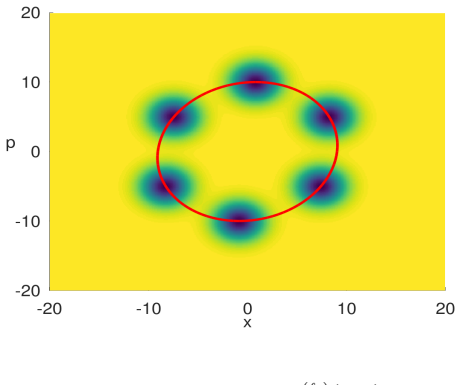
Numerically integrate the Lindblad equation from a Fock initial state $|1\rangle\langle 1|$, or another state outside the exponential-product family, under harmonic driving. If the Husimi distribution at long times is not the Gaussian $\frac{2\gamma}{\mu}\exp\left[-\frac{2\gamma}{\mu}|\alpha-\alpha^{(lc)}(t)|^2\right]$, the claim that all initial states converge to the quantum limit cycle fails.
Extended reading notes
Core claim
The core claim is form-invariance of the ansatz $\rho(t)=Z(t)e^{\beta(t)\hat{a}^{\dagger}}e^{\sigma(t)\hat{a}^{\dagger}\hat{a}}e^{\beta^{*}(t)\hat{a}}$ under the Lindblad equation for a damped, forced oscillator. Substitution reduces the operator equation to scalar differential equations: $\sigma$ is governed by a Riccati equation independent of the force, $\beta$ is proportional to the classical forced amplitude $\alpha(t)$, and $Z$ follows from a coherent-state trace. In the long-time limit with harmonic driving $f(t)=f_0\cos\Omega t$, the density operator becomes the displaced thermal state of Eq. (101) with Husimi distribution $\rho(\alpha,t)=\frac{2\gamma}{\mu}\exp\left[-\frac{2\gamma}{\mu}|\alpha-\alpha^{(lc)}(t)|^2\right]$. For $\nu=0$ this limit cycle is a pure coherent state, and the paper shows that the non-Hermitian Hamiltonian with complex frequency reproduces the Lindblad results in that case.
Load-bearing premise
The paper assumes, without proving, that every initial quantum state is pulled to the same final cycle; its explicit solution is constructed only for the special exponential-product (Gaussian) family of states.
Editorial extensions
If this is right
- Position, momentum, and occupation-number expectation values are obtained in closed form, with $\langle\hat{a}\rangle=\alpha(t)$ and $\langle\hat{n}\rangle=1/b-1+|\alpha(t)|^2$.
- The quantum limit cycle is a Gaussian in phase space whose width is fixed by the ratio $2\gamma/\mu$, independent of the driving strength.
- For $\nu=0$, any state in the solution class is driven into a coherent state, a pure quantum limit cycle.
- The entropy depends only on $\mu$ and $\nu$, not on the drive, and approaches $S_\infty=-(1/2\gamma)(\nu\log\nu-\mu\log\mu+2\gamma\log 2\gamma)$.
- The non-Hermitian Hamiltonian with complex frequency reproduces the Lindblad expectation values for $\nu=0$ and coherent initial states.
Reading between the lines
- If the contraction to the attractor holds for arbitrary initial states, preparing a Fock or superposition state should still end in the same Gaussian limit cycle; a persistent non-Gaussian tail after many drive periods would falsify the global claim.
- The same exponential-product decoupling should work for other force profiles, since the center $\alpha(t)$ is just the convolution of the force with the damped propagator.
- The fixed-width Gaussian structure suggests that quantum noise in this system is fully characterized by the two rates $\gamma$ and $\gamma'$, leaving the classical cycle shape untouched; extracting the width from measured Q-functions at several drive amplitudes would test this.
Signed reviews
Editorial analysis
A structured set of objections, weighed in public.
Referee Report
Summary. The paper studies the Lindblad master equation for a quantum harmonic oscillator with a classical driving force, in both the force-free and the harmonically driven cases. The main technical result is that the exponential-product ansatz ρ(t) = Z(t) exp[β(t)a†] exp[σ(t)a†a] exp[β*(t)a] is form-invariant under the Lindblad dynamics, leading to a closed system of ordinary differential equations for the parameters. For harmonic driving, the long-time limit of this Gaussian family is identified as a displaced thermal state, the quantum limit cycle, with the explicit Husimi distribution in Eq. (102). The paper also derives closed-form expressions for expectation values, the entropy, and the Husimi distribution, and compares the ν=0 case with a non-Hermitian Hamiltonian description. The presentation is pedagogical and the algebra is carried out in detail.
Significance. The algebraic derivation is careful, elementary, and self-contained, and it provides a useful closed-form example of a limit cycle in an open quantum system, which is rare in textbook-level literature. The explicit formulas for the Husimi distribution, the mean values, and the entropy, together with the exact solution of the Gaussian parameter equations, make the paper a valuable didactic reference. The comparison with non-Hermitian Hamiltonian dynamics for coherent initial states is also instructive. However, the paper's central claim that this solution represents the global quantum limit cycle for arbitrary initial states is not established by the derivation, and this gap affects the interpretation of the main result. The internal consistency of the Gaussian-family calculation is nonetheless sound, and the gap appears fixable by either adding a proof/reference for global attraction or by carefully restricting the claims to the special solution family.
major comments (1)
- [Section 4, after Eq. (100) and the ν=0 remark] The statement that 'the density operator converges for long times to the limit cycle distribution' is only demonstrated within the special Gaussian family (55). The analogous claim in the ν=0 paragraph, that 'any initial distribution is driven into a coherent state,' is even more explicitly global and is not supported by the derivation; the offered argument that coherent states remain coherent presupposes the uniqueness of the long-time limit, which is exactly what needs proof. Section 6 concedes that the analysis covers 'only a special class of solutions.' This is load-bearing because the title and abstract present the quantum limit cycle as a property of the damped and forced oscillator, not merely of a selected family of initial states. The authors should either prove (or cite a standard result for) the global attractivity of the periodic state, or restrict all long-time statements to the Gaussian family and remove the unqualified claim about arbitrary initial states.
minor comments (5)
- [Eq. (101)] As printed, the limit-cycle density operator ρ^(lc)(t) = (2γ/μ) e^{|α^(lc)(t)|^2} e^{βa†} e^{log(ν/μ)n} e^{β*a} is not normalized: using the trace formula (78) gives trace ≠ 1 unless the prefactor is e^{-(2γ/μ)|α^(lc)|^2}. This also follows from the general expression (89) with β = (2γ/μ)α and b = 2γ/μ, and is consistent with the Husimi distribution (102). Please correct the sign and coefficient in the exponential prefactor.
- [Eq. (68)] There appear to be typographical errors in the exponents: 'µβey' and 'µe2y' should be 'µβe^σ' and 'µe^{2σ}' respectively, consistent with the neighboring terms and with Eq. (66).
- [Section 5, paragraph after Eq. (120)] The sentence 'we find precise agreement if the Lindblad parameter ν is chosen as ν = 0 and therefore γ = μ' is incorrect: for ν = 0, the Lindblad parameters in Eq. (10) give μ = 2γ, not γ = μ. The agreement requires μ/2 = γ in the decay of ⟨a⟩ in Eqs. (29) and (113).
- [Eq. (92)] The intermediate expression '= b e^{-|β|^2/b+βα*+b|α|^2+β*α}' has the wrong sign on the b|α|^2 term; it should be '-b|α|^2'. The subsequent equality to a simple exponential is also missing the factors that are later included correctly in Eq. (94). Please revise this intermediate line to avoid confusion.
- [Figure 1 caption] The caption uses 'ω0' in the expression for the resonance frequency, while the main text (after Eq. (45)) uses 'ω' for the oscillator frequency. Please make the notation consistent.
Circularity Check
No circularity: the exponential-product solution and limit cycle are derived by direct operator algebra, with no fitted parameters and no load-bearing self-citation.
full rationale
The central derivation is self-contained. The exponential-product form (86) is an ansatz, not a fitted output: direct substitution into the Lindblad equation yields the coefficient equations (69)-(71), and the substitution β = α(1-u) reduces them to the linear equation (75) for α. The long-time limit then follows exactly, with u(t)→ν/μ and b(t)→2γ/μ, giving Eqs. (101)-(102). No parameter is fitted to the limit-cycle result; the Lindblad rates µ and ν are inputs, and the driving amplitude enters only through the solved linear response F(t). The citations to Fujii [2] and to the author's earlier work [15] are contextual or ancillary: the forced-solution derivation does not rest on them, and [15] is used only for a comparison in Sec. 5. The paper's assertion that all initial states converge to the Gaussian limit cycle is not proved, but that is an unproved uniqueness/contraction statement, not a reduction-by-construction or a fitted parameter renamed as a prediction. Hence there is no circular step to report.
Assumptions & free parameters
assumptions (3)
- domain assumption The Lindblad master equation (9) with jump operators a and a† models the damped harmonic oscillator.
- domain assumption The dynamics contracts all initial states to the special Gaussian limit-cycle solution.
- standard math Coherent-state completeness and the operator identities (58)-(61) hold.
Cite this review
Pith. "Pith review of Lindblad dynamics of the damped and forced quantum harmonic oscillator." pith.science (2026). https://pith.science/paper/YRMKG3SU
@misc{pith2026190801187,
  author       = {Pith},
  title        = {Pith review of: Lindblad dynamics of the damped and forced quantum harmonic oscillator},
  year         = {2026},
  howpublished = {\url{https://pith.science/paper/YRMKG3SU}},
  note         = {Machine review of arXiv:1908.01187}
}
read the original abstract
The quantum dynamics of a damped and forced harmonic oscillator is investigated in terms of a Lindblad master equation. Elementary algebraic techniques are employed allowing for example to analyze the long time behavior, i.e. the quantum limit cycle. The time evolution of various expectation values is obtained in closed form as well as the entropy and the Husimi phase space distribution. We also discuss the related description in terms of a non-Hermitian Hamiltonian.
Figures
Reference graph
Works this paper leans on
-
[1]
W. H. Louisell, Quantum Statistical Properties of Radiation, John Wiley, New York, 1973
work page 1973
-
[2]
Quantum Damped Harmonic Oscillator
K. Fujii, arXiv:1209.1437 (2012)
work page Pith review arXiv 2012
- [3]
-
[4]
Five Lectures On Dissipative Master Equations
B.-G. Englert and G. Morigi, arXiv:quant-ph/0206116 (2012)
work page Pith review arXiv 2012
- [5]
- [6]
-
[7]
Breuer and F
H.-P. Breuer and F. Petruccione, The Theory of Open Quantum Systems , Oxford University Press, Oxford, 2002
2002
-
[8]
H. J. Korsch and K. Rapedius, Europ. J. Phys. 37 (2016) 055410 23
work page 2016
Show all 15 references
-
[9]
R. Endo, K. Fujii, and T. Suzuki, arXiv:0710.2724 (2012)
2012 arXiv
- [10]
-
[11]
Steeb and Y
W.-H. Steeb and Y. Hardy, Matrix Calculus and Kronecker Product , World Scientific, Singapore, 2011
2011
-
[12]
Am-Shallem, A
M. Am-Shallem, A. Levy, I. Schaefer, and R. Kosloff, arXiv:1510.08634v2 (2015)
2015 arXiv
-
[13]
M. Ban, J. Math. Phys. 33 (1992) 3213
1992
-
[14]
Isar, Fortschr
A. Isar, Fortschr. Phys. 47 (1999) 855
1999
-
[15]
E. M. Graefe, M. H¨ oning, and H. J. Korsch, J. Phys. A43 (2010) 075306 24
2010
Reviewed August 14, 2026 · model on record in the stance chip above.
Discussion (0). Continue with ORCID to comment.