REVIEW 5 major objections 8 minor 59 references
Frequency-Based Reservoir computing
T0 review · 5 major / 8 minor · reviewed 2026-07-31 · grok-4.5
Pith's one-line read Reservoirs built from independent oscillators store input frequencies by selective amplification and can be tuned for short-term chaotic forecasting.
desk verdict Clean block-diagonal oscillatory reservoir with a usable short-term knob; mechanism is spectral evidence, not a prediction theorem, and novelty sits inside an already busy oscillatory-RC lane. read the letter →
The pith
A machine-rendered reading of the paper's core claim, the machinery that carries it, and where it could break.
The reading
What carries the argument
Selective frequency amplification: each two-node unit, treated as a nonlinear oscillator forced by the input, preferentially boosts spectral content near its intrinsic frequency (visible in power-spectrum heat maps), so the full reservoir stores the input as a bank of frequency-specific traces that a linear readout can recombine.
What would settle it
Build a frequency-based reservoir whose intrinsic frequencies are deliberately mistuned away from the input’s dominant bands and check whether closed-loop short- and long-term forecast error rises sharply relative to a matched random reservoir and to a correctly tuned frequency roster on the same Lorenz or Mackey–Glass task.
Extended reading notes
Core claim
A reservoir whose recurrent layer is an ensemble of independent oscillatory units with prescribed intrinsic frequencies selectively amplifies and stores input frequency components near each unit’s frequency; the stored content is sufficient for linear-readout prediction of chaotic time series, matches or exceeds equivalent random reservoirs, and can be optimized by reshaping the frequency roster to improve short-term forecasts.
Load-bearing premise
That the selective amplification seen in the power spectra is what actually makes the linear readout succeed on continuous-spectrum chaos, and that comparing architectures under the same hand-chosen hyperparameters fairly isolates the design rather than residual tuning.
Editorial extensions
If this is right
- Hyperparameters (leaky rate, spectral radius, input gain, noise) acquire direct physical meaning as scalers of the intrinsic-frequency bank and of the forced-oscillator regime, so they can be chosen from spectral theory rather than black-box search.
- Coupling among units is optional; computation occurs at the unit level, which simplifies hardware and neuromorphic realizations to banks of independent oscillators.
- Short-term prediction can be improved by deliberately over-representing high intrinsic frequencies when the target has fast content—an optimization path random reservoirs do not expose.
- The same construction extends to spatiotemporal chaos (Kuramoto–Sivashinsky), indicating the mechanism is not limited to low-dimensional scalar series.
Reading between the lines
- If unit-level storage is sufficient, the minimal number of oscillators needed for a given chaotic attractor should scale with the number of dominant spectral bands rather than with embedding dimension, a testable scaling law the paper leaves open.
- The same frequency-roster design could be dropped into other untrained recurrent architectures (beyond classical reservoirs) wherever interpretability and short-horizon tuning matter.
- Noise’s dual role—sustaining fast decaying modes while breaking overly coherent slow modes—suggests an optimal noise schedule that tracks the target’s spectral tilt, not a single scalar intensity.
Editorial analysis
A structured set of objections, weighed in public.
Referee Report
Summary. The manuscript proposes a "frequency-based reservoir computer": a recurrent layer whose connectivity matrix is block-diagonal with 2×2 rotation-scaling blocks, so that the reservoir is an ensemble of independent damped oscillatory units (motivated by Wilson–Cowan E–I pairs), each with a prescribed intrinsic frequency ω_k drawn from a roster spanning [ω_min, ω_max]. Only a linear readout (minimum-norm least squares) is trained. The paper claims three things: (i) driven units selectively amplify input frequency components near their intrinsic frequency — shown via pwelch heat maps for synthetic periodic, Mackey-Glass, and Lorenz-63 inputs; (ii) this reservoir performs as well as or better than a random reservoir of matched size and connection count on Mackey-Glass, Lorenz-63, and Kuramoto-Sivashinsky closed-loop forecasting; (iii) the frequency roster can be reshaped to improve short-term Lorenz prediction, an optimization capability asserted to be absent in random reservoirs. The architecture is clean, sparse (4N−1 connections), and the empirical demonstrations are plausible, but the mechanistic claim is supported only qualitatively and the comparative claims rest on thin statistics and a possibly unfair baseline protocol.
Significance. If the claims hold up, the paper offers a genuinely interpretable reservoir design: an extremely sparse recurrent layer (4N−1 connections for N units, vs. O(N²) in standard ESNs) whose hyperparameters all carry physical meaning (leak α scales intrinsic frequencies, spectral radius sets ω_max, input scale ε controls the linear/nonlinear response regime). The uncoupled-oscillator construction is simple enough to be reproducible from the text, is directly relevant to neuromorphic implementations, and the short-term-forecast result in Fig. 7f with statistics over 500 initial conditions is the kind of falsifiable, quantified evidence the field values. The selective-amplification picture, if made quantitative, would be a useful handle on a long-standing interpretability problem. Impact is moderate: the architecture is close in spirit to existing oscillator reservoirs, and the practical performance advantage over tuned ESNs is not yet demonstrated.
major comments (5)
- [§II, Figs. 4-6] §II, 'Selective frequency amplification as a mechanism for chaotic time series prediction' (Figs. 4–6): the central mechanistic claim rests entirely on qualitative pwelch heat maps. The load-bearing inference — 'when the reservoir is sufficiently large ... a simple linear combination W_out r(t) should be enough to recover all the information about the input' — is asserted, not demonstrated. For a broadband (continuous-spectrum) input like Mackey-Glass or Lorenz-63, amplification of components near intrinsic ω_k does not by itself imply the readout can reconstruct u(t+1); one needs a quantitative link between the units' frequency responses and prediction error. A concrete test would be: (i) measure each unit's effective transfer function under the actual driving input; (ii) correlate per-band readout weight magnitude |W_out| with amplification; and (iii) ablate units in a frequency band a
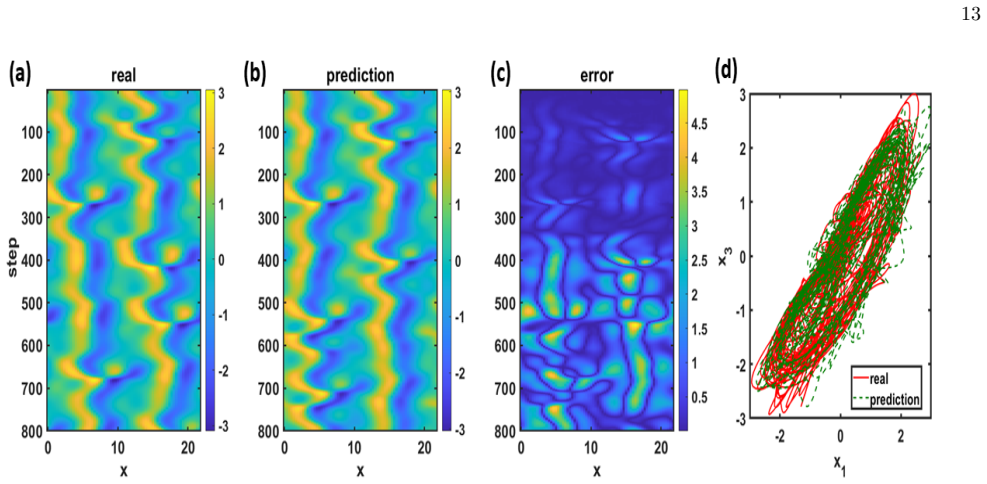
- [Fig. 3, Fig. 8, §II] The comparative claim 'performs as well as or better than equivalent random reservoirs' is supported only by single-trajectory plots. Fig. 3 shows one Mackey-Glass and one Lorenz-63 closed-loop run with no error metric; only Fig. 7f gives statistics (mean±std over 500 ICs), and only for the short-term Lorenz task. Fig. 8 (Kuramoto-Sivashinsky) reports no random-reservoir baseline at all, despite the same-comparison framing used elsewhere. Standard quantitative metrics (valid time in Lyapunov units, NRMSE with dispersion over initial conditions and over reservoir/input-matrix realizations — note W_in is random even for the frequency-based reservoir) should be reported for all three systems, otherwise the headline comparison is not evaluable.
- [Fig. 7, 'Optimizing the Frequency-based reservoir'] Fig. 7 and the associated text: the claim that the frequency-based reservoir 'can be optimized to improve short-term prediction, a property that random reservoirs lack' is not supported by the protocol used. The random reservoir in Fig. 7f is a single default configuration (fixed α, ρ, ε, σ, degree q), while the frequency-based reservoir is optimized by reshaping the ω_k roster after observing the default's test performance. Random reservoirs are routinely optimized for short-term prediction by tuning exactly these hyperparameters (the manuscript itself cites Bayesian optimization and the noise-resonance work of Zhai et al. [32]); reshaping the roster has the same epistemic status as tuning ρ. The comparison needed is the optimized frequency-based reservoir against a comparably optimized random reservoir (e.g., grid/random search over ρ, α, ε, σ with the same evaluation budget), or a cle
- [Methods, 'Forecasting the Lorenz-63 chaotic system'] Methods, Lorenz-63 subsection: the input is stated as u = [x(t), y(t), x(t)]; the third component is presumably z(t) (consistent with the §II discussion of the z-component's dominant spectral peak and with Eqs. 12–14). If the duplication of x is a typo, it must be corrected; if the model was genuinely trained on [x, y, x], the Lorenz-63 results are not forecasting the full system and the attractor reconstruction in Fig. 3f is misleading. Please clarify which was used.
- [Methods, Eq. (8)-(9)] Eq. (8) and surrounding text: the Jacobian is given as J = (1−α)I + αA, which is exact only if the derivative of tanh is replaced by 1, i.e., linearization at r = 0. Under driving, r(t) is generically nonzero and the actual instantaneous Jacobian is (1−α)I + α diag(sech²(...)) A, so the prescribed eigenvalues (and hence the intrinsic frequencies f_k of Eq. 9) are only nominal. Since the entire interpretability framework hangs on units oscillating at prescribed frequencies, the text should state this approximation explicitly and quantify how much the realized oscillation frequencies deviate from f_k under the chaotic inputs used (this can be read off the Fig. 5/6 heat maps, which would strengthen the paper). Relatedly, the eigenvalue formula below Eq. (8) reads '(1+α) + αν_k ± jαω_k'; the first term should be (1−α).
minor comments (8)
- [Fig. 4 caption] Fig. 4 caption: panel labels are inconsistent — '(c) log(Power) for large amplitude values ε = 0.1' should presumably be ε = 0.5, and panels (g) and (h) are both labeled ε = 0.5 while the text describes (g) as intermediate. Please correct the ε values in the caption.
- [§II; Methods; Fig. 7] Unit/node bookkeeping is inconsistent throughout: §II defines N = 301 units (601 nodes), but Methods says 'N = 301 units, which corresponds to 2N−1 = 601 units' (should be nodes), and the Fig. 7 subsection says 'the network size was also reduced to N = 301' while the Fig. 7 caption gives N = 150 for panel (b). Please state units vs. nodes unambiguously at each occurrence.
- [§II (optimization, KS paragraphs); Methods] Broken cross-references: the optimization section cites 'Fig.6-(f)' and '(Fig.6)' where Fig. 7(f) and Fig. 7(b/e) are meant; the KS section refers to 'Fig.3-(b)', 'Fig.3-(c)', 'Fig.3-(d)' where Fig. 8(b,c,d) is intended; and Methods says the Mackey-Glass attractor is 'Fig.8-(c)' where Fig. 3(c) is meant.
- [Various] Spelling: 'Kuramoto-Shivanski' (§II) and 'Kuramoto-Sivashinki' (Methods heading) should both be 'Kuramoto-Sivashinsky'. Also 'RESUL TS' heading, 'the magic relies on hyperparameter optimization' (informal), and 'a reservoir computing trains' in the abstract.
- [§III Discussion] Discussion: the claim '2N ≤ 2p, where N is the number of units and p the number of harmonics' reduces trivially to N ≤ p; presumably a sharper bound was intended. Also 'essential property for brain computation' and similar promotional phrasing could be toned down.
- [Methods; 'Properties of the frequency-based reservoir'] The effective-noise discussion (Methods) notes the actual noise intensity is ϵσ scaled by a uniform random factor, i.e., heterogeneous per node; this deserves mention when the optimal-σ results are discussed, since σ spans 10^−7 to 10^−1 across tasks — a five-order-of-magnitude range that is itself a significant hyperparameter sensitivity worth reporting.
- [§I/§III] Related work: the reservoir here is an ensemble of uncoupled driven damped oscillators; the connection to filter-bank / random-feature views of echo-state networks and to classical tapped-delay embeddings would help position the novelty of the 'selective amplification' framing relative to known resonance behavior of driven leaky units.
- [References] References [36] and [52] are the same Strogatz book cited twice; [10] is an arXiv preprint — check whether a published version exists.
Circularity Check
No load-bearing circularity: mechanism is observed forced-oscillator response plus standard RC readout; closed-loop forecasts are not forced by construction.
-
other
[§II Optimizing the Frequency-based reservoir; Fig. 7(b–f)]
"We found that under the default connectivity (Fig.7-(b)), the frequency-based reservoir performs worse than the random reservoir (Fig.6-(f)). The default connectivity leads to an overrepresentation of units with low intrinsic frequencies... To address the overrepresentation... we reshape the connectivity so that half of the units with low intrinsic frequencies now have the same higher intrinsic frequencies as the remaining units. This new configuration... significantly overperforms the random reservoir (Fig.7-(f))."
The frequency roster used to claim that FBRC ‘can be optimized’ for short-term Lorenz prediction is chosen after observing default failure and the same spectral over-processing of low frequencies that the paper treats as the operative mechanism. This is mild post-hoc task-specific redesign, not a fit-equals-prediction identity, and does not make the closed-loop scores tautological.
full rationale
The paper’s chain is architectural design → empirical power-spectrum observation → linear readout training → held-out closed-loop testing. The recurrent matrix A is prescribed with complex-conjugate blocks (Eq. 3) so that units have chosen intrinsic frequencies; selective frequency amplification is then read off heat maps of driven units (Figs. 4–6) and identified with multi-frequency nonlinear resonance—an interpretive label for a known forced-oscillator effect, not a quantity fitted to the forecast target and re-exported as a prediction. W_out is ordinary least-squares (lsqminnorm) on training states; test performance is closed-loop trajectory/attractor error on Mackey–Glass, Lorenz-63, and KS, which is not equal to the training residual by construction. Self-citations ([34],[35],[49]) support the noise/rhythm interpretation only and are not used as uniqueness theorems that force the architecture. The sole mild concern is that the short-term Lorenz frequency-roster “optimization” (Fig. 7) is redesigned after default underperformance and after inspecting the same spectra used to narrate the mechanism; that is post-hoc architecture search informed by the task spectrum, not a fitted parameter renamed as an independent prediction. Overall the central claims remain externally testable and are not definitionally equivalent to their inputs.
Assumptions & free parameters
free parameters (7)
- leaky rate α =
0.5 (main text)
- spectral radius ρ / ω_max roster =
task-dependent; default spectrum in Fig. 2
- input scale ε =
0.05 (MG example)
- noise intensity σ =
task-specific (Methods)
- reservoir size N (units) =
301 (main low-D); 2201 (KS)
- random reservoir degree q =
q≈0.00525 (MG); 0.0067 (Lorenz short)
- short-term Lorenz frequency reshape =
hand redesign in Fig. 7c
assumptions (5)
- domain assumption Standard discrete leaky reservoir update r←(1−α)r+α tanh(Ar+Win u) with linear readout trained by least squares.
- ad hoc to paper A block-diagonal matrix of 2×2 rotation-scaling blocks with complex-conjugate eigenvalues is a valid untrained reservoir recurrent layer.
- ad hoc to paper Coupling between units is optional because computation occurs at the unit level; uncoupled ensembles suffice.
- ad hoc to paper Power spectral density structure of driven units (selective peaks near intrinsic ω) explains information storage used by the linear readout for chaotic prediction.
- domain assumption Brain hierarchy of timescales and Wilson-Cowan E-I oscillation motivate but need not equal the implemented tanh blocks.
invented entities (2)
-
Frequency-based reservoir (ensemble of independent prescribed-frequency E-I units)
-
Selective frequency amplification mechanism
Cite this review
Pith. "Pith review of Frequency-Based Reservoir computing." pith.science (2026). https://pith.science/paper/YRMPSKKD
@misc{pith2026260724420,
  author       = {Pith},
  title        = {Pith review of: Frequency-Based Reservoir computing},
  year         = {2026},
  howpublished = {\url{https://pith.science/paper/YRMPSKKD}},
  note         = {Machine review of arXiv:2607.24420}
}
read the original abstract
Reservoir computing has emerged as an efficient machine learning framework for predicting time series generated by dynamical systems. In contrast to other machine and deep learning approaches, a reservoir computing trains only the output layer via linear regression, leaving the reservoir (recurrent layer) untrained. This simplification makes reservoir computers easier to train and more amenable to experimentation. However, because current reservoirs consist of networks of randomly connected nodes and require the optimization of numerous hyperparameters, a framework that precisely explains how reservoir computing operates and how it can be optimized remains missing. Here, we propose a frequency-based reservoir inspired by the brain's oscillatory dynamics and its hierarchy of timescales. The frequency-based reservoir can be interpreted as an ensemble of independent oscillatory units, each processing a portion of the input's frequency content. This allows us to understand the reservoir's internal behavior by modeling it as a single unit driven by an external input. Borrowing from the theory of a nonlinear oscillator forced by complex periodic inputs, we found that units of the frequency-based reservoir selectively amplify and store specific input frequencies, which are then used for prediction. The frequency-based reservoir performs as well as or better than equivalent random reservoirs. Furthermore, the frequency-based approach can be optimized to improve short-term prediction, a property that random reservoirs lack. Finally, we show that the frequency-based reservoir can also predict complex spatiotemporal dynamics. Our results show that reservoir computing can be designed using brain properties and theoretical insights borrowed from the physics of forced nonlinear oscillators.
Figures


Figures from the paper (5 more)


Reference graph
Works this paper leans on
-
[32]
Emergence of a resonance in machine learning,
Zheng-Meng Zhai, Ling-Wei Kong, and Ying-Cheng Lai, “Emergence of a resonance in machine learning,” Physical Review Research5, 033127 (2023)
2023
-
[1]
The “echo state
Herbert Jaeger, “The “echo state” approach to analysing and training recurrent neural networks-with an erratum note,” Bonn, Germany: German national research center for information technology gmd technical report148, 13 (2001)
2001
-
[2]
Harnessing nonlinearity: Predicting chaotic systems and saving energy in wireless communication,
Herbert Jaeger and Harald Haas, “Harnessing nonlinearity: Predicting chaotic systems and saving energy in wireless communication,” science304, 78–80 (2004)
2004
-
[3]
Optimization and applications of echo state networks with leaky-integrator neurons,
Herbert Jaeger, Mantas Lukoˇ seviˇ cius, Dan Popovici, and Udo Siewert, “Optimization and applications of echo state networks with leaky-integrator neurons,” Neural networks20, 335–352 (2007)
2007
-
[4]
Reservoir computing approaches to recurrent neural network training,
Mantas Lukoˇ seviˇ cius and Herbert Jaeger, “Reservoir computing approaches to recurrent neural network training,” Com- puter science review3, 127–149 (2009)
2009
-
[5]
Recent advances in physical reservoir computing: A review,
Gouhei Tanaka, Toshiyuki Yamane, Jean Benoit H´ eroux, Ryosho Nakane, Naoki Kanazawa, Seiji Takeda, Hidetoshi Nu- mata, Daiju Nakano, and Akira Hirose, “Recent advances in physical reservoir computing: A review,” Neural Networks 115, 100–123 (2019)
2019
-
[6]
Real-time computing without stable states: A new frame- work for neural computation based on perturbations,
Wolfgang Maass, Thomas Natschl¨ ager, and Henry Markram, “Real-time computing without stable states: A new frame- work for neural computation based on perturbations,” Neural computation14, 2531–2560 (2002)
2002
-
[7]
Boosting reservoir computing with brain-inspired adaptive control of ei balance,
Keshav Srinivasan, Dietmar Plenz, and Michelle Girvan, “Boosting reservoir computing with brain-inspired adaptive control of ei balance,” Nature Communications16, 10212 (2025)
2025
Show all 59 references
-
[8]
Random oscillators network for time series processing,
Andrea Ceni, Andrea Cossu, Maximilian W St¨ olzle, Jingyue Liu, Cosimo Della Santina, Davide Bacciu, and Claudio Gallicchio, “Random oscillators network for time series processing,” inInternational Conference on Artificial Intelligence and Statistics(PMLR, 2024) pp. 4807–4815
2024
-
[9]
The functional role of oscillatory dynamics in neocor- tical circuits: a computational perspective,
Felix Effenberger, Pedro Carvalho, Igor Dubinin, and Wolf Singer, “The functional role of oscillatory dynamics in neocor- tical circuits: a computational perspective,” Proceedings of the National Academy of Sciences122, e2412830122 (2025)
2025
-
[10]
Brain-inspired interpretable reservoir computing with resonant recurrent neural networks,
Mark A Kramer, “Brain-inspired interpretable reservoir computing with resonant recurrent neural networks,” arXiv preprint arXiv:2506.17083 (2025)
2025
-
[11]
Gyorgy Buzsaki,Rhythms of the Brain(Oxford University Press, 2006)
2006
-
[12]
Stochastic generation of gamma-band activity in primary visual cortex of awake and anesthetized monkeys,
Dajun Xing, Yutai Shen, Samuel Burns, Chun-I Yeh, Robert Shapley, and Wu Li, “Stochastic generation of gamma-band activity in primary visual cortex of awake and anesthetized monkeys,” Journal of Neuroscience32, 13873–13880a (2012)
2012
-
[13]
Is gamma-band activity in the local field potential of v1 cortex a “clock
Samuel P Burns, Dajun Xing, and Robert M Shapley, “Is gamma-band activity in the local field potential of v1 cortex a “clock” or filtered noise?” Journal of Neuroscience31, 9658–9664 (2011)
2011
-
[14]
Neurophysiological and computational principles of cortical rhythms in cognition,
Xiao-Jing Wang, “Neurophysiological and computational principles of cortical rhythms in cognition,” Physiological reviews 90, 1195–1268 (2010)
2010
-
[15]
A mechanism for cognitive dynamics: neuronal communication through neuronal coherence,
Pascal Fries, “A mechanism for cognitive dynamics: neuronal communication through neuronal coherence,” Trends in 22 cognitive sciences9, 474–480 (2005)
2005
-
[16]
Rhythms for cognition: communication through coherence,
Pascal Fries, “Rhythms for cognition: communication through coherence,” Neuron88, 220–235 (2015)
2015
-
[17]
Flexible information routing by transient syn- chrony,
Agostina Palmigiano, Theo Geisel, Fred Wolf, and Demian Battaglia, “Flexible information routing by transient syn- chrony,” Nature neuroscience20, 1014 (2017)
2017
-
[18]
Attentional stimulus selection through selective synchronization between monkey visual areas,
Conrado A Bosman, Jan-Mathijs Schoffelen, Nicolas Brunet, Robert Oostenveld, Andre M Bastos, Thilo Womelsdorf, Birthe Rubehn, Thomas Stieglitz, Peter De Weerd, and Pascal Fries, “Attentional stimulus selection through selective synchronization between monkey visual areas,” Neu...
2012
-
[19]
Successful execution of working memory linked to synchronized high-frequency gamma oscillations,
Jun Yamamoto, Junghyup Suh, Daigo Takeuchi, and Susumu Tonegawa, “Successful execution of working memory linked to synchronized high-frequency gamma oscillations,” Cell157, 845–857 (2014)
2014
-
[20]
Gamma and beta bursts underlie working memory,
Mikael Lundqvist, Jonas Rose, Pawel Herman, Scott L Brincat, Timothy J Buschman, and Earl K Miller, “Gamma and beta bursts underlie working memory,” Neuron90, 152–164 (2016)
2016
-
[21]
A hierarchy of temporal receptive windows in human cortex,
Uri Hasson, Eunice Yang, Ignacio Vallines, David J Heeger, and Nava Rubin, “A hierarchy of temporal receptive windows in human cortex,” Journal of neuroscience28, 2539–2550 (2008)
2008
-
[22]
A hierarchy of intrinsic timescales across primate cortex,
John D Murray, Alberto Bernacchia, David J Freedman, Ranulfo Romo, Jonathan D Wallis, Xinying Cai, Camillo Padoa- Schioppa, Tatiana Pasternak, Hyojung Seo, Daeyeol Lee,et al., “A hierarchy of intrinsic timescales across primate cortex,” Nature neuroscience17, 1661–1663 (2014)
2014
-
[23]
Distinct timescales of population coding across cortex,
Caroline A Runyan, Eugenio Piasini, Stefano Panzeri, and Christopher D Harvey, “Distinct timescales of population coding across cortex,” Nature548, 92–96 (2017)
2017
-
[24]
Multiple timescales of neural dynamics and integration of task-relevant signals across cortex,
Mehran Spitmaan, Hyojung Seo, Daeyeol Lee, and Alireza Soltani, “Multiple timescales of neural dynamics and integration of task-relevant signals across cortex,” Proceedings of the National Academy of Sciences117, 22522–22531 (2020)
2020
-
[25]
Survey of spiking in the mouse visual system reveals functional hierarchy,
Joshua H Siegle, Xiaoxuan Jia, S´ everine Durand, Sam Gale, Corbett Bennett, Nile Graddis, Greggory Heller, Tamina K Ramirez, Hannah Choi, Jennifer A Luviano,et al., “Survey of spiking in the mouse visual system reveals functional hierarchy,” Nature592, 86–92 (2021)
2021
-
[26]
Intrinsic timescales as an organizational principle of neural processing across the whole rhesus macaque brain,
Ana MG Manea, Anna Zilverstand, Kamil Ugurbil, Sarah R Heilbronner, and Jan Zimmermann, “Intrinsic timescales as an organizational principle of neural processing across the whole rhesus macaque brain,” Elife11, e75540 (2022)
2022
-
[27]
Hierarchical timescales in the neocortex: Mathematical mechanism and biological insights,
Songting Li and Xiao-Jing Wang, “Hierarchical timescales in the neocortex: Mathematical mechanism and biological insights,” Proceedings of the National Academy of Sciences119, e2110274119 (2022)
2022
-
[28]
Excitatory and inhibitory interactions in localized populations of model neurons,
Hugh R Wilson and Jack D Cowan, “Excitatory and inhibitory interactions in localized populations of model neurons,” Biophysical journal12, 1–24 (1972)
1972
-
[29]
Emergent oscillations in networks of stochastic spiking neurons,
Edward Wallace, Marc Benayoun, Wim Van Drongelen, and Jack D Cowan, “Emergent oscillations in networks of stochastic spiking neurons,” Plos one6(2011)
2011
-
[30]
Oscillation and chaos in physiological control systems,
Michael C Mackey and Leon Glass, “Oscillation and chaos in physiological control systems,” Science197, 287–289 (1977)
1977
-
[31]
Deterministic nonperiodic flow 1,
Edward N Lorenz, “Deterministic nonperiodic flow 1,” inUniversality in Chaos, 2nd edition(Routledge, 2017) pp. 367–378
2017
-
[33]
Spontaneous variability in gamma dynamics described by a damped harmonic oscillator driven by noise,
Georgios Spyropoulos, Matteo Saponati, Jarrod Robert Dowdall, Marieke Louise Sch¨ olvinck, Conrado Arturo Bosman, Bruss Lima, Alina Peter, Irene Onorato, Johanna Klon-Lipok, Rasmus Roese,et al., “Spontaneous variability in gamma dynamics described by a damped harmonic oscillat...
2022
-
[34]
Determinants of brain rhythm burst statistics,
Arthur S Powanwe and Andr´ e Longtin, “Determinants of brain rhythm burst statistics,” Scientific Reports9, 1–23 (2019)
2019
-
[35]
Amplitude-phase description of stochastic neural oscillators across the hopf bifurcation,
Arthur S Powanwe and Andr´ e Longtin, “Amplitude-phase description of stochastic neural oscillators across the hopf bifurcation,” Physical Review Research3, 033040 (2021)
2021
-
[36]
Nonlinear dynamics and chaos: with applications to physics, biology, chemistry, and engineering (studies in nonlinearity),
Stephen Strogatz, “Nonlinear dynamics and chaos: with applications to physics, biology, chemistry, and engineering (studies in nonlinearity),” (2001). 23
2001
-
[37]
Amplified biochemical oscillations in cellular systems,
Alan J McKane, James D Nagy, Timothy J Newman, and Marianne O Stefanini, “Amplified biochemical oscillations in cellular systems,” Journal of Statistical Physics128, 165–191 (2007)
2007
-
[38]
Fluctuations and oscillations in a simple epidemic model,
Ganna Rozhnova and Ana Nunes, “Fluctuations and oscillations in a simple epidemic model,” Physical Review E79, 041922 (2009)
2009
-
[39]
Predator-prey cycles from resonant amplification of demographic stochasticity,
Alan J McKane and Timothy J Newman, “Predator-prey cycles from resonant amplification of demographic stochasticity,” Physical review letters94, 218102 (2005)
2005
-
[40]
Modelling biochemical oscillations and cellular rhythms,
Albert Goldbeter, “Modelling biochemical oscillations and cellular rhythms,” Current Science , 933–939 (1997)
1997
-
[41]
Albert Goldbeter,Biochemical oscillations and cellular rhythms: the molecular bases of periodic and chaotic behaviour (Cambridge university press, 1997)
1997
-
[42]
Synchronization and rhythmic processes in physiology,
Leon Glass, “Synchronization and rhythmic processes in physiology,” Nature410, 277–284 (2001)
2001
-
[43]
Waves traveling over a map of visual space can ignite short-term predictions of sensory input,
Gabriel B Benigno, Roberto C Budzinski, Zachary W Davis, John H Reynolds, and Lyle Muller, “Waves traveling over a map of visual space can ignite short-term predictions of sensory input,” Nature Communications14, 3409 (2023)
2023
-
[44]
Image segmentation with traveling waves in an exactly solvable recurrent neural network,
Luisa HB Liboni, Roberto C Budzinski, Alexandra N Busch, Sindy L¨ owe, Thomas A Keller, Max Welling, and Lyle E Muller, “Image segmentation with traveling waves in an exactly solvable recurrent neural network,” Proceedings of the National Academy of Sciences122, e2321319121 (2025)
2025
-
[45]
Next generation reservoir computing,
Daniel J Gauthier, Erik Bollt, Aaron Griffith, and Wendson AS Barbosa, “Next generation reservoir computing,” Nature communications12, 5564 (2021)
2021
-
[46]
Local exponents of nonlinear compression in periodically driven noisy oscillators,
Benjamin Lindner, Kai Dierkes, and Frank J¨ ulicher, “Local exponents of nonlinear compression in periodically driven noisy oscillators,” Physical review letters103, 250601 (2009)
2009
-
[47]
Coupled oscillatory recurrent neural network (cornn): An accurate and (gradient) stable architecture for learning long time dependencies,
T Konstantin Rusch and Siddhartha Mishra, “Coupled oscillatory recurrent neural network (cornn): An accurate and (gradient) stable architecture for learning long time dependencies,” arXiv preprint arXiv:2010.00951 (2020)
2010 arXiv
-
[48]
Graph-coupled oscillator networks,
T Konstantin Rusch, Ben Chamberlain, James Rowbottom, Siddhartha Mishra, and Michael Bronstein, “Graph-coupled oscillator networks,” inInternational Conference on Machine Learning(PMLR, 2022) pp. 18888–18909
2022
-
[49]
Brain rhythm bursts are enhanced by multiplicative noise,
Arthur S Powanwe and Andr´ e Longtin, “Brain rhythm bursts are enhanced by multiplicative noise,” Chaos: An Interdis- ciplinary Journal of Nonlinear Science31(2021)
2021
-
[50]
On the influence of amplitude on the connectivity between phases,
Andreas Daffertshofer and Bernadette van Wijk, “On the influence of amplitude on the connectivity between phases,” Frontiers in neuroinformatics5, 6 (2011)
2011
-
[51]
Dynamics of gamma bursts in local field potentials,
Priscilla E Greenwood, Mark D McDonnell, and Lawrence M Ward, “Dynamics of gamma bursts in local field potentials,” Neural computation27, 74–103 (2015)
2015
-
[52]
Nonlinear dynamics and chaos: with applications to physics,
Steven H Strogatz, “Nonlinear dynamics and chaos: with applications to physics,” Biology, Chemistry and Engineering , 1 (1994)
1994
-
[53]
3 (springer Berlin, 1985)
Crispin W Gardineret al.,Handbook of stochastic methods, Vol. 3 (springer Berlin, 1985)
1985
-
[54]
A kuramoto coupling of quasi-cycle oscillators with application to neural networks,
Priscilla E Greenwood, Mark D McDonnell, and Lawrence M Ward, “A kuramoto coupling of quasi-cycle oscillators with application to neural networks,” Journal of Coupled Systems and Multiscale Dynamics4, 1–13 (2016)
2016
-
[55]
Phase dynamics of delay-coupled quasi-cycles with application to brain rhythms,
Arthur S Powanwe and Andr´ e Longtin, “Phase dynamics of delay-coupled quasi-cycles with application to brain rhythms,” Physical Review Research2, 043067 (2020)
2020
-
[56]
An exact mathematical description of computation with transient spatiotemporal dynamics in a complex-valued neural network,
Roberto C Budzinski, Alexandra N Busch, Samuel Mestern, Erwan Martin, Luisa HB Liboni, Federico W Pasini, J´ an Min´ aˇ c, Todd Coleman, Wataru Inoue, and Lyle E Muller, “An exact mathematical description of computation with transient spatiotemporal dynamics in a complex-value...
2024
-
[57]
Deep oscillatory neural network,
Nurani Rajagopal Rohan, C Vigneswaran, Sayan Ghosh, Kishore Rajendran, A Gaurav, and V Srinivasa Chakravarthy, “Deep oscillatory neural network,” Scientific Reports15, 40968 (2025)
2025
-
[58]
Neural wave machines: learning spatiotemporally structured representations with locally coupled oscillatory recurrent neural networks,
T Anderson Keller and Max Welling, “Neural wave machines: learning spatiotemporally structured representations with locally coupled oscillatory recurrent neural networks,” inInternational Conference on Machine Learning(PMLR, 2023) 24 pp. 16168–16189
2023
-
[59]
Circadian clocks limited by noise,
Naama Barkai and Stanislas Leibler, “Circadian clocks limited by noise,” Nature403, 267–268 (2000)
2000
Reviewed July 31, 2026 · model on record in the stance chip above.
Discussion (0). Continue with ORCID to comment.