REVIEW 3 major objections 4 minor 27 references
Prediction of the SVOM MXT camera end of life spectral performance based on proton irradiation results
T0 review · 3 major / 4 minor · reviewed 2026-08-07 · deepseek-v4-flash
Pith's one-line read After three years' worth of proton damage, the SVOM MXT detector, once corrected for charge-transfer inefficiency, is predicted to stay below the 200 eV energy-resolution limit and still detect 200 eV photons.
desk verdict Solid irradiation study with a genuinely new CTI-energy inversion; the compliance claim holds with margin, but the unaddressed year-long room-temperature annealing of the spare and a fluence model with no uncertainty are the places to push. read the letter →
The pith
A machine-rendered reading of the paper's core claim, the machinery that carries it, and where it could break.
The reading
What carries the argument
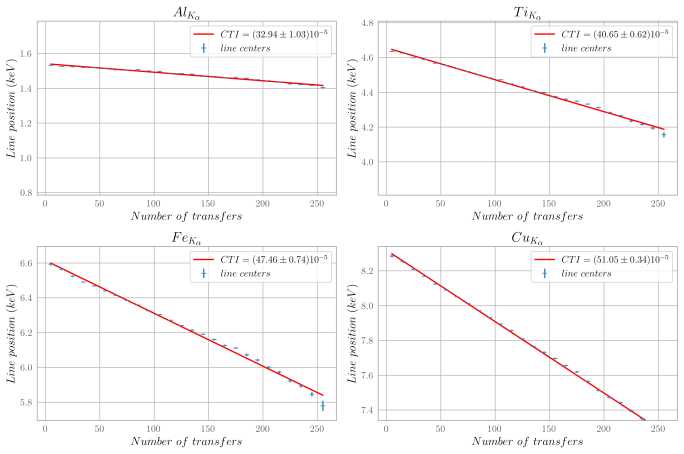
The argument is carried by a 256x256 pixel pnCCD detector (a fully depleted charge-coupled device built from pn junctions) and by one measured quantity, the charge transfer inefficiency $\mathrm{CTI} = \alpha / E_0$, the fractional charge lost per row transfer, obtained from the slope of spectral-line centroids versus the number of transfers. The paper measures CTI over the 0.2-1.9 keV range with a monoenergetic synchrotron beam and over 1.5-8 keV with an X-ray fluorescence source, fits linear CTI$(E)$ laws, and applies an iterative column-by-column correction $E_{\mathrm{corrected}} = E_{\mathrm{raw}} / \mathrm{CTE}^{255-j}$ that alternates gain and offset calibration with CTI estimation until CTI falls below $10^{-5}$. The energy resolution after correction is then fitted with a Crystal-ball function, which handles the asymmetric low-energy tails produced by trapping. A half-shielded detector geometry provides an internal non-irradiated reference, and two sources with different fluxes expose a trap-filling effect that determines which CTI law is used to predict in-flight performance.
What would settle it
Compare the in-flight calibration data after about three years in orbit with the prediction: if the CTI-corrected FWHM at 1.5 keV measured from the internal iron-55 source and from supernova-remnant line observations exceeds 200 eV, or if the measured energy-dependent CTI law deviates from the linear trend obtained on the irradiated spare, then the end-of-life compliance claim is refuted. A quicker laboratory check would be to anneal the irradiated spare at room temperature for a controlled period and re-measure CTI and resolution; if significant recovery appears, the roughly one-year delay before characterization may have inflated the measured margins.
Extended reading notes
Core claim
On the paper's own terms, the central discovery is that the spare MXT detector, after receiving the three-year-equivalent 50 MeV proton fluence of $6 \times 10^9$ protons/cm$^2$, remains compliant with the instrument's end-of-life spectral requirements once the radiation-induced charge-transfer inefficiency is corrected. Measured at $\text{-}65^\circ\mathrm{C}$, the FWHM at 1.5 keV rises from about 70 eV at beginning of life to about 150 eV, below the 200 eV requirement, while the mean low-level threshold rises from 46 eV to about 104 eV and a 200 eV spectral line is still clearly detected. The dominant degradation term, CTI, increases by roughly an order of magnitude and is found to grow with photon energy, an inversion of the decreasing-with-energy trend seen on the non-irradiated detector, and the authors show that a linear, energy-dependent CTI correction law restores the spectra. They conclude that the flight camera will operate at its required performance for the whole nominal mission, but that the internal calibration source alone will not be sufficient to track the degradation, making regular observations of sky calibration sources necessary.
Load-bearing premise
The prediction rests on the assumption that a single room-temperature irradiation at the simulated three-year proton fluence of $6 \times 10^9$ protons/cm$^2$ faithfully reproduces in-flight damage, with that fluence accurate and with secondary-particle damage and any annealing of the spare before measurement too small to matter.
Editorial extensions
If this is right
- MXT will keep its full 0.2-10 keV spectral band for the three-year nominal mission, since 200 eV photons remain detectable despite the threshold rising to about 104 eV.
- The 1.5 keV energy resolution will remain below the 200 eV end-of-life requirement with about 50 eV of margin, so the instrument's spectroscopy stays usable for the entire mission.
- The internal iron-55 calibration source will be insufficient on its own to monitor degradation, making regular observations of astrophysical calibration sources such as supernova remnants necessary to track the energy-dependent CTI.
- The CTI law measured with the low-flux monoenergetic beam, rather than the bright X-ray fluorescence source, will be the preferred predictor of in-flight behavior, because its illumination is closer to realistic astrophysical source fluxes.
Reading between the lines
- A testable extension would be to anneal the irradiated spare at room temperature for a controlled period and re-measure CTI and resolution, because the roughly one-year delay between irradiation and characterization could have allowed partial recovery and inflated the reported margins.
- If the energy-increasing CTI trend holds in flight, other silicon-based X-ray detectors on future missions may also need energy-dependent CTI corrections that rise with energy rather than the decreasing-with-energy laws assumed for unirradiated devices.
- The observed trap-filling dependence implies that ground irradiation tests using bright, uniform laboratory sources can underestimate CTI; future qualification campaigns should match the per-pixel flux to realistic astrophysical levels or measure at several fluxes.
- Because the low-level threshold is not uniform across the detector, some pixels or regions may lose sensitivity to 200 eV photons earlier than the average threshold of about 104 eV suggests, so monitoring the threshold distribution, not just its mean, would sharpen the end-of-life margin estimate.
Editorial analysis
A structured set of objections, weighed in public.
Referee Report
Summary. The paper reports a ground-based irradiation campaign on a spare flight model of the SVOM MXT pnCCD camera, using 50 MeV protons at a fluence of 6x10^9 p/cm^2 intended to represent the 3-year end-of-life (EoL) displacement damage in the SVOM orbit. The irradiated detector was characterized with a laboratory X-ray fluorescence source (Xfluo) and at the SOLEIL synchrotron beamline, measuring CTI, dark noise, low-level threshold, and spectral resolution as functions of energy and temperature. After applying an energy-dependent CTI correction, the authors find that the 1.5 keV FWHM degrades from about 70 eV to 151-164 eV, below the 200 eV EoL requirement, and that 200 eV photons remain detectable. They also report an unexpected inversion of the CTI-energy trend after irradiation, which their existing model cannot reproduce. The central claim is that the MXT camera will remain compliant with its spectral requirements over the nominal mission lifetime, subject to the validity of the assumed fluence and the absence of significant post-irradiation annealing.
Significance. If correct, the paper provides a valuable empirical basis for predicting the in-flight spectral performance of SVOM/MXT and for planning calibration strategies, and it documents a radiation effect (inversion of CTI versus energy) that is not currently modeled. The strengths are that the compliance claim is based on direct measurements on a flight-like spare detector, with two independent X-ray sources and a clear CTI correction procedure. The main weaknesses are that the end-of-life prediction rests on a single simulated fluence with no quoted uncertainty, and that the paper does not address the possibility of room-temperature annealing during the year between irradiation and characterization, which could bias the measured degradation low. These issues do not invalidate the measurements but they limit the robustness of the extrapolation to flight.
major comments (3)
- [Sections 2.4 and 2.5] The paper does not discuss the possibility of post-irradiation annealing during the interval between the proton irradiation in June 2022 and the principal characterization at SOLEIL in June 2023. The detector was stored at room temperature during this period, whereas the flight detector will be operated at -65 °C and will not anneal. If significant room-temperature annealing occurred, the measured CTI and FWHM would be lower than the as-irradiated values, making the reported 49 eV margin at 1.5 keV optimistic. The authors should either provide evidence that annealing is negligible (for example, by comparing the July 2022 Xfluo measurements with the later SOLEIL data and discussing the opposite sign of the CTI difference), or quantify a systematic uncertainty from annealing.
- [Section 2.2 and Table 2] The end-of-life fluence of 6x10^9 50 MeV-equivalent protons/cm^2 is a single output of the GEANT4/AP8MIN simulation, with no uncertainty estimate, and the simulation neglects secondary-particle damage. Since this fluence is the load-bearing quantity that defines the irradiation level and hence the entire EoL prediction, the paper should discuss the sensitivity of the compliance conclusion to plausible variations in the fluence (e.g., from AP8MIN versus AP9, or from the neglected secondaries). Without such a discussion, the margin reported in Section 3.6 cannot be considered a robust EoL margin.
- [Section 3.6 and Tables 5 and 6] The energy-resolution margin is quoted with statistical errors only. The difference between the SOLEIL FWHM (151 ± 1 eV at 1550 eV) and the Xfluo FWHM (164 ± 3 eV at 1486 eV) is not propagated as a systematic uncertainty, nor are the effects of the choice of fitting function (Crystal ball versus Gaussian) or the uncertainty in the CTI correction law. Because the margin to the 200 eV requirement is only ~49 eV on the SOLEIL value, a systematic error budget is needed to support the claim that MXT remains compliant with margin.
minor comments (4)
- [Introduction and Section 3.6] The requirement terminology is inconsistent: the introduction states 'better than 200 eV FWHM (+250%)' after 3 years, while Section 3.6 compares an 'increase up to 234%' with a 'requirement of a 250% increase'. If the requirement is 200 eV absolute, the '+250%' phrasing is misleading; if it is a relative increase, the BOL value and the arithmetic should be stated explicitly.
- [Abstract] There is a typographical spacing issue in 'charge transfer inefficiency (CTI)' ('ine fficiency') in the abstract, and similar spacing artifacts appear elsewhere (e.g., 'inefficiency' in Section 2.3).
- [Section 2.5.1] The paper states that 'the X-ray fluence was fixed for each of our characterisation campaigns' but does not list the actual X-ray fluence values for the Xfluo and SOLEIL measurements; providing these values would help the reader assess trap-filling effects.
- [Section 4.3] The claim that the CTI-energy inversion is 'never reported in literature so far' is strong; a more cautious phrasing such as 'not, to our knowledge, reported for pnCCDs' would be appropriate given the limited literature search described.
Circularity Check
No significant circularity: the end-of-life compliance claim is an empirical result of a defined irradiation test, not a fitted or self-referential derivation.
full rationale
The paper's central chain is empirical: Section 2.2 fixes the 3-year fluence from a GEANT4/AP8MIN model (Ceraudo 2019); Section 2.4 applies that fluence to a spare detector; Sections 3.2-3.6 measure CTI, LLT, and FWHM; Section 5 compares to the 200 eV requirement. No equation in this chain is defined in terms of the predicted compliance. The CTI correction law (Eqs. 3-4) is fitted to measured centroid-slope CTI values, and the EoL FWHM is then measured on the CTI-corrected spectra; the residual width is not the fit target, and the conclusion (151 +/- 1 eV vs 164 +/- 3 eV under the alternative Xfluo law) survives either choice, so it is not forced by construction. The self-citations (Ceraudo 2019 for fluence; Schneider et al. 2023 and Meuris et al. 2023 for pre-irradiation baselines) are stated-assumption, externally checkable inputs, not uniqueness claims or fitted outputs. The paper itself flags limitations - secondary-particle damage is neglected (Section 2.2) and the Ceraudo 2019 model cannot reproduce the observed CTI(E) trend (Section 4.3) - and the possible one-year room-temperature annealing before the 2023 SOLEIL run is not addressed; these are validity risks, not circularities.
Assumptions & free parameters
free parameters (5)
- End-of-life 50 MeV equivalent proton fluence =
6 x 10^9 protons/cm^2
- SOLEIL CTI(E) intercept =
(33.3 +/- 0.85) x 10^-5
- SOLEIL CTI(E) slope =
(8.19 +/- 0.75) x 10^-5 per keV
- Xfluo CTI(E) intercept =
(24.8 +/- 0.44) x 10^-5
- Xfluo CTI(E) slope =
(2.57 +/- 0.24) x 10^-5 per keV
assumptions (6)
- domain assumption AP8MIN plus GEANT4 simulation predicts the 3-year in-orbit proton fluence adequately, with secondary-particle damage negligible.
- domain assumption Room-temperature irradiation with the detector powered off is representative of in-flight damage accumulation.
- ad hoc to paper No significant annealing occurred between irradiation in June 2022 and characterization in 2023.
- domain assumption The spare detector from the same production batch is representative of the flight detector.
- domain assumption SOLEIL source flux and illumination geometry mimic in-flight astrophysical source conditions.
- domain assumption Charge loss along detector rows is linear, allowing CTI to be read from a linear regression of line centroids versus transfer number.
Cite this review
Pith. "Pith review of Prediction of the SVOM MXT camera end of life spectral performance based on proton irradiation results." pith.science (2026). https://pith.science/paper/YRPYOJ2K
@misc{pith2026250602271,
  author       = {Pith},
  title        = {Pith review of: Prediction of the SVOM MXT camera end of life spectral performance based on proton irradiation results},
  year         = {2026},
  howpublished = {\url{https://pith.science/paper/YRPYOJ2K}},
  note         = {Machine review of arXiv:2506.02271}
}
read the original abstract
SVOM, the Space-based Variable astronomical Object Monitor, launched on June 22nd 2024, is a Chinese-French mission focused on exploring the brightest phenomena in the cosmos - Gamma-Ray Bursts. Among the four instruments on board is the Micro-channel X-ray Telescope (MXT). The MXT camera features a 256x256 pixel pnCCD detector to perform X-ray imaging and spectroscopy in the 0.2-10 keV energy range. Cruising in a low-Earth orbit (600 km) that crosses the South Atlantic Anomaly, the MXT focal plane is exposed to radiation, primarily protons, that will lead to performance degradation over time. The challenge for MXT, and possibly for future missions with similar mass and mechanical constraints, is to maintain spectral performance all along the mission duration. To assess the expected radiation-induced performance degradation, a spare flight model of MXT focal plane underwent an irradiation campaign with 50 MeV protons at the Arronax cyclotron facility in June 2022. Then, the proton irradiated spare model was characterized in detail at the X-ray Metrology beamline of the SOLEIL Synchrotron facility in June 2023, as well as with a laboratory X-ray fluorescence source. We find through the evaluation of key indicators of performance such as the charge transfer inefficiency (CTI) and the low energy threshold, that MXT will remain compliant to its requirements over the SVOM mission lifetime. We also report an unexpected effect of proton irradiation that is the inversion of the trend of CTI with energy, recovered with two different sources illuminating the detector, and never reported in literature so far.
Figures


Figures from the paper (10 more)




Reference graph
Works this paper leans on
-
[1]
write newline
" write newline "" before.all 'output.state := FUNCTION n.dashify 't := "" t empty not t #1 #1 substring "-" = t #1 #2 substring "--" = not "--" * t #2 global.max substring 't := t #1 #1 substring "-" = "-" * t #2 global.max substring 't := while if t #1 #1 substring * t #2 global.max substring 't := if while FUNCTION word.in bbl.in ":" * " " * FUNCTION f...
-
[2]
write newline
" write newline "" before.all 'output.state := FUNCTION n.dashify 't := "" t empty not t #1 #1 substring "-" = t #1 #2 substring "--" = not "--" * t #2 global.max substring 't := t #1 #1 substring "-" = "-" * t #2 global.max substring 't := while if t #1 #1 substring * t #2 global.max substring 't := if while FUNCTION word.in bbl.in ":" * " " * FUNCTION f...
-
[3]
write newline
" write newline "" before.all 'output.state := FUNCTION n.dashify 't := "" t empty not t #1 #1 substring "-" = t #1 #2 substring "--" = not "--" * t #2 global.max substring 't := t #1 #1 substring "-" = "-" * t #2 global.max substring 't := while if t #1 #1 substring * t #2 global.max substring 't := if while FUNCTION word.in bbl.in ":" * " " * FUNCTION f...
-
[4]
Agostinelli, J
S. Agostinelli, J. Allison, K. Amako, J. Apostolakis, H. Araujo, P. Arce, M. Asai, D. Axen, S. Banerjee, G. Barrand, F. Behner, L. Bellagamba, J. Boudreau, L. Broglia, A. Brunengo, H. Burkhardt, S. Chauvie, J. Chuma, R. Chytracek, G. Cooperman, G. Cosmo, P. Degtyarenko, A. Dell'Acqua, G. Depaola, D. Dietrich, R. Enami, A. Feliciello, C. Ferguson, H. Fesef...
2003
-
[5]
Allison, K
J. Allison, K. Amako, J. Apostolakis, P. Arce, M. Asai, T. Aso, E. Bagli, A. Bagulya, S. Banerjee, G. Barrand, B.R. Beck, A.G. Bogdanov, D. Brandt, J.M.C. Brown, H. Burkhardt, Ph. Canal, D. Cano-Ott, S. Chauvie, K. Cho, G.A.P. Cirrone, G. Cooperman, M.A. Cortés-Giraldo, G. Cosmo, G. Cuttone, G. Depaola, L. Desorgher, X. Dong, A. Dotti, V.D. Elvira, G. Fol...
2016
-
[6]
J.-L. Atteia, B. Cordier, and J. Wei. The svom mission. In The Sixteenth Marcel Grossmann Meeting, pages 104--132. 2022. doi:10.1142/9789811269776_0007
-
[7]
Francesco Ceraudo. Caractérisation et optimisation des performances du plan focal du télescope X de la mission d’astronomie spatiale SVOM. PhD thesis, 2019. URL http://www.theses.fr/2019SACLS595. Thèse de doctorat dirigée par Cordier, Bertrand Astronomie et Astrophysique Université Paris-Saclay (ComUE) 2019
work page 2019
-
[9]
D. Götz, M. Boutelier, V. Burwitz, R. Chipaux, and B. Cordier. The scientific performance of the microchannel x-ray telescope on board the svom mission. 2023. ISSN 0168-9002. doi:https://doi.org/10.1007/s10686-022-09881-6
Show all 27 references
-
[10]
Jansen , D
F. Jansen , D. Lumb , B. Altieri , J. Clavel , M. Ehle , C. Erd , C. Gabriel , M. Guainazzi , P. Gondoin , R. Much , R. Munoz , M. Santos , N. Schartel , D. Texier , and G. Vacanti . XMM-Newton observatory. I. The spacecraft and operations . A&A, 365: 0 L1--L6, January 2001. d...
2001 doi
-
[11]
Marshall, P.W
C.J. Marshall, P.W. Marshall, A. Waczynski, E.J. Polidan, S.D. Johnson, R.A. Kimble, R.A. Reed, G. Delo, D. Schlossberg, A.M. Russell, T. Beck, Y. Wen, J. Yagelowich, and R.J. Hill. Hot pixel annealing behavior in ccds irradiated at -84/spl deg/c. IEEE Transactions on Nuclear ...
2005
-
[12]
Meidinger, B
N. Meidinger, B. Schmalhofer, and L. Struder. Alpha particle, proton and x-ray damage in fully depleted pn-junction ccd detectors for x-ray imaging and spectroscopy. IEEE Transactions on Nuclear Science, 45 0 (6): 0 2849--2856, 1998. doi:10.1109/23.736538
1998 doi
-
[14]
Particle and x-ray damage in pn-ccds
Norbert Meidinger, Bernhard Schmalhofer, and Lothar Strüder. Particle and x-ray damage in pn-ccds. Nuclear Instruments and Methods in Physics Research Section A: Accelerators, Spectrometers, Detectors and Associated Equipment, 439 0 (2): 0 319--336, 2000. ISSN 0168-9002. doi:h...
-
[15]
Andritschke, K
Norbert Meidinger, R. Andritschke, K. Dennerl, O. Hälker, Gunther Hasinger, Robert Hartmann, G. Hartner, Surian Herrmann, Peter Holl, N. Kimmel, H. Soltau, and Lothar Strüder. First measurements with duo/rosita pnccds. Proceedings of SPIE - The International Society for Optica...
2005 doi
-
[16]
Andritschke, J
Norbert Meidinger, R. Andritschke, J. Elbs, O. Hälker, Robert Hartmann, Gunther Hasinger, Surian Herrmann, Peter Holl, N. Kimmel, S. Müller, P. Predehl, and G. Schächner. Erosita camera design and first performance measurements with ccds - art. no. 70110j. Proc SPIE, 7011, 08 ...
2008 doi
-
[17]
Ccd detector development for the erosita space telescope
Norbert Meidinger, Robert Andritschke, Walter Assmann, Stefanie Ebermayer, Johannes Elbs, Olaf Hälker, Emanuel Heindl, Sven Herrmann, Nils Kimmel, Daniel Pietschner, Jonas Reiffers, Sabine Reinhardt, Gabriele Schächner, Lothar Strüder, and Georg Weidenspointner. Ccd detector d...
2010
-
[18]
Visticot
Aline Meuris, Benjamin Schneider, Hugo Allaire, David Baudin, Ion Cojocari, Paulo da Silva, Eric Doumayrou, Diego Götz, Philippe Ferrando, Philippe Laurent, Michel Lortholary, Pascal Mercère, Frederic Pinsard, Marin Prieur, Thibault Pichon, Léna Provost, Diana Renaud, Nicolas ...
2023
-
[19]
McCarthy, Alan Wells, Wojtek Hajdas, Felix Mattenberger, Alex Zehnder, and Oleg Terekhov
Alan Owens, Kieran J. McCarthy, Alan Wells, Wojtek Hajdas, Felix Mattenberger, Alex Zehnder, and Oleg Terekhov. Measured radiation damage in charge coupled devices exposed to simulated deep orbit proton fluxes. Nuclear Instruments and Methods in Physics Research Section A: Acc...
1995
-
[20]
Comparative study of cryogenic versus room-temperature proton irradiation of n-channel ccds and subsequent annealing
Thibaut Prod’homme, Peter Verhoeve, Frédéric Lemmel, Hans Smit, Sander Blommaert, Cornelis van der Luijt, Ivo Visser, Thierry Beaufort, Yves Levillain, and Brian Shortt. Comparative study of cryogenic versus room-temperature proton irradiation of n-channel ccds and subsequent ...
2019
-
[21]
Schneider, Nicolas Renault, Diego Götz, A
B. Schneider, Nicolas Renault, Diego Götz, A. Meuris, Philippe Ferrando, Vadim Burwitz, Doumayrou Eric, T. Lavanant, Norbert Meidinger, and K. Mercier. Spectral performance of the microchannel x-ray telescope on board the svom mission. Experimental Astronomy, 56: 0 1--21, 04 2...
2023 doi
-
[22]
The environments giving birth to long Gamma Ray Bursts : preparing the SVOM science
Benjamin Schneider. The environments giving birth to long Gamma Ray Bursts : preparing the SVOM science. PhD thesis, 2022. URL http://www.theses.fr/2022UPASP123/document. Thèse de doctorat dirigée par Le Floch, Emeric Astronomie et Astrophysique université Paris-Saclay 2022
2022
-
[23]
A study of the radiative CASCADE transitions between the Upsilon-Prime and Upsilon resonances
Tomasz Skwarnicki. A study of the radiative CASCADE transitions between the Upsilon-Prime and Upsilon resonances. PhD thesis, Cracow, INP, 1986
1986
-
[24]
u der and N. Meidinger. Ccd detectors. In Joachim E. Tr \
L. Str \"u der and N. Meidinger. Ccd detectors. In Joachim E. Tr \"u mper and G \"u nther Hasinger, editors, The Universe in X-Rays, pages 51--71. Springer Berlin Heidelberg, Berlin, Heidelberg, 2008. ISBN 978-3-540-34412-4. doi:10.1007/978-3-540-34412-4. URL https://doi.org/1...
2008 doi
-
[25]
pnccds on xmm-newton—42 months in orbit
Lothar Strüder, Jakob Englhauser, Robert Hartmann, Peter Holl, Norbert Meidinger, Heike Soltau, Ulrich Briel, Konrad Dennerl, Michael Freyberg, Frank Haberl, Gisela Hartner, Elmar Pfeffermann, Thomas Stadlbauer, and Eckehard Kendziorra. pnccds on xmm-newton—42 months in orbit....
2003 doi
-
[26]
, Arefiev, V
Sunyaev, R. , Arefiev, V. , Babyshkin, V. , Bogomolov, A. , Borisov, K. , Buntov, M. , Brunner, H. , Burenin, R. , Churazov, E. , Coutinho, D. , Eder, J. , Eismont, N. , Freyberg, M. , Gilfanov, M. , Gureyev, P. , Hasinger, G. , Khabibullin, I. , Kolmykov, V. , Komovkin, S. , ...
2021
-
[27]
Charge transfer inefficiency increase of the ccd detector induced by proton and neutron irradiations
Zujun Wang, Yuanyuan Xue, Rui Xu, Hao Ning, Qianli Jiao, Junwei Li, Lili Ding, and Tongxuan Jia. Charge transfer inefficiency increase of the ccd detector induced by proton and neutron irradiations. Nuclear Instruments and Methods in Physics Research Section A: Accelerators, S...
2020
-
[28]
J. Wei, B. Cordier, S. Antier, P. Antilogus, J. L. Atteia, A. Bajat, S. Basa, V. Beckmann, M. G. Bernardini, S. Boissier, L. Bouchet, V. Burwitz, A. Claret, Z. G. Dai, F. Daigne, J. Deng, D. Dornic, H. Feng, T. Foglizzo, H. Gao, N. Gehrels, O. Godet, A. Goldwurm, F. Gonzalez, ...
2016
-
[29]
The einstein probe mission
Weimin Yuan, Chen Zhang, Yong Chen, and Zhixing Ling. The einstein probe mission. In Handbook of X-ray and Gamma-ray Astrophysics, page 1–30. Springer Nature Singapore, 2022. ISBN 9789811645440. doi:10.1007/978-981-16-4544-0_151-1. URL http://dx.doi.org/10.1007/978-981-16-4544-0_151-1
2022 doi
Reviewed August 7, 2026 · model on record in the stance chip above.
Discussion (0). Continue with ORCID to comment.