REVIEW 3 major objections 6 minor 2 cited by
Precovery Observations of 3I/ATLAS from TESS Suggests Possible Distant Activity
T0 review · 3 major / 6 minor · reviewed 2026-08-06 · deepseek-v4-flash
Pith's one-line read TESS precovery data suggest 3I/ATLAS was active at 6 au, months before it was discovered, with brightening that cannot be explained by distance geometry alone.
desk verdict Solid TESS precovery detection of 3I/ATLAS; the distant-activity claim is plausible and honestly hedged, but the second-epoch differential in a crowded field is the weak link. read the letter →
The pith
A machine-rendered reading of the paper's core claim, the machinery that carries it, and where it could break.
The reading
What carries the argument
The machinery is the shift-stack precovery pipeline: predict 3I/ATLAS's pixel position in each TESS full-frame image from its known orbit, cut out a small postcard around that position, and sum thousands of cutouts into one deep image per detector. A data-driven smoothing filter removes slowly varying background structure before stacking, and contaminated frames are rejected. A 3x3-pixel aperture on the median stack supplies the flux, which is converted to a TESS magnitude with a fixed zeropoint and then to a visual absolute magnitude through the relation V = Tmag + 0.8 and the standard distance normalization. The pipeline is validated by recovering the main-belt asteroid 896 Sphinx and its known rotation period.
What would settle it
A direct test is to obtain archival V-band (or g- and r-band) photometry of 3I/ATLAS from May-June 2025: if those measurements place it about one magnitude fainter than the TESS-derived H_V, the apparent excess over the HST nucleus limit disappears and the distant-activity argument fails. A confirming result would be a resolved coma or dust production signature in deep precovery images from that same window.
Extended reading notes
Core claim
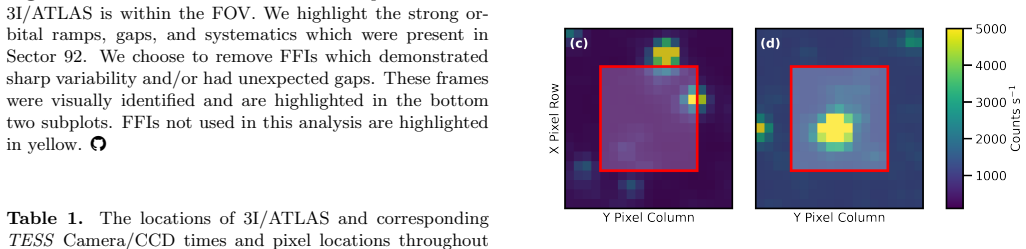
Using a shift-stack technique on nearly ten thousand TESS frames, the authors recover 3I/ATLAS at 19 sigma on one detector and 11 sigma on another, measuring TESS magnitudes of 20.83 +/- 0.05 and 19.28 +/- 0.05. Converted to absolute visual magnitudes, these give H_V = 13.72 +/- 0.35 and 12.52 +/- 0.35, both of which are brighter than the H > 15.4 nucleus limit from HST. The observed brightening of 1.55 mag between the two epochs is about 1.1 mag larger than the roughly 0.4 mag expected from geometry alone, and the excess is interpreted as cometary activity rather than a bare, rotating nucleus. The paper explicitly notes the activity inference is tentative: the color-based magnitude conversion carries a +/- 0.3 mag uncertainty, and the 3-sigma errors allow the object to have been about a magnitude fainter in the first epoch. Its conclusion is that the data are consistent with weak pre-discovery activity, likely driven by hypervolatiles.
Load-bearing premise
Because the paper itself concedes the color conversion allows the first-epoch brightness to be about 1 mag fainter, the claim that 3I/ATLAS was active at 6 au stands on the assumption that the object's color matches the cometary average used to convert TESS magnitudes to V.
Editorial extensions
If this is right
- The light curve of 3I/ATLAS now extends back to May 2025, roughly two months before discovery, at heliocentric distances of 5.5 to 6.4 au.
- If the activity is real, water-ice sublimation is ruled out as the driver at these distances, and CO, CO2, or another hypervolatile must be responsible.
- The brightening between the two TESS epochs indicates activity increasing as the object approached the Sun and warmed.
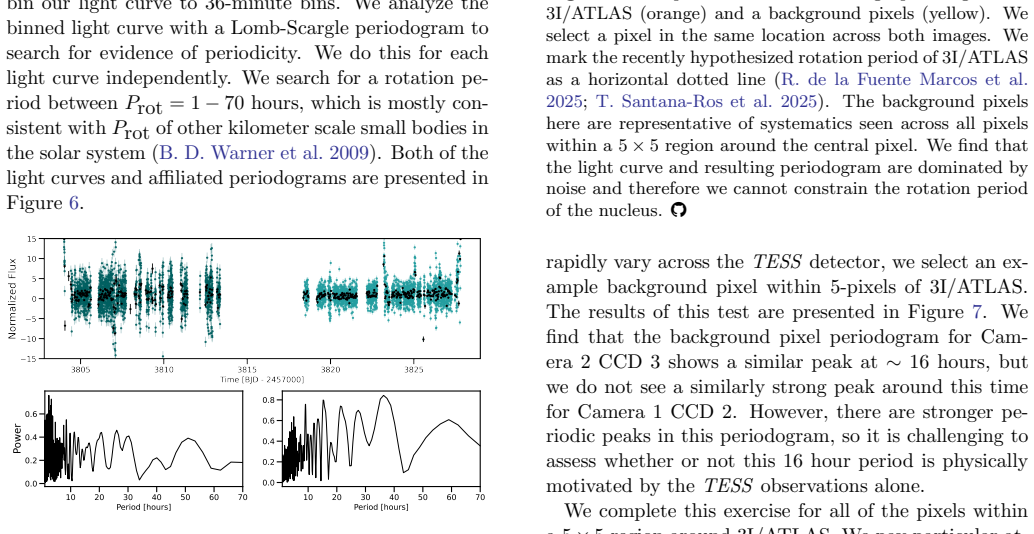
- The 16-hour rotation-period candidate reported elsewhere is not confirmed; the TESS light curves are dominated by systematics that also appear in background pixels.
- These precovery magnitudes are consistent with the brighter end of the July 2025 photometry, supporting a gradual activity evolution rather than a sudden outburst.
Reading between the lines
- (Editorial) The same shift-stack treatment of other TESS ecliptic-sector data could yield precovery detections of future interstellar objects, since TESS is now observing the ecliptic plane.
- (Editorial) A multi-filter precovery campaign, even a single simultaneous V-band point, would directly test the color assumption that anchors the H_V values and turn a tentative signal into a firm one.
- (Editorial) If distant activity is confirmed, the interstellar-object population may be routinely volatile-rich at large heliocentric distances, which would affect models of planetesimal formation in other systems.
- (Editorial) A natural follow-up is to search for nongravitational acceleration in 3I/ATLAS's orbit; activity at 6 au, if real, should leave a measurable dynamical signature.
Editorial analysis
A structured set of objections, weighed in public.
Referee Report
Summary. This paper reports precovery photometry of interstellar object 3I/ATLAS in TESS Sector 92 full-frame images. Using a shift-and-stack algorithm on roughly 9,800 calibrated FFIs, the authors detect the object on two camera/CCD combinations at 19 sigma and 11 sigma, with TESS magnitudes Tmag = 20.83 ± 0.05 and 19.28 ± 0.05. Applying the TESS-to-V color relation of Farnham et al. (2021) and an n = 2 distance normalization, they derive absolute visual magnitudes HV = 13.72 ± 0.35 and 12.52 ± 0.35, which are brighter than the HST nucleus limit H > 15.4. The 1.55 mag brightening between the two epochs exceeds the geometric factor of about 1.5 expected from the changing Sun and observer distances, leading the authors to suggest possible activity at heliocentric distances near 6 au. The paper also extracts a 20-day light curve and finds no statistically significant rotation period. The pipeline is validated by recovering the known 21.04-hour rotation period of minor planet 896 Sphinx.
Significance. If the activity inference holds, these are the earliest precovery observations of 3I/ATLAS and would indicate volatile activity at about 6 au, which is important for understanding hypervolatile-driven mass loss in interstellar objects. The paper's strengths are its public data and code, the validation against 896 Sphinx, and the explicit null result for rotation. However, the activity claim is a differential measurement across two different detectors, and it depends on external color and zeropoint calibrations whose uncertainties the authors themselves acknowledge in Section 4. The result is therefore a tentative suggestion rather than a secure detection of distant activity, and the central claim needs to be hardened or softened accordingly.
major comments (3)
- [§3.1, Eq. (1), Table 1] The central activity claim rests on the 1.55 mag brightening between the Camera 2 CCD 3 and Camera 1 CCD 2 deep stacks, but this is a cross-detector differential measured with a single global TESS zeropoint (Eq. 1) and an adopted error of only 0.05 mag. The manuscript states that it is standard practice not to recalculate the zeropoint, but it does not bound the expected zeropoint variation across cameras and CCDs in Sector 92. Because the activity evidence is concentrated in the Camera 1 CCD 2 epoch, an inter-detector zeropoint offset of only a few tenths of a magnitude would erase the anomaly. Please calibrate the relative zeropoint using field stars common to both detectors, or demonstrate from similar TESS data that the cross-detector zeropoint dispersion is smaller than about 0.1 mag, and propagate this into the reported magnitudes.
- [§2.2, §2.5, Fig. 5] The Camera 1 CCD 2 deep stack has a central-pixel flux of 0.589 ± 0.016 e−1 s−1 and a background scatter of 0.141 ± 0.039 e−1 s−1, while the 3×3 aperture flux is 2.904 ± 0.016 e−1 s−1. The crowding filter in Section 2.2 only removes frames where more than half of the pixels in an 11×11 box are flagged as >2σ outliers; it does not ensure that the specific 3×3 aperture is free of unresolved stellar flux. In a field this crowded, undetected neighbours could contribute a substantial fraction of the 3×3 flux, biasing Tmag bright and mimicking activity. Please quantify this by comparing apertures of different sizes, fitting a PSF, or performing the same stacking on nearby off-source positions with the same filter, and report the resulting contamination correction.
- [§3.1, §3.3 (Eq. 2), §4] The statement in Section 3.1 that the observations are 'statistically inconsistent with an asteroid-like reflectance model' is based only on the 0.05 mag photometric errors. It does not include the ±0.3 mag uncertainty in V = Tmag + 0.8 (Eq. 2), nor the cross-detector and crowding systematics discussed above. The authors themselves note in Section 4 that the 3σ color uncertainty permits the object to be about 1 mag fainter, which would substantially reduce the inferred brightness anomaly. The inconsistency claim should be rephrased as tentative, and the HV values should be reported with a full systematic budget (color, zeropoint, crowding) rather than the current 0.35 mag uncertainty, which appears to be dominated by the color term alone.
minor comments (6)
- [§3.1] The arithmetic of the claimed flux excess is inconsistent: the expected Tmag of about 20.5 versus the observed 19.28 differs by 1.22 mag, which is a flux ratio of about 3, not the 'factor of 5' stated in the text.
- [Abstract and Table 1] The abstract says 'average TESS magnitude' but reports two separate epoch values; this phrasing should be changed to avoid implying a single averaged measurement.
- [§2.1, §2.2] The removal of contaminated FFIs is described as by-eye identification, and the crowding threshold and Savitzky-Golay window length are chosen by visual inspection; a reproducibility statement or machine-readable list of excluded frames would strengthen the analysis.
- [§3.2] The conclusion that there is no statistically significant rotation period would be more informative with an upper limit on the allowed light-curve amplitude, rather than only a null periodogram comparison.
- [Fig. 9] The caption for Figure 9 should clarify that the lower time axis applies to 3I/ATLAS and not to 2I/Borisov; the current wording is confusing.
- [Throughout] There are several minor typographical and grammatical issues, including 'The top axes represents' in the Fig. 9 caption and an orphaned '/gtb' markup artifact in Section 1.
Circularity Check
No significant circularity: the TESS detection and distant-activity inference are derived from the FFI data using external calibrations and an explicit inactive-body null model, not from a fitted or self-defined quantity.
full rationale
I walked the derivation chain from FFI photometry to Tmag (Eq. 1), V (Eq. 2), HV (Eq. 3), and the activity inference. Eq. 1 is a stated instrumental zeropoint calibration with an adopted 0.05 mag error; Eq. 2 is an external color relation from Farnham et al. (2021) carrying a stated ±0.3 mag uncertainty; Eq. 3 with n = 2 is the standard inactive-body distance normalization, used as a null hypothesis rather than as a fitted parameter. The activity claim is the residual between the observed second-epoch brightness and the geometric factor-of-1.5 expectation; no constant is fitted to the target photometry and then renamed a prediction. The detection is independently validated by recovery of 896 Sphinx against a literature rotation period, and the deep-stack significances (19σ and 11σ) are propagated from the calibrated FFI errors. The HST nucleus limit is external (Jewitt et al. 2025). The only author-overlapping citation, Seligman et al. (2025) for ZTF precovery photometry, is used for context and secular light-curve comparison rather than to establish the TESS detection or the activity residual; agreement with Martinez-Palomera et al. (2025) provides an independent cross-check. The acknowledged color uncertainty weakens the activity conclusion by permitting a ~1 mag fainter first epoch, but that is an accuracy and robustness limitation, not a circular reduction. I therefore find no step in which the paper's output is equivalent by construction to its input.
Assumptions & free parameters
free parameters (4)
- Savitsky-Golay window length =
307 pixels
- Crowding rejection threshold =
2σ, >50% of 11x11 pixels
- Photometric aperture =
3x3 pixels
- Activity index n =
2
assumptions (6)
- domain assumption The Farnham et al. (2021) relation V = Tmag + 0.8 applies to 3I/ATLAS
- domain assumption The TESS zeropoint of 20.44 is identical for both camera/CCD configurations
- domain assumption The JPL Horizons ephemeris for 3I/ATLAS is accurate over the May-June 2025 window
- domain assumption The background varies smoothly at the scale of the Savitsky-Golay window (307 px)
- domain assumption 3I/ATLAS is effectively point-like at the TESS pixel scale
- domain assumption The HST-derived nucleus limit (R < 2.8 km, H > 15.4) from Jewitt et al. (2025) is correct
Cite this review
Pith. "Pith review of Precovery Observations of 3I/ATLAS from TESS Suggests Possible Distant Activity." pith.science (2026). https://pith.science/paper/YS7CZJT7
@misc{pith2026250721967,
  author       = {Pith},
  title        = {Pith review of: Precovery Observations of 3I/ATLAS from TESS Suggests Possible Distant Activity},
  year         = {2026},
  howpublished = {\url{https://pith.science/paper/YS7CZJT7}},
  note         = {Machine review of arXiv:2507.21967}
}
abstract
3I/ATLAS is the third macroscopic interstellar object detected traversing the Solar System. Since its initial discovery on UT 01 July 2025, hundreds of hours on a range of observational facilities have been dedicated to measure the physical properties of this object. These observations have provided astrometry to refine the orbital solution, photometry to measure the color, a rotation period and secular light curve, and spectroscopy to characterize the composition of the coma. Here, we report precovery photometry of 3I/ATLAS as observed with NASA's Transiting Exoplanet Survey Satellite (TESS). 3I/ATLAS was observed nearly continuously by TESS from UT 07 May 2025 to 02 June 2025. We use the shift-stack method to create deep stack images to recover the object. These composite images reveal that 3I/ATLAS has an average TESS magnitude of $T_\textrm{mag} = 20.83 \pm 0.05, 19.28 \pm 0.05$ and an absolute visual magnitude of $H_V = 13.72 \pm 0.35; 12.52 \pm 0.35$, the latter being consistent with magnitudes reported in July 2025. When coupled with recent HST images deriving a nucleus size of R$<$2.8 km (H$>$15.4), our measurements suggest that 3I/ATLAS may have been active out at $\sim 6$ au. Additionally, we extract a $\sim 20$ day light curve and find no statistically significant evidence of a nucleus rotation period. Nevertheless, the data presented here are some of the earliest precovery images of 3I/ATLAS and may be used in conjunction with future observations to constrain the properties of our third interstellar interloper.
Figures


Figures from the paper (9 more)




Forward citations
Cited by 2 Pith papers
-
Near-Discovery Observations of Interstellar Comet 3I/ATLAS with the NASA Infrared Telescope Facility
New observations of interstellar comet 3I/ATLAS produce the first near-infrared spectrum, showing a red slope that turns neutral at longer wavelengths, no water ice absorption, and a model-dependent upper limit of <7%...
-
The Kinematic Age of 3I/ATLAS and its Implications for Early Planet Formation
3I/ATLAS is likely an old, active comet about 2 km across, and its high speed implies it formed roughly 3 to 11 billion years ago around a low-metallicity star.
Reference graph
Works this paper leans on
-
[1]
, " * write output.state after.block = add.period write newline
ENTRY address archivePrefix author booktitle chapter doi edition editor eprint howpublished institution journal key month number organization pages publisher school series title misctitle type volume year version url label extra.label sort.label short.list INTEGERS output.state before.all mid.sentence after.sentence after.block FUNCTION init.state.consts ...
-
[2]
write newline
" write newline "" before.all 'output.state := FUNCTION format.url url empty "" new.block "" url * "" * if FUNCTION format.eprint eprint empty "" archivePrefix empty "" archivePrefix "arXiv" = new.block " " eprint * " " * new.block " " eprint * " " * if if if FUNCTION format.doi doi empty "" " " doi * " " * if FUNCTION format.pid doi empty eprint empty ur...
-
[3]
thebibliography [1] 20pt to REFERENCES 6pt =0pt \@twocolumntrue 12pt -12pt 10pt plus 3pt =0pt =0pt =1pt plus 1pt =0pt =0pt -12pt =13pt plus 1pt =20pt =13pt plus 1pt \@M =10000 =-1.0em =0pt =0pt 0pt =0pt =1.0em @enumiv\@empty 10000 10000 `\.\@m \@noitemerr \@latex@warning Empty `thebibliography' environment \@ifnextchar \@reference \@latexerr Missing key o...
arXiv 2017
-
[4]
R., Serra-Ricart , M., Licandro , J., et al
Alarcon , M. R., Serra-Ricart , M., Licandro , J., et al. 2025, Deep g'-band Imaging of Interstellar Comet 3I/ATLAS from the Two-meter Twin Telescope (TTT) ,, The Astronomer's Telegram, No. 17264 https://www.astronomerstelegram.org/?read=17264
2025
-
[5]
E., Shrestha , M., Bostroem , K
Andrews , J. E., Shrestha , M., Bostroem , K. A., et al. 2025, title Asymmetries and Circumstellar Interaction in the Type II SN 2024bch , , 980, 37, 10.3847/1538-4357/ada555
-
[6]
Aravind , K., Ganesh , S., Venkataramani , K., et al. 2021, title Activity of the first interstellar comet 2I/Borisov around perihelion: results from Indian observatories , , 502, 3491, 10.1093/mnras/stab084
-
[7]
Astropy Collaboration , Robitaille , T. P., Tollerud , E. J., et al. 2013, title Astropy: A community Python package for astronomy , , 558, A33, 10.1051/0004-6361/201322068
-
[8]
Astropy Collaboration , Price-Whelan , A. M., Sip o cz , B. M., et al. 2018, title The Astropy Project: Building an Open-science Project and Status of the v2.0 Core Package , , 156, 123, 10.3847/1538-3881/aabc4f
Show all 103 references
-
[9]
M., Lim , P
Astropy Collaboration , Price-Whelan , A. M., Lim , P. L., et al. 2022, title The Astropy Project: Sustaining and Growing a Community-oriented Open-source Project and the Latest Major Release (v5.0) of the Core Package , , 935, 167, 10.3847/1538-4357/ac7c74
2022 doi
-
[10]
2021, title Unusual polarimetric properties for interstellar comet 2I/Borisov , Nature Communications, 12, 1797, 10.1038/s41467-021-22000-x
Bagnulo , S., Cellino , A., Kolokolova , L., et al. 2021, title Unusual polarimetric properties for interstellar comet 2I/Borisov , Nature Communications, 12, 1797, 10.1038/s41467-021-22000-x
2021 doi
-
[11]
T., Schwamb , M
Bannister , M. T., Schwamb , M. E., Fraser , W. C., et al. 2017, title Col-OSSOS: Colors of the Interstellar Planetesimal 1I/ Oumuamua , ApJL, 851, L38, 10.3847/2041-8213/aaa07c
2017 doi
-
[12]
T., Opitom , C., Fitzsimmons , A., et al
Bannister , M. T., Opitom , C., Fitzsimmons , A., et al. 2020, title Interstellar comet 2I/Borisov as seen by MUSE: C _2 , NH _2 and red CN detections , arXiv e-prints, arXiv:2001.11605. 2001.11605
2020 arXiv
-
[13]
Belton , M. J. S., Hainaut , O. R., Meech , K. J., et al. 2018, title The Excited Spin State of 1I/2017 U1 Oumuamua , , 856, L21, 10.3847/2041-8213/aab370
2018 doi
-
[14]
B., & Seligman , D
Bergner , J. B., & Seligman , D. Z. 2023, title Acceleration of 1I/`Oumuamua from radiolytically produced H _ 2 in H _ 2 O ice , , 615, 610, 10.1038/s41586-022-05687-w
2023 doi
-
[15]
W., Feldman , P
Bodewits , D., Noonan , J. W., Feldman , P. D., et al. 2020, title The carbon monoxide-rich interstellar comet 2I/Borisov , Nature Astronomy, 4, 867, 10.1038/s41550-020-1095-2
2020 doi
-
[16]
T., Sato , H., et al
Borisov , G., Durig , D. T., Sato , H., et al. 2019, title Comet C/2019 Q4 (Borisov) , Central Bureau Electronic Telegrams, 4666, 1
2019
-
[17]
2023, title Long Period Comets are Vehicles to the Past: The Systematic Analysis of 100+ Long Period Comets , in AAS/Division for Planetary Sciences Meeting Abstracts, Vol
Bufanda , E., Meech , K., Kleyna , J., Keane , J., & Hainaut , O. 2023, title Long Period Comets are Vehicles to the Past: The Systematic Analysis of 100+ Long Period Comets , in AAS/Division for Planetary Sciences Meeting Abstracts, Vol. 55, AAS/Division for Planetary Science...
2023
-
[18]
J., Levine , A., Fausnaugh , M., et al
Burke , C. J., Levine , A., Fausnaugh , M., et al. 2020, TESS-Point: High precision TESS pointing tool ,, Astrophysics Source Code Library, record ascl:2003.001
2020
- [19]
-
[20]
V., Ragozzine , D., Granvik , M., & Stephens , D
Cook , N. V., Ragozzine , D., Granvik , M., & Stephens , D. C. 2016, title Realistic Detectability of Close Interstellar Comets , ApJ, 825, 51, 10.3847/0004-637X/825/1/51
2016 doi
-
[21]
A., Milam , S
Cordiner , M. A., Milam , S. N., Biver , N., et al. 2020, title Unusually high CO abundance of the first active interstellar comet , Nature Astronomy, 4, 861, 10.1038/s41550-020-1087-2
2020 doi
-
[22]
2020, title Dust Environment Model of the Interstellar Comet 2I/Borisov , , 893, L12, 10.3847/2041-8213/ab8455
Cremonese , G., Fulle , M., Cambianica , P., et al. 2020, title Dust Environment Model of the Interstellar Comet 2I/Borisov , , 893, L12, 10.3847/2041-8213/ab8455
2020 doi
-
[23]
R., et al
de la Fuente Marcos , R., Licandro , J., Alarcon , M. R., et al. 2025, title Assessing interstellar comet 3I/ATLAS with the 10.4 m Gran Telescopio Canarias and the Two-meter Twin Telescope , arXiv e-prints, arXiv:2507.12922. 2507.12922
2025 arXiv
- [24]
-
[25]
2025, title 3I/ATLAS = C/2025 N1 (ATLAS) , MPEC
Denneau , L., Siverd , R., Tonry , J., et al. 2025, title 3I/ATLAS = C/2025 N1 (ATLAS) , MPEC
2025
- [26]
-
[27]
C., & Jewitt , D
Drahus , M., Yang , B., Lis , D. C., & Jewitt , D. 2017, title New Limits to CO Outgassing in Centaurs , MNRAS, 468, 2897, 10.1093/mnras/stw2227
2017 doi
-
[28]
2017, title An Observational Upper Limit on the Interstellar Number Density of Asteroids and Comets , Astronomical Journal, 153, 133, 10.3847/1538-3881/aa5c8a
Engelhardt , T., Jedicke , R., Vere s , P., et al. 2017, title An Observational Upper Limit on the Interstellar Number Density of Asteroids and Comets , Astronomical Journal, 153, 133, 10.3847/1538-3881/aa5c8a
2017 doi
-
[29]
1967, title Comet discoveries and observational selection , , 72, 716, 10.1086/110299
Everhart , E. 1967, title Comet discoveries and observational selection , , 72, 716, 10.1086/110299
1967 doi
-
[30]
L., Kelley , M
Farnham , T. L., Kelley , M. S. P., & Bauer , J. M. 2021, title Early Activity in Comet C/2014 UN271 Bernardinelli-Bernstein as Observed by TESS , , 2, 236, 10.3847/PSJ/ac323d
2021 doi
-
[31]
L., Kelley , M
Farnham , T. L., Kelley , M. S. P., Knight , M. M., & Feaga , L. M. 2019, title First Results from TESS Observations of Comet 46P/Wirtanen , , 886, L24, 10.3847/2041-8213/ab564d
2019 doi
-
[32]
M., Vallely , P
Fausnaugh , M. M., Vallely , P. J., Tucker , M. A., et al. 2023, title Four Years of Type Ia Supernovae Observed by TESS: Early-time Light-curve Shapes and Constraints on Companion Interaction Models , , 956, 108, 10.3847/1538-4357/aceaef
2023 doi
-
[33]
D., Montet , B
Feinstein , A. D., Montet , B. T., Foreman-Mackey , D., et al. 2019, title eleanor: An Open-source Tool for Extracting Light Curves from the TESS Full-frame Images , , 131, 094502, 10.1088/1538-3873/ab291c
2019 doi
-
[34]
2024, title Interstellar Objects and Exocomets , in Comets III, ed
Fitzsimmons , A., Meech , K., Matr \`a , L., & Pfalzner , S. 2024, title Interstellar Objects and Exocomets , in Comets III, ed. K. J. Meech , M. R. Combi , D. Bockel \'e e-Morvan , S. N. Raymodn , & M. E. Zolensky , 731--766
2024
-
[35]
2018, title Spectroscopy and thermal modelling of the first interstellar object 1I/2017 U1 `Oumuamua , Nature Astronomy, 2, 133, 10.1038/s41550-017-0361-4
Fitzsimmons , A., Snodgrass , C., Rozitis , B., et al. 2018, title Spectroscopy and thermal modelling of the first interstellar object 1I/2017 U1 `Oumuamua , Nature Astronomy, 2, 133, 10.1038/s41550-017-0361-4
2018 doi
-
[36]
J., et al
Fitzsimmons , A., Hainaut , O., Meech , K. J., et al. 2019, title Detection of CN Gas in Interstellar Object 2I/Borisov , , 885, L9, 10.3847/2041-8213/ab49fc
2019 doi
-
[37]
C., Pravec , P., Fitzsimmons , A., et al
Fraser , W. C., Pravec , P., Fitzsimmons , A., et al. 2018, title The tumbling rotational state of 1I/`Oumuamua , Nature Astronomy, 2, 383, 10.1038/s41550-018-0398-z
2018 doi
-
[38]
C., Porter , S
Fraser , W. C., Porter , S. B., Peltier , L., et al. 2024, title Candidate Distant Trans-Neptunian Objects Detected by the New Horizons Subaru TNO Survey , , 5, 227, 10.3847/PSJ/ad6f9e
2024 doi
-
[39]
2017, title Origin of Interstellar Object A/2017 U1 in a Nearby Young Stellar Association? , RNAAS, 1, 13, 10.3847/2515-5172/aa9851
Gaidos , E., Williams , J., & Kraus , A. 2017, title Origin of Interstellar Object A/2017 U1 in a Nearby Young Stellar Association? , RNAAS, 1, 13, 10.3847/2515-5172/aa9851
2017 doi
-
[40]
2020, title Initial characterization of interstellar comet 2I/Borisov , Nature Astronomy, 4, 53, 10.1038/s41550-019-0931-8
Guzik , P., Drahus , M., Rusek , K., et al. 2020, title Initial characterization of interstellar comet 2I/Borisov , Nature Astronomy, 4, 53, 10.1038/s41550-019-0931-8
2020 doi
-
[41]
J., Seligman , D
Hoover , D. J., Seligman , D. Z., & Payne , M. J. 2022, title The Population of Interstellar Objects Detectable with the LSST and Accessible for In Situ Rendezvous with Various Mission Designs , Planetary Science Journal, 3, 71, 10.3847/PSJ/ac58fe
2022 doi
-
[42]
Hui , M.-T., & Knight , M. M. 2019, title New Insights into Interstellar Object 1I/2017 U1 ( Oumuamua) from SOHO/STEREO Nondetections , , 158, 256, 10.3847/1538-3881/ab50b8
2019 doi
-
[43]
Hui , M.-T., Ye , Q.-Z., F \"o hring , D., Hung , D., & Tholen , D. J. 2020, title Physical Characterization of Interstellar Comet 2I/2019 Q4 (Borisov) , , 160, 92, 10.3847/1538-3881/ab9df8
2020 doi
-
[44]
D., et al
Hunter, J. D., et al. 2007, title Matplotlib: A 2D graphics environment, Computing in science and engineering, 9, 90
2007
-
[45]
P., & Desch , S
Jackson , A. P., & Desch , S. J. 2021, title 1I/`Oumuamua as an N _ 2 Ice Fragment of an exo Pluto Surface: I. Size and Compositional Constraints , Journal of Geophysical Research (Planets), 126, e06706, 10.1029/2020JE006706
2021 doi
-
[46]
2025, Hubble Space Telescope Observations of the Interstellar Interloper 3I/ATLAS, 2508.02934
Jewitt, D., Hui, M.-T., Mutchler, M., Kim, Y., & Agarwal, J. 2025, Hubble Space Telescope Observations of the Interstellar Interloper 3I/ATLAS, 2508.02934
2025 arXiv
-
[47]
2019, title Initial Characterization of Interstellar Comet 2I/2019 Q4 (Borisov) , , 886, L29, 10.3847/2041-8213/ab530b
Jewitt , D., & Luu , J. 2019, title Initial Characterization of Interstellar Comet 2I/2019 Q4 (Borisov) , , 886, L29, 10.3847/2041-8213/ab530b
2019 doi
-
[48]
2025, Interstellar Interloper C/2025 N1 is Active ,, The Astronomer's Telegram, No
Jewitt , D., & Luu , J. 2025, Interstellar Interloper C/2025 N1 is Active ,, The Astronomer's Telegram, No. 17263 https://www.astronomerstelegram.org/?read=17263
2025
-
[49]
2017, title Interstellar Interloper 1I/2017 U1: Observations from the NOT and WIYN Telescopes , Astrophysical Journal Letters, 850, L36, 10.3847/2041-8213/aa9b2f
Jewitt , D., Luu , J., Rajagopal , J., et al. 2017, title Interstellar Interloper 1I/2017 U1: Observations from the NOT and WIYN Telescopes , Astrophysical Journal Letters, 850, L36, 10.3847/2041-8213/aa9b2f
2017 doi
-
[50]
Jewitt , D., & Seligman , D. Z. 2023, title The Interstellar Interlopers , , 61, 197, 10.1146/annurev-astro-071221-054221
2023 doi
-
[51]
W., et al
Kareta , T., Andrews , J., Noonan , J. W., et al. 2020, title Carbon Chain Depletion of 2I/Borisov , , 889, L38, 10.3847/2041-8213/ab6a08
2020 doi
-
[52]
2025, title Near-Discovery Observations of Interstellar Comet 3I/ATLAS with the NASA Infrared Telescope Facility , arXiv e-prints, arXiv:2507.12234
Kareta , T., Champagne , C., McClure , L., et al. 2025, title Near-Discovery Observations of Interstellar Comet 3I/ATLAS with the NASA Infrared Telescope Facility , arXiv e-prints, arXiv:2507.12234. 2507.12234
2025 arXiv
-
[53]
2020, title Coma Anisotropy and the Rotation Pole of Interstellar Comet 2I/Borisov , , 895, L34, 10.3847/2041-8213/ab9228
Kim , Y., Jewitt , D., Mutchler , M., et al. 2020, title Coma Anisotropy and the Rotation Pole of Interstellar Comet 2I/Borisov , , 895, L34, 10.3847/2041-8213/ab9228
2020 doi
-
[54]
E., et al
Kiss , C., Tak \'a cs , N., Kalup , C. E., et al. 2025, title Three fast-rotating Jovian trojans identified by TESS set new population density limits , , 694, L17, 10.1051/0004-6361/202453509
2025 doi
-
[55]
M., Protopapa , S., Kelley , M
Knight , M. M., Protopapa , S., Kelley , M. S. P., et al. 2017, title On the Rotation Period and Shape of the Hyperbolic Asteroid 1I/ Oumuamua (2017 U1) from Its Lightcurve , Astrophysical Journal Letters, 851, L31, 10.3847/2041-8213/aa9d81
2017 doi
-
[56]
2023, title Near-term strategies to rendezvous with an interstellar object , Acta Astronautica, 206, 133, 10.1016/j.actaastro.2023.02.021
Landau , D., Donitz , B., & Karimi , R. 2023, title Near-term strategies to rendezvous with an interstellar object , Acta Astronautica, 206, 133, 10.1016/j.actaastro.2023.02.021
2023 doi
-
[57]
W., Lee , C.-H., Gerdes , D
Lin , H. W., Lee , C.-H., Gerdes , D. W., et al. 2020, title Detection of Diatomic Carbon in 2I/Borisov , , 889, L30, 10.3847/2041-8213/ab6bd9
2020 doi
-
[58]
Lomb , N. R. 1976, title Least-Squares Frequency Analysis of Unequally Spaced Data , , 39, 447, 10.1007/BF00648343
1976 doi
-
[59]
2017, title Kinematics of the Interstellar Vagabond 1I/Oumuamua (A/2017 U1) , Research Notes of the American Astronomical Society, 1, 21, 10.3847/2515-5172/aa9bdc
Mamajek , E. 2017, title Kinematics of the Interstellar Vagabond 1I/Oumuamua (A/2017 U1) , Research Notes of the American Astronomical Society, 1, 21, 10.3847/2515-5172/aa9bdc
2017 doi
-
[60]
2025, title Pre-discovery TESS Observations of Interstellar Object 3I/ATLAS , arXiv e-prints, arXiv:2508.02499, 10.48550/arXiv.2508.02499
Martinez-Palomera , J., Tuson , A., Hedges , C., et al. 2025, title Pre-discovery TESS Observations of Interstellar Object 3I/ATLAS , arXiv e-prints, arXiv:2508.02499, 10.48550/arXiv.2508.02499
2025 doi
-
[61]
2023, title Synthetic population of interstellar objects in the Solar System , Astronomy and Computing, 42, 100690, 10.1016/j.ascom.2023.100690
Mar c eta , D. 2023, title Synthetic population of interstellar objects in the Solar System , Astronomy and Computing, 42, 100690, 10.1016/j.ascom.2023.100690
2023
-
[62]
Mar c eta , D., & Seligman , D. Z. 2023, title Synthetic Detections of Interstellar Objects with the Rubin Observatory Legacy Survey of Space and Time , Planetary Science Journal, 4, 230, 10.3847/PSJ/ad08c1
2023 doi
-
[63]
2019, title Modelling the light curve of `Oumuamua: evidence for torque and disc-like shape , MNRAS, 489, 3003, 10.1093/mnras/stz2380
Mashchenko , S. 2019, title Modelling the light curve of `Oumuamua: evidence for torque and disc-like shape , MNRAS, 489, 3003, 10.1093/mnras/stz2380
2019 doi
-
[64]
2017, title Palomar Optical Spectrum of Hyperbolic Near-Earth Object A/2017 U1 , arXiv e-prints, arXiv:1710.09977
Masiero , J. 2017, title Palomar Optical Spectrum of Hyperbolic Near-Earth Object A/2017 U1 , arXiv e-prints, arXiv:1710.09977. 1710.09977
2017 arXiv
-
[65]
R., Grav , T., Mainzer , A
Masiero , J. R., Grav , T., Mainzer , A. K., et al. 2014, title Main-belt Asteroids with WISE/NEOWISE: Near-infrared Albedos , , 791, 121, 10.1088/0004-637X/791/2/121
2014 doi
-
[66]
2024, title High CO _ 2 Abundance in Interstellar Comet 2I/Borisov Inferred from Oxygen Line Ratio Measurements , in AAS/Division for Planetary Sciences Meeting Abstracts, Vol
McKay , A., Opitom , C., Jehin , E., et al. 2024, title High CO _ 2 Abundance in Interstellar Comet 2I/Borisov Inferred from Oxygen Line Ratio Measurements , in AAS/Division for Planetary Sciences Meeting Abstracts, Vol. 56, 56th Annual Meeting of the Division for Planetary Sc...
2024
-
[67]
J., Cochran , A
McKay , A. J., Cochran , A. L., Dello Russo , N., & DiSanti , M. A. 2020, title Detection of a Water Tracer in Interstellar Comet 2I/Borisov , , 889, L10, 10.3847/2041-8213/ab64ed
2020 doi
-
[68]
J., Weryk , R., Micheli , M., et al
Meech , K. J., Weryk , R., Micheli , M., et al. 2017, title A brief visit from a red and extremely elongated interstellar asteroid , Nature, 552, 378, 10.1038/nature25020
2017 doi
-
[69]
J., et al
Micheli , M., Farnocchia , D., Meech , K. J., et al. 2018, title Non-gravitational acceleration in the trajectory of 1I/2017 U1 ('Oumuamua) , Nature, 559, 223, 10.1038/s41586-018-0254-4
2018 doi
-
[70]
2022, title High-performance solar sails for interstellar object rendezvous , Acta Astronautica, 200, 242, 10.1016/j.actaastro.2022.07.053
Miller , D., Duvigneaud , F., Menken , W., Landau , D., & Linares , R. 2022, title High-performance solar sails for interstellar object rendezvous , Acta Astronautica, 200, 242, 10.1016/j.actaastro.2022.07.053
2022 doi
- [71]
-
[72]
L., & Loeb , A
Moro-Mart \' n , A., Turner , E. L., & Loeb , A. 2009, title Will the Large Synoptic Survey Telescope Detect Extra-Solar Planetesimals Entering the Solar System? , Astrophysical Journa, 704, 733, 10.1088/0004-637X/704/1/733
2009 doi
-
[73]
2019, title 2I/Borisov: A C _ 2 -depleted interstellar comet , , 631, L8, 10.1051/0004-6361/201936959
Opitom , C., Fitzsimmons , A., Jehin , E., et al. 2019, title 2I/Borisov: A C _ 2 -depleted interstellar comet , , 631, L8, 10.1051/0004-6361/201936959
2019 doi
-
[74]
2025, Initial VLT/MUSE spectroscopy of the interstellar object 3I/ATLAS, 2507.05226
Opitom, C., Snodgrass, C., Jehin, E., et al. 2025, Initial VLT/MUSE spectroscopy of the interstellar object 3I/ATLAS, 2507.05226
2025 arXiv
-
[75]
L., Pereira , C
Ortiz , J. L., Pereira , C. L., Sicardy , B., et al. 2023, title Changing material around (2060) Chiron revealed by an occultation on December 15, 2022 , , 676, L12, 10.1051/0004-6361/202347025
2023 doi
-
[76]
2020, title Solar System Objects Observed with TESS First Data Release: Bright Main-belt and Trojan Asteroids from the Southern Survey , , 247, 26, 10.3847/1538-4365/ab64f0
P \'a l , A., Szak \'a ts , R., Kiss , C., et al. 2020, title Solar System Objects Observed with TESS First Data Release: Bright Main-belt and Trojan Asteroids from the Southern Survey , , 247, 26, 10.3847/1538-4365/ab64f0
2020 doi
-
[77]
L., Braga-Ribas , F., Sicardy , B., et al
Pereira , C. L., Braga-Ribas , F., Sicardy , B., et al. 2025, title Centaur 29P/Schwassmann-Wachmann 1 and its near-nucleus environment from a stellar occultation , Philosophical Transactions of the Royal Society of London Series A, 383, 20240189, 10.1098/rsta.2024.0189
2025
-
[78]
2018, title Lightcurve Analysis for Fourteen Main-belt Minor Planets , Minor Planet Bulletin, 45, 347
Polakis , T. 2018, title Lightcurve Analysis for Fourteen Main-belt Minor Planets , Minor Planet Bulletin, 45, 347
2018
-
[79]
R., Winn , J
Ricker , G. R., Winn , J. N., Vanderspek , R., et al. 2015, title Transiting Exoplanet Survey Satellite (TESS) , Journal of Astronomical Telescopes, Instruments, and Systems, 1, 014003, 10.1117/1.JATIS.1.1.014003
2015 doi
-
[80]
2025, title Temporal Evolution of the Third Interstellar Comet 3I/ATLAS: Spin, Color, Spectra and Dust Activity , arXiv e-prints, arXiv:2508.00808, 10.48550/arXiv.2508.00808
Santana-Ros , T., Ivanova , O., Mykhailova , S., et al. 2025, title Temporal Evolution of the Third Interstellar Comet 3I/ATLAS: Spin, Color, Spectra and Dust Activity , arXiv e-prints, arXiv:2508.00808, 10.48550/arXiv.2508.00808
2025 doi
-
[81]
Scargle , J. D. 1982, title Studies in astronomical time series analysis. II. Statistical aspects of spectral analysis of unevenly spaced data. , , 263, 835, 10.1086/160554
1982 doi
-
[82]
2019, title Outgassing As Trigger of 1I/`Oumuamua's Nongravitational Acceleration: Could This Hypothesis Work at All? , arXiv e-prints, arXiv:1905.00935, 10.48550/arXiv.1905.00935
Sekanina , Z. 2019, title Outgassing As Trigger of 1I/`Oumuamua's Nongravitational Acceleration: Could This Hypothesis Work at All? , arXiv e-prints, arXiv:1905.00935, 10.48550/arXiv.1905.00935
-
[83]
2018, title The Feasibility and Benefits of In Situ Exploration of Oumuamua-like Objects , , 155, 217, 10.3847/1538-3881/aabd37
Seligman , D., & Laughlin , G. 2018, title The Feasibility and Benefits of In Situ Exploration of Oumuamua-like Objects , , 155, 217, 10.3847/1538-3881/aabd37
2018 doi
-
[84]
2020, title Evidence that 1I/2017 U1 ('Oumuamua) was Composed of Molecular Hydrogen Ice , , 896, L8, 10.3847/2041-8213/ab963f
Seligman , D., & Laughlin , G. 2020, title Evidence that 1I/2017 U1 ('Oumuamua) was Composed of Molecular Hydrogen Ice , , 896, L8, 10.3847/2041-8213/ab963f
2020 doi
-
[85]
Z., Levine , W
Seligman , D. Z., Levine , W. G., Cabot , S. H. C., Laughlin , G., & Meech , K. 2021, title On the Spin Dynamics of Elongated Minor Bodies with Applications to a Possible Solar System Analogue Composition for 'Oumuamua , , 920, 28, 10.3847/1538-4357/ac1594
2021 doi
-
[86]
Z., & Moro-Mart \' n , A
Seligman , D. Z., & Moro-Mart \' n , A. 2023, title Interstellar objects , Contemporary Physics, 63, 200, 10.1080/00107514.2023.2203976
2023
- [87]
-
[88]
M., P \'a l , A., Szigeti , L., et al
Szab \'o , G. M., P \'a l , A., Szigeti , L., et al. 2022, title Rotation periods and shape asphericity in asteroid families based on TESS S1-S13 observations , , 661, A48, 10.1051/0004-6361/202142223
2022 doi
-
[89]
G., Seligman , D
Taylor , A. G., Seligman , D. Z., Hainaut , O. R., & Meech , K. J. 2023, title Fitting the Light Curve of 1I/'Oumuamua with a Nonprincipal Axis Rotational Model and Outgassing Torques , , 4, 186, 10.3847/PSJ/acf617
2023 doi
-
[90]
L., Denneau , L., Heinze , A
Tonry , J. L., Denneau , L., Heinze , A. N., et al. 2018 a , title ATLAS: A High-cadence All-sky Survey System , , 130, 064505, 10.1088/1538-3873/aabadf
2018 doi
-
[91]
L., Denneau , L., Flewelling , H., et al
Tonry , J. L., Denneau , L., Flewelling , H., et al. 2018 b , title The ATLAS All-Sky Stellar Reference Catalog , , 867, 105, 10.3847/1538-4357/aae386
2018 doi
-
[92]
E., Mommert, M., Hora, J
Trilling, D. E., Mommert, M., Hora, J. L., et al. 2018, title Spitzer observations of interstellar object 1I/‘Oumuamua, Astronomical Journal, 156, 261
2018
-
[93]
C., & Varoquaux, G
Van Der Walt, S., Colbert, S. C., & Varoquaux, G. 2011, title The NumPy array: a structure for efficient numerical computation, Computing in Science & Engineering, 13, 22
2011
-
[94]
P., Fausnaugh , M., et al
Vanderspek , R., Doty , J. P., Fausnaugh , M., et al. 2018, TESS Instrument Handbook, v0.1, Mikulski Archive for Space Telescopes , https://archive.stsci.edu/missions/tess/doc/TESS_Instrument_Handbook_v0.1.pdf
2018
-
[95]
E., et al
Virtanen, P., Gommers, R., Oliphant, T. E., et al. 2020, title SciPy 1.0: Fundamental Algorithms for Scientific Computing in Python , Nature Methods, 17, 261, 10.1038/s41592-019-0686-2
2020 doi
-
[96]
D., Harris , A
Warner , B. D., Harris , A. W., & Pravec , P. 2009, title The asteroid lightcurve database , , 202, 134, 10.1016/j.icarus.2009.02.003
2009 doi
-
[97]
V., Sato , H., Sarneczky , K., et al
Williams , G. V., Sato , H., Sarneczky , K., et al. 2017, title Minor Planets 2017 SN\_33 and 2017 U1 , Central Bureau Electronic Telegrams, 4450, 1
2017
-
[98]
A., et al
Womack , M., Curtis , O., Rabson , D. A., et al. 2021, title The Visual Lightcurve of Comet C/1995 O1 (Hale-Bopp) from 1995 to 1999 , , 2, 17, 10.3847/PSJ/abd32c
2021 doi
-
[99]
Xing , Z., Bodewits , D., Noonan , J., & Bannister , M. T. 2020, title Water Production Rates and Activity of Interstellar Comet 2I/Borisov , , 893, L48, 10.3847/2041-8213/ab86be
2020 doi
-
[100]
J., Connelley , M., & Keane , J
Yang , B., Meech , K. J., Connelley , M., & Keane , J. V. 2025, title Spectroscopic Characterization of Interstellar Object 3I/ATLAS: Water Ice in the Coma , arXiv e-prints, arXiv:2507.14916. 2507.14916
2025
-
[101]
A., et al
Yang, B., Li, A., Cordiner, M. A., et al. 2021, title Compact pebbles and the evolution of volatiles in the interstellar comet 2I/Borisov, Nature Astronomy, 10.1038/s41550-021-01336-w
2021 doi
-
[102]
Ye , Q., Kelley , M. S. P., Bolin , B. T., et al. 2020, title Pre-discovery Activity of New Interstellar Comet 2I/Borisov beyond 5 au , , 159, 77, 10.3847/1538-3881/ab659b
2020 doi
-
[103]
Ye , Q.-Z., Zhang , Q., Kelley , M. S. P., & Brown , P. G. 2017, title 1I/2017 U1 (`Oumuamua) is Hot: Imaging, Spectroscopy, and Search of Meteor Activity , Astrophysical Journal Letters, 851, L5, 10.3847/2041-8213/aa9a34
2017 doi
Reviewed August 6, 2026 · model on record in the stance chip above.
Discussion (0). Sign in to comment.