REVIEW 4 major objections 5 minor 49 references
DUViN: Diffusion-Based Underwater Visual Navigation via Knowledge-Transferred Depth Features
T0 review · 4 major / 5 minor · reviewed 2026-08-05 · deepseek-v4-flash
Pith's one-line read A diffusion navigation policy trained on in-air data transfers to real underwater robots after swapping only the depth encoder.
desk verdict A useful encoder-transfer idea for underwater navigation with one solid real-vehicle result, but the full 4-DoF goal-reaching claim is only validated in simulation using the same physics family that trained the transferred encoder. read the letter →
The pith
A machine-rendered reading of the paper's core claim, the machinery that carries it, and where it could break.
The reading
What carries the argument
The load-bearing mechanism is the encoder swap: a DepthAnything V2 encoder whose features condition the diffusion navigation policy is fine-tuned on underwater depth estimation under a frozen decoder, using an underwater image formation model to provide physics-based supervision (the PUDE transfer). A feature-normalization step, inspired by adaptive instance normalization, rescales compressed features using the initial frame's statistics to counter per-episode scale variation and turbidity-induced domain shift. The frozen diffusion policy—a 1D CNN denoising model conditioned by a transformer over the observation sequence—then generates smooth 4-DoF velocity commands that the AUV's low-level
What would settle it
Run the same encoder-adapted policy on a second underwater vehicle with different mass, buoyancy, or thruster response, or in an open-water site with currents, and compare success and collision rates against the BlueROV2 tank results. If performance collapses while depth estimates stay accurate, the encoder-only transfer claim is false; equally, if swapping the physics-adapted encoder for a generically fine-tuned encoder gives the same success, the 'knowledge-transferred depth features' explanation is not supported.
Extended reading notes
Core claim
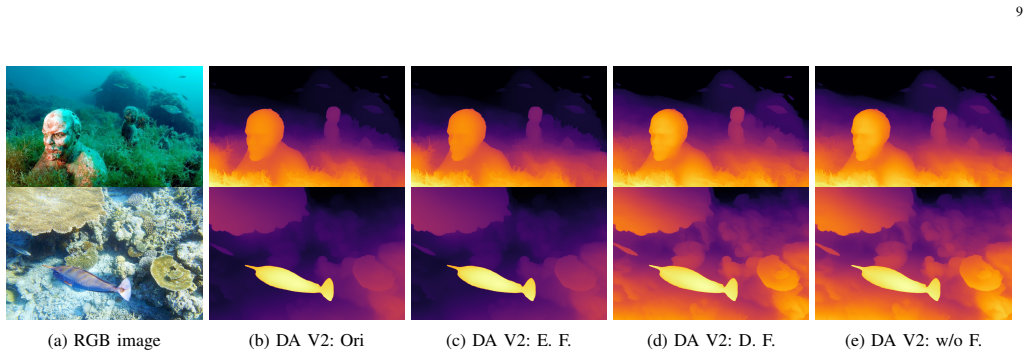
The central claim is that the in-air-to-underwater domain gap in an end-to-end vision navigation stack is carried almost entirely by the depth feature encoder, so adapting that single module is enough to make a frozen diffusion policy work underwater. The paper first trains a diffusion-based policy that maps a short sequence of compressed depth features plus goal direction and distance into 4-DoF velocity commands, with the initial image serving as an altitude reference. It then retrains the encoder on real underwater images with a physics-informed, self-supervised depth objective (PUDE) while freezing the depth decoder; a controlled comparison shows that encoder-frozen training gives almost
Load-bearing premise
The whole transfer rests on the assumption that the visual encoder is the only part of the pipeline that needs to change: the frozen diffusion policy, trained on in-air MPC expert data with an in-air dynamics model, will keep working underwater once its input features are adapted.
Editorial extensions
If this is right
- Underwater navigation policies can be trained without collecting underwater navigation data: in-air simulation plus a self-supervised encoder adaptation may be sufficient.
- The recipe is modular: any pretrained in-air depth encoder is a candidate, so advances in in-air depth models can flow into underwater navigation by repeating the Phase 2 adaptation.
- The reference-image altitude conditioning gives a purely visual way to hold altitude and reject vertical disturbances, reducing reliance on acoustic altimeters.
- The large performance gap between an RGB-conditioned baseline (0% underwater) and depth-feature DUViN suggests that representation choice, not policy architecture, dominates transfer under turbidity.
- Real-vehicle validation on a BlueROV2 shows the approach can be deployed on low-cost ROV hardware with onboard monocular vision.
- DUViN's 100% simulated success across water types indicates the method degrades gracefully rather than failing outright as visibility drops.
Reading between the lines
- The encoder-only transfer result suggests the same adapted representation may benefit other underwater vision tasks that consume depth features, such as visual SLAM front-ends or manipulation, since the adaptation is task-agnostic.
- The single-vehicle, small-tank validation leaves open whether dynamics mismatch—rather than visual domain shift—will dominate in open water with currents; a direct test is deploying the same encoder swap on a different ROV without any dynamics adaptation.
- A testable extension is to predict navigation success from depth-estimation quality: if collision-free rate tracks depth error or feature-difference maps across water types, then depth accuracy is the bottleneck and future data collection should target turbid scenes.
- Because inference runs at 2 Hz with asynchronous reuse of action sequences, the policy's effective agility is capped; closing that loop through faster inference or predictive action execution is likely needed for dynamic obstacle avoidance.
Editorial analysis
A structured set of objections, weighed in public.
Referee Report
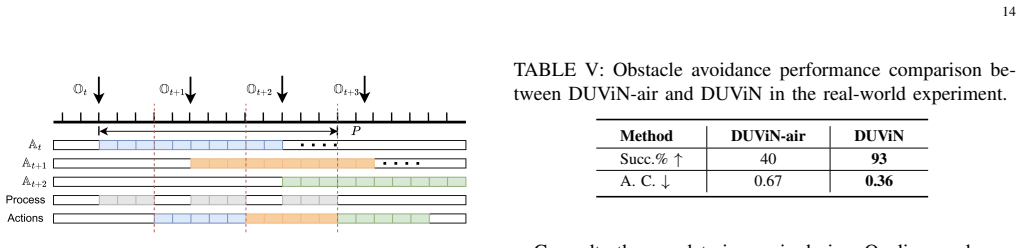
Summary. The paper proposes DUViN, an imitation-learned diffusion policy for underwater visual navigation. In Phase 1, the policy is trained in an in-air Unity simulator on MPC-generated 4-DoF velocity commands, using compressed intermediate features from DepthAnything V2 rather than raw RGB. In Phase 2, only the depth encoder is adapted to the underwater domain by retraining it on a physics-informed underwater depth estimation task (PUDE) with a frozen decoder; the adapted encoder is then plugged into the frozen navigation policy. Evaluation is conducted in simulated underwater environments with three Jerlov water types and in a real indoor tank with a BlueROV2, covering obstacle avoidance, altitude maintenance, and goal-awareness in separate experiments. The central reported results are 100% simulated goal-reaching success for DUViN and a 93% versus 40% real obstacle-avoidance success rate against the non-adapted encoder variant (DUViN-air).
Significance. The paper addresses a relevant and difficult problem: transferring an end-to-end vision-based navigation policy from in-air data to underwater deployment without large underwater navigation datasets. The proposed two-phase strategy is clear, and the decision to adapt only the encoder while freezing the decoder is well motivated by the experiments in Table I. The real-vehicle comparison between DUViN and DUViN-air is a useful ablation and shows a practically meaningful improvement under degraded visibility. The use of abstract depth features is a sensible way to reduce sensitivity to appearance shift. If the results generalize beyond the tested tank, the transfer recipe would be a practical contribution to underwater robotics. However, the evidence for the paper's headline claim of end-to-end 4-DoF goal-directed navigation is currently incomplete: the real experiments are component-level, and the only full goal-reaching results are simulated with an image-formation model closely related to the one used in the adaptation step.
major comments (4)
- [§VI-C] The real-world experiments do not exercise the claimed end-to-end 4-DoF goal-reaching behavior. The obstacle avoidance experiment (Table V) only drives the vehicle forward through three obstacles, with success defined as 'navigated through all obstacles without getting stuck,' not arrival at a designated destination. The altitude-maintenance experiment (§VI-C.3) explicitly activates only the altitude control module while the other degrees of freedom are manually controlled. The goal-awareness experiment (§VI-C.4) tests only heading choice around a single cylinder, using a virtual goal obtained by integrating gyro data, with the distance ratio fixed at 0.7. No real experiment combines goal-reaching, obstacle avoidance, and terrain-following in one 4-DoF mission. The headline claim is therefore supported only by simulation.
- [§VI-B, Eq. (20)] The simulated full-mission results may be confounded by distribution matching between adaptation and evaluation. The synthetic underwater test images are generated by Eq. (20), a physics-based attenuation/backscatter/PSF model from the authors' prior works, and the Phase 2 adaptation (Sec. V) is performed with PUDE, which also uses a physics-informed underwater image formation model of the same type. Consequently, the improved simulated margin of DUViN over DUViN-air may partly be an artifact of the encoder being adapted to the same generative family used at test time. The real 93%-vs-40% result is suggestive, but it is one vehicle in a 3 m indoor tank. I recommend adding either a real integrated goal-reaching mission or an evaluation with held-out image formation models / real underwater footage to support the generalization claim.
- [§VI-C.2, Table V] The key real-world comparison lacks statistical reporting. Each model is evaluated over only 15 runs, and Table V reports point estimates without confidence intervals or a significance test. Since success is binary, the 93%-vs-40% difference is promising, but the paper should report per-trial outcomes, a confidence interval (e.g., Wilson interval), and a test such as Fisher's exact test. Additionally, the success criterion does not measure goal arrival, so this table cannot by itself support the 'goal-reaching' language used in the abstract.
- [§VI-B.3, Eq. (18)] The altitude-maintenance evaluation is partly self-referential. The Z-axis supervision is generated by an MPC whose cost explicitly minimizes (z_m - z0)^2 (Eq. 18), and the DUViN-woA ablation simply removes this term from the training objective. The fact that DUViN-woA drifts is therefore expected and primarily confirms that the training objective was learned. In the real altitude experiments, the altitude module is isolated from the rest of the navigation policy, so this does not validate the policy's ability to maintain altitude while simultaneously navigating to a goal, avoiding obstacles, and controlling yaw. The paper should either add an integrated altitude-plus-navigation experiment or explicitly delimit the altitude claim to the isolated module.
minor comments (5)
- [§IV-A, Eq. (1)] The definition of O_t with indices {0, t-P+1, ..., t} is ambiguous when t < P: the text says o_1 is used for padding, but the set notation suggests o_0 and overlapping indices. Please define the padding convention explicitly.
- [Table I] The metric δ < 1.153 is unusual; standard depth evaluation typically uses δ < 1.25, 1.25^2, and 1.25^3. If 1.153 is intentional (perhaps from a specific benchmark), please cite or justify it; otherwise it is likely a typo.
- [§VI-B, Tables III-IV] Success rates and collision counts over 20 trials are reported without confidence intervals or trial-level variability, and the qualitative claim that DUViN is 'more robust' under increasing turbidity would be easier to assess with e.g. Wilson intervals.
- [§IV-A, Eq. (13)] The diffusion training loss writes E_{k, ε_k} but does not explicitly specify the distribution of k (presumably uniform over {1,...,K}) or the exact variance schedule. Please make these implementation details explicit for reproducibility.
- [Figs. 8 and 13] The label 'DUViN(a)' is confusing: it is used for the depth estimation result from the DUViN extractor, but it could be misread as a variant of DUViN. Please rename it, e.g., 'DA V2 (D.F.)' or 'DUViN depth', to avoid ambiguity.
Circularity Check
No significant circularity: the transfer claim is validated by an external prior method and by real-world experiments, and the altitude-maintenance test is a training-target sanity check rather than a derived prediction.
full rationale
The paper's derivation chain has no step in which an output quantity is definitionally equal to an input quantity. Phase 1 supervises a diffusion policy with MPC-generated velocities (Eqs. 16-19); Phase 2 re-trains the DepthAnything encoder with the PUDE objective from the authors' prior ECCV paper [35]; deployment swaps the encoder. The simulated evaluation uses Eq. (20), a physics-based underwater image-formation model cited to [46]-[47]. This creates a possible distribution-matching confound between the synthetic test renderer and PUDE's physics priors, but it is not a circular reduction: PUDE is an external, peer-reviewed method, the encoder is trained on real underwater images (SeaThru/SQUID), and the real-world tank experiments (Table V, Figs. 13-16) evaluate the same claim outside the simulator. The altitude-maintenance comparison (DUViN vs. DUViN-woA, Eq. 18) is a sanity check that a policy trained to imitate altitude-keeping expert labels has learned those labels; it does not present the training objective as a derived prediction. No fitted parameter is renamed as a prediction, and no uniqueness theorem or ansatz is imported solely through self-citation. Therefore no specific circular step can be quoted, and the score is 0.
Assumptions & free parameters
free parameters (4)
- lambda1 =
10
- lambda2 =
10
- kappa =
0.99
- Vmax =
(0.6, 0.4, 0.2, 0.15) m/s and rad/s
assumptions (6)
- domain assumption The underwater image formation model (Eq. 20: attenuation, backscatter, forward scatter, marine snow) adequately represents real underwater degradation.
- domain assumption The 6-DoF Fossen dynamics model (Eq. 22) with BlueROV2 Heavy parameters from [49] generates expert trajectories that transfer to the real vehicle.
- domain assumption Depth features from a large-scale in-air pretrained model are a domain-shift-robust representation for navigation.
- domain assumption Underwater domain shift in the depth model is carried primarily by the encoder, so encoder-only adaptation suffices for the navigation policy.
- domain assumption Destination direction and distance are available to the vehicle (e.g., via USBL).
- standard math Pretrained DINOv2/DepthAnything V2 features and the DDPM diffusion framework behave as published.
Cite this review
Pith. "Pith review of DUViN: Diffusion-Based Underwater Visual Navigation via Knowledge-Transferred Depth Features." pith.science (2026). https://pith.science/paper/YSBHFK3B
@misc{pith2026250902983,
  author       = {Pith},
  title        = {Pith review of: DUViN: Diffusion-Based Underwater Visual Navigation via Knowledge-Transferred Depth Features},
  year         = {2026},
  howpublished = {\url{https://pith.science/paper/YSBHFK3B}},
  note         = {Machine review of arXiv:2509.02983}
}
read the original abstract
Autonomous underwater navigation remains a challenging problem due to limited sensing capabilities and the difficulty of constructing accurate maps in underwater environments. In this paper, we propose a Diffusion-based Underwater Visual Navigation policy via knowledge-transferred depth features, named DUViN, which enables vision-based end-to-end 4-DoF motion control for underwater vehicles in unknown environments. DUViN guides the vehicle to avoid obstacles and maintain a safe and perception awareness altitude relative to the terrain without relying on pre-built maps. To address the difficulty of collecting large-scale underwater navigation datasets, we propose a method that ensures robust generalization under domain shifts from in-air to underwater environments by leveraging depth features and introducing a novel model transfer strategy. Specifically, our training framework consists of two phases: we first train the diffusion-based visual navigation policy on in-air datasets using a pre-trained depth feature extractor. Secondly, we retrain the extractor on an underwater depth estimation task and integrate the adapted extractor into the trained navigation policy from the first step. Experiments in both simulated and real-world underwater environments demonstrate the effectiveness and generalization of our approach. The experimental videos are available at https://www.youtube.com/playlist?list=PLqt2s-RyCf1gfXJgFzKjmwIqYhrP4I-7Y.
Figures


Figures from the paper (11 more)




Reference graph
Works this paper leans on
-
[18]
Uivnav: Underwater information-driven vision- based navigation via imitation learning,
X. Lin, N. Karapetyan, K. Joshi, T. Liu, N. Chopra, M. Yu, P. Tokekar, and Y . Aloimonos, “Uivnav: Underwater information-driven vision- based navigation via imitation learning,” in Proc. IEEE Int. Conf. Robot. Autom. (ICRA). IEEE, 2024, pp. 5250–5256
work page 2024
-
[1]
Advancements in the field of autonomous underwater vehicle,
A. Sahoo, S. K. Dwivedy, and P. S. Robi, “Advancements in the field of autonomous underwater vehicle,” Ocean Eng., vol. 181, 2019
work page 2019
-
[2]
Sensor-driven online coverage planning for autonomous underwater vehicles,
L. Paull, S. Saeedi, M. Seto, and H. Li, “Sensor-driven online coverage planning for autonomous underwater vehicles,” IEEE/ASME Transac- tions on Mechatronics , vol. 18, no. 6, pp. 1827–1838, 2012
work page 2012
-
[3]
W. Zhang, S. Wei, Y . Teng, J. Zhang, X. Wang, and Z. Yan, “Dynamic obstacle avoidance for unmanned underwater vehicles based on an improved velocity obstacle method,” Sensors, vol. 17, no. 12, p. 2742, 2017
work page 2017
-
[4]
Autonomous underwater vehicle navigation: A review,
B. Zhang, D. Ji, S. Liu, X. Zhu, and W. Xu, “Autonomous underwater vehicle navigation: A review,” Ocean Eng., vol. 273, p. 113861, 2023
work page 2023
-
[5]
T. Manderson, J. C. G. Higuera, R. Cheng, and G. Dudek, “Vision- based autonomous underwater swimming in dense coral for combined collision avoidance and target selection,” in Proc. IEEE/RSJ Int. Conf. Intell. Robots Syst. (IROS) . IEEE, 2018, pp. 1885–1891
work page 2018
-
[6]
Human diver-inspired visual navigation: Towards coverage path planning of shipwrecks,
N. Karapetyan, J. V . Johnson, and I. Rekleitis, “Human diver-inspired visual navigation: Towards coverage path planning of shipwrecks,” Mar. Technol. Soc. J., vol. 55, no. 4, pp. 24–32, 2021
work page 2021
-
[7]
V oxblox: Incremental 3d euclidean signed distance fields for on-board mav planning,
H. Oleynikova, Z. Taylor, M. Fehr, R. Siegwart, and J. Nieto, “V oxblox: Incremental 3d euclidean signed distance fields for on-board mav planning,” in Proc. IEEE/RSJ Int. Conf. Intell. Robots Syst. (IROS) . IEEE, 2017, pp. 1366–1373
work page 2017
Show all 49 references
-
[8]
Fiesta: Fast incremental euclidean distance fields for online motion planning of aerial robots,
L. Han, F. Gao, B. Zhou, and S. Shen, “Fiesta: Fast incremental euclidean distance fields for online motion planning of aerial robots,” in Proc. IEEE/RSJ Int. Conf. Intell. Robots Syst. (IROS) . IEEE, 2019, pp. 4423–4430
2019
-
[9]
Visual navigation in real-world indoor environments using end-to-end deep reinforcement learning,
J. Kulh ´anek, E. Derner, and R. Babuˇska, “Visual navigation in real-world indoor environments using end-to-end deep reinforcement learning,” IEEE Robot. Autom. Lett. , vol. 6, no. 3, pp. 4345–4352, 2021
2021
-
[10]
A reduction of imitation learning and structured prediction to no-regret online learning,
S. Ross, G. Gordon, and D. Bagnell, “A reduction of imitation learning and structured prediction to no-regret online learning,” inProc. Int. Conf. Artif. Intell. Stat. (AISTATS) . JMLR, 2011, pp. 627–635
2011
-
[11]
End- to-end learning for self-driving cars,
M. Bojarski, D. Del Testa, D. Dworakowski, B. Firner, B. Flepp, P. Goyal, L. D. Jackel, M. Monfort, U. Muller, J. Zhang et al. , “End- to-end learning for self-driving cars,” arXiv, vol. 1604.07316, 2016
2016 arXiv
-
[12]
Soft actor-critic: Off- policy maximum entropy deep reinforcement learning with a stochastic actor,
T. Haarnoja, A. Zhou, P. Abbeel, and S. Levine, “Soft actor-critic: Off- policy maximum entropy deep reinforcement learning with a stochastic actor,” in Proc. Int. Conf. Mach. Learn. (ICML) . PMLR, 2018, pp. 1861–1870
2018
-
[13]
Continuous control with deep reinforcement learning,
T. P. Lillicrap, J. J. Hunt, A. Pritzel, N. Heess, T. Erez, Y . Tassa, D. Silver, and D. Wierstra, “Continuous control with deep reinforcement learning,” arXiv, vol. 1509.02971, 2015
2015 arXiv
-
[14]
Rapid exploration for open-world navigation with latent goal models,
D. Shah, B. Eysenbach, G. Kahn, N. Rhinehart, and S. Levine, “Rapid exploration for open-world navigation with latent goal models,” arXiv, vol. 2104.05859, 2021
2021 arXiv
-
[15]
Vint: A foundation model for visual navigation,
D. Shah, A. Sridhar, N. Dashora, K. Stachowicz, K. Black, N. Hirose, and S. Levine, “Vint: A foundation model for visual navigation,” arXiv, vol. 2306.14846, 2023
2023 arXiv
-
[16]
Nomad: Goal masked diffusion policies for navigation and exploration,
A. Sridhar, D. Shah, C. Glossop, and S. Levine, “Nomad: Goal masked diffusion policies for navigation and exploration,” in Proc. IEEE Int. Conf. Robot. Autom. (ICRA) . IEEE, 2024, pp. 63–70
2024
-
[17]
Navigating to objects in the real world,
T. Gervet, S. Chintala, D. Batra, J. Malik, and D. S. Chaplot, “Navigating to objects in the real world,” Sci. Robot. , vol. 8, no. 79, p. eadf6991, 2023
2023
-
[19]
Aquavis: A perception-aware autonomous navigation framework for underwater vehicles,
M. Xanthidis, M. Kalaitzakis, N. Karapetyan, J. Johnson, N. Vitzi- laios, J. M. O’Kane, and I. Rekleitis, “Aquavis: A perception-aware autonomous navigation framework for underwater vehicles,” in Proc. IEEE/RSJ Int. Conf. Intell. Robots Syst. (IROS). IEEE, 2021, pp. 5410– 5417
2021
-
[20]
Hybrid dynamic moving obstacle avoidance using a stochastic reachable set- based potential field,
N. Malone, H.-T. Chiang, K. Lesser, M. Oishi, and L. Tapia, “Hybrid dynamic moving obstacle avoidance using a stochastic reachable set- based potential field,” IEEE Trans. Robot., vol. 33, no. 5, pp. 1124–1138, 2017
2017
-
[21]
Fapp: Fast and adaptive perception and planning for uavs in dynamic cluttered environments,
M. Lu, X. Fan, H. Chen, and P. Lu, “Fapp: Fast and adaptive perception and planning for uavs in dynamic cluttered environments,” IEEE Trans. Robot., 2024
2024
-
[22]
Self- supervised deep reinforcement learning with generalized computation graphs for robot navigation,
G. Kahn, A. Villaflor, B. Ding, P. Abbeel, and S. Levine, “Self- supervised deep reinforcement learning with generalized computation graphs for robot navigation,” in Proc. IEEE Int. Conf. Robot. Autom. (ICRA). IEEE, 2018, pp. 5129–5136
2018
-
[23]
Towards generalization in target-driven visual navigation by using deep reinforcement learning,
A. Devo, G. Mezzetti, G. Costante, M. L. Fravolini, and P. Valigi, “Towards generalization in target-driven visual navigation by using deep reinforcement learning,” IEEE Trans. Robot. , vol. 36, no. 5, pp. 1546– 1561, 2020
2020
-
[24]
Domain randomization for transferring deep neural networks from simulation to the real world,
J. Tobin, R. Fong, A. Ray, J. Schneider, W. Zaremba, and P. Abbeel, “Domain randomization for transferring deep neural networks from simulation to the real world,” in Proc. IEEE/RSJ Int. Conf. Intell. Robots Syst. (IROS). IEEE, 2017, pp. 23–30
2017
-
[25]
End- to-end driving via conditional imitation learning,
F. Codevilla, M. M ¨uller, A. L´opez, V . Koltun, and A. Dosovitskiy, “End- to-end driving via conditional imitation learning,” in Proc. IEEE Int. Conf. Robot. Autom. (ICRA) . IEEE, 2018, pp. 4693–4700
2018
-
[26]
Vision-based goal-conditioned policies for underwater navigation in the presence of obstacles,
T. Manderson, J. C. G. Higuera, S. Wapnick, J.-F. Tremblay, F. Shkurti, D. Meger, and G. Dudek, “Vision-based goal-conditioned policies for underwater navigation in the presence of obstacles,” arXiv, vol. 2006.16235, 2020
2006 arXiv
-
[27]
Towards robust monocular depth estimation: Mixing datasets for zero-shot cross- dataset transfer,
R. Ranftl, K. Lasinger, D. Hafner, K. Schindler, and V . Koltun, “Towards robust monocular depth estimation: Mixing datasets for zero-shot cross- dataset transfer,” IEEE Trans. Pattern Anal. Mach. Intell., vol. 44, no. 3, pp. 1623–1637, 2020
2020
-
[28]
Vision transformers for dense prediction,
R. Ranftl, A. Bochkovskiy, and V . Koltun, “Vision transformers for dense prediction,” in Proc. IEEE/CVF Int. Conf. Comput. Vis. (ICCV) , 2021, pp. 12 179–12 188
2021
-
[29]
Depth anything: Unleashing the power of large-scale unlabeled data,
L. Yang, B. Kang, Z. Huang, X. Xu, J. Feng, and H. Zhao, “Depth anything: Unleashing the power of large-scale unlabeled data,” in Proc. IEEE/CVF Conf. Comput. Vis. Pattern Recognit. (CVPR) , 2024, pp. 10 371–10 381
2024
-
[30]
Depth anything v2,
L. Yang, B. Kang, Z. Huang, Z. Zhao, X. Xu, J. Feng, and H. Zhao, “Depth anything v2,” Adv. Neural Inf. Process. Syst. (NeurIPS), vol. 37, pp. 21 875–21 911, 2024
2024
-
[31]
Udepth: Fast monocular depth estimation for visually-guided underwater robots,
B. Yu, J. Wu, and M. J. Islam, “Udepth: Fast monocular depth estimation for visually-guided underwater robots,” in 2023 IEEE International Conference on Robotics and Automation (ICRA) . IEEE, 2023, pp. 3116–3123
2023
-
[32]
Unsupervised single image underwater depth estimation,
H. Gupta and K. Mitra, “Unsupervised single image underwater depth estimation,” in Proc. IEEE Int. Conf. Image Process. (ICIP) . IEEE, 2019, pp. 624–628. 18
2019
-
[33]
Uw-gan: Single-image depth estimation and image enhancement for underwater images,
P. Hambarde, S. Murala, and A. Dhall, “Uw-gan: Single-image depth estimation and image enhancement for underwater images,” IEEE Trans. Instrum. Meas., vol. 70, pp. 1–12, 2021
2021
-
[34]
Self-supervised monocular depth underwater,
S. Amitai, I. Klein, and T. Treibitz, “Self-supervised monocular depth underwater,” in 2023 IEEE International Conference on Robotics and Automation (ICRA). IEEE, 2023, pp. 1098–1104
2023
-
[35]
Physics-informed knowledge transfer for underwater monocular depth estimation,
J. Yang, M. Gong, and Y . Pu, “Physics-informed knowledge transfer for underwater monocular depth estimation,” in Proc. Eur. Conf. Comput. Vis. (ECCV). Springer, 2024, pp. 449–465
2024
-
[36]
Dinov2: Learn- ing robust visual features without supervision,
M. Oquab, T. Darcet, T. Moutakanni, H. V o, M. Szafraniec, V . Khalidov, P. Fernandez, D. Haziza, F. Massa, A. El-Nouby et al., “Dinov2: Learn- ing robust visual features without supervision,” arXiv, vol. 2304.07193, 2023
2023 arXiv
-
[37]
Arbitrary style transfer in real-time with adaptive instance normalization,
X. Huang and S. Belongie, “Arbitrary style transfer in real-time with adaptive instance normalization,” in Proc. IEEE Int. Conf. Comput. Vis. (ICCV), 2017, pp. 1501–1510
2017
-
[38]
Film: Visual reasoning with a general conditioning layer,
E. Perez, F. Strub, H. De Vries, V . Dumoulin, and A. Courville, “Film: Visual reasoning with a general conditioning layer,” in Proc. AAAI Conf. Artif. Intell. (AAAI) , vol. 32, no. 1, 2018
2018
-
[39]
Diffusion policy: Visuomotor policy learning via action diffusion,
C. Chi, Z. Xu, S. Feng, E. Cousineau, Y . Du, B. Burchfiel, R. Tedrake, and S. Song, “Diffusion policy: Visuomotor policy learning via action diffusion,” Int. J. Robot. Res. (IJRR) , 2023
2023
-
[40]
Denoising diffusion probabilistic models,
J. Ho, A. Jain, and P. Abbeel, “Denoising diffusion probabilistic models,” Adv. Neural Inf. Process. Syst. (NeurIPS), vol. 33, pp. 6840–6851, 2020
2020
-
[41]
T. I. Fossen, Handbook of Marine Craft Hydrodynamics and Motion Control. John Wiley & Sons, 2011
2011
-
[42]
Sea-thru: A method for removing water from underwater images,
D. Akkaynak and T. Treibitz, “Sea-thru: A method for removing water from underwater images,” inProc. IEEE/CVF Conf. Comput. Vis. Pattern Recognit. (CVPR), 2019, pp. 1682–1691
2019
-
[43]
Underwater single image color restoration using haze-lines and a new quantitative dataset,
D. Berman, D. Levy, S. Avidan, and T. Treibitz, “Underwater single image color restoration using haze-lines and a new quantitative dataset,” IEEE Trans. Pattern Anal. Mach. Intell. , vol. 43, no. 8, pp. 2822–2837, 2020
2020
-
[44]
Depth map prediction from a single image using a multi-scale deep network,
D. Eigen, C. Puhrsch, and R. Fergus, “Depth map prediction from a single image using a multi-scale deep network,”Adv. Neural Inf. Process. Syst. (NeurIPS), vol. 27, 2014
2014
-
[45]
An underwater image enhancement benchmark dataset and beyond,
C. Li, C. Guo, W. Ren, R. Cong, J. Hou, S. Kwong, and D. Tao, “An underwater image enhancement benchmark dataset and beyond,” IEEE Trans. Image Process., vol. 29, pp. 4376–4389, 2019
2019
-
[46]
Knowledge distillation for feature extraction in underwater vslam,
J. Yang, M. Gong, G. Nair, J. H. Lee, J. Monty, and Y . Pu, “Knowledge distillation for feature extraction in underwater vslam,” in Proc. IEEE Int. Conf. Robot. Autom. (ICRA) . IEEE, 2023, pp. 5163–5169
2023
-
[47]
Knowledge distillation for underwater feature extraction and matching via gan-synthesized images,
J. Yang, M. Gong, and Y . Pu, “Knowledge distillation for underwater feature extraction and matching via gan-synthesized images,” arXiv, vol. 2504.08253, 2025
2025 arXiv
-
[48]
Jerlov, Optical Oceanography
N. Jerlov, Optical Oceanography. Elsevier, 1968
1968
-
[49]
An open-source benchmark simulator: Control of a bluerov2 underwater robot,
M. von Benzon, F. F. Sørensen, E. Uth, J. Jouffroy, J. Liniger, and S. Ped- ersen, “An open-source benchmark simulator: Control of a bluerov2 underwater robot,” J. Mar. Sci. Eng. , vol. 10, no. 12, p. 1898, 2022
2022
Reviewed August 5, 2026 · model on record in the stance chip above.
Discussion (0). Sign in to comment.