REVIEW 4 major objections 7 minor 56 references
PrivDPR: Synthetic Graph Publishing with Deep PageRank under Differential Privacy
T0 review · 4 major / 7 minor · reviewed 2026-08-10 · deepseek-v4-flash
Pith's one-line read This paper claims that a deep PageRank network with weight-normalized layers can synthesize graphs under node-level differential privacy by trading network depth for privacy noise.
desk verdict Interesting and fixable: the depth-sensitivity mechanism is real, but the privacy proof has a factor-of-2 gap and the utility claims outrun the evidence. read the letter →
The pith
A machine-rendered reading of the paper's core claim, the machinery that carries it, and where it could break.
The reading
What carries the argument
The central objects are the deep PageRank objective and the Cauchy-Schwarz upper bound $\mathcal{L}(v_i,v_j;\Theta)$ from Lemma 4.1, which replaces the non-decomposable PageRank loss with an edge-wise training loss. Weight normalization $W/(\|sW\|_2)$ with $s>1$ is the mechanism that makes each layer shrink the gradient bound by a factor $1/s$, so the full bound $M(1/s)^{L+1}$ follows from the chain-rule/Lipschitz estimate of the network. The layer count $L$ is then chosen from the log-inequality $\log\left(\frac{S_\nabla}{BM}\right)/\log\left(\frac{1}{s}\right)-1 \le L$, turning network depth into the privacy knob.
What would settle it
Take a fixed graph, fix $s$ and the batch size, train PrivDPR with $L$ chosen from Eq. (12), and measure the empirical $\ell_2$ norm of the gradient of the edge-wise loss with respect to $V$ over training; if it does not stay at or below the preset $S_\nabla$, the sensitivity bound in Theorem 4.2 is false. Alternatively, compute the PageRank vectors of the published graph and of the input graph; if their Spearman correlation is near zero while the training loss has converged, the surrogate objective is not preserving the structure the method claims.
Extended reading notes
Core claim
At the center of the paper is Theorem 4.2, which bounds the $\ell_2$ norm of $\partial \mathcal{L}(v_i,v_j;\Theta)/\partial V$ by $M(1/s)^{L+1}$ for a weight-normalized deep PageRank with normalization $W/\|sW\|_2$ and sigmoid activations. Choosing the number of layers according to $\log\left(\frac{S_\nabla}{BM}\right)/\log\left(\frac{1}{s}\right)-1 \le L$ therefore makes the batch gradient's sensitivity at most the preset value $S_\nabla$, and the same inequality with $S_\nabla$ replaced by $S_\nabla/T$ counters the noise increase from splitting $\varepsilon$ across $T$ gradient updates. Theorem 5.1 then assembles node-level DP from the per-iteration Gaussian mechanism, sequential composition, and post-processing. The paper's claim is that this depth-for-privacy trade-off, not a stronger composition calculus, is what lets a private deep graph generator work under small privacy budgets.
Load-bearing premise
The training minimizes an upper-bound surrogate for the PageRank objective, and the paper explicitly says the proof that this bound approximates the objective is future work; if that surrogate does not preserve PageRank structure, the synthetic graph's utility claim fails even though the DP guarantee may hold.
Editorial extensions
If this is right
- Node-level synthetic graph release with $(\varepsilon,\delta)$-DP is achievable at privacy budgets as small as $\varepsilon=0.1$ without moments accountant style composition.
- Adding hidden layers lowers the required Gaussian noise, so a user can preset a target sensitivity and size the network accordingly.
- Because DP is preserved under post-processing, the published graph can feed arbitrary downstream queries without extra privacy cost.
- The training loop runs in time linear in the number of nodes for fixed batch and walk parameters, so the method is claimed to scale to large graphs.
Reading between the lines
- The privacy theorem only guarantees that the released node embedding matrix is close in distribution; whether that embedding captures PageRank structure rests on the unproven approximation ratio of the upper-bound loss, so a natural test is to compare node rankings from the synthetic graph with true PageRank values.
- The exponential drop $(1/s)^{L+1}$ suggests the gradient can vanish for large $L$; the method may inherit vanishing-gradient behavior and need residual connections or skip layers, which the paper does not discuss.
- One could apply the same weight-normalization-and-depth argument to other random-walk embedding objectives, not just PageRank, to obtain node-level DP for embeddings more generally.
Signed reviews
Editorial analysis
A structured set of objections, weighed in public.
Referee Report
Summary. PrivDPR proposes a node-level differentially private synthetic graph publishing method based on a deep PageRank objective. The algorithm learns a node embedding matrix V by adding Gaussian noise to the gradient of V during training, while using weight normalization to bound the per-edge gradient norm by M(1/s)^{L+1}. The paper's central theoretical claims are that increasing the number of network layers can meet any preset sensitivity S∇ and mitigate privacy budget splitting, and that the final synthetic graph satisfies (ε,δ)-node-level DP. The empirical section compares PrivDPR with GAP, DPGGAN, DPGVAE, and a non-private variant on five datasets across eight structural metrics and two downstream tasks.
Significance. If the privacy proof were fully correct, the depth-versus-sensitivity trade-off would be a useful addition to the DP graph synthesis toolbox, and the paper's explicit targeting of node-level DP (rather than the weaker edge-level DP) is valuable. The manuscript is clearly written, the experiments are broad, and the authors provide a public code repository. However, the load-bearing privacy analysis contains a factor-of-2 sensitivity error, the data-dependent random-walk batch construction is not accounted for in the proof, and the absolute utility numbers are modest; the current version therefore does not yet substantiate the claimed privacy guarantee or the abstract's 'high data utility' statement.
major comments (4)
- [Sec. 4.3.1, Eq. (11); Sec. 5.1, Theorem 5.1] The sensitivity of the batch gradient sum is underestimated by a factor of 2. Theorem 4.2 gives ||∂L(vi,vj;Θ)/∂V||_2 ≤ ρ = M(1/s)^{L+1} for each edge, and Eq. (11) sets Bρ ≤ S∇ by claiming that the worst-case norm of the sum over B affected gradients is at most Bρ. Under the bounded node DP adopted in Definition 3, two neighboring graphs both contribute B edges to the batch: for each edge, the gradient in G and the gradient in G′ each have norm at most ρ, so by the triangle inequality the per-edge difference is at most 2ρ and the sensitivity of the sum is at most 2Bρ, not Bρ. Consequently, the Gaussian noise in Theorem 5.1 is scaled too small for the stated (ε,δ)-node-level DP guarantee. The error is fixable by requiring S∇ ≥ 2Bρ (or increasing L by one layer), but as written the central privacy claim is not established.
- [Sec. 5.1, Theorem 5.1; Algorithm 2, lines 4–7] The privacy proof does not account for the data-dependent random-walk batch construction. In Algorithm 2, the batch E_B is generated by performing random walks on the input graph (lines 5–7), so the distribution over batches is itself a function of the private graph. Theorem 5.1 only analyzes the Gaussian mechanism for a fixed batch, i.e., it shows that the noisy sum of gradients is DP conditioned on a batch. However, a mixture of DP mechanisms with data-dependent mixture weights is not necessarily DP. To complete the proof, the authors need either to make the batch selection data-independent or to bound the privacy loss of the random-walk sampling itself, for example by a subsampling argument with data-independent probabilities. Without this, the per-iteration DP claim and the composition argument in Theorem 5.1 are not fully justified.
- [Sec. 4.2, Lemma 4.1 and following paragraph] The approximation ratio of the surrogate objective is left open. The paper minimizes the edge-wise upper bound L(vi,vj) from Lemma 4.1 in place of the PageRank objective in Eq. (3), and it explicitly states that the proof of the approximation ratio is 'currently a subject for future research'. If this upper bound is loose or does not preserve the minimizer structure of PageRank, then the learned embedding V may not reflect the PageRank properties that motivate the method. The DP guarantee is independent of this issue, but the utility claim and the name 'deep PageRank' depend on it. The authors should either provide a bound on the approximation ratio or clearly qualify the theoretical connection to PageRank.
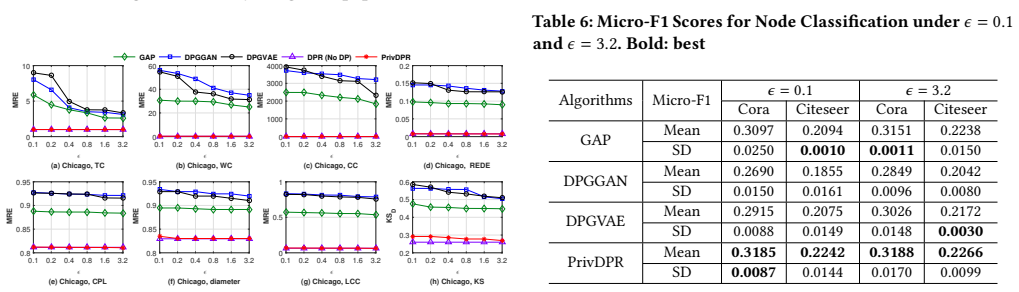
- [Sec. 6, Tables 2–5 and Figure 2] The reported utilities appear too low to support the abstract's claim of 'high data utility'. For example, the mean relative error for triangle count is around 0.99 across all datasets in Tables 2 and 3, the KS distance on Cora and Citeseer is around 0.5–0.6, and the link-prediction AUC of PrivDPR is only about 0.50–0.60 in Tables 4 and 5, which is close to random guessing. While PrivDPR often outperforms the baselines, the absolute numbers suggest that the synthetic graphs preserve only weak structural fidelity. The utility claims should be reworded, and the discussion should address why the absolute errors are this large.
minor comments (7)
- [Sec. 6, Baselines] The sentence 'For a fair comparison, we configure GAP to generate synthetic graphs using the same generation method as PrivDPR' is duplicated in Section 6; please remove the duplicate.
- [Theorem 4.2] The phrase 'maximum number of layers' should be 'minimum number of layers', since the inequality provides a lower bound on L for a preset sensitivity S∇.
- [Sec. 4.3.2] The text says 'we evenly divide privacy parameters ε and σ'; this should likely read 'ε and δ', since σ is computed from ε/T and δ/T via the Gaussian mechanism.
- [Eq. (3)] The typesetting of Eq. (3) is difficult to parse; please display the PageRank objective with unambiguous parentheses and define all terms, for example the placement of (1−γ)/N inside the outer parentheses.
- [Algorithm 2, line 12 and Appendix A] Algorithm 2 says 'Sample graphs from VV^T to generate score matrix S', but the reconstruction procedure in Appendix A builds a transition count matrix from random walks over the learned embeddings; please reconcile the description so that the reader can reproduce the reconstruction.
- [Notation throughout] The batch size is denoted ♭ in Algorithm 2 but B in Eqs. (6)–(7) and Theorem 4.2; please use a consistent symbol.
- [Sec. 6.3 and Tables 4–5] The non-private baseline DPR (No DP) is described in Section 6 but does not appear in the link prediction or node classification tables; please either include it or state why it is omitted.
Circularity Check
No load-bearing circularity; the central DP sensitivity derivation is self-contained. The score reflects only minor non-load-bearing self-citations and non-circular caveats.
full rationale
No circular step is present in the derivation chain. Theorem 4.2 bounds the per-edge gradient norm, ||∂L(vi,vj;Theta)/∂V||_2 <= M(1/s)^(L+1), from Lemma 4.4 and the explicit weight-normalization choice W_WN(W)=W/||sW||_2; this is an input to the privacy proof, not a restatement of the (epsilon,delta) target. Eq. (7) calibrates Gaussian noise to a preset S_∇, and Eq. (11) shows how choosing L makes B M (1/s)^(L+1) <= S_∇; this is a genuine sensitivity analysis rather than a fitted prediction. Theorem 5.1 then invokes only standard sequential composition and post-processing. The authors' self-citations ([11], [44]-[47], [52]) appear only as related-work references and are not load-bearing premises. Two caveats should be weighed separately rather than as circularity: the paper explicitly states 'The proof of this upper bound on the approximation ratio is currently a subject for future research' (Section 4.2), leaving the surrogate objective's fidelity to PageRank unproven; and Eq. (11)'s worst-case bound B M (1/s)^(L+1) bounds the norm of one batch sum, whereas the sensitivity of the difference of two neighboring batch sums under bounded node DP would be at most 2 B M (1/s)^(L+1), so the noise calibration may be off by a factor of two. Both are correctness/utility concerns, not cases where an equation reduces by construction to its own input.
Assumptions & free parameters
free parameters (8)
- Weight normalization parameter s =
8
- Hidden dimension d =
64
- Preset sensitivity S∇ =
5
- Embedding dimension r =
128
- Random walk parameters Rwn and Rwl =
Rwn=2, Rwl=16
- Batch size ♭ =
16
- Learning rate η =
1e-3
- Epochs nepochs =
5
assumptions (6)
- standard math Standard DP composition and Gaussian mechanism theorems
- standard math Cauchy-Schwarz inequality used in Lemma 4.1
- domain assumption Activation function has bounded derivative and output in [0,1]
- domain assumption Weight normalization yields spectral norm exactly 1/s
- domain assumption Random walk batch sensitivity is bounded by B times the per-edge gradient bound
- ad hoc to paper The edge-wise upper bound approximates the PageRank objective
Cite this review
Pith. "Pith review of PrivDPR: Synthetic Graph Publishing with Deep PageRank under Differential Privacy." pith.science (2026). https://pith.science/paper/YSPRYIUL
@misc{pith2026250102354,
  author       = {Pith},
  title        = {Pith review of: PrivDPR: Synthetic Graph Publishing with Deep PageRank under Differential Privacy},
  year         = {2026},
  howpublished = {\url{https://pith.science/paper/YSPRYIUL}},
  note         = {Machine review of arXiv:2501.02354}
}
read the original abstract
The objective of privacy-preserving synthetic graph publishing is to safeguard individuals' privacy while retaining the utility of original data. Most existing methods focus on graph neural networks under differential privacy (DP), and yet two fundamental problems in generating synthetic graphs remain open. First, the current research often encounters high sensitivity due to the intricate relationships between nodes in a graph. Second, DP is usually achieved through advanced composition mechanisms that tend to converge prematurely when working with a small privacy budget. In this paper, inspired by the simplicity, effectiveness, and ease of analysis of PageRank, we design PrivDPR, a novel privacy-preserving deep PageRank for graph synthesis. In particular, we achieve DP by adding noise to the gradient for a specific weight during learning. Utilizing weight normalization as a bridge, we theoretically reveal that increasing the number of layers in PrivDPR can effectively mitigate the high sensitivity and privacy budget splitting. Through formal privacy analysis, we prove that the synthetic graph generated by PrivDPR satisfies node-level DP. Experiments on real-world graph datasets show that PrivDPR preserves high data utility across multiple graph structural properties.
Figures


Figures from the paper (2 more)

Reference graph
Works this paper leans on
-
[1]
Martin Abadi, Andy Chu, Ian Goodfellow, H Brendan McMahan, Ilya Mironov, Kunal Talwar, and Li Zhang. 2016. Deep learning with differential privacy. In ACM SIGSAC Conference on Computer and Communications Security . 308–318
work page 2016
-
[2]
Aleksandar Bojchevski, Oleksandr Shchur, Daniel Zügner, and Stephan Günne- mann. 2018. NetGAN: Generating graphs via random walks. In International Conference on Machine Learning . 610–619
work page 2018
-
[3]
Rui Chen, Benjamin C Fung, Philip S Yu, and Bipin C Desai. 2014. Correlated network data publication via differential privacy. The VLDB Journal 23, 4 (2014), 653–676
work page 2014
-
[4]
Ameya Daigavane, Gagan Madan, Aditya Sinha, Abhradeep Guha Thakurta, Gaurav Aggarwal, and Prateek Jain. 2021. Node-level differentially private graph neural networks. arXiv preprint arXiv:2111.15521 (2021)
arXiv 2021
-
[5]
Lun Du, Xu Chen, Fei Gao, Qiang Fu, Kunqing Xie, Shi Han, and Dongmei Zhang
-
[6]
Cynthia Dwork. 2006. Differential privacy. In International Colloquium on Au- tomata, Languages, and Programming . 1–12
work page 2006
-
[7]
Cynthia Dwork, Frank McSherry, Kobbi Nissim, and Adam Smith. 2006. Cali- brating noise to sensitivity in private data analysis. In Theory of Cryptography Conference. 265–284
work page 2006
-
[8]
Cynthia Dwork and Aaron Roth. 2014. The algorithmic foundations of differential privacy. Foundations and Trends in Theoretical Computer Science. 9, 3–4 (2014), 211–407
work page 2014
Show all 56 references
-
[9]
Marek Eliáš, Michael Kapralov, Janardhan Kulkarni, and Yin Tat Lee. 2020. Dif- ferentially private release of synthetic graphs. In Annual ACM-SIAM Symposium on Discrete Algorithms. 560–578
2020
-
[10]
Alessandro Epasto, Vahab Mirrokni, Bryan Perozzi, Anton Tsitsulin, and Peilin Zhong. 2022. Differentially private graph learning via sensitivity-bounded per- sonalized pagerank. In International Conference Neural Information Processing Systems. 22617–22627
2022
-
[11]
Jie Fu, Qingqing Ye, Haibo Hu, Zhili Chen, Lulu Wang, Kuncan Wang, and Xun Ran. 2024. DPSUR: Accelerating differentially private stochastic gradient descent using selective update and release. In Proceedings of the VLDB Endowment . 1200– 1213
2024
-
[12]
Tianchong Gao and Feng Li. 2019. Preserving persistent homology in differ- entially private graph publications. In IEEE INFOCOM Conference on Computer Communications. 2242–2250
2019
-
[13]
Anupam Gupta, Aaron Roth, and Jonathan Ullman. 2012. Iterative constructions and private data release. In Theory of Cryptography Conference . 339–356
2012
-
[14]
Michael Hay, Chao Li, Gerome Miklau, and David Jensen. 2009. Accurate es- timation of the degree distribution of private networks. In IEEE International Conference on Data Mining . 169–178
2009
-
[15]
Michael Hay, Kun Liu, Gerome Miklau, Jian Pei, and Evimaria Terzi. 2011. Privacy- aware data management in information networks. In ACM SIGMOD Conference on Management of Data . 1201–1204
2011
-
[16]
Haibo Hu, Jianliang Xu, Xizhong Xu, Kexin Pei, Byron Choi, and Shuigeng Zhou
-
[17]
Xun Jian, Yue Wang, and Lei Chen. 2021. Publishing graphs under node differen- tial privacy. IEEE Transactions on Knowledge and Data Engineering 35, 4 (2021), 4164–4177
2021
-
[18]
Fan Jiang, Carson K Leung, and Adam GM Pazdor. 2016. Big data mining of social networks for friend recommendation. In IEEE/ACM International Conference on Advances in Social Networks Analysis and Mining . 921–922
2016
-
[19]
Zach Jorgensen, Ting Yu, and Graham Cormode. 2016. Publishing attributed social graphs with formal privacy guarantees. In ACM SIGMOD Conference on Management of Data. 107–122
2016
-
[20]
Thomas N Kipf and Max Welling. 2016. Variational graph auto-encoders. arXiv preprint arXiv:1611.07308 (2016)
2016 arXiv
-
[21]
Yi-An Lai, Chin-Chi Hsu, Wen Hao Chen, Mi-Yen Yeh, and Shou-De Lin. 2017. PRUNE: Preserving proximity and global ranking for network embedding. In International Conference Neural Information Processing Systems . 5257–5266
2017
-
[22]
Jure Leskovec, Daniel Huttenlocher, and Jon Kleinberg. 2010. Signed networks in social media. In International Conference on Human Factors in Computing Systems . 1361–1370
2010
-
[23]
Jure Leskovec, Jon Kleinberg, and Christos Faloutsos. 2007. Graph Evolution: Densification and shrinking diameters.ACM Transactions on Knowledge Discovery From Data 1, 1 (2007), 2–es
2007
-
[24]
Ashwin Machanavajjhala, Daniel Kifer, Johannes Gehrke, and Muthuramakrish- nan Venkitasubramaniam. 2007. l-diversity: Privacy beyond k-anonymity. ACM Transactions on Knowledge Discovery from Data 1, 1 (2007), 3–es
2007
-
[25]
Mir and Rebecca N
Darakhshan J. Mir and Rebecca N. Wright. 2009. A differentially private graph estimator. In IEEE International Conference on Data Mining Workshops . 122–129
2009
-
[26]
Peter J Mucha and Mason A Porter. 2010. Communities in multislice voting networks. Chaos: An Interdisciplinary Journal of Nonlinear Science 20, 4 (2010)
2010
-
[27]
Iyiola E Olatunji, Thorben Funke, and Megha Khosla. 2023. Releasing graph neural networks with differential privacy guarantees. Transactions on Machine Learning Research (2023), 2835–8856
2023
-
[28]
Lawrence Page, Sergey Brin, Rajeev Motwani, and Terry Winograd. 1998. The PageRank citation ranking: Bring order to the web . Technical Report. Stanford InfoLab
1998
-
[29]
Bryan Perozzi, Rami Al-Rfou, and Steven Skiena. 2014. DeepWalk: Online learning of social representations. In ACM SIGKDD Conference on Knowledge Discovery and Data Mining. 701–710
2014
-
[30]
Davide Proserpio, Sharon Goldberg, and Frank McSherry. 2014. Calibrating data to sensitivity in private data analysis. In Proceedings of the VLDB Endowment . 637–648
2014
-
[31]
Luca Rendsburg, Holger Heidrich, and Ulrike Von Luxburg. 2020. NetGAN without GAN: From random walks to low-rank approximations. In International Conference on Machine Learning . 8073–8082
2020
-
[32]
Sina Sajadmanesh, Ali Shahin Shamsabadi, Aurélien Bellet, and Daniel Gatica- Perez. 2023. GAP: Differentially private graph neural networks with aggregation perturbation. In USENIX Security Symposium. 3223–3240
2023
-
[33]
Alessandra Sala, Xiaohan Zhao, Christo Wilson, Haitao Zheng, and Ben Y Zhao
-
[34]
Prithviraj Sen, Galileo Namata, Mustafa Bilgic, Lise Getoor, Brian Galligher, and Tina Eliassi-Rad. 2008. Collective classification in network data. AI Magazine 29, 3 (2008), 93–106
2008
-
[35]
Dushyant Sharma, Rishabh Shukla, Anil Kumar Giri, and Sumit Kumar. 2019. A brief review on search engine optimization. In International Conference on Cloud Computing, Data Science and Engineering . 687–692
2019
-
[36]
Haipei Sun, Xiaokui Xiao, Issa Khalil, Yin Yang, Zhan Qin, Hui Wang, and Ting Yu
-
[37]
Latanya Sweeney. 2002. k-anonymity: A model for protecting privacy. Inter- national Journal of Uncertainty, Fuzziness and Knowledge-Based Systems 10, 05 (2002), 557–570
2002
-
[38]
Jian Tang, Meng Qu, Mingzhe Wang, Ming Zhang, Jun Yan, and Qiaozhu Mei. 2015. LINE: Large-scale information network embedding. In International Conference on World Wide Web. 1067–1077
2015
-
[39]
Cunchao Tu, Xiangkai Zeng, Hao Wang, Zhengyan Zhang, Zhiyuan Liu, Maosong Sun, Bo Zhang, and Leyu Lin. 2018. A unified framework for community detection and network representation learning. IEEE Transactions on Knowledge and Data Engineering 31, 6 (2018), 1051–1065
2018
-
[40]
Yue Wang and Xintao Wu. 2013. Preserving differential privacy in degree- correlation based graph generation. Transactions on data privacy 6, 2 (2013), 127
2013
-
[41]
Zihang Xiang, Tianhao Wang, and Di Wang. 2024. Preserving node-level privacy in graph neural networks. InIEEE Symposium on Security and Privacy. 4714–4732
2024
-
[42]
Qian Xiao, Rui Chen, and Kian-Lee Tan. 2014. Differentially private network data release via structural inference. In ACM SIGKDD Conference on Knowledge Discovery and Data Mining . 911–920
2014
-
[43]
Carl Yang, Haonan Wang, Ke Zhang, Liang Chen, and Lichao Sun. 2021. Se- cure deep graph generation with link differential privacy. In International Joint Conference on Artificial Intelligence. 3271–3278
2021
-
[44]
Qingqing Ye, Haibo Hu, Kai Huang, Man Ho Au, and Qiao Xue. 2023. Stateful Switch: Optimized time series release with local differential privacy. In IEEE INFOCOM Conference on Computer Communications . 1–10
2023
-
[45]
Qingqing Ye, Haibo Hu, Ninghui Li, Xiaofeng Meng, Huadi Zheng, and Haotian Yan. 2021. Beyond Value Perturbation: Local differential privacy in the temporal setting. In IEEE INFOCOM Conference on Computer Communications . 1–10
2021
-
[46]
Qingqing Ye, Haibo Hu, Xiaofeng Meng, and Huadi Zheng. 2019. PrivKV: Key- value data collection with local differential privacy. InIEEE Symposium on Security and Privacy. 317–331
2019
-
[47]
Qingqing Ye, Haibo Hu, Xiaofeng Meng, Huadi Zheng, Kai Huang, Chengfang Fang, and Jie Shi. 2021. PrivKVM*: Revisiting key-value statistics estimation with local differential privacy. IEEE Transactions on Dependable and Secure Computing 20, 1 (2021), 17–35
2021
-
[48]
Jiaxuan You, Rex Ying, Xiang Ren, William Hamilton, and Jure Leskovec. 2018. GraphRNN: Generating realistic graphs with deep auto-regressive models. In International Conference on Machine Learning . 5708–5717
2018
-
[49]
Quan Yuan, Zhikun Zhang, Linkang Du, Min Chen, Peng Cheng, and Mingyang Sun. 2023. PrivGraph: Differentially private graph data publication by exploiting community information. In USENIX Security Symposium. 3241–3258
2023
-
[50]
Muhan Zhang and Yixin Chen. 2018. Link prediction based on graph neural networks. In International Conference Neural Information Processing Systems . 5165–5175
2018
-
[51]
Qiuchen Zhang, Hong kyu Lee, Jing Ma, Jian Lou, Carl Yang, and Li Xiong. 2024. DPAR: Decoupled graph neural networks with node-level differential privacy. In Proceedings of the ACM on Web Conference . 1170–1181. PrivDPR: Synthetic Graph Publishing with Deep PageRank under Diff...
2024
-
[52]
Yuemin Zhang, Qingqing Ye, Rui Chen, Haibo Hu, and Qilong Han. 2023. Trajec- tory data collection with local differential privacy. In Proceedings of the VLDB Endowment. 2591–2604. Appendix A Graph Synthesis In what follows, we describe the specific details of generating graphs...
2023
-
[2011]
InACM SIGCOMM Internet Measurement Conference
Sharing graphs using differentially private graph models. InACM SIGCOMM Internet Measurement Conference. 81–98
-
[2014]
In IEEE International Conference on Data Engineering
Private search on key-value stores with hierarchical indexes. In IEEE International Conference on Data Engineering . 628–639
-
[2019]
InACM SIGSAC Conference on Computer and Communications Security
Analyzing subgraph statistics from extended local views with decentralized differential privacy. InACM SIGSAC Conference on Computer and Communications Security. 703–717
-
[2022]
In ACM International Conference on Web Search and Data Mining
Understanding and improvement of adversarial training for network embedding from an optimization perspective. In ACM International Conference on Web Search and Data Mining . 230–240
Reviewed August 10, 2026 · model on record in the stance chip above.
Discussion (0). Continue with ORCID to comment.