REVIEW 5 major objections 5 minor 66 references
Supervised Contrastive Learning for Ordinal Engagement Measurement
T0 review · 5 major / 5 minor · reviewed 2026-08-07 · deepseek-v4-flash
Pith's one-line read Supervised contrastive learning, trained on augmented time-series features and decoded by an ordinal head, improves the measurement of rare student engagement states in videos.
desk verdict A legitimate empirical combination—supervised contrastive learning plus ordinal classification for engagement measurement—with real but modest gains; the central claim overstates what Table III actually shows. read the letter →
The pith
A machine-rendered reading of the paper's core claim, the machinery that carries it, and where it could break.
The reading
What carries the argument
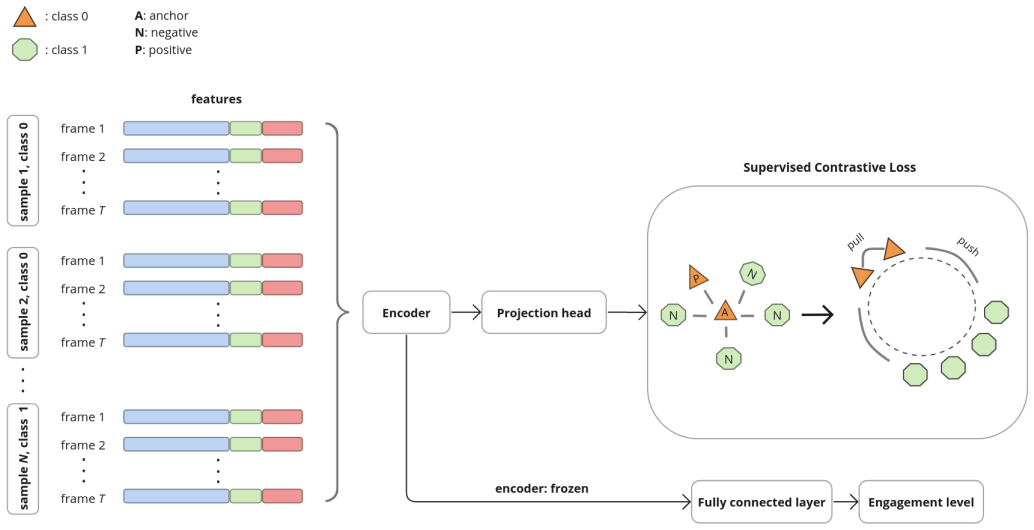
The load-bearing object is the supervised contrastive loss [31], used as a first training phase: an encoder (LSTM or TCN) plus a projection head is trained so that the dot-product similarity of representations is high for samples with the same engagement label and low for samples with different labels. After this phase the projection head is discarded, the encoder is frozen, and a small fully connected head is trained on the frozen representations with cross-entropy. Ordinality enters through the reduction of [39], which turns the four-class problem into three binary above/below classifiers whose probabilities are combined into four class probabilities. The augmentation step—jittering, magnitude scaling, time shifting, permutation, and flipping of the feature sequences—creates the extra views of rare-class samples that the contrastive loss relies on. The machinery's job is to shape the representation space so the under-represented engagement levels are not collapsed into majority classes before the final classifier sees them.
What would settle it
Re-run the same pipeline with the augmentation magnitudes and oversampling factors chosen on a held-out split that is never merged into training; if the class 1 recall gain over the non-contrastive ordinal setting (0.3452 versus 0.2024) disappears or shrinks to the non-contrastive level, the claim that supervised contrastive learning itself is responsible for the rare-class improvement would be refuted.
Extended reading notes
Core claim
The paper's central claim is that the failure mode of engagement classifiers—collapsing rare classes into majority classes—can be attacked at the representation level before any final classifier is trained. The authors report that a two-phase pipeline (supervised contrastive pretraining of a sequential encoder, then frozen-encoder cross-entropy training of a small head) outperforms its non-contrastive counterparts on class-specific precision and recall, and that adding time-series augmentation plus an ordinal decomposition of the four engagement levels gives the best rare-class numbers. They also report that class-weighted cross-entropy, a common imbalance remedy, makes results worse under DAiSEE's extreme imbalance, whereas their contrastive route does not. The claim is not that this setting has the highest total accuracy on DAiSEE—two published methods remain slightly ahead in accuracy—but that it is the best at separating the scarce and confusable engagement levels while staying competitive.
Load-bearing premise
The load-bearing assumption is that the augmentation parameters and factors, selected because they gave the best result on the validation data and then trained on that same validation set merged into the training set, preserve the true engagement labels and did not overfit the test set through tuning.
Editorial extensions
If this is right
- Contrastive pretraining with augmentation and ordinal decoding is the configuration that best separates rare engagement classes, so future engagement pipelines should treat it as a candidate training regime rather than relying on plain cross-entropy.
- Class-weighted losses, although a standard imbalance remedy, hurt on DAiSEE because classes 0 and 1 are so scarce; the paper's recipe is a more stable alternative.
- Fusing the 256-dimensional latent affective vector with valence, arousal, and behavioral features through the auxiliary network consistently improves results over using only affect and behavioral features.
- TCN encoders generally beat LSTM encoders on this task, but LSTM retains an edge in recall for some rare classes, so the two encoders are not interchangeable.
Reading between the lines
- Editorial: A natural check outside the paper is whether the same contrastive-plus-ordinal recipe transfers to other ordinal, imbalanced time-series tasks, such as patient engagement in virtual rehabilitation, where the class-ordering assumption also holds.
- Editorial: Because the augmentation factors were tuned on validation and that validation set was later absorbed into training, the reported minority-class gains may partly reflect tuning; a preregistered augmentation schedule would settle this.
- Editorial: The mechanism suggests a cheap extension—applying label-preserving augmentation inside the contrastive loss rather than only at the input—which could sharpen separation of adjacent engagement levels.
Editorial analysis
A structured set of objections, weighed in public.
Referee Report
Summary. The paper proposes a supervised contrastive learning framework with time-series data augmentation for ordinal classification of student engagement from video. Affective and behavioral features are extracted from video frames, fused with a latent affective vector, and fed to either an LSTM or a TCN encoder trained with a supervised contrastive loss, followed by an ordinal classifier based on binary decompositions. The method is evaluated on the DAiSEE dataset, with ablations over feature sets, loss functions, augmentation, and ordinal versus flat classification. The authors claim that the contrastive-augmented ordinal setting (row (f) in Table III) achieves the highest precision and recall in classes 1 and 2 while maintaining competitive overall accuracy, and that this demonstrates success in addressing class imbalance and class confusion.
Significance. If the claims were fully supported, the paper would provide a useful application of supervised contrastive learning to student engagement measurement, a domain where class imbalance and class confusion are known difficulties. The study covers a reasonable set of ablations and uses a public dataset, which aids reproducibility. However, the significance is limited by the incremental nature of the contribution relative to prior ordinal engagement work [12] and by the fact that several of the paper's central quantitative claims are contradicted by its own tables. The reported overall accuracy (0.6732) is slightly below two existing methods, and the claimed class-2 recall advantage is not present. The paper would be more valuable if the claims were narrowed and supported by statistical validation.
major comments (5)
- [Section IV-C, Table III] The central claim in Section IV-C that row (f) achieves 'the highest precision and recall in classes 1 and 2' is not supported by Table III. Row (a') reports class 2 recall of 0.7574, which is higher than row (f)'s 0.6995. Row (f) also has a slightly lower total accuracy (0.6732) than row (a') (0.6754). The actual improvement is confined to class 1 precision and recall, while class 2 recall drops. The conclusion that contrastive training succeeds at reducing class confusion and imbalance is therefore overstated and must be narrowed or re-examined.
- [Section IV-C] The sentence 'contrastive learning consistently outperformed traditional learning with cross-entropy loss, as evident from rows (a) and (c)' is contradicted by the table. For Affect+Behavioral+Latent features with TCN, row (a) has accuracy 0.6050 while row (c) has 0.5990. Thus 'consistently' is inaccurate; the benefit of contrastive learning is only observed in specific configurations, often after augmentation. The claim needs to be qualified.
- [Section IV-B] The augmentation factors (jitter scale, magnitude, shift, and the factor-of-ten and factor-of-1.5 oversampling rates) were selected to give 'the most optimal result' on the validation set, after which the validation set was merged into the training set. This procedure does not provide an independent check of the augmentation choices, and it risks overfitting to the test set via validation-set tuning. The reported minority-class gains could be an artifact of this tuning. A nested validation scheme or a separate held-out set should be used, and the results should be averaged over multiple runs with different seeds.
- [Section IV-C] No error bars, confidence intervals, or significance tests are reported for any number in Table III or Table V. Many of the differences that drive the conclusions are small (e.g., 0.6732 vs 0.6754), and the class-0 test set contains only 4 samples, so precision/recall values for that class are meaningless (e.g., the 0.5/0.25 in the TCN contrastive row corresponds to one correct prediction out of four). Without repeated runs or statistical testing, the claimed improvements cannot be distinguished from noise.
- [Table V, Section IV-C] The claim that the proposed method 'outperforms all other prior methods' is not supported by the reported numbers. The proposed accuracy (0.6732) is below the affective and behavioral features + Ordinal TCN [12] (0.6740) and EfficientNet+LSTM [45] (0.6748). While these differences are small, the text presents the comparison favorably without acknowledging that the proposed method does not surpass these two methods, nor does it provide significance tests to establish that any difference is reliable.
minor comments (5)
- [Section III, first paragraph] The phrase 'The intermediates steps are as follows' should read 'The intermediate steps are as follows'.
- [Introduction, reference list] In the Introduction, the citation sequence '[12], [17]–[20], [20], [20]–[27]' contains duplicate [20] entries; this should be cleaned up.
- [Table III] The row labels (a), (a'), through (f) are not consistently defined in the experimental setup; row (a') is only mentioned in the Results section. A table caption listing all configurations would improve readability.
- [Section IV-B] The description of the ordinal training procedure is incomplete. It should state whether each of the C-1 binary classifiers is trained on all samples (with modified labels) or only on adjacent classes, and how the binary probability estimates are combined at inference to obtain the class probabilities in Eq. (2).
- [Table IV] The caption for Table IV displays 'predicted labels' four times without distinguishing the four sub-matrices. Please label each sub-matrix (a)-(d) and indicate which configuration it corresponds to, including the absence of the best non-contrastive row (a').
Circularity Check
No significant circularity: the proposed method is a combination of external standard components (SupCon loss, Frank-Hall ordinal decomposition, time-series augmentation) evaluated on the public DAiSEE test set, and the central claim does not reduce by construction to any fitted input.
full rationale
The paper's derivation chain is: extract affect/behavioral features; train a supervised contrastive encoder with the standard SupCon loss of Eq. (1); discard the projection head and train a classifier on frozen representations; optionally decompose the four-class problem into three binary ordinal tasks using the standard cumulative-probability relations of Eq. (2); then evaluate on the DAiSEE test set. Every component is drawn from external, non-author sources (Khosla et al. for SupCon; Frank and Hall for ordinal decomposition; Iwana and Uchida for augmentation; DAiSEE as an external benchmark). No equation in the paper is fitted to produce the reported test outcomes, and no reported quantity is defined in terms of the quantity it is said to predict. The augmentation factors were selected on the validation split ('giving the most optimal result') before validation was merged into training; this is a model-selection/overfitting risk, not a circular reduction, because the test set was not used for tuning and the claimed gains are not statistical identities. Self-citations to Abedi and Khan [12] supply feature choices, ordinal motivation, and a baseline, but the paper's central contrastive result does not depend on any unverified claim unique to those citations. The central conclusion's factual support is questionable (row (f) does not have the highest class-2 recall in Table III; row (a') has 0.7574 vs 0.6995), but an overstated reading of the numbers is a correctness concern, not circular reasoning. Accordingly, no circularity step is present.
Assumptions & free parameters
free parameters (6)
- Augmentation factors for minority/majority classes =
10x for classes 0 and 1, 1.5x for classes 2 and 3
- Jitter noise scale =
1/10 of peak-to-peak feature value
- Magnitude scaling factor =
0.75
- Time shift amount =
5 units
- TCN hyperparameters =
levels=8, hidden=256, kernel=16, dropout=0.1
- LSTM hidden size =
two layers with 256 hidden units
assumptions (5)
- domain assumption Time-series augmentations (jittering, scaling, shifting, permutation, flipping) preserve the engagement label of a video segment.
- domain assumption The ordinal decomposition into C-1 independent binary classifiers (Frank and Hall) is valid for engagement intensities.
- domain assumption DAiSEE's engagement labels are reliable ground truth and the four levels are ordinal.
- domain assumption Pre-trained OpenFace and EmoFAN features contain sufficient signal for engagement.
- domain assumption Supervised contrastive loss with same-label positives reduces class confusion under extreme imbalance.
Cite this review
Pith. "Pith review of Supervised Contrastive Learning for Ordinal Engagement Measurement." pith.science (2026). https://pith.science/paper/YSTUR6QM
@misc{pith2026250520676,
  author       = {Pith},
  title        = {Pith review of: Supervised Contrastive Learning for Ordinal Engagement Measurement},
  year         = {2026},
  howpublished = {\url{https://pith.science/paper/YSTUR6QM}},
  note         = {Machine review of arXiv:2505.20676}
}
read the original abstract
Student engagement plays a crucial role in the successful delivery of educational programs. Automated engagement measurement helps instructors monitor student participation, identify disengagement, and adapt their teaching strategies to enhance learning outcomes effectively. This paper identifies two key challenges in this problem: class imbalance and incorporating order into engagement levels rather than treating it as mere categories. Then, a novel approach to video-based student engagement measurement in virtual learning environments is proposed that utilizes supervised contrastive learning for ordinal classification of engagement. Various affective and behavioral features are extracted from video samples and utilized to train ordinal classifiers within a supervised contrastive learning framework (with a sequential classifier as the encoder). A key step involves the application of diverse time-series data augmentation techniques to these feature vectors, enhancing model training. The effectiveness of the proposed method was evaluated using a publicly available dataset for engagement measurement, DAiSEE, containing videos of students who participated in virtual learning programs. The results demonstrate the robust ability of the proposed method for the classification of the engagement level. This approach promises a significant contribution to understanding and enhancing student engagement in virtual learning environments.
Figures
Reference graph
Works this paper leans on
-
[12]
Affect-driven ordinal engagement measure- ment from videos,
A. Abedi and S. S. Khan, “Affect-driven ordinal engagement measure- ment from videos,” Multimedia Tools and Applications , 2023
work page 2023
-
[45]
T. Selim, I. Elkabani, and M. Abdou, “Students engagement level detection in online e-learning using hybrid efficientnetb7 together with tcn, lstm, and bi-lstm,” IEEE Access, vol. 10, pp. 99 573–99 583, 2022
work page 2022
-
[1]
Covid-19 pandemic–online education in the new normal and the next normal,
X. Xie, K. Siau, and F. F.-H. Nah, “Covid-19 pandemic–online education in the new normal and the next normal,” Journal of information technology case and application research , vol. 22, no. 3, pp. 175–187, 2020
work page 2020
-
[2]
Perceptions and behaviors of learner engagement with virtual educational platforms,
K. Dickinson, K. Caldwell, E. Graviss, D. Nguyen, M. Awad, J. Olasky, S. Tan, J. Winer, K. Pei, A. E. T. Committee et al. , “Perceptions and behaviors of learner engagement with virtual educational platforms,”The American Journal of Surgery , vol. 224, no. 1, pp. 371–374, 2022
work page 2022
-
[3]
Engagement in online learning: student attitudes and behavior during covid-19,
B. Hollister, P. Nair, S. Hill-Lindsay, and L. Chukoskie, “Engagement in online learning: student attitudes and behavior during covid-19,” in Frontiers in Education, vol. 7. Frontiers Media SA, 2022, p. 851019
work page 2022
-
[4]
U. Dogan, “Student engagement, academic self-efficacy, and academic motivation as predictors of academic performance,” The Anthropologist, vol. 20, no. 3, pp. 553–561, 2015
work page 2015
-
[5]
Automatic prediction of presentation style and student engagement from videos,
C. Thomas, K. Sarma, S. Gajula, and D. Jayagopi, “Automatic prediction of presentation style and student engagement from videos,” Computers and Education: Artificial Intelligence , p. 100079, 2022
work page 2022
-
[6]
Inconsistencies in measuring student engagement in virtual learning-a critical review,
S. S. Khan, A. Abedi, and T. Colella, “Inconsistencies in measuring student engagement in virtual learning-a critical review,” 2022
work page 2022
Show all 66 references
-
[7]
Automatic engagement estimation in smart education/learning settings: a systematic review of engage- ment definitions, datasets, and methods,
S. N. Karimah and S. Hasegawa, “Automatic engagement estimation in smart education/learning settings: a systematic review of engage- ment definitions, datasets, and methods,” Smart Learning Environments, vol. 9, no. 1, pp. 1–48, 2022
2022
-
[8]
The challenges of defining and measuring student engagement in science,
G. M. Sinatra, B. C. Heddy, and D. Lombardi, “The challenges of defining and measuring student engagement in science,” pp. 1–13, 2015
2015
-
[9]
Advanced, analytic, auto- mated (aaa) measurement of engagement during learning,
S. D’Mello, E. Dieterle, and A. Duckworth, “Advanced, analytic, auto- mated (aaa) measurement of engagement during learning,” Educational psychologist, vol. 52, no. 2, pp. 104–123, 2017
2017
-
[10]
Improving state-of-the-art in detecting student engagement with resnet and tcn hybrid network,
A. Abedi and S. Khan, “Improving state-of-the-art in detecting student engagement with resnet and tcn hybrid network,” in 2021 18th Confer- ence on Robots and Vision (CRV) . IEEE, 2021, pp. 151–157
2021
-
[11]
Detecting disengagement in virtual learning as an anomaly using temporal convolutional network autoencoder,
S. S. K. Ali Abedi, “Detecting disengagement in virtual learning as an anomaly using temporal convolutional network autoencoder,” Signal, Image and Video Processing , 2023
2023
-
[13]
Tclr: Temporal con- trastive learning for video representation,
I. Dave, R. Gupta, M. N. Rizve, and M. Shah, “Tclr: Temporal con- trastive learning for video representation,” Computer Vision and Image Understanding, vol. 219, p. 103406, 2022
2022
-
[14]
Deep learning based engagement recognition in highly imbalanced data,
D. Dresvyanskiy, W. Minker, and A. Karpov, “Deep learning based engagement recognition in highly imbalanced data,” in Speech and Com- puter: 23rd International Conference, SPECOM 2021, St. Petersburg, Russia, September 27–30, 2021, Proceedings 23 . Springer, 2021, pp. 166–178
2021
-
[15]
Deep facial spatiotemporal network for engagement prediction in online learning,
J. Liao, Y . Liang, and J. Pan, “Deep facial spatiotemporal network for engagement prediction in online learning,” Applied Intelligence, vol. 51, no. 10, pp. 6609–6621, 2021
2021
-
[16]
Class-attention video transformer for engagement intensity prediction,
X. Ai, V . S. Sheng, and C. Li, “Class-attention video transformer for engagement intensity prediction,” arXiv preprint arXiv:2208.07216 , 2022
2022 arXiv
-
[17]
Fine-grained engagement recognition in online learning environment,
T. Huang, Y . Mei, H. Zhang, S. Liu, and H. Yang, “Fine-grained engagement recognition in online learning environment,” in 2019 IEEE 9th International Conference on Electronics Information and Emergency Communication (ICEIEC). IEEE, 2019, pp. 338–341
2019
-
[18]
The faces of engagement: Automatic recognition of student engagement from facial expressions,
J. Whitehill, Z. Serpell, Y .-C. Lin, A. Foster, and J. Movellan, “The faces of engagement: Automatic recognition of student engagement from facial expressions,” IEEE Transactions on Affective Computing , vol. 5, no. 1, pp. 86–98, 2014
2014
-
[19]
Toward active and unobtrusive engagement assessment of distance learners,
B. Booth, A. Ali, S. Narayanan, I. Bennett, and A. Farag, “Toward active and unobtrusive engagement assessment of distance learners,” in 2017 Seventh International Conference on Affective Computing and Intelligent Interaction (ACII). IEEE, 2017, pp. 470–476
2017
-
[20]
Prediction and lo- calization of student engagement in the wild,
A. Kaur, A. Mustafa, L. Mehta, and A. Dhall, “Prediction and lo- calization of student engagement in the wild,” in 2018 Digital Image Computing: Techniques and Applications (DICTA) . IEEE, 2018, pp. 1–8
2018
-
[21]
Automatic engagement prediction with gap feature,
X. Niu, H. Han, J. Zeng, X. Sun, S. Shan, Y . Huang, S. Yang, and X. Chen, “Automatic engagement prediction with gap feature,” in Proceedings of the 20th ACM International Conference on Multimodal Interaction, 2018, pp. 599–603
2018
-
[22]
Multimodal approach to engagement and disengagement detection with highly imbalanced in-the-wild data,
D. Fedotov, O. Perepelkina, E. Kazimirova, M. Konstantinova, and W. Minker, “Multimodal approach to engagement and disengagement detection with highly imbalanced in-the-wild data,” in Proceedings of the Workshop on Modeling Cognitive Processes from Multimodal Data , 2018, pp. 1–9
2018
-
[23]
Predicting engagement intensity in the wild using temporal convolutional network,
C. Thomas, N. Nair, and D. Jayagopi, “Predicting engagement intensity in the wild using temporal convolutional network,” in Proceedings of the 20th ACM International Conference on Multimodal Interaction , 2018, pp. 604–610
2018
-
[24]
Faceen- gage: robust estimation of gameplay engagement from user-contributed (youtube) videos,
X. Chen, L. Niu, A. Veeraraghavan, and A. Sabharwal, “Faceen- gage: robust estimation of gameplay engagement from user-contributed (youtube) videos,” IEEE Transactions on Affective Computing , 2019
2019
-
[25]
Advanced multi-instance learning method with multi-features engineering and conservative opti- mization for engagement intensity prediction,
J. Wu, B. Yang, Y . Wang, and G. Hattori, “Advanced multi-instance learning method with multi-features engineering and conservative opti- mization for engagement intensity prediction,” in Proceedings of the 2020 International Conference on Multimodal Interaction , 2020, pp. 777–783
2020
-
[26]
Automatic student engagement in online learning environment based on neural turing machine,
X. Ma, M. Xu, Y . Dong, and Z. Sun, “Automatic student engagement in online learning environment based on neural turing machine,” Interna- tional Journal of Information and Education Technology , vol. 11, no. 3, pp. 107–111, 2021
2021
-
[27]
Engagement detection with multi-task training in e-learning environments,
O. Copur, M. Nakıp, S. Scardapane, and J. Slowack, “Engagement detection with multi-task training in e-learning environments,” in In- ternational Conference on Image Analysis and Processing . Springer, 2022, pp. 411–422
2022
-
[28]
Automatic student engagement measurement using machine learning techniques: A literature study of data and methods,
S. Mandia, R. Mitharwal, and K. Singh, “Automatic student engagement measurement using machine learning techniques: A literature study of data and methods,” Multimedia Tools and Applications , vol. 83, no. 16, pp. 49 641–49 672, 2024
2024
-
[29]
A simple framework for contrastive learning of visual representations,
T. Chen, S. Kornblith, M. Norouzi, and G. Hinton, “A simple framework for contrastive learning of visual representations,” in Proceedings of the International Conference on Machine Learning (ICML) . PMLR, 2020, pp. 1597–1607
2020
-
[30]
Supervised contrastive learning for detecting anomalous driving behaviours from multimodal videos,
S. S. Khan, Z. Shen, H. Sun, A. Patel, and A. Abedi, “Supervised contrastive learning for detecting anomalous driving behaviours from multimodal videos,” in 2022 19th Conference on Robots and Vision (CRV). IEEE, 2022, pp. 16–23
2022
-
[31]
Supervised contrastive learning,
P. Khosla, P. Teterwak, C. Wang, A. Sarna, Y . Tian, P. Isola, A. Maschinot, C. Liu, and D. Krishnan, “Supervised contrastive learning,” 2020. [Online]. Available: https://arxiv.org/abs/2004.11362
2020 arXiv
-
[32]
Time series contrastive learning with information-aware augmentations,
D. Luo, W. Cheng, Y . Wang, D. Xu, J. Ni, W. Yu, X. Zhang, Y . Liu, Y . Chen, H. Chen et al. , “Time series contrastive learning with information-aware augmentations,” in Proceedings of the AAAI Conference on Artificial Intelligence , vol. 37, no. 4, 2023, pp. 4534– 4542
2023
-
[33]
Supervised contrastive regression,
K. Zha, P. Cao, Y . Yang, and D. Katabi, “Supervised contrastive regression,” arXiv preprint arXiv:2210.01189 , 2022
2022 arXiv
-
[34]
Not all negatives are equal: Label-aware contrastive loss for fine-grained text classification,
V . Suresh and D. C. Ong, “Not all negatives are equal: Label-aware contrastive loss for fine-grained text classification,” arXiv preprint arXiv:2109.05427, 2021
2021 arXiv
-
[35]
Improving contrastive learning on imbalanced data via open-world sampling,
Z. Jiang, T. Chen, T. Chen, and Z. Wang, “Improving contrastive learning on imbalanced data via open-world sampling,” Advances in Neural Information Processing Systems , vol. 34, pp. 5997–6009, 2021
2021
-
[36]
A circumplex model of affect
J. A. Russell, “A circumplex model of affect.” Journal of personality and social psychology , vol. 39, no. 6, p. 1161, 1980
1980
-
[37]
Engagement detection in online learning: a review,
M. Dewan, M. Murshed, and F. Lin, “Engagement detection in online learning: a review,” Smart Learning Environments , vol. 6, no. 1, pp. 1–20, 2019
2019
-
[38]
An empirical survey of data augmentation for time series classification with neural networks,
B. K. Iwana and S. Uchida, “An empirical survey of data augmentation for time series classification with neural networks,” Plos one , vol. 16, no. 7, p. e0254841, 2021
2021
-
[39]
A simple approach to ordinal classification,
E. Frank and M. Hall, “A simple approach to ordinal classification,” in Machine Learning: ECML 2001: 12th European Conference on Machine Learning Freiburg, Germany, September 5–7, 2001 Proceedings 12 . Springer, 2001, pp. 145–156
2001
-
[40]
Daisee: Towards user engagement recognition in the wild,
A. Gupta et al. , “Daisee: Towards user engagement recognition in the wild,” arXiv preprint arXiv:1609.01885 , 2016. [Online]. Available: https://arxiv.org/abs/1609.01885
2016 arXiv
-
[41]
Learning deep spatiotemporal feature for engagement recognition of online courses,
L. Geng, M. Xu, Z. Wei, and X. Zhou, “Learning deep spatiotemporal feature for engagement recognition of online courses,” in 2019 IEEE Symposium Series on Computational Intelligence (SSCI) . IEEE, 2019, pp. 442–447
2019
-
[42]
An novel end-toend network for automatic student engagement recognition,
H. Zhang, X. Xiao, T. Huang, S. Liu, Y . Xia, and J. Li, “An novel end-toend network for automatic student engagement recognition,” in 2019 IEEE 9th International Conference on Electronics Information and Emergency Communication (ICEIEC) . IEEE, 2019, pp. 342–345
2019
-
[43]
An optimized cnn model for engagement recognition in an e-learning environment,
Y . Hu, Z. Jiang, and K. Zhu, “An optimized cnn model for engagement recognition in an e-learning environment,” Applied Sciences , vol. 12, no. 16, p. 8007, 2022
2022
-
[44]
Threedimen- sional densenet self-attention neural network for automatic detection of student’s engagement,
N. Mehta, S. Prasad, S. Saurav, R. Saini, and S. Singh, “Threedimen- sional densenet self-attention neural network for automatic detection of student’s engagement,” Applied Intelligence, pp. 1–21, 2022
2022
-
[46]
Do i have your attention: A large scale engagement prediction dataset and baselines,
M. Singh, X. Hoque, D. Zeng, Y . Wang, K. Ikeda, and A. Dhall, “Do i have your attention: A large scale engagement prediction dataset and baselines,” arXiv preprint arXiv:2302.00431 , 2023
2023 arXiv
-
[47]
Recognition of student engagement and affective states using convnextlarge and ensemble gru in e-learning,
F. M. Shiri, T. Perumal, N. Mustapha, R. Mohamed, M. A. B. Ahmadon, and S. Yamaguchi, “Recognition of student engagement and affective states using convnextlarge and ensemble gru in e-learning,” Preprint, 2023
2023
-
[48]
Multimodal graph learning based on 3d haar semi-tight framelet for student engagement prediction,
M. Li, X. Zhuang, L. Bai, and W. Ding, “Multimodal graph learning based on 3d haar semi-tight framelet for student engagement prediction,” Information Fusion, vol. 105, p. 102224, 2024
2024
-
[49]
Re-distributing facial features for engagement prediction with moderntcn,
X. Li, W. Zhu, Q. Li, C. Hou, and Y . Zhang, “Re-distributing facial features for engagement prediction with moderntcn,” Computers, Materials & Continua , vol. 81, no. 1, pp. 369–391, 2024. [Online]. Available: https://www.techscience.com/cmc/v81n1/58326
2024
-
[50]
Msc-trans: A multi-feature-fusion network with encoding structure for student engagement detection,
Y . Liu, W. Tan, and L. He, “Msc-trans: A multi-feature-fusion network with encoding structure for student engagement detection,” IEEE Transactions on Learning Technologies , 2024, preprint. [Online]. Available: https://www.ivysci.com/journals/1939-1382
2024
-
[51]
Detection of student engagement in e-learning environments using efficientnetv2- l together with rnn-based models,
F. M. Shiri, E. Ahmadi, M. Rezaee, and T. Perumal, “Detection of student engagement in e-learning environments using efficientnetv2- l together with rnn-based models,” Journal on Artificial Intelligence , vol. 6, 2024
2024
-
[52]
Enhancing frame-level student engagement clas- sification through knowledge transfer techniques,
R. Das and S. Dev, “Enhancing frame-level student engagement clas- sification through knowledge transfer techniques,” Applied Intelligence, vol. 54, pp. 2263–2276, 2024
2024
-
[53]
A self- supervised learning network for student engagement recognition from facial expressions,
W. L. Zhang, R. S. Jia, H. Wang, C. Y . Che, and H. M. Sun, “A self- supervised learning network for student engagement recognition from facial expressions,” IEEE Transactions on Circuits and Systems for Video Technology, 2024
2024
-
[54]
Engagement measurement based on facial landmarks and spatial-temporal graph convolutional networks,
A. Abedi and S. S. Khan, “Engagement measurement based on facial landmarks and spatial-temporal graph convolutional networks,” in Pat- tern Recognition, A. Antonacopoulos, S. Chaudhuri, R. Chellappa, C.- L. Liu, S. Bhattacharya, and U. Pal, Eds. Cham: Springer Nature Switzerla...
2025
-
[55]
Bag of states: A non-sequential approach to video-based engagement measurement,
A. Abedi, C. Thomas, D. B. Jayagopi, and S. S. Khan, “Bag of states: A non-sequential approach to video-based engagement measurement,” arXiv preprint arXiv:2301.06730 , 2023
2023 arXiv
-
[56]
Blink rate patterns provide a reliable measure of individual engagement with scene content,
C. Ranti, W. Jones, A. Klin, and S. Shultz, “Blink rate patterns provide a reliable measure of individual engagement with scene content,”Scientific reports, vol. 10, no. 1, pp. 1–10, 2020
2020
-
[57]
Openface 2.0: Facial behavior analysis toolkit,
T. Baltrusaitis et al. , “Openface 2.0: Facial behavior analysis toolkit,” in 2018 13th IEEE International Conference on Automatic Face and Gesture Recognition (FG 2018) , 2018
2018
-
[58]
Understanding the behaviour of contrastive loss,
F. Wang and H. Liu, “Understanding the behaviour of contrastive loss,” in Proceedings of the IEEE/CVF conference on computer vision and pattern recognition, 2021, pp. 2495–2504
2021
-
[59]
The ordinal nature of emotions: An emerging approach,
G. N. Yannakakis, R. Cowie, and C. Busso, “The ordinal nature of emotions: An emerging approach,” IEEE Transactions on Affective Computing, vol. 12, no. 1, pp. 16–35, 2018
2018
-
[60]
Estimation of continuous valence and arousal levels from faces in naturalistic conditions,
A. Toisoul, A. Dhall, R. Goecke, T. Gedeon, and M. Wagner, “Estimation of continuous valence and arousal levels from faces in naturalistic conditions,” Nature Machine Intelligence , vol. 3, no. 1, pp. 42–50,
-
[61]
Affectnet: A database for facial expression, valence, and arousal computing in the wild,
A. Mollahosseini, B. Hasani, and M. H. Mahoor, “Affectnet: A database for facial expression, valence, and arousal computing in the wild,” in IEEE, 2017
2017
-
[62]
Pytorch: An imperative style, high-performance deep learning library,
A. Paszke, S. Gross, F. Massa, A. Lerer, J. Bradbury, G. Chanan, T. Killeen, Z. Lin, N. Gimelshein, L. Antiga et al. , “Pytorch: An imperative style, high-performance deep learning library,” Advances in neural information processing systems , vol. 32, 2019
2019
-
[63]
Scikit-learn: Machine learning in python,
F. Pedregosa, G. Varoquaux, A. Gramfort, V . Michel, B. Thirion, O. Grisel, M. Blondel, P. Prettenhofer, R. Weiss, V . Dubourg et al. , “Scikit-learn: Machine learning in python,” the Journal of machine Learning research, vol. 12, pp. 2825–2830, 2011
2011
-
[64]
Facial Expression Recognition in Video Using 3D-CNN Deep Features Discrimination,
G. Sathisha, C. K. Subbaraya, and G. K. Ravikumar, “Facial Expression Recognition in Video Using 3D-CNN Deep Features Discrimination,” in 2024 3rd International Conference for Innovation in Technology, INOCON 2024. Institute of Electrical and Electronics Engineers Inc., 2024
2024
-
[65]
Leveraging part-and-sensitive attention network and transformer for learner engagement detection,
R. Su, L. He, and M. Luo, “Leveraging part-and-sensitive attention network and transformer for learner engagement detection,” Alexandria Engineering Journal, vol. 107, pp. 198–204, 11 2024
2024
-
[2021]
Available: https://doi.org/10.1038/s42256-020-00285-2
[Online]. Available: https://doi.org/10.1038/s42256-020-00285-2
Reviewed August 7, 2026 · model on record in the stance chip above.
Discussion (0). Sign in to comment.